
BH 101 Introduction to Bible and Hermeneutics BH
BH 101 Introduction to Bible and Hermeneutics
BH 101: Synthesis and Application Jeremy D. Little Fourth Saturday Fall 2018
Session 1 Synthesis Statements

You answered all the questions…. now what do you do with all this information? ? ?
Synthesis Statements • Observation: points out “what you see” in the text, and questions arise as a result • Interpretation: answer the questions and shows you “what it means” • Synthesis Statements: statements that pull Biblical information together in a logical format to: – Understand what it states and why it is stated – Build a bridge from the original context to correct applications for today
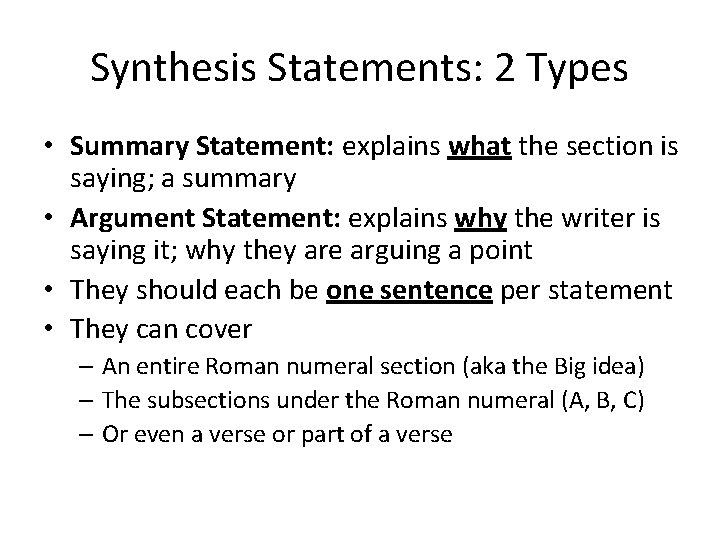
Synthesis Statements: 2 Types • Summary Statement: explains what the section is saying; a summary • Argument Statement: explains why the writer is saying it; why they are arguing a point • They should each be one sentence per statement • They can cover – An entire Roman numeral section (aka the Big idea) – The subsections under the Roman numeral (A, B, C) – Or even a verse or part of a verse
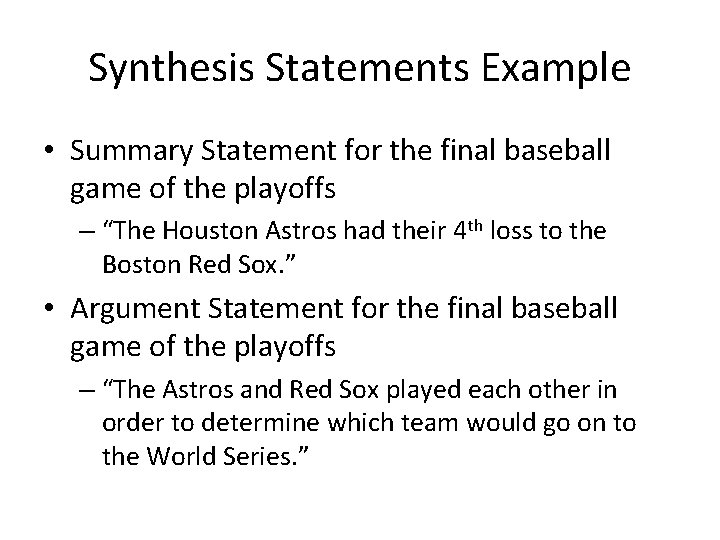
Synthesis Statements Example • Summary Statement for the final baseball game of the playoffs – “The Houston Astros had their 4 th loss to the Boston Red Sox. ” • Argument Statement for the final baseball game of the playoffs – “The Astros and Red Sox played each other in order to determine which team would go on to the World Series. ”
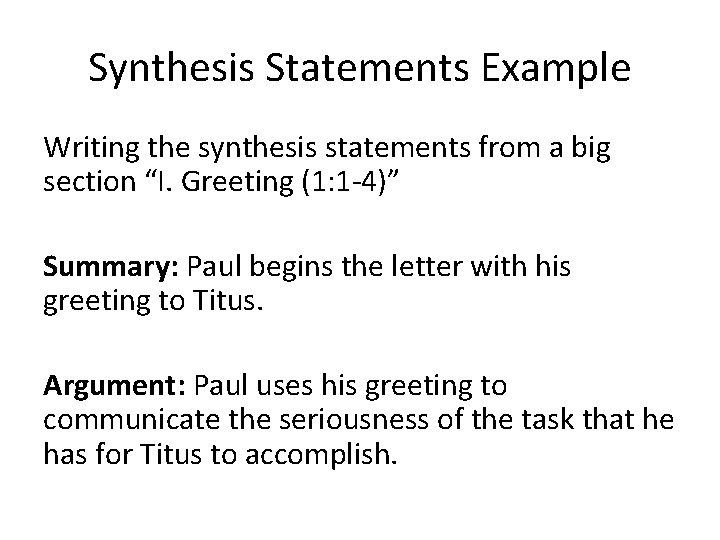
Synthesis Statements Example Writing the synthesis statements from a big section “I. Greeting (1: 1 -4)” Summary: Paul begins the letter with his greeting to Titus. Argument: Paul uses his greeting to communicate the seriousness of the task that he has for Titus to accomplish.
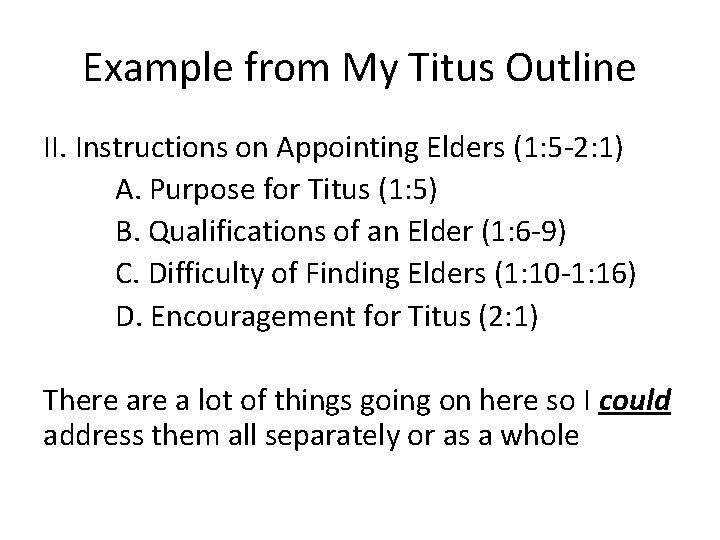
Example from My Titus Outline II. Instructions on Appointing Elders (1: 5 -2: 1) A. Purpose for Titus (1: 5) B. Qualifications of an Elder (1: 6 -9) C. Difficulty of Finding Elders (1: 10 -1: 16) D. Encouragement for Titus (2: 1) There a lot of things going on here so I could address them all separately or as a whole
Example from My Titus Outline A. Purpose for Titus (1: 5) Summary: Paul explains that he left Titus on Crete to appoint elders in every city. Argument: Titus needs to understand that what is lacking is the appointment of multiple elders in all the local churches in each city.
Example from My Titus Outline B. Qualifications of an Elder (1: 6 -9) Summary: Paul gives Titus the qualifications that he must use in appointing the elders. Argument: The qualifications are so high because each elder must be able to both exhort sound doctrine and refute those that contradict sound doctrine.
Example from My Titus Outline C. Difficulty of Finding Elders (1: 10 -1: 16) Summary: Paul warns Titus that the character of many of the Cretans is not in accord with the qualifications he just mentioned. Argument: Titus must be incredibly diligent to only appoint qualified elders since they will be hard to find on Crete.
Example from My Titus Outline D. Encouragement for Titus (2: 1) Summary: Paul encourages Titus to also teach sound doctrine. Argument: Titus must also ensure that he does not compromise his values in the midst of the Cretan culture.
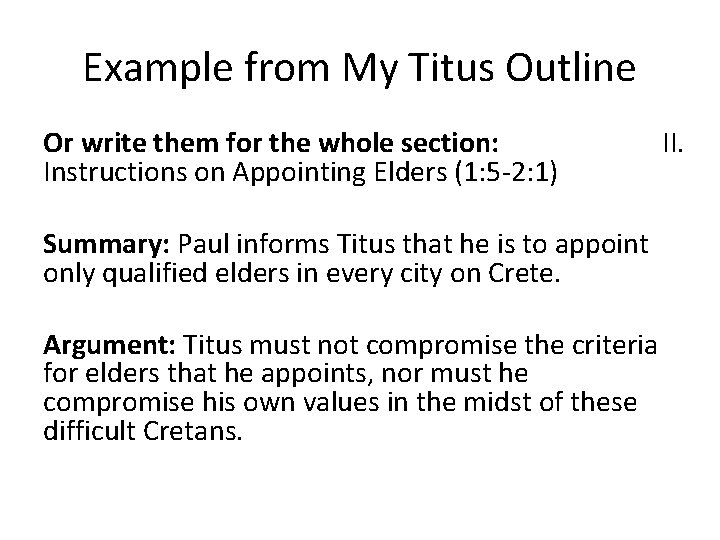
Example from My Titus Outline Or write them for the whole section: II. Instructions on Appointing Elders (1: 5 -2: 1) Summary: Paul informs Titus that he is to appoint only qualified elders in every city on Crete. Argument: Titus must not compromise the criteria for elders that he appoints, nor must he compromise his own values in the midst of these difficult Cretans.
Example in Titus • Spend the rest of the time writing synthesis statements (Summary and Argument) in Titus • Work alone or in groups • We will share our findings in the last few minutes of this section

Session 1 Synthesis Statements

15 Minute Break

Session 2 Timeless Truths
Bridging the Context Gap • Understand Scripture in the original context • There is only 1 correct interpretation for any given Scripture, but innumerable applications • You must bridge thousands of years gap to apply it to today’s context
Problems in Bridging the Gap • Old Testament vs. New Testament • Old Traditions vs. New Traditions • Major and Minor Denominations • Culture and Geography • Ever changing Societal values • Bad Hermeneutics
Timeless Truths • Timeless Truths: are truths that transcend all traditions, cultures, preferences, etc. • Not all passages are timeless, but they all contain timeless truths that can be applied • Identifying Timeless Truths will move you towards correct applications. • You can’t pick and choose applications when it suits you
Bridging the Context Gap • Context will drive when and how certain texts are more or less directly applicable • There are objective factors which make it either more or less directly applicable
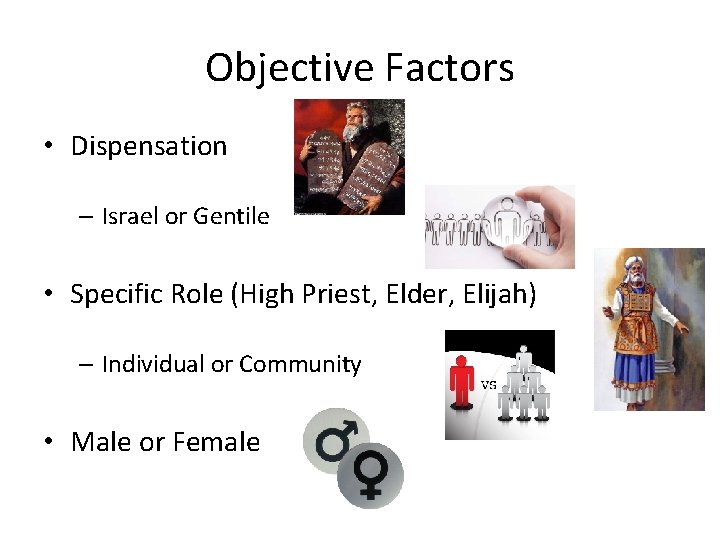
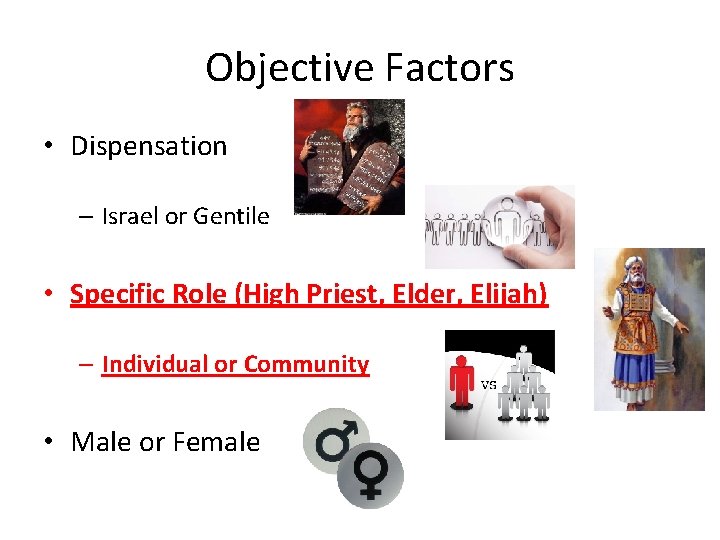
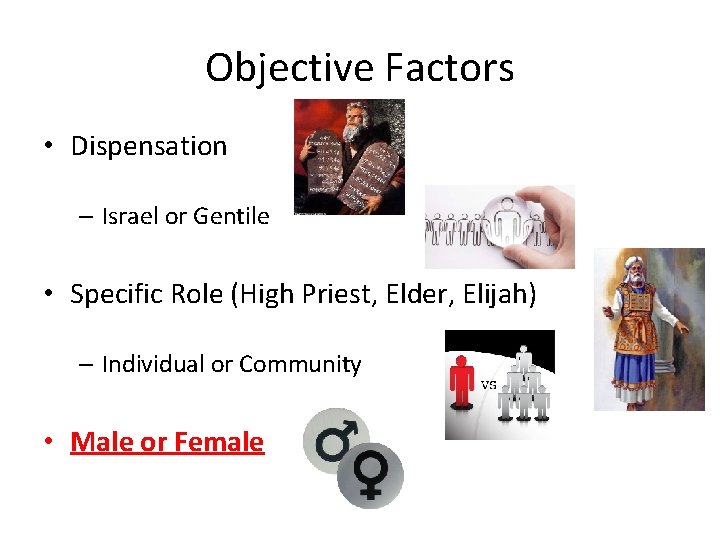
Objective Factors • Dispensation – Israel or Gentile • Specific Role (High Priest, Elder, Elijah) – Individual or Community • Male or Female
Objective Factors • Dispensation – Israel or Gentile • Specific Role (High Priest, Elder, Elijah) – Individual or Community • Male or Female
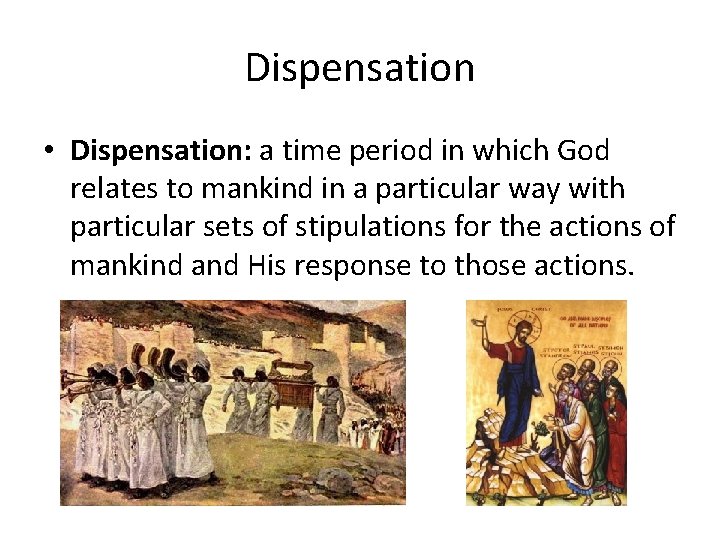
Dispensation • Dispensation: a time period in which God relates to mankind in a particular way with particular sets of stipulations for the actions of mankind and His response to those actions.
Dispensations Summary • Dispensation of Innocence (Garden of Eden) • Dispensation of Conscience (The Fall to Abraham or Moses) • Dispensation of the Old Covenant (Moses to Jesus) • Dispensation of the New Covenant (Jesus to His Return) • Dispensation of the Kingdom of God (Post Return to Eternity) Can you apply them all in the same way?
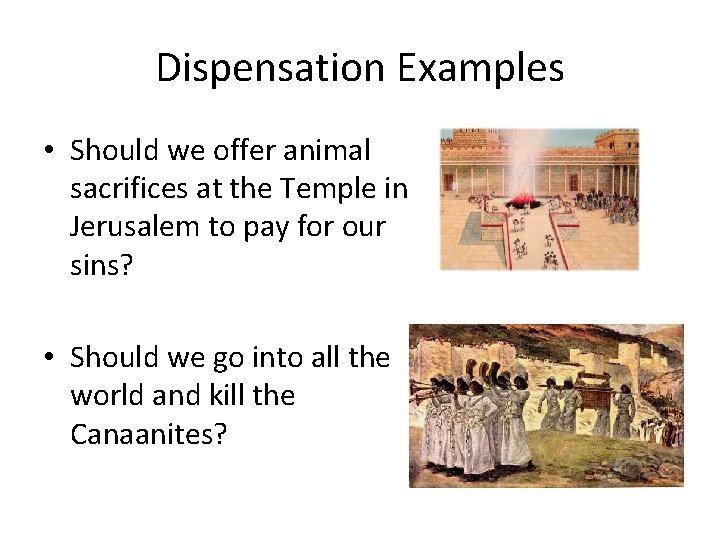
Dispensation Examples • Should we offer animal sacrifices at the Temple in Jerusalem to pay for our sins? • Should we go into all the world and kill the Canaanites?
Timeless Truths • Offer sacrifices? – Animal sacrifices were needed for the forgiveness of sins, but Jesus was the ultimate sacrifice. – Other sacrifices were fellowship, peace, thanksgiving, etc. – we can do that by being a living sacrifice. • Kill the Canaanites? – Israel was God’s tool of judgment on them, and they were warned not become like them. We should be vigilant to not become like the world.
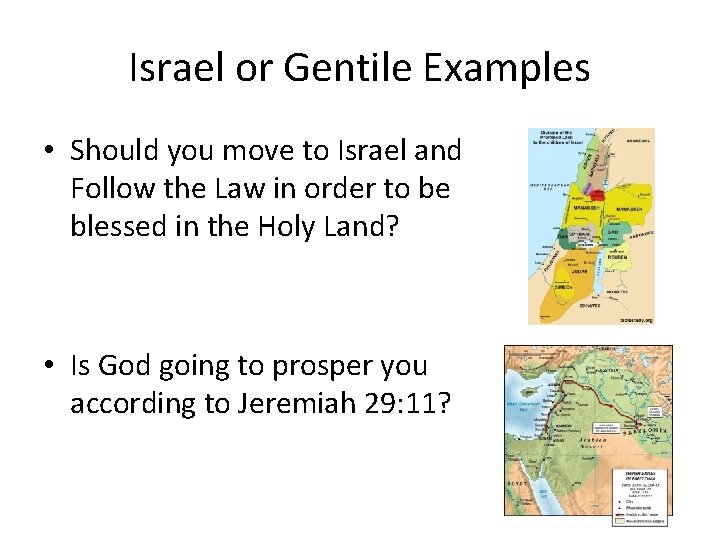
Israel or Gentile Examples • Should you move to Israel and Follow the Law in order to be blessed in the Holy Land? • Is God going to prosper you according to Jeremiah 29: 11?
Timeless Truths • Follow the Law and move to Israel? – The Law was for Israel to be blessed or cursed in the Land, we must live a holy life to do God’s will and be blessed by Him wherever we live. • Jeremiah 29: 11 – God was speaking to encourage the Jewish exiles in Babylon. God does have plans for our lives, and we must trust His plan regardless if we are to be blessed with worldly things.
Objective Factors • Dispensation – Israel or Gentile • Specific Role (High Priest, Elder, Elijah) – Individual or Community • Male or Female
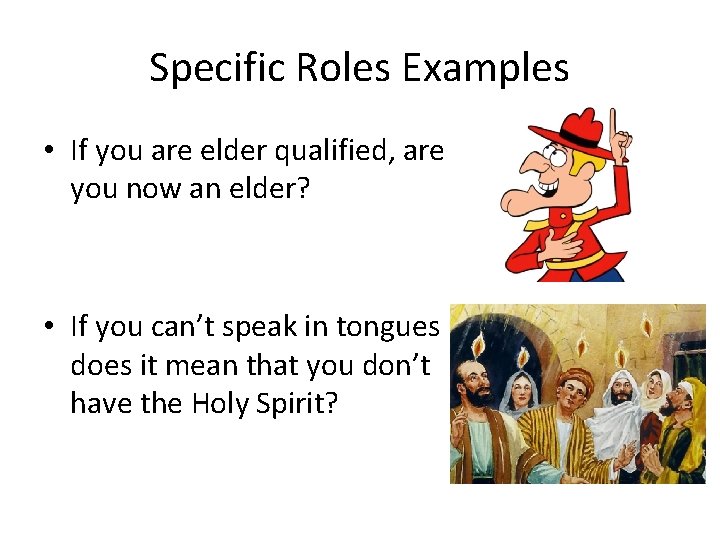
Specific Roles Examples • If you are elder qualified, are you now an elder? • If you can’t speak in tongues does it mean that you don’t have the Holy Spirit?
Timeless Truths • Elder qualified? – All Christians should strive to live up to the standards of elder qualifications regardless if they are an elder or not. • Speak in tongues or no Holy Spirit? – The Holy Spirit gives different gifts to believers as He sees fit. Not all speak in tongues, but we should love and live into the gift that God has given us regardless of what it is.
Objective Factors • Dispensation – Israel or Gentile • Specific Role (High Priest, Elder, Elijah) – Individual or Community • Male or Female
Male or Female Examples • Should older men train up the younger women? • Should women serve in the office of elder?
Timeless Truths • Men training women? – Women should train women. • Women serve as elders? – Men alone should serve as elders as they must be the husband of one wife.
From Synthesis to Timeless Truths • Once you consider the objective factors, move on to your Synthesis Statements • Synthesis Statements are the primer for Timeless Truths • Timeless Truths are the primer for making correct applications
My Previous Example from Titus II. Instructions on Appointing Elders (1: 5 -2: 1) Summary: Paul informs Titus that he is to appoint only qualified elders in every city on Crete. Argument: Titus must not compromise the criteria for elders that he appoints, nor must he compromise his own values in the midst of these difficult Cretans.
Objective Factors Test • Dispensation – This is in a New Covenant community (local church) so it directly applies to today – Israel or Gentiles: This applies to all believers as it is a Universal Church issue • Specific Role – This applies to elders and those that appoint the elders – Individual or Community: The qualifications apply to individuals, but the example is applicable to the community • Male or Female – Only a man can be the husband of one wife, so only a man can be an elder
Example from Titus Summary Statement (1: 5 -2: 1): Paul informs Titus that he is to appoint only qualified elders in every city on Crete. Timeless Truths: • Multiple male elders should lead each local church • A qualified elder(s) should vet the potential elder(s)
Example from Titus Argument Statement (1: 5 -2: 1): Titus must neither compromise the criteria for elders that he appoints, nor must he compromise his own values in the midst of these difficult Cretans. Timeless Truth: • There should never be a compromise on the qualifications of an elder • The potential elder must meet all of the qualifications • The appointer of elders should remain steadfast in keeping their qualification pure
Conclusion • You can catalogue these truths for later study. • This will allow you to begin making connections to other scriptures which share these timeless principles with other dimensions.
Example in Titus • Use your Synthesis Statements (Summary and Argument) to write timeless principles in Titus • Work alone or in groups • We will share our findings in the last few minutes of this section

Session 2 Timeless Truths

15 Minute Break

Session 3 Applying God’s Word to You
Revisiting the Hearer and Doer James 1: 22 -25 • Can you be a hearer without doing? • Can you be a doer without hearing? • If you only hear can you deceive yourself? • If you only do can you deceive yourself? • Where should the person be going in order to hear and do?
Hendrick’s Quotes on Application “Interpretation is not a substitute for application. ” “Knowledge is not a substitute for experience. ” “Conviction is not a substitute for action. ” “The Bible was not written to satisfy your curiosity; it was written to transform your life. ” “Observation plus interpretation without application equals abortion. ”
Observation and Interpretation • Observation: Answers the questions “What does it say? ” • Interpretation: Answers the question “What does it mean? ”
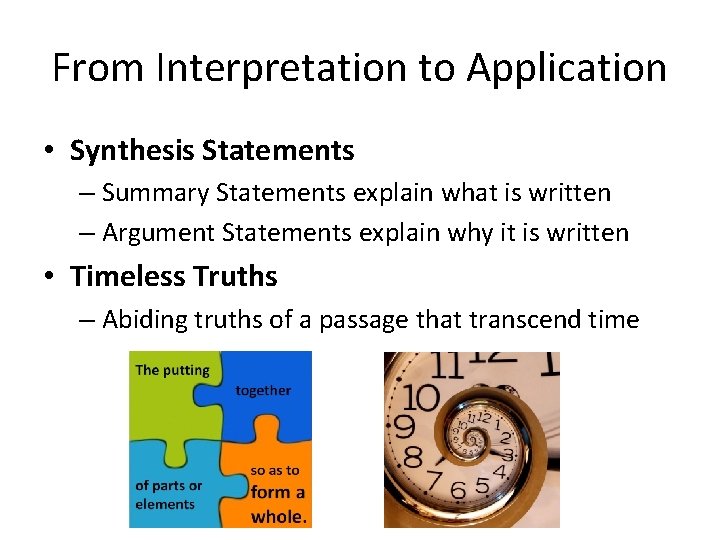
From Interpretation to Application • Synthesis Statements – Summary Statements explain what is written – Argument Statements explain why it is written • Timeless Truths – Abiding truths of a passage that transcend time
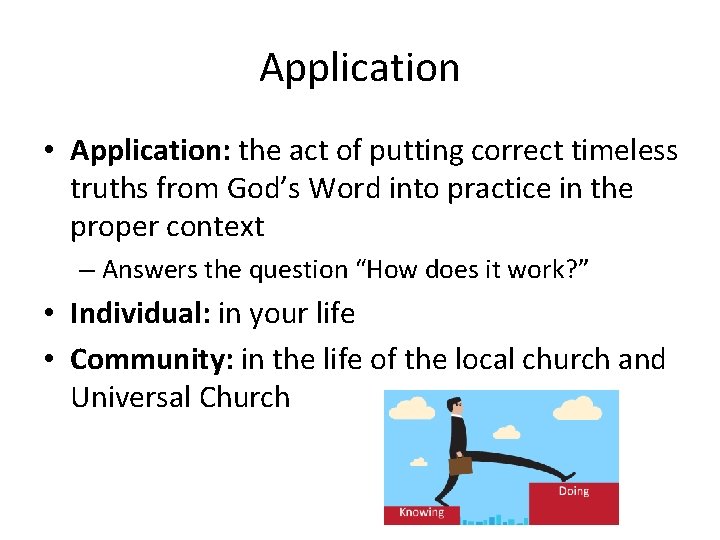
Application • Application: the act of putting correct timeless truths from God’s Word into practice in the proper context – Answers the question “How does it work? ” • Individual: in your life • Community: in the life of the local church and Universal Church
Application Definition Parts • “The act of putting correct timeless truths from God’s Word…” – The more time spent in observation, the more accurate your interpretation – Good Interpretation = Good Timeless Truths – All must come from God’s Word alone!
Application Definition Parts • “…into practice…” – Generally Applied • “Be kind to everyone. ” – Specifically Applied (S. M. A. R. T. Goals) • Specific Measurable Attainable Relevant Timely • “Be kind to your spouse when you come home from work. ”
Application Definition Parts • “…in the proper context. ” – of God’s Word and in practice • • Historical Cultural Geographical Grammatical Literal (when literal) Figurative (when figurative) In light of the other Scriptures In light of God’s Character
Application: Individual & Community • Applications to Individuals – Elders, Deacons, Brothers, Sisters, Husbands, Wives, Men, Women, Young, Old, YOU • Applications to the Community – Local Churches: CBC, The Met, Lakewood United Methodist, St. Cuthbert’s Episcopal, house churches – The Universal Church: All believers combined regardless of denomination
Biblical Application Pitfalls • What happens if your observations are wrong? • What happens if your interpretation is wrong? • What happens if your timeless truths are wrong? • What happens to you if your applications are wrong? • What happens to the people you influence when your applications are wrong?
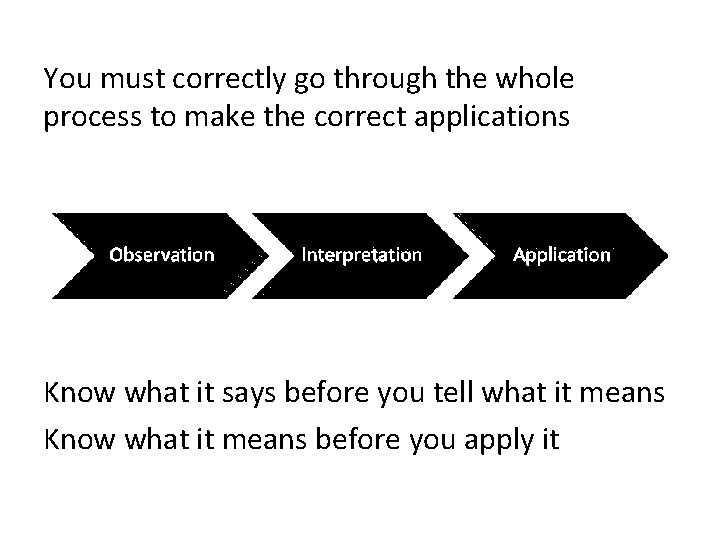
You must correctly go through the whole process to make the correct applications Know what it says before you tell what it means Know what it means before you apply it
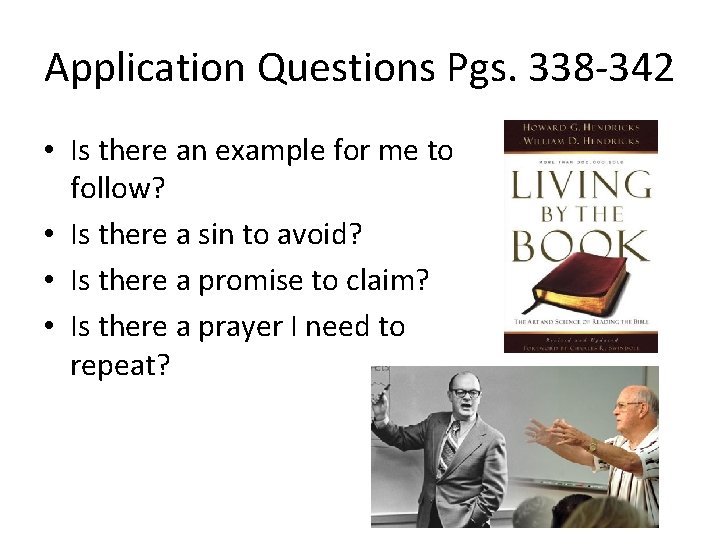
Application Questions Pgs. 338 -342 • Is there an example for me to follow? • Is there a sin to avoid? • Is there a promise to claim? • Is there a prayer I need to repeat?
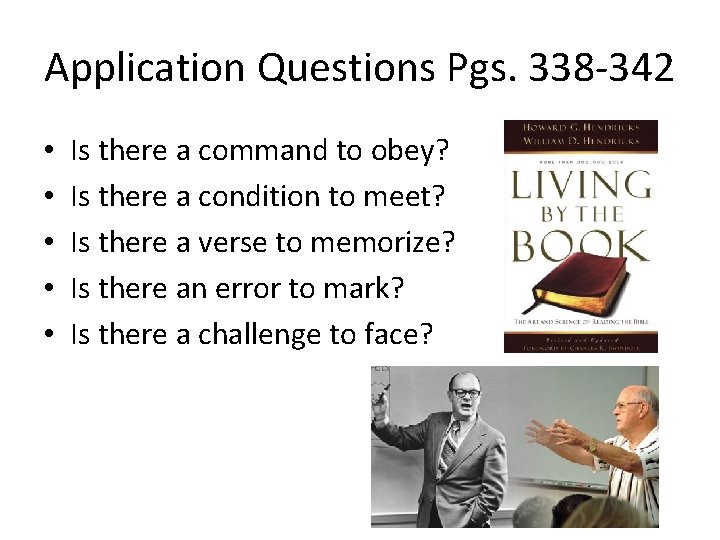
Application Questions Pgs. 338 -342 • • • Is there a command to obey? Is there a condition to meet? Is there a verse to memorize? Is there an error to mark? Is there a challenge to face?
Example from Titus • Timeless Truths from Titus 1: 5 -2: 1 – There should be multiple male elders in a local church – A qualified man should vet the potential elder – The appointer of elders should remain steadfast – There should never be a compromise on the qualifications of an elder – The potential elder must meet all of the qualifications • Do any of these apply to you? • Check out Hendrick’s questions as a starting point
Example from Titus • Timeless Truth: The potential elder must meet all of the qualifications • Hendrick’s Question: Is there an example for me to follow? • General Application: The elder qualifications in Titus are an example that I should follow. • Rationale: Whether you are an elder or not, male or female; everyone should live in this manner • Limitation: Just because you follow these does not mean that you are an elder.
Example from Titus • General application: we should strive to meet these elder qualifications • To get specific, look at the individual qualifications and find one you struggle with • Specific Application: “I need to learn to be more hospitable to guests when they come over to my house. ” – S. M. A. R. T. (Specific, Measurable, Attainable, Relevant, and Timely)
Example in Titus • Use your timeless truths to write general and specific individual applications in Titus • Work alone or in groups • We will share our findings in the last few minutes of this section

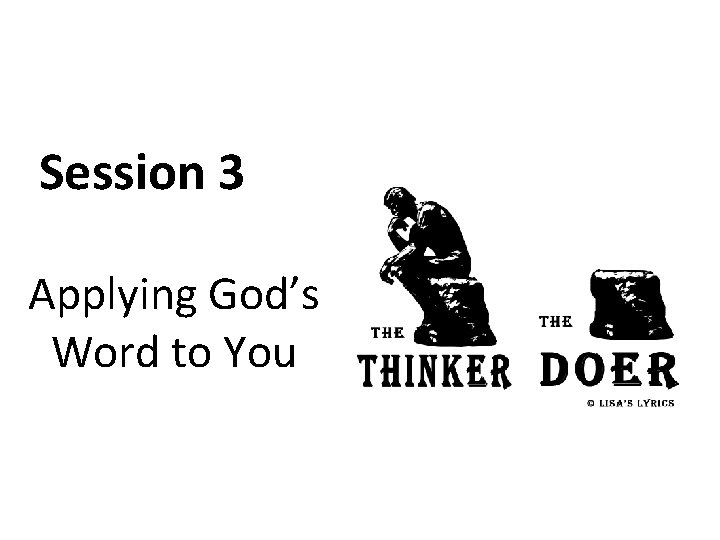
Session 3 Applying God’s Word to You

Lunch Break

Session 4 Applying God’s Word to the Church
Application Review • Application: the act of putting correct timeless truths from God’s Word into practice in the proper context – It answers the question “How does it work? ” • Individual: in your life • Community: in the life of the local church and Universal Church
Defining The Church • Church is not, nor has it ever been a building, the Church is made up of the people • There is no such thing as para-Church as it is all part of the Body of Christ; para-Church is Church • We are the Body of Christ and He is the head (Eph. 4: 11 -16) • Scope of “Church” – The Universal (Catholic) Church = All believers regardless of denomination – The Local Church = A body of believers that assemble in a certain locale
Church Applications • Applications that apply to the Church – You must be careful to distinguish from the Church and individuals – You must be careful to make certain that the Church is following God’s Word
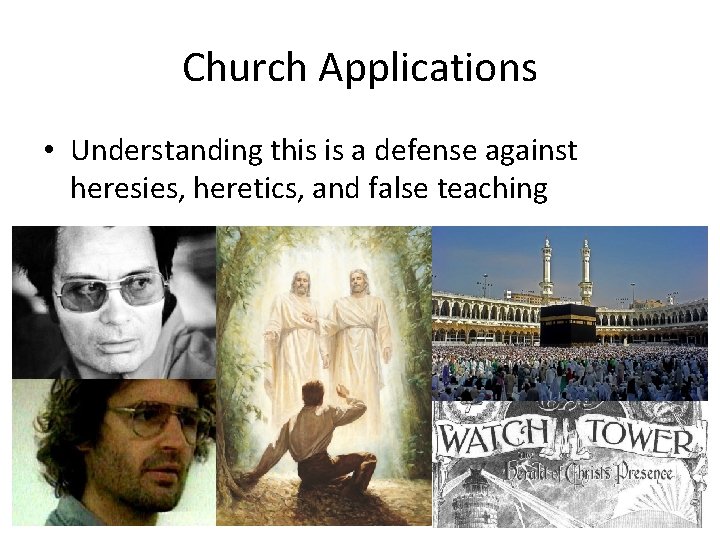
Church Applications • Understanding this is a defense against heresies, heretics, and false teaching
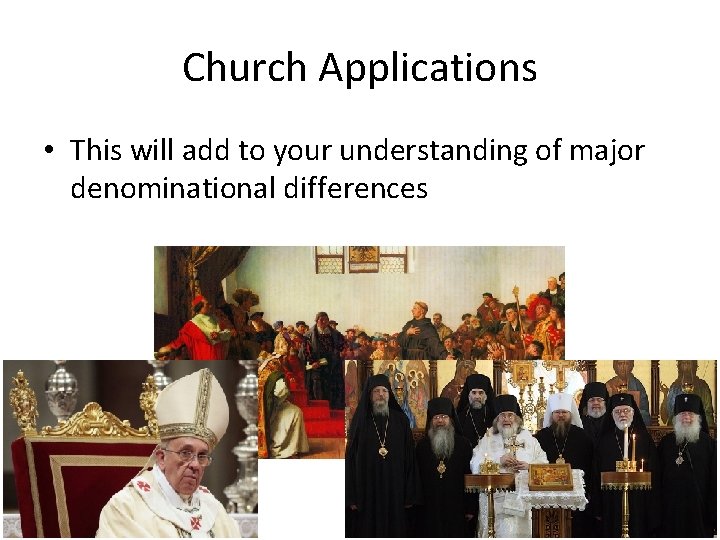
Church Applications • This will add to your understanding of major denominational differences
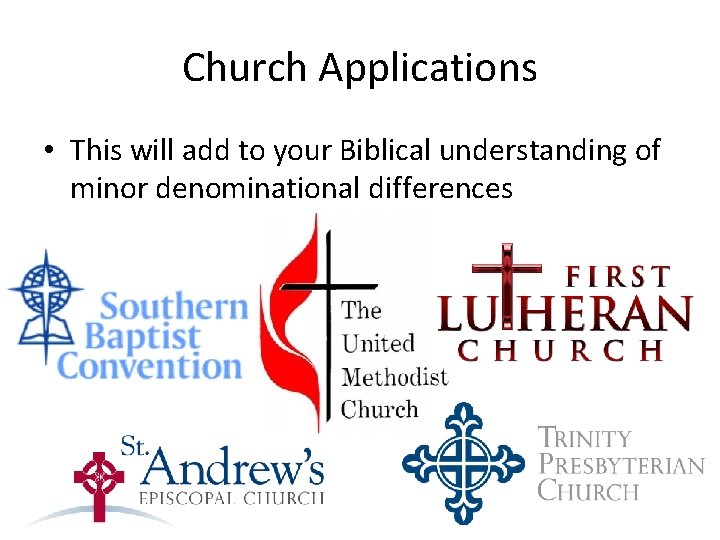
Church Applications • This will add to your Biblical understanding of minor denominational differences
Church Applications • This will add to your Biblical understanding of your own local church
Church Applications • This will add to your Biblical understanding of your own small group
Church Applications • Driven by the Biblical context • Help us to identify and refute heresy and false teaching • Should force us toward unity of understanding despite all denominational differences • Should force us to re-evaluate and change what is wrong, fill what is lacking, and cut what is useless • Should conform us more to His image
Application Questions Pgs. 338 -342 • Does this apply to me or the Church? • Is this an example or a prescription for us to follow? • Is there a sin for us to avoid? • Is there a promise for us to claim? • Is there a prayer we need to repeat?
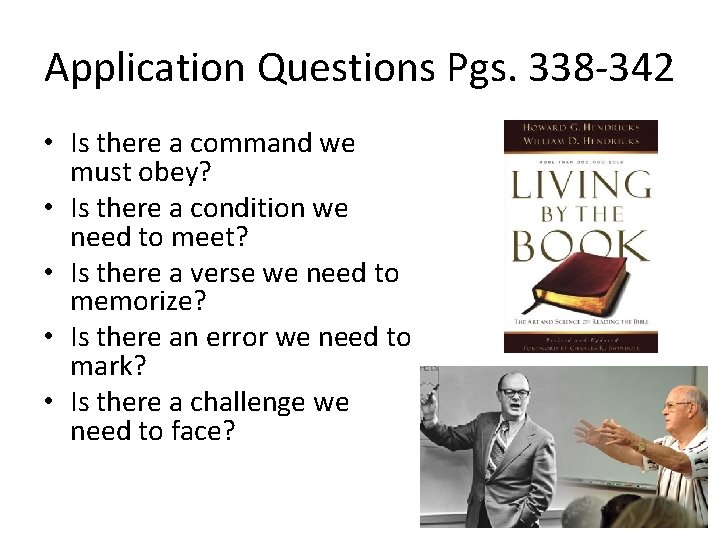
Application Questions Pgs. 338 -342 • Is there a command we must obey? • Is there a condition we need to meet? • Is there a verse we need to memorize? • Is there an error we need to mark? • Is there a challenge we need to face?
Example from Titus • Timeless Truths from Titus 1: 5 -2: 1 – There should be multiple male elders leading a local church – A qualified elder should vet the potential elder – The appointer of elders should remain steadfast – There should never be a compromise on the qualifications of an elder – The potential elder must meet all of the qualifications • Do any of these apply to the Church? • All of these apply to the Church!
Example from Titus • Relevant Questions: – Does this apply to me or the Church? – Is this an example or a prescription for us to follow? – Is there a command we must obey? – Is there a condition we need to meet? – Is there a verse we need to memorize? – Is there an error we need to mark? – Is there a challenge we need to face?
Church Applications from Titus 1 • Applications from Timeless Truths – Each local church should be ruled by multiple male elders – Qualified elders should vet potential elders – Qualified elders should remain steadfast to the qualifications of an elder – The qualifications for an elder cannot change – If someone does not meet the qualifications for an elder, then they should not be one • Applications from one verse: Titus 1: 9 – Elders must teach sound doctrine – Elders must refute unsound doctrine
Example in Titus • Go back through Titus and look through the verses and your timeless principles to write applications for the Church. • Work alone or in groups • We will share our findings in the last few minutes of this section

Session 4 Applying God’s Word to the Church

15 Minute Break

Session 5 Course Synthesis
Course Synthesis • Observation, Interpretation, Application…now what? • Your job now is to put it all together in a way that you can understand it, and to share with others in your context • I gave you templates to help you organize your work – Feel free to put it in a format that works best for the way God designed you • Keep your notes & work in a lasting way – Carbonite
Examples • Presentations for groups – Compile a few pages of notes to guide your lecture – Or use Power Point • Wordy slides for their notes • Sparse slides with handouts (my new preference) • Small Group and One on One – Use templates for their pre-work then discuss – Q & A – Observation, Interpretation, Application • Write books, papers, articles, etc. • Make videos or podcasts • Do your thing
Presentations
The Book of Revelation: Formal Introduction Jeremy D. Little Fellowship & 2 GAB 9/2/2018
Formal Introduction: A Survey of the Main Components • • • Author (who wrote it) Date Written (when it was written) Provenance (where it was written) Audience/Destination (who it was written to) Occasion/Purpose (why it was written) Genre (what type of literature it is) – Narrative, Poetry, Prophetic, Wisdom, Apocalyptic, Epistles • Controversial Issues
Importance of Formal Introductions • Careful work will lead to: – Better interpretation – Identification of relevant Biblical cross references – Better connection to the history of the Church • Careless work will lead to: – Incorrect interpretation – Failure to identify relevant Bible cross references • Incorrect interpretation of those cross references – Disconnect with the history of the Church – The spread of confusion and the rise of cults
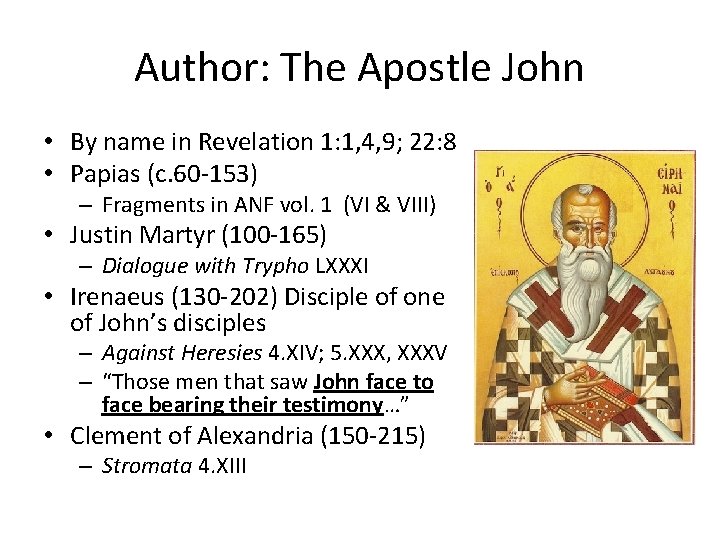
Author: The Apostle John • By name in Revelation 1: 1, 4, 9; 22: 8 • Papias (c. 60 -153) – Fragments in ANF vol. 1 (VI & VIII) • Justin Martyr (100 -165) – Dialogue with Trypho LXXXI • Irenaeus (130 -202) Disciple of one of John’s disciples – Against Heresies 4. XIV; 5. XXX, XXXV – “Those men that saw John face to face bearing their testimony…” • Clement of Alexandria (150 -215) – Stromata 4. XIII
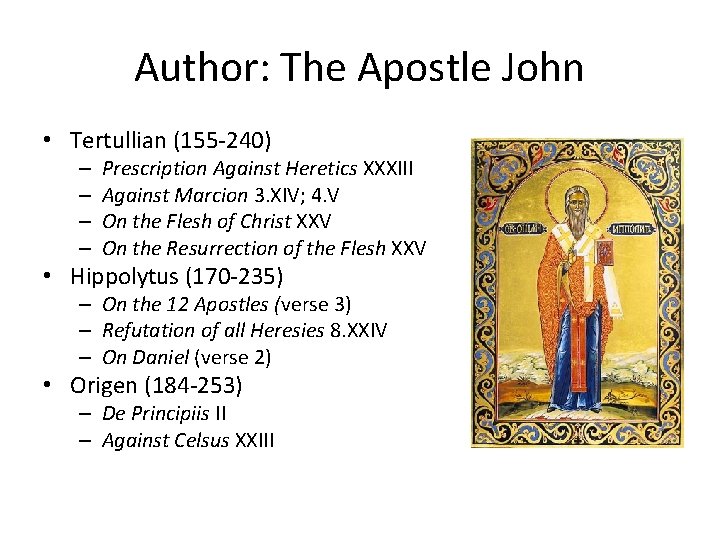
Author: The Apostle John • Tertullian (155 -240) – – Prescription Against Heretics XXXIII Against Marcion 3. XIV; 4. V On the Flesh of Christ XXV On the Resurrection of the Flesh XXV • Hippolytus (170 -235) – On the 12 Apostles (verse 3) – Refutation of all Heresies 8. XXIV – On Daniel (verse 2) • Origen (184 -253) – De Principiis II – Against Celsus XXIII
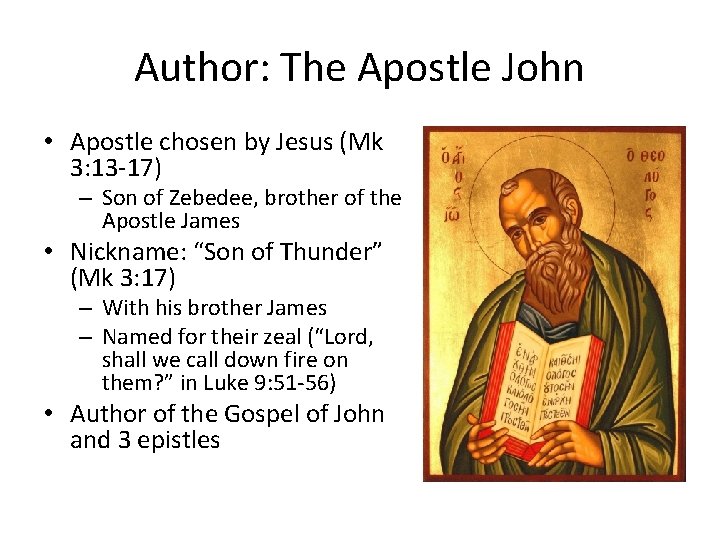
Author: The Apostle John • Apostle chosen by Jesus (Mk 3: 13 -17) – Son of Zebedee, brother of the Apostle James • Nickname: “Son of Thunder” (Mk 3: 17) – With his brother James – Named for their zeal (“Lord, shall we call down fire on them? ” in Luke 9: 51 -56) • Author of the Gospel of John and 3 epistles
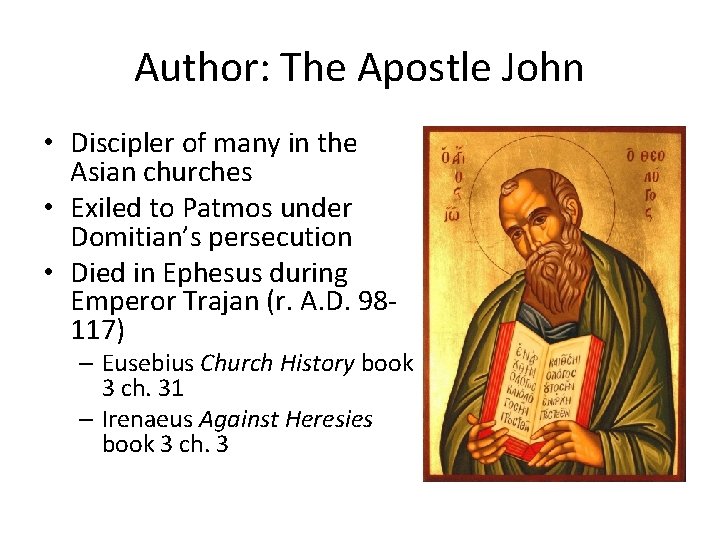
Author: The Apostle John • Discipler of many in the Asian churches • Exiled to Patmos under Domitian’s persecution • Died in Ephesus during Emperor Trajan (r. A. D. 98117) – Eusebius Church History book 3 ch. 31 – Irenaeus Against Heresies book 3 ch. 3
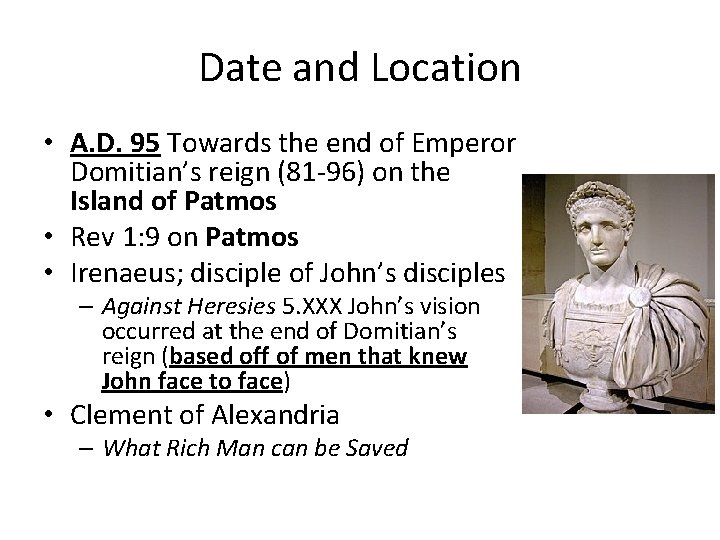
Date and Location • A. D. 95 Towards the end of Emperor Domitian’s reign (81 -96) on the Island of Patmos • Rev 1: 9 on Patmos • Irenaeus; disciple of John’s disciples – Against Heresies 5. XXX John’s vision occurred at the end of Domitian’s reign (based off of men that knew John face to face) • Clement of Alexandria – What Rich Man can be Saved
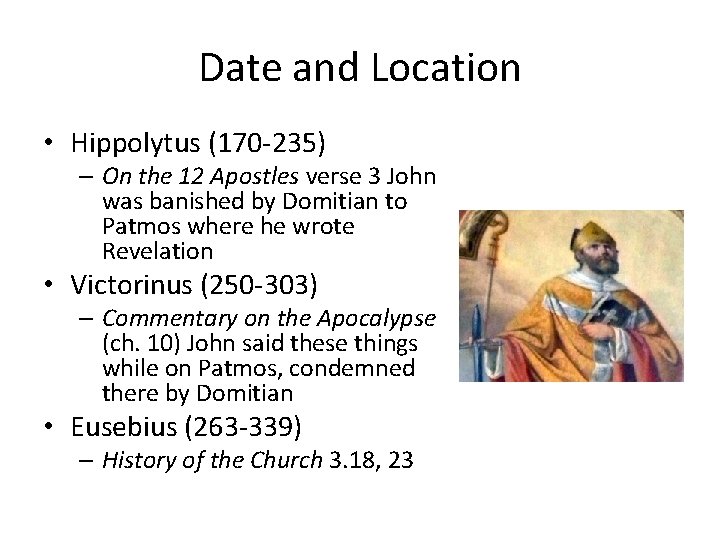
Date and Location • Hippolytus (170 -235) – On the 12 Apostles verse 3 John was banished by Domitian to Patmos where he wrote Revelation • Victorinus (250 -303) – Commentary on the Apocalypse (ch. 10) John said these things while on Patmos, condemned there by Domitian • Eusebius (263 -339) – History of the Church 3. 18, 23
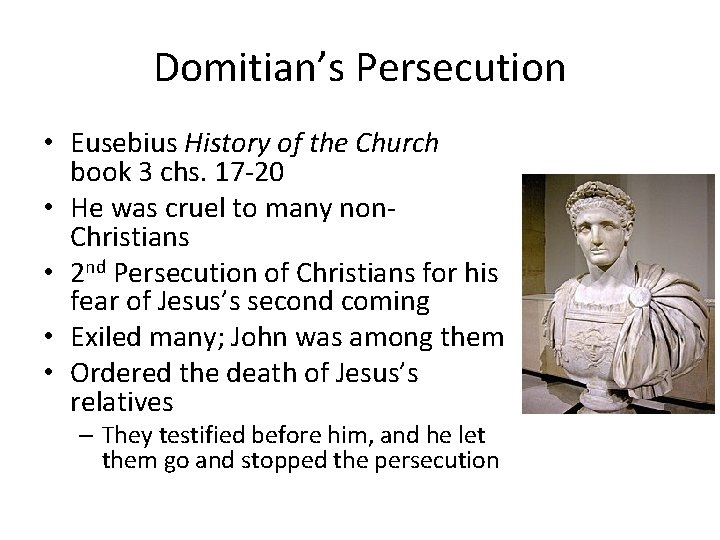
Domitian’s Persecution • Eusebius History of the Church book 3 chs. 17 -20 • He was cruel to many non. Christians • 2 nd Persecution of Christians for his fear of Jesus’s second coming • Exiled many; John was among them • Ordered the death of Jesus’s relatives – They testified before him, and he let them go and stopped the persecution
Audience, Purpose, Genre • The 7 Churches in Asia (Rev 1: 4) – All Scripture was also circulated amongst the churches • The ECF mention that John would go in a regular circuit to the local churches in Asia – He also returned there after the exile on Patmos • Purpose – Address individual issues in the churches – Record what John saw concerning what was, is, and is to come (Rev. 1: 19) • Apocalyptic/Prophetic and Epistolary
The Book of Revelation: The Fifth and Sixth Seals Jeremy D. Little Fellowship & 2 GAB 11/18/2018
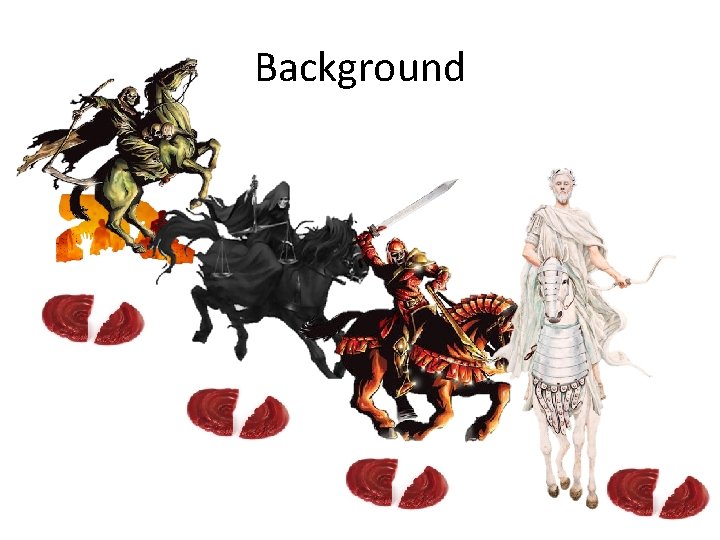
Background
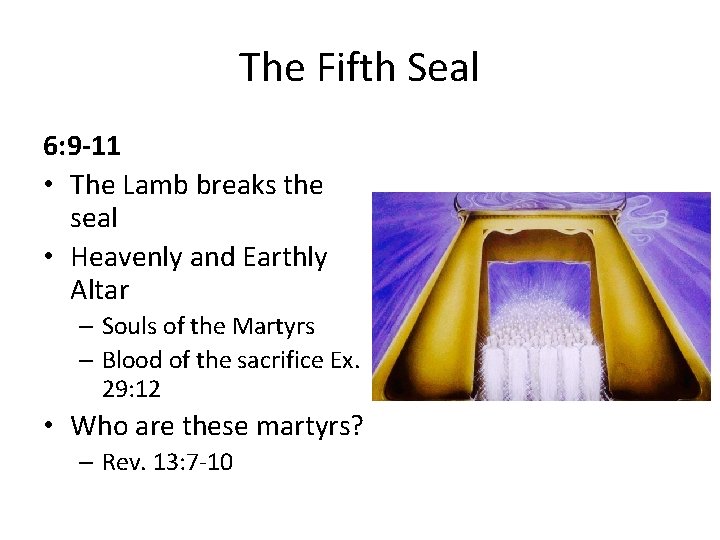
The Fifth Seal 6: 9 -11 • The Lamb breaks the seal • Heavenly and Earthly Altar – Souls of the Martyrs – Blood of the sacrifice Ex. 29: 12 • Who are these martyrs? – Rev. 13: 7 -10
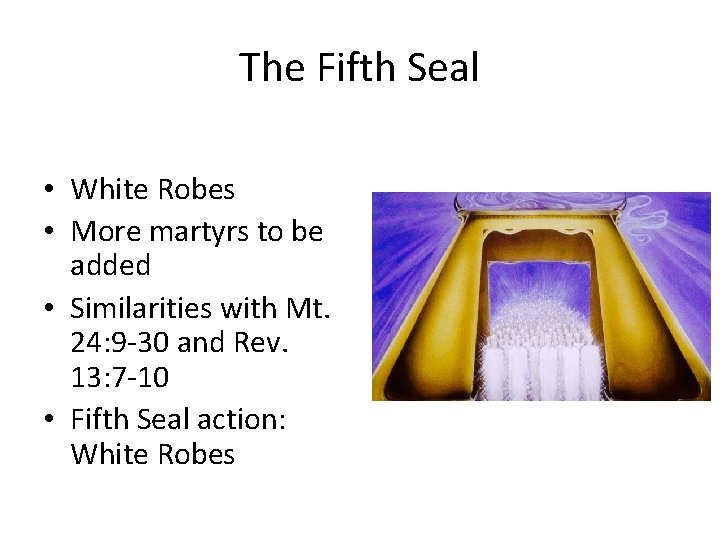
The Fifth Seal • White Robes • More martyrs to be added • Similarities with Mt. 24: 9 -30 and Rev. 13: 7 -10 • Fifth Seal action: White Robes
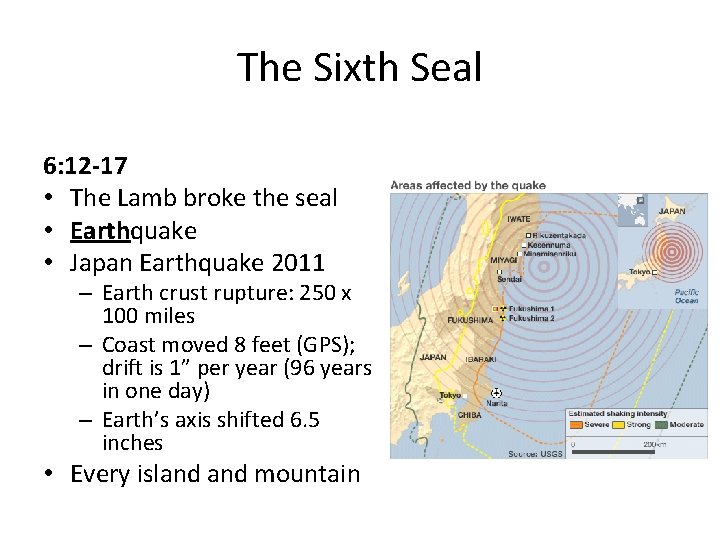
The Sixth Seal 6: 12 -17 • The Lamb broke the seal • Earthquake • Japan Earthquake 2011 – Earth crust rupture: 250 x 100 miles – Coast moved 8 feet (GPS); drift is 1” per year (96 years in one day) – Earth’s axis shifted 6. 5 inches • Every island mountain
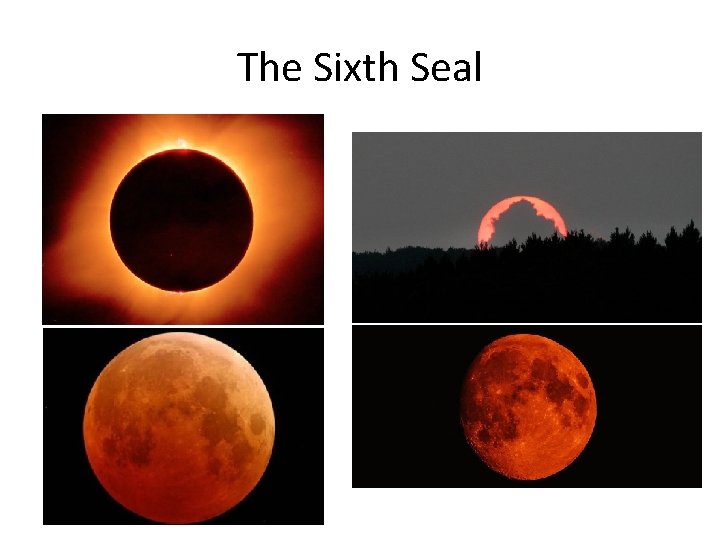
The Sixth Seal
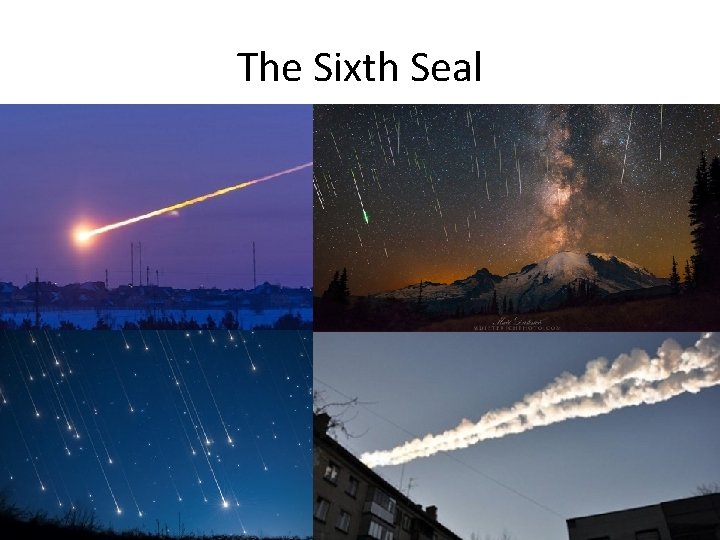
The Sixth Seal
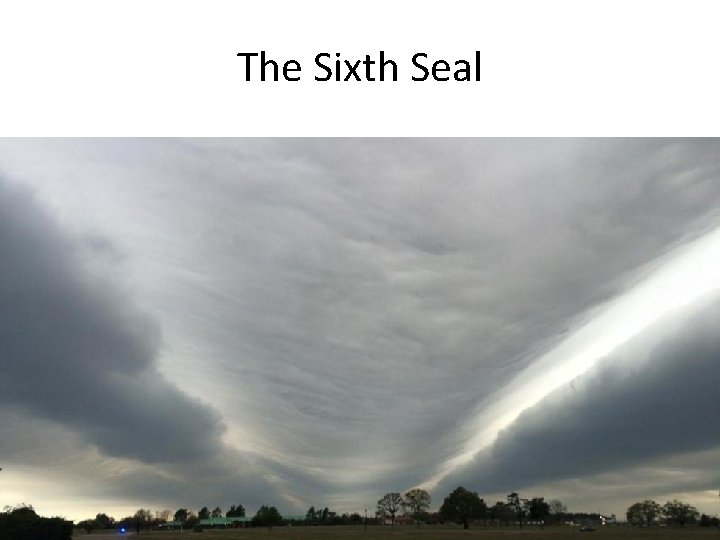
The Sixth Seal

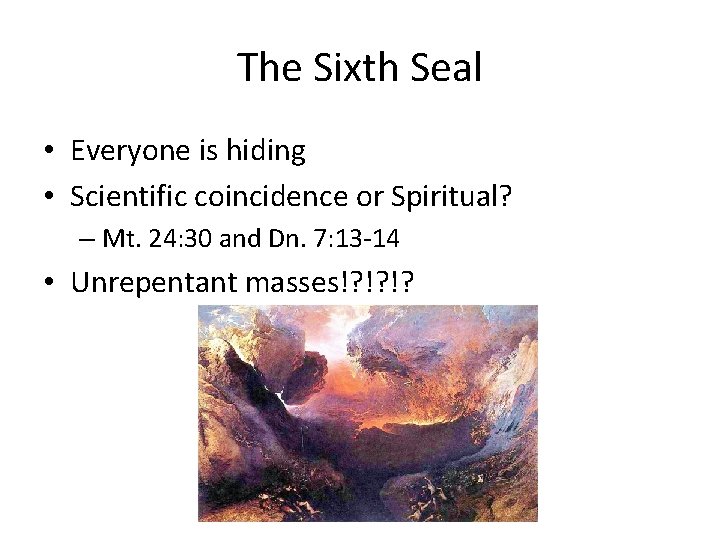
The Sixth Seal • Everyone is hiding • Scientific coincidence or Spiritual? – Mt. 24: 30 and Dn. 7: 13 -14 • Unrepentant masses!? !? !?
Applications • When you sin: confess and repent, do not harden your hearts like these people will • Do not fear those that kill the body; God is the master of your soul • If you are to be a martyr, then be a martyr and maintain your testimony • God is in control of every aspect of nature • God is in control of the End Times

Small Groups and One on One
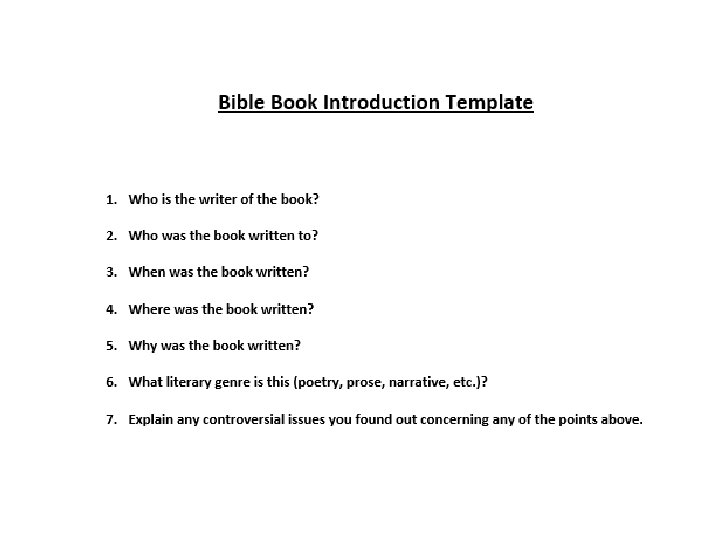
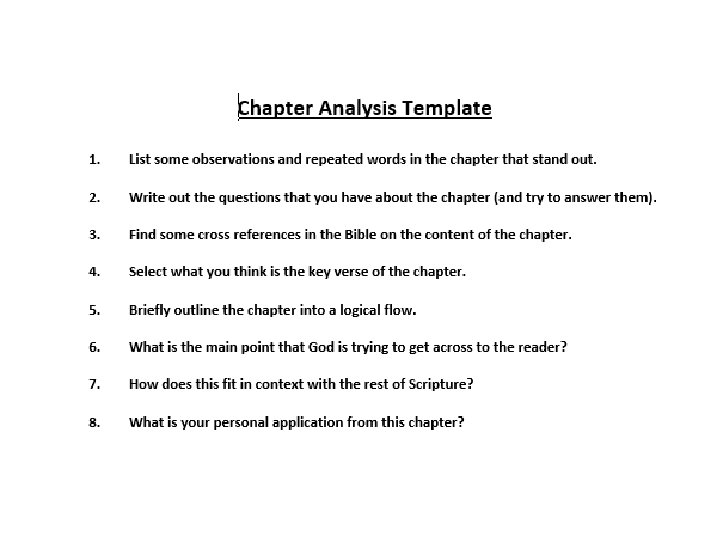
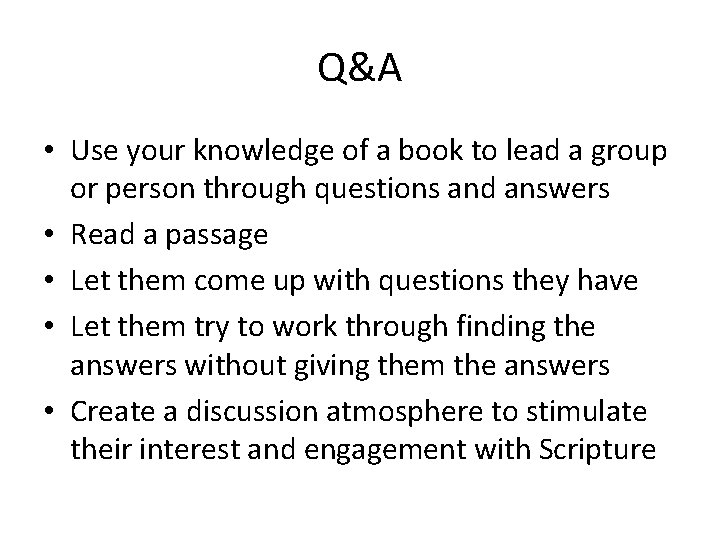
Q&A • Use your knowledge of a book to lead a group or person through questions and answers • Read a passage • Let them come up with questions they have • Let them try to work through finding the answers without giving them the answers • Create a discussion atmosphere to stimulate their interest and engagement with Scripture
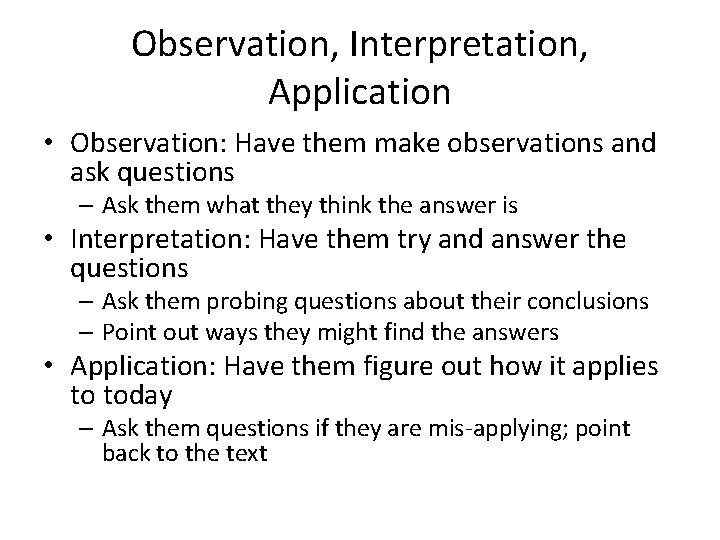
Observation, Interpretation, Application • Observation: Have them make observations and ask questions – Ask them what they think the answer is • Interpretation: Have them try and answer the questions – Ask them probing questions about their conclusions – Point out ways they might find the answers • Application: Have them figure out how it applies to today – Ask them questions if they are mis-applying; point back to the text
Writing • Write your own research papers for yourself or for others using the method you learned • Write a book • Submit articles for publication • Write curriculum • Etc…
Make Videos or Podcasts • Make videos and put them on the internet – You. Tube is free for all and it is international Creative videos Teaching videos Short videos Long videos 2 GAB has nearly 250 videos on You. Tube • CBC has a bunch of videos on Vimeo • • •
You can use any method that works for the glory of God You were tailor-made by God for a specific reason with specific gifts and skills You have freedom to use your creativity to glorify God
Course Conclusion
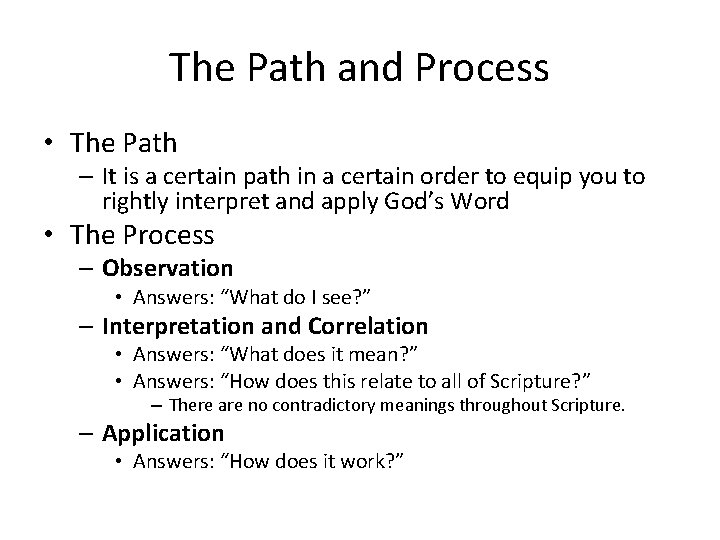
The Path and Process • The Path – It is a certain path in a certain order to equip you to rightly interpret and apply God’s Word • The Process – Observation • Answers: “What do I see? ” – Interpretation and Correlation • Answers: “What does it mean? ” • Answers: “How does this relate to all of Scripture? ” – There are no contradictory meanings throughout Scripture. – Application • Answers: “How does it work? ”
The Product • You should become more like Christ • You have had first-hand exposure to the Scriptures in a way that you haven’t before • You are hopefully better equipped, encouraged, and edified so that you can apply this to yourself and your ministry
Bringing it All Together • Living By the Book Pg. 317 • God’s Word transforms a person • A person can impact a community that is filled with transformed persons • A community of transformed persons can transform the world • It starts with you letting God’s Word transform you
II Timothy 2: 15 15 Be diligent to present yourself approved to God as a workman who does not need to be ashamed, accurately handling the word of truth. Study it, do it, then pass it on to others that will pass it on to others that will pass it on to others…

Session 5 Course Synthesis

- Slides: 134