
BGP Convergence Jennifer Rexford Outline Border Gateway Protocol
BGP Convergence Jennifer Rexford
Outline • Border Gateway Protocol (BGP) – Prefix-based routing at the AS level – Policy-based path-vector protocol – Incremental protocol with update messages • BGP convergence – Causes of BGP routing changes – Path exploration during convergence – Minimum route advertisement timer • BGP does not necessarily converge – Bistable routing configurations – Protocol oscillation

Interdomain Routing • AS-level topology – Destinations are IP prefixes (e. g. , 12. 0. 0. 0/8) – Nodes are Autonomous Systems (ASes) – Links are connections and business relationships 4 3 5 2 1 Client 7 6 Web server
Challenges for Interdomain Routing • Scale – Prefixes: 150, 000 -200, 000, and growing – ASes: 20, 000 visible ones, and growing – AS paths and routers: at least in the millions… • Privacy – ASes don’t want to divulge internal topologies – … or their business relationships with neighbors • Policy – No Internet-wide notion of a link cost metric – Need control over where you send traffic – … and who can send traffic through you

Shortest-Path Routing is Restrictive • All traffic must travel on shortest paths • All nodes need common notion of link costs • Incompatible with commercial relationships National ISP 1 Regional ISP 3 Cust 3 National ISP 2 Regional ISP 2 Cust 2 YES NO Regional ISP 1 Cust 1
Link-State Routing is Problematic • Topology information is flooded – High bandwidth and storage overhead – Forces nodes to divulge sensitive information • Entire path computed locally per node – High processing overhead in a large network • Minimizes some notion of total distance – Works only if policy is shared and uniform • Typically used only inside an AS – E. g. , OSPF and IS-IS

Distance Vector is on the Right Track • Advantages – Hides details of the network topology – Nodes determine only “next hop” toward the dest • Disadvantages – Minimizes some notion of total distance, which is difficult in an interdomain setting – Slow convergence due to the counting-to-infinity problem (“bad news travels slowly”) • Idea: extend the notion of a distance vector

Path-Vector Routing • Extension of distance-vector routing – Support flexible routing policies – Avoid count-to-infinity problem • Key idea: advertise the entire path – Distance vector: send distance metric per dest d – Path vector: send the entire path for each dest d 3 “d: path (2, 1)” “d: path (1)” 1 2 data traffic d
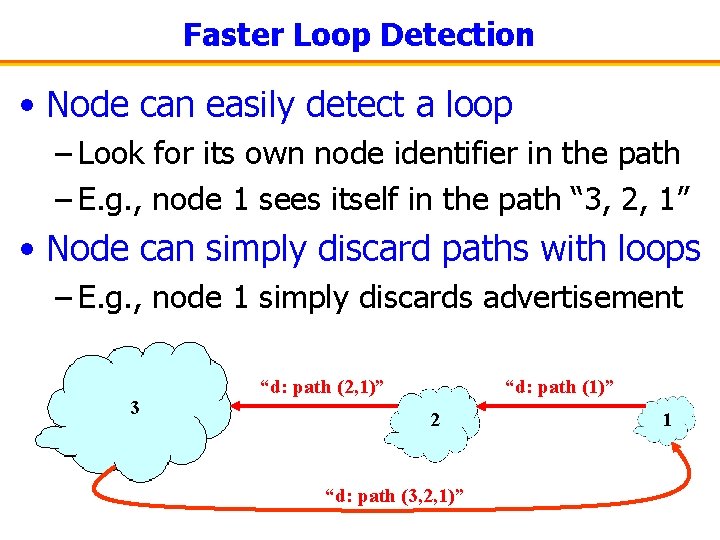
Faster Loop Detection • Node can easily detect a loop – Look for its own node identifier in the path – E. g. , node 1 sees itself in the path “ 3, 2, 1” • Node can simply discard paths with loops – E. g. , node 1 simply discards advertisement 3 “d: path (2, 1)” “d: path (1)” 2 “d: path (3, 2, 1)” 1
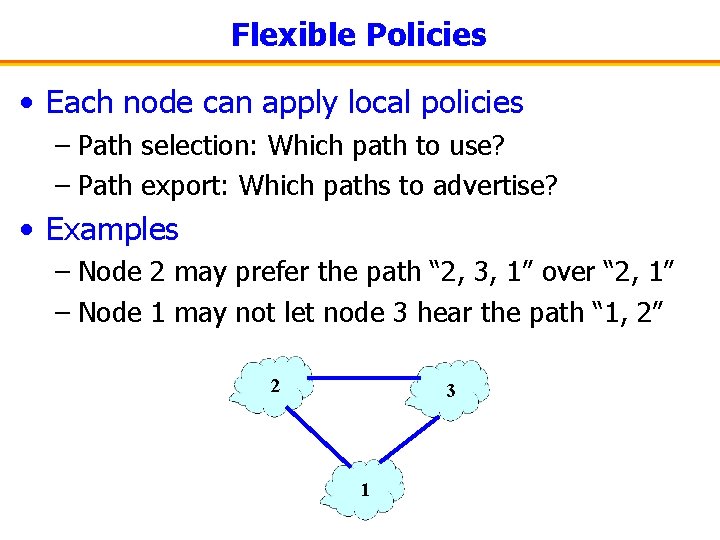
Flexible Policies • Each node can apply local policies – Path selection: Which path to use? – Path export: Which paths to advertise? • Examples – Node 2 may prefer the path “ 2, 3, 1” over “ 2, 1” – Node 1 may not let node 3 hear the path “ 1, 2” 2 3 1

Border Gateway Protocol • Interdomain routing protocol for the Internet – Prefix-based path-vector protocol – Policy-based routing based on AS Paths – Evolved during the past 15 years • 1989 : BGP-1 [RFC 1105] – Replacement for EGP (1984, RFC 904) • 1990 : BGP-2 [RFC 1163] • 1991 : BGP-3 [RFC 1267] • 1995 : BGP-4 [RFC 1771] – Support for Classless Interdomain Routing (CIDR)

BGP Operations Establish session on TCP port 179 AS 1 BGP session Exchange all active routes AS 2 Exchange incremental updates While connection is ALIVE exchange route UPDATE messages
Incremental Protocol • A node learns multiple paths to destination – Stores all of the routes in a routing table – Applies policy to select a single active route – … and may advertise the route to its neighbors • Incremental updates – Announcement • Upon selecting a new active route, add node id to path • … and (optionally) advertise to each neighbor – Withdrawal • If the active route is no longer available • … send a withdrawal message to the neighbors
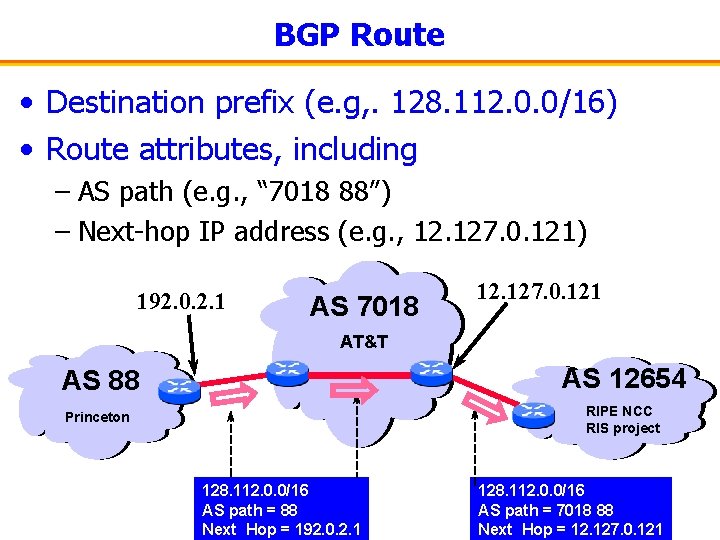
BGP Route • Destination prefix (e. g, . 128. 112. 0. 0/16) • Route attributes, including – AS path (e. g. , “ 7018 88”) – Next-hop IP address (e. g. , 12. 127. 0. 121) 192. 0. 2. 1 AS 7018 12. 127. 0. 121 AT&T AS 88 AS 12654 Princeton RIPE NCC RIS project 128. 112. 0. 0/16 AS path = 88 Next Hop = 192. 0. 2. 1 128. 112. 0. 0/16 AS path = 7018 88 Next Hop = 12. 127. 0. 121
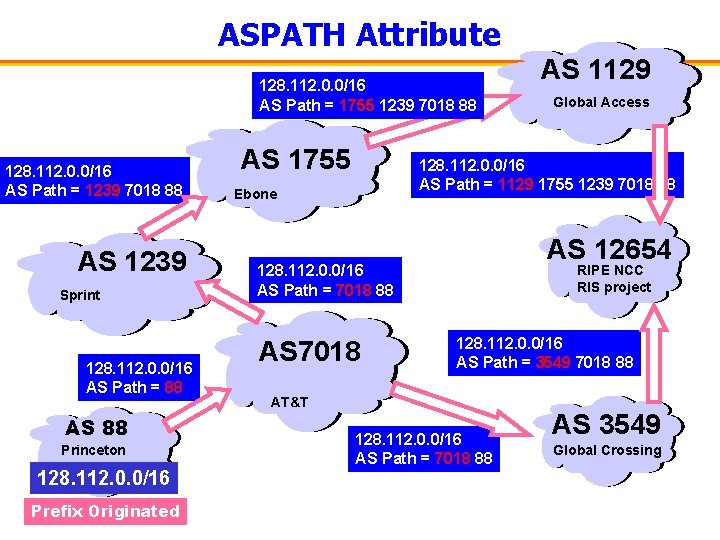
ASPATH Attribute 128. 112. 0. 0/16 AS Path = 1755 1239 7018 88 128. 112. 0. 0/16 AS Path = 1239 7018 88 AS 1239 Sprint 128. 112. 0. 0/16 AS Path = 88 AS 88 Princeton 128. 112. 0. 0/16 Prefix Originated AS 1755 AS 1129 Global Access 128. 112. 0. 0/16 AS Path = 1129 1755 1239 7018 88 Ebone AS 12654 128. 112. 0. 0/16 AS Path = 7018 88 AS 7018 RIPE NCC RIS project 128. 112. 0. 0/16 AS Path = 3549 7018 88 AT&T 128. 112. 0. 0/16 AS Path = 7018 88 AS 3549 Global Crossing

BGP Path Selection • Simplest case AS 1129 – Shortest AS path – Arbitrary tie break • BGP not limited to shortest-path routing Global Access 128. 112. 0. 0/16 AS Path = 1129 1755 1239 7018 88 – Policy-based routing • Example – Five-hop AS path preferred over a three-hop AS path – AS 12654 prefers path through Global Access AS 12654 RIPE NCC RIS project 128. 112. 0. 0/16 AS Path = 3549 7018 88 AS 3549 Global Crossing
Causes of BGP Routing Changes • Topology changes – Equipment going up or down – Deployment of new routers or sessions • BGP session failures – Due to equipment failures, maintenance, etc. – Or, due to congestion on the physical path • Changes in routing policy – Reconfiguration of preferences – Reconfiguration of route filters • Persistent protocol oscillation – Conflicts between policies in different ASes
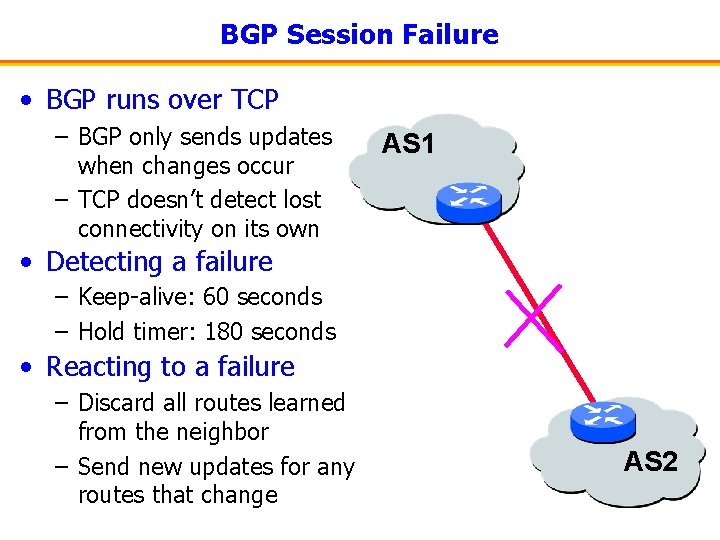
BGP Session Failure • BGP runs over TCP – BGP only sends updates when changes occur – TCP doesn’t detect lost connectivity on its own AS 1 • Detecting a failure – Keep-alive: 60 seconds – Hold timer: 180 seconds • Reacting to a failure – Discard all routes learned from the neighbor – Send new updates for any routes that change AS 2
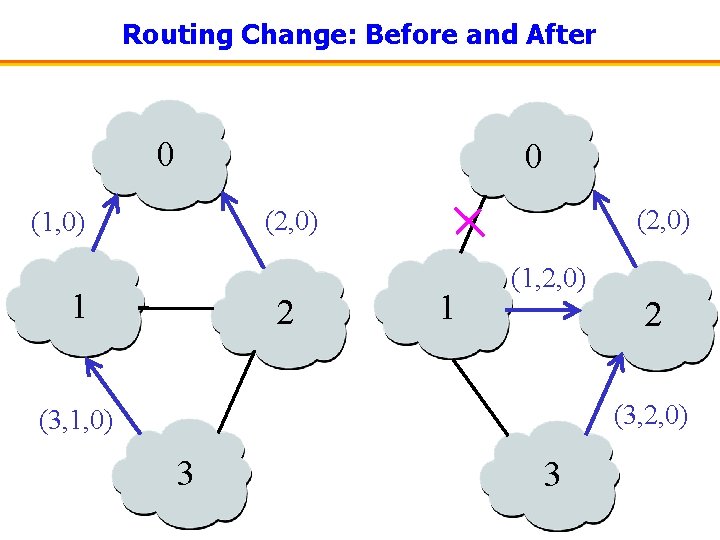
Routing Change: Before and After 0 0 (2, 0) (1, 0) 1 2 1 (1, 2, 0) 2 (3, 2, 0) (3, 1, 0) 3 3
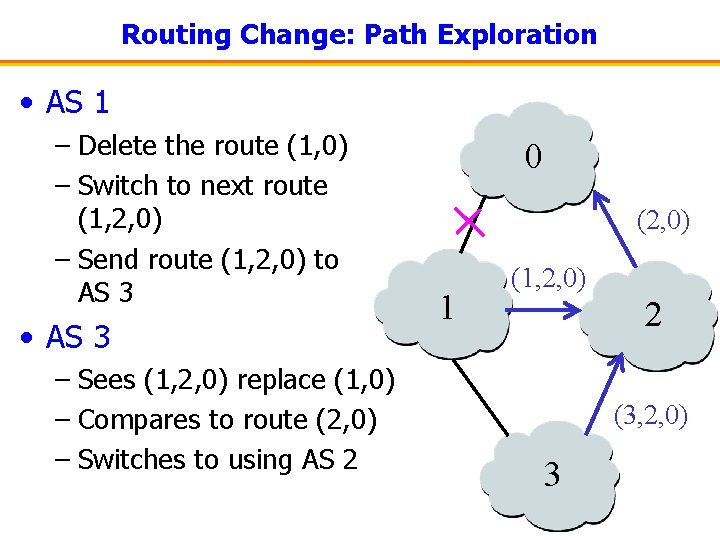
Routing Change: Path Exploration • AS 1 – Delete the route (1, 0) – Switch to next route (1, 2, 0) – Send route (1, 2, 0) to AS 3 • AS 3 – Sees (1, 2, 0) replace (1, 0) – Compares to route (2, 0) – Switches to using AS 2 0 (2, 0) 1 (1, 2, 0) 2 (3, 2, 0) 3
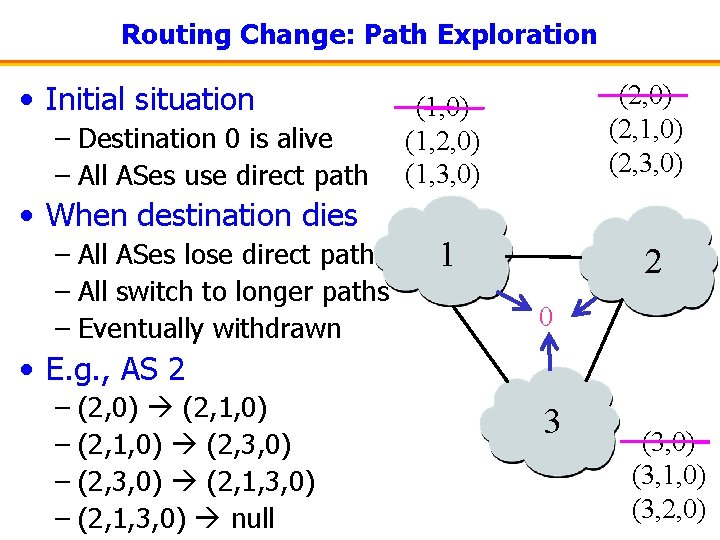
Routing Change: Path Exploration • Initial situation – Destination 0 is alive – All ASes use direct path (1, 0) (1, 2, 0) (1, 3, 0) (2, 1, 0) (2, 3, 0) 1 2 • When destination dies – All ASes lose direct path – All switch to longer paths – Eventually withdrawn 0 • E. g. , AS 2 – (2, 0) (2, 1, 0) – (2, 1, 0) (2, 3, 0) – (2, 3, 0) (2, 1, 3, 0) – (2, 1, 3, 0) null 3 (3, 0) (3, 1, 0) (3, 2, 0)
Time Between Steps in Path Exploration • Minimum route advertisement interval (MRAI) – Minimum spacing between announcements – For a particular (prefix, peer) pair • Advantages – Provides a rate limit on BGP updates – Allows grouping of updates within the interval • Disadvantages – Adds delay to the convergence process – E. g. , 30 seconds for each step
BGP Converges Slowly, if at All • Path vector avoids count-to-infinity – But, ASes still must explore many alternate paths – … to find the highest-ranked path that is still available • Fortunately, in practice – Most popular destinations have very stable BGP routes – And most instability lies in a few unpopular destinations • Still, lower BGP convergence delay is a goal – Can be tens of seconds to tens of minutes – High for important interactive applications – … or even conventional application, like Web browsing
Interaction with Route Flap Damping • Motivation for route-flap damping – Flaky equipment goes up and down repeatedly – Leading to excessive BGP update messages – Eventually, want to suppress those updates • Route Flap Damping – Accumulate a penalty with each routing change – … for each (prefix, peer) pair – Add a fixed penalty for each update message – … and decay the penalty exponentially with time – Apply thresholds to suppress or reuse the route
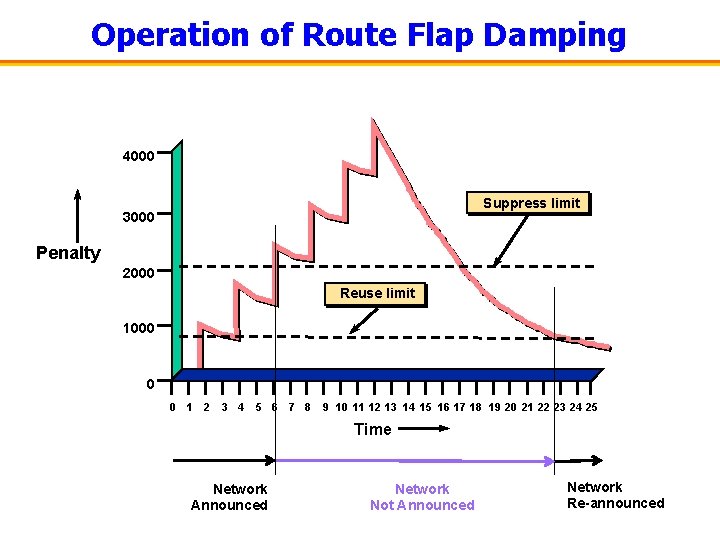
Operation of Route Flap Damping 4000 Suppress limit 3000 Penalty 2000 Reuse limit 1000 0 0 1 2 3 4 5 6 7 8 9 10 11 12 13 14 15 16 17 18 19 20 21 22 23 24 25 Time Network Announced Network Not Announced Network Re-announced
Interaction with Route Flap Damping • What are the right thresholds? • Set too high – Route flaps consume a lot of resources – Users experience more transient disruptions • Set too low – Regular path exploration triggers suppression – Users experience loss of connectivity • Not easy to set the parameters “correctly”… – Route-flap damping disabled in many ASes
Research Questions • How fast does BGP converge? – The n! upper bound is not all that meaningful – What is the tight upper bound? – How does delay depend on the topology? – How does delay depend on the routing policies? • How to make BGP converge faster? – Any way to skip parts of path exploration process? – Any way to precompute the failover paths? – Any benefits if BGP were a multipath protocol? • Any way to safely dampen unstable routes?
BGP Modeling: What Problem Does BGP Solve? • Most do shortest-path routing – Shortest hop count • Distance vector routing (e. g. , RIP) – Shortest path as sum of link weights • Link-state routing (e. g. , OSPF and IS-IS) • Policy makes BGP is more complicated – An AS might not tell a neighbor about a path • E. g. , Sprint can’t reach UUNET through AT&T – An AS might prefer one path over a shorter one • E. g. , ISP prefers to send traffic through a customer What is a good model for BGP?
Could Use A Simulation Model • Simulate the message passing – Advertisements and withdrawals – Message format – Timers • Simulate the routing policy on each session – Filter certain route advertisements – Manipulate the attributes of others • Simulate the decision process – Each router applying all the steps per prefix Feasible, but tedious and ill-suited formal arguments
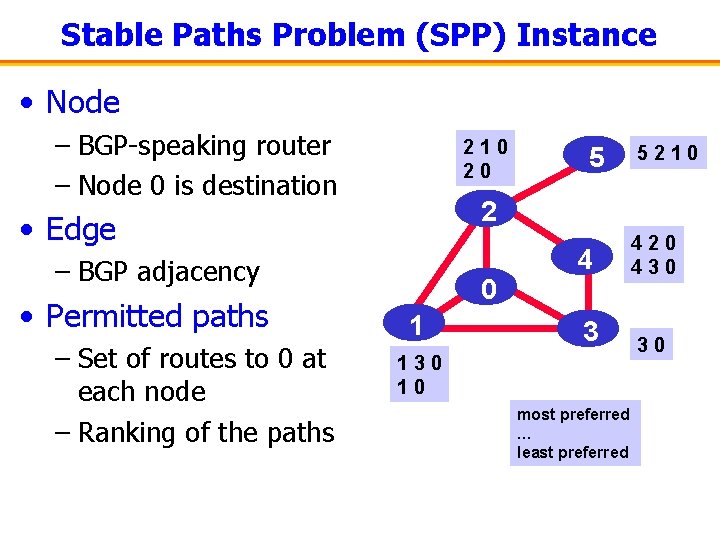
Stable Paths Problem (SPP) Instance • Node – BGP-speaking router – Node 0 is destination 210 2 20 – BGP adjacency – Set of 1 routes to 0 at each node – Ranking of the paths 5210 2 • Edge • Permitted paths 5 0 1 4 420 430 3 30 10 most preferred … least preferred
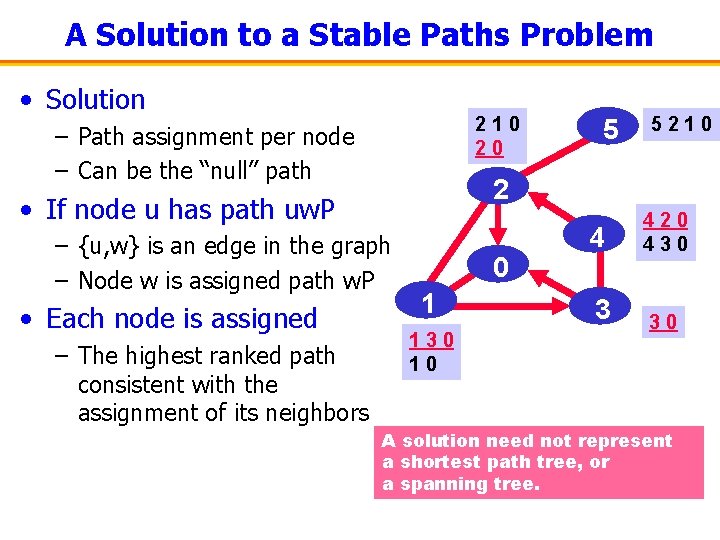
A Solution to a Stable Paths Problem • Solution 2 210 20 – Path assignment per node – Can be the “null” path – {u, w} is an edge in the graph – Node w is assigned path w. P – The highest ranked path 1 consistent with the assignment of its neighbors 5210 2 • If node u has path uw. P • Each node is assigned 5 0 1 130 10 4 420 430 3 30 A solution need not represent a shortest path tree, or a spanning tree.
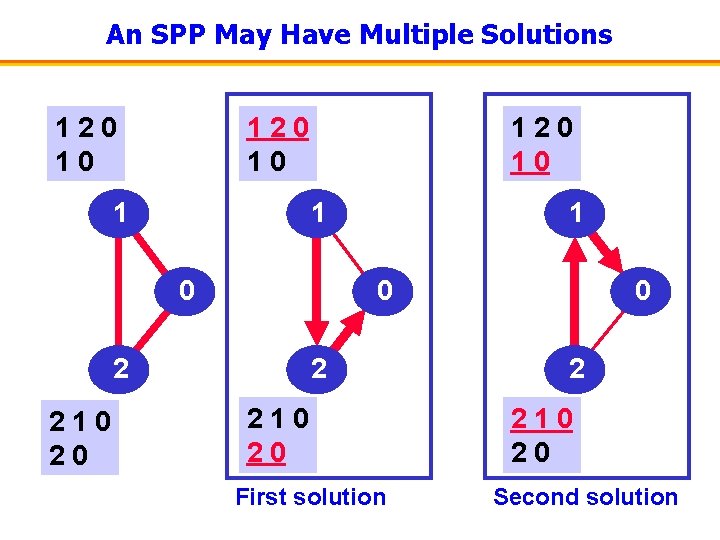
An SPP May Have Multiple Solutions 120 10 1 0 0 0 2 210 20 1 2 210 20 First solution 2 210 20 Second solution
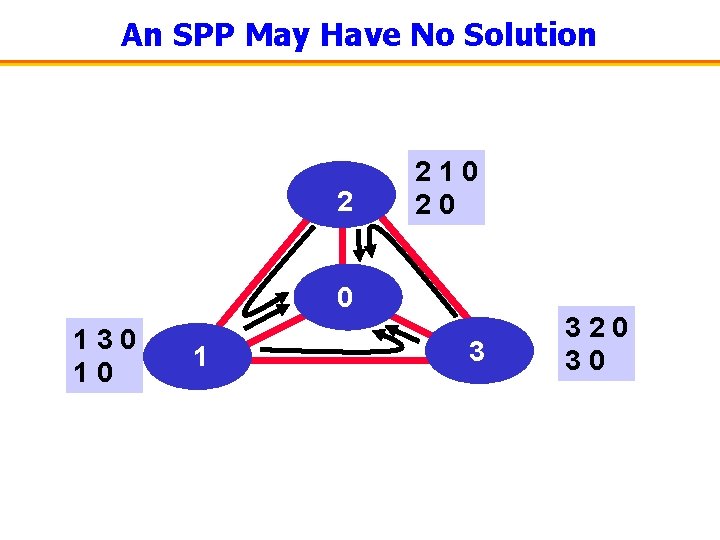
An SPP May Have No Solution 2 210 20 4 0 130 10 1 3 3 320 30
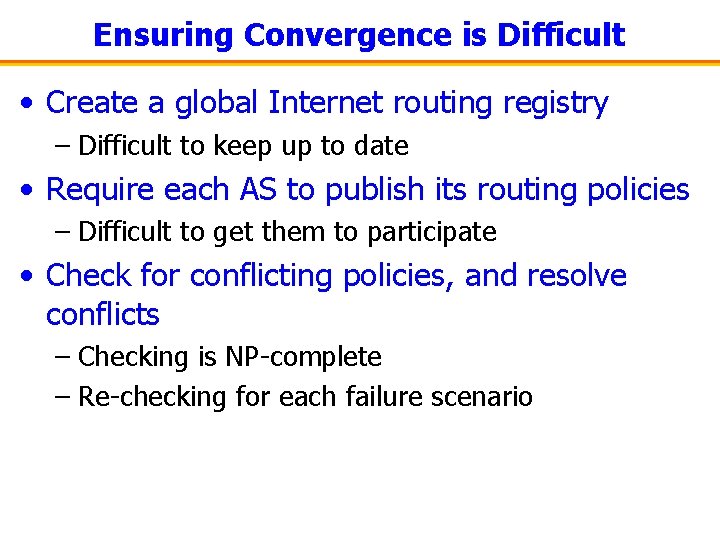
Ensuring Convergence is Difficult • Create a global Internet routing registry – Difficult to keep up to date • Require each AS to publish its routing policies – Difficult to get them to participate • Check for conflicting policies, and resolve conflicts – Checking is NP-complete – Re-checking for each failure scenario
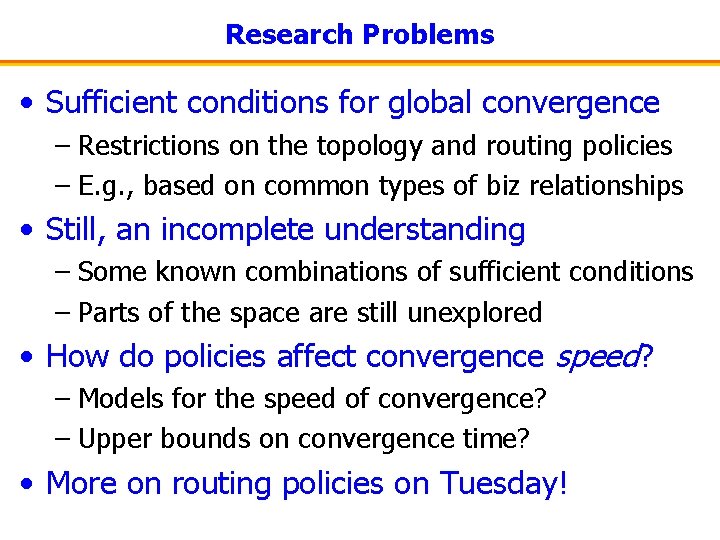
Research Problems • Sufficient conditions for global convergence – Restrictions on the topology and routing policies – E. g. , based on common types of biz relationships • Still, an incomplete understanding – Some known combinations of sufficient conditions – Parts of the space are still unexplored • How do policies affect convergence speed? – Models for the speed of convergence? – Upper bounds on convergence time? • More on routing policies on Tuesday!
- Slides: 35