
BGA Bronze C Radio Telephony Portsmouth Naval GC
BGA Bronze C Radio Telephony Portsmouth Naval GC Neil Shaw January 2012
Introduction - 1 RT Licence required for VHF Aeronautical Band Range 118. 000 to 136. 960 Mhz. 760 Channels. FRTOL is issued by CAA after passing Written Exam & Practical Test It is primarily designed to meet the needs of power pilots ◦ Much of the syllabus is irrelevant to glider pilots CAP 413 covers the CAA RT standards FRTOL is required for Cross-Country Flying: ◦ to cross controlled air space ◦ to enter a ATZ / MATZ
Introduction - 2 The radio set in a glider/car must be: ◦ Licenced – “Radiocommunications Agency Wireless Telegraphy Licence” ◦ Registered Call Sign – (If in a Glider with a Competition Number, registered by BGA (revalidated annually)) ◦ Built to specific standards to ensure it operates on the exact frequency, bandwidth, power output, spurious transmissions All Equipment should be subject to a periodic check (4 yearly) and certification by an authorised tester
Introduction - 3 Like so many things we need to learn, there is a mixture of hugely practical and some relatively useless stuff. Early radios were very unreliable and sometimes difficult to hear. Standard phraseology came about to reduce the length of transmissions and make messages easier to understand. Anyone with an aviation transceiver could send bogus messages, and disrupt air traffic into busy airports. Licensing is part of a safety control mechanism.
Introduction - 4 The Civil Aviation Authority (CAA) controls all UK aviation radio operations. The aims are: ◦ to ensure the sets themselves (referred to as stations), operate correctly without interfering with other transmitters ◦ the users are trained to follow strict procedures. ◦ Glider pilots are exempted from holding formal licences provided they stick to the limited range of frequencies allocated to them. Some of the Bronze C syllabus covers subjects that cannot be practised without an operators licence, but is still required knowledge. British Glider Pilots are allegedly amongst the worst in the world for radio skills! At the end of this introduction you will begin to recognise some of the failings that routinely happen. Good operating skills are obvious to those "in the know", many pilots operate in ignorance without realising they are making fools of themselves.
The Air Navigation Order – Article 21 says: There is no requirement for a Pilot Licence or a Radio -telephonist Licence when a glider is not being flown for Public Transport or Aerial work subject to various conditions regarding Radio: ◦ To be used only for purposes of Instruction, Safety or Navigation ◦ Only if the Transmitter is preset to a number of assigned frequencies that cannot be changed in flight This means you cannot fly a glider which is fitted with a 760 Channel Radio, if you do not have an RT licence GLIDING AT LEE IS DIFFERENT: We have a special dispensation to communicate to Lee Radio (A/G station) on 118. 925, which is NOT a gliding
Radio Range VHF radio operates by line of sight The higher you fly, the greater the range At 5, 000’ you have the potential to be heard across 8, 000 square miles!! The “skip effect” with inversions can exaggerate greatly If you can’t contact a particular station, wait until you are closer or higher Avoid interfering with operations at other airfields Careful consideration is given by CAA to spacing of frequencies across the UK. Limits are set as follows to support: ◦ ◦ Under 3, 000’ and within 10 nm for comms to Air-Ground Under 5, 000’ and within 25 miles for comms to ATC Under 10, 000’ for comms to Approach Use of 8. 33 khz spacing above FL 100.
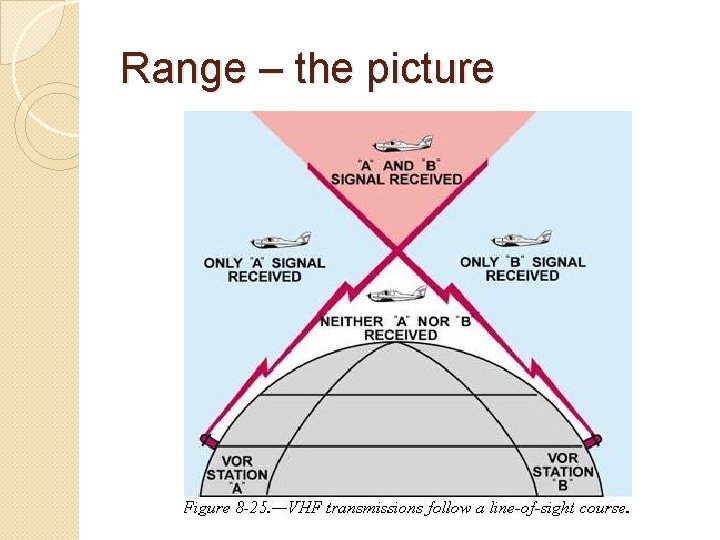
Range – the picture
Range – the maths - 1 VHF transmission range is a function of transmitter power, receiver sensitivity, and distance to the horizon, since VHF signals propagate under normal conditions as a near line-of-sight phenomenon. The distance to the radio horizon is slightly extended over the geometric line of sight to the horizon, as radio waves are weakly bent back toward the Earth by the atmosphere. An approximation to calculate the line-of-sight horizon distance (on Earth) is: ◦ distance in miles = sq root of 1. 5 x Af (where Af is the height of the antenna in feet) ◦ distance in km = sq root of 12. 746 x Am (where Am is the height of the antenna in metres).
Range – the maths - 2 Example: ◦ At 7, 000 ft AMSL, approximate VHF range = square root of (1. 5 x 7, 000) = square root of (10, 000) = 100 nm These approximations are only valid for antennas at heights that are small compared to the radius of the Earth. They may not necessarily be accurate in mountainous areas, since the landscape may not be transparent enough for radio waves.
Setting the right level After turning on, set the squelch off Adjust the volume so the background noise is just a bit too loud Now adjust/set the squelch back on
Etiquette and usage - 1 Aviate – Navigate - Communicate Listen before you speak, avoid over-riding others Listen to what others are saying – be alert Don’t speak before pressing transmit Don’t use for chat – ideally just: ◦ ◦ ◦ ◦ Position no more often than 30 mins Weather, if conditions have changed Imminent unscheduled landing Warning of collision risks Training instructions Cloud flying warnings Changes to another frequency
Etiquette and usage - 2 Keep messages short and to the point Engage Brain - THINK *before* you speak Speak distinctly and at a steady pace/volume Pause after each block of information Use the Phonetic Alphabet
Radio around the airfield Ground stations can never give instructions to an aircraft unless they are air traffic controllers operating in a controlled environment. Transmissions are often blind, a reply is not necessarily expected—“Lee Radio, November Three, Downwind, Left-hand, Runway two-three” Transmissions usually start with the station being called, followed by your call sign--"you, this is me"
Radio Checks It is good practice to check your radio is working properly before flight: “Lee Radio, November Three, Radio Check” “November Three, Lee Radio, Readability Five” “Readability Five also, November Three”
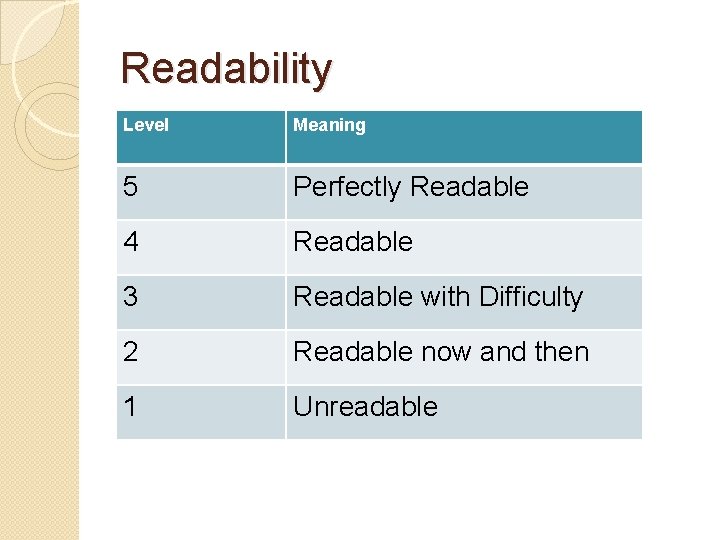
Readability Level Meaning 5 Perfectly Readable 4 Readable 3 Readable with Difficulty 2 Readable now and then 1 Unreadable
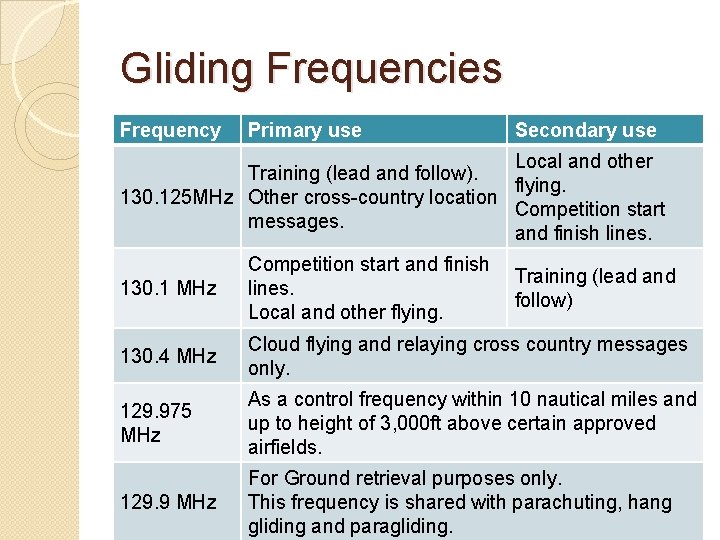
Gliding Frequencies Frequency Primary use Secondary use Local and other Training (lead and follow). flying. 130. 125 MHz Other cross-country location Competition start messages. and finish lines. 130. 1 MHz Competition start and finish lines. Local and other flying. 130. 4 MHz Cloud flying and relaying cross country messages only. 129. 975 MHz As a control frequency within 10 nautical miles and up to height of 3, 000 ft above certain approved airfields. 129. 9 MHz For Ground retrieval purposes only. This frequency is shared with parachuting, hang gliding and paragliding. Training (lead and follow)
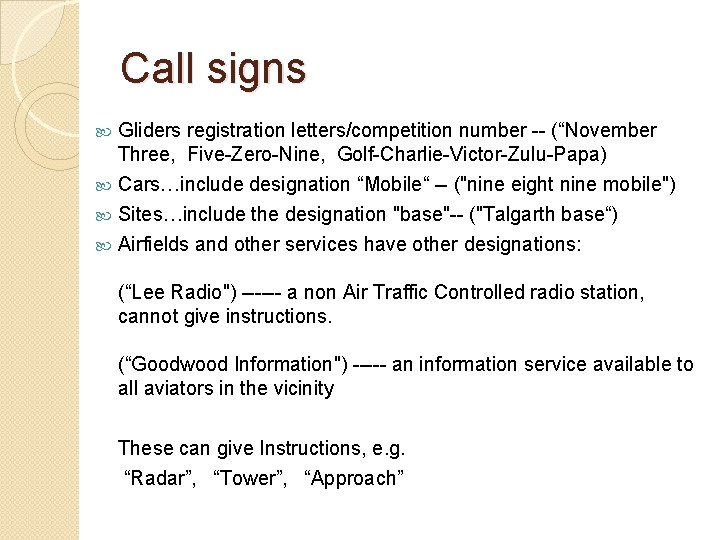
Call signs Gliders registration letters/competition number -- (“November Three, Five-Zero-Nine, Golf-Charlie-Victor-Zulu-Papa) Cars…include designation “Mobile“ -- ("nine eight nine mobile") Sites…include the designation "base"-- ("Talgarth base“) Airfields and other services have other designations: (“Lee Radio") ------ a non Air Traffic Controlled radio station, cannot give instructions. (“Goodwood Information") ----- an information service available to all aviators in the vicinity These can give Instructions, e. g. “Radar”, “Tower”, “Approach”
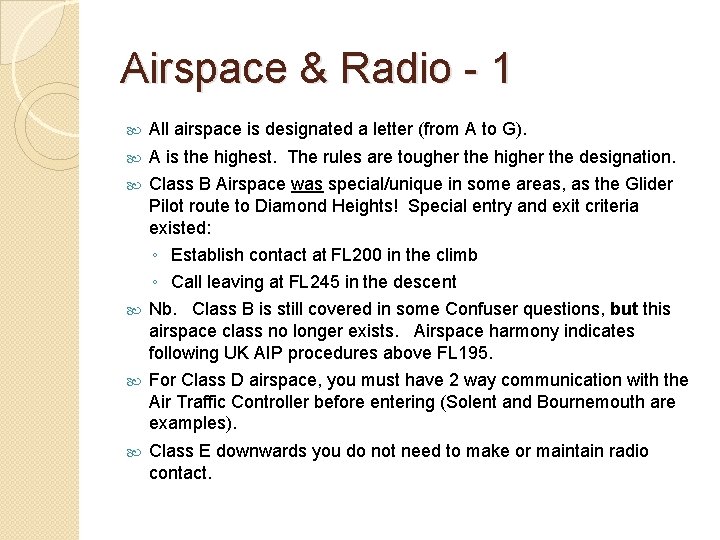
Airspace & Radio - 1 All airspace is designated a letter (from A to G). A is the highest. The rules are tougher the higher the designation. Class B Airspace was special/unique in some areas, as the Glider Pilot route to Diamond Heights! Special entry and exit criteria existed: ◦ Establish contact at FL 200 in the climb ◦ Call leaving at FL 245 in the descent Nb. Class B is still covered in some Confuser questions, but this airspace class no longer exists. Airspace harmony indicates following UK AIP procedures above FL 195. For Class D airspace, you must have 2 way communication with the Air Traffic Controller before entering (Solent and Bournemouth are examples). Class E downwards you do not need to make or maintain radio contact.
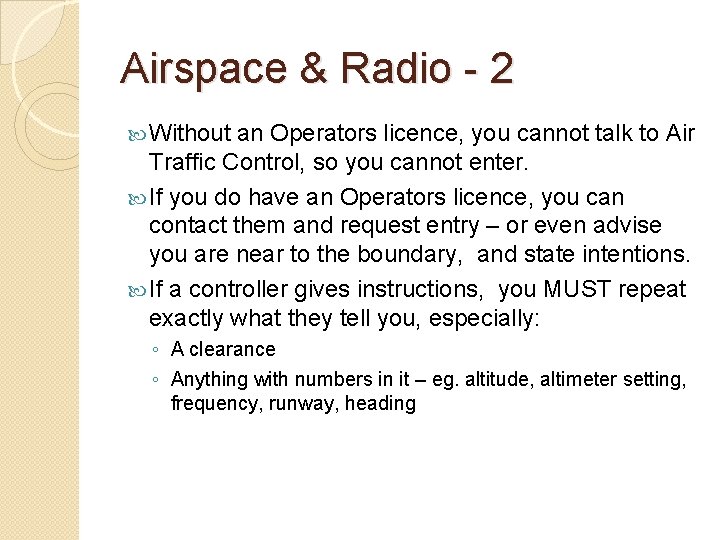
Airspace & Radio - 2 Without an Operators licence, you cannot talk to Air Traffic Control, so you cannot enter. If you do have an Operators licence, you can contact them and request entry – or even advise you are near to the boundary, and state intentions. If a controller gives instructions, you MUST repeat exactly what they tell you, especially: ◦ A clearance ◦ Anything with numbers in it – eg. altitude, altimeter setting, frequency, runway, heading
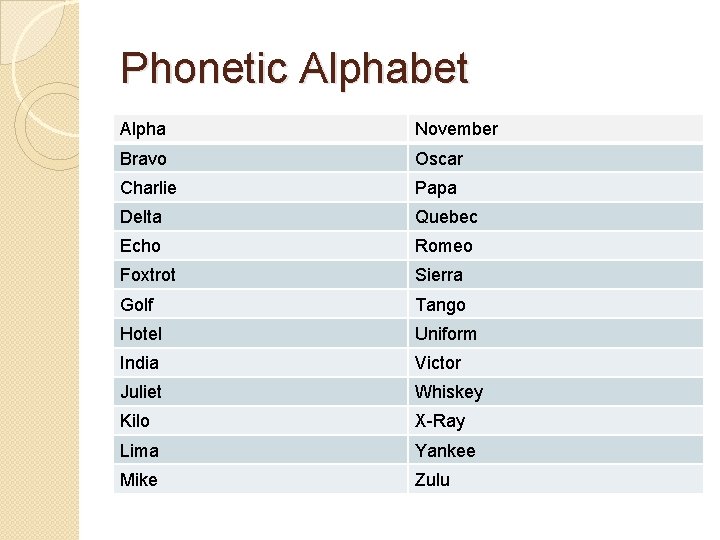
Phonetic Alphabet Alpha November Bravo Oscar Charlie Papa Delta Quebec Echo Romeo Foxtrot Sierra Golf Tango Hotel Uniform India Victor Juliet Whiskey Kilo X-Ray Lima Yankee Mike Zulu
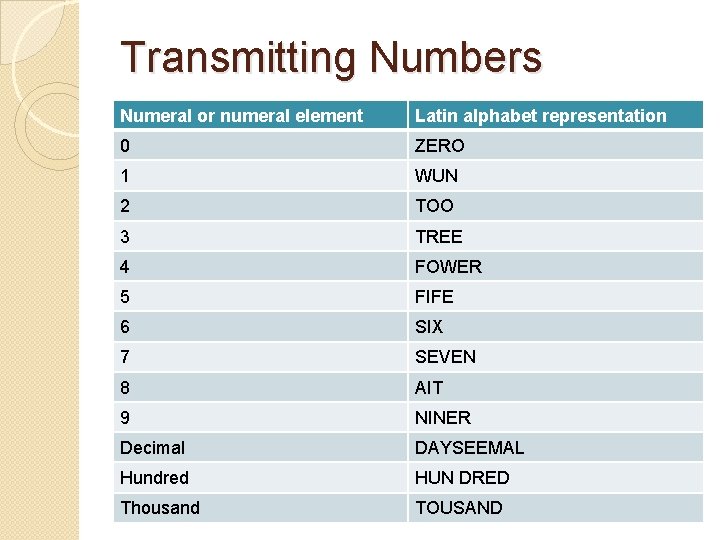
Transmitting Numbers Numeral or numeral element Latin alphabet representation 0 ZERO 1 WUN 2 TOO 3 TREE 4 FOWER 5 FIFE 6 SIX 7 SEVEN 8 AIT 9 NINER Decimal DAYSEEMAL Hundred HUN DRED Thousand TOUSAND
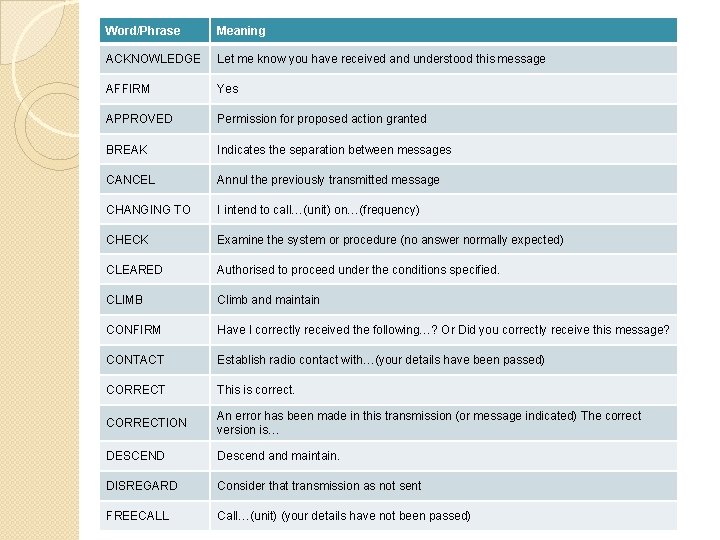
Word/Phrase Meaning ACKNOWLEDGE Let me know you have received and understood this message AFFIRM Yes APPROVED Permission for proposed action granted BREAK Indicates the separation between messages CANCEL Annul the previously transmitted message CHANGING TO I intend to call…(unit) on…(frequency) CHECK Examine the system or procedure (no answer normally expected) CLEARED Authorised to proceed under the conditions specified. CLIMB Climb and maintain CONFIRM Have I correctly received the following…? Or Did you correctly receive this message? CONTACT Establish radio contact with…(your details have been passed) CORRECT This is correct. CORRECTION An error has been made in this transmission (or message indicated) The correct version is… DESCEND Descend and maintain. DISREGARD Consider that transmission as not sent FREECALL Call…(unit) (your details have not been passed)
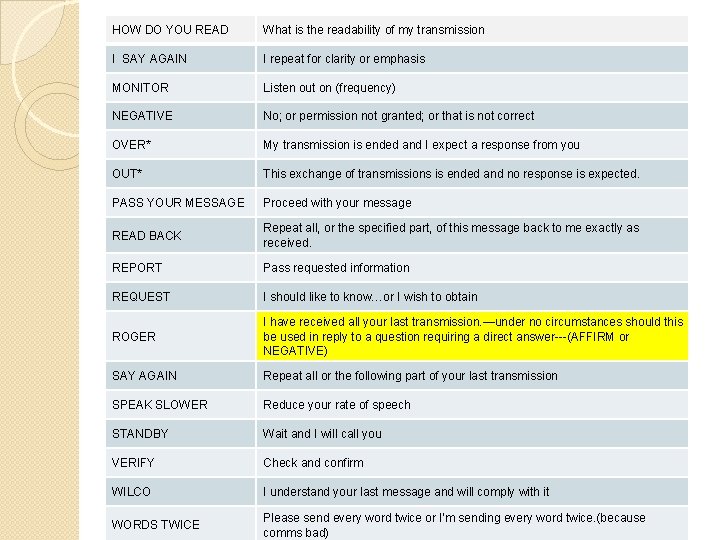
HOW DO YOU READ What is the readability of my transmission I SAY AGAIN I repeat for clarity or emphasis MONITOR Listen out on (frequency) NEGATIVE No; or permission not granted; or that is not correct OVER* My transmission is ended and I expect a response from you OUT* This exchange of transmissions is ended and no response is expected. PASS YOUR MESSAGE Proceed with your message READ BACK Repeat all, or the specified part, of this message back to me exactly as received. REPORT Pass requested information REQUEST I should like to know…or I wish to obtain ROGER I have received all your last transmission. —under no circumstances should this be used in reply to a question requiring a direct answer---(AFFIRM or NEGATIVE) SAY AGAIN Repeat all or the following part of your last transmission SPEAK SLOWER Reduce your rate of speech STANDBY Wait and I will call you VERIFY Check and confirm WILCO I understand your last message and will comply with it WORDS TWICE Please send every word twice or I’m sending every word twice. (because comms bad)
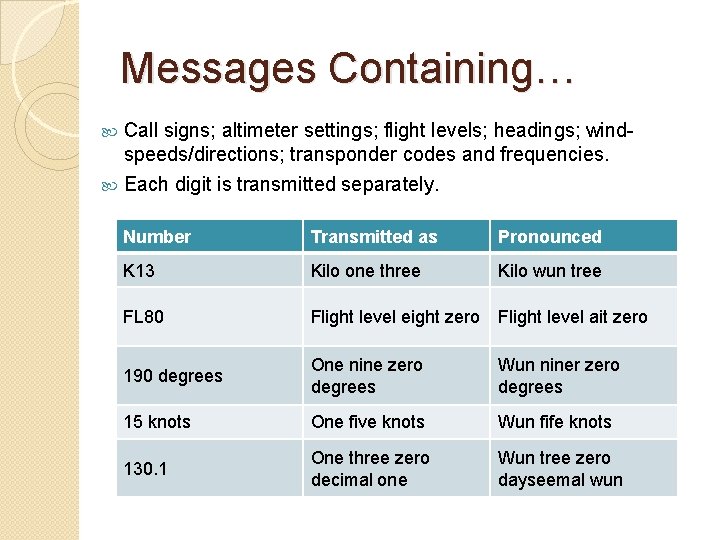
Messages Containing… Call signs; altimeter settings; flight levels; headings; windspeeds/directions; transponder codes and frequencies. Each digit is transmitted separately. Number Transmitted as Pronounced K 13 Kilo one three Kilo wun tree FL 80 Flight level eight zero Flight level ait zero 190 degrees One nine zero degrees Wun niner zero degrees 15 knots One five knots Wun fife knots 130. 1 One three zero decimal one Wun tree zero dayseemal wun
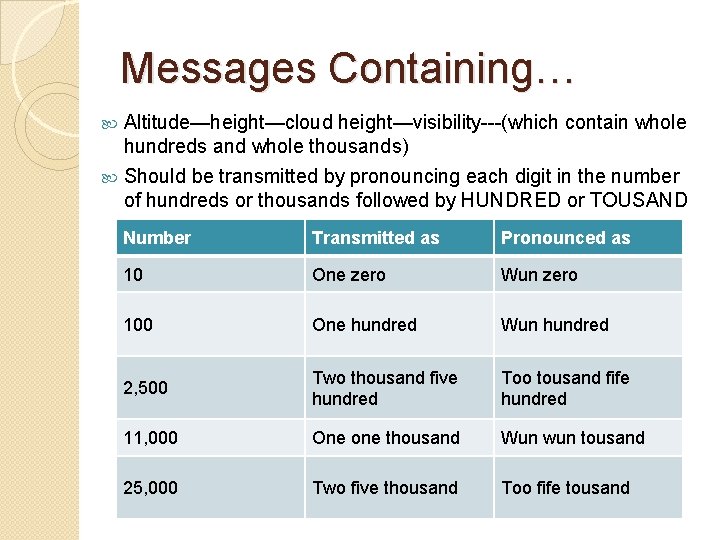
Messages Containing… Altitude—height—cloud height—visibility---(which contain whole hundreds and whole thousands) Should be transmitted by pronouncing each digit in the number of hundreds or thousands followed by HUNDRED or TOUSAND Number Transmitted as Pronounced as 10 One zero Wun zero 100 One hundred Wun hundred 2, 500 Two thousand five hundred Too tousand fife hundred 11, 000 One one thousand Wun wun tousand 25, 000 Two five thousand Too fife tousand
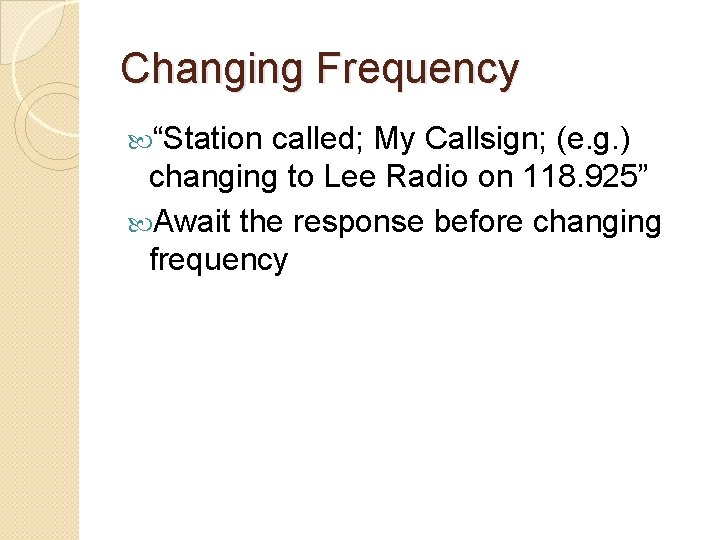
Changing Frequency “Station called; My Callsign; (e. g. ) changing to Lee Radio on 118. 925” Await the response before changing frequency
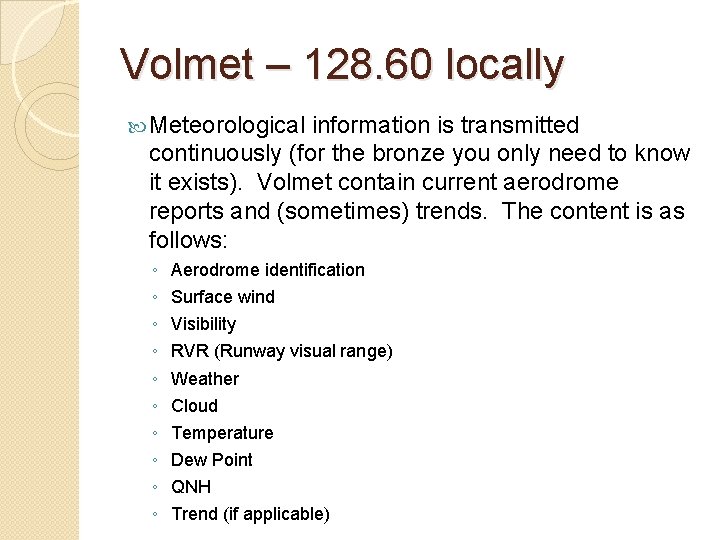
Volmet – 128. 60 locally Meteorological information is transmitted continuously (for the bronze you only need to know it exists). Volmet contain current aerodrome reports and (sometimes) trends. The content is as follows: ◦ ◦ ◦ ◦ ◦ Aerodrome identification Surface wind Visibility RVR (Runway visual range) Weather Cloud Temperature Dew Point QNH Trend (if applicable)
Q-Codes The only Q codes you need to know at Bronze level are: ◦ QFE… The observed pressure at a specified datum (usually the aerodrome or runway threshold elevation). The altimeter will read height above the airfield. ◦ QNH…. QFE reduced to sea level pressure using the standard atmosphere lapse rate. Airfield QNH – sea level sub-scale pressure setting (will indicate airfield elevation when aircraft is on the ground). Valid for a 25 mile radius of the airfield, whilst under the airfield ATC. Regional QNH – average sea level sub-scale pressure setting over the whole of the ASR**
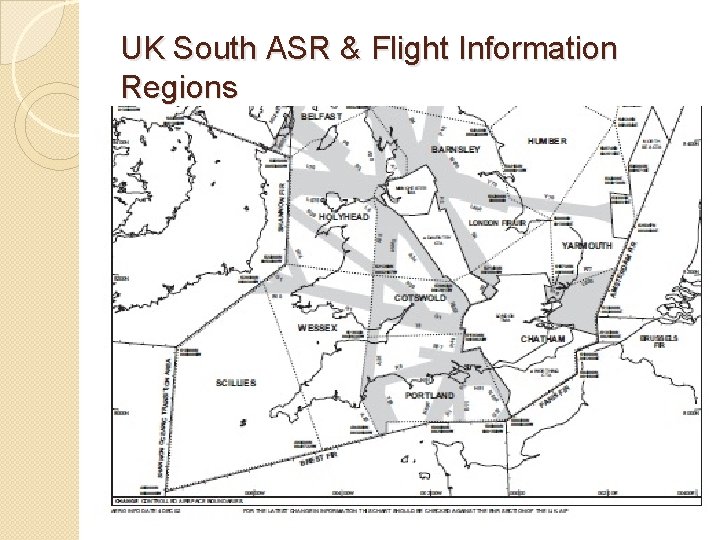
UK South ASR & Flight Information Regions
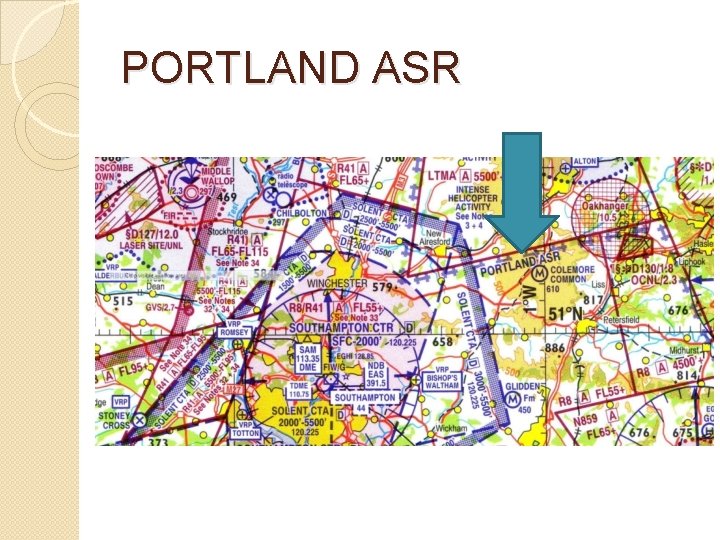
PORTLAND ASR
Q-Codes - other QNE ◦ Altitude indicated when the aircraft is on the ground with 1013. 2 mb set. You do not need to remember this. Main use is for old altimeters at high airfields – where unable to turn pressure setting low enough for QFE to be set. QTE ◦ True bearing from an aeronautical station to you QDM ◦ Magnetic Heading to steer to an aeronautical station – no allowance for wind
Emergencies In the event of difficulty (uncertain of position, or some other pressing situation) you should remain on your base frequency, however if you get no response 121. 5 MHz is the UK “Dn. D” distress frequency. This frequency is manned 24/7. LONDON CENTRE handles South of 55 Deg North SCOTTISH CENTRE handles North of 55 Deg North The telephone number for Dn. D (worth keeping in your glider and mobile-phone) is 01489 612406
Emergencies There are two recognised states of emergency: ◦ Distress--- A condition of being threatened by serious and/or imminent danger and requiring immediate assistance. ◦ Urgency--- A condition concerning the safety of an aircraft or other vehicle, or of some person on board or within sight, but not requiring immediate assistance. In the case of distress, the call is prefixed MAYDAY<MAYDAY, In the case of urgency the call is prefixed PAN-PAN>PAN-PAN You can use these on the ground if appropriate (eg. after a field-landing accident) Nb. If you hear an Emergency Call, maintain radio silence**, but note the details in case you have to relay the message
Emergencies - Content of Message Whenever possible the emergency message should be relayed in the following order: MAYDAY/MAYDAY or PAN-PAN/PAN-PAN Name of station addressed Your call sign Type of aircraft Nature of emergency Intention of person in command Present or last known position, height and heading Pilot qualifications Any other useful information, number of POB
Mayday Relay ** if no reply to the Emergency Call, you will need to RELAY the message: MAYDAY Station Called (My) Callsign Has intercepted a Distress Message from (Callsign of aircraft in difficulty) I say again (Repeat all of the distress message that you have heard)
Training Fix You can practice making a call on 121. 5 MHz to get a position fix, even without a licence Tune in, wait 2 minutes to see a real emergency not in place “Practice PAN, Glider (Your reg) requires training fix Give feedback on the accuracy Do not leave the frequency without permission, or they may assume you are lost with radio failure
Radio Failure Check: ◦ ◦ ◦ The correct frequency is selected The station being called should be open for watch You are in range of the station The volume is not turned down The transmitter is not jammed in the “transmit” position (In a power aircraft) If there is a “side-tone” evident from your own transmissions (if not, you are not transmitting) If you have a transponder, set 7600 ! BLIND TRANSMISSIONS Are made where two-way communication cannot be established, but where it is believed the called station is able to receive the transmission
Suggested Reference Materials CAA “Safety Sense” leaflets 08, 22, 26, 27 ◦ http: //www. caa. co. uk/applicati on. aspx? catid=33&pagetype= 65&appid=11&mode=list&type =sercat&id=21 Confuser test questions ◦ http: //www. bfgc. co. uk/Confuser/confu ser. aspx Guide to VFR in the UK ◦ http: //www. caa. co. uk/docs/64/VFR_G uide_2011. pdf
Acknowledgments Keith Morton – PNGC Don Puttock - Black Mountains Gliding Club ◦ http: //www. blackmountainsgliding. co. uk/radio. php John Mc. Cullagh - Bronze & Beyond BGA - Article Oct/Nov 2011
Any Questions ? Let’s try some exam questions!
- Slides: 41