
BFT 218 CHAPTER 1 INTRODUCTION TO MANUFACTURING TECHNOLOGY
BFT 218 CHAPTER 1 INTRODUCTION TO MANUFACTURING TECHNOLOGY

CONTENT 1. 2. 3. 4. 5. 6. What is Manufacturing? Manufacturing Technology? Manufacturing Industries Manufacturing Processes Production System Why Manufacturing is important?
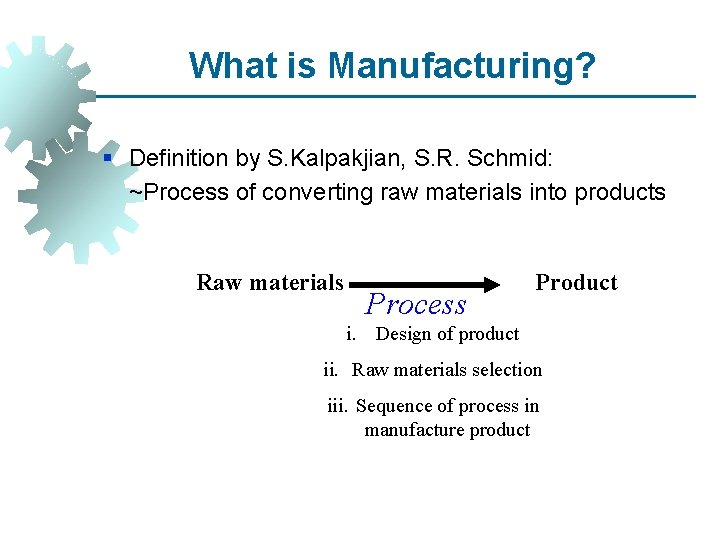
What is Manufacturing? § Definition by S. Kalpakjian, S. R. Schmid: ~Process of converting raw materials into products Raw materials Process Product i. Design of product ii. Raw materials selection iii. Sequence of process in manufacture product

What is Manufacturing? § Definition by Mikell P. Groover: a) Technologically b) Economically

Manufacturing activities must be responsive to several demands and trends Product must fully meet design requirements and specifications ust be m s d o th e m n o ti c Produ d to flexible to respon ands dem changing market ies can it v ti c a g n ri tu c fa Manu effect e th y d tu s to d be modele ct quality u d ro p n o rs to c of fa and cost Manufactured environmental friendly and economical method Organization mus t str for higher quality ive and productivity
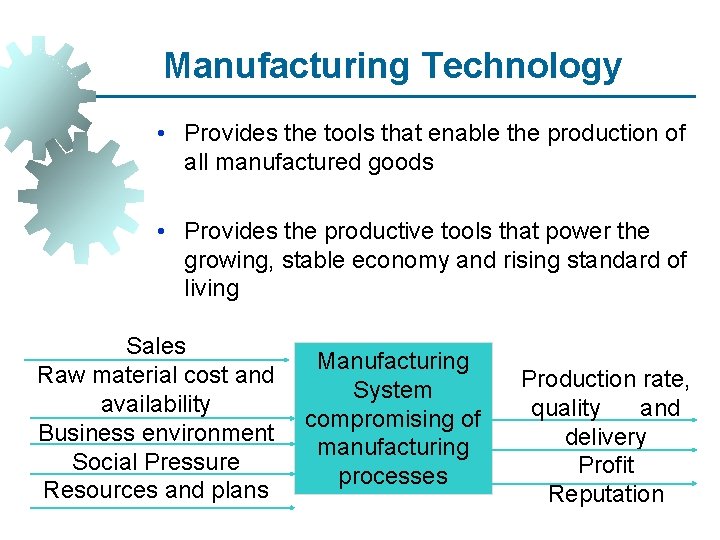
Manufacturing Technology • Provides the tools that enable the production of all manufactured goods • Provides the productive tools that power the growing, stable economy and rising standard of living Sales Raw material cost and availability Business environment Social Pressure Resources and plans Manufacturing System compromising of manufacturing processes Production rate, quality and delivery Profit Reputation

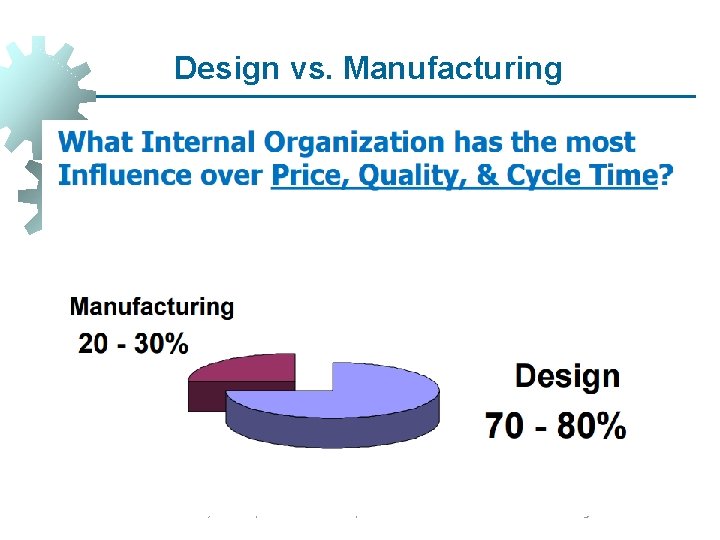
Design vs. Manufacturing © 2007 John Wiley & Sons, Inc. M P Groover, Fundamentals of Modern Manufacturing 3/e
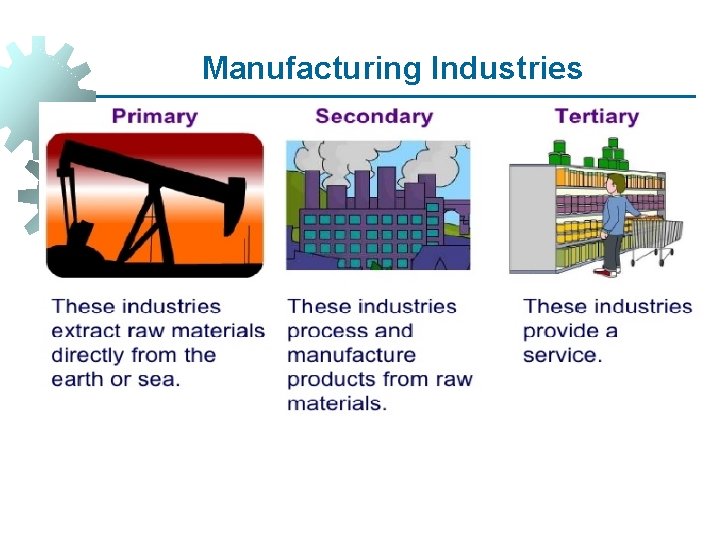
Manufacturing Industries
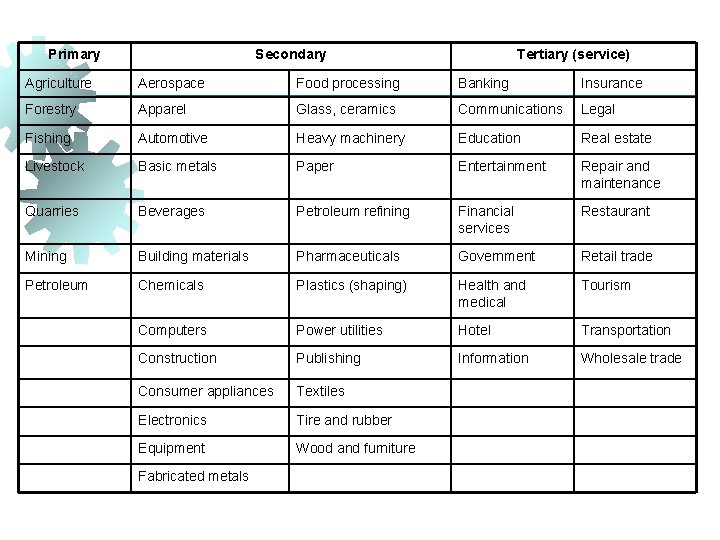
Primary Secondary Tertiary (service) Agriculture Aerospace Food processing Banking Insurance Forestry Apparel Glass, ceramics Communications Legal Fishing Automotive Heavy machinery Education Real estate Livestock Basic metals Paper Entertainment Repair and maintenance Quarries Beverages Petroleum refining Financial services Restaurant Mining Building materials Pharmaceuticals Government Retail trade Petroleum Chemicals Plastics (shaping) Health and medical Tourism Computers Power utilities Hotel Transportation Construction Publishing Information Wholesale trade Consumer appliances Textiles Electronics Tire and rubber Equipment Wood and furniture Fabricated metals

Manufacturing Processes Can be divided into two basic types: i. Processing Operation Transform a work material from one state of completion to a more advanced state by changing the geometry, properties, or appearance of the starting material. ii. Assembly Operation Joins two or more components in order to create a new desired product © 2007 John Wiley & Sons, Inc. M P Groover, Fundamentals of Modern Manufacturing 3/e
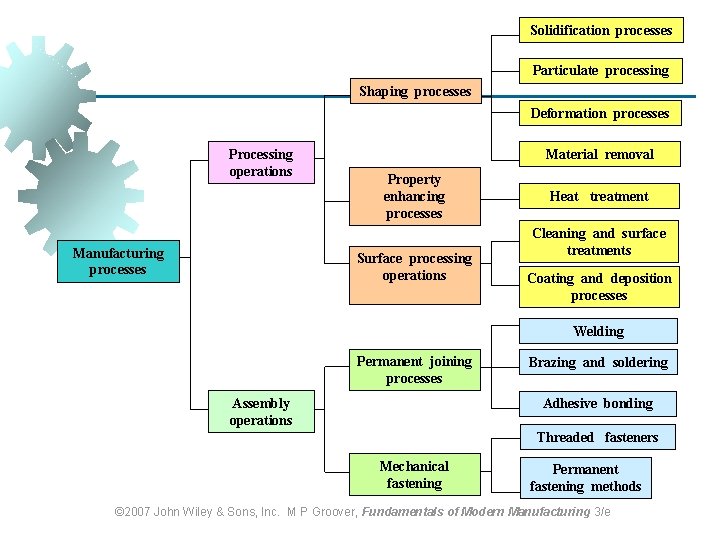
Solidification processes Particulate processing Shaping processes Deformation processes Processing operations Manufacturing processes Material removal Property enhancing processes Surface processing operations Heat treatment Cleaning and surface treatments Coating and deposition processes Welding Permanent joining processes Assembly operations Brazing and soldering Adhesive bonding Threaded fasteners Mechanical fastening Permanent fastening methods © 2007 John Wiley & Sons, Inc. M P Groover, Fundamentals of Modern Manufacturing 3/e

Shaping Processes – Four Categories 1. 2. 3. 4. Solidification processes - starting material is a heated liquid or semifluid Particulate processing - starting material consists of powders Deformation processes - starting material is a ductile solid (commonly metal) Material removal processes - starting material is a ductile or brittle solid © 2007 John Wiley & Sons, Inc. M P Groover, Fundamentals of Modern Manufacturing 3/e
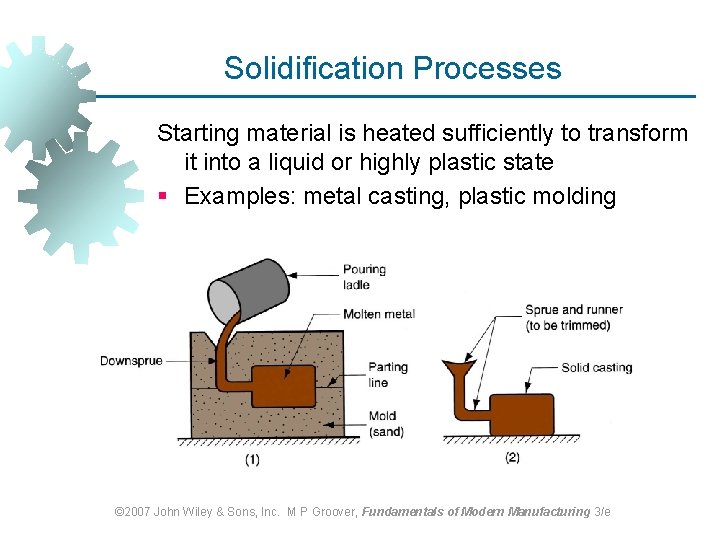
Solidification Processes Starting material is heated sufficiently to transform it into a liquid or highly plastic state § Examples: metal casting, plastic molding © 2007 John Wiley & Sons, Inc. M P Groover, Fundamentals of Modern Manufacturing 3/e
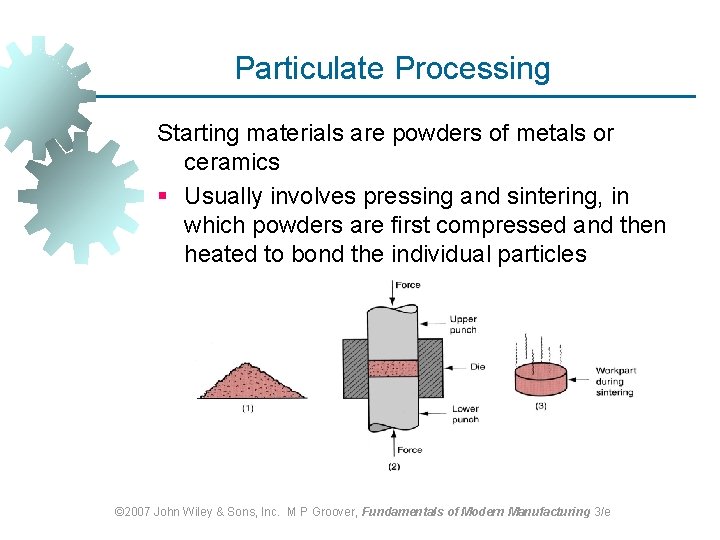
Particulate Processing Starting materials are powders of metals or ceramics § Usually involves pressing and sintering, in which powders are first compressed and then heated to bond the individual particles © 2007 John Wiley & Sons, Inc. M P Groover, Fundamentals of Modern Manufacturing 3/e

Deformation Processes Starting workpart is shaped by application of forces that exceed the yield strength of the material § Examples: (a) forging, (b) extrusion © 2007 John Wiley & Sons, Inc. M P Groover, Fundamentals of Modern Manufacturing 3/e

Material Removal Processes Excess material removed from the starting piece so what remains is the desired geometry § Examples: machining such as turning, drilling, and milling; also grinding and nontraditional processes © 2007 John Wiley & Sons, Inc. M P Groover, Fundamentals of Modern Manufacturing 3/e
Surface Processing Operations § § § Cleaning - chemical and mechanical processes to remove dirt, oil, and other contaminants from the surface Surface treatments - mechanical working such as sand blasting, and physical processes like diffusion Coating and thin film deposition - coating exterior surface of the workpart © 2007 John Wiley & Sons, Inc. M P Groover, Fundamentals of Modern Manufacturing 3/e

Assembly Operations Two or more separate parts are joined to form a new entity § Types of assembly operations: 1. Joining processes – create a permanent joint § Welding, brazing, soldering, and adhesive bonding 2. Mechanical assembly – fastening by mechanical methods § Threaded fasteners (screws, bolts and nuts); press fitting, expansion fits © 2007 John Wiley & Sons, Inc. M P Groover, Fundamentals of Modern Manufacturing 3/e
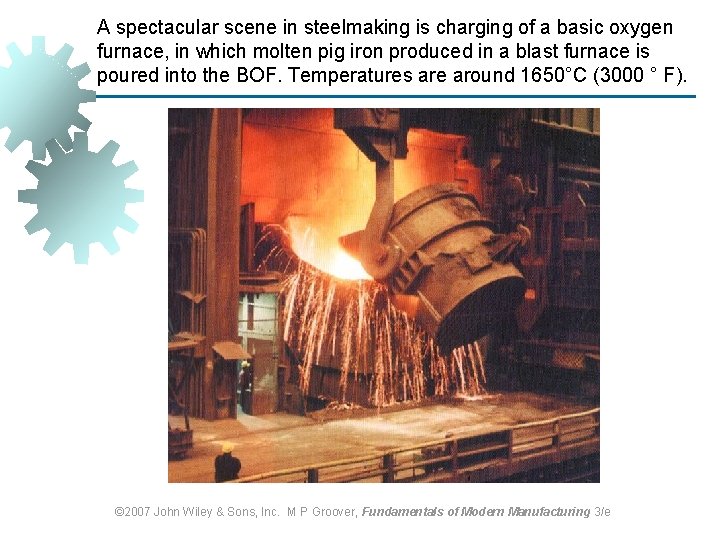
A spectacular scene in steelmaking is charging of a basic oxygen furnace, in which molten pig iron produced in a blast furnace is poured into the BOF. Temperatures are around 1650°C (3000 ° F). © 2007 John Wiley & Sons, Inc. M P Groover, Fundamentals of Modern Manufacturing 3/e
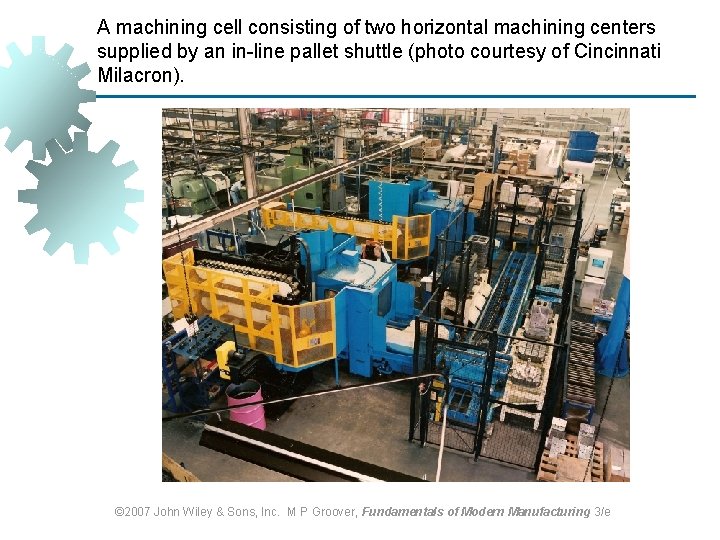
A machining cell consisting of two horizontal machining centers supplied by an in-line pallet shuttle (photo courtesy of Cincinnati Milacron). © 2007 John Wiley & Sons, Inc. M P Groover, Fundamentals of Modern Manufacturing 3/e
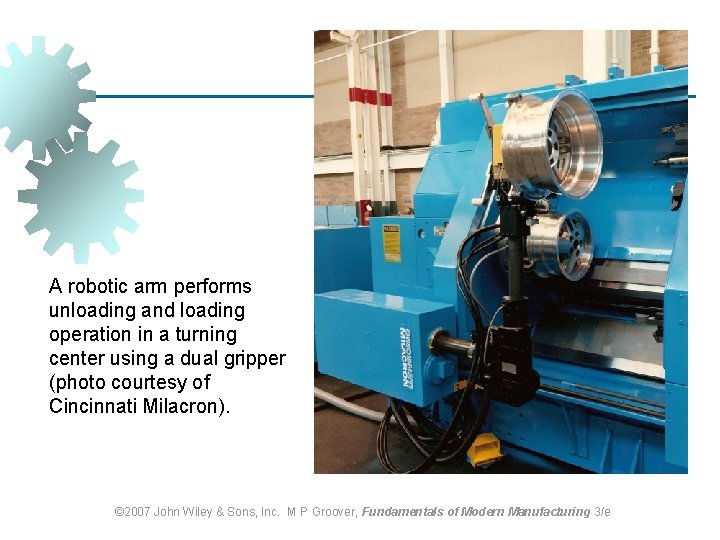
A robotic arm performs unloading and loading operation in a turning center using a dual gripper (photo courtesy of Cincinnati Milacron). © 2007 John Wiley & Sons, Inc. M P Groover, Fundamentals of Modern Manufacturing 3/e
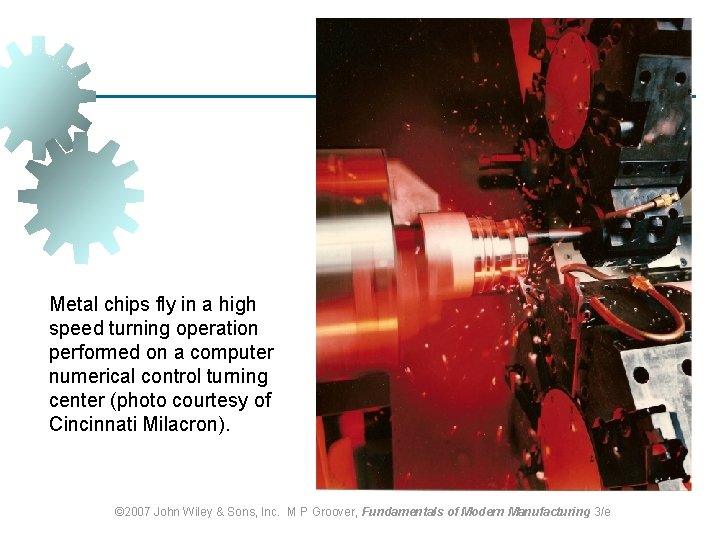
Metal chips fly in a high speed turning operation performed on a computer numerical control turning center (photo courtesy of Cincinnati Milacron). © 2007 John Wiley & Sons, Inc. M P Groover, Fundamentals of Modern Manufacturing 3/e
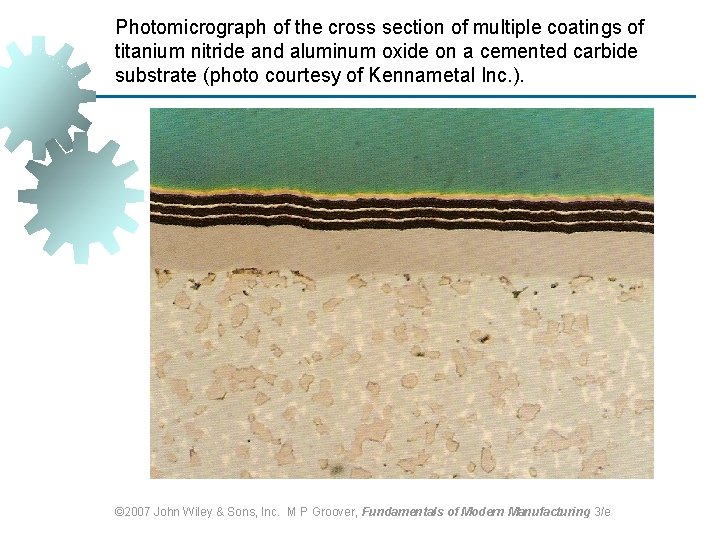
Photomicrograph of the cross section of multiple coatings of titanium nitride and aluminum oxide on a cemented carbide substrate (photo courtesy of Kennametal Inc. ). © 2007 John Wiley & Sons, Inc. M P Groover, Fundamentals of Modern Manufacturing 3/e
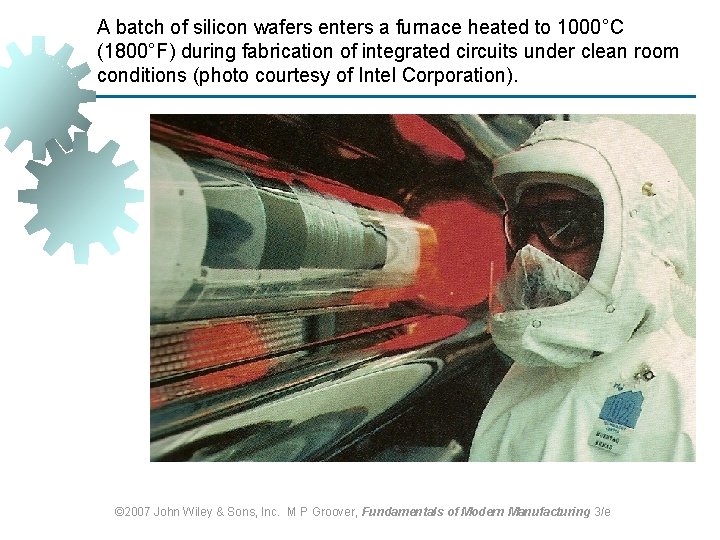
A batch of silicon wafers enters a furnace heated to 1000°C (1800°F) during fabrication of integrated circuits under clean room conditions (photo courtesy of Intel Corporation). © 2007 John Wiley & Sons, Inc. M P Groover, Fundamentals of Modern Manufacturing 3/e
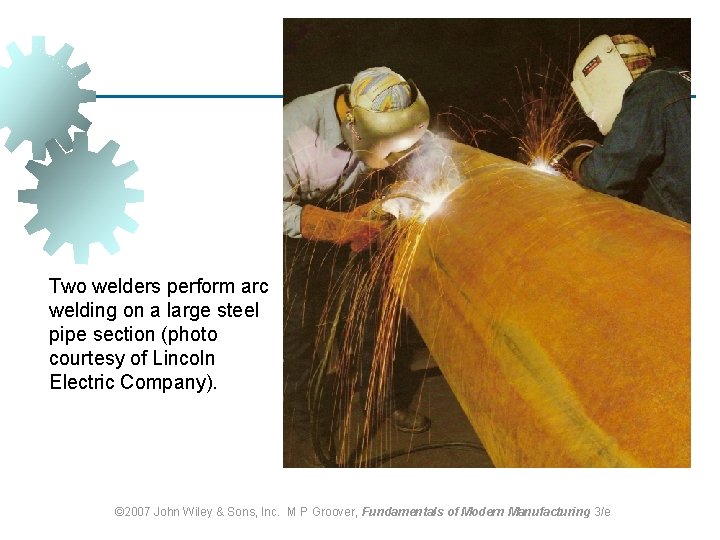
Two welders perform arc welding on a large steel pipe section (photo courtesy of Lincoln Electric Company). © 2007 John Wiley & Sons, Inc. M P Groover, Fundamentals of Modern Manufacturing 3/e
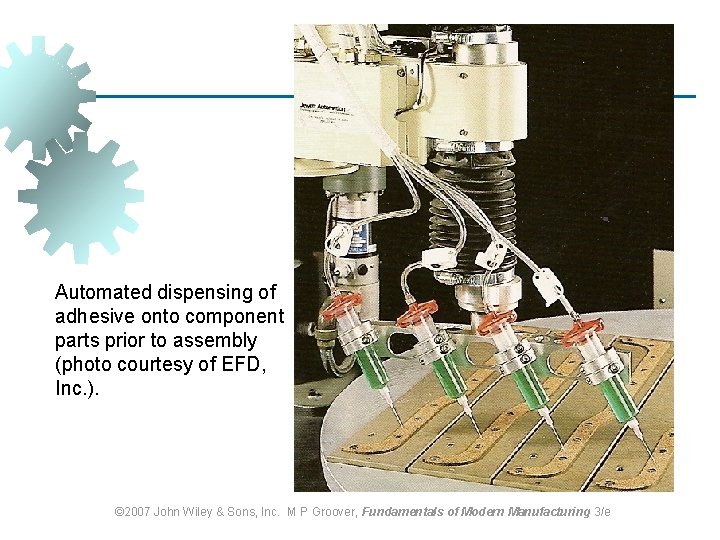
Automated dispensing of adhesive onto component parts prior to assembly (photo courtesy of EFD, Inc. ). © 2007 John Wiley & Sons, Inc. M P Groover, Fundamentals of Modern Manufacturing 3/e

Assembly workers on an engine assembly line (photo courtesy of Ford Motor Company). © 2007 John Wiley & Sons, Inc. M P Groover, Fundamentals of Modern Manufacturing 3/e
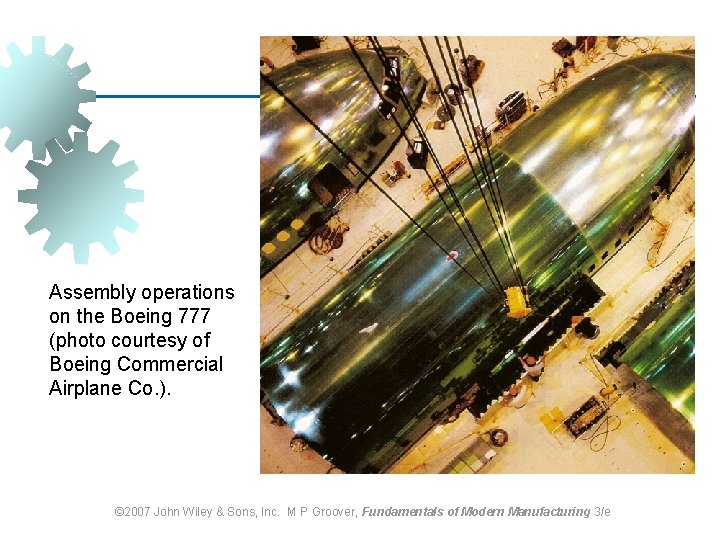
Assembly operations on the Boeing 777 (photo courtesy of Boeing Commercial Airplane Co. ). © 2007 John Wiley & Sons, Inc. M P Groover, Fundamentals of Modern Manufacturing 3/e
Production Systems § Production systems consists of people, equipment, and procedures § In general, direct labor people are responsible for operating the manufacturing equipment § Professional staff people are responsible for manufacturing support. § Two categories of production systems: § Production facilities § Manufacturing support systems
Production Facilities § The factory, production equipment, and material handling systems § Refers to the physical equipment and the arrangement of equipment in the factory.
Manufacturing Support Systems § To design the processes and equipment, plan and control the production orders, and satisfy product quality requirements. § Typical departments: 1. Manufacturing engineering 2. Production planning and control 3. Quality control

Manufacturing Support Systems 1. Manufacturing Engineering § Responsible for planning the manufacturing processes – deciding which processes should be used to make the parts and assemble the products. § This department is also involved in designing and ordering the machine tools and other equipment used by the operating departments to accomplish processing and assembly.
Manufacturing Support Systems 2. Production Planning and Control § Responsible for solving the logistics problems in manufacturing - ordering materials and purchased parts, scheduling production, and making sure that the operating departments have the necessary capacity to meet the production schedules.

Manufacturing Support Systems 3. Quality Control § Designing and building products that conform to specifications and satisfy customer expectations. § Much of this effort is the responsibility of the QC department.
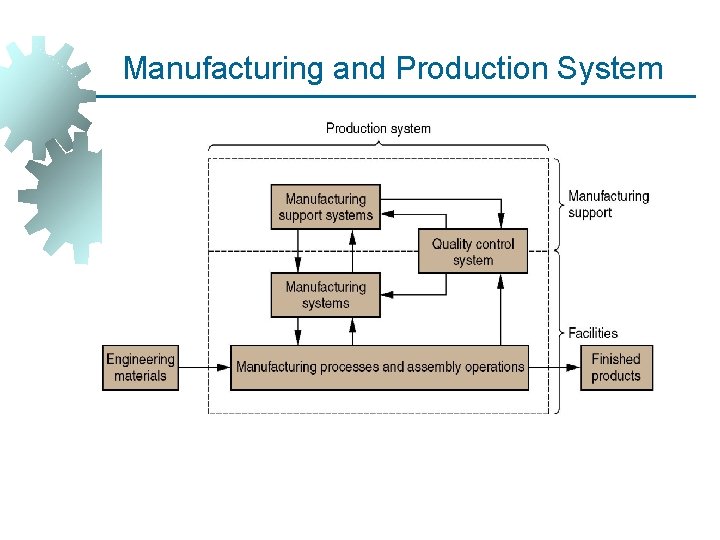
Manufacturing and Production System
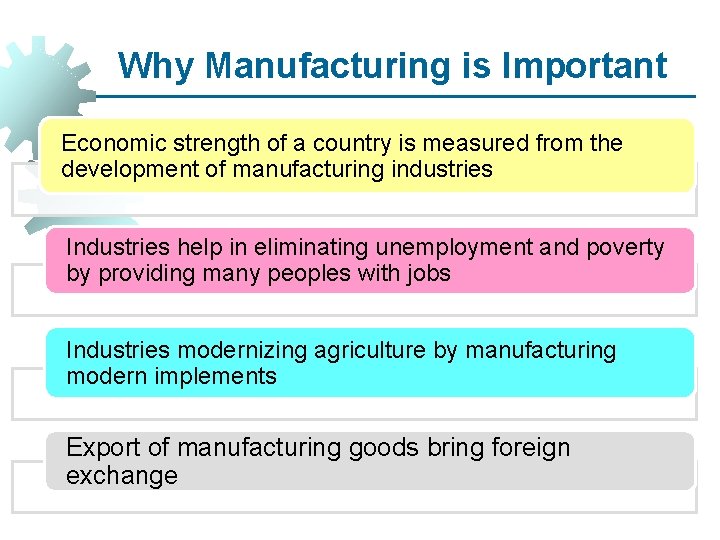
Why Manufacturing is Important Economic strength of a country is measured from the development of manufacturing industries Industries help in eliminating unemployment and poverty by providing many peoples with jobs Industries modernizing agriculture by manufacturing modern implements Export of manufacturing goods bring foreign exchange
- Slides: 37