
BF 528 Sequence Analysis Fundamentals Short Read Sequencing
BF 528 - Sequence Analysis Fundamentals
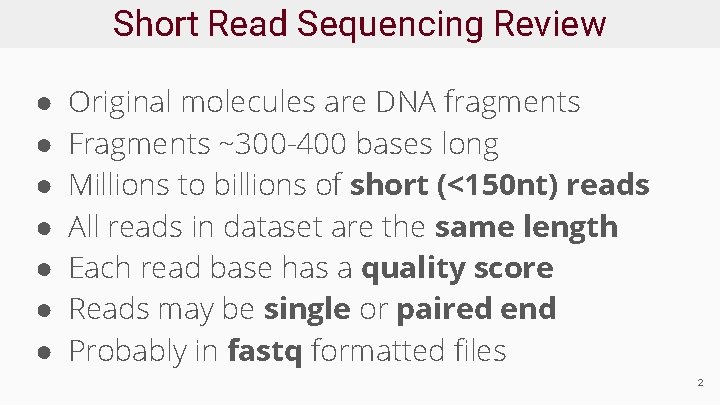
Short Read Sequencing Review ● ● ● ● Original molecules are DNA fragments Fragments ~300 -400 bases long Millions to billions of short (<150 nt) reads All reads in dataset are the same length Each read base has a quality score Reads may be single or paired end Probably in fastq formatted files 2
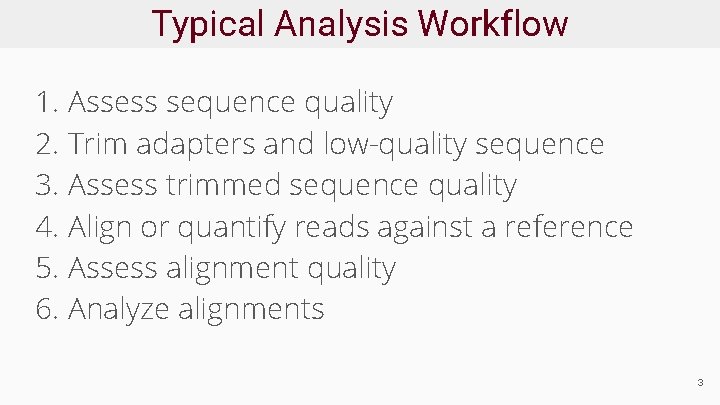
Typical Analysis Workflow 1. Assess sequence quality 2. Trim adapters and low-quality sequence 3. Assess trimmed sequence quality 4. Align or quantify reads against a reference 5. Assess alignment quality 6. Analyze alignments 3
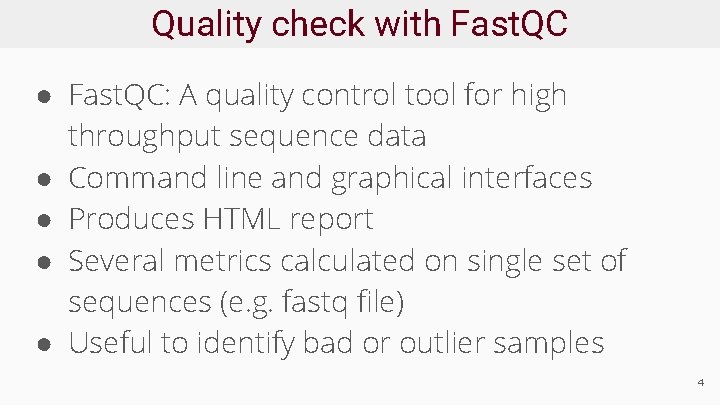
Quality check with Fast. QC ● Fast. QC: A quality control tool for high throughput sequence data ● Command line and graphical interfaces ● Produces HTML report ● Several metrics calculated on single set of sequences (e. g. fastq file) ● Useful to identify bad or outlier samples 4

Fast. QC: Read Quality ● Untrimmed reads all have same length ● Each position in each read has a Phred score ● Quantify the distribution of Phred scores in each position Beginning of most reads is of high quality Quality can degrade towards the end of read 5
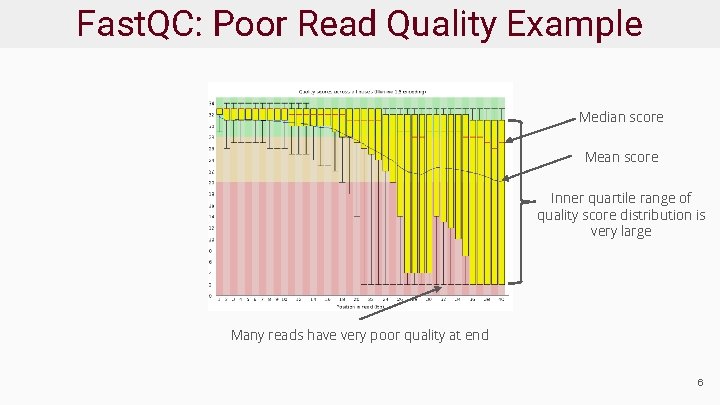
Fast. QC: Poor Read Quality Example Median score Mean score Inner quartile range of quality score distribution is very large Many reads have very poor quality at end 6
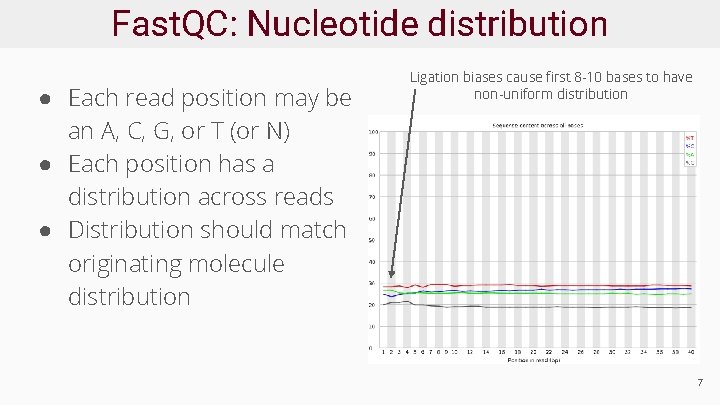
Fast. QC: Nucleotide distribution ● Each read position may be an A, C, G, or T (or N) ● Each position has a distribution across reads ● Distribution should match originating molecule distribution Ligation biases cause first 8 -10 bases to have non-uniform distribution 7
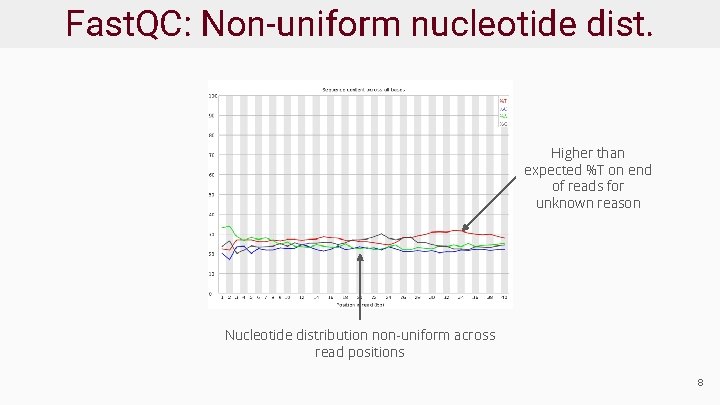
Fast. QC: Non-uniform nucleotide dist. Higher than expected %T on end of reads for unknown reason Nucleotide distribution non-uniform across read positions 8
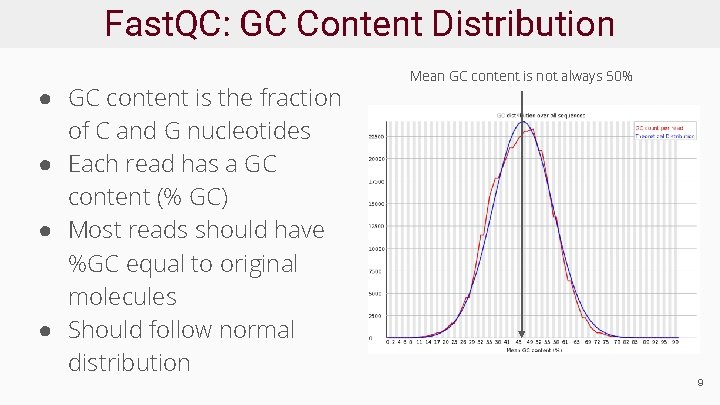
Fast. QC: GC Content Distribution ● GC content is the fraction of C and G nucleotides ● Each read has a GC content (% GC) ● Most reads should have %GC equal to original molecules ● Should follow normal distribution Mean GC content is not always 50% 9
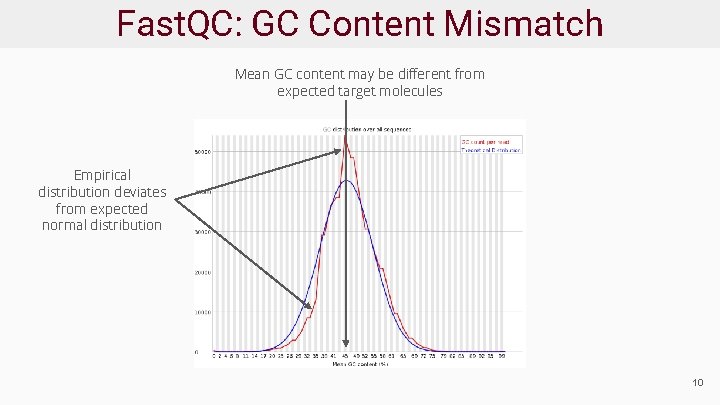
Fast. QC: GC Content Mismatch Mean GC content may be different from expected target molecules Empirical distribution deviates from expected normal distribution 10
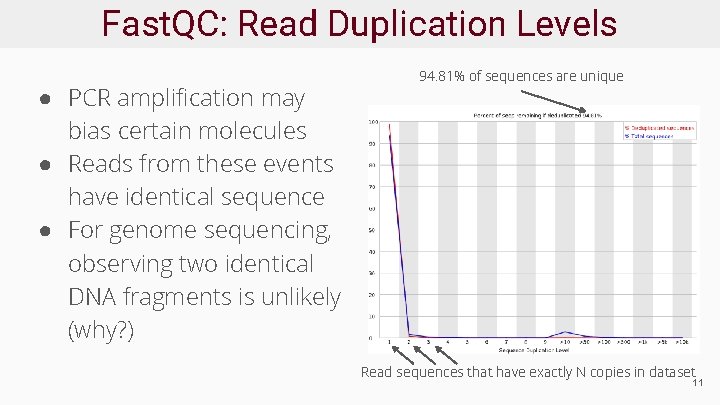
Fast. QC: Read Duplication Levels ● PCR amplification may bias certain molecules ● Reads from these events have identical sequence ● For genome sequencing, observing two identical DNA fragments is unlikely (why? ) 94. 81% of sequences are unique Read sequences that have exactly N copies in dataset 11
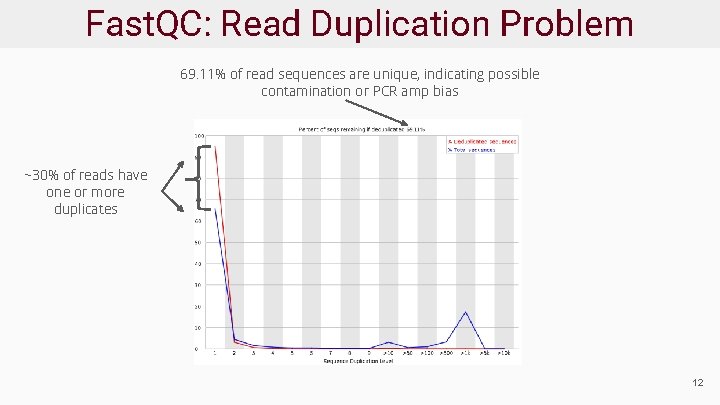
Fast. QC: Read Duplication Problem 69. 11% of read sequences are unique, indicating possible contamination or PCR amp bias ~30% of reads have one or more duplicates 12
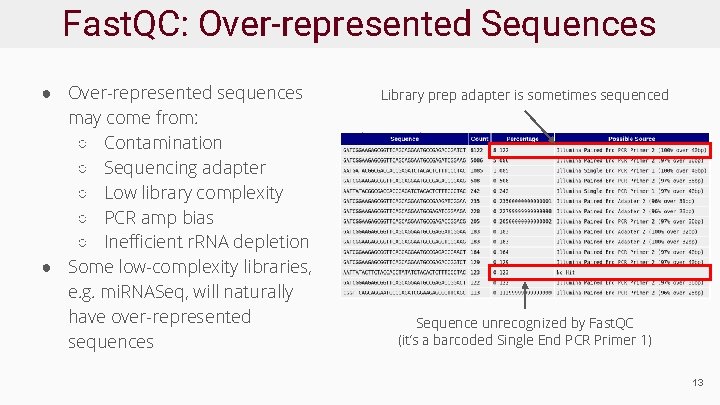
Fast. QC: Over-represented Sequences ● Over-represented sequences may come from: ○ Contamination ○ Sequencing adapter ○ Low library complexity ○ PCR amp bias ○ Inefficient r. RNA depletion ● Some low-complexity libraries, e. g. mi. RNASeq, will naturally have over-represented sequences Library prep adapter is sometimes sequenced Sequence unrecognized by Fast. QC (it’s a barcoded Single End PCR Primer 1) 13
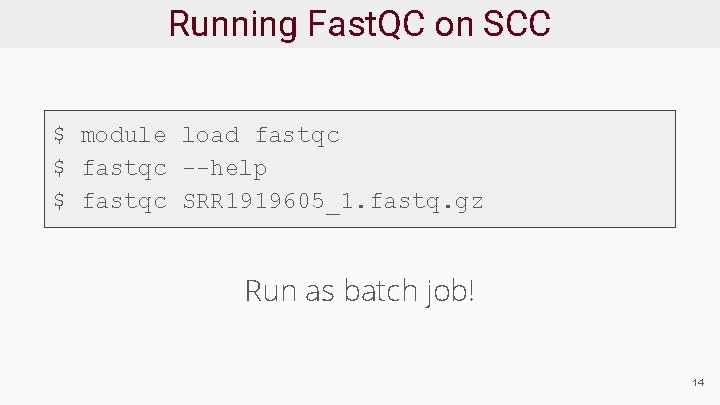
Running Fast. QC on SCC $ module load fastqc $ fastqc --help $ fastqc SRR 1919605_1. fastq. gz Run as batch job! 14
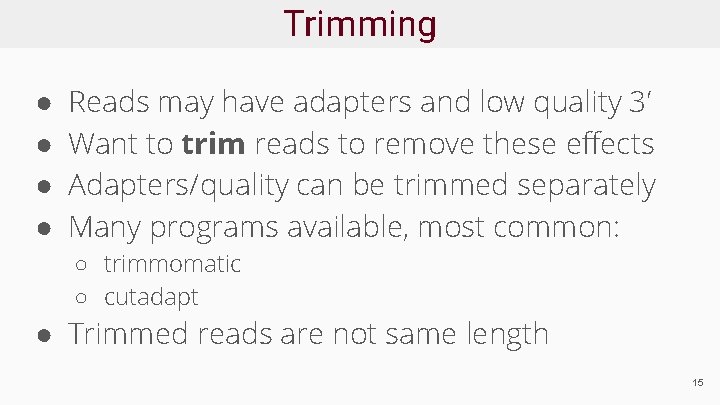
Trimming ● ● Reads may have adapters and low quality 3’ Want to trim reads to remove these effects Adapters/quality can be trimmed separately Many programs available, most common: ○ trimmomatic ○ cutadapt ● Trimmed reads are not same length 15
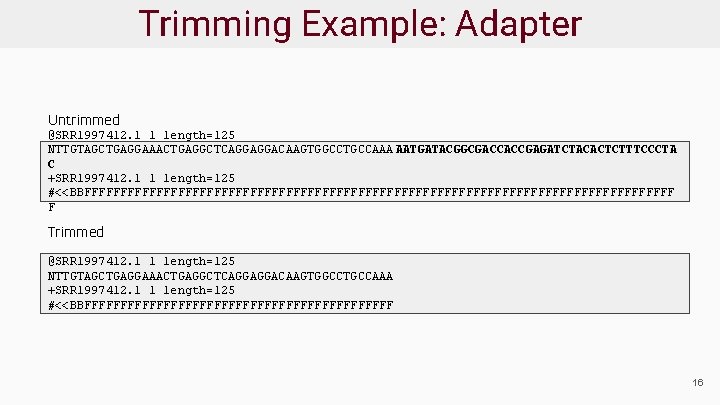
Trimming Example: Adapter Untrimmed @SRR 1997412. 1 1 length=125 NTTGTAGCTGAGGAAACTGAGGCTCAGGAGGACAAGTGGCCTGCCAAA AATGATACGGCGACCACCGAGATCTACACTCTTTCCCTA C +SRR 1997412. 1 1 length=125 #<<BBFFFFFFFFFFFFFFFFFFFFFFFFFFFFFFFFFFFFFFFFF F Trimmed @SRR 1997412. 1 1 length=125 NTTGTAGCTGAGGAAACTGAGGCTCAGGAGGACAAGTGGCCTGCCAAA +SRR 1997412. 1 1 length=125 #<<BBFFFFFFFFFFFFFFFFFFFFFF 16
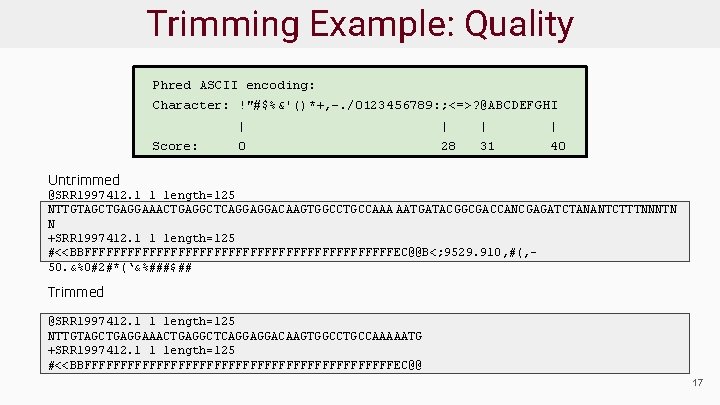
Trimming Example: Quality Phred ASCII encoding: Character: !"#$%&'()*+, -. /0123456789: ; <=>? @ABCDEFGHI Score: | | 0 28 31 40 Untrimmed @SRR 1997412. 1 1 length=125 NTTGTAGCTGAGGAAACTGAGGCTCAGGAGGACAAGTGGCCTGCCAAA AATGATACGGCGACCANCGAGATCTANANTCTTTNNNTN N +SRR 1997412. 1 1 length=125 #<<BBFFFFFFFFFFFFFFFFFFFFFFEC@@B<; 9529. 910, #(, 50. &%0#2#*(‘&%###$## Trimmed @SRR 1997412. 1 1 length=125 NTTGTAGCTGAGGAAACTGAGGCTCAGGAGGACAAGTGGCCTGCCAAAAATG +SRR 1997412. 1 1 length=125 #<<BBFFFFFFFFFFFFFFFFFFFFFFEC@@ 17
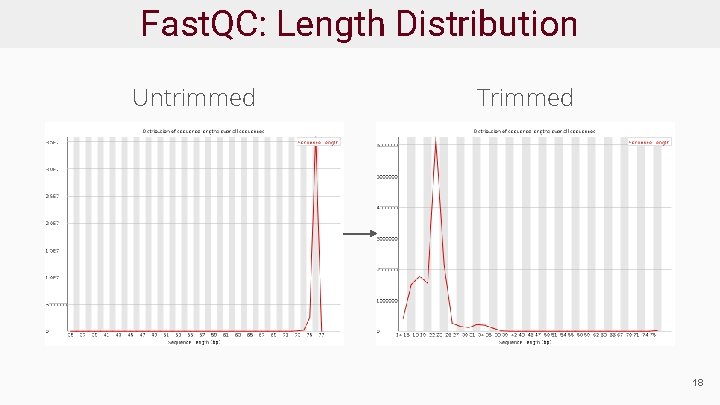
Fast. QC: Length Distribution Untrimmed Trimmed 18
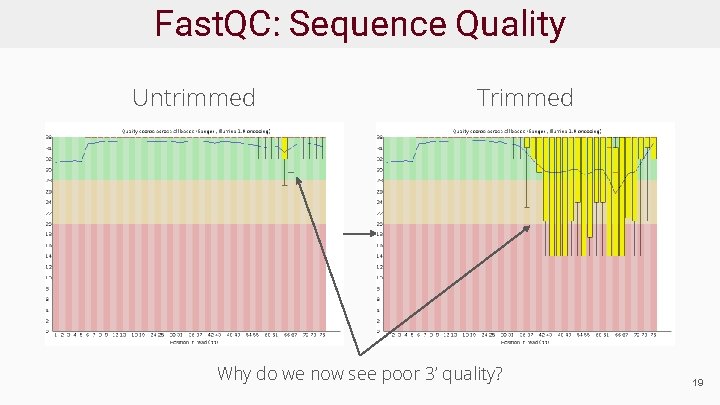
Fast. QC: Sequence Quality Untrimmed Trimmed Why do we now see poor 3’ quality? 19
Alignment of short reads ● Trimmed reads used for all downstream analysis ● Alignment matches reads to some reference ● Usually one of two approaches: ○ Align - high resolution, explicit alignment, slow ○ Quasi-align - ‘good enough’ resolution, heuristic alignment, fast 20
Alignment tools ● Many tools to align reads ● General aligners ○ bwa ○ bowtie and bowtie 2 ○ SNAP → forces reads to align close to each other ● Purpose specific (e. g. RNA-Seq) ○ STAR ○ tophat 21
Alignment reference ● The reference is a haploid representation of the consensus of multiple individuals. ● Human genome: ○ GRCh 37 (aka hg 19) ○ GRCh 38 (hg 38) ● Mouse: ○ GRCm 38 (mm 10) ○ NCBI 37 (mm 9) ● It is in fasta format (. fa or. fasta) 22
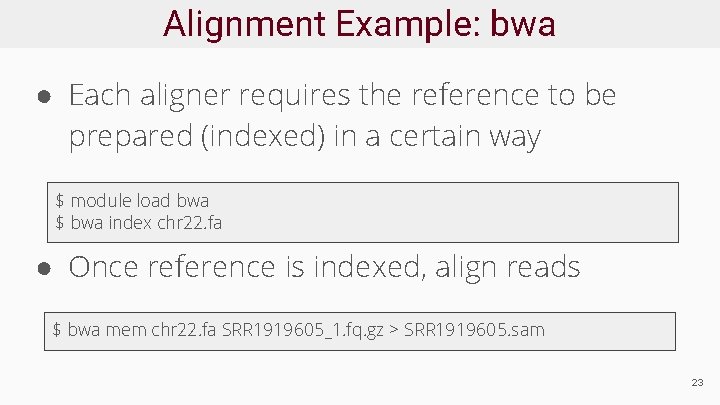
Alignment Example: bwa ● Each aligner requires the reference to be prepared (indexed) in a certain way $ module load bwa $ bwa index chr 22. fa ● Once reference is indexed, align reads $ bwa mem chr 22. fa SRR 1919605_1. fq. gz > SRR 1919605. sam 23
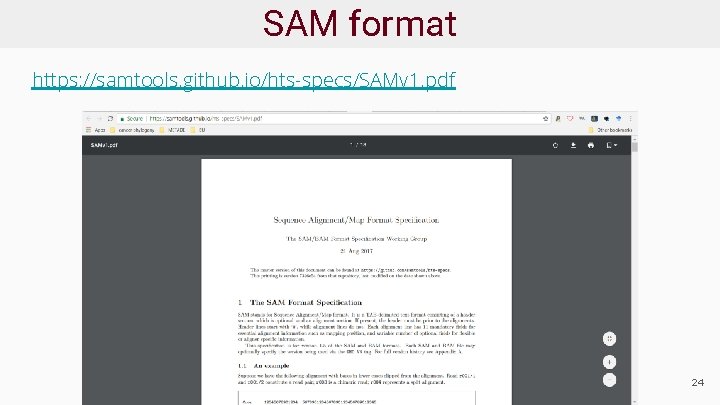
SAM format https: //samtools. github. io/hts-specs/SAMv 1. pdf 24
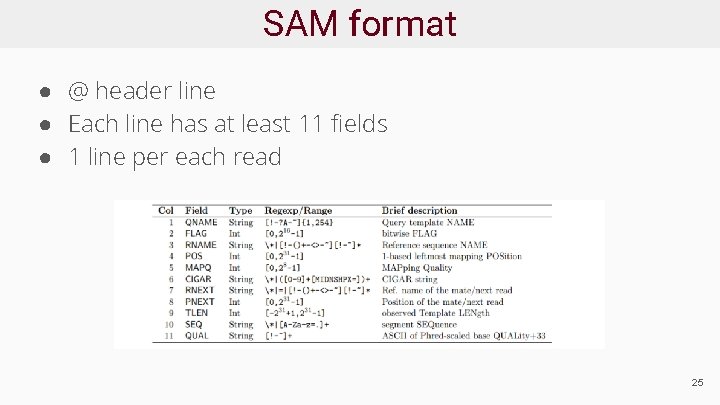
SAM format ● @ header line ● Each line has at least 11 fields ● 1 line per each read 25
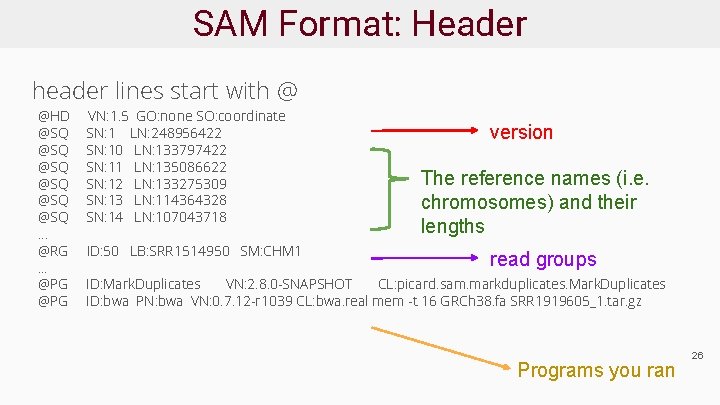
SAM Format: Header header lines start with @ @HD @SQ @SQ @SQ … @RG. . . @PG VN: 1. 5 GO: none SO: coordinate SN: 1 LN: 248956422 SN: 10 LN: 133797422 SN: 11 LN: 135086622 SN: 12 LN: 133275309 SN: 13 LN: 114364328 SN: 14 LN: 107043718 ID: 50 LB: SRR 1514950 SM: CHM 1 version The reference names (i. e. chromosomes) and their lengths read groups ID: Mark. Duplicates VN: 2. 8. 0 -SNAPSHOT CL: picard. sam. markduplicates. Mark. Duplicates ID: bwa PN: bwa VN: 0. 7. 12 -r 1039 CL: bwa. real mem -t 16 GRCh 38. fa SRR 1919605_1. tar. gz Programs you ran 26
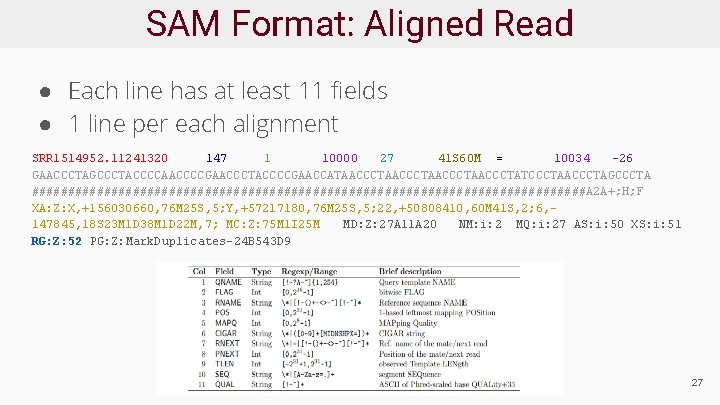
SAM Format: Aligned Read ● Each line has at least 11 fields ● 1 line per each alignment SRR 1514952. 11241320 147 1 10000 27 41 S 60 M = 10034 -26 GAACCCTAGCCCTACCCCAACCCCGAACCCTACCCCGAACCATAACCCTAACCCTATCCCTAACCCTAGCCCTA #######################################A 2 A+; H; F XA: Z: X, +156030660, 76 M 25 S, 5; Y, +57217180, 76 M 25 S, 5; 22, +50808410, 60 M 41 S, 2; 6, 147845, 18 S 23 M 1 D 38 M 1 D 22 M, 7; MC: Z: 75 M 1 I 25 M MD: Z: 27 A 11 A 20 NM: i: 2 MQ: i: 27 AS: i: 50 XS: i: 51 RG: Z: 52 PG: Z: Mark. Duplicates-24 B 543 D 9 27
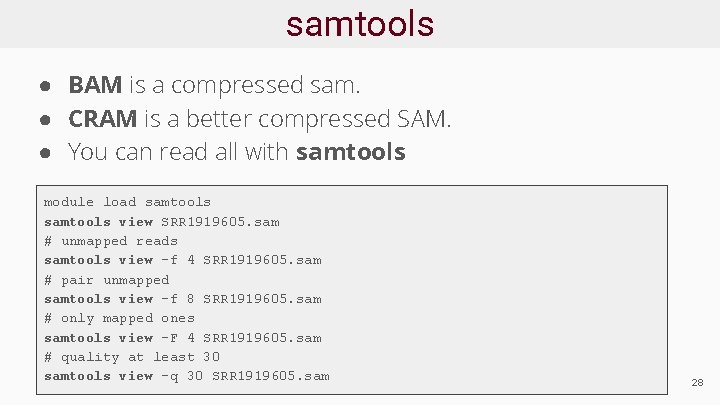
samtools ● BAM is a compressed sam. ● CRAM is a better compressed SAM. ● You can read all with samtools module load samtools view SRR 1919605. sam # unmapped reads samtools view -f 4 SRR 1919605. sam # pair unmapped samtools view -f 8 SRR 1919605. sam # only mapped ones samtools view -F 4 SRR 1919605. sam # quality at least 30 samtools view -q 30 SRR 1919605. sam 28
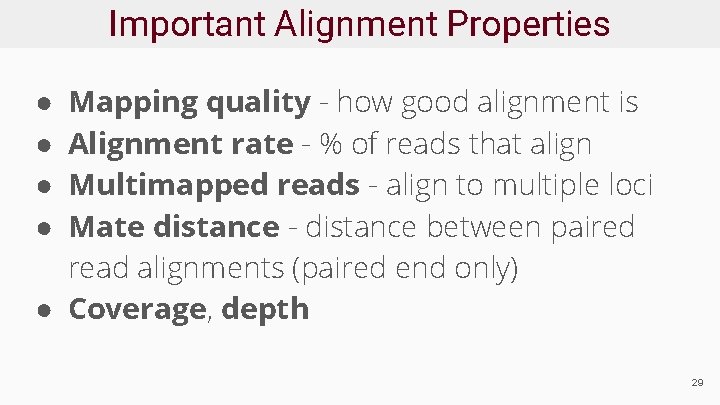
Important Alignment Properties Mapping quality - how good alignment is Alignment rate - % of reads that align Multimapped reads - align to multiple loci Mate distance - distance between paired read alignments (paired end only) ● Coverage, depth ● ● 29
Quasi-alignment tools ● Heuristic approach to alignment ○ i. e. fast, but not as sensitive as full alignment ● Typically against a reference of relatively short sequences (e. g. transcriptome) ● Include GC content, multimap adjustment ● Used for quantification estimation ○ i. e. what is the estimated expression of a gene? 30
Identifying Outlier Samples ● Flag sample if: ○ ○ Deviate from expected (e. g. GC content) Deviate from most other samples Contain suspect sequences (e. g. contamination) Aligns poorly ● Multi. QC - tool for combining output from many tools run on many samples 31
- Slides: 31