
Beyond the Standard EPI New MRI Sequences available
Beyond the Standard EPI – New MRI Sequences available at the CBU Marta Morgado Correia MRC Cognition and Brain Sciences Unit Date
New Head Coil

32 -Channel Coil • 32 independent channels acquiring data simultaneously • Image SNR is proportional to the square root of number of channels • Upgrading from a 12 channel coil to a 32 channel coil results in increased SNR Expected SNR gain: (would have to acquire ~2. 7 times more data to see the same SNR increase with the 12 channel coil)

12 vs 32 Channels - MPRAGE

12 vs 32 Channels - MPRAGE 12 Channels 32 Channels
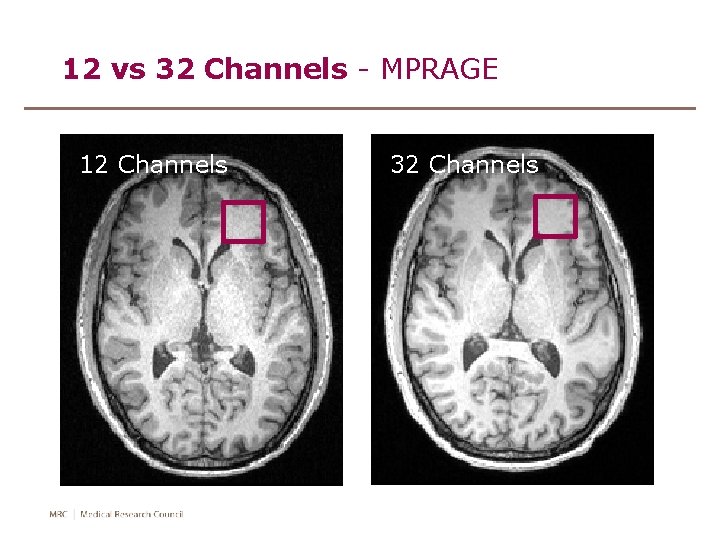
12 vs 32 Channels - MPRAGE 12 Channels 32 Channels
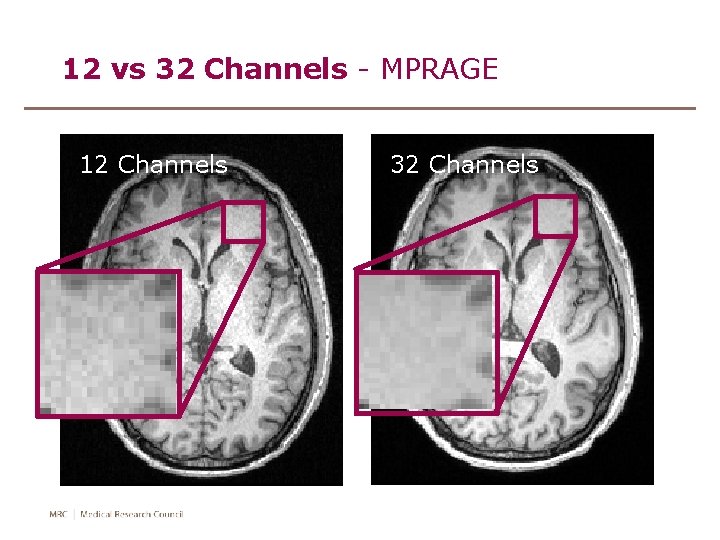
12 vs 32 Channels - MPRAGE 12 Channels 32 Channels
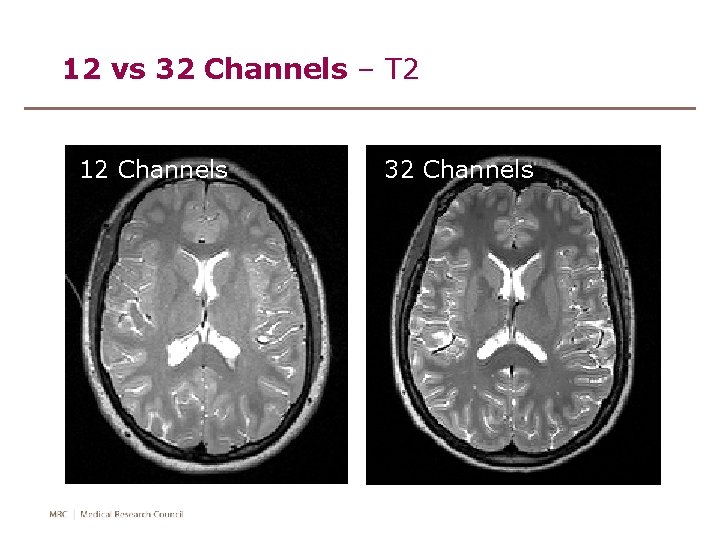
12 vs 32 Channels – T 2 12 Channels 32 Channels
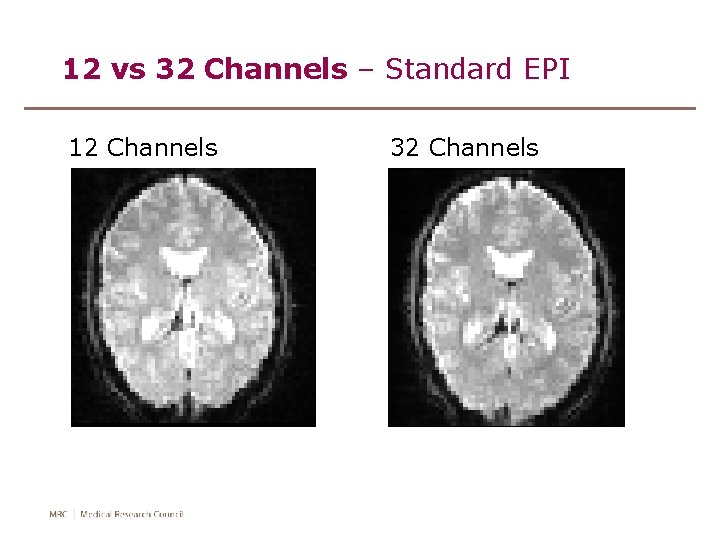
12 vs 32 Channels – Standard EPI 12 Channels 32 Channels
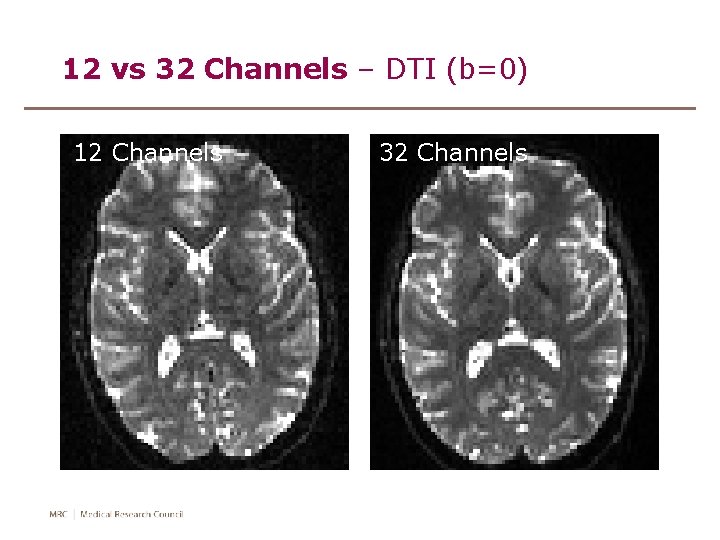
12 vs 32 Channels – DTI (b=0) 12 Channels 32 Channels
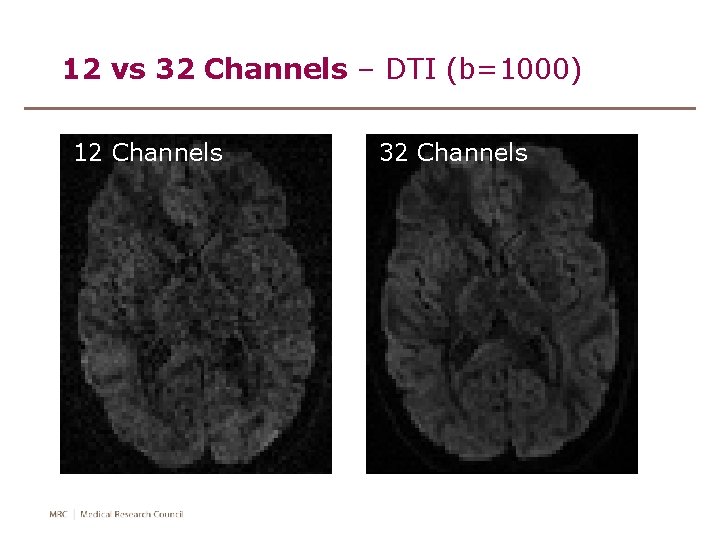
12 vs 32 Channels – DTI (b=1000) 12 Channels 32 Channels
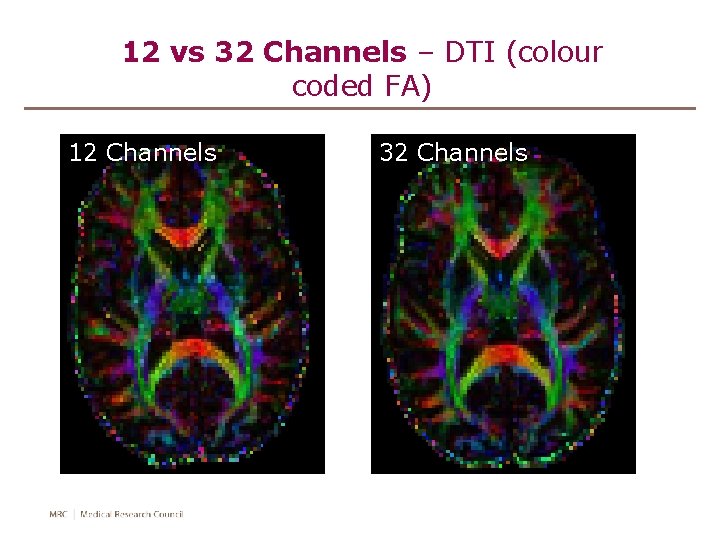
12 vs 32 Channels – DTI (colour coded FA) 12 Channels 32 Channels
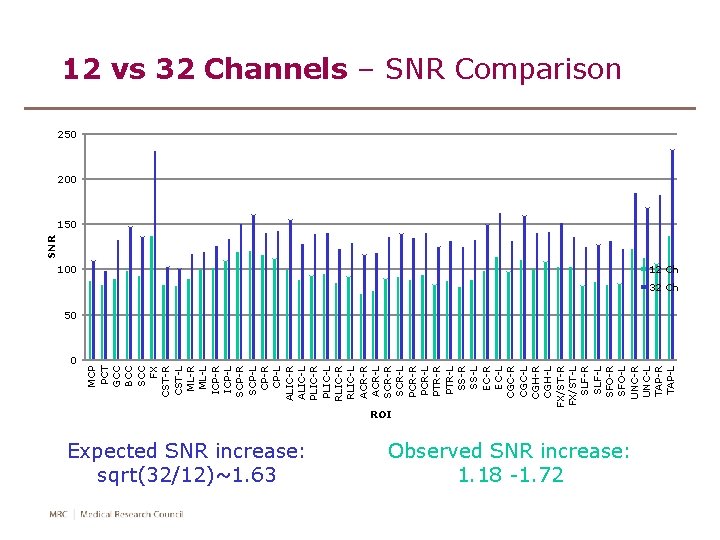
MCP PCT GCC BCC SCC FX CST-R CST-L ML-R ML-L ICP-R ICP-L SCP-R SCP-L CP-R CP-L ALIC-R ALIC-L PLIC-R PLIC-L RLIC-R RLIC-L ACR-R ACR-L SCR-R SCR-L PCR-R PCR-L PTR-R PTR-L SS-R SS-L EC-R EC-L CGC-R CGC-L CGH-R CGH-L FX/ST-R FX/ST-L SLF-R SLF-L SFO-R SFO-L UNC-R UNC-L TAP-R TAP-L SNR 12 vs 32 Channels – SNR Comparison 250 200 150 100 12 Ch 32 Ch 50 0 ROI Expected SNR increase: sqrt(32/12)~1. 63 Observed SNR increase: 1. 18 -1. 72
Other things you should know • Auditory stimulus presentation available now • Vision correction currently being developed (thanks to Gary) • Haven’t yet found a volunteer that didn’t fit in the coil • Using different padding is sometimes needed • No time added to sequence acquisition time
Silent EPI S Schmitter (University of Heidelberg)
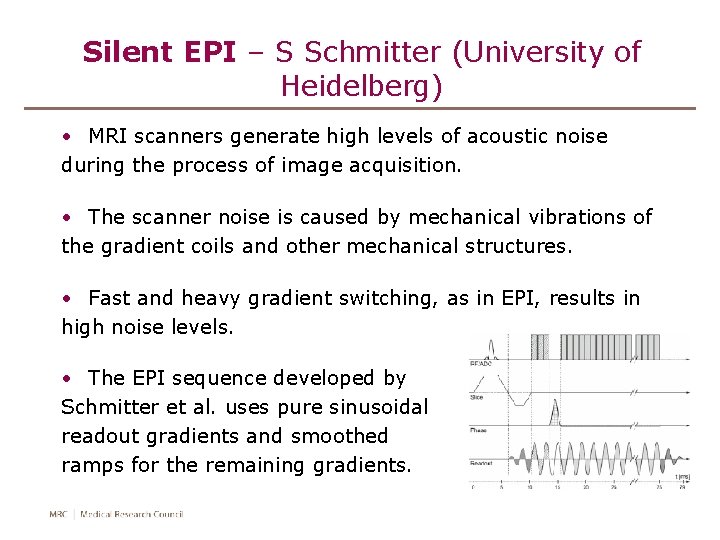
Silent EPI – S Schmitter (University of Heidelberg) • MRI scanners generate high levels of acoustic noise during the process of image acquisition. • The scanner noise is caused by mechanical vibrations of the gradient coils and other mechanical structures. • Fast and heavy gradient switching, as in EPI, results in high noise levels. • The EPI sequence developed by Schmitter et al. uses pure sinusoidal readout gradients and smoothed ramps for the remaining gradients.
Silent EPI imaging parameters • Acquisition time: 2640 ms (per volume) • 32 slices • in-plane resolution: 3 x 3 mm 2 • Slice thickness: 3 mm + 25% gap (3. 75 mm) • TE: 44 ms • 21 db quieter than standard EPI
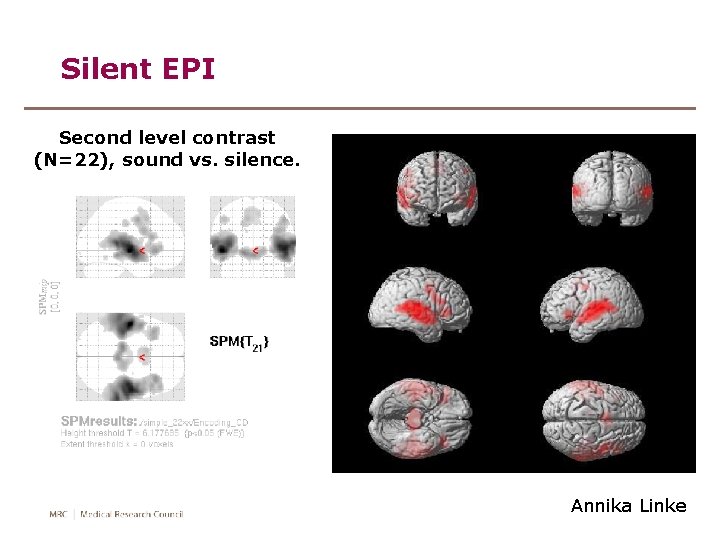
Silent EPI Second level contrast (N=22), sound vs. silence. Annika Linke
Silent EPI • There is slightly more drop out than in the standard EPI (due to the higher TE used). • The TR is longer for 32 slices (TR=2640 ms). • The signal in auditory regions is the same or higher than obtained with the standard sequence. • It is 21 db quieter than the standard sequence which makes it worth it for auditory studies. Annika Linke
Multi-echo EPI B. Poser (Donders)
Multi-echo EPI – B Poser (Donders) • Multiple images acquired at different values of TE. • Signal loss due to field inhomogeneities increases with TE. • The images acquired at the lower echo times show less signal loss in areas affected by susceptibility artefacts.
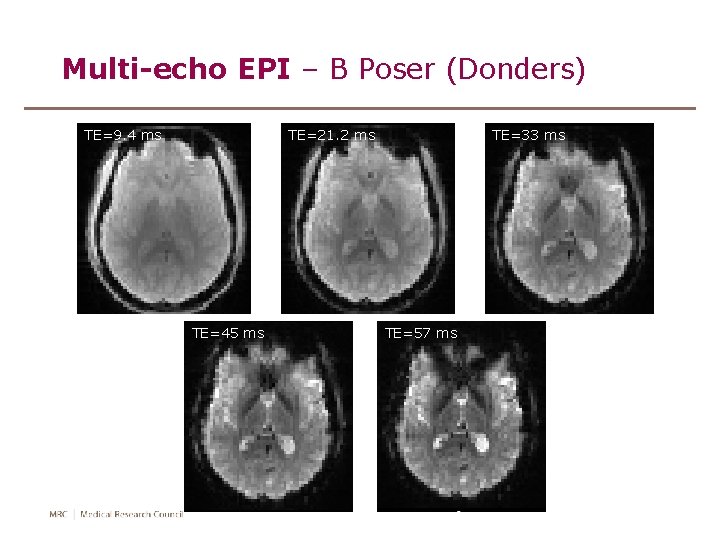
Multi-echo EPI – B Poser (Donders) TE=9. 4 ms TE=21. 2 ms TE=45 ms TE=33 ms TE=57 ms
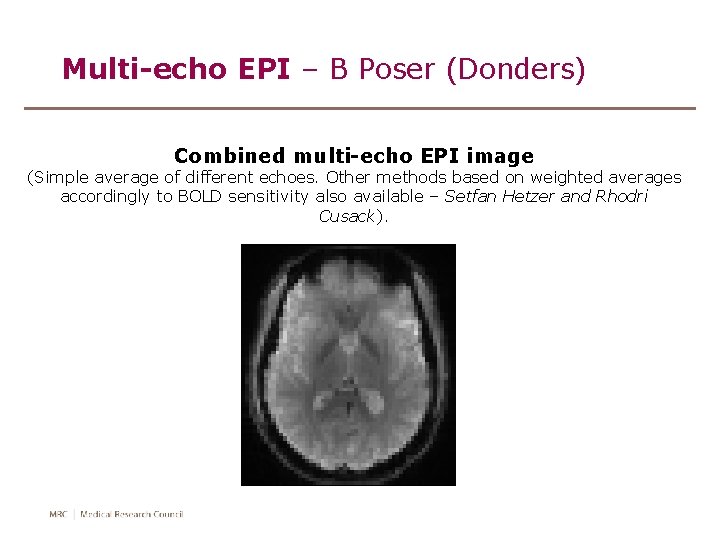
Multi-echo EPI – B Poser (Donders) Combined multi-echo EPI image (Simple average of different echoes. Other methods based on weighted averages accordingly to BOLD sensitivity also available – Setfan Hetzer and Rhodri Cusack).
Multi-echo EPI imaging parameters • Acquisition time: 2470 ms (per volume) • 32 slices • in-plane resolution: 3 x 3 mm 2 • Slice thickness: 3 mm + 25% gap (3. 75 mm) • TE: 9. 4 ms, 21. 2 ms, 33 ms, 45 ms, 57 ms • ISSS version also available
3 D EPI B. Poser (Donders)
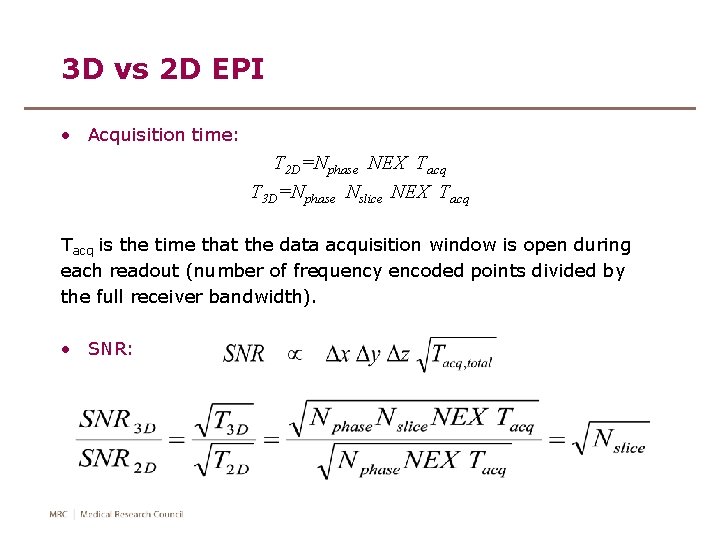
3 D vs 2 D EPI • Acquisition time: T 2 D=Nphase NEX Tacq T 3 D=Nphase Nslice NEX Tacq is the time that the data acquisition window is open during each readout (number of frequency encoded points divided by the full receiver bandwidth). • SNR:
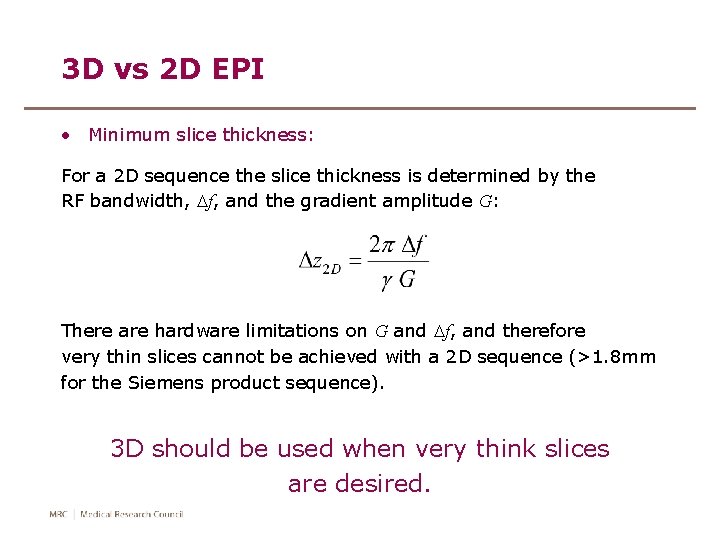
3 D vs 2 D EPI • Minimum slice thickness: For a 2 D sequence the slice thickness is determined by the RF bandwidth, Df, and the gradient amplitude G: There are hardware limitations on G and Df, and therefore very thin slices cannot be achieved with a 2 D sequence (>1. 8 mm for the Siemens product sequence). 3 D should be used when very think slices are desired.
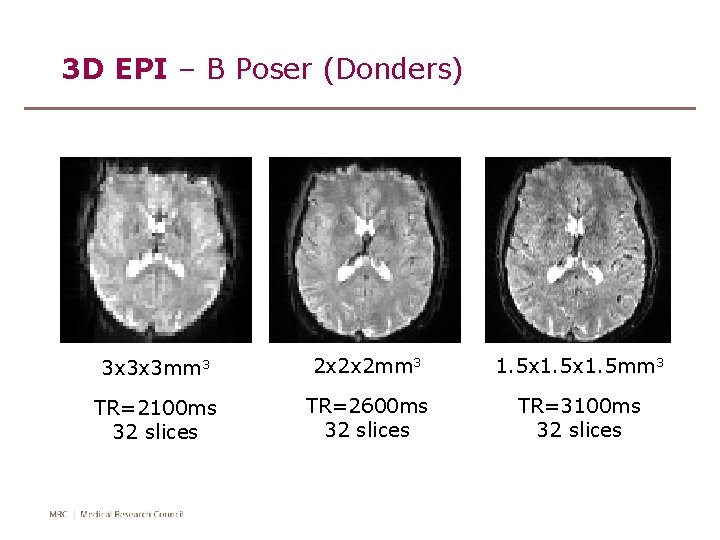
3 D EPI – B Poser (Donders) 3 x 3 x 3 mm 3 2 x 2 x 2 mm 3 1. 5 x 1. 5 mm 3 TR=2100 ms 32 slices TR=2600 ms 32 slices TR=3100 ms 32 slices
EPI sequence comparison Passive viewing of objects/scrambled objects vs. Fixation Rhodri Cusack
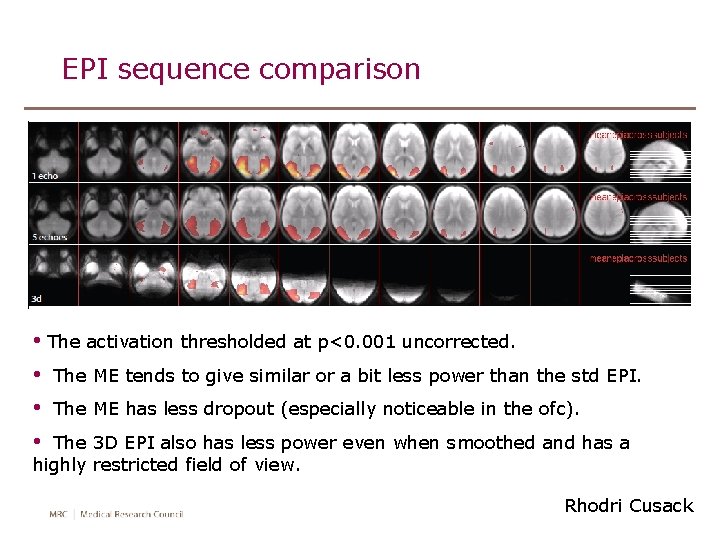
EPI sequence comparison • The activation thresholded at p<0. 001 uncorrected. • The ME tends to give similar or a bit less power than the std EPI. • The ME has less dropout (especially noticeable in the ofc). • The 3 D EPI also has less power even when smoothed and has a highly restricted field of view. Rhodri Cusack
High Resolution T 2
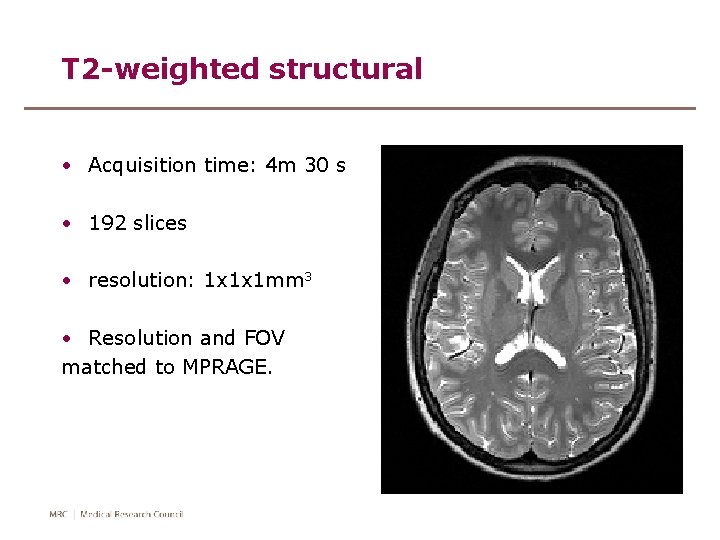
T 2 -weighted structural • Acquisition time: 4 m 30 s • 192 slices • resolution: 1 x 1 x 1 mm 3 • Resolution and FOV matched to MPRAGE.
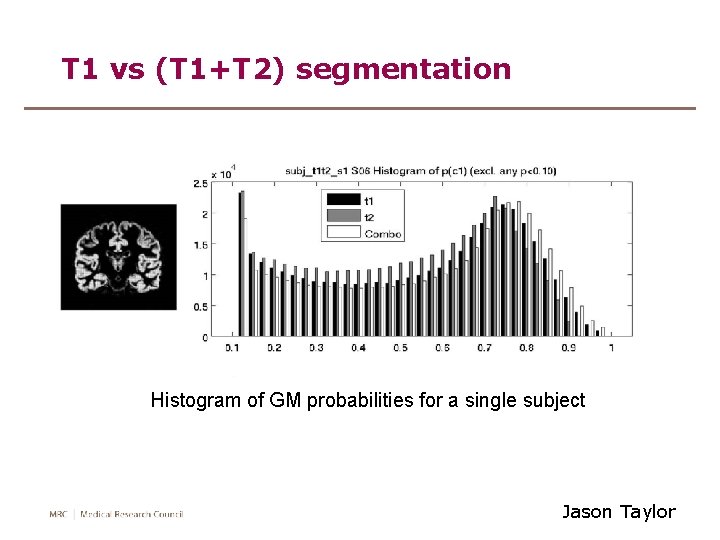
T 1 vs (T 1+T 2) segmentation Histogram of GM probabilities for a single subject Jason Taylor
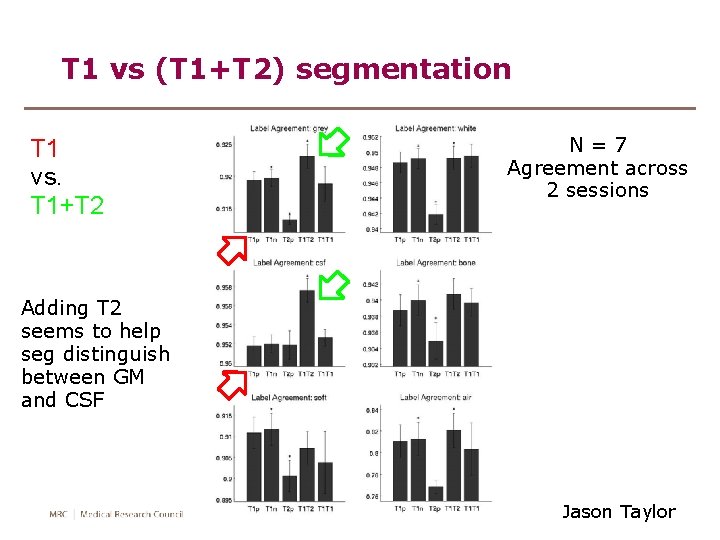
T 1 vs (T 1+T 2) segmentation T 1 vs. T 1+T 2 N=7 Agreement across 2 sessions Adding T 2 seems to help seg distinguish between GM and CSF Jason Taylor
Generalised Q-sampling Imaging
Generalised Q-sampling Imaging (GQI) • The traditional diffusion tensor model assumes a single fibre orientation per voxel. • Q-ball Imaging (QBI) and Diffusion Spectrum Imaging (DSI) remove this assumption and aim to reconstructed the full orientation distribution function (ODF) for each voxel. • Traditionally these methods use a large number of directions (up to 500) resulting in very long acquisition times. • GQI (Fang-Cheng Yeh et al. ) is able to resolve crossing fibres using as little as 101 directions.
GQI imaging parameters • Acquisition time: 14 mins, 21 secs • 55 slices (full brain coverage) • resolution: 2. 5 x 2. 5 mm 3 • 101 directions • Maximum b-value: 4000 s/mm 2 • TE: 69 ms • TR=8200 ms
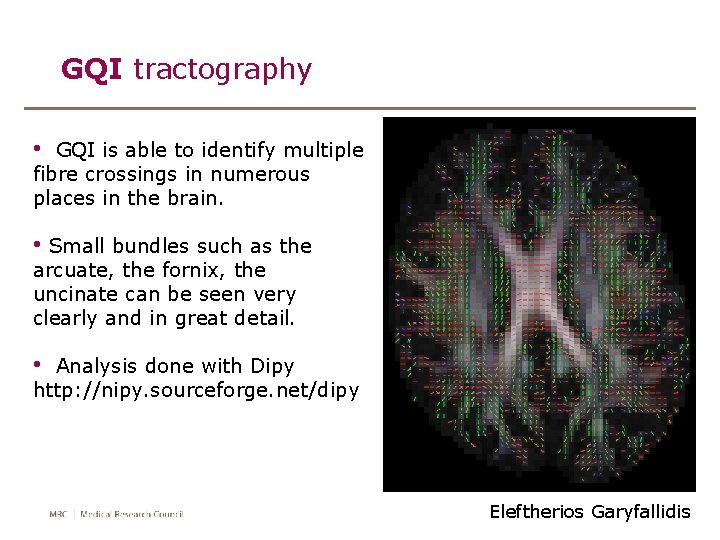
GQI tractography • GQI is able to identify multiple fibre crossings in numerous places in the brain. • Small bundles such as the arcuate, the fornix, the uncinate can be seen very clearly and in great detail. • Analysis done with Dipy http: //nipy. sourceforge. net/dipy Eleftherios Garyfallidis
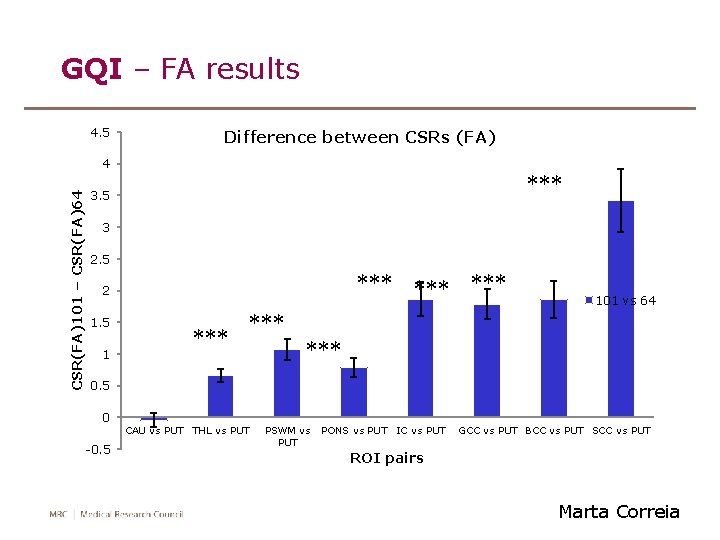
GQI – FA results 4. 5 Difference between CSRs (FA) CSR(FA)101 – CSR(FA)64 4 *** 3. 5 3 2. 5 *** *** 2 1. 5 1 *** 101 vs 64 *** 0. 5 0 -0. 5 CAU vs PUT THL vs PUT PSWM vs PUT PONS vs PUT IC vs PUT GCC vs PUT BCC vs PUT SCC vs PUT ROI pairs Marta Correia
Magnetization Transfer Imaging
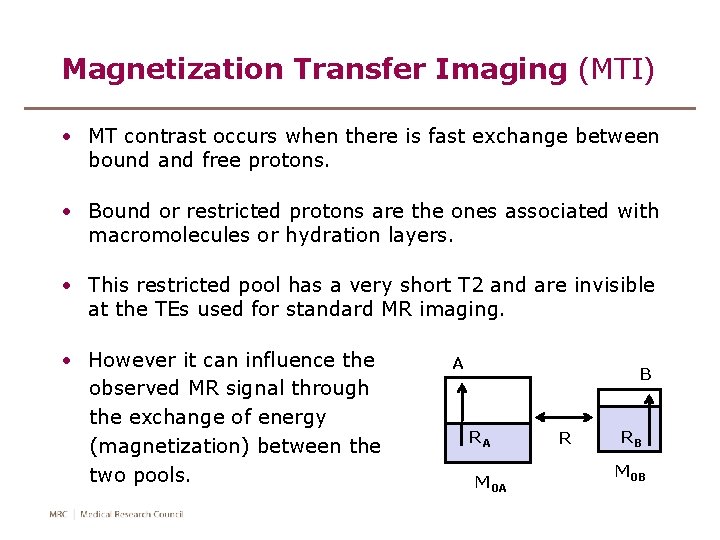
Magnetization Transfer Imaging (MTI) • MT contrast occurs when there is fast exchange between bound and free protons. • Bound or restricted protons are the ones associated with macromolecules or hydration layers. • This restricted pool has a very short T 2 and are invisible at the TEs used for standard MR imaging. • However it can influence the observed MR signal through the exchange of energy (magnetization) between the two pools. A B RA M 0 A R RB M 0 B
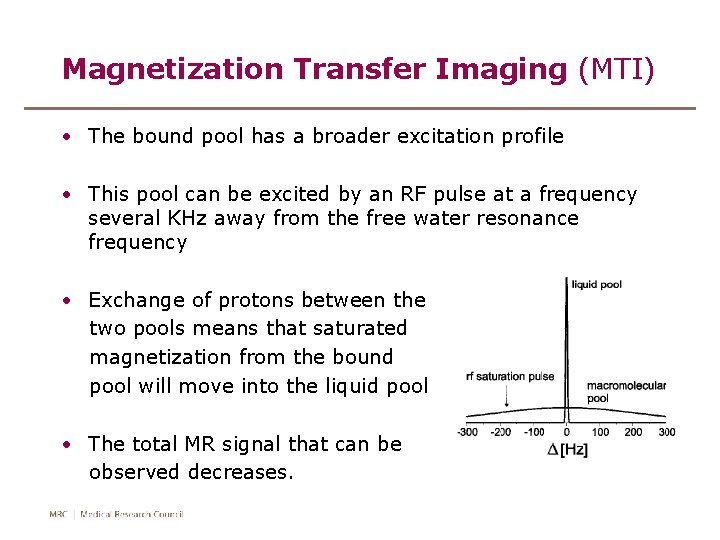
Magnetization Transfer Imaging (MTI) • The bound pool has a broader excitation profile • This pool can be excited by an RF pulse at a frequency several KHz away from the free water resonance frequency • Exchange of protons between the two pools means that saturated magnetization from the bound pool will move into the liquid pool • The total MR signal that can be observed decreases.
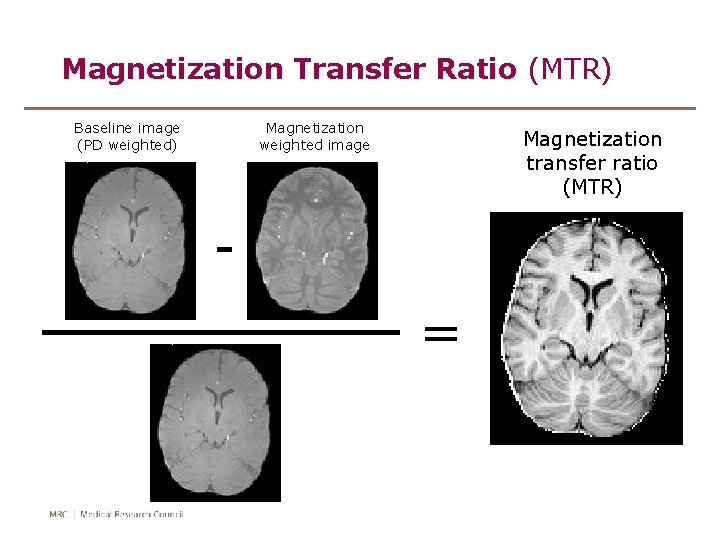
Magnetization Transfer Ratio (MTR) Baseline image (PD weighted) Magnetization weighted image Magnetization transfer ratio (MTR) =
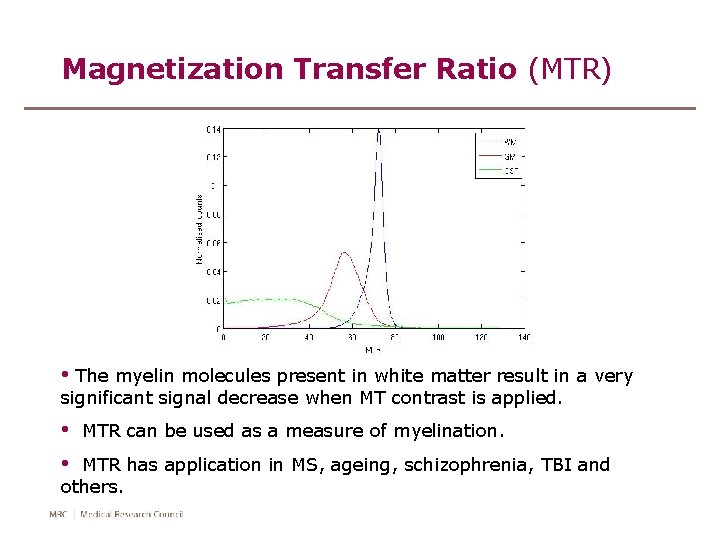
Magnetization Transfer Ratio (MTR) • The myelin molecules present in white matter result in a very significant signal decrease when MT contrast is applied. • • MTR can be used as a measure of myelination. MTR has application in MS, ageing, schizophrenia, TBI and others.
MTI imaging parameters • Acquisition time: 2 x 2 mins 36 sec (5 min 12 secs) • 84 slices (full brain coverage) • in-plane resolution: 1. 5 x 1. 5 mm 2 • Slice thickness: 1. 5 mm (no gap) • TR=30 ms • TE=5 ms
Susceptibility Weighted Imaging
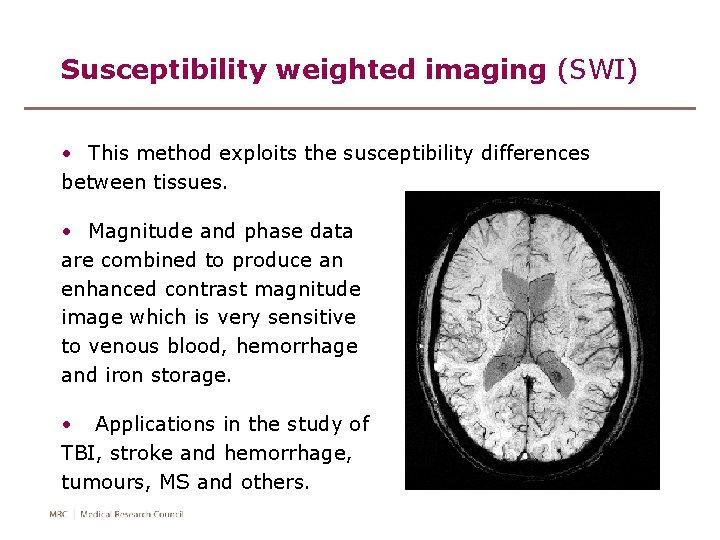
Susceptibility weighted imaging (SWI) • This method exploits the susceptibility differences between tissues. • Magnitude and phase data are combined to produce an enhanced contrast magnitude image which is very sensitive to venous blood, hemorrhage and iron storage. • Applications in the study of TBI, stroke and hemorrhage, tumours, MS and others.
SWI imaging parameters • Acquisition time: 6 mins 28 secs • 72 slices • in-plane resolution: 0. 6 x 0. 5 mm 2 • Slice thickness: 1. 2 mm (no gaps) • TR: 28 ms • TE: 20 ms
Thank you Rhodri Cusack Stefan Hetzer Annika Linke Eleftherios Garyfallidis Jason Taylor Michele Veldman Lorina Naci Jonathan Peelle Matt Davis Rik Henson Steve, Helen and Di Everybody who has volunteered as subjects.
And that’s all! For now. . .
- Slides: 50