
BEYOND THE SILOS OF THE LAMS TIME TO
BEYOND THE SILOS OF THE LAM’S: TIME TO SPEAK UP COLLABORATIVE AND OPEN SOFTWARE DEVELOPMENT DIRECTIONS FOR LIBRARIES, ARCHIVES AND MUSEUMS James Michalko, Moderator Vice President, OCLC Research OCLC, Inc. David A. Greenbaum Director, Data Services University of California, Berkeley Beth Sandore Associate Dean Associate University Librarian for IT Planning and Policy University of Illinois at Urbana-Champaign Robert H. Mc. Donald Associate Dean for Library Technologies Executive Director, Kuali OLE Indiana University TAG US #CNI 10 S #LAM
BACKGROUND: SILOS OF LAM’S � Libraries, archives, museums’ content lives in separate and inaccessible silos � Disservice to scholars & publics � Long-term obstacles for management � Cost-prohibitive technology infrastructure � Insufficient support within LAM’s for separate systems and infrastructures
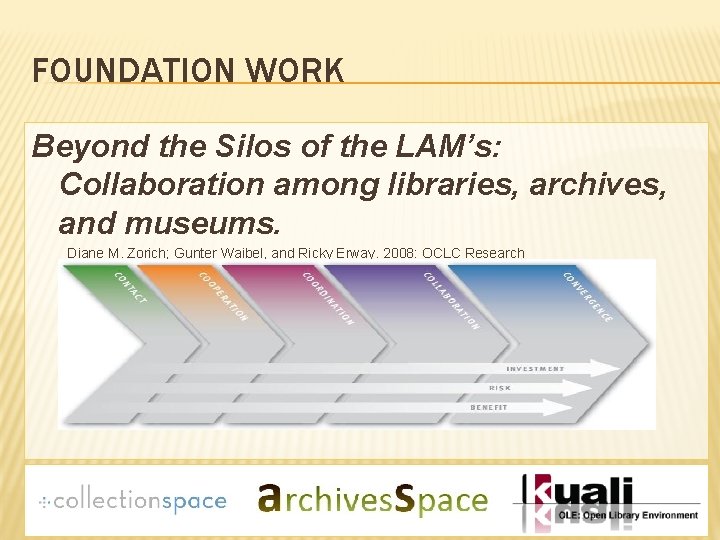
FOUNDATION WORK Beyond the Silos of the LAM’s: Collaboration among libraries, archives, and museums. Diane M. Zorich; Gunter Waibel, and Ricky Erway. 2008: OCLC Research http: //www. oclc. org/research/publications/library/2008 -05. pdf
THE KEY QUESTIONS FOR LAM’S � Mellon Foundation supporting development of three open source software products: Kuali OLE for libraries � Archives. Space: the Next Generation Archival Management Tool for archives � Collection. Space for museums � A new opportunity for coordination? collaboration? convergence? � On what dimensions? With what degrees of difficulty? Payoffs? To whom? �
ARCHIVESSPACE: BACKGROUND � Next generation archival management and access system � Archivist’s � Users: Toolkit + Archon = access & management archivists and researchers, all types & sizes � Approach: access & management � “By archivists, for archivists” � Planning: 2010 – re-conceptualize AT & Archon � Development: 2011 -2012
ARCHIVESSPACE: COLLABORATION & CONNECTION � Partners: UC San Diego, New York University, Univ. of Illinois and AT, Archon communities � Partnerships with communities: � Academic � Cultural heritage � Technology � Content � Challenges: � Governance; sustainable business model � Balance: archival management : integrated content access
KUALI OLE: MISSION The mission of Kuali OLE is to develop a sustainable Kuali system that provides academic library management services for higher education. It will use the legal umbrella of the Kuali Foundation, adhere to the Kuali licensing guidelines, and use the Kuali middleware, infrastructure, tools and processes.
KUALI OLE: BACKGROUND OLE Project lead by Duke with 15 partners Universities, Consortiums & National Libraries � Community engagement & participation effort – over 300 participants from more than 100 institutions � Described a service registry of library business process � Surfaced sufficient need & ability to go forward with a build project for a community-sourced library system � Led to Kuali OLE Build initiative with 9 core partners. � JISC Report – ILS Systems and the Shared Services Survey (http: //www. jisc. ac. uk/publications/briefingpapers/2008/librarymanagementbp. aspx) �
KUALI OLE: COLLABORATION AND CONNECTION
KUALI OLE: TIMELINE � Design project – Sept 2008 – July 2009 � Develop build partnership – Fall 2009 � Kuali Charter � Proposal for Mellon funding � Commitment by partners � Build – 2010 – 1212 � phase 1 – hiring, governance & design review � phase 2 – infrastructure & data flows � phase 3 – integration & testing � phase 4 – implementation & extension
CNI Spring Forum 2010 David A. Greenbaum Director, IST-Data Services, UC Berkeley Co-Director, CSpace Co-Director, Project Bamboo www. collectionspace. org CSpace is being developed with the generous support of the Andrew W. Mellon Foundation
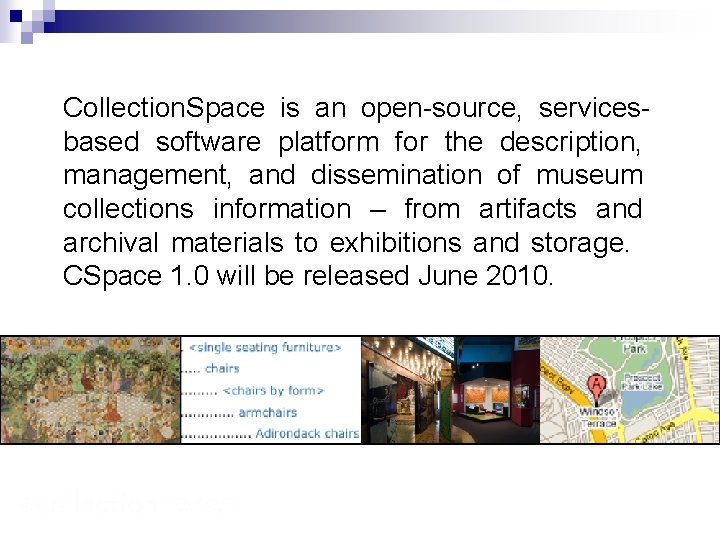
Collection. Space is an open-source, servicesbased software platform for the description, management, and dissemination of museum collections information – from artifacts and archival materials to exhibitions and storage. CSpace 1. 0 will be released June 2010.
Project Partners n n Museum of the Moving Image, New York University of California, Berkeley, Information Services and Technology Division University of Cambridge, Centre for Applied Research in Educational Technologies University of Toronto, Adaptive Technology Resource Centre, Fluid Project
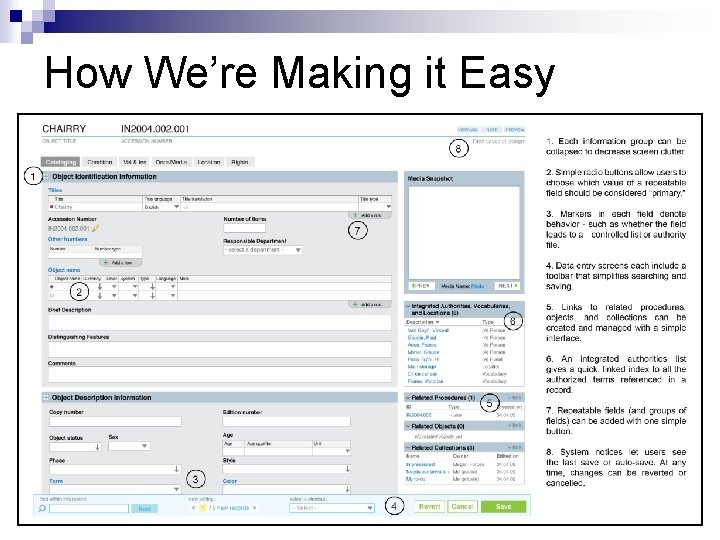
How We’re Making it Easy
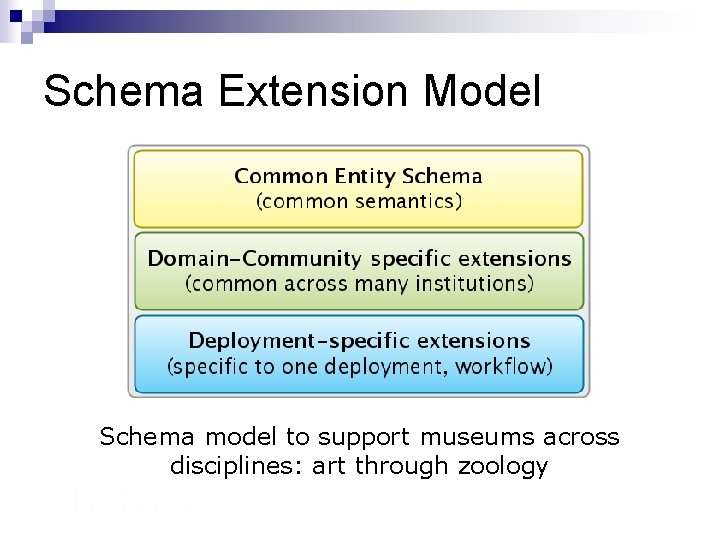
Schema Extension Model Schema model to support museums across disciplines: art through zoology
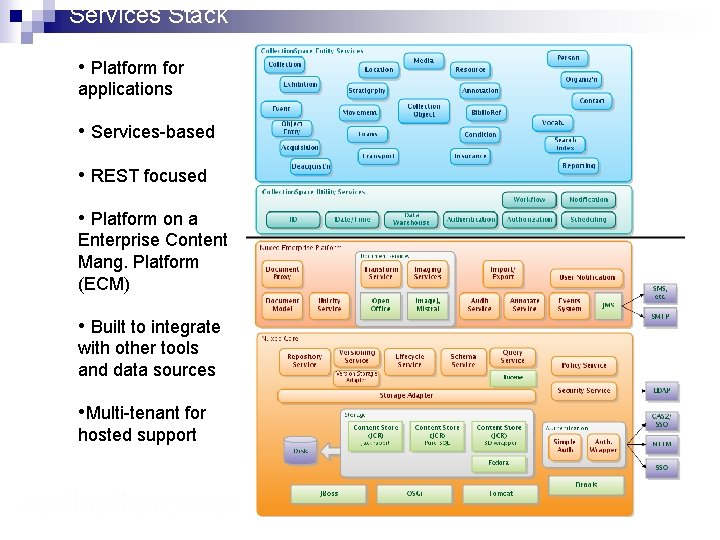
Services Stack • Platform for applications • Services-based • REST focused • Platform on a Enterprise Content Mang. Platform (ECM) • Built to integrate with other tools and data sources • Multi-tenant for hosted support
Collaboration and Connections n n n n Sustainability of: (1) software development, (2) deployments, and (3) operations. Each with different dimensions. A Community of communities. . . Archives, libraries, and other key content technologies Local: Berkeley Campus Collections Community Disciplinary: Integrated with multiple disciplinary-based, consortia in/outside of campuses (e. g, Herbaria) Global: Strong interest in a Foundation structure Who and how to align? Foundation. Space? 17
THE GOOD, THE BAD & THE UGLY � End-user Experience � Technical Architecture � Organizational/Consortial
AUDIENCE PARTICIPATION � http: //app. sliderocket. com/app/Full. Player. aspx? id=d 38 f 28 a 5 -44 da-4 d 60 -8 ca 1 -4 d 3 f 21 a 3 b 8 e 4
PROJECT LINKS � Collection. Space - http: //www. collectionspace. org � Archives. Space – � http: //www. archiviststoolkit. org/ � http: //www. archon. org/ � Kuali OLE – http: //www. kuali. org/ole
- Slides: 20