
Beyond the Early Grade Mathematics Assessment Informing Practice
Beyond the Early Grade Mathematics Assessment: Informing Practice Dr. Yasmin Sitabkhan RTI International is a registered trademark and a trade name of Research Triangle Institute. www. rti. org
Outline § What we need to know about children’s mathematics § Formal and informal mathematics § Capturing informal mathematics § How informal mathematics can be used
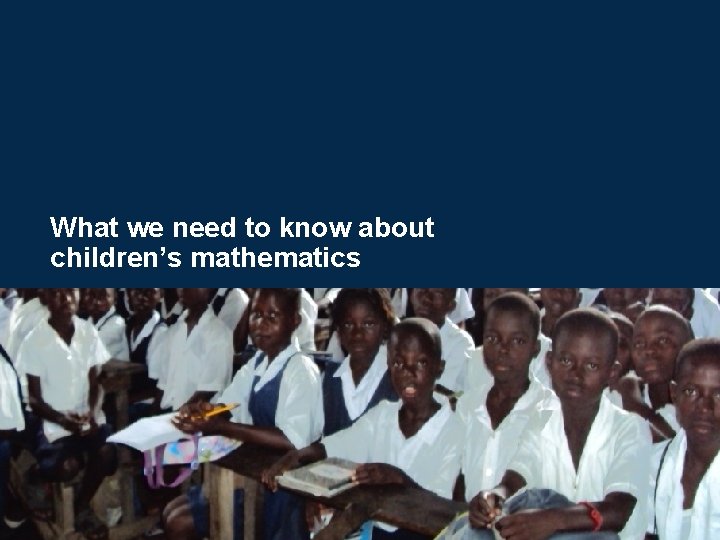
What we need to know about children’s mathematics
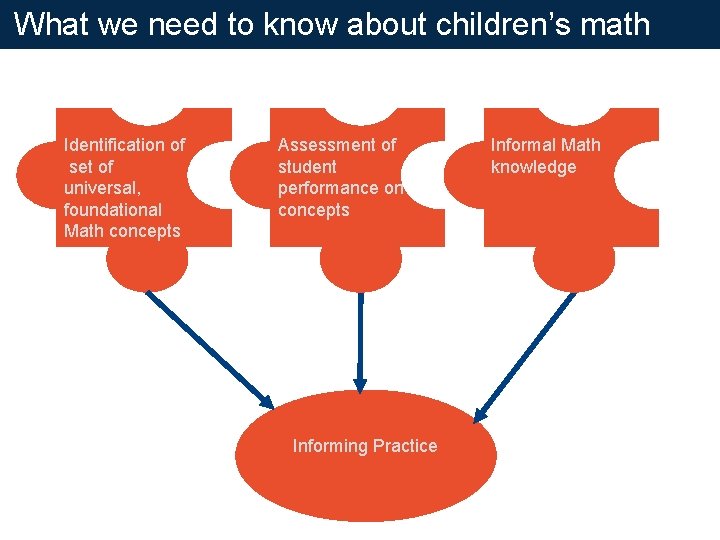
What we need to know about children’s math Identification of set of universal, foundational Math concepts Assessment of student performance on concepts Informing Practice Informal Math knowledge

Formal and Informal Mathematics

Formal and Informal Mathematics § Formal Mathematics Historically-developed system taught explicitly through formal education • Abstract • Examples: algorithms, base-10 notation, written equations • § Informal Mathematics Based on everyday activities • Concrete • Often referred to as workplace mathematics, preschool mathematics, outof-school mathematics, everyday mathematics, street mathematics • Example: math used when shopping • 6
Formal and Informal Mathematics 7 § Children develop systems of informal mathematics through experience in the world § Children interpret formal mathematics through their informal mathematics knowledge – Linking concrete with abstract – Everyday understandings give meaning to formal ones, and vice versa (Vygotsky, 1986)
Capturing Informal Mathematics- an illustration
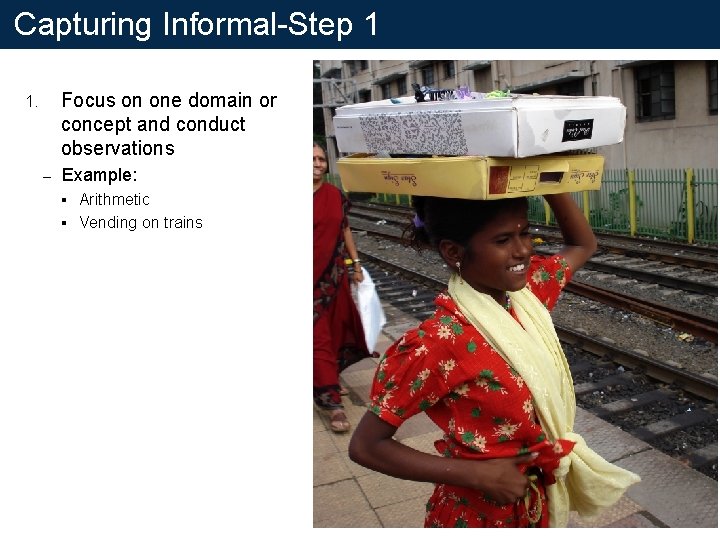
Capturing Informal-Step 1 Focus on one domain or concept and conduct observations 1. – Example: Arithmetic § Vending on trains §
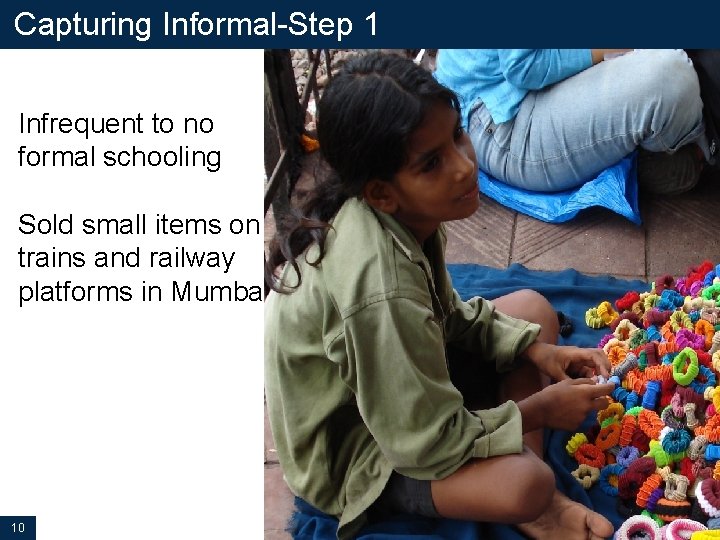
Capturing Informal-Step 1 Infrequent to no formal schooling Sold small items on trains and railway platforms in Mumbai 10
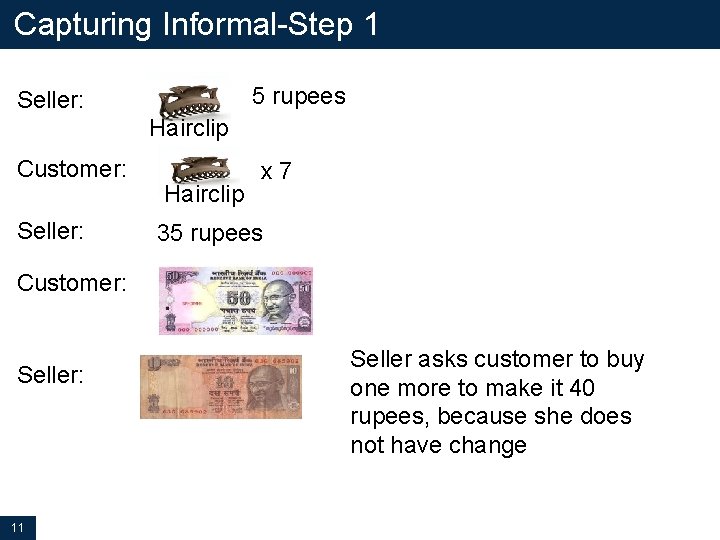
Capturing Informal-Step 1 5 rupees Seller: Customer: Seller: Hairclip x 7 Hairclip 35 rupees Customer: Seller asks customer to buy one more to make it 40 rupees, because she does not have change 11
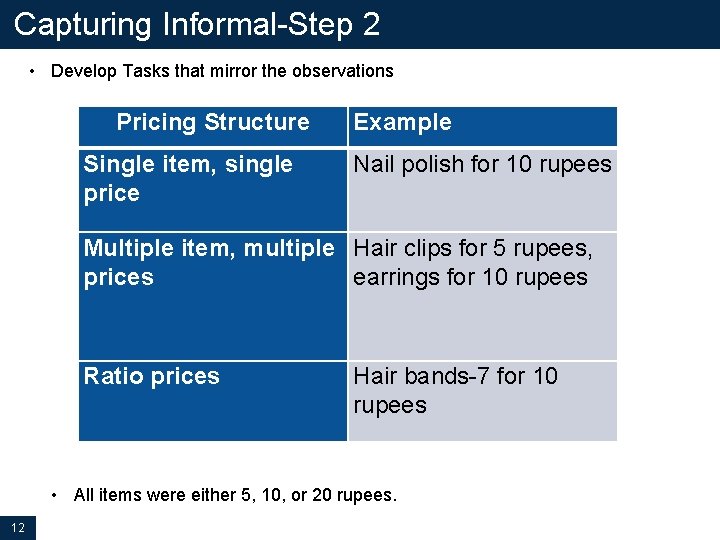
Capturing Informal-Step 2 • Develop Tasks that mirror the observations Pricing Structure Single item, single price Example Nail polish for 10 rupees Multiple item, multiple Hair clips for 5 rupees, prices earrings for 10 rupees Ratio prices Hair bands-7 for 10 rupees • All items were either 5, 10, or 20 rupees. 12
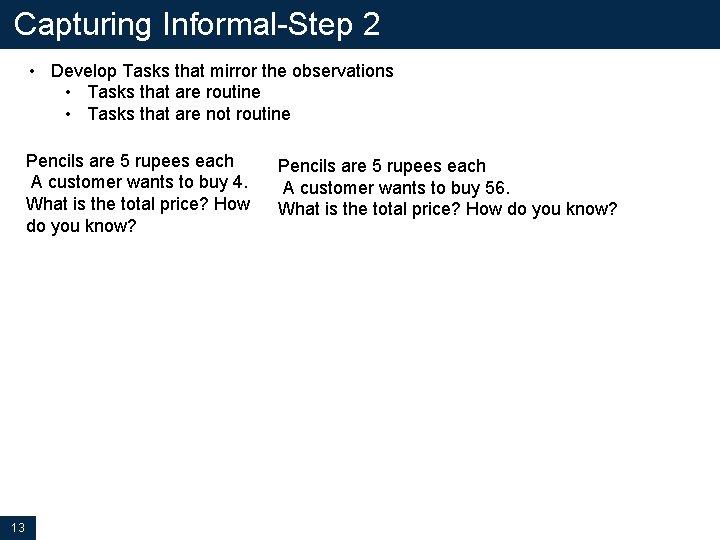
Capturing Informal-Step 2 • Develop Tasks that mirror the observations • Tasks that are routine • Tasks that are not routine Pencils are 5 rupees each A customer wants to buy 4. What is the total price? How do you know? 13 Pencils are 5 rupees each A customer wants to buy 56. What is the total price? How do you know?
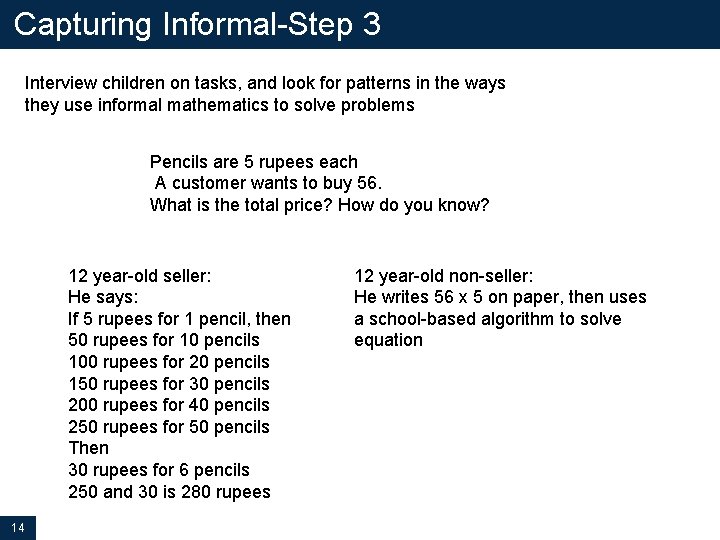
Capturing Informal-Step 3 Interview children on tasks, and look for patterns in the ways they use informal mathematics to solve problems Pencils are 5 rupees each A customer wants to buy 56. What is the total price? How do you know? 12 year-old seller: He says: If 5 rupees for 1 pencil, then 50 rupees for 10 pencils 100 rupees for 20 pencils 150 rupees for 30 pencils 200 rupees for 40 pencils 250 rupees for 50 pencils Then 30 rupees for 6 pencils 250 and 30 is 280 rupees 14 12 year-old non-seller: He writes 56 x 5 on paper, then uses a school-based algorithm to solve equation
Uses of informal math knowledge
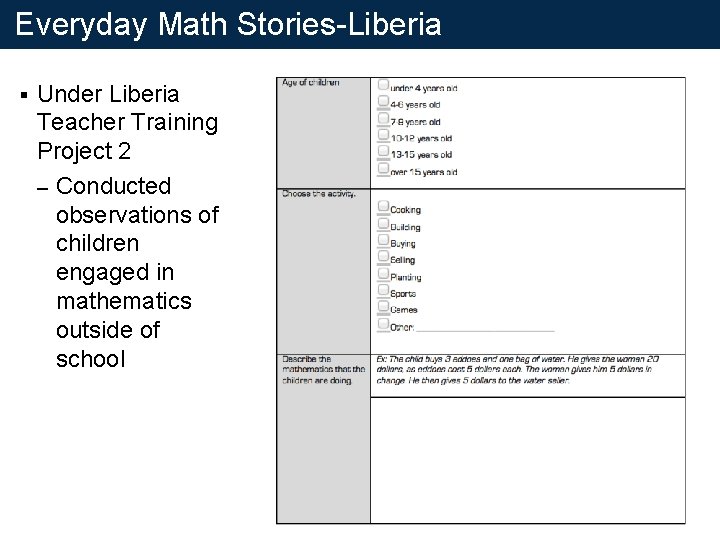
Everyday Math Stories-Liberia § Under Liberia Teacher Training Project 2 – Conducted observations of children engaged in mathematics outside of school
Everyday Math Stories-Liberia – Created “everyday math” stories that mirrored the mathematics children used outside of school, based on observations Lucky Daniel By Yolanda G. Issac-sie “We are almost late Daniel, ” Mom called as she sat in the car waiting to drop Daniel at school before going to work. Daniel came running, and at last as he sat in the front next to his mother. As his mom was driving, Daniel shouted “Mom, look! That aunty Janet. ” Daniel called out the window. Mom stopped the car and Aunty J came to speak to them. “Here’s 10 dollars for you D. You can add this to your lunch money. ” Daniel said thank you. When they reached the school, Daniel’s mom gave him 20 more dollars. Now Daniel had 30 dollars! During recess, Daniel bought a rice bread, and sour milk. The rice bread was 20. 00 and the milk cost 10. 00. Daniel paid the lady that was selling the rice bread and milk. It was delicious. Daniel was glad that he had met Aunty Janet on his way to school, because otherwise he would not have been able to buy the rice bread and the milk!
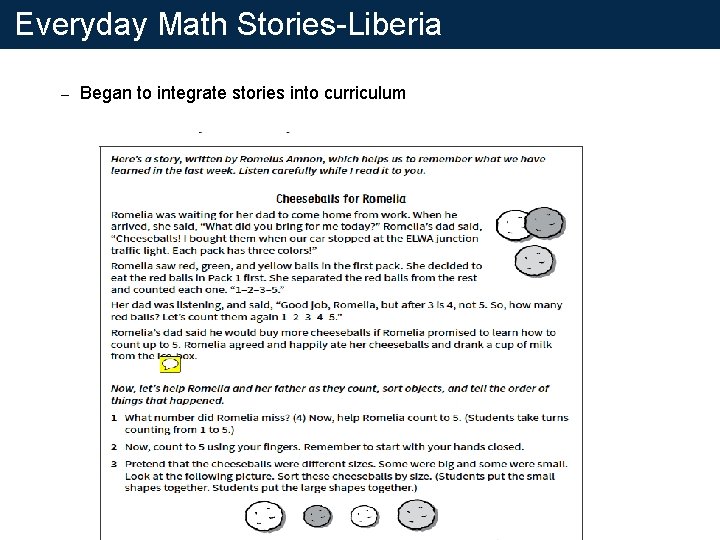
Everyday Math Stories-Liberia – Began to integrate stories into curriculum
Conclusions and next steps Informal mathematics is important to capture § Together with an assessment like the EGMA it provides a more complete picture of children’s knowledge of mathematics § Can help curriculum writers bridge formal and informal mathematics to improve teaching and learning § Validates and recognizes the mathematics that occurs in out-of-school settings §
Thank you! ysitabkhan@rti. org
- Slides: 20