
Beyond NAS and SAN The Evolution of Storage
Beyond NAS and SAN: The Evolution of Storage Marc Farley Author Building Storage Networks
What We’ll Do l Analyze storage network functions l Apply these functions in NAS and SANs l Observe market pressures forcing changes l Identify evolving architectures
Fundamental Functions of Storage Networks Building Blocks l Wiring • Fibre Channel. Parallel SCSI, Ethernet, IP l Storing • Devices & Subsystems, I/O Controllers, Virtualization SW & HW (RAID, Volume Managers, Mirroring) l Filing • File systems, Databases, Backup, Replication
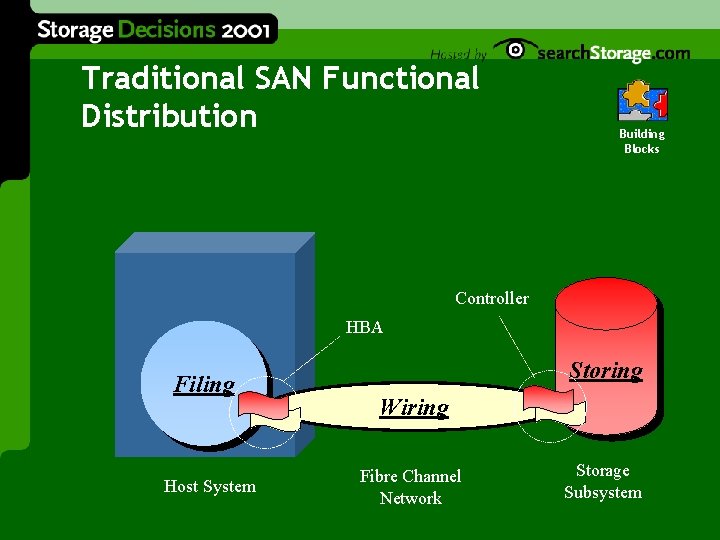
Traditional SAN Functional Distribution Building Blocks Controller HBA Filing Host System Storing Wiring Fibre Channel Network Storage Subsystem
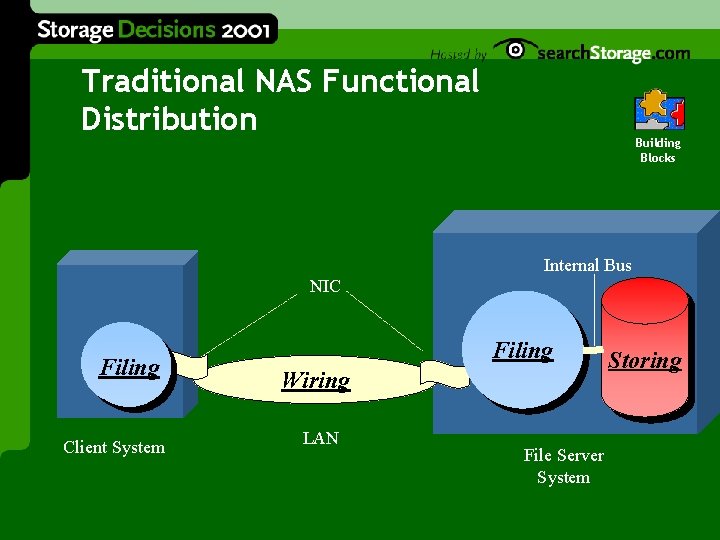
Traditional NAS Functional Distribution Building Blocks Internal Bus NIC Filing Client System Filing Wiring LAN File Server System Storing
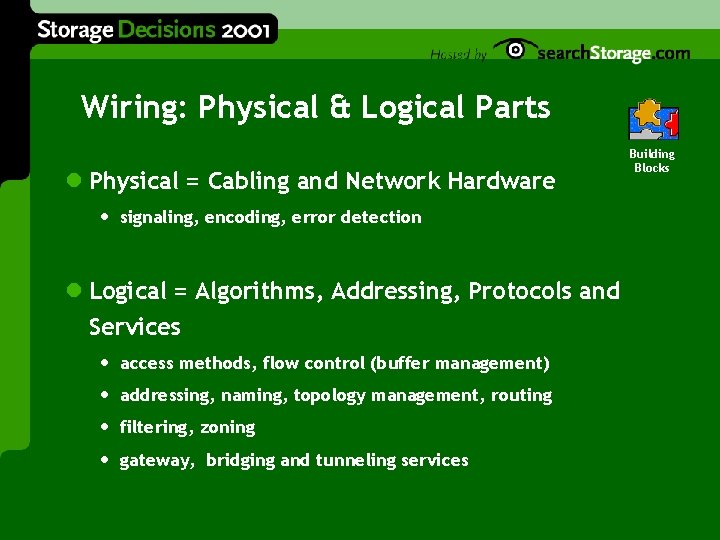
Wiring: Physical & Logical Parts l Physical = Cabling and Network Hardware • signaling, encoding, error detection l Logical = Algorithms, Addressing, Protocols and Services • access methods, flow control (buffer management) • addressing, naming, topology management, routing • filtering, zoning • gateway, bridging and tunneling services Building Blocks
Wiring: Fibre Channel and i-SCSI l Functionally equivalent as wiring technologies l More of a business issue than a technology issue l Question: Will i-SCSI SANs be implemented as distinct networks or grow as part of the existing Ethernet/IP infrastructure? l i-SCSI leverage might be less than expected - but it might be good enough Building Blocks
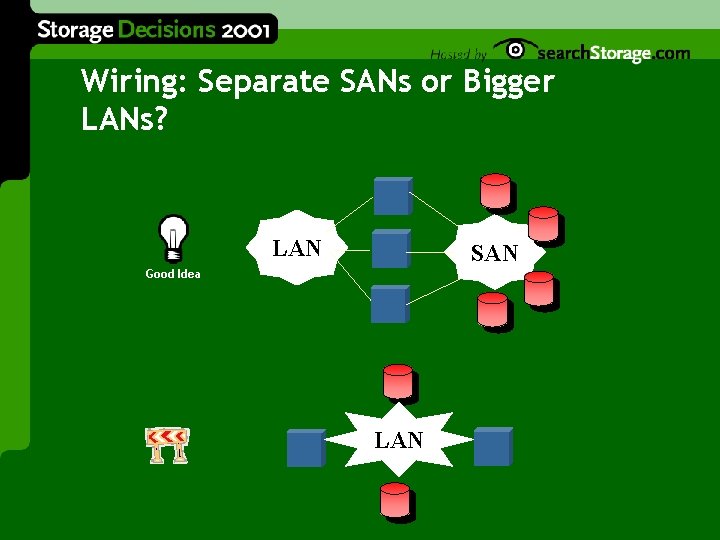
Wiring: Separate SANs or Bigger LANs? LAN SAN Good Idea LAN
An Question for the Audience…. . An Idea l What is the best routing method for storage traffic? • To date, storage networks have borrowed from IP networking • OSPF in IP networks (NAS) & FSPF in Fibre Channel • What do you want? • Fast recovery & optimal availability – OR • Compatibility with IP routing
Storing Building Blocks l Block level operations • storage block addressing • store, retrieve, status, resource reservation l Subsystems and Virtual Devices • block translation, mirroring, multiple ports, LUN masking l I/O commands between initiators and targets • SCSI, serial SCSI, SCSI adaptations, IDE • Error correction really happens here
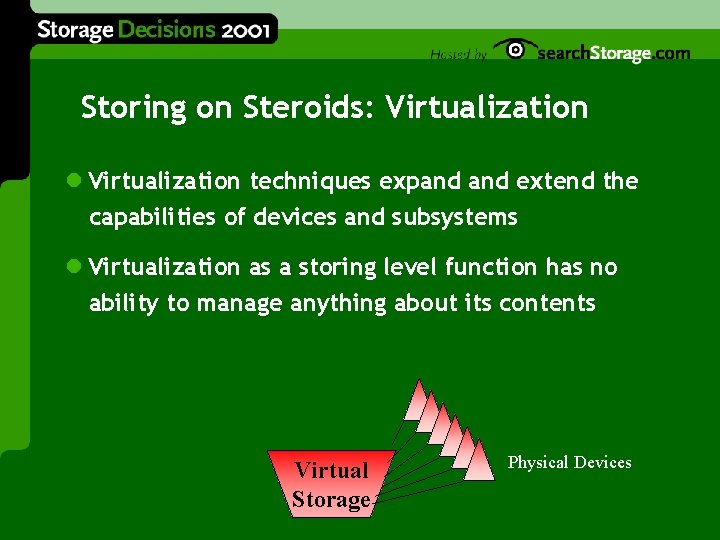
Storing on Steroids: Virtualization l Virtualization techniques expand extend the capabilities of devices and subsystems l Virtualization as a storing level function has no ability to manage anything about its contents Virtual Storage Physical Devices
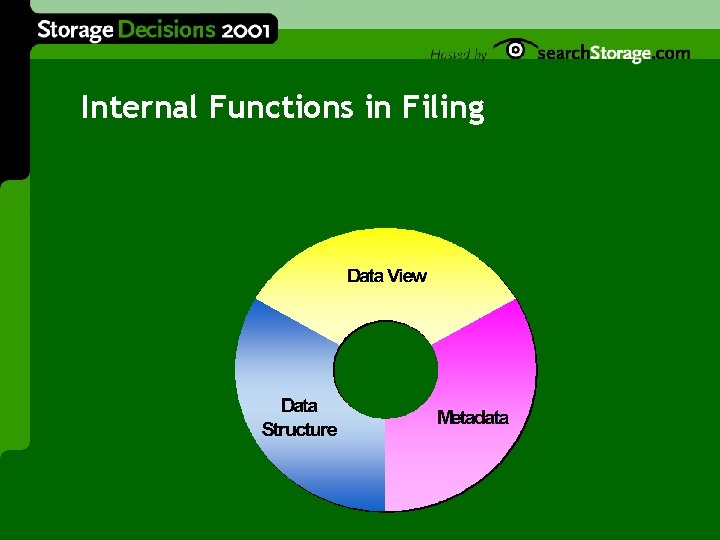
Filing Building Blocks l Representation of data • files, directories, tables, records l Storage data structure (block address layout) • equalized performance, maintain free blocks l System kernel integration • kernel manages time, file system manages space l File semantics • Open, close, update, delete, block range operations
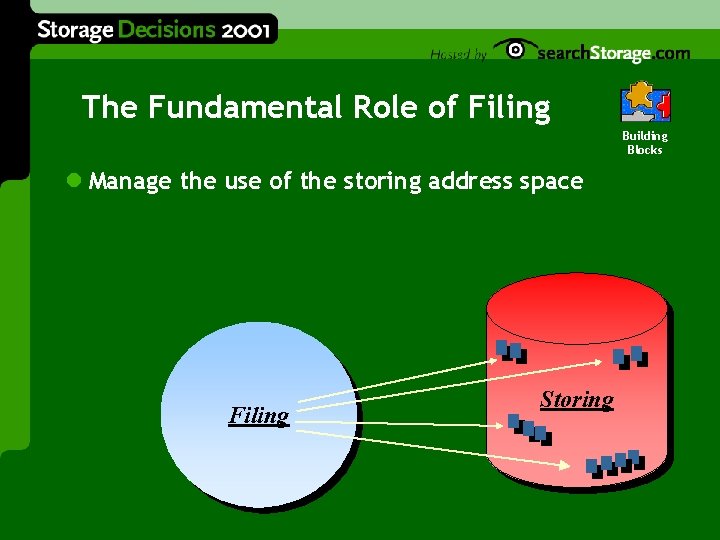
The Fundamental Role of Filing Building Blocks l Manage the use of the storing address space Filing Storing
Internal Functions in Filing
NAS & SAN REDUX
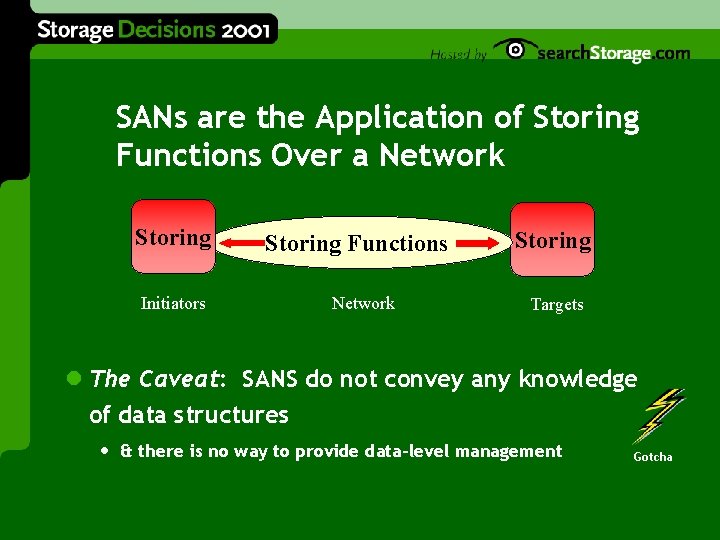
SANs are the Application of Storing Functions Over a Network Storing Initiators Storing Functions Network Storing Targets l The Caveat: SANS do not convey any knowledge of data structures • & there is no way to provide data-level management Gotcha
![Virtualization Creates Storing Structures ] But not data structures Physical Devices Storing Block Data](http://slidetodoc.com/presentation_image_h2/fa6395296e00de13b9ba692f649dd74a/image-17.jpg "Virtualization Creates Storing Structures ] But not data structures Physical Devices Storing Block Data")
Virtualization Creates Storing Structures ] But not data structures Physical Devices Storing Block Data Storing Initiators Network Virtual Targets
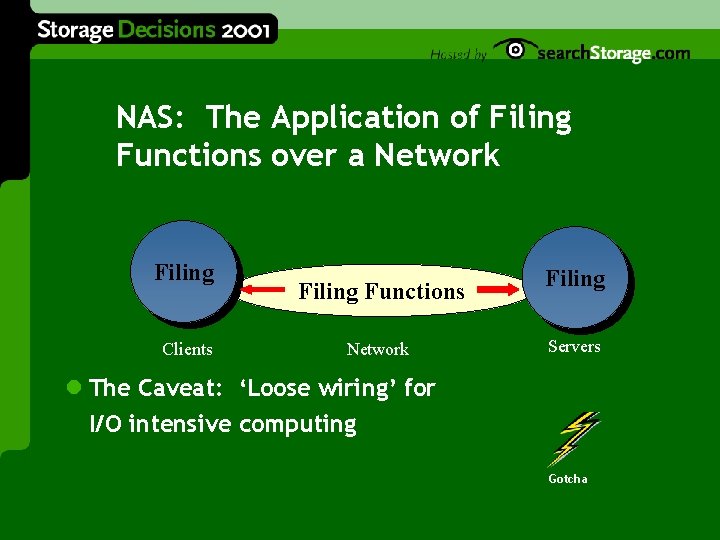
NAS: The Application of Filing Functions over a Network Filing Clients Filing Functions Network Filing Servers l The Caveat: ‘Loose wiring’ for I/O intensive computing Gotcha
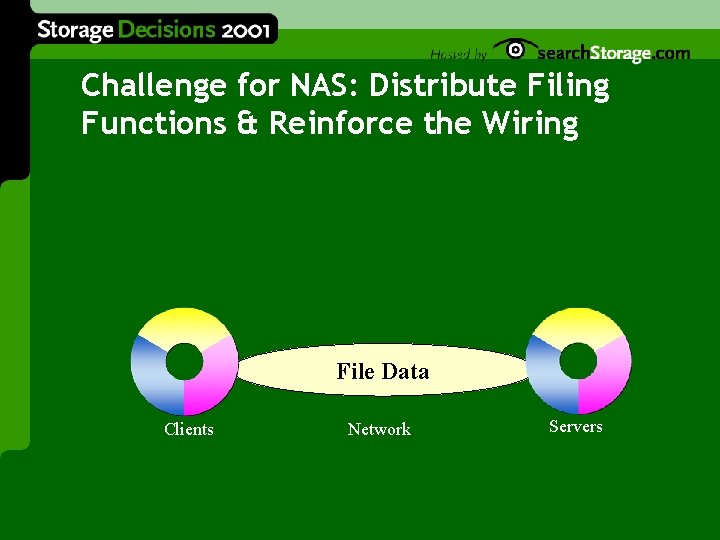
Challenge for NAS: Distribute Filing Functions & Reinforce the Wiring File Data Clients Network Servers
Storage Network Requirements
Market Needs l Integrity l Recoverability l Security l Availability l Manageability (Scalability) Best Practice
Data Integrity Must be Maintained l Error free transmissions • Fiber optic cabling l Data segregation is a good thing • Who wants a Battle Royale over data? • Any to any connectivity is not required • Storage networks differ a lot from data networks • Zoning, masking and fencing are band-aids for existing architectural weaknesses • Filing enforces data integrity through locking Gotcha
Data Recoverability = Redundancy l Data redundancy system redundancy l Mirroring is fast, but relatively inefficient • Extended distance mirrors are “open territory” • System buffer management is a caveat l Data structures must have integrity • Journalled file systems, database commitments l File system intelligence is most efficient • Serverless backup, data snapshots, replication Gotcha
Security - the Great Afterthought l Protecting Data From Theft l File systems have done this for decades • System-login is the gatekeeper Gotcha l There are no constructs for storing-level security l Wiring-level security can be done, but is slow l Encryption is S-L-O-W for I/O • IP-SEC may provide a method
Remember the Good Old Days of SCSI? l Data integrity was less exposed with Parallel SCSI • Human error was far less likely • Storage was not accessible to hackers l Processing power on the storage end is needed to provide security functions
Data Availability l Remove the system as a bottleneck • (And integrity and security become more suspect) l Availability doesn’t necessarily mean “seamless” • Single servers in SANs can failover using redundant paths • NAS network failures must re-connect l Data sharing can provide availability • NAS file locking can ensure integrity for server farms • Data sharing in SANs is expensive and complex
The Fine Print in Scalability l Maxed-out NAS requires additional mount points • Users and application configurations must change l SANs can use virtualization • Does “V” ensure integrity? • Is “V” recoverable? (will it support serverless backup? ) l File system data structures must be included for non-stop scalability! Secret
The Fine Print in Scalability l How does the filing function know about the new storing address space? Filing Storing
Evolving Architectures
Evolving Storage Network Architectures l Filing technologies are intimately involved with: • Integrity • Recoverability • Security • Availability (sharing) • Scalability • Performance (efficiency - working smart) l Hmmmmm? Maybe filing could be important! Good Idea
DAFS l Network Appliance (and others? ) l Puts rigor into NAS wiring l Important proof of concept for NAS • Eliminate doubts about NAS for database I/O
Relocating Filing Functions in the Storage Network l Systems need to have a data view • Can be achieved by aggregating views from distributed l Metadata is moved out of host systems • Distributed or network-central l Data structures can be managed by the subsystem • Enables subsystem-based recoverability • Delivers enormous scalability
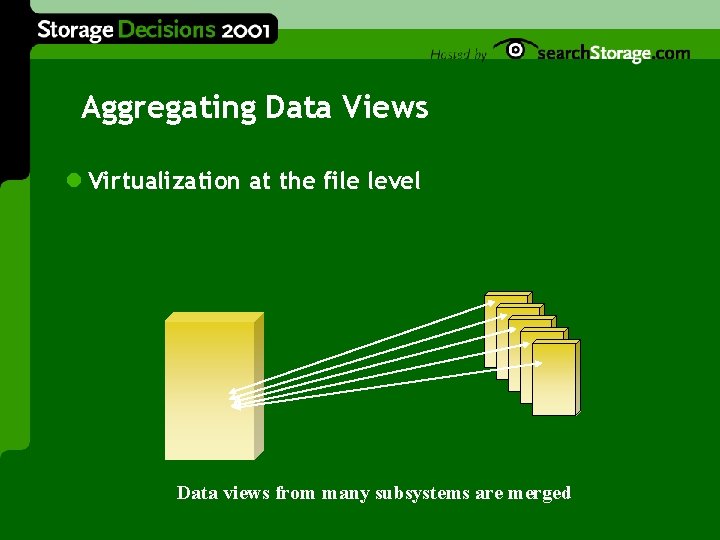
Aggregating Data Views l Virtualization at the file level Data views from many subsystems are merged
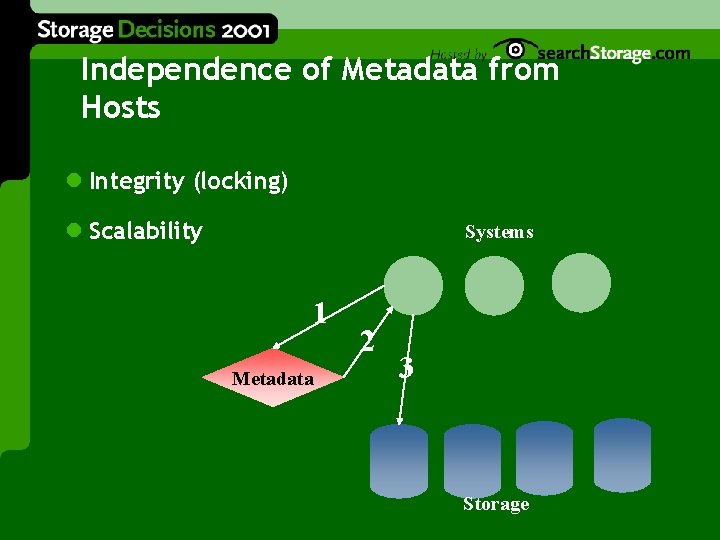
Independence of Metadata from Hosts l Integrity (locking) l Scalability Systems 1 Metadata 2 3 Storage
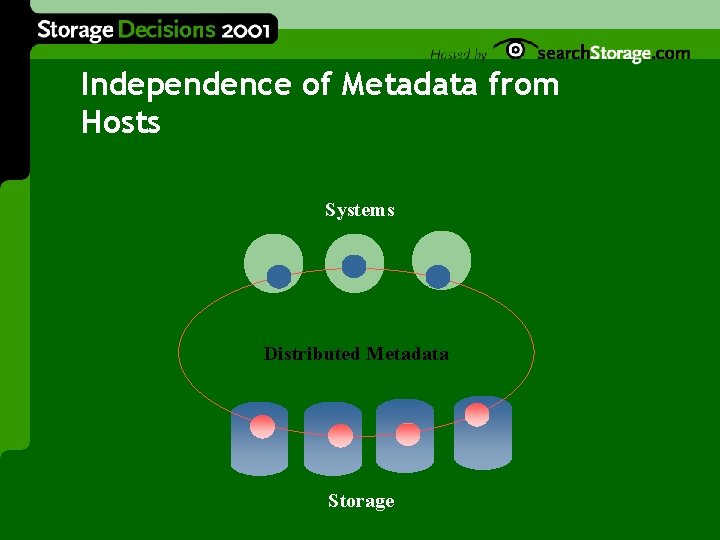
Independence of Metadata from Hosts Systems Distributed Metadata Storage
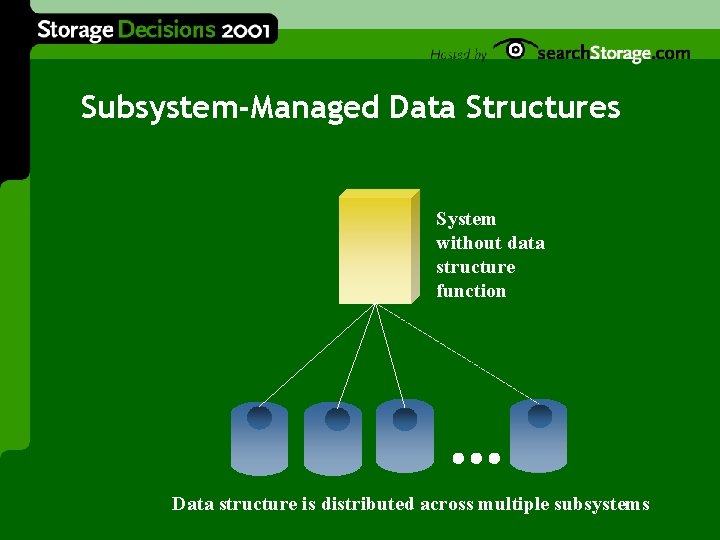
Subsystem-Managed Data Structures System without data structure function Data structure is distributed across multiple subsystems
- Slides: 36