
Beyond Moores Law Spencer Anderson 13 April 2015
Beyond Moore's Law Spencer Anderson 13 - April- 2015 Moore's Law has both theoretical and practical limits. Most practical limits (e. g. energy, spatial) are far removed from theoretical limits, with considerable room for improvement. By using new arhitectures, methods and materials (e. g. dark silicon, Ga. As), these current limits can be surpassed. Moore's Law will continue to advance for the foreseeable future.
Overview Theoretical and practical limits of computing – Current practical limits of Moore's Law – Technological vs ultimate limits Design limits, connection limits, energy limits Emergent solutions to current limitations – New design/manufacturing methods, new materials
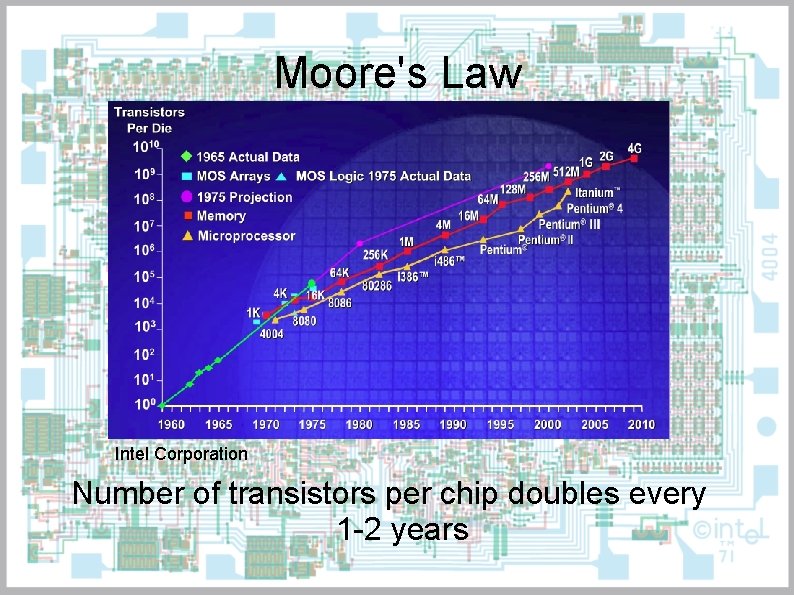
Moore's Law Intel Corporation Number of transistors per chip doubles every 1 -2 years
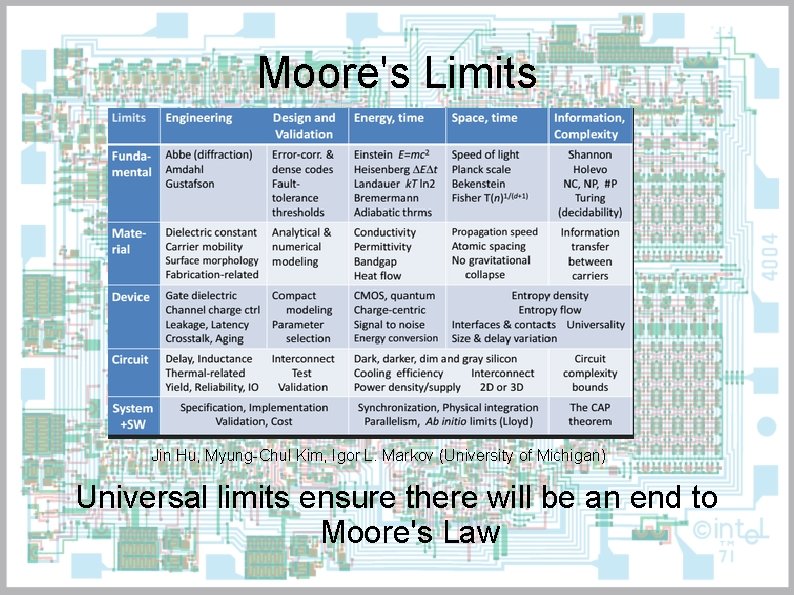
Moore's Limits Jin Hu, Myung-Chul Kim, Igor L. Markov (University of Michigan) Universal limits ensure there will be an end to Moore's Law
Limits of the Limits "Some limits are hopelessly loose and can be ignored, while other limits remain conjectural and are based on empirical evidence only; these may be very difficult to establish rigorously. " - Markov, I. (2014, August 14). Limits on fundamental limits to computation. Nature. There is still considerable room for improvement
Three Big Limits Design and Manufacturing Speed of Light Material limits, design methodology Imposes size/speed trade-off Power Management Inefficiency adds up
Today's Solutions Design Changes Interconnection Improvements Parallel processing, active power management, new computer architectures Layout optimization, optical transmission New Materials Gallium arsenide, carbon
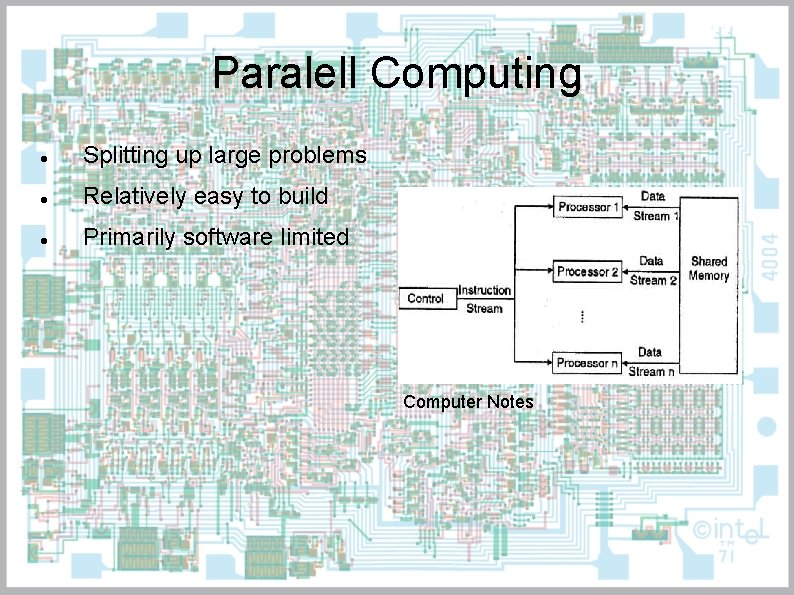
Paralell Computing Splitting up large problems Relatively easy to build Primarily software limited Computer Notes
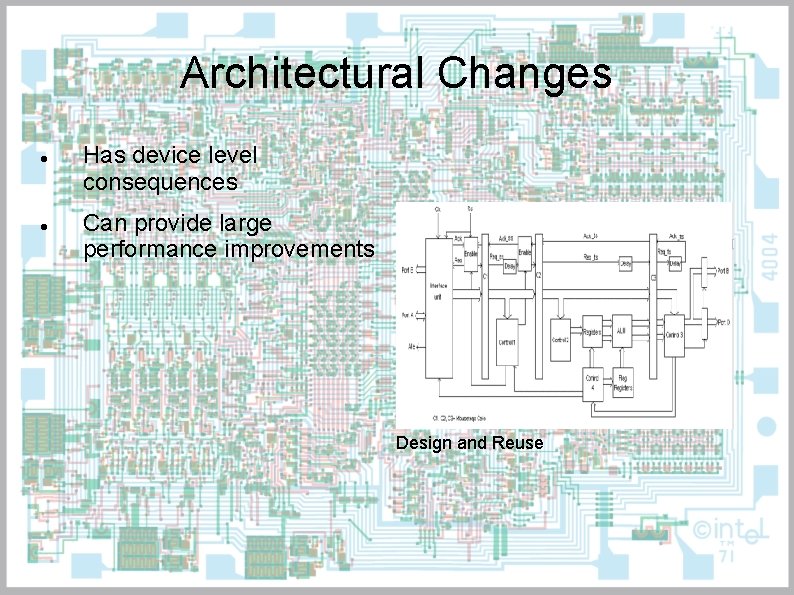
Architectural Changes Has device level consequences Can provide large performance improvements Design and Reuse
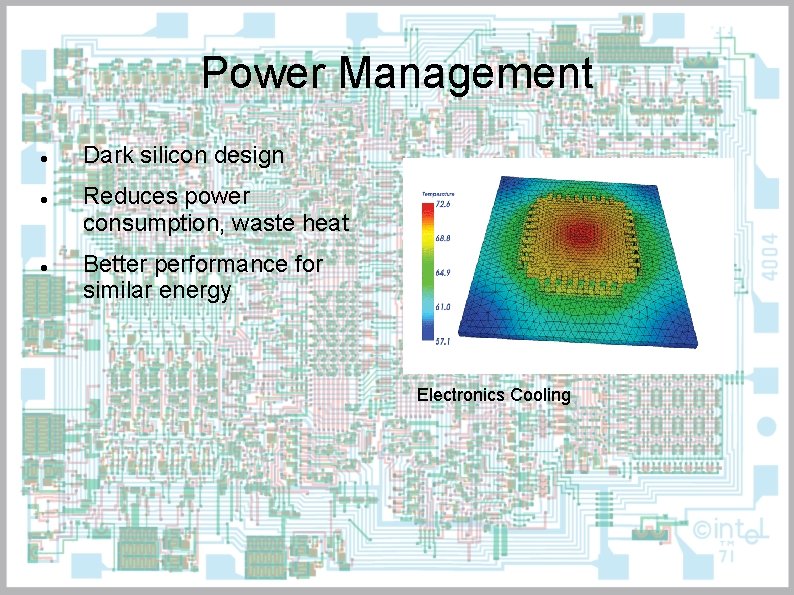
Power Management Dark silicon design Reduces power consumption, waste heat Better performance for similar energy Electronics Cooling
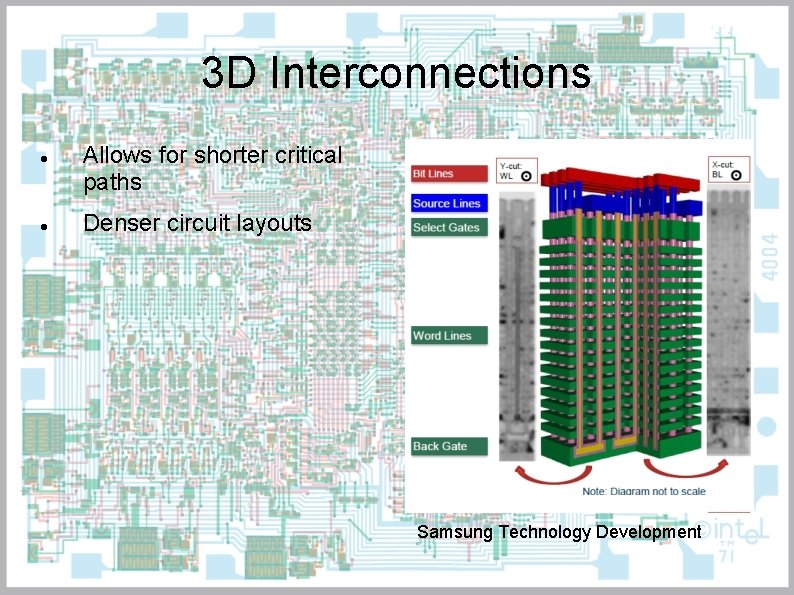
3 D Interconnections Allows for shorter critical paths Denser circuit layouts Samsung Technology Development
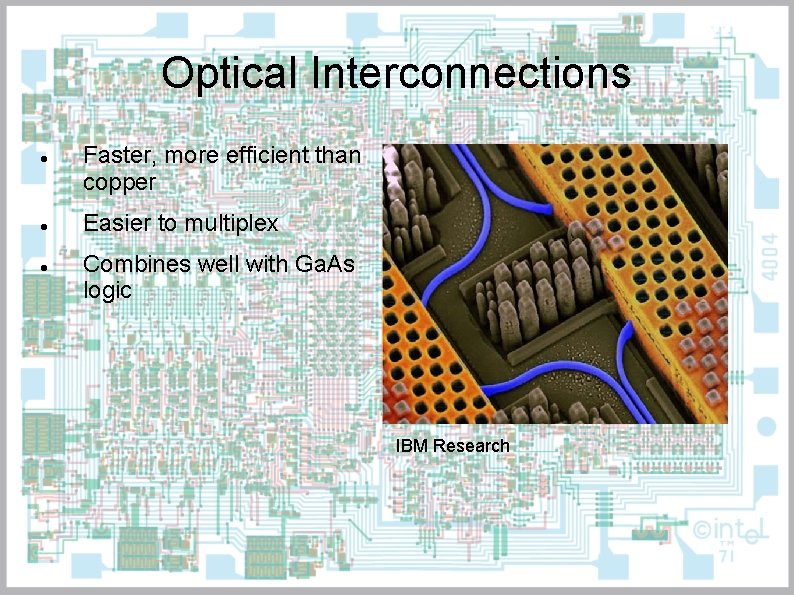
Optical Interconnections Faster, more efficient than copper Easier to multiplex Combines well with Ga. As logic IBM Research
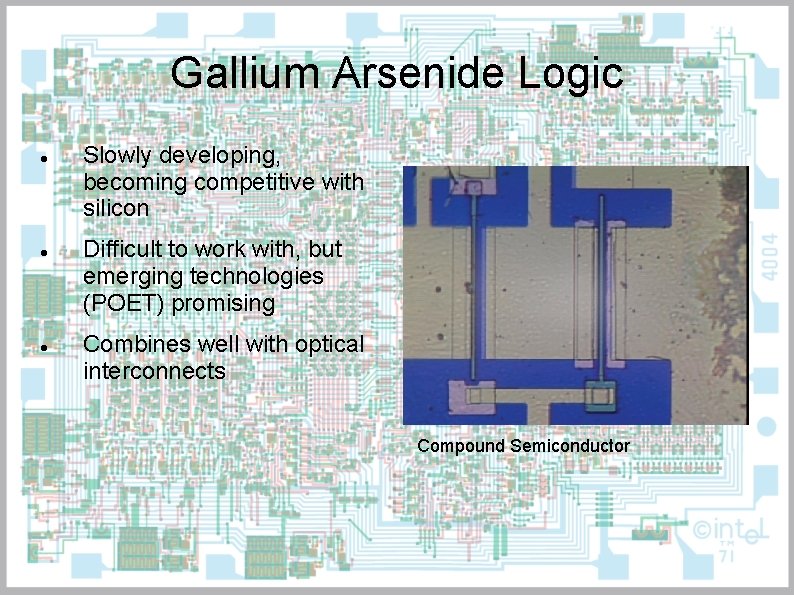
Gallium Arsenide Logic Slowly developing, becoming competitive with silicon Difficult to work with, but emerging technologies (POET) promising Combines well with optical interconnects Compound Semiconductor
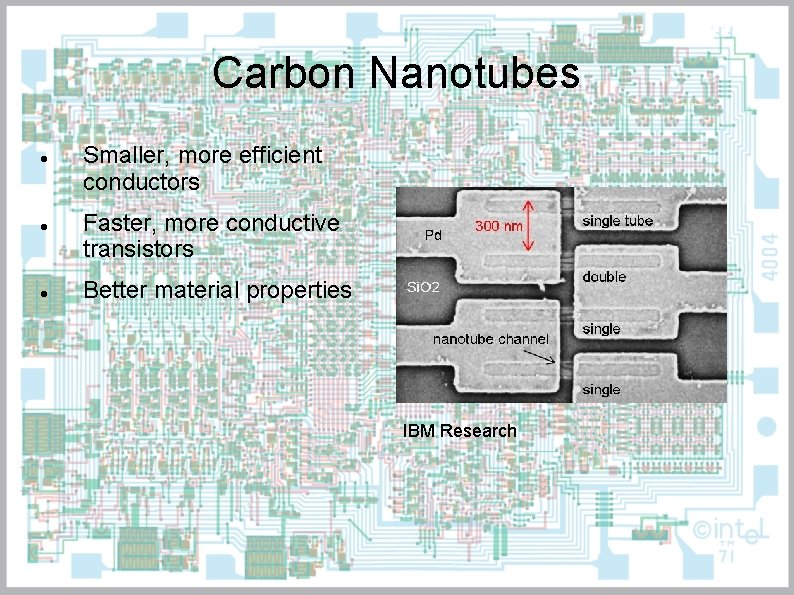
Carbon Nanotubes Smaller, more efficient conductors Faster, more conductive transistors Better material properties IBM Research
Conclusions The ultimate limits of Moore's Law have not yet been reached. Improvements have been occurring across all fronts Moore's Law will continue for at least several decades Computers can still improve in areas not governed by Moore's Law
References Markov, Igor. "Limits on Fundamental Limits to Computation. " Nature (2014). Web. 9 Apr. 2015. Kish, Lazlo. "End of Moore's Law: Thermal (noise) Death of Integration in Micro and Nano Electronics. " Physics Letters A (2002). Print. "IBM Betting Carbon Nanotubes Can Restore Moore’s Law by 2020. " Extreme Tech. 5 July 2014. Web. 15 Apr. 2015. <http: //www. extremetech. com/computing/185688 -ibm-betting-carbon-nanotubescan-restore-moores-law-by-2020>. Taylor, Geoffery. "Ga. As: The Logical Successor to CMOS. " Compound Semiconductors. 21 July 2014. Web. 15 Apr. 2015. <http: //www. compoundsemiconductor. net/article/94567 -gaas-the-logicalsuccessor-to-cmos. html> Pedram, M. , & Nazarian, S. (2006). Thermal Modeling, Analysis and Management in VLSI Circuits: Principles and Methods. Abate, T. (2014, December 15). Stanford team combines logic, memory to build a 'high-rise' chip. Retrieved April 12, 2015, from http: //engineering. stanford. edu/news/stanford-team-combines-logicmemory-build-high-rise-chip
Key Concepts Moore's Law has several theoretical limits that have not been reached Computational limits are not necessarily bounded to Moore's Law High level design can have large consequences at the device level Device size is not always the most relevant limitation Most new semiconductor technologies can and will be used to improve digital logic
- Slides: 17