
Beyond Medical Ethics at the End of Life

Beyond Medical Ethics at the End of Life James Hallenbeck, MD
Goals z. Review major principles of Western medical ethics z. Discuss problems with advance directive decision making z. Suggest a conceptual framework for considering cultural issues that may be a work
Major Principles of Medical ethics z. Autonomy z. Beneficence z. Nonmaleficence z. Justice
Advance Directive Decision Making- key concepts. . . z. Surrogate Decision making z. Substituted Judgment Where did these ideas come from? What values do they reflect? Does everybody share these values?

Medical ethics and Advance Directives z. Priority on autonomy reflects the value of individualism in Western society z. Unclear how many Americans share this value system

Advance Directives z. A problem for autonomyy. Question: How can you act autonomously when you are in a coma? y. Answer: Surrogate decision making.
Advance Directives z. Few Americans filled out advance directives z. Doctors didn’t seem to pay much attention to them z. Solution: Patient Self. Determination Act of 1990 y. Requires health care facilities to raise the issue of advanced directives with patients on admission
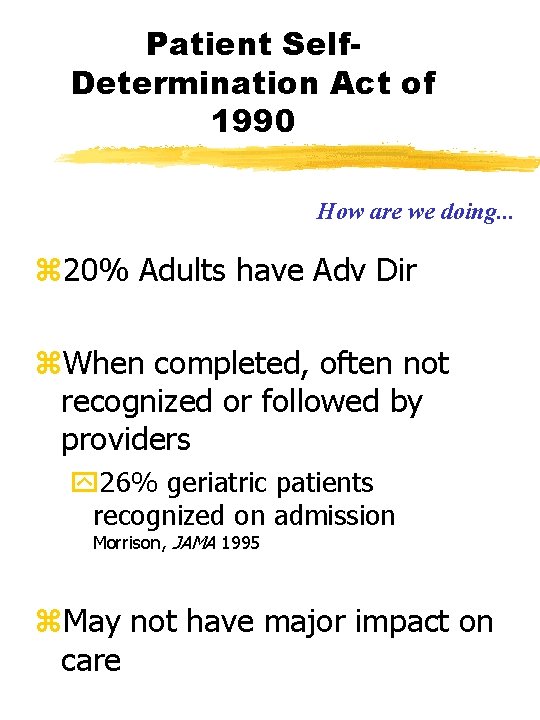
Patient Self. Determination Act of 1990 How are we doing. . . z 20% Adults have Adv Dir z. When completed, often not recognized or followed by providers y 26% geriatric patients recognized on admission Morrison, JAMA 1995 z. May not have major impact on care
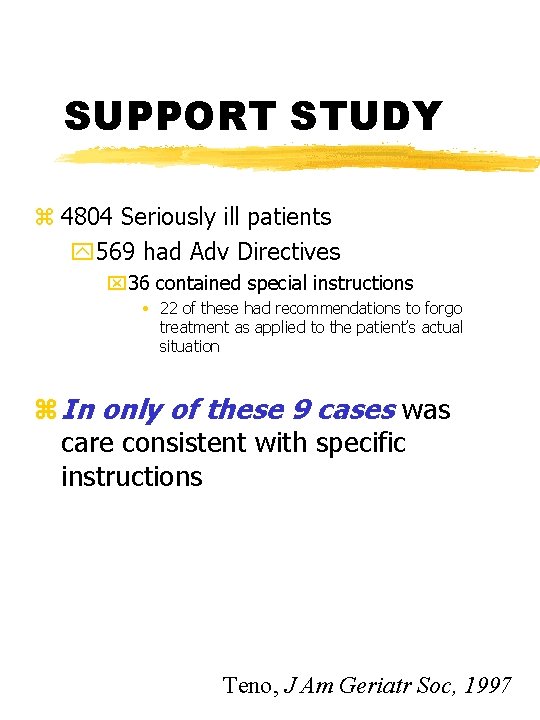
SUPPORT STUDY z 4804 Seriously ill patients y 569 had Adv Directives x 36 contained special instructions • 22 of these had recommendations to forgo treatment as applied to the patient’s actual situation z In only of these 9 cases was care consistent with specific instructions Teno, J Am Geriatr Soc, 1997
Cultural Issues at the End-of-Life z. Cultural sub-groups come into contact in the provision of care z. Sub-groups unable to “provide for their own” z. Patients, families and providers prevented from acting autonomously z. The stakes are high y. Issues addressed at EOL at core of cultural values y. Big bucks
Situation- Patient doing poorly in ICU z. Patient on ventilator, but unlikely to survive z. Patient sedated/unable to speak for self z. You believe extubation and comfort care would be most appropriate z. You go to talk with patient’s spouse about this
Possible reasons for asking that everything be done z. Denial z. Language or communication barrier z. Different value system
Value System #1 z. Don’t share believe in futility y. Futility seen as test of faith z. May place greater value on life -preservation than comfort per se z. Distrust of medical system y. Fear of discrimination
Value System #2 - Role Obligation z. Belief that the greatest good occurs if one is true to one’s role z. Role obligation makes substituted judgment a difficult concept z. May value interdependence over independence
Cultural Competence z. Learn about differences in groups commonly encountered z. Reflection on one’s own culture z. Resources to assist y. Cultural guides y. Texts z. Communication/Negotiation skills
SUMMARY “Advance care planning will occur infrequently as long as patients, potential proxy decision makers, and clinicians fail to understand their intent, do not accept the underlying values behind their use, find it difficult to discuss this topic, and have no access to the mechanisms for accomplishing the communication or directive. ” Perlman, Hastings C Report, 1994
- Slides: 16