
Beyond ITIL To BS 15000 How Did It
Beyond ITIL To BS 15000
How Did It Start BS 15000 is the world's first formal standard for IT Service Management developed by the British Standards Institute. • BS 15000 grew from ITIL and the need to demonstrate conformance with best practice. • Developed by BSi as part of their guidance on IT Service Management. • Designed form the beginning to fit in with ITIL, by many of the same people who were rewriting ITIL at the time.
What Is BS 15000 The heart of BS 15000 is some 6½ pages of carefully chosen words. These words set out to define and delineate what things an organisation must to do in order to deliver and support IT services for its customers, be they internal or external customers. It was developed by the British Standards Institution (BSi), initially in 2000, and has now been revamped and released as part of a larger integrated family of IT Service management publications.
What Is BS 15000 The “Scheme” • The BS 15000 certification scheme was formally launched on 1 st July 2003. • The scheme is owned and administered by IT Service Management Forum (it. SMF). • The it. SMF accredits auditing organisations to assess certification of an IT service provider against the requirements of BS 15000.
What Is BS 15000 itself consists of two parts. Part 1 is the formal standard, this sets out what an organisation is required to do for compliance and to achieve certification against that standard. Also available is the PD 0015 workbook – a self service assessment workbook for companies wishing to achieve BS 15000.
What Is BS 15000 The specification defines the requirements for an organisation to deliver managed services of an acceptable quality for it’s customers. It documents a list of objectives and controls that an organisation may require to meet their business needs.
What Is BS 15000 Part 2, known as the ‘Code of Practice’ expands upon the bare requirement, offering expansion and guidance to service providers who wish to achieve the standard. It follows the same base structure as Part 1 but in less formal terminology, expanding where appropriate. It describes the Best Practices for service management processes within the scope of BS 15000 -1
Why BS 15000 Gartner’s View : “BS 15000 certification should be much more indicative of quality and performance in IT Services Management than ISO 9001: 2000. This is because it will be much tougher to obtain certification and therefore would be more valued because of its direct relevance” - Gartner, July 2003
Why BS 15000 What are the key business drivers of the standard? : - • To provide a formal and auditable standard for the delivery of IT Services within an organisation. • To reinforce and provide formal accreditation based on the best practice as defined by the existing BSI Code of Practice for IT Service Management (PD 0005) and the Internationally adopted IT infrastructure Library (ITIL) best practice guidance. • To be the foundation of a future ISO international standard.
Why BS 15000 What’s in it for the industry? : - • Greater momentum of industry norms based around ITIL • Common vocabulary and service metrics • Improved consistency in quality of service
Why BS 15000 Why an organisation should look to becoming BS 15000 accredited? : - • • Gain a marketing/competitive edge Potentially required by UK Government Developed to fit in with ISO 9000 family Gartner sees a bright future for the standard, predicting a significant proportion of end-user (40%+) IT organisations seeking conformance by 2008

Why BS 15000 What does achieving certification mean? Demonstration of • The Provision of High Quality IT Service • Commitment to Service Management • Understanding of Best Practice • Implementation of Best Practice • Ongoing Maintenance of Best Practice
Why BS 15000 What about the future? • No competing international standards therefore Gartner believe it is very likely that BS 15000 will be put forward to the International Organisation for Standardization (ISO) for it to become an ISO standard in its own right or as part of ISO 9001.
What is involved? Typically an organisation will need to: • Demonstrate to their own satisfaction that they have appropriate evidence of conformance to the Standard • Obtain an outside view prior to the audit – either external Consultant or Internal Audit Team • Arrange and participate in the formal audit
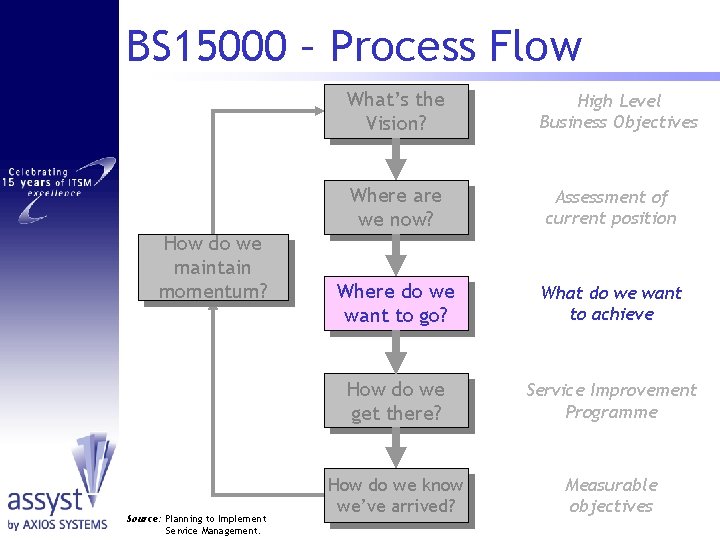
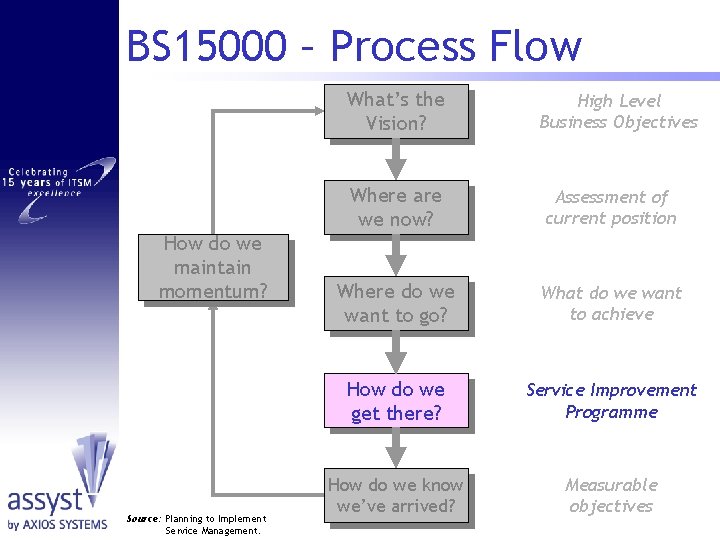
The BS 15000 Journey • • What’s the Vision? Where are we now? Where do we want to go? How do we get there? How do we know we’ve arrived? How do we maintain momentum? Planning BS 15000 “To infinity and beyond……”
BS 15000 – For Beginners What’s the current position? What do we want to achieve? How do we get there?
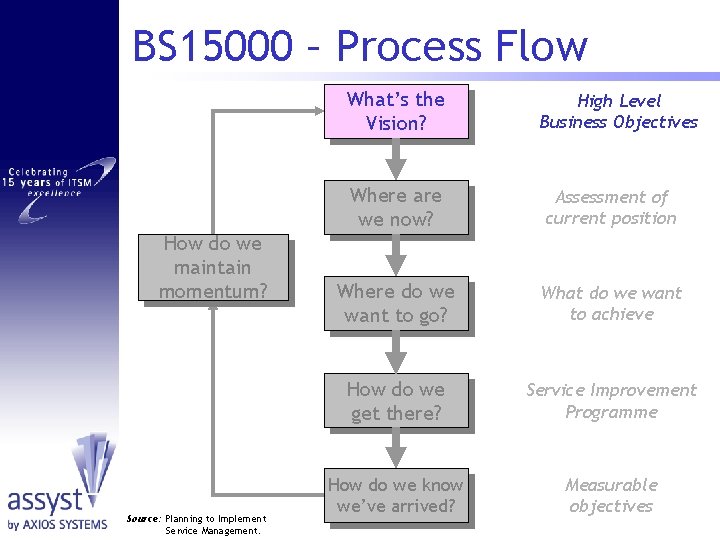
BS 15000 – Process Flow What’s the Vision? How do we maintain momentum? Source: Planning to Implement Service Management. High Level Business Objectives Where are we now? Assessment of current position Where do we want to go? What do we want to achieve How do we get there? Service Improvement Programme How do we know we’ve arrived? Measurable objectives
What’s the Vision? A Service Management vision is mutually agreed between IT and the Business by looking at their forward business objectives. The vision must include all aspects required to realise the vision, People, Processes and Products.
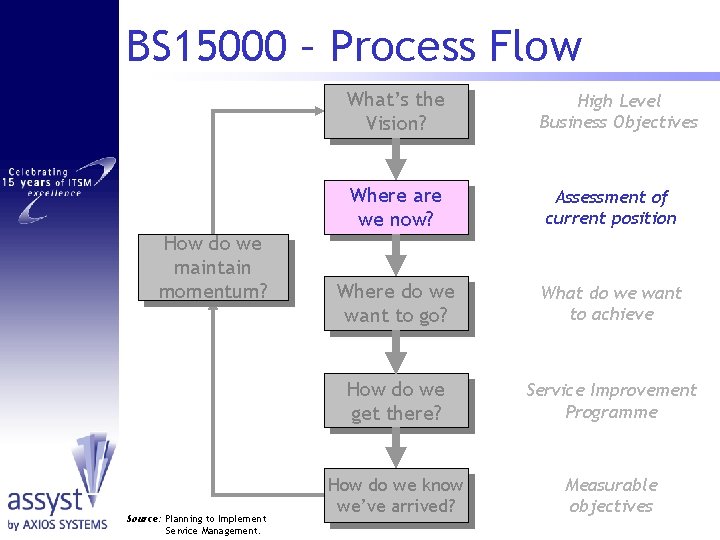
BS 15000 – Process Flow What’s the Vision? How do we maintain momentum? Source: Planning to Implement Service Management. High Level Business Objectives Where are we now? Assessment of current position Where do we want to go? What do we want to achieve How do we get there? Service Improvement Programme How do we know we’ve arrived? Measurable objectives
Where Are We Now? • Operation maturity – – Compare process philosophy with ITIL Identify skill levels Establish depth of documentation Establish awareness • Current Performance – Product metrics – Service Level Agreements • Customer Satisfaction – Surveys – Liaison meetings
Potential Barriers • • • Budget Are appropriate processes in place? Are the right skill sets available? Will technology permit progress? Does the organisation culture encourage change? • How far are we from where we expected to be? • Is the IT organisation focused on the Business?
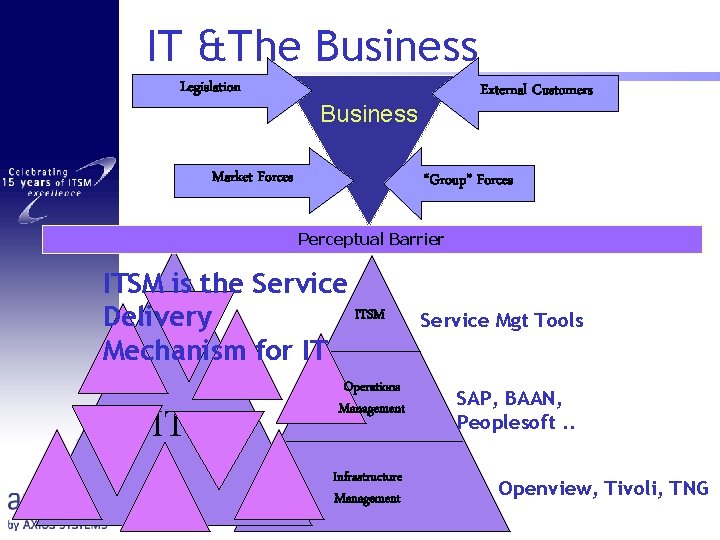
IT &The Business Legislation External Customers Business Market Forces “Group” Forces Perceptual Barrier ITSM is the Service ITSM Delivery Mechanism for IT IT Operations Management Infrastructure Management Service Mgt Tools SAP, BAAN, Peoplesoft. . Openview, Tivoli, TNG
BS 15000 – Process Flow What’s the Vision? How do we maintain momentum? Source: Planning to Implement Service Management. High Level Business Objectives Where are we now? Assessment of current position Where do we want to go? What do we want to achieve How do we get there? Service Improvement Programme How do we know we’ve arrived? Measurable objectives
What We Want To Achieve
BS 15000 – Process Flow What’s the Vision? How do we maintain momentum? Source: Planning to Implement Service Management. High Level Business Objectives Where are we now? Assessment of current position Where do we want to go? What do we want to achieve How do we get there? Service Improvement Programme How do we know we’ve arrived? Measurable objectives
How is the journey managed? • Imperative to effectively manage the project • Identified Project Manager • Defined Project organisation • Issues identified and resolved • Resources need to be available • Regular progress reports
Communication • • • Awareness campaign Keep people informed Outline reasons and benefits Use all available methods Throughout the project Encourage feedback and comments
Organisational Change • The SIP will cross many organisational boundaries • It may also result in people working differently and even doing different jobs • Even the best plan will suffer if these are not taken into account • This is why gaining commitment, motivation, involvement and communication are so important • These aspects can reduce the resistance to the changes
Cultural Change • The SIP will also have an impact on the Culture of the organisation • It will change values, beliefs and practices shared within the organisation • Again, many people will be resistant to these changes • It is important to discuss these issues and reiterate the benefits of the programme
Training • If process and products are changing, people will need training • Identify people affected • Identify best training approach, class, self-learning, external etc • Plan for the training
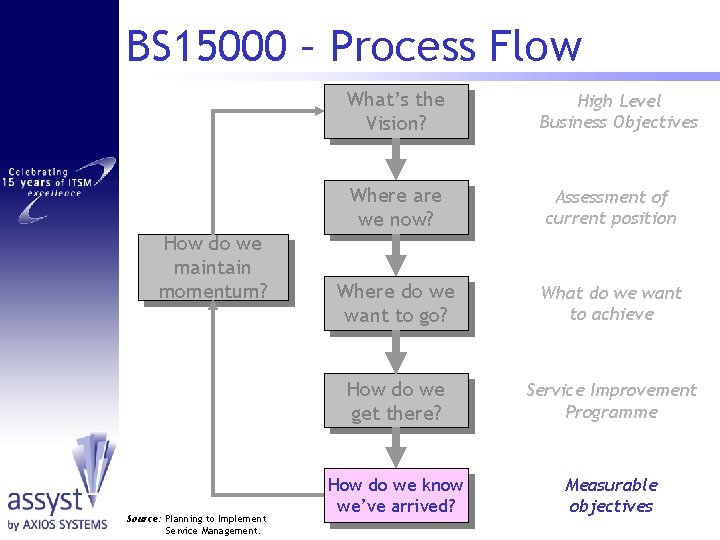
BS 15000 – Process Flow What’s the Vision? How do we maintain momentum? Source: Planning to Implement Service Management. High Level Business Objectives Where are we now? Assessment of current position Where do we want to go? What do we want to achieve How do we get there? Service Improvement Programme How do we know we’ve arrived? Measurable objectives
Arrival After our careful planning and exhausting journey, how do we know we have arrived at the correct destination?
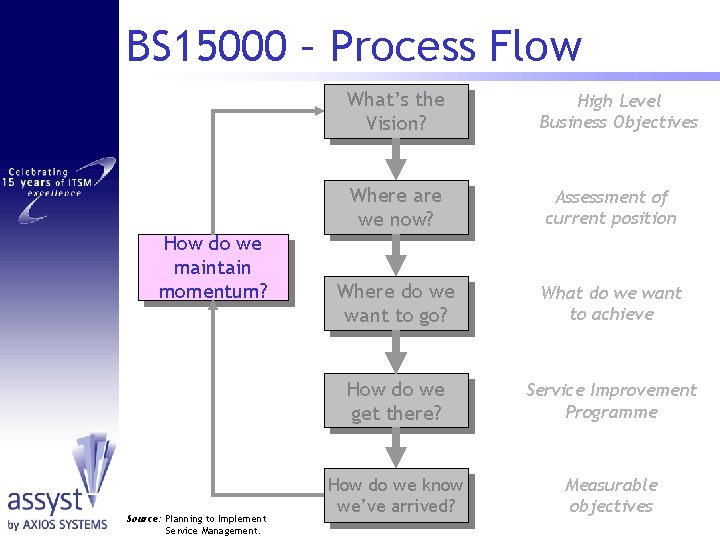
BS 15000 – Process Flow What’s the Vision? How do we maintain momentum? Source: Planning to Implement Service Management. High Level Business Objectives Where are we now? Assessment of current position Where do we want to go? What do we want to achieve How do we get there? Service Improvement Programme How do we know we’ve arrived? Measurable objectives
Maintaining Momentum Once we have achieved our goals, how do we ensure we maintain them? We may have arrived at the correct destination, but how do we stop ourselves ending back up where we started?
Momentum Issues • • • Initial enthusiasm quickly vanishes Perceived lack of success Business “fashions” change Technology advances impact programme Loss of “Champions” Resistance to change re-surfaces
Maintaining Momentum • Continuous measurement • Regular reports • Shout about success • Continued improvement • Staff motivation • Constantly reinforce message • Retain focus
Achieving BS 15000 • Assessing your current practices. • Comparing that with BS 15000 process requirements. • Documenting and understanding the differences. • Closing the gap. • Being audited for compliance • Having the party. • Maintaining that compliance
Demonstrating Conformance The auditors will need to be satisfied that : • The relevant processes exist within the organisation • The processes are documented in appropriate procedures • All relevant staff have access to, understand follow those procedures
Demonstrating Conformance Traditionally , within the ISO 9000 certification process, most of the demonstration of conformance has rested upon supporting documentation. Within BS 15000 much of the evidence can be supported by the proper implementation of a fully integrated Service Management tool.
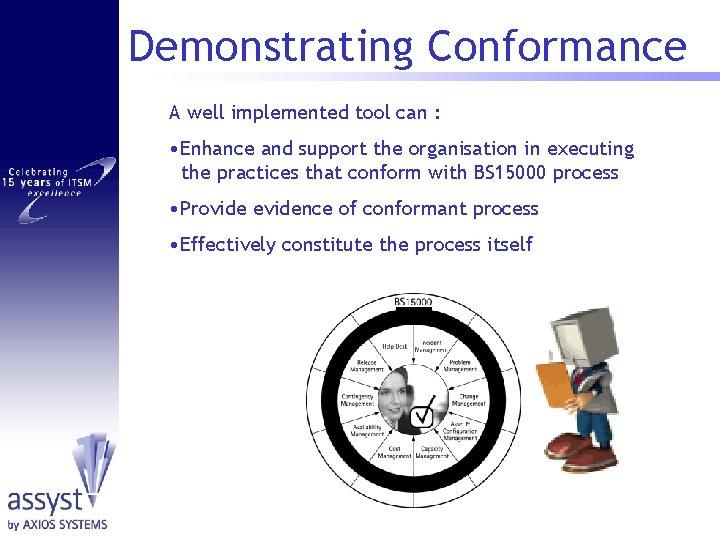
Demonstrating Conformance A well implemented tool can : • Enhance and support the organisation in executing the practices that conform with BS 15000 process • Provide evidence of conformant process • Effectively constitute the process itself
What Is BS 15000 Incident Management - Specification Objective: to restore agreed service to the business as soon as possible or to respond to service requests. All incidents shall be recorded. Procedures shall be adopted to manage the impact of service incidents.
What Is BS 15000 Incident Management - Specification Procedures shall define the : • Recording • Prioritisation • Business Impact • Classification • Updating • Escalation • Resolution and formal closure of all incidents
What Is BS 15000 Incident Management - Specification The customer shall be kept informed of the progress of their reported incident or service request and alerted in advance if their service levels cannot be met and an action agreed. All staff involved in incident management shall have access to relevant information such as : • Known errors • Problem resolutions • Configuration Management Database
What Is BS 15000 Incident Management – Code of Practice Objective : to restore normal service as soon as possible in order to minimise business disruption. Incident management should be : • Both a proactive and reactive process, responding to incidents that affect , or potentially could affect the service. • Be concerned with the restoration of the customers’ service, not with determining the cause of the incidents.
What Is BS 15000 Incident Management – Code of Practice The Incident management process should include : • Call reception, recording, priority assignment, classification. • First line resolution or referral. • Consideration of security issues. • Incident tracking & lifecycle management. • Incident verification & closure. • First line customer liaison. • Escalation.
What Is BS 15000 Incident Management – Code of Practice The record closure procedure should include checking to ensure that : • Details of resolution have been accurately logged. • The cause is categorised to facilitate analysis. • Both customer & support staff are aware of the resolution. • The customer agrees that the resolution has been achieved. • If a resolution is not to be achieved or not possible, the customer is informed.
How Can A Tool Help? BS 15000 also requires that service Incidents are effectively managed and customers kept informed of the progress of Incidents. In line with the BS 15000 standard a tool should allow incidents to be : • Tracked • Meaningfully Updated for tends and reporting • Measured against SLA targets • Escalated with appropriate notification to Users • Re-assigned based on working procedures • State Changed to Problem, Known Error and Change • Formally Resolved and Closed
How Can A Tool Help? BS 15000 also requires that staff managing incidents have access to all relevant information. The Tool should have : • A comprehensive Knowledgebase • “Similar” matching functionality for • Incidents • Problems • Known Errors • An internal Configuration Management Database
How Can A TOOL Help? BS 15000 also requires that all Changes should be recorded and classified. It also requires that the change process will control : • The approval • The implementation • The review • The ability to reverse or alter the process
How Can A Tool Help? A Tool should also support all of these as well as : • Emergency changes • CAB assessment • Forward schedule of change/change calendar • Strategic decision points to control the direction and content of the process • The ability to dynamically alter the assigned or authorising user or support teams • Complaints process • Control of Configuration Items
How Can A Tool Help? Configuration management objective: To define and control the components of the service and infrastructure and maintain accurate configuration information.
How Can A Tool Help? The CMDB should hold details of all C. I. s and their components including a Service Catalogue. It also maintains records of the C. I. s : • Physical and Organisational details • Financial and SLA details • Maintenance and Supplier contracts • Movement history • Relationships with other C. I. s for impact assessment • Ongoing costs and current status.
How Can A Tool Help? Service Level Management objective: To define , agree, record and manage levels of service
How Can A Tool Help? The Tool should record and measure distinct SLAs for each incident , problem or change : • The SLA agreed with the Customer • The OLA within IT • The supplier SLA • Response , resolution and Escalation times for all of these.
How Can A Tool Help? Many of the standard reports available within the Tool should address the BS 15000 requirements in the area of Service Reporting, including : • Performance against service levels • Non compliance and issues, e. g. against the SLA or security breaches • Performance reporting following major events • Trend information based on physical, organisational and product structures • Fault types
Summary We Have Looked At : - • What BS 15000 Is • How It Came About • Why We Should Have It • How We Can Get It • How Can A Tool Help
Beyond ITIL To BS 15000
- Slides: 57