
Beyond Handles The Digital Object Architecture James M
Beyond Handles: The Digital Object Architecture James M. Erwin Defense Technical Information Center 29 January 2003 Corporation for National Research Initiatives
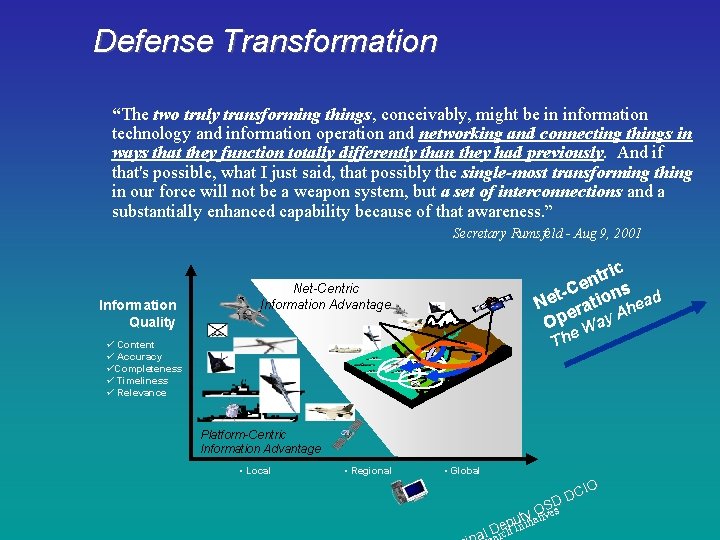
Defense Transformation “The two truly transforming things, conceivably, might be in information technology and information operation and networking and connecting things in ways that they function totally differently than they had previously. And if that's possible, what I just said, that possibly the single-most transforming thing in our force will not be a weapon system, but a set of interconnections and a substantially enhanced capability because of that awareness. ” Secretary Rumsfeld - Aug 9, 2001 Information Quality Net-Centric Information Advantage 61 ter Thea el. MBR ent Hz 8 G 40 elem. Aent /2 R em P 4448 6 el 25 169 T A TP MB Hz 7 G el. ric t n e s d C n t o e i N at Ahea r e Op Way The ü Content ü Accuracy üCompleteness ü Timeliness ü Relevance Platform-Centric Information Advantage • Local • Regional • Global CIO D D OSes y iv pu. Intitiat e l Drch
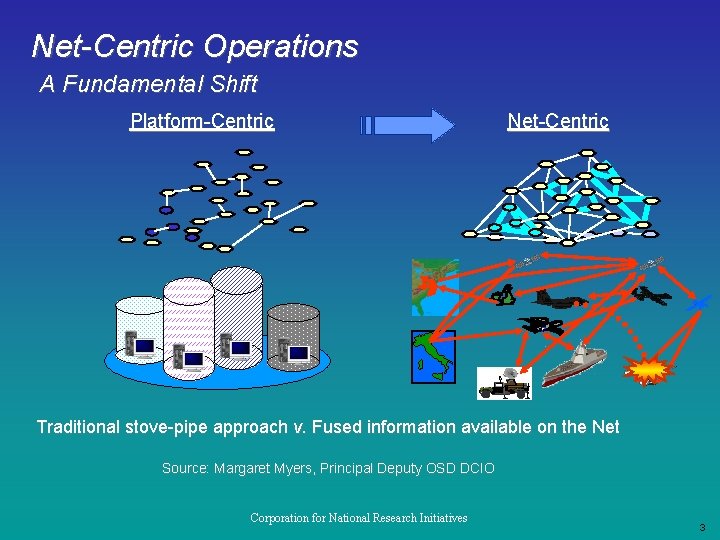
Net-Centric Operations A Fundamental Shift Platform-Centric Net-Centric 533 AF 78 533 Traditional stove-pipe approach v. Fused information available on the Net Source: Margaret Myers, Principal Deputy OSD DCIO Corporation for National Research Initiatives 3
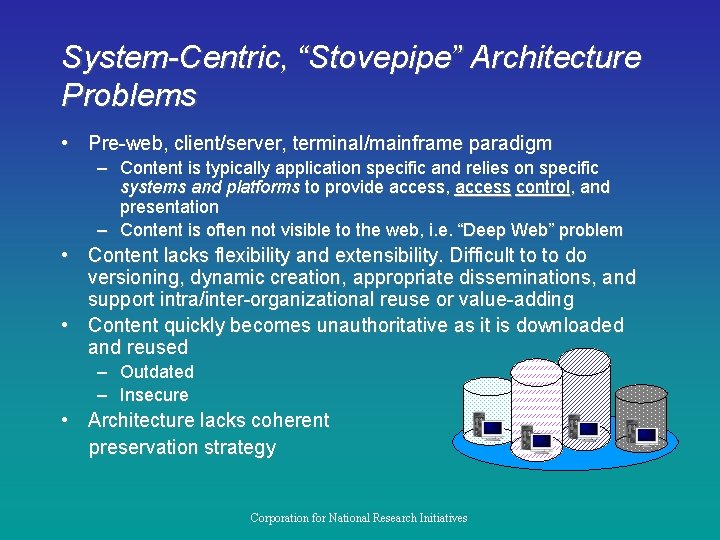
System-Centric, “Stovepipe” Architecture Problems • Pre-web, client/server, terminal/mainframe paradigm – Content is typically application specific and relies on specific systems and platforms to provide access, access control, and presentation – Content is often not visible to the web, i. e. “Deep Web” problem • Content lacks flexibility and extensibility. Difficult to to do versioning, dynamic creation, appropriate disseminations, and support intra/inter-organizational reuse or value-adding • Content quickly becomes unauthoritative as it is downloaded and reused – Outdated – Insecure • Architecture lacks coherent preservation strategy Corporation for National Research Initiatives
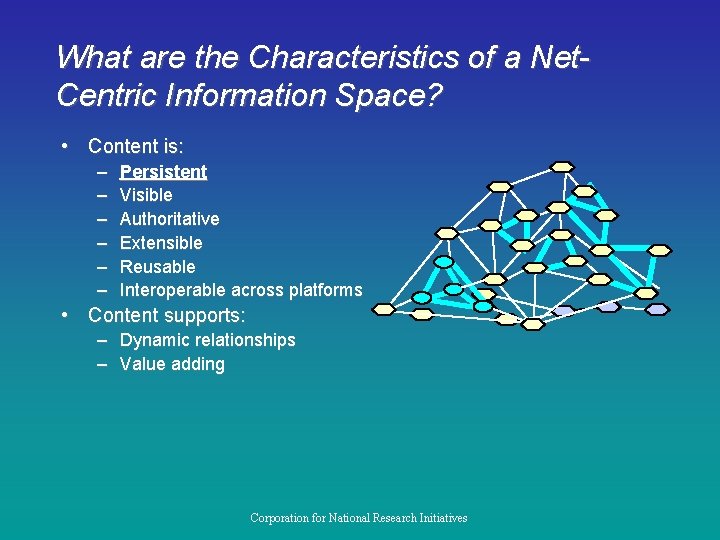
What are the Characteristics of a Net. Centric Information Space? • Content is: – – – Persistent Visible Authoritative Extensible Reusable Interoperable across platforms • Content supports: – Dynamic relationships – Value adding Corporation for National Research Initiatives
Digital Object Architecture • Network paradigm – Content is not application specific and does not rely on specific systems and platforms to provide access, access control, and presentation – Content can easily be made visible to the web • Content is flexible and extensible – Lends itself to versioning, dynamic creation, appropriate disseminations, and intra/inter-organizational reuse – Supports the establishment of content relationships – Is networkable across system/organizational boundaries – Content remains authoritative as it is accessed and reused – Supports coherent preservation strategies Corporation for National Research Initiatives
Digital Object Architecture Components Digital Objects l Persistently identified l Self contained - Self described - Self aware l Integral access control l Extensible Repositories l Contain digital objects l Are, themselves, digital objects l Repository Access Protocol (RAP) l Platform independent Handle System l Persistent identification l Distributed Architecture Resource Discovery l Search engines l Databases l Digital information l Digital objects Corporation for National Research Initiatives
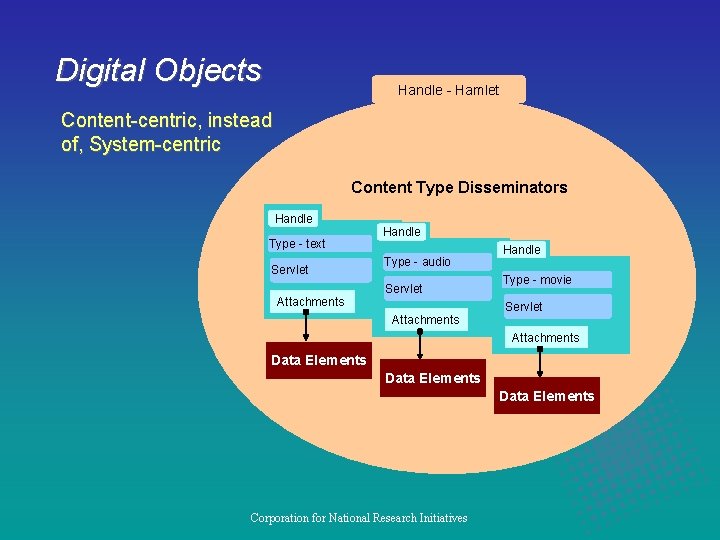
Digital Objects Handle - Hamlet Content-centric, instead of, System-centric Content Type Disseminators Handle Type - text Servlet Attachments Handle Type - audio Servlet Attachments Handle Type - movie Servlet Attachments Data Elements Corporation for National Research Initiatives
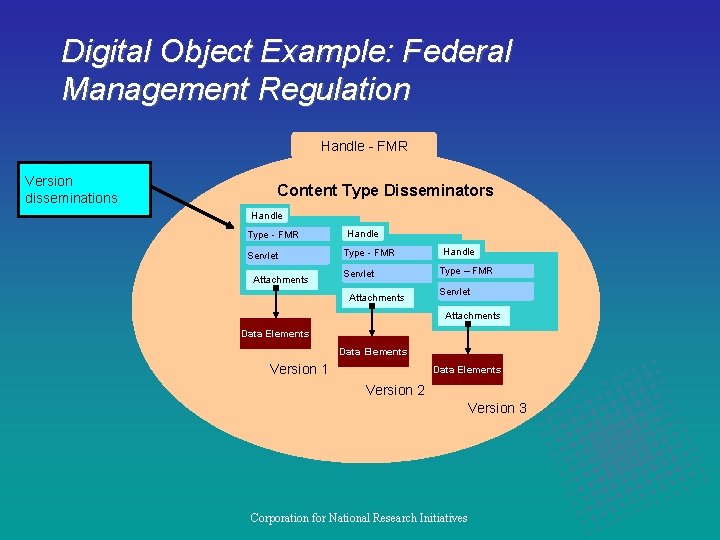
Digital Object Example: Federal Management Regulation Handle - FMR Version disseminations Content Type Disseminators Handle Type - FMR Servlet Attachments Handle Type – FMR Servlet Attachments Data Elements Version 1 Data Elements Version 2 Version 3 Corporation for National Research Initiatives
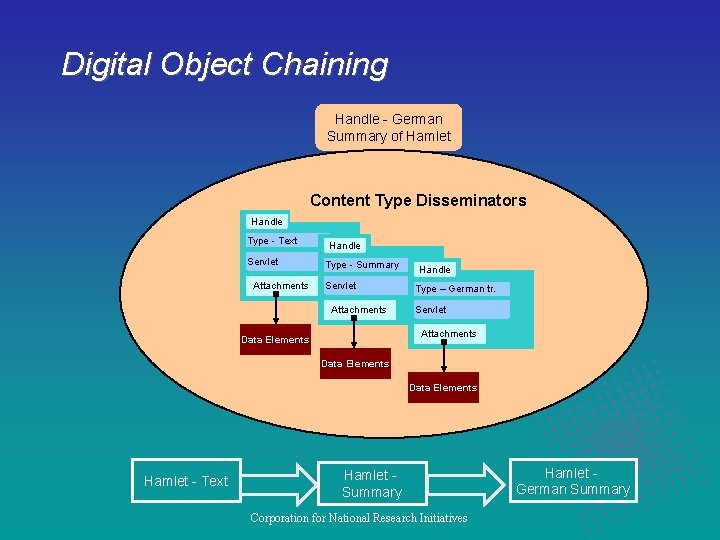
Digital Object Chaining Handle - German Summary of Hamlet Content Type Disseminators Content Disseminators Handle Type - Text Servlet Attachments Handle Type - Summary Servlet Attachments Handle Type – German tr. Servlet Attachments Data Elements Hamlet - Text Hamlet Summary Corporation for National Research Initiatives Hamlet German Summary
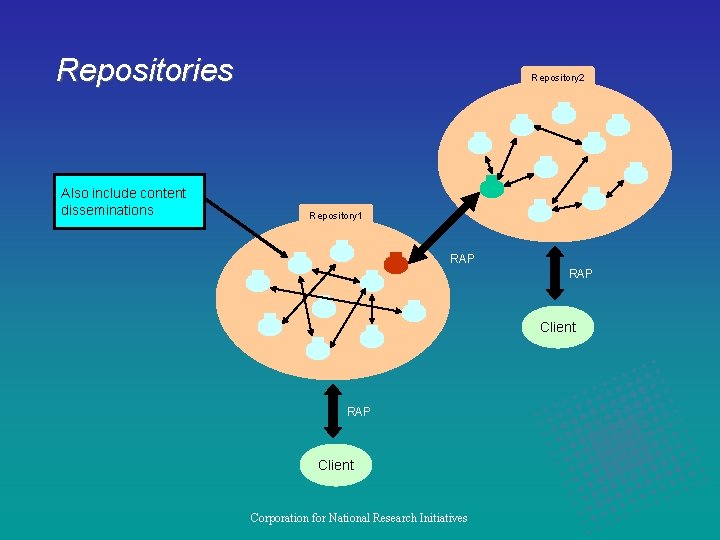
Repositories Also include content disseminations Repository 2 Repository 1 RAP Client Corporation for National Research Initiatives
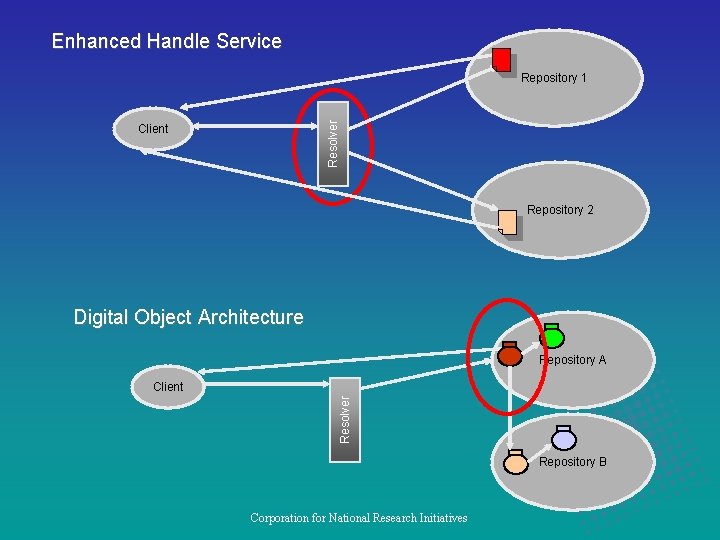
Enhanced Handle Service Resolver Repository 1 Client Repository 2 Digital Object Architecture Repository A Resolver Client Repository B Corporation for National Research Initiatives
Digital Object Architecture Business Case • Provides useful, authoritative, visible, and dynamic access to information – Encourages the innovative, value-added, dynamic and, therefore, effective use of digital information – Provides global visibility/coordination over information – Controls access to information – Reuses generated content, techniques, and disseminations – Preserves information functionality – Discourages generation of multiple, and potentially different, versions of information • Provides interoperability and platform independence • Provides greater security – – Supports real-time access control changes Supports partial dissemination Corporation for National Research Initiatives
What’s Been Done • Handles: – Established Handles infrastructure - CNRI – Established DOIs, registry agencies, and transfer mechanisms for the commercial publishing industry -- CNRI and DOI Foundation – Implemented the DOD Handles Service and Handles Registry for DTIC held unclassified/unlimited technical reports -- DTIC • Digital Object Architecture: – Implemented a prototype Digital Object Repository, i. e. Defense Virtual Library, for technical reports, photographs, sound files, and moving images -- DTIC and CNRI – Successfully tested repository interoperability -- CNRI and Cornell University Corporation for National Research Initiatives
Real Capability • Handles: – Handles reference from STINET http: //stinet. dtic. mil/str/index. html – Handles reference from Naval Postgraduate School http: //library. nps. navy. mil/home/distance. htm – Handles Registry http: //hdl. dtic. mil/wobin/Web. Objects/Handles • Digital Object Architecture – Defense Virtual Library http: //dvl. dtic. mil/ Corporation for National Research Initiatives
What Needs to be Done • Implement an expanded Handles Service – Provide persistent identification of and access to public release and limited information – Provide multiple Handle resolution – Partnership with other government organizations to provide persistent identification of digital information Get persistent control over government information!!! Corporation for National Research Initiatives
What Needs to be Done • Implement Digital Object Architecture – Demonstrate capabilities and benefits of the Digital Object Architecture in a real world environment, e. g. R&D Life Cycle documents, conference proceedings, STI, complex documents, FMRs, Directives and Instructions, and FAR/DFAR – Demonstrate integrated access to multiple information repositories – Develop robust, reusable access control disseminators – Develop digital object based preservation strategies – Develop a metadata registry to support cross-repository information discovery Corporation for National Research Initiatives
Interested in Partnering with DTIC? • Contact – – – Jim Erwin - (703) 767 -9180 Barbara Nekoba (Handles) - (703) 767 -8004 Steve Markheim (Digital Object Architecture) - 767 -8053 • {jerwin; bnekoba; smarkhei}@dtic. mil Corporation for National Research Initiatives
- Slides: 18