
Beyond Fixed Grid Learning Geometric Image Representation with
Beyond Fixed Grid: Learning Geometric Image Representation with a Deformable Grid Jun Gao, Zian Wang , Jinchen Xuan , and Sanja Fidler University of Toronto, Vector Institute, NVIDIA, Peking University 報告人: 陳顗汝 ar. Xiv: 2008. 09269 v 1 [cs. CV] 21 Aug 2020
01 Introduction 02 Related Works 03 Deformable Grid 04 Applications 05 Experiments 06 Conclusion
01 Introduction In modern computer vision approaches, an image is treated as a fixed uniform grid and processed through a deep convolutional neural network. Very high resolution images are typically processed at a lower resolution for increased efficiency, whereby the image is essentially blurred and subsampled. In many of the traditional computer vision pipelines the high resolution image was instead partitioned into a smaller set of superpixels that conform to image boundaries, leading to more effective reasoning in downstream tasks.
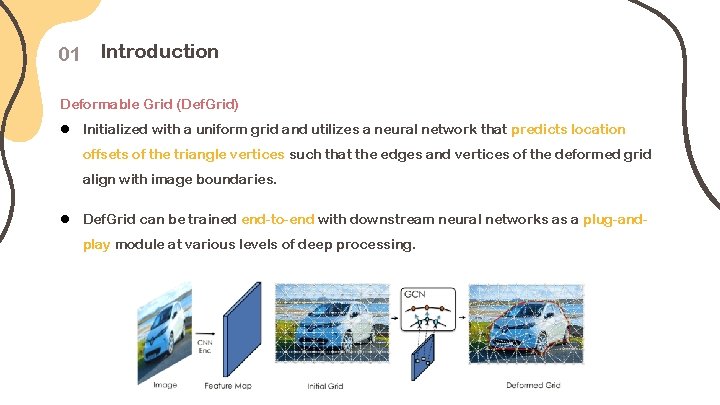
01 Introduction Deformable Grid (Def. Grid) l Initialized with a uniform grid and utilizes a neural network that predicts location offsets of the triangle vertices such that the edges and vertices of the deformed grid align with image boundaries. l Def. Grid can be trained end-to-end with downstream neural networks as a plug-andplay module at various levels of deep processing.
02 Related Works Deformable Structure Deformable convolutions predict position offsets of each cell in the convolutional kernel’s grid with the aim to better capture object deformation. Def. Grid aligns with image boundaries, allows downstream tasks such as object segmentation to perform reasoning directly on the low-dimensional grid.
02 Related Works Image Partitioning l "Superpixel meshes for fast edge-preserving surface reconstruction" used Constrained Delaunay triangulation to get the triangular mesh. l In "Superpixels and polygons using simple non-iterative clustering", a noniterative method was proposed to obtain superpixels, followed by a polygonization method using a contour tracing algorithm. Def. Grid produces a triangular grid that conforms to image boundaries and is end-to-end trainable.
02 Related Works Superpixels l SSN made clustering-based approaches differentiable by softly assigning pixels to superpixels with the exponential function. l SEAL learns superpixels by exploiting segmentation affinities. Both of these methods produce superpixels with highly irregular boundaries and region topology. l Superpixel lattices partition the image recursively, finding horizontal and vertical paths with minimal boundary cost at each iteration. It produces regular grid-like topology. Def. Grid utilizes differentiable operations to predict boundary aligned triangular grids and is end-to-end trainable.
03 Deformable Grid The grid is deformed via a neural network that a predicts position offset for each vertex while ensuring the topology does not change. When the edges of the grid align with image boundaries, the pixels inside each grid cell have minimal variance of RGB values, and vice versa. This paper aim to minimize this variance in a differentiable way with respect to the positions of the vertices, to make it amenable to deep learning.
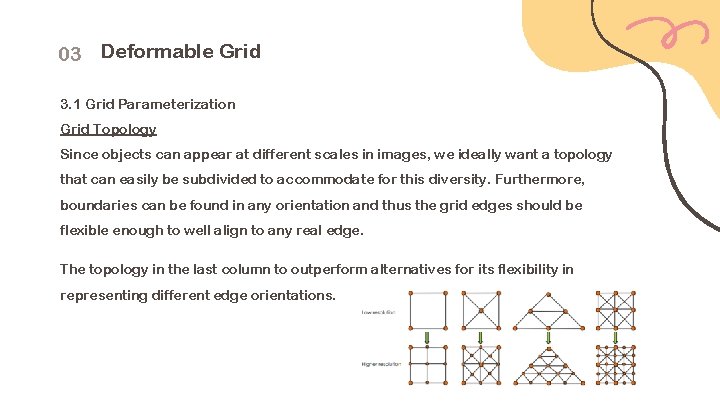
03 Deformable Grid 3. 1 Grid Parameterization Grid Topology Since objects can appear at different scales in images, we ideally want a topology that can easily be subdivided to accommodate for this diversity. Furthermore, boundaries can be found in any orientation and thus the grid edges should be flexible enough to well align to any real edge. The topology in the last column to outperform alternatives for its flexibility in representing different edge orientations.
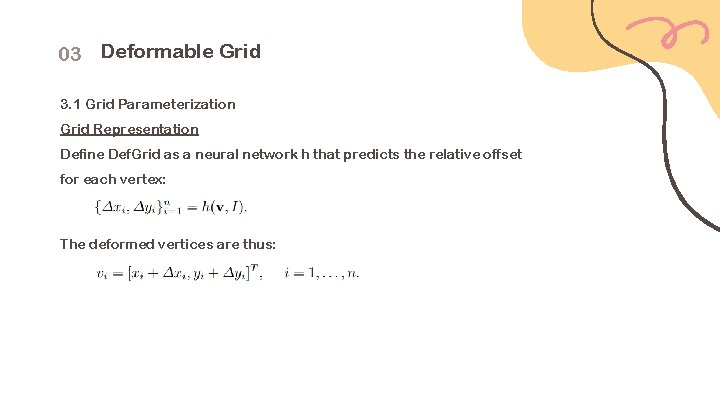
03 Deformable Grid 3. 1 Grid Parameterization Grid Representation Define Def. Grid as a neural network h that predicts the relative offset for each vertex: The deformed vertices are thus:
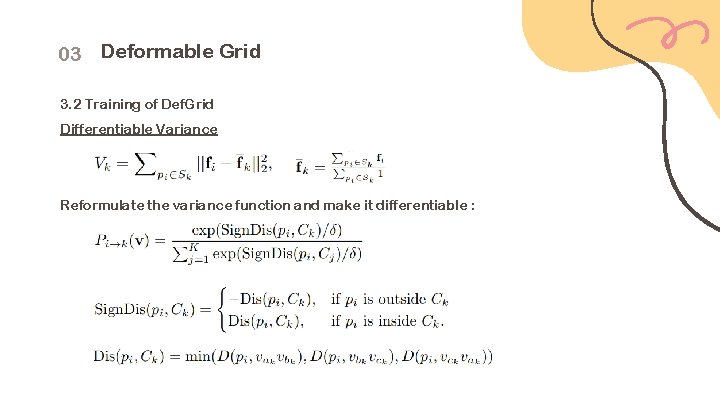
03 Deformable Grid 3. 2 Training of Def. Grid Differentiable Variance Reformulate the variance function and make it differentiable :
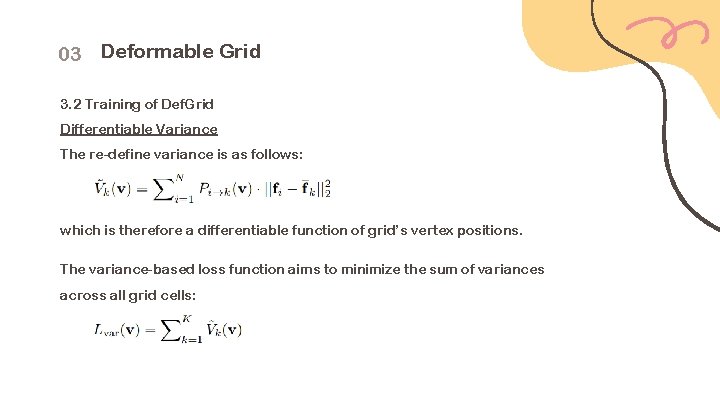
03 Deformable Grid 3. 2 Training of Def. Grid Differentiable Variance The re-define variance is as follows: which is therefore a differentiable function of grid’s vertex positions. The variance-based loss function aims to minimize the sum of variances across all grid cells:
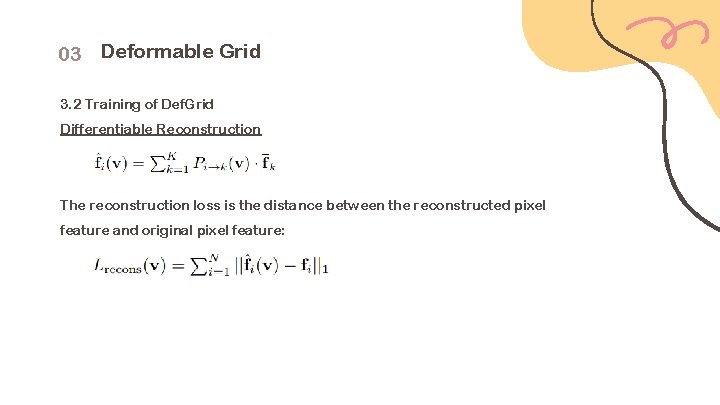
03 Deformable Grid 3. 2 Training of Def. Grid Differentiable Reconstruction The reconstruction loss is the distance between the reconstructed pixel feature and original pixel feature:
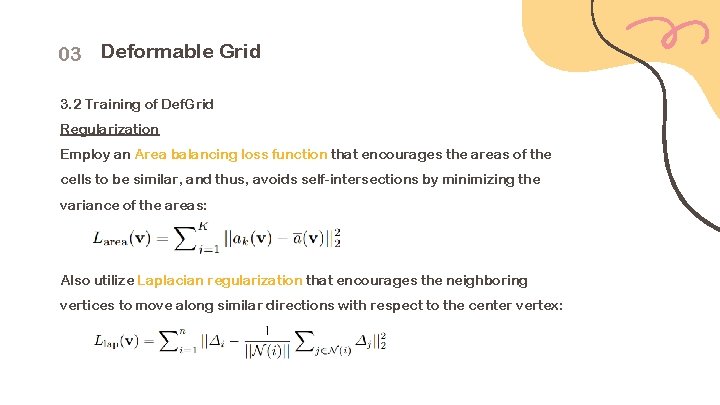
03 Deformable Grid 3. 2 Training of Def. Grid Regularization Employ an Area balancing loss function that encourages the areas of the cells to be similar, and thus, avoids self-intersections by minimizing the variance of the areas: Also utilize Laplacian regularization that encourages the neighboring vertices to move along similar directions with respect to the center vertex:
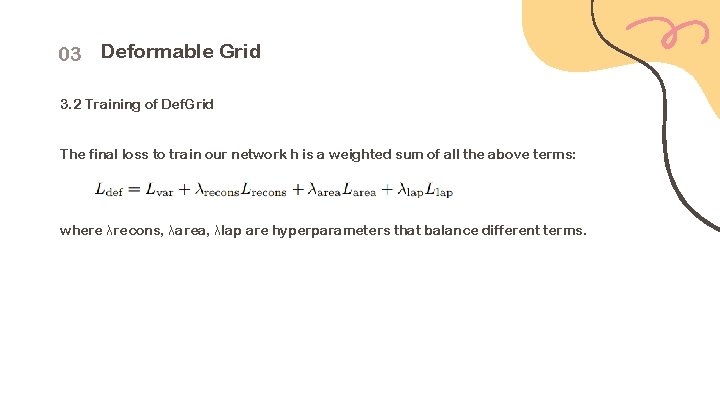
03 Deformable Grid 3. 2 Training of Def. Grid The final loss to train our network h is a weighted sum of all the above terms: where λrecons, λarea, λlap are hyperparameters that balance different terms.
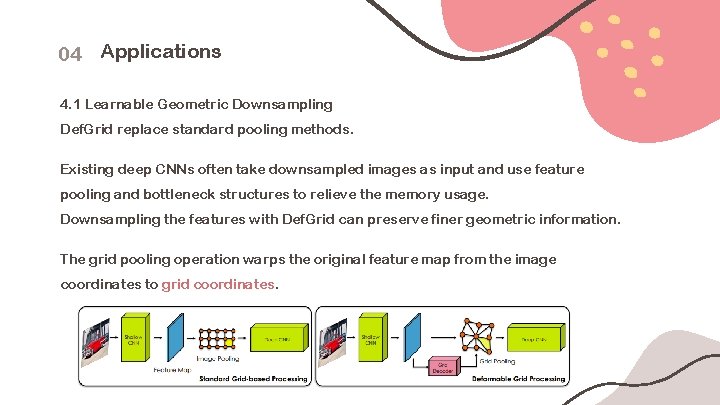
04 Applications 4. 1 Learnable Geometric Downsampling Def. Grid replace standard pooling methods. Existing deep CNNs often take downsampled images as input and use feature pooling and bottleneck structures to relieve the memory usage. Downsampling the features with Def. Grid can preserve finer geometric information. The grid pooling operation warps the original feature map from the image coordinates to grid coordinates.
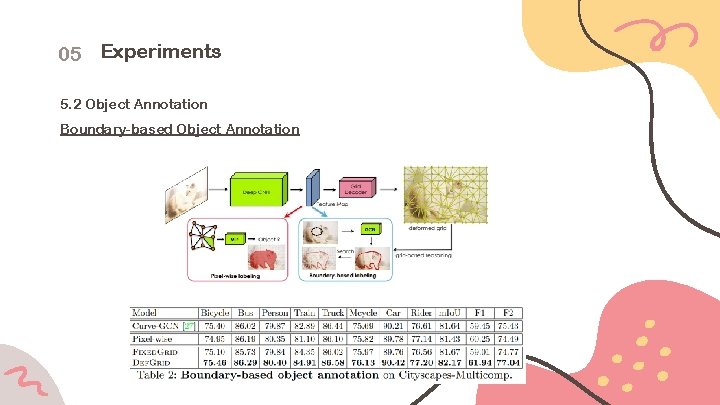
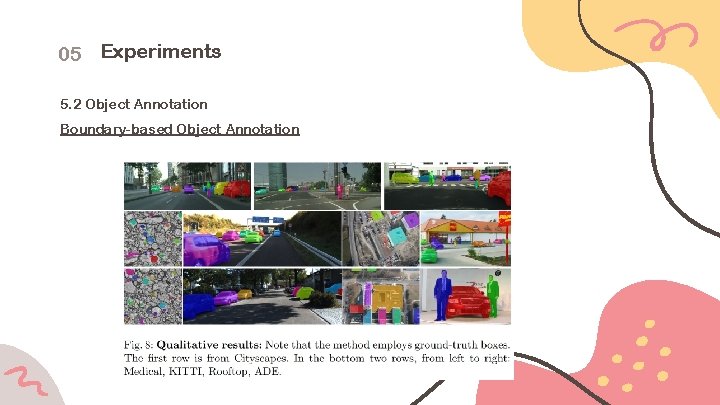
04 Applications 4. 2 Object Mask Annotation Object mask annotation is the problem of outlining a foreground object given a user-provided bounding box. Two dominant approaches have been proposed to tackle this task. The first approach utilizes a deep neural network to predict a pixel-wise mask. The second approach tries to outline the boundary with a polygon/spline.
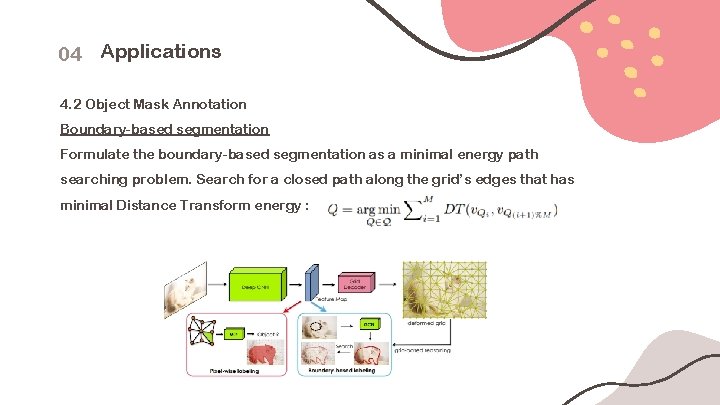
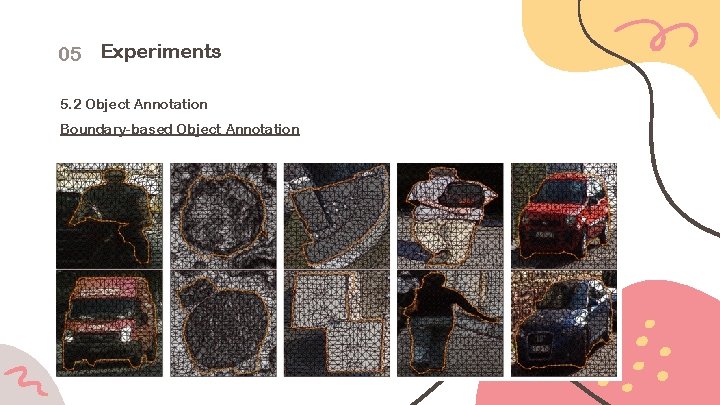
04 Applications 4. 2 Object Mask Annotation Boundary-based segmentation Formulate the boundary-based segmentation as a minimal energy path searching problem. Search for a closed path along the grid’s edges that has minimal Distance Transform energy :
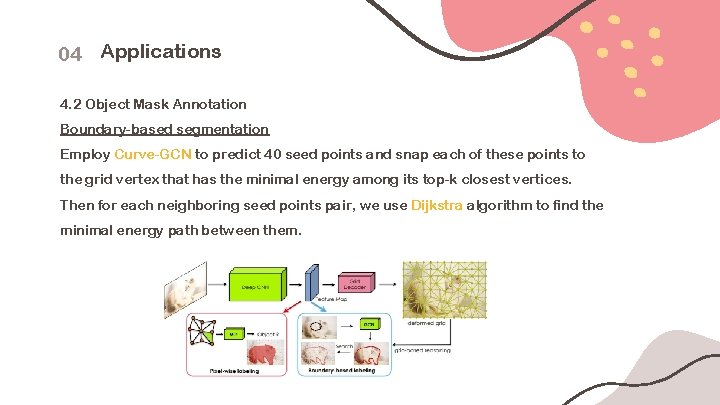
04 Applications 4. 2 Object Mask Annotation Boundary-based segmentation Employ Curve-GCN to predict 40 seed points and snap each of these points to the grid vertex that has the minimal energy among its top-k closest vertices. Then for each neighboring seed points pair, we use Dijkstra algorithm to find the minimal energy path between them.
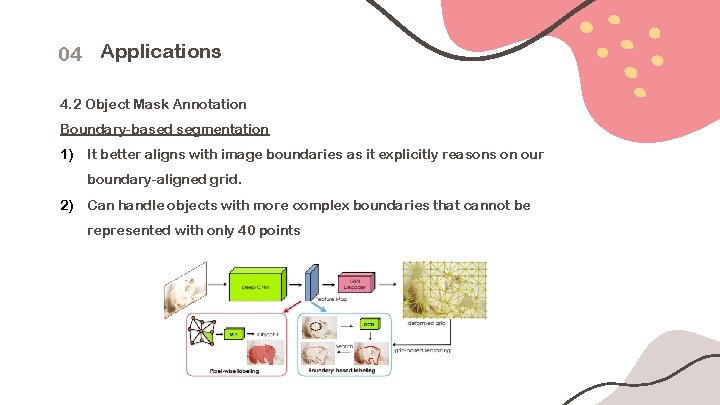
04 Applications 4. 2 Object Mask Annotation Boundary-based segmentation 1) It better aligns with image boundaries as it explicitly reasons on our boundary-aligned grid. 2) Can handle objects with more complex boundaries that cannot be represented with only 40 points
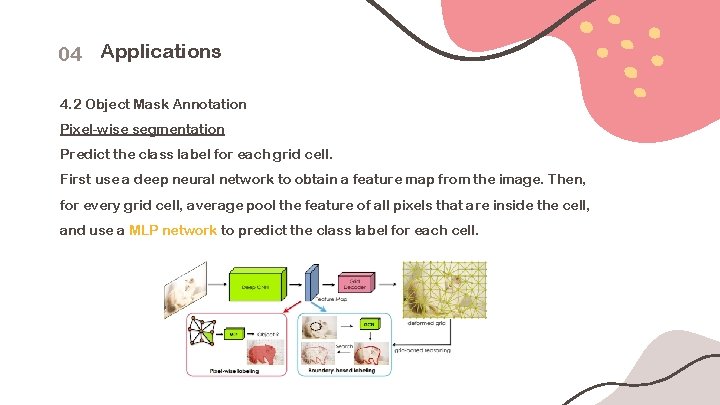
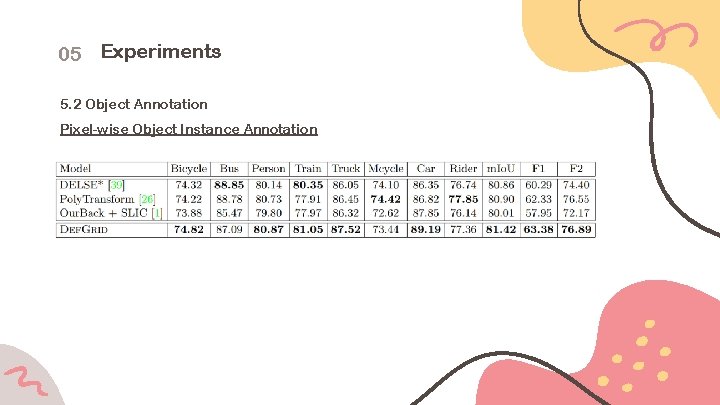
04 Applications 4. 2 Object Mask Annotation Pixel-wise segmentation Predict the class label for each grid cell. First use a deep neural network to obtain a feature map from the image. Then, for every grid cell, average pool the feature of all pixels that are inside the cell, and use a MLP network to predict the class label for each cell.
04 Applications 4. 3 Unsupervised Image Partitioning We can already view the deformed triangular cells as “superpixels”, and go further and cluster cells by using the affinity between them. In particular, we view the deformed grid as an undirected weighted graph where each grid cell is a node and an edge connects two nodes if they share an edge in the grid. The weight for each edge is the affinity between two cells, which can be calculated using RGB values of pixels inside the cells.
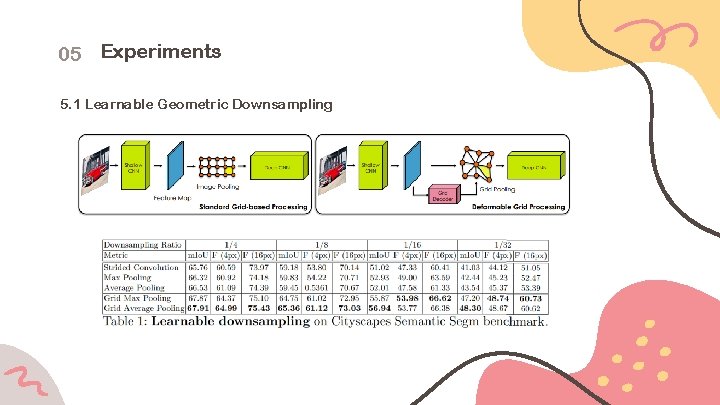
05 Experiments 5. 1 Learnable Geometric Downsampling
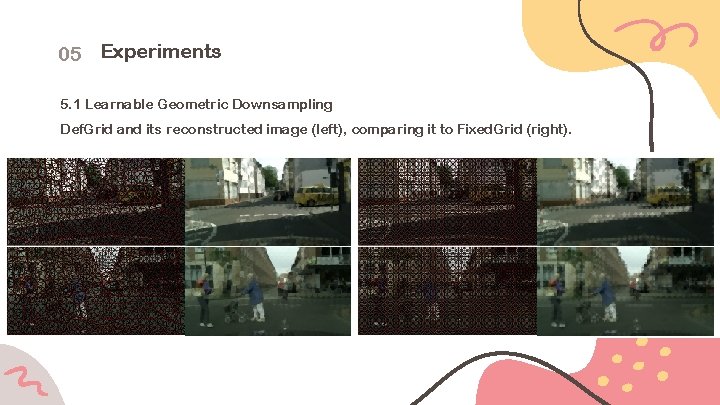
05 Experiments 5. 1 Learnable Geometric Downsampling Def. Grid and its reconstructed image (left), comparing it to Fixed. Grid (right).
05 Experiments 5. 2 Object Annotation Boundary-based Object Annotation
05 Experiments 5. 2 Object Annotation Boundary-based Object Annotation
05 Experiments 5. 2 Object Annotation Boundary-based Object Annotation
05 Experiments 5. 2 Object Annotation Pixel-wise Object Instance Annotation
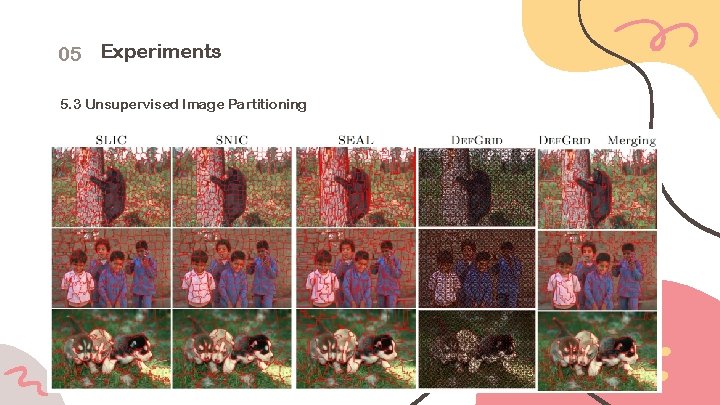
05 Experiments 5. 3 Unsupervised Image Partitioning
06 Conclusion In this paper, they proposed to deform a regular grid to better align with image boundaries as a more efficient way to process images. Def. Grid is a neural network that predicts offsets for vertices in a grid to perform the alignment. This method produces accurate superpixel segmentations and leads to a large improvements for semantic segmentation.

Thanks for listening !
- Slides: 31