
Beyond Equality Equity Social Justice Cultural Competency What
Beyond Equality: Equity, Social Justice, & Cultural Competency
What is Culture? Shared set of customs, beliefs, and experiences Learned Can be passed on/transmitted Can be “unlearned” Everyone has a culture
“Who Are You? ” Activity Find a partner. Choose who is Partner A and Partner B. Partner A repeatedly ask your Partner B the following question: WHO ARE YOU? Respond Then in one word or short phrase. switch.
Processing Share One Answer: I am____. Which identities do you think play a role in how people perceive you? Which identities play a role in how people interact with you? Which identities impact how people communicate with you? Please explain your answers.
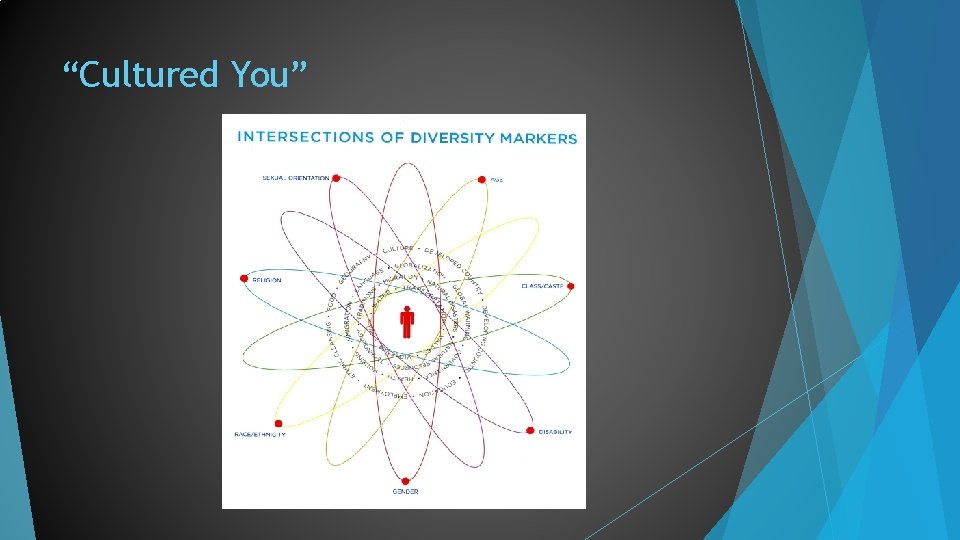
“Cultured You”
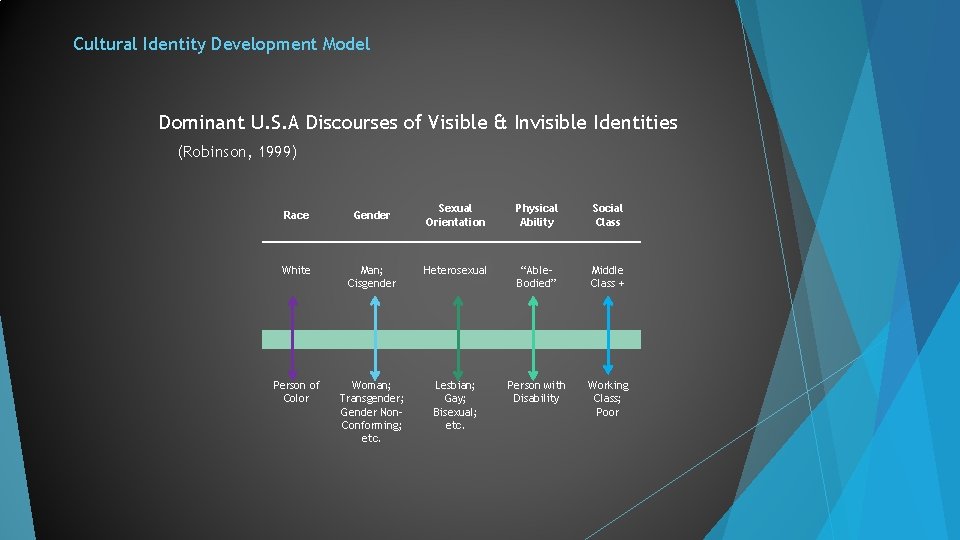
Cultural Identity Development Model Dominant U. S. A Discourses of Visible & Invisible Identities (Robinson, 1999) Sexual Orientation Physical Ability Social Class Man; Cisgender Heterosexual “Able. Bodied” Middle Class + Woman; Transgender; Gender Non. Conforming; etc. Lesbian; Gay; Bisexual; etc. Person with Disability Working Class; Poor Race Gender White Person of Color
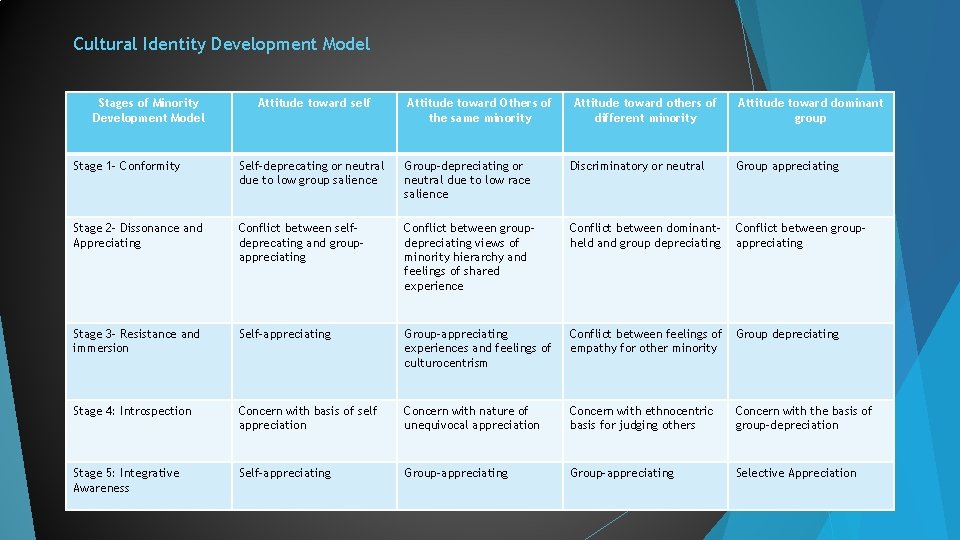
Cultural Identity Development Model Stages of Minority Development Model Attitude toward self Attitude toward Others of the same minority Attitude toward others of different minority Attitude toward dominant group Stage 1 - Conformity Self-deprecating or neutral due to low group salience Group-depreciating or neutral due to low race salience Discriminatory or neutral Group appreciating Stage 2 - Dissonance and Appreciating Conflict between selfdeprecating and groupappreciating Conflict between groupdepreciating views of minority hierarchy and feelings of shared experience Conflict between dominantheld and group depreciating Conflict between groupappreciating Stage 3 - Resistance and immersion Self-appreciating Group-appreciating experiences and feelings of culturocentrism Conflict between feelings of empathy for other minority Group depreciating Stage 4: Introspection Concern with basis of self appreciation Concern with nature of unequivocal appreciation Concern with ethnocentric basis for judging others Concern with the basis of group-depreciation Stage 5: Integrative Awareness Self-appreciating Group-appreciating Selective Appreciation
Multiple Identities Everyone is made of multiple identities. Sexual Orientation, Gender, Sex, Ethnicity, Age, Ability, Religion, Creed, Socio-Economic Status, Nation of Origin, Immigration Status, etc. One’s identities can come into conflict with each other or create a unique cultural group within other groups. No one identity is more or less important than another, they all make us who we are. Intercultural vs. Intracultural
What is Cultural Competency? A developmental process occurring at individual and system levels that evolves over an extended time period. Cultural competence refers to an ability to interact effectively with people of different cultures. It is defined as a set of congruent behaviors, attitudes, and policies that come together in a system, agency, or those professionals [and students] to work effectively in cross cultural situations. (Cross, et al. 1989; Isaacs & Benjamin, 1991). Operationally defined, cultural competence is the integration and knowledge about individuals and groups of people into specific standards, policies, practices and attitudes used in appropriate cultural settings to increase the quality of service thereby producing better outcomes (Davis, 1997) It is an ongoing process that requires consistent awareness of self and others, self-reflection, education, and practice.
Why is Cultural Competence Important? Exposes you to new experiences, perspectives, and people Helps you: Navigate a multicultural society and pluralistic world Build healthy relationships Avoid and manage conflicts Creates Be more inclusive and welcoming communities a better communicator successful in your leadership roles, education, professional life, and personal life
Levels of Cultural Competency Cultural competence happens at several stages: Personal – knowledge of one’s own cultural identities and how they impact our attitudes, behaviors, and values Interpersonal - our ability as individuals to successfully and effectively interact with people from a variety of cultures and navigate cultural differences Societal/Systemic - deals with the systemic structures within society (government, organizations, etc. ) and how they deal with and address culture difference
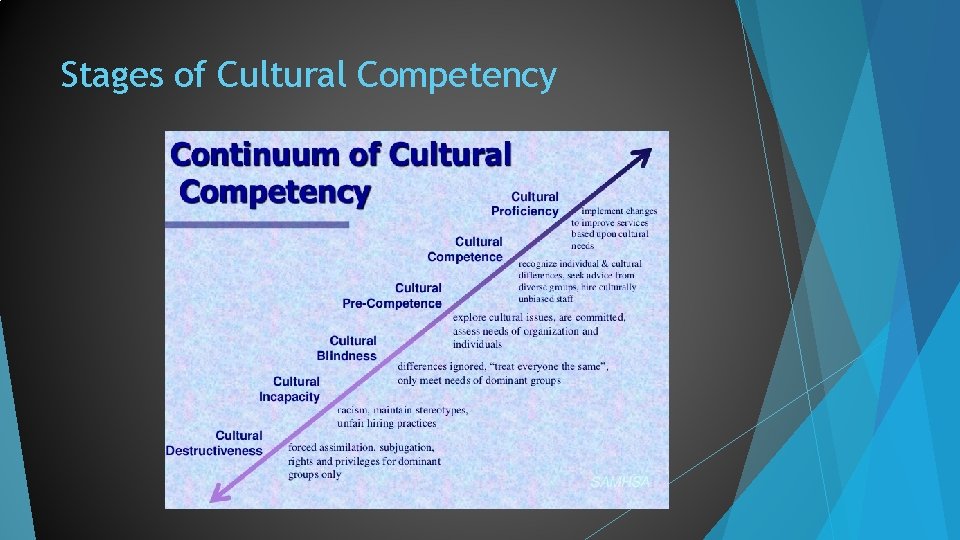
Stages of Cultural Competency
Cultural Competency Continuum Cultural Destructiveness –Conscious, active and intentional disregard for cultural difference Cultural Incapacity- Unconscious or conscious disregard for cultural differences characterized by negative attitudes towards cultural differences, holding and perpetuating stereotypes, and unwillingness to interact with people with different cultural values, beliefs, and practices. Cultural Blindness- ignorance of or inattention to cultural differences and their significance in communication and personal interactions.
Cultural Competency Continuum Cultural Pre-Competence- Possessing a basic level of knowledge about cultural differences and demonstrating the ability to effectively interact with people from different cultural values, beliefs, and practices. In this stage, one is just beginning to recognize the significance of culture and is in the process of gaining more knowledge, training and resources in these areas. Cultural Competence/Advanced Cultural Competence- When Individuals hold culture in high esteem and actively seek to add to their cultural competence by: adding to their awareness and knowledge of other cultures, proactively addressing cultural insensitivity and changing discriminatory practices creating inclusive and welcoming environments where everyone is treated equitably and with respect.
Cultural Competency Skill Areas Awareness (Personal and Interpersonal) Knowledge of one’s own “cultural lens” (i. e. cultural background, beliefs, values, practices, etc. ) The ability to recognize one’s own potential and real prejudices and biases based on cultural differences Awareness of when my “cultural lens” is inhibiting and/or interfering with my interactions with or sensitivity with people who are from cultural backgrounds other than my own. Exposure to and knowledge of a variety of cultures (i. e. cultural perspectives, values, practices, etc. ) other than one’s own Types of Activities & Experiences that Build Awareness personal reflection identity exploration and development exercises personality/strengths assessments educational cultural programming social cultural programming
Cultural Competency Skill Areas Cultural Knowledge Understanding and comprehension of culture’s different from one’s own Knowledge of the dynamics and issues surrounding culture and cultural competency (i. e. privilege, systems of oppression, social justice theory, etc. ) Activities & Experiences that Build Cultural Knowledge educational cultural programming social cultural programming multicultural communities involvement and/or membership in multicultural/community activism organizations social justice curriculum
Cultural Competency Skill Areas Sensitivity (Empathy) • Openness to learning about other cultures • The ability to listen to and consider the perspectives of other people without allowing one’s own values, perspectives and biases to interfere • The ability to override our prejudices and biases and respond to cultural differences in a culturally sensitive and effective way Activities & Experiences that Build Sensitivity • personal reflection • educational workshops and trainings on diversity, multiculturalism, and/or social justice • involvement and/or membership in multicultural/social justice organizations • educational cultural programming
Cultural Competency Skill Areas Communication and Dialogue • The ability to interact effectively with people from cultural backgrounds other than one’s own. • The ability to navigate and resolve the conflicts that arise due to differences in cultural beliefs, values and perspectives. • Actively encouraging open communication and dialogue between various cultures • Ability to facilitate dialogue with and between various cultural groups. Activities & Experiences that Build Communication and Dialogue • intergroup dialogues • conflict management training • involvement and/or membership in multicultural/social justice organizations
Cultural Competency Skill Areas Adaptability Commitment to the continuous leaning necessary to deal with issues caused by cultural difference. • Ability to integrate cultural knowledge into attitudes behavior, practices, and policies either as an individual or an organization • The ability to recognize cultural cues • Ability to navigate the dynamics of difference • Activities & Experiences that Build Adaptability • cultural immersion programs • involvement, membership and/or leadership in multicultural organizations • prolonged exposure to cultures other than one’s own
Cultural Competency Skill Areas Engagement & Immersion • Actively seeking opportunities to interact with cultures other than one’s own • Actively creating welcoming and inclusive spaces where people from all cultural backgrounds have their perspectives, practices, values and beliefs respected and considered Activities & Experiences that Build Engagement & Immersion • cultural immersion programs (study abroad, etc. ) • active study of another culture through personal experience or course work (taking a language; majors that deal with the exploration of various cultures • involvement, membership and/or leadership in multicultural organizations • prolonged exposure to cultures other than one’s own
Cultural Competency Skill Areas Advocacy • Ability to recognize and confront social inequities and injustices • Ability and willingness to advocate for positive social change • Utilizing resources to serve underrepresented and marginalized populations Activities & Experiences that Build Advocacy • community service/service learning programs • anti –oppression training • advocacy/ally trainings
Equality vs. Equity vs. Social Justice Equality Providing the same resources, policies, and practices, regardless of difference; limited; individually the same Equity Providing resources, policies, and practices based on varying needs; limited; individual differences Social Justice A process of providing resources, policies, and practices based on varying needs and working towards eliminating the causes of the disparities; unlimited; structural differences
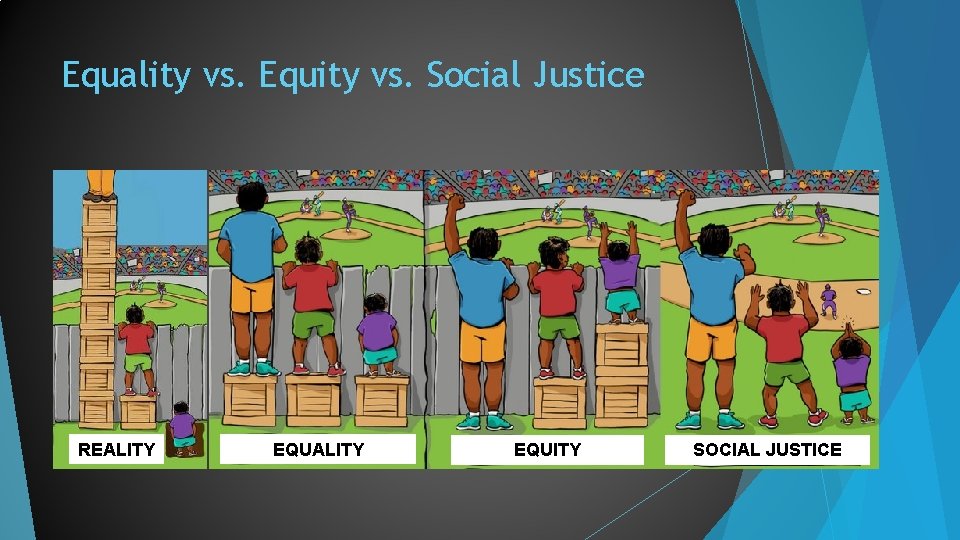
Equality vs. Equity vs. Social Justice REALITY EQUITY SOCIAL JUSTICE
Class is a “Fence” Social Stratification; Reinforces Itself Socially Constructed Culturally Specific Hierarchical Changes Over Time Intersectional and Interconnected with Other Identities Economic Status, Nation of Origin, Religion, Language, Jobs, Family History, Education Level, Race, Ethnicity, Appearance, etc. Any of the Above Can Also Be Indicators of Class Structural Oppression
Class is a “Fence” The Oblongs What are the “fences” in this clip?
Impact Areas of Structural Oppression Economics Health/Wellness/Healthcare Safety Education Type of Work Geographic Location Leisure Time Quality of Housing Access to Technology Environment Increased Risk Factors
Can You See the “Fence”? Implicit-Association Tests (IAT’s) Absorbed cultural messages that influence our world view Impossible to see if you do not know they exist Are possible to change with work/time Note: IAT’s Can be used to assess bias, but not for HR/staffing purposes
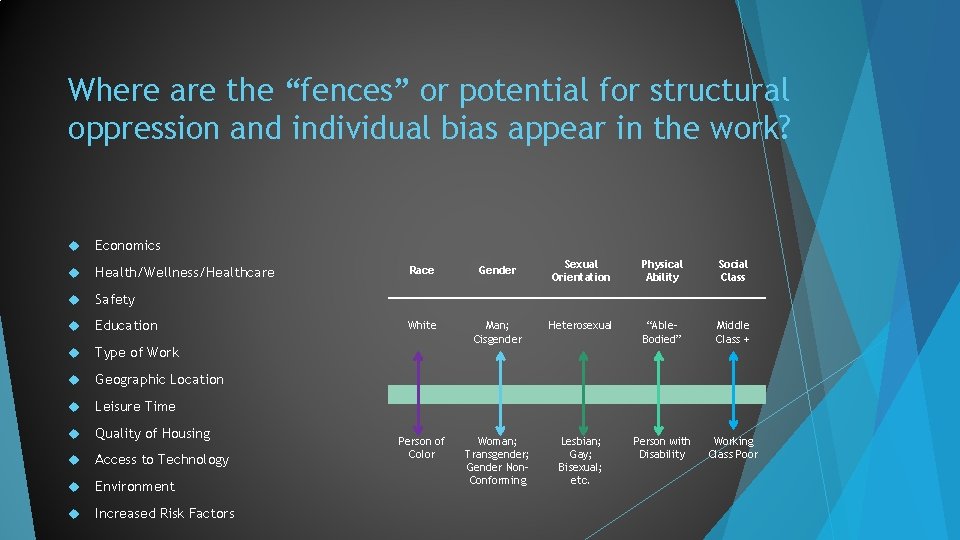
Where are the “fences” or potential for structural oppression and individual bias appear in the work? Economics Health/Wellness/Healthcare Safety Education Type of Work Geographic Location Leisure Time Quality of Housing Access to Technology Environment Increased Risk Factors Sexual Orientation Physical Ability Social Class Man; Cisgender Heterosexual “Able. Bodied” Middle Class + Woman; Transgender; Gender Non. Conforming Lesbian; Gay; Bisexual; etc. Person with Disability Working Class Poor Race Gender White Person of Color
Communicating with Diverse People We all have biases We all can be the offender/offended Learning effective self & community advocacy is critical Helping vs. Serving Discomfort vs. Unsafe
Causes of Conflict Different values and beliefs systems Overwhelming stressors Unknown or known elements in environment Communication Breakdown (most common cause) Investment of both parties Hidden agendas
Helping vs. Fixing vs. Serving “In the service of life”
Helping vs. Fixing vs. Serving “In the service of life”
- Slides: 32