
Beyond Divide Conquer How to Support Productive Group
Beyond Divide & Conquer: How to Support Productive Group Work Meghan Kessler & Saad Shehab Department of Curriculum & Instruction College of Education University of Illinois at Urbana-Champaign
Introductions & Agenda 1) Opening discussion: What is collaborative learning? 2) The role of students in collaborative learning 3) Simulated collaborative learning activity 4) The role of teachers in collaborative learning 5) Wrap-up
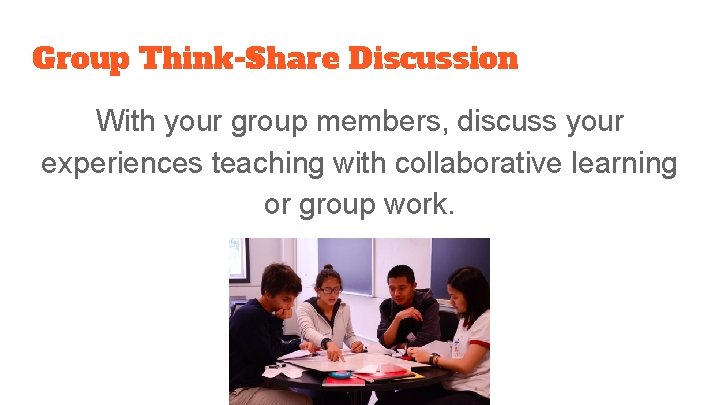
Group Think-Share Discussion With your group members, discuss your experiences teaching with collaborative learning or group work.
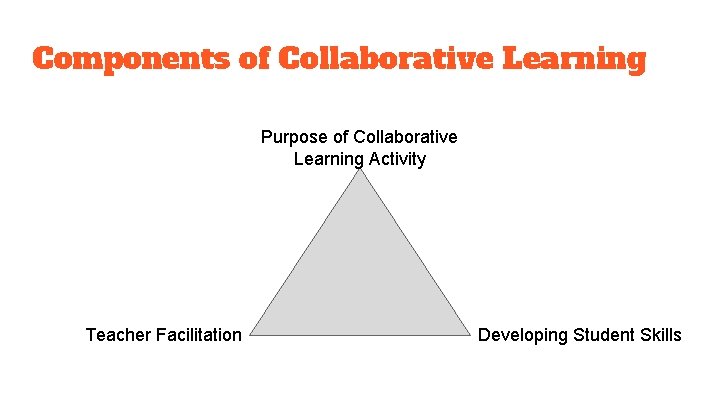
Components of Collaborative Learning Purpose of Collaborative Learning Activity Teacher Facilitation Developing Student Skills
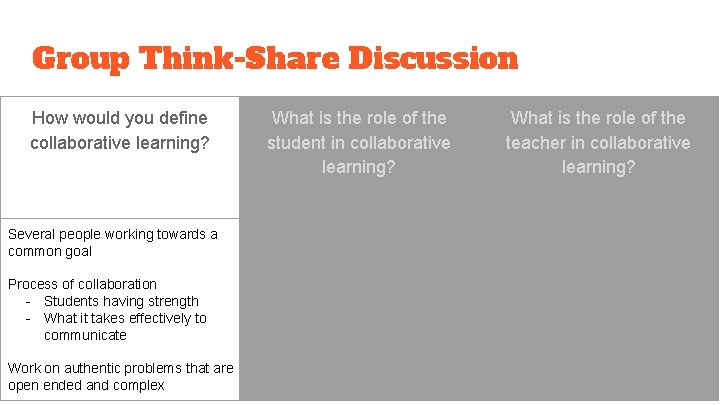
Group Think-Share Discussion How would you define collaborative learning? Several people working towards a common goal Process of collaboration - Students having strength - What it takes effectively to communicate Work on authentic problems that are open ended and complex What is the role of the student in collaborative learning? What is the role of the teacher in collaborative learning?
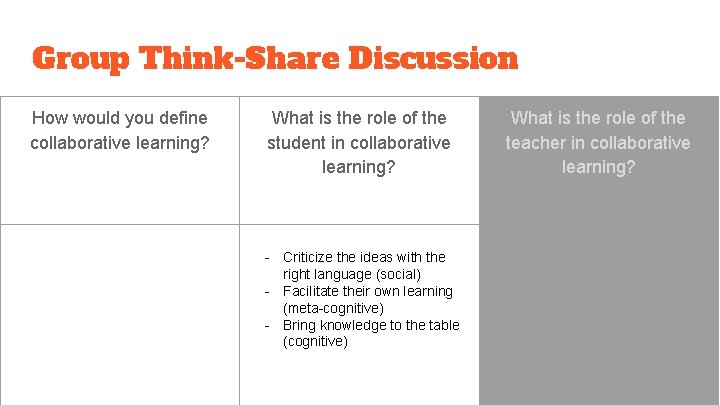
Group Think-Share Discussion How would you define collaborative learning? What is the role of the student in collaborative learning? - Criticize the ideas with the right language (social) - Facilitate their own learning (meta-cognitive) - Bring knowledge to the table (cognitive) What is the role of the teacher in collaborative learning?
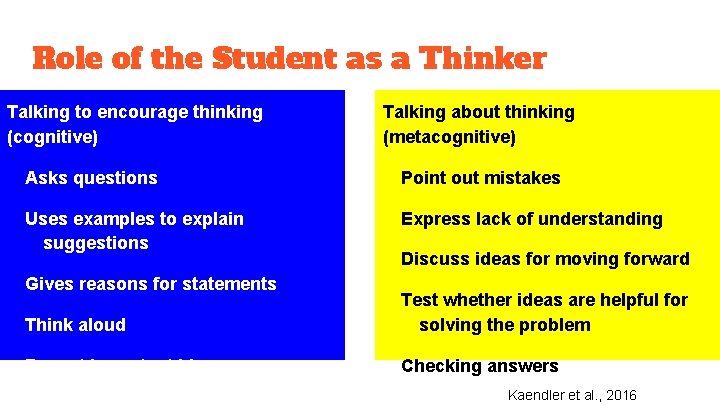
Role of the Student as a Thinker Talking to encourage thinking (cognitive) Talking about thinking (metacognitive) Asks questions Point out mistakes Uses examples to explain suggestions Express lack of understanding Gives reasons for statements Discuss ideas for moving forward Think aloud Test whether ideas are helpful for solving the problem Repeat important ideas Checking answers Kaendler et al. , 2016
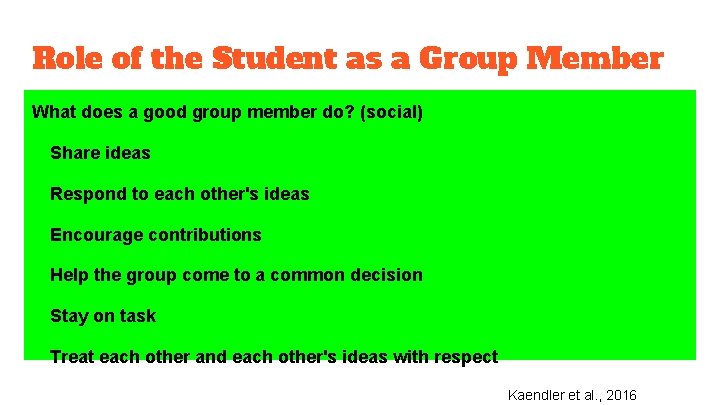
Role of the Student as a Group Member What does a good group member do? (social) Share ideas Respond to each other's ideas Encourage contributions Help the group come to a common decision Stay on task Treat each other and each other's ideas with respect Kaendler et al. , 2016
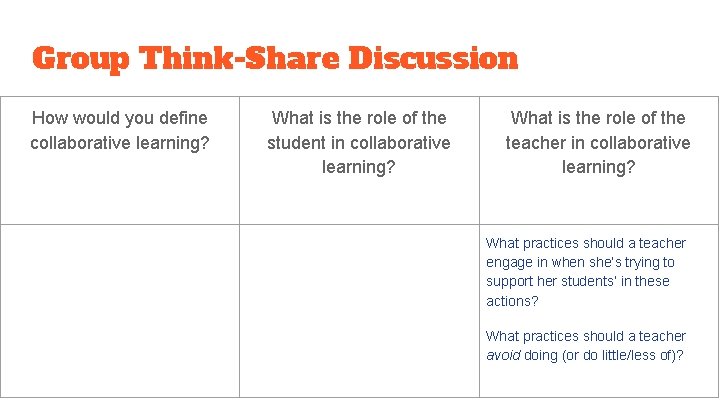
Group Think-Share Discussion How would you define collaborative learning? What is the role of the student in collaborative learning? What is the role of the teacher in collaborative learning? What practices should a teacher engage in when she’s trying to support her students’ in these actions? What practices should a teacher avoid doing (or do little/less of)?
Simulated Collaborative Learning Activity
Activity Pretend that you and your team members are on staff together at Illini Grade School in Champaign. Your principal has put your team in charge of planning a one-day field trip for all of the fifth graders (50 students) to Chicago. You know you will be traveling to the Museum of Science and Industry, but other details are up to your team. Your principal requires that you turn in a proposal for this trip. Your proposal must include a detailed itinerary from 8: 30 a. m. when the students have arrived to school until 6: 00 p. m. when the students will return from Chicago.
Activity Wrap Up Now that you have planned your field trip. Let’s reflect on what we have learned. If you were given the task to mentor a first-year teacher, what advice would you have about planning such a field trip?
Activity Debrief & Reflection What was the purpose of this activity (get inside the teacher’s head)? What did you notice you and your group members doing during the activity? What did you notice Meghan doing to monitor and support your group’s collaboration?
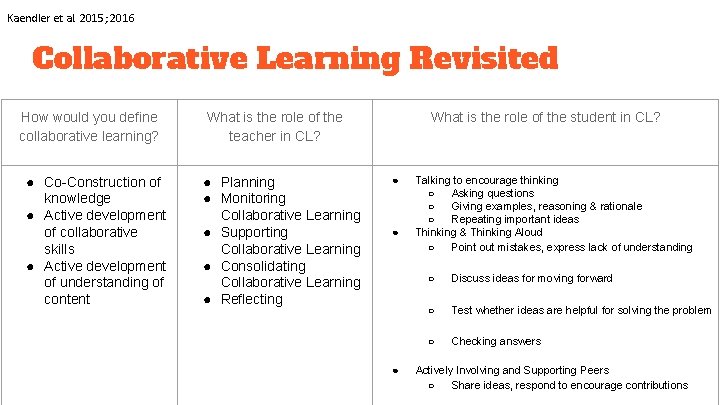
Kaendler et al. 2015; 2016 Collaborative Learning Revisited How would you define collaborative learning? ● Co-Construction of knowledge ● Active development of collaborative skills ● Active development of understanding of content What is the role of the teacher in CL? ● Planning ● Monitoring Collaborative Learning ● Supporting Collaborative Learning ● Consolidating Collaborative Learning ● Reflecting What is the role of the student in CL? ● ● ● Talking to encourage thinking ○ Asking questions ○ Giving examples, reasoning & rationale ○ Repeating important ideas Thinking & Thinking Aloud ○ Point out mistakes, express lack of understanding ○ Discuss ideas for moving forward ○ Test whether ideas are helpful for solving the problem ○ Checking answers Actively Involving and Supporting Peers ○ Share ideas, respond to encourage contributions
Additional Resources for Teachers Cohen, E. G. , & Lotan, R. A. (2014). Designing Groupwork: Strategies for the Heterogeneous Classroom Third Edition. Teachers College Press. Harvey, S. , & Daniels, H. (2009). Comprehension & collaboration: Inquiry circles in action. Portsmouth, NH: Heinemann.
References Kaendler, C. , Wiedmann, M. , Leuders, T. , Rummel, N. , & Spada, H. (2016). Monitoring student interaction during collaborative learning: Design and evaluation of a training program for pre-service teachers. Psychology Learning & Teaching, 15(1), 44 -64. Kaendler, C. , Wiedmann, M. , Rummel, N. , & Spada, H. (2015). Teacher competencies for the implementation of collaborative learning in the classroom: a framework and research review. Educational Psychology Review, 27(3), 505 -536.
Thank you! Meghan: makessl 2@illinois. edu Saad: shehab 2@illinois. edu
- Slides: 17