
Beyond Didactic Presentations in Clinical Training Thinking Outside
Beyond Didactic Presentations in Clinical Training: Thinking Outside the Powerpoint Box March 11, 2008 Presented by the National Network of Prevention Training Centers (NNPTC) Parts I (Clinical), II (Behavioral) and III (Partner Services) Featuring … Cornelis Rietmeijer, MD, Ph. D Laura Bachman, MD, MPH Linda Creegan, MS, FNP M. Terry Hogan, MPH Katherine Hsu, MD, MPH Patricia Jennings, Dr. PH, PA-C Patricia Coury-Doniger, NP, MSN Anne Rompalo, MD, Sc. M

Laboratory Procedure Courses National Network of Prevention Training Centers Linda Creegan, MS, FNP California STD/HIV Prevention Training Center Oakland, CA National STD Prevention Conference Chicago, March 2008

CLINICIANS…. . Are you new to the STD clinic? Trichomoniasis? Herpes? Bacterial Vaginosis? Syphilis? Is your clinic starting to use a new test? Rapid HIV test? Darkfield microscopy?

NNPTC Laboratory Procedure Courses Participants learn to perform. . . • Tests for STD specialty clinics – Syphilis tests • Rapid RPR test • Darkfield microscopy – Gram stains – Saline and KOH wet mounts • Other Point-of-Care (POC) tests for STD and HIV
Tests for STD Specialty Clinics

Serologic Tests for Syphilis • Utility of rapid RPR test – Evaluate patients with symptoms of primary or secondary syphilis – Assess contacts to syphilis infection – Facilitate immediate diagnosis, treatment, and initiation of partner management activities • Learn to perform and interpret qualitative and quantitated RPR tests
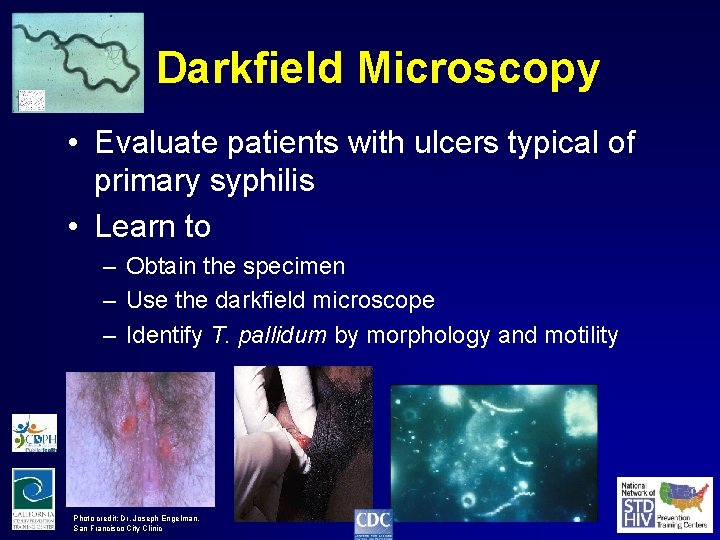
Darkfield Microscopy • Evaluate patients with ulcers typical of primary syphilis • Learn to – Obtain the specimen – Use the darkfield microscope – Identify T. pallidum by morphology and motility Photo credit: Dr. Joseph Engelman, San Francisco City Clinic

Identifying T. pallidum by DF • Morphology – Rigid, uniform, tightlycoiled spirals – Length: 6 -20 micrometers – Width: VERY thin • 0. 10 -0. 18 micrometers, below the resolution of the light microscope • Motility – Exhibits three types of movement • Translation: slow, forward or backwards movement • Rotation: turning around the longitudinal axis • Flexion: stiff bending, usually in the middle, and returning to original position
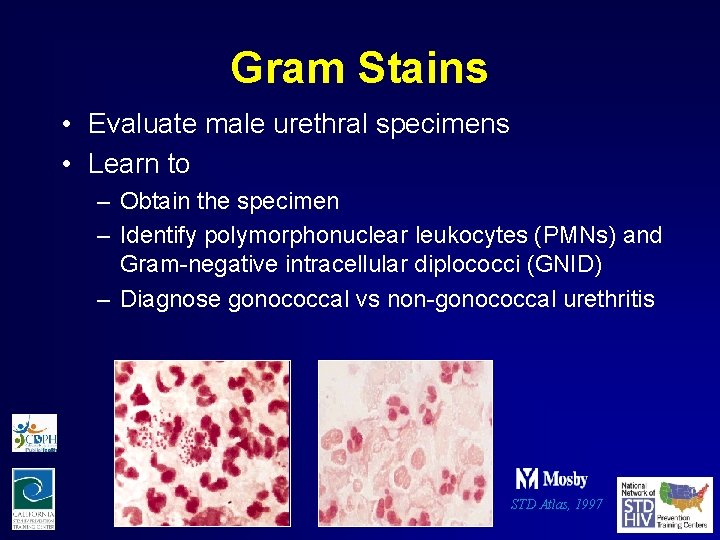
Gram Stains • Evaluate male urethral specimens • Learn to – Obtain the specimen – Identify polymorphonuclear leukocytes (PMNs) and Gram-negative intracellular diplococci (GNID) – Diagnose gonococcal vs non-gonococcal urethritis STD Atlas, 1997
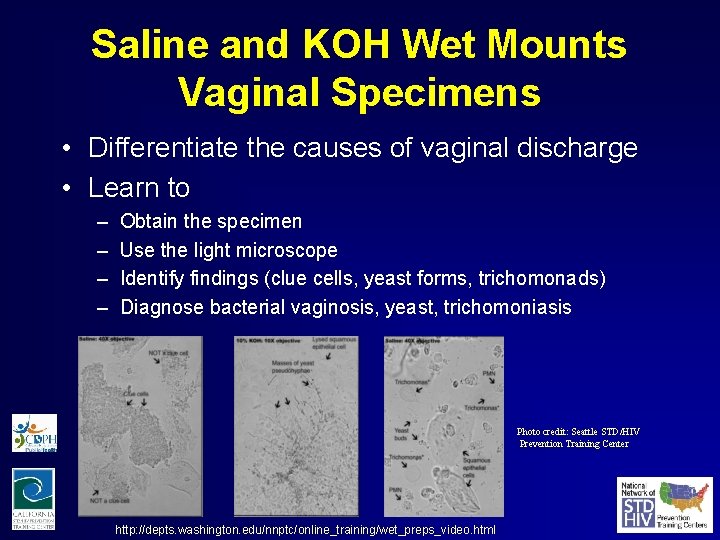
Saline and KOH Wet Mounts Vaginal Specimens • Differentiate the causes of vaginal discharge • Learn to – – Obtain the specimen Use the light microscope Identify findings (clue cells, yeast forms, trichomonads) Diagnose bacterial vaginosis, yeast, trichomoniasis Photo credit: Seattle STD/HIV Prevention Training Center http: //depts. washington. edu/nnptc/online_training/wet_preps_video. html
Other Rapid Point-of-Care Tests for STD
What are Point-of-Care tests? • Run in clinic or field setting • Provide results at same clinic visit • Very easy to perform – Usually require only microscope or simple lab equipment – Often CLIA waived
Point-of-Care STD Tests: A Paradox • Generally not as sensitive/specific as delayed lab tests – Not intended to replace traditional STD tests, where these are available HOWEVER… • In populations of patients less likely to return for results or when F/U is difficult, higher treatment levels can be achieved with POC than with delayed tests – Homeless clinics – Emergency rooms – Correctional facilities
Point-of-Care STD Tests • POC tests for common STD • Learn about – – – HSV 2 Bacterial vaginosis Trichomoniasis Chlamydia Gonorrhea – Lab regulatory issues (CLIA) – Obtaining specimens – Using test kits – Interpreting results – Maintaining quality assurance
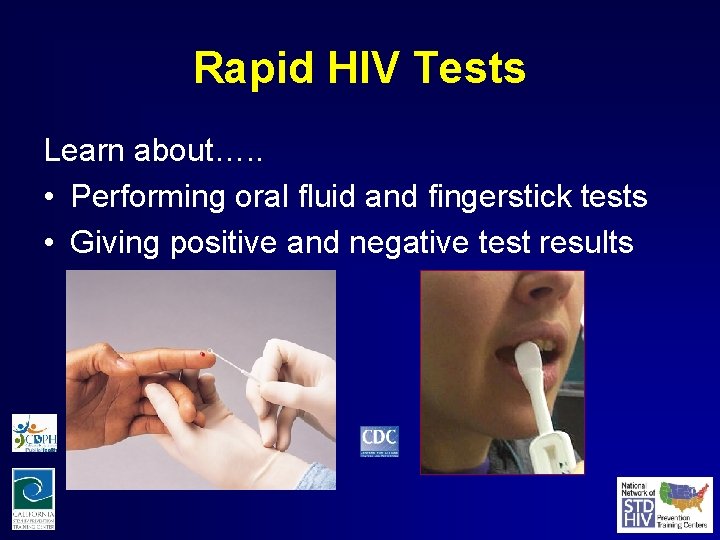
Rapid HIV Tests Learn about…. . • Performing oral fluid and fingerstick tests • Giving positive and negative test results
Enroll in a Lab Procedure Course offered by your regional Prevention Training Center!
- Slides: 16