
Beyond Classical Search Local Search RN III Chapter

Beyond Classical Search (Local Search) R&N III: Chapter 4 1
Local Search § Light-memory search method § No search tree; only the current state is represented! § Only applicable to problems where the path is irrelevant (e. g. , 8 -queen), unless the path is encoded in the state § Many similarities with optimization techniques 2
Hill-climbing search • “is a loop that continuously moves in the direction of increasing value” – It terminates when a peak is reached. • Hill climbing does not look ahead of the immediate neighbors of the current state. • Basic Hill-climbing – “Like climbing Everest in a thick fog with amnesia” 22 oktober 2021 3 AI 1
(Steepest Ascent) Hill-climbing search • “is a loop that continuously moves in the direction of increasing value” – It terminates when a peak is reached. • Hill climbing does not look ahead of the immediate neighbors of the current state. • Hill-climbing chooses randomly among the set of best successors, if there is more than one. • Hill-climbing a. k. a. greedy local search 22 oktober 2021 4 AI 1
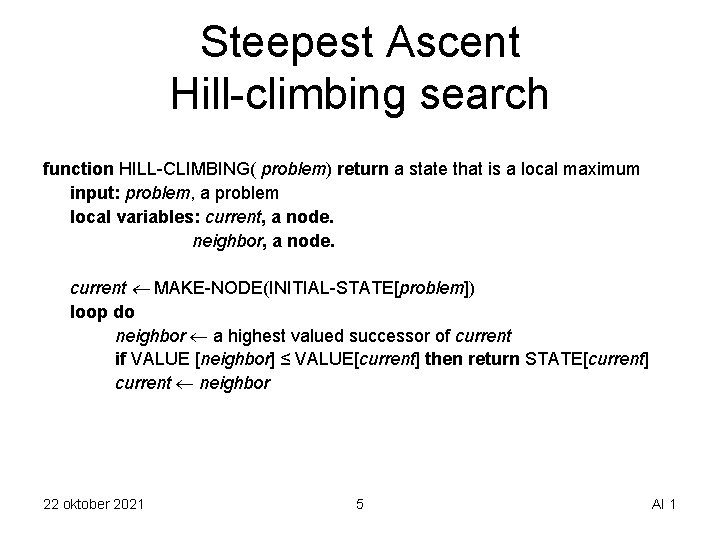
Steepest Ascent Hill-climbing search function HILL-CLIMBING( problem) return a state that is a local maximum input: problem, a problem local variables: current, a node. neighbor, a node. current MAKE-NODE(INITIAL-STATE[problem]) loop do neighbor a highest valued successor of current if VALUE [neighbor] ≤ VALUE[current] then return STATE[current] current neighbor 22 oktober 2021 5 AI 1
Hill-climbing example • 8 -queens problem (complete-state formulation). • Successor function: move a single queen to another square in the same column. • Heuristic function h(n): the number of pairs of queens that are attacking each other (directly or indirectly). 22 oktober 2021 6 AI 1
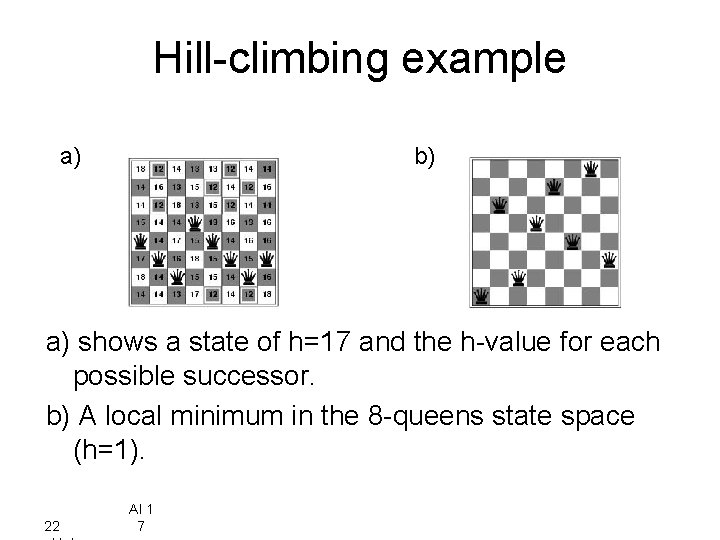
Hill-climbing example a) b) a) shows a state of h=17 and the h-value for each possible successor. b) A local minimum in the 8 -queens state space (h=1). 22 AI 1 7
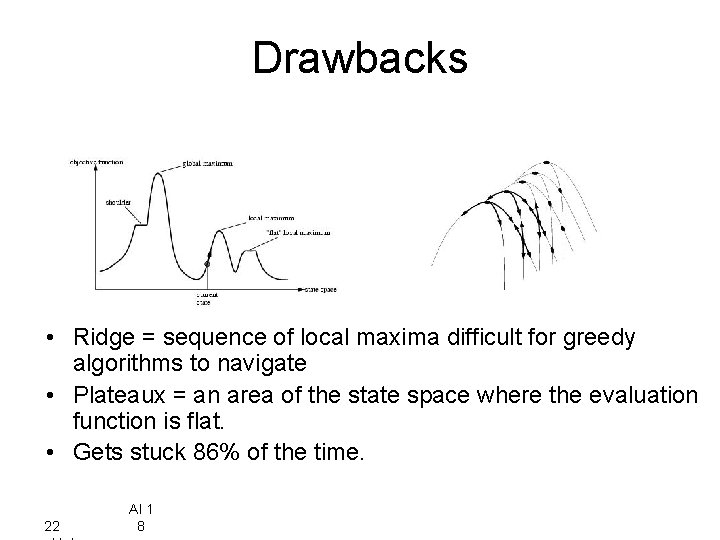
Drawbacks • Ridge = sequence of local maxima difficult for greedy algorithms to navigate • Plateaux = an area of the state space where the evaluation function is flat. • Gets stuck 86% of the time. 22 AI 1 8
Hill-climbing variations • Stochastic hill-climbing – Random selection among the uphill moves. – The selection probability can vary with the steepness of the uphill move. • First-choice hill-climbing – cfr. stochastic hill climbing by generating successors randomly until a better one is found. • Random-restart hill-climbing – Tries to avoid getting stuck in local maxima. 22 oktober 2021 9 AI 1
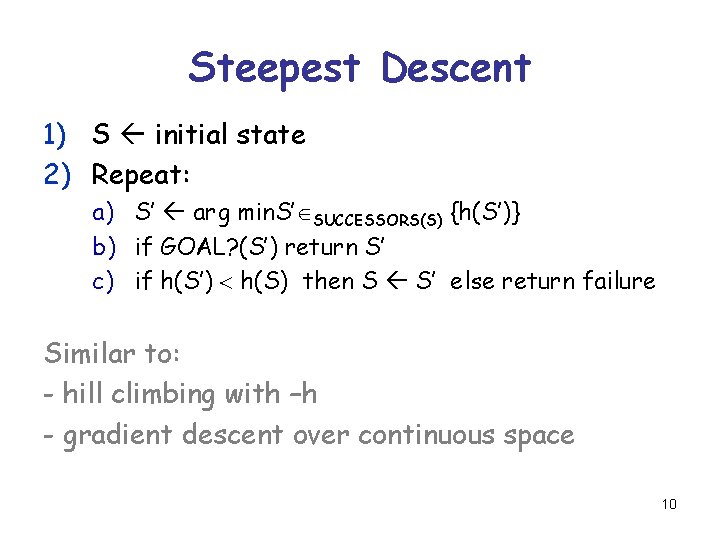
Steepest Descent 1) S initial state 2) Repeat: a) S’ arg min. S’ SUCCESSORS(S) {h(S’)} b) if GOAL? (S’) return S’ c) if h(S’) h(S) then S S’ else return failure Similar to: - hill climbing with –h - gradient descent over continuous space 10
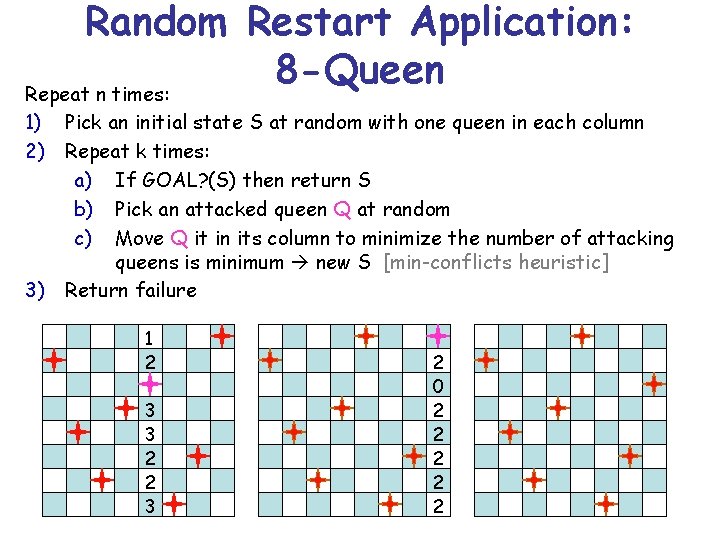
Random Restart Application: 8 -Queen Repeat n times: 1) Pick an initial state S at random with one queen in each column 2) Repeat k times: a) If GOAL? (S) then return S b) Pick an attacked queen Q at random c) Move Q it in its column to minimize the number of attacking queens is minimum new S [min-conflicts heuristic] 3) Return failure 1 2 3 3 2 2 3 2 0 2 2 2
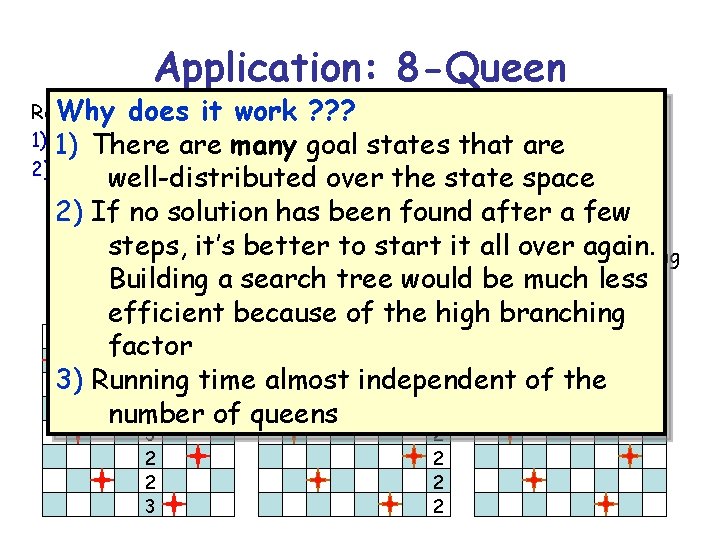
Application: 8 -Queen Repeat Whyn times: does it work ? ? ? 1) 1)Pick an initial state S at random with one that queen in each column There are many goal states are 2) Repeat k times: well-distributed over the state space a) If GOAL? (S) then return S 2)b)If. Pick no an solution has been found after a few attacked queen Q at random start it overofagain. c) steps, Move Q it’s it in better its column to to minimize theall number attacking queens is minimum new S would be much less Building a search tree efficient because of the high branching 1 factor 2 2 3) Running time almost independent of the 0 3 2 number of queens 3 2 2 2 2
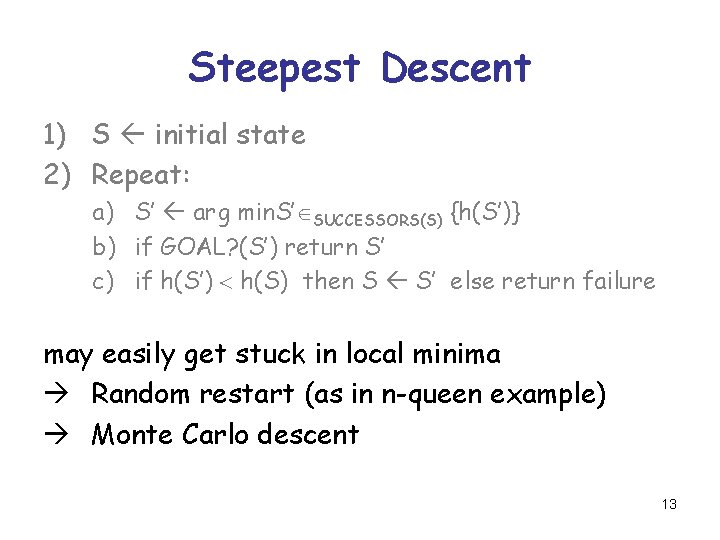
Steepest Descent 1) S initial state 2) Repeat: a) S’ arg min. S’ SUCCESSORS(S) {h(S’)} b) if GOAL? (S’) return S’ c) if h(S’) h(S) then S S’ else return failure may easily get stuck in local minima Random restart (as in n-queen example) Monte Carlo descent 13
Simulated annealing • Escape local maxima by allowing “bad” moves. – Idea: but gradually decrease their size and frequency. • Origin; metallurgical annealing • Bouncing ball analogy: – Shaking hard (= high temperature). – Shaking less (= lower the temperature). • If T decreases slowly enough, best state is reached. • Applied for VLSI layout, airline scheduling, etc. 22 oktober 2021 14 AI 1
Simulated annealing function SIMULATED-ANNEALING( problem, schedule) return a solution state input: problem, a problem schedule, a mapping from time to temperature local variables: current, a node. next, a node. T, a “temperature” controlling the probability of downward steps current MAKE-NODE(INITIAL-STATE[problem]) for t 1 to ∞ do T schedule[t] if T = 0 then return current next a randomly selected successor of current ∆E VALUE[next] - VALUE[current] if ∆E > 0 then current next else current next only with probability e∆E /T 22 oktober 2021 15 AI 1
Local beam search • Keep track of k states instead of one – – Initially: k random states Next: determine all successors of k states If any of successors is goal finished Else select k best from successors and repeat. • Major difference with random-restart search – Information is shared among k search threads. • Can suffer from lack of diversity. – Stochastic variant: choose k successors at proportionally to state success. 22 oktober 2021 16 AI 1
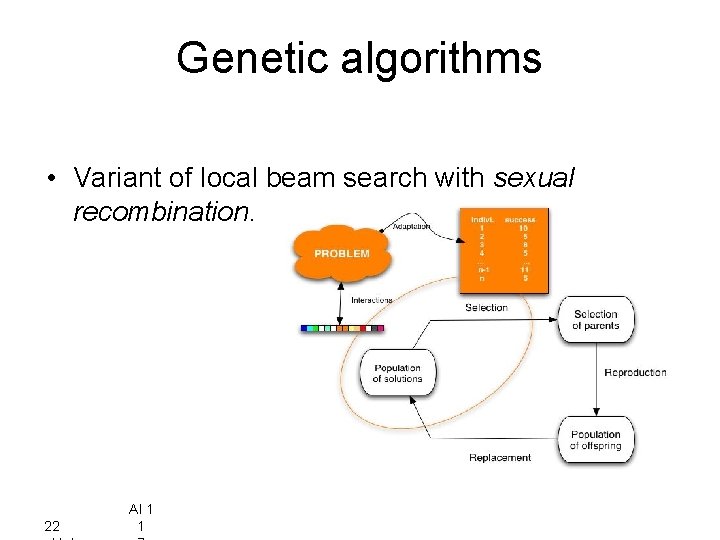
Genetic algorithms • Variant of local beam search with sexual recombination. 22 AI 1 1
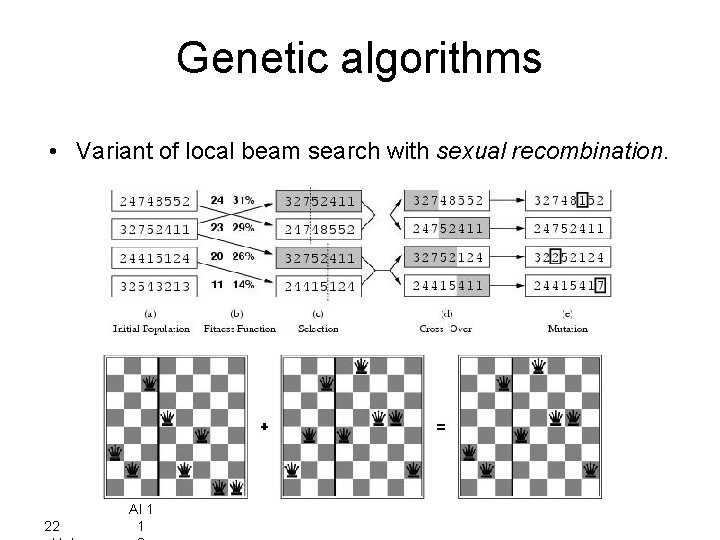
Genetic algorithms • Variant of local beam search with sexual recombination. 22 AI 1 1
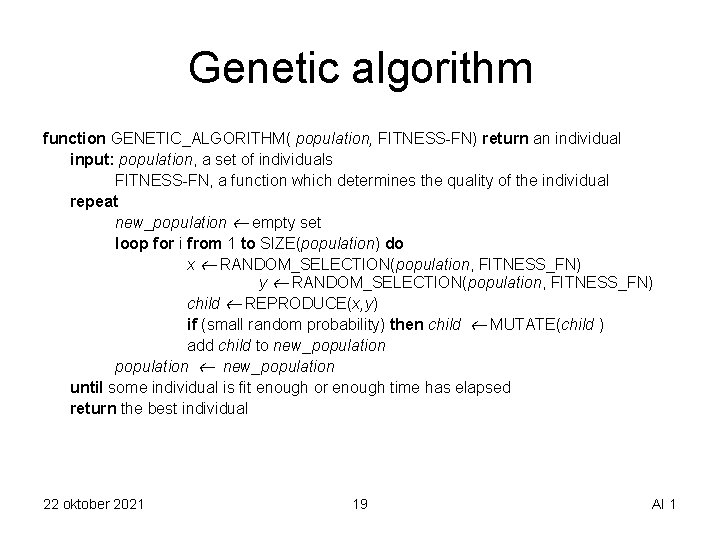
Genetic algorithm function GENETIC_ALGORITHM( population, FITNESS-FN) return an individual input: population, a set of individuals FITNESS-FN, a function which determines the quality of the individual repeat new_population empty set loop for i from 1 to SIZE(population) do x RANDOM_SELECTION(population, FITNESS_FN) y RANDOM_SELECTION(population, FITNESS_FN) child REPRODUCE(x, y) if (small random probability) then child MUTATE(child ) add child to new_population until some individual is fit enough or enough time has elapsed return the best individual 22 oktober 2021 19 AI 1
Exploration problems • Until now all algorithms were offline. – Offline= solution is determined before executing it. – Online = interleaving computation and action • Online search is necessary for dynamic and semi-dynamic environments – It is impossible to take into account all possible contingencies. • Used for exploration problems: – Unknown states and actions. – e. g. any robot in a new environment, a newborn baby, … 22 oktober 2021 20 AI 1
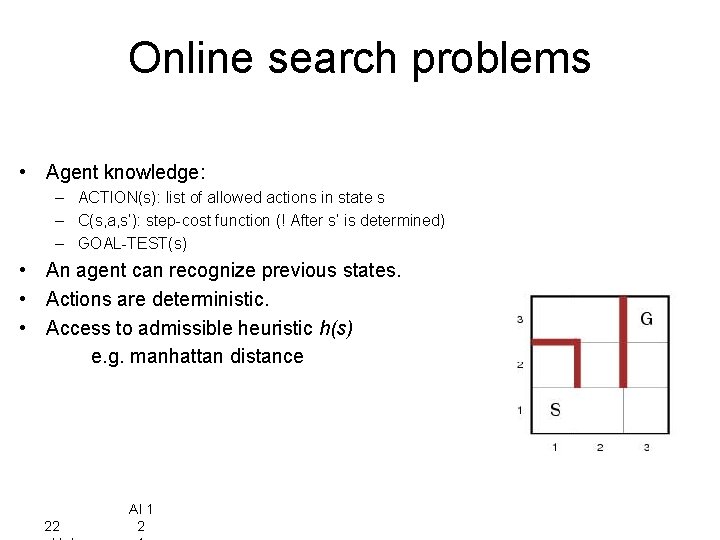
Online search problems • Agent knowledge: – ACTION(s): list of allowed actions in state s – C(s, a, s’): step-cost function (! After s’ is determined) – GOAL-TEST(s) • An agent can recognize previous states. • Actions are deterministic. • Access to admissible heuristic h(s) e. g. manhattan distance 22 AI 1 2
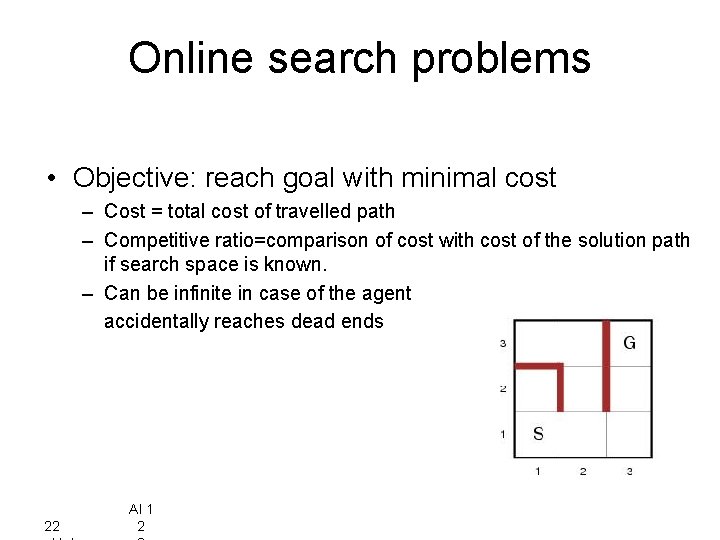
Online search problems • Objective: reach goal with minimal cost – Cost = total cost of travelled path – Competitive ratio=comparison of cost with cost of the solution path if search space is known. – Can be infinite in case of the agent accidentally reaches dead ends 22 AI 1 2
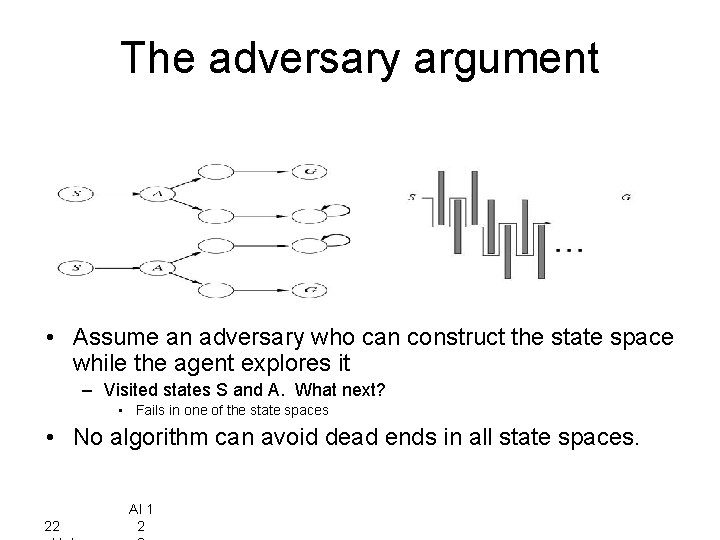
The adversary argument • Assume an adversary who can construct the state space while the agent explores it – Visited states S and A. What next? • Fails in one of the state spaces • No algorithm can avoid dead ends in all state spaces. 22 AI 1 2
Online search agents • The agent maintains a map of the environment. – Updated based on percept input. – This map is used to decide next action. Note difference with e. g. A* An online version can only expand the node it is physically in (local order) 22 oktober 2021 24 AI 1
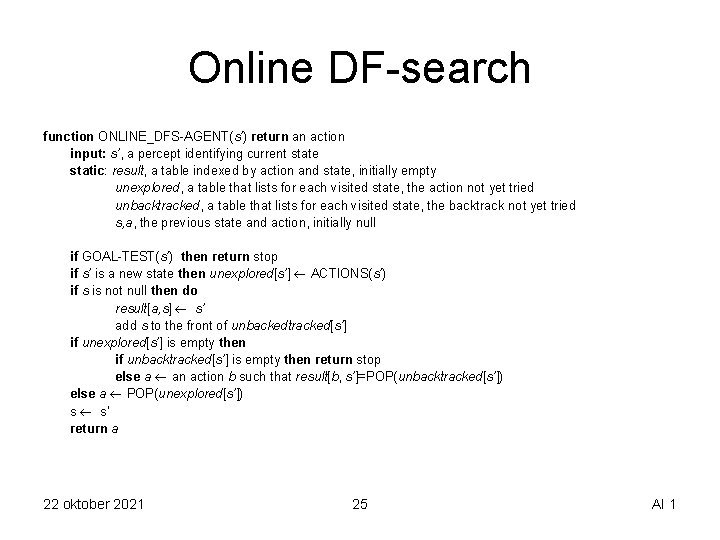
Online DF-search function ONLINE_DFS-AGENT(s’) return an action input: s’, a percept identifying current state static: result, a table indexed by action and state, initially empty unexplored, a table that lists for each visited state, the action not yet tried unbacktracked, a table that lists for each visited state, the backtrack not yet tried s, a, the previous state and action, initially null if GOAL-TEST(s’) then return stop if s’ is a new state then unexplored[s’] ACTIONS(s’) if s is not null then do result[a, s] s’ add s to the front of unbackedtracked[s’] if unexplored[s’] is empty then if unbacktracked[s’] is empty then return stop else a an action b such that result[b, s’]=POP(unbacktracked[s’]) else a POP(unexplored[s’]) s s’ return a 22 oktober 2021 25 AI 1
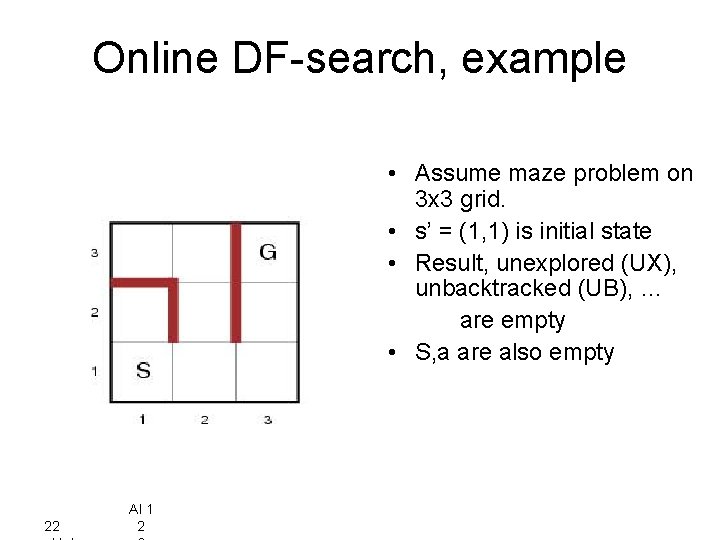
Online DF-search, example • Assume maze problem on 3 x 3 grid. • s’ = (1, 1) is initial state • Result, unexplored (UX), unbacktracked (UB), … are empty • S, a are also empty 22 AI 1 2
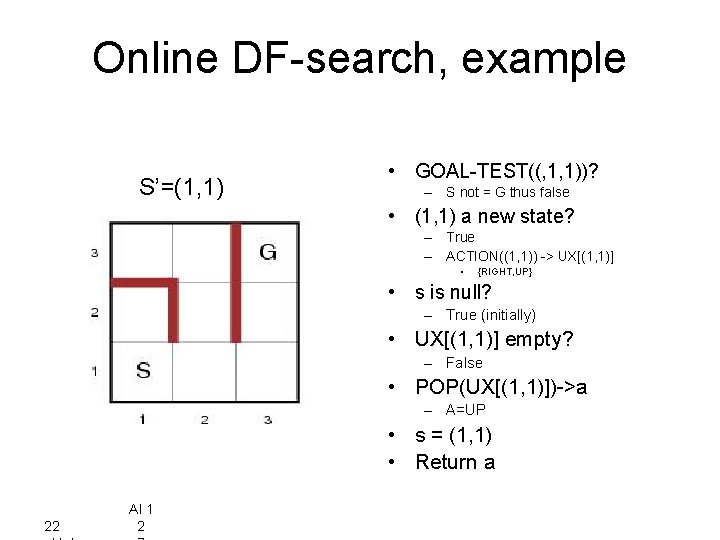
Online DF-search, example S’=(1, 1) • GOAL-TEST((, 1, 1))? – S not = G thus false • (1, 1) a new state? – True – ACTION((1, 1)) -> UX[(1, 1)] • {RIGHT, UP} • s is null? – True (initially) • UX[(1, 1)] empty? – False • POP(UX[(1, 1)])->a – A=UP • s = (1, 1) • Return a 22 AI 1 2
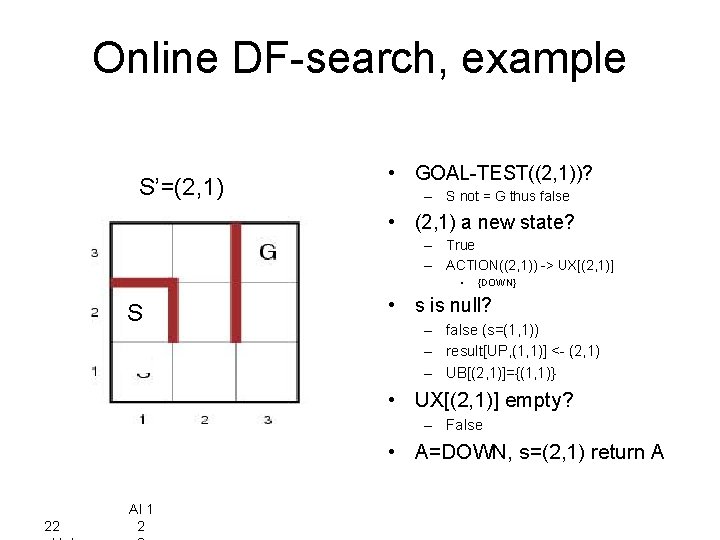
Online DF-search, example S’=(2, 1) • GOAL-TEST((2, 1))? – S not = G thus false • (2, 1) a new state? – True – ACTION((2, 1)) -> UX[(2, 1)] • S {DOWN} • s is null? – false (s=(1, 1)) – result[UP, (1, 1)] <- (2, 1) – UB[(2, 1)]={(1, 1)} • UX[(2, 1)] empty? – False • A=DOWN, s=(2, 1) return A 22 AI 1 2
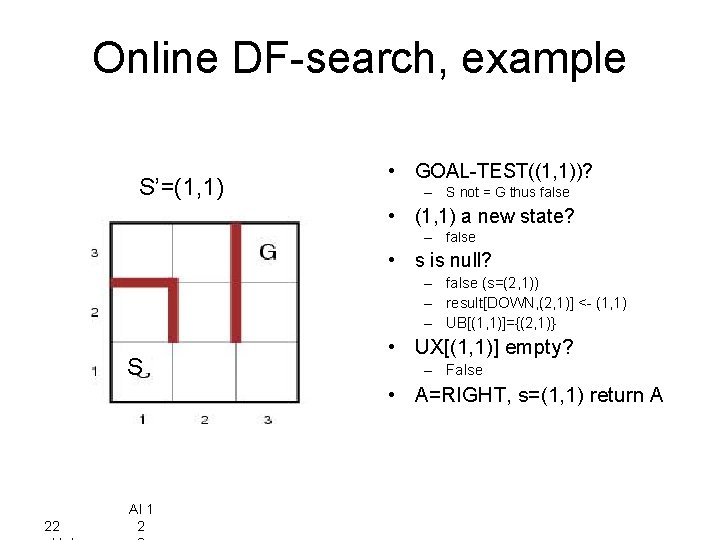
Online DF-search, example S’=(1, 1) • GOAL-TEST((1, 1))? – S not = G thus false • (1, 1) a new state? – false • s is null? – false (s=(2, 1)) – result[DOWN, (2, 1)] <- (1, 1) – UB[(1, 1)]={(2, 1)} S • UX[(1, 1)] empty? – False • A=RIGHT, s=(1, 1) return A 22 AI 1 2
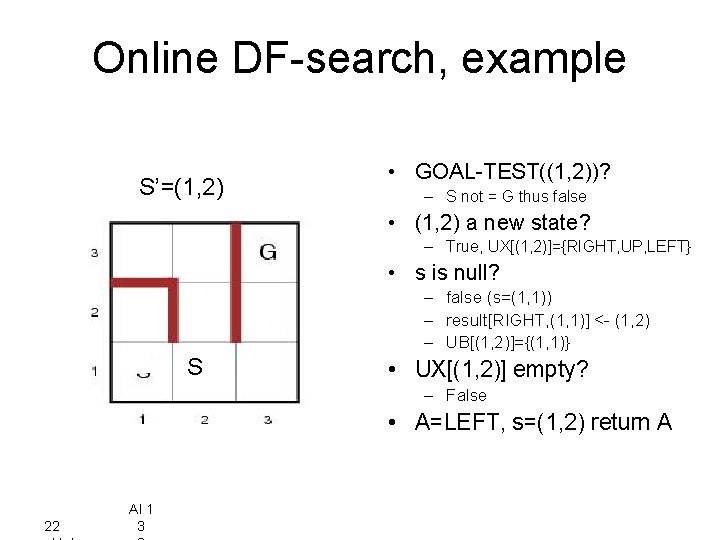
Online DF-search, example S’=(1, 2) • GOAL-TEST((1, 2))? – S not = G thus false • (1, 2) a new state? – True, UX[(1, 2)]={RIGHT, UP, LEFT} • s is null? – false (s=(1, 1)) – result[RIGHT, (1, 1)] <- (1, 2) – UB[(1, 2)]={(1, 1)} S • UX[(1, 2)] empty? – False • A=LEFT, s=(1, 2) return A 22 AI 1 3
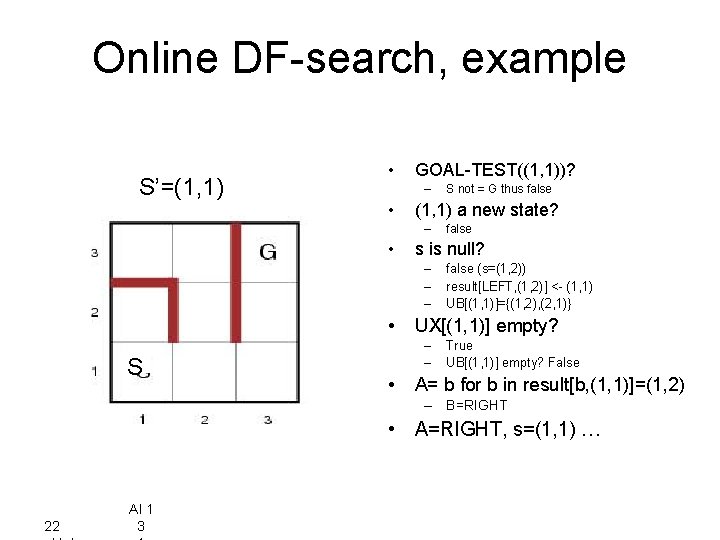
Online DF-search, example S’=(1, 1) • GOAL-TEST((1, 1))? – • (1, 1) a new state? – • S false (s=(1, 2)) result[LEFT, (1, 2)] <- (1, 1) UB[(1, 1)]={(1, 2), (2, 1)} UX[(1, 1)] empty? – – • false s is null? – – – • S not = G thus false True UB[(1, 1)] empty? False A= b for b in result[b, (1, 1)]=(1, 2) – B=RIGHT • A=RIGHT, s=(1, 1) … 22 AI 1 3
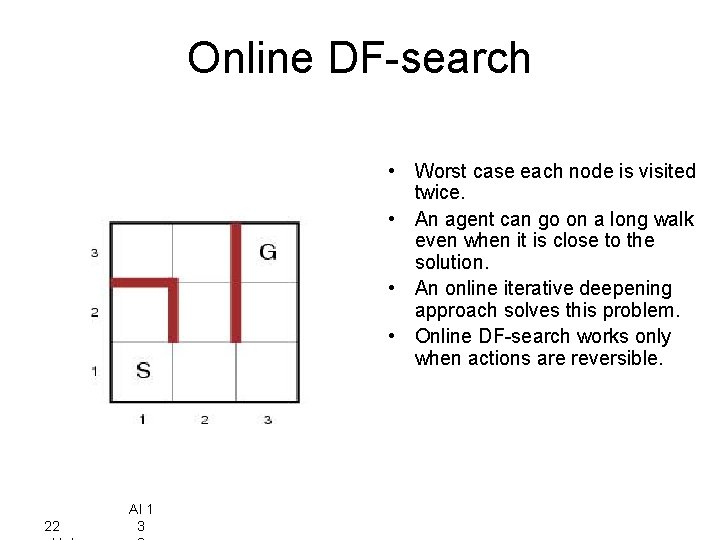
Online DF-search • Worst case each node is visited twice. • An agent can go on a long walk even when it is close to the solution. • An online iterative deepening approach solves this problem. • Online DF-search works only when actions are reversible. 22 AI 1 3
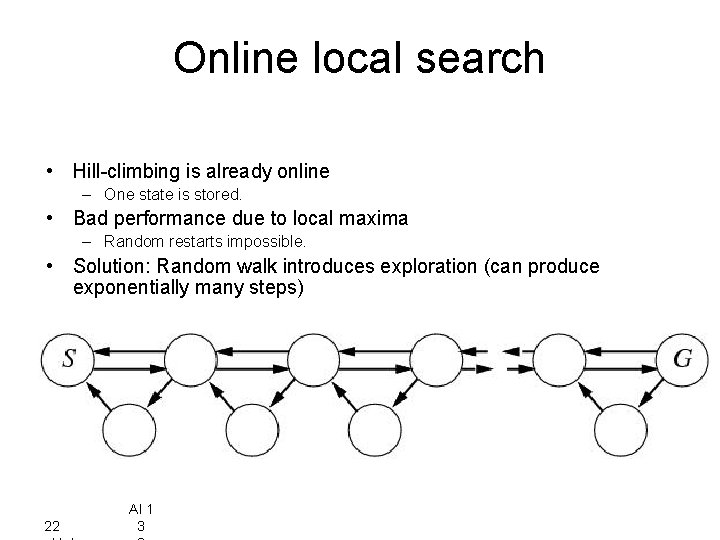
Online local search • Hill-climbing is already online – One state is stored. • Bad performance due to local maxima – Random restarts impossible. • Solution: Random walk introduces exploration (can produce exponentially many steps) 22 AI 1 3
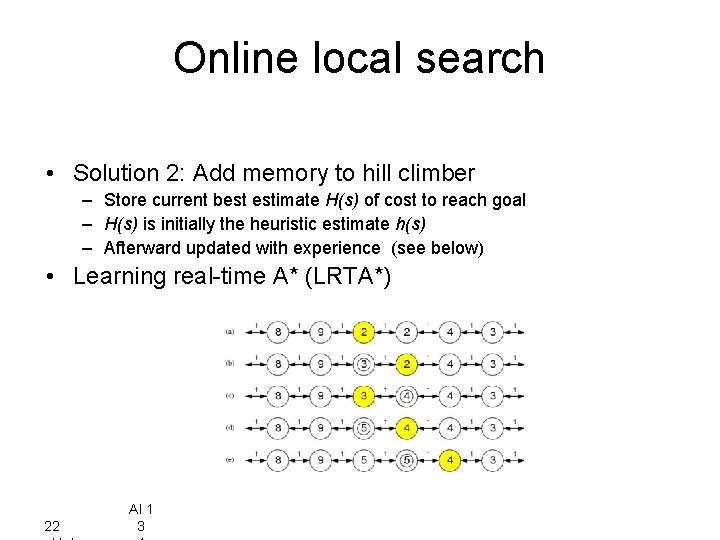
Online local search • Solution 2: Add memory to hill climber – Store current best estimate H(s) of cost to reach goal – H(s) is initially the heuristic estimate h(s) – Afterward updated with experience (see below) • Learning real-time A* (LRTA*) 22 AI 1 3
- Slides: 34