
Beyond Breakeven Why Capitalization Matters Utah Symphony Utah
Beyond Breakeven Why Capitalization Matters Utah Symphony | Utah Opera
Agenda • Lessons learned from a Philadelphia capitalization study, “Getting Beyond Breakeven” • Discussion of capitalization – Why it matters – How to develop a capitalization strategy 2
CAPITALIZATION STUDY
Introduction to the study • Commissioned by Pew Charitable Trusts and William Penn Foundation in 2008 /2009 – Funders were worried about financial health despite significant investments. – Assessed data from PACDP for 150 organizations and interviewed leadership from a subset of 60 4
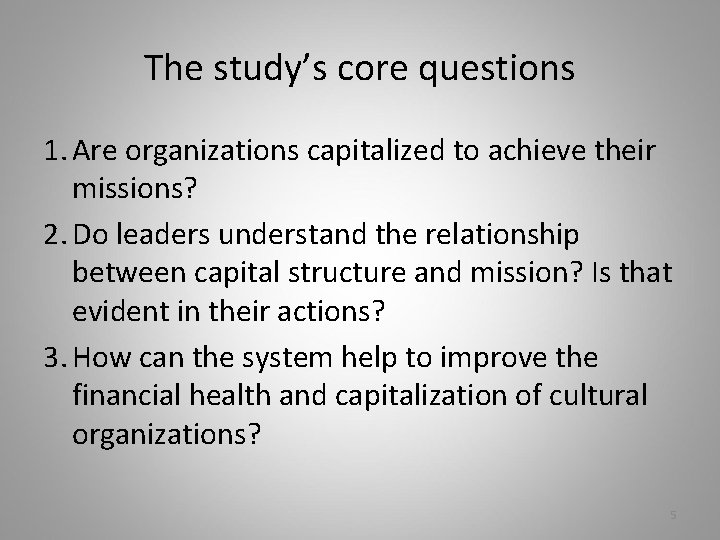
The study’s core questions 1. Are organizations capitalized to achieve their missions? 2. Do leaders understand the relationship between capital structure and mission? Is that evident in their actions? 3. How can the system help to improve the financial health and capitalization of cultural organizations? 5
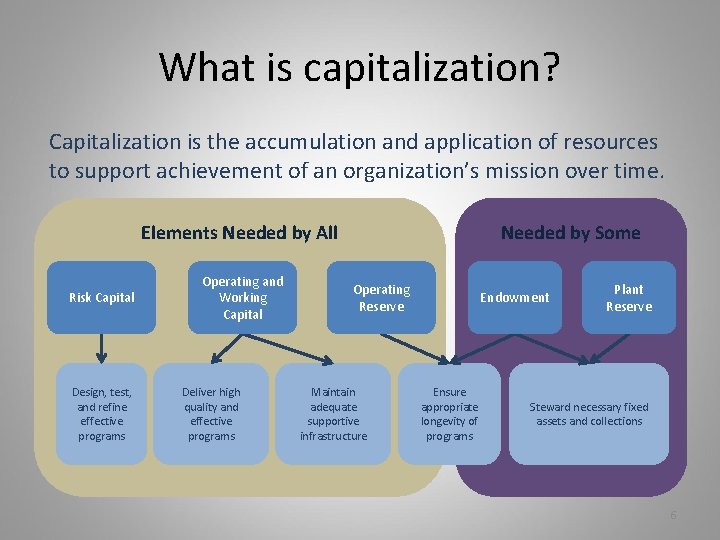
What is capitalization? Capitalization is the accumulation and application of resources to support achievement of an organization’s mission over time. Elements Needed by All Risk Capital Design, test, and refine effective programs Operating and Working Capital Deliver high quality and effective programs Needed by Some Operating Reserve Maintain adequate supportive infrastructure Endowment Ensure appropriate longevity of programs Plant Reserve Steward necessary fixed assets and collections 6
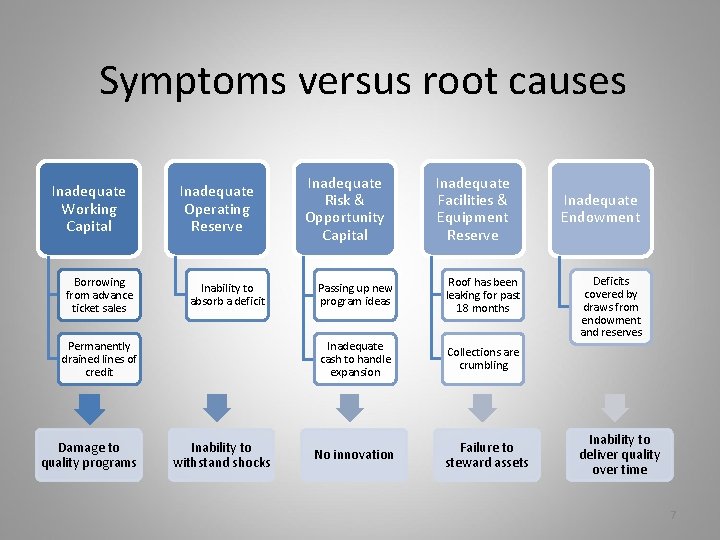
Symptoms versus root causes Inadequate Working Capital Borrowing from advance ticket sales Inadequate Operating Reserve Inability to absorb a deficit Permanently drained lines of credit Damage to quality programs Inability to withstand shocks Inadequate Risk & Opportunity Capital Inadequate Facilities & Equipment Reserve Passing up new program ideas Roof has been leaking for past 18 months Inadequate cash to handle expansion Collections are crumbling No innovation Failure to steward assets Inadequate Endowment Deficits covered by draws from endowment and reserves Inability to deliver quality over time 7
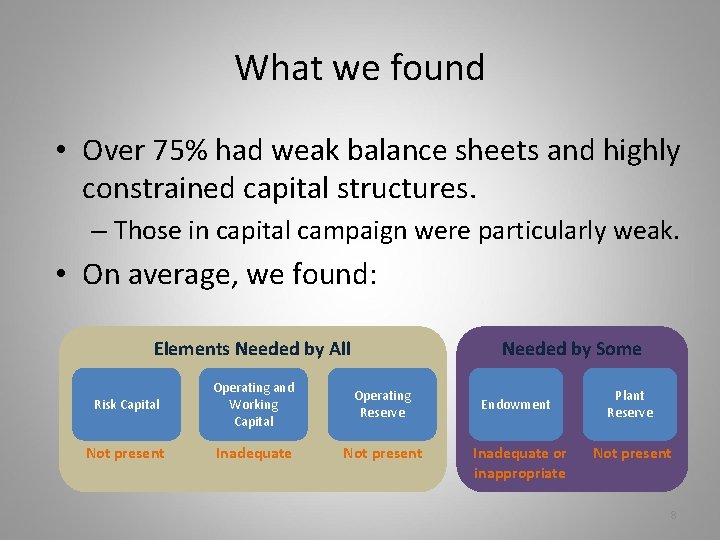
What we found • Over 75% had weak balance sheets and highly constrained capital structures. – Those in capital campaign were particularly weak. • On average, we found: Elements Needed by All Needed by Some Risk Capital Operating and Working Capital Operating Reserve Not present Inadequate Not present Endowment Inadequate or inappropriate Plant Reserve Not present 8
It’s not about knowledge! • But, we found that the majority of nonprofit leaders understand their financial position. – Neither discipline nor budget size is a factor. • Many can point to the corrosive effects of poor capitalization but feel powerless to address it. 9
Where’s the disconnect? • Internally focused planning • Lack of integration of financial technical assistance • Incentives of both funders and supporters that are often misaligned to support the larger goals of solid capitalization 10
Planning was not contextualized • While plans were mandated, many were not contextualized in the marketplace. – Benchmarking was substituted for market testing. • Market research must include feedback from audiences and funders, and a look at the competitive landscape. – Without external validation, demand projections can be unrealistic, leading to poor decision-making and lack of effective contingency planning. 11
Financial TA was not integrated • Many recipients of TA reported frustration with the results of financial analysis because they were not tied to a larger strategy for response. – “So I have a bad balance sheet. I know that. What do I do about it? ” 12
Incentives not aligned • Most incentives are geared toward breakeven annual budgets or success of isolated projects. • Many organizations worry that they will be seen as weak and, ultimately, “unfundable” if they are honest about undercapitalization. – Reserves and endowment are often deleted from capital campaign goals because they can make projects look impossible. 13
Organizations are in a double bind • “I feel as if the arts world is at a critical moment when we need to take some real risks. Yet somehow there is an overall feeling that art groups need to be financially conservative. There is not much reward to taking risks unless you succeed every time – which, of course, is not the nature of risk. ” 14
Capitalization -- It’s all about risk • • Can you invest in the art? Can you invest in audience? Can you respond to external forces? What are the long term effects if you can’t? 15
CREATING A CAPITALIZATION STRATEGY
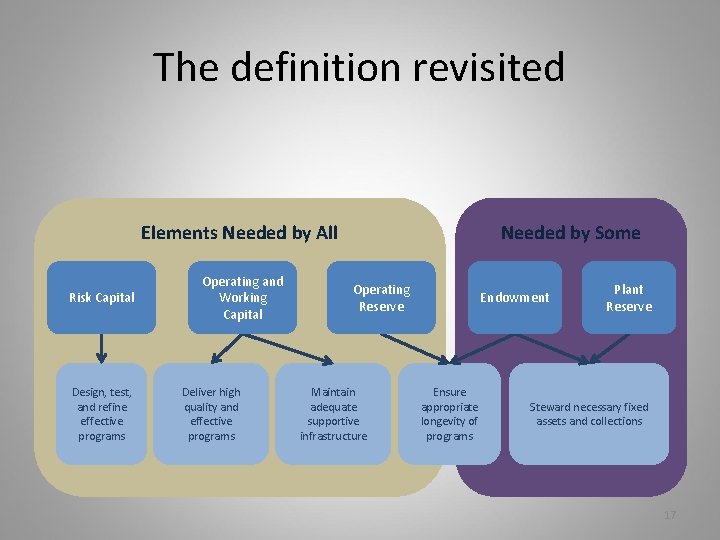
The definition revisited Elements Needed by All Risk Capital Design, test, and refine effective programs Operating and Working Capital Deliver high quality and effective programs Needed by Some Operating Reserve Maintain adequate supportive infrastructure Endowment Ensure appropriate longevity of programs Plant Reserve Steward necessary fixed assets and collections 17
How well are you capitalized now? • Look at the balance sheet first. It: – records an organization’s accumulated financial performance over time. – demonstrates the strength and availability of an organization’s asset base to support its future. – measures liquidity. 18
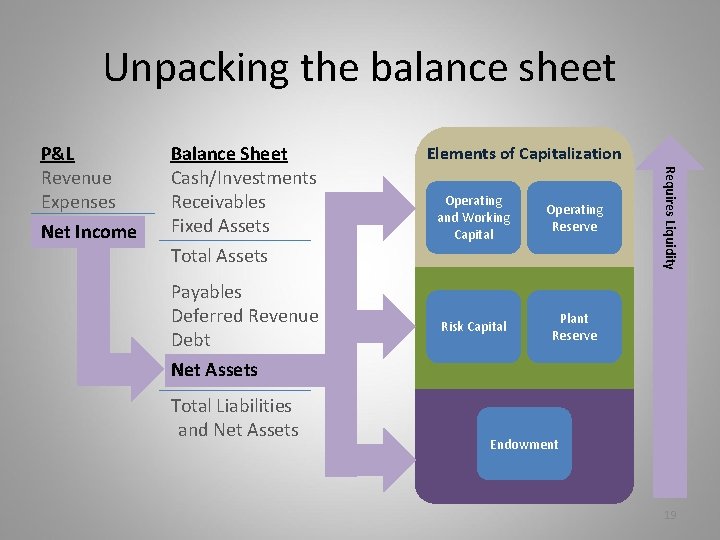
Unpacking the balance sheet Balance Sheet Cash/Investments Receivables Fixed Assets Total Assets Payables Deferred Revenue Debt Net Assets Total Liabilities and Net Assets Elements of Capitalization Operating and Working Capital Operating Reserve Risk Capital Plant Reserve Requires Liquidity P&L Revenue Expenses Net Income Endowment 19
Now what? • There are no cookie cutter answers. • A capitalization strategy looks at an organization’s: – – Mission and vision Business model drivers Time horizon and lifecycle Marketplace • With this in mind, the strategy determines the types of funds required. • It then articulates the necessary size of the funds, the timing of the need, and the method for obtaining the required resources. 20
Mission and Vision • Organizations must have a clearly articulated mission and vision. • They should also have a well-defined approach and methodology to fulfilling the mission. • Board and staff must agree upon the mission and approach. • Once defined, the mission and vision must be considered through the following lenses. 21
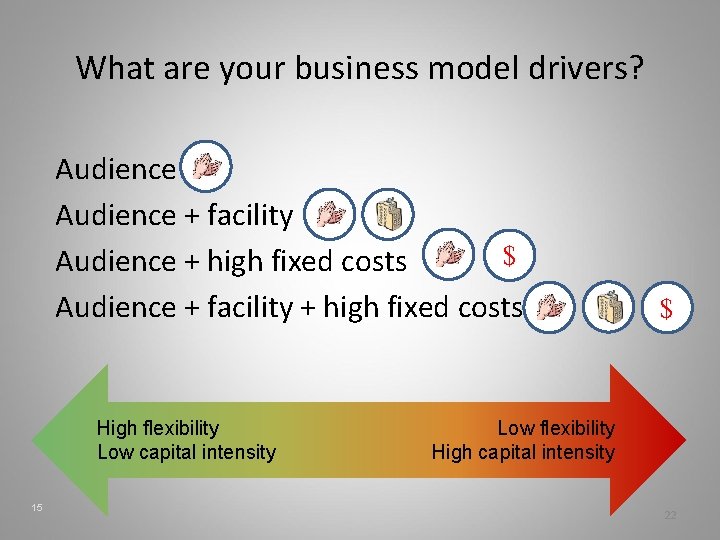
What are your business model drivers? Audience + facility $ Audience + high fixed costs Audience + facility + high fixed costs High flexibility Low capital intensity 15 $ Low flexibility High capital intensity 22
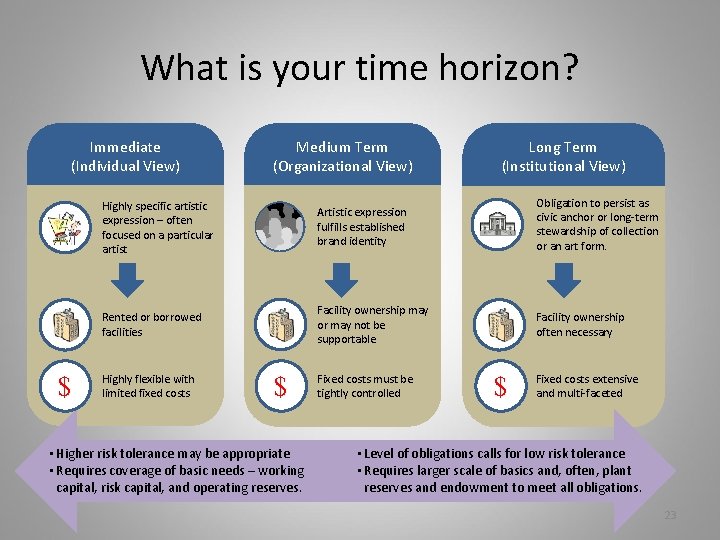
What is your time horizon? Immediate (Individual View) $ Medium Term (Organizational View) Long Term (Institutional View) Highly specific artistic expression – often focused on a particular artist Artistic expression fulfills established brand identity Obligation to persist as civic anchor or long-term stewardship of collection or an art form. Rented or borrowed facilities Facility ownership may or may not be supportable Facility ownership often necessary Highly flexible with limited fixed costs Fixed costs must be tightly controlled Fixed costs extensive and multi-faceted $ • Higher risk tolerance may be appropriate • Requires coverage of basic needs – working capital, risk capital, and operating reserves. $ • Level of obligations calls for low risk tolerance • Requires larger scale of basics and, often, plant reserves and endowment to meet all obligations. 23
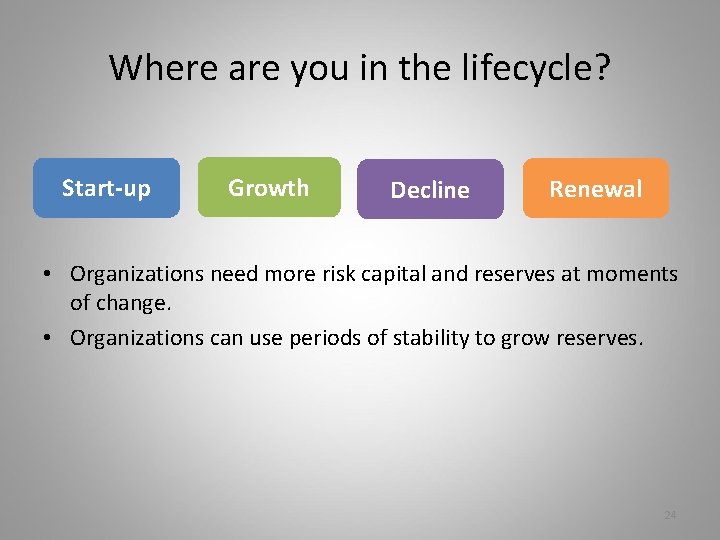
Where are you in the lifecycle? Start-up Growth Decline Renewal • Organizations need more risk capital and reserves at moments of change. • Organizations can use periods of stability to grow reserves. 24
Importance of the marketplace • A thorough understanding of the marketplace tests the mission and vision and predicts the resources available : – – Definition of Audience Demand/Pricing Support Competition • These questions can only be answered in the context of the local community and are particularly important during projected program or facility expansions 25
Resources • Analyzing the marketplace also helps determine cost of doing business: – Talent – Fixed costs – Marketing and development investments • Organizations with facilities must also define long- term systems replacement needs and funding requirements 26
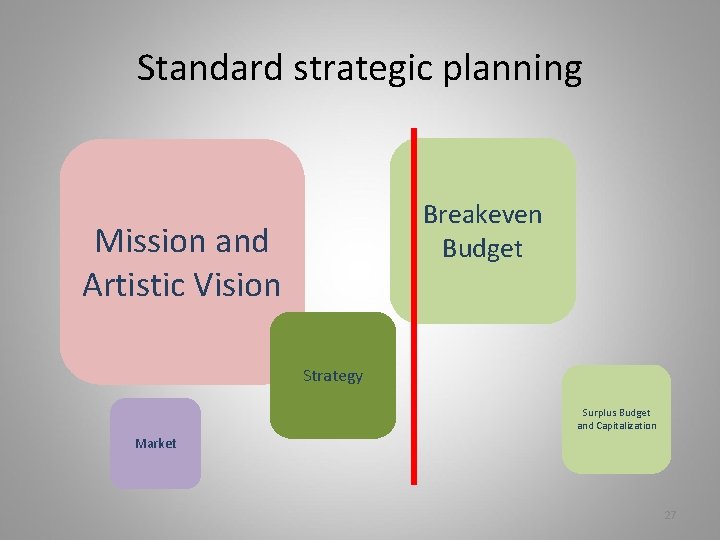
Standard strategic planning Breakeven Budget Mission and Artistic Vision Strategy Surplus Budget and Capitalization Market 27
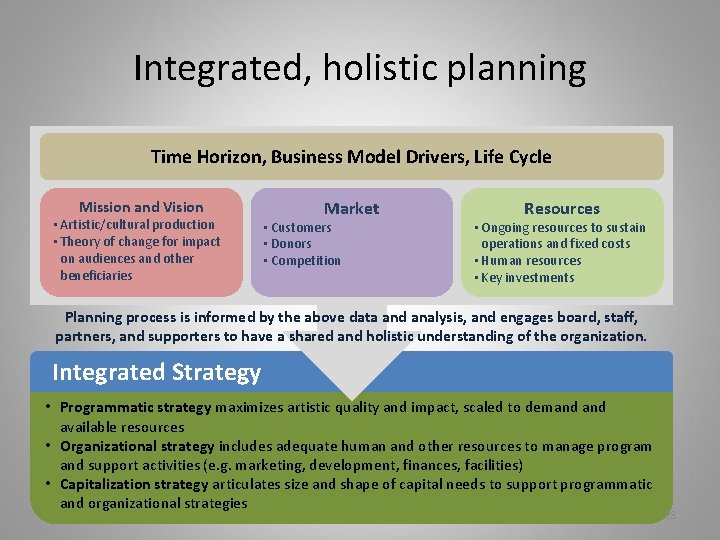
Integrated, holistic planning Time Horizon, Business Model Drivers, Life Cycle Mission and Vision • Artistic/cultural production • Theory of change for impact on audiences and other beneficiaries Market • Customers • Donors • Competition Resources • Ongoing resources to sustain operations and fixed costs • Human resources • Key investments Planning process is informed by the above data and analysis, and engages board, staff, partners, and supporters to have a shared and holistic understanding of the organization. Integrated Strategy • Programmatic strategy maximizes artistic quality and impact, scaled to demand available resources • Organizational strategy includes adequate human and other resources to manage program and support activities (e. g. marketing, development, finances, facilities) • Capitalization strategy articulates size and shape of capital needs to support programmatic and organizational strategies 28
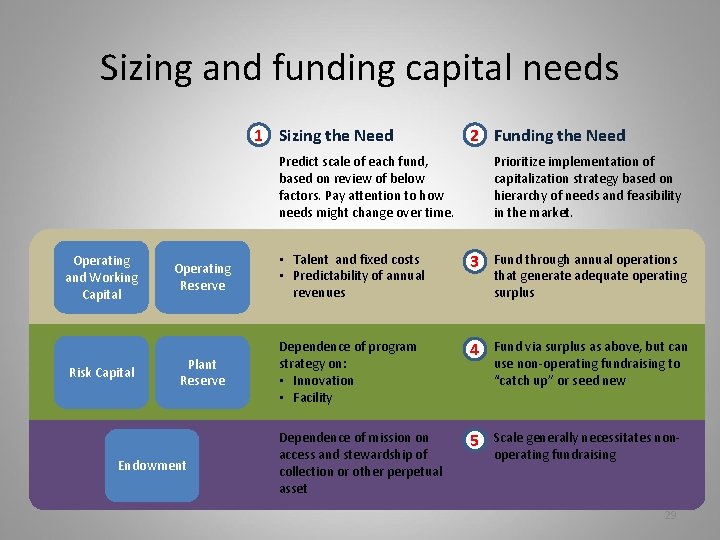
Sizing and funding capital needs 1 Sizing the Need 2 Funding the Need Predict scale of each fund, based on review of below factors. Pay attention to how needs might change over time. Operating and Working Capital Risk Capital Prioritize implementation of capitalization strategy based on hierarchy of needs and feasibility in the market. Operating Reserve • Talent and fixed costs • Predictability of annual revenues 3 Fund through annual operations that generate adequate operating surplus Plant Reserve Dependence of program strategy on: • Innovation • Facility 4 Fund via surplus as above, but can use non-operating fundraising to “catch up” or seed new Dependence of mission on access and stewardship of collection or other perpetual asset 5 Scale generally necessitates nonoperating fundraising Endowment 29
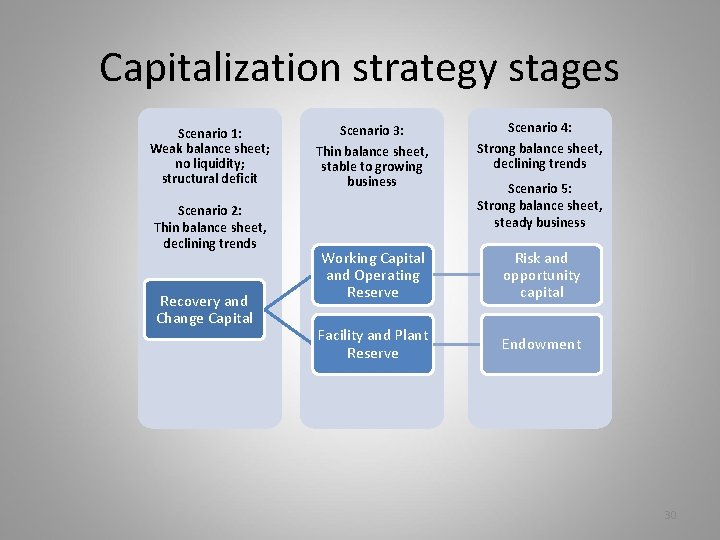
Capitalization strategy stages Scenario 1: Weak balance sheet; no liquidity; structural deficit Scenario 2: Thin balance sheet, declining trends Recovery and Change Capital Scenario 4: Scenario 3: Thin balance sheet, stable to growing business Strong balance sheet, declining trends Working Capital and Operating Reserve Risk and opportunity capital Facility and Plant Reserve Endowment Scenario 5: Strong balance sheet, steady business 30
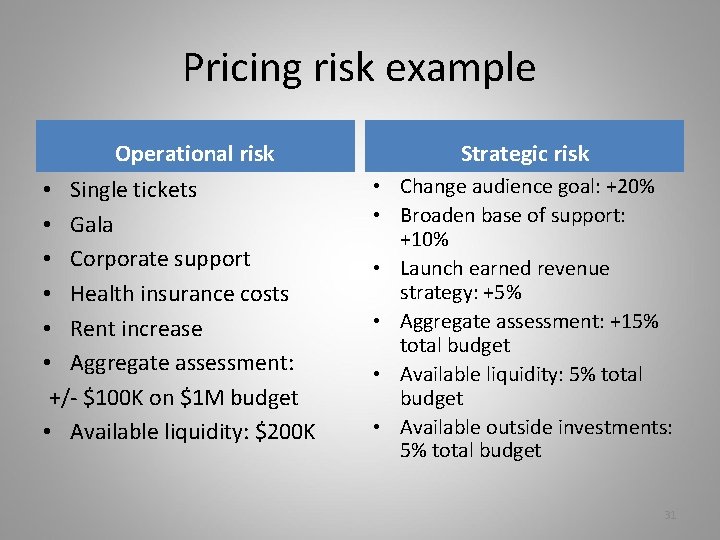
Pricing risk example Operational risk • Single tickets • Gala • Corporate support • Health insurance costs • Rent increase • Aggregate assessment: +/- $100 K on $1 M budget • Available liquidity: $200 K Strategic risk • Change audience goal: +20% • Broaden base of support: +10% • Launch earned revenue strategy: +5% • Aggregate assessment: +15% total budget • Available liquidity: 5% total budget • Available outside investments: 5% total budget 31
You can do this. • There are many tools to help in this work. – National Arts Strategy and Urban Institute tool on reserves policy. – TDC’s tools on facilities readiness and capitalization (in development). – Nonprofit Finance Fund’s facility replacement plans. • Consultants can help but only to a point. – You need to be in the driver’s seat. – Consultants are there to advise and help, not make decisions or tell you what to do. 32
The process matters. • Gathering the data and making strategic decisions needs to be an inclusive process. – Requires full engagement of the board upfront – Requires input from multiple staff departments – no one has the full picture. • Strategy can only be executed effectively if all parts of the organization are moving together. 33
External support is essential. • The best strategy in the world won’t help if you don’t have the support of your funders, donors, and audiences. • A holistic planning process will engage external supporters to test your ideas from the outset. 34
What if they don’t get it? • The fear of misunderstanding from external stakeholders is a real one. • Holistic planning will give you the tools to have a meaningful and honest conversation about the full extent of your capital needs. – Data and sound reasoning are always helpful. – May take an iterative process to change mindsets. – Difficult goals may take negotiation to gain acceptance. • More and more, funders are paying attention to capitalization. – GIA capitalization project is getting the word out. – Best to be prepared to answer these questions before you are asked – now is the time to do this. 35

ADDITIONAL INFORMATION
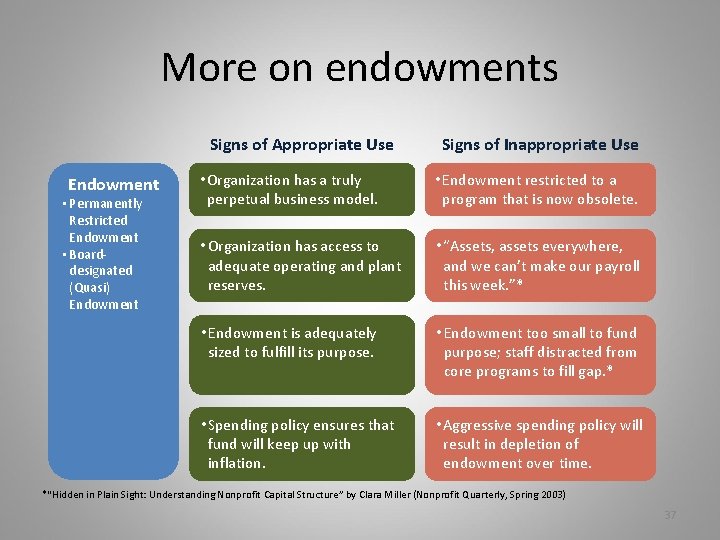
More on endowments Signs of Appropriate Use Endowment • Permanently Restricted Endowment • Boarddesignated (Quasi) Endowment Signs of Inappropriate Use • Organization has a truly perpetual business model. • Endowment restricted to a program that is now obsolete. • Organization has access to adequate operating and plant reserves. • “Assets, assets everywhere, and we can’t make our payroll this week. ”* • Endowment is adequately sized to fulfill its purpose. • Endowment too small to fund purpose; staff distracted from core programs to fill gap. * • Spending policy ensures that fund will keep up with inflation. • Aggressive spending policy will result in depletion of endowment over time. *“Hidden in Plain Sight: Understanding Nonprofit Capital Structure” by Clara Miller (Nonprofit Quarterly, Spring 2003) 37
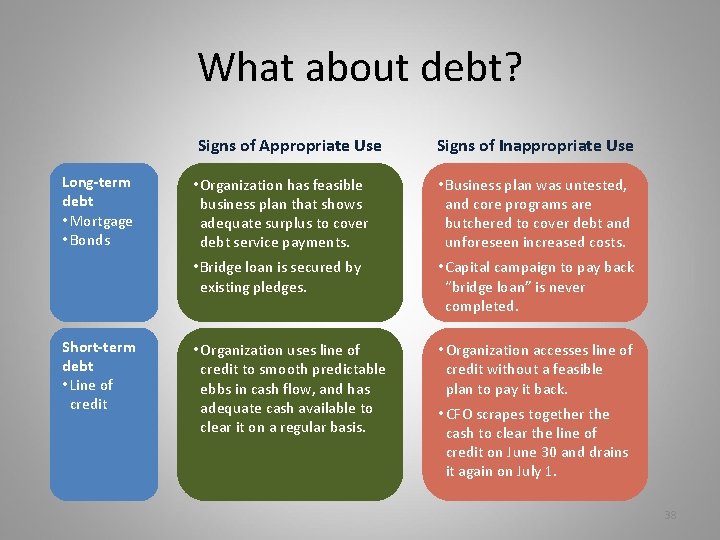
What about debt? Signs of Appropriate Use Long-term debt • Mortgage • Bonds Short-term debt • Line of credit Signs of Inappropriate Use • Organization has feasible business plan that shows adequate surplus to cover debt service payments. • Business plan was untested, and core programs are butchered to cover debt and unforeseen increased costs. • Bridge loan is secured by existing pledges. • Capital campaign to pay back “bridge loan” is never completed. • Organization uses line of credit to smooth predictable ebbs in cash flow, and has adequate cash available to clear it on a regular basis. • Organization accesses line of credit without a feasible plan to pay it back. • CFO scrapes together the cash to clear the line of credit on June 30 and drains it again on July 1. 38
- Slides: 38