
Beyond bags of features Adding spatial information Global
Beyond bags of features: Adding spatial information • Global spatial layout: spatial pyramid matching • Spatial weighting the features

Spatial pyramid matching • Add spatial information to the bag-of-features • Perform matching in 2 D image space [Lazebnik, Schmid & Ponce, CVPR 2006]
![Related work Similar approaches: Subblock description [Szummer & Picard, 1997] SIFT [Lowe, 1999] GIST](http://slidetodoc.com/presentation_image_h2/6d00a9683beadaee76573684477cd91f/image-3.jpg "Related work Similar approaches: Subblock description [Szummer & Picard, 1997] SIFT [Lowe, 1999] GIST")
Related work Similar approaches: Subblock description [Szummer & Picard, 1997] SIFT [Lowe, 1999] GIST [Torralba et al. , 2003] SIFT Szummer & Picard (1997) Lowe (1999, 2004) Gist Torralba et al. (2003)
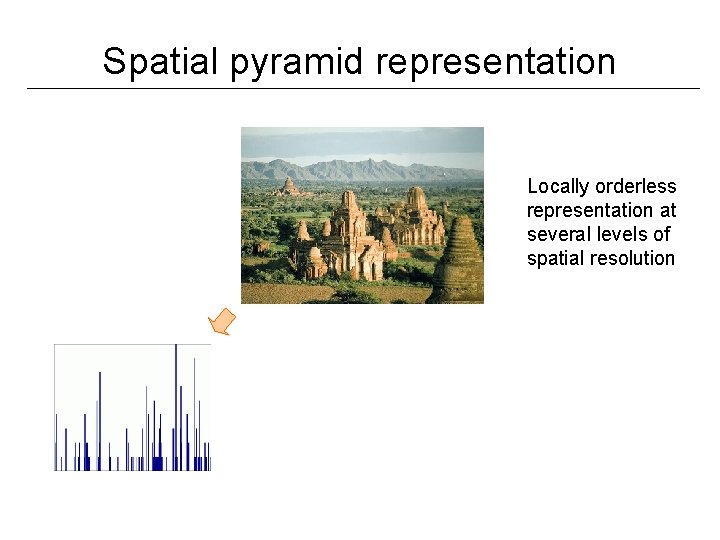
Spatial pyramid representation Locally orderless representation at several levels of spatial resolution level 0
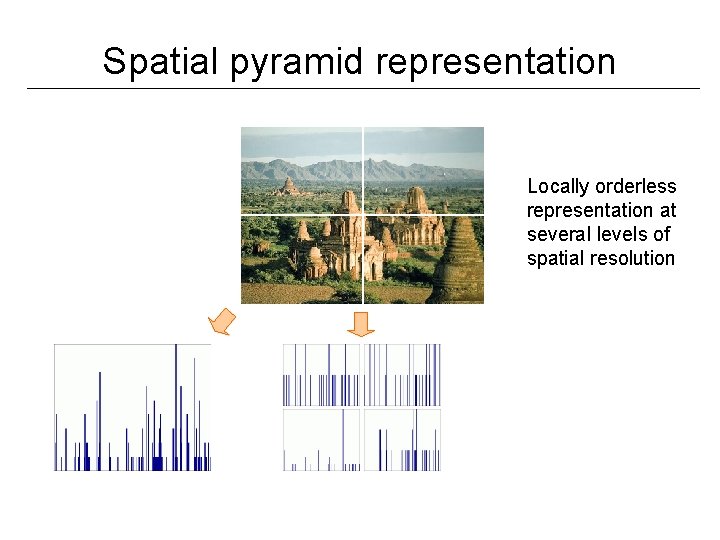
Spatial pyramid representation Locally orderless representation at several levels of spatial resolution level 0 level 1
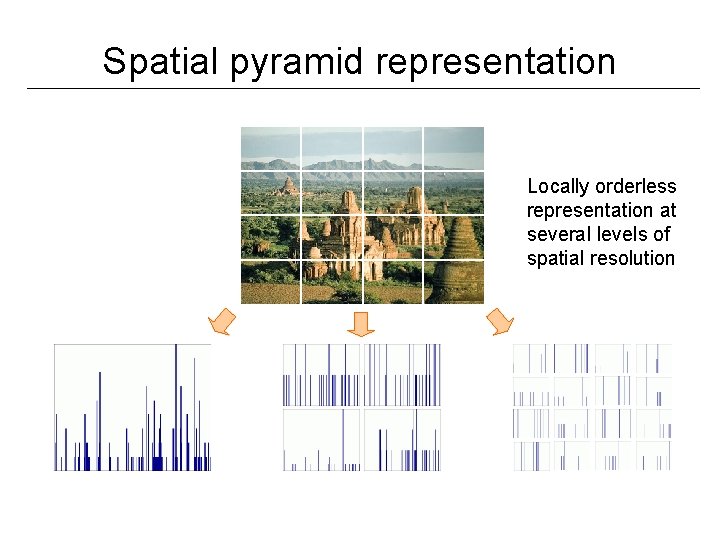
Spatial pyramid representation Locally orderless representation at several levels of spatial resolution level 0 level 1 level 2
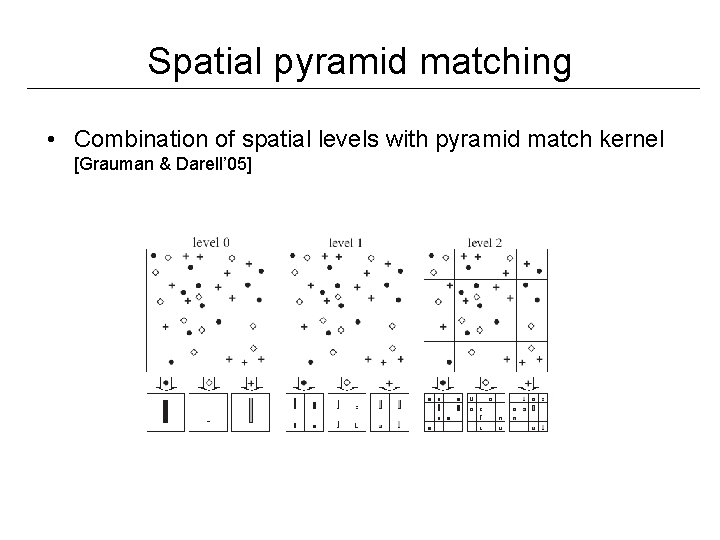
Spatial pyramid matching • Combination of spatial levels with pyramid match kernel [Grauman & Darell’ 05]
![Pyramid match kernel [Grauman & Darell’ 05] optimal partial matching between sets of features](http://slidetodoc.com/presentation_image_h2/6d00a9683beadaee76573684477cd91f/image-8.jpg "Pyramid match kernel [Grauman & Darell’ 05] optimal partial matching between sets of features")
Pyramid match kernel [Grauman & Darell’ 05] optimal partial matching between sets of features
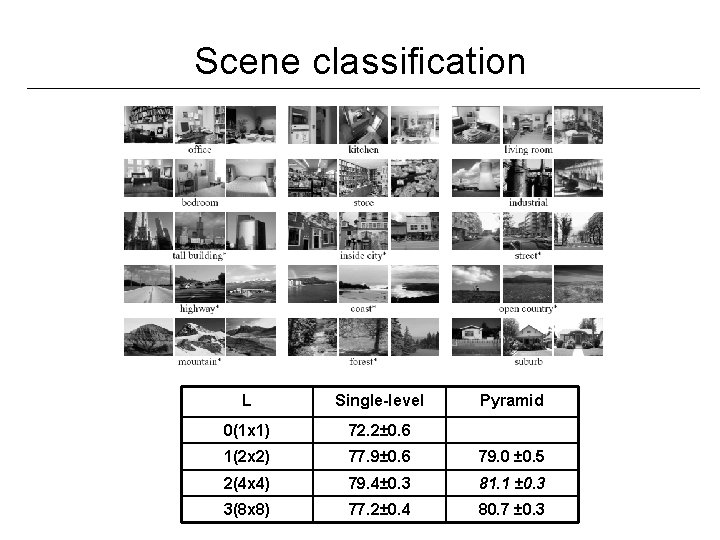
Scene classification L Single-level Pyramid 0(1 x 1) 72. 2± 0. 6 1(2 x 2) 77. 9± 0. 6 79. 0 ± 0. 5 2(4 x 4) 79. 4± 0. 3 81. 1 ± 0. 3 3(8 x 8) 77. 2± 0. 4 80. 7 ± 0. 3

Retrieval examples
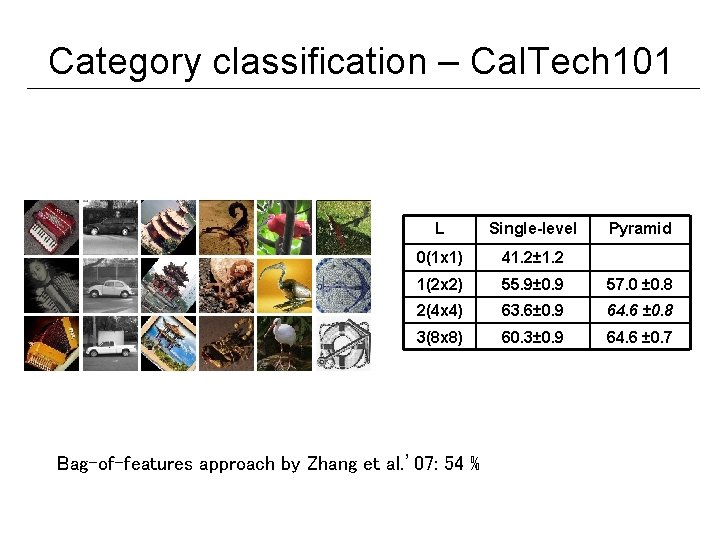
Category classification – Cal. Tech 101 L Single-level 0(1 x 1) 41. 2± 1. 2 1(2 x 2) 55. 9± 0. 9 57. 0 ± 0. 8 2(4 x 4) 63. 6± 0. 9 64. 6 ± 0. 8 3(8 x 8) 60. 3± 0. 9 64. 6 ± 0. 7 Bag-of-features approach by Zhang et al. ’ 07: 54 % Pyramid
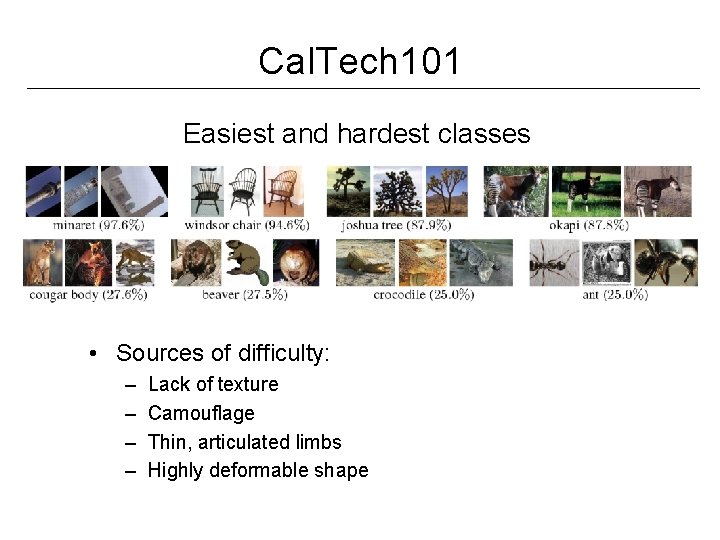
Cal. Tech 101 Easiest and hardest classes • Sources of difficulty: – – Lack of texture Camouflage Thin, articulated limbs Highly deformable shape

Discussion • Summary – Spatial pyramid representation: appearance of local image patches + coarse global position information – Substantial improvement over bag of features – Depends on the similarity of image layout • Extensions – Integrating different types of features, learning weights, use of different grids [Zhang’ 07, Bosch & Zisserman’ 07, Varma et al. ’ 07, Marszalek et al. ’ 07] – Flexible, object-centered grid
Overview • Global spatial layout: spatial pyramid matching • Spatial weighting the features
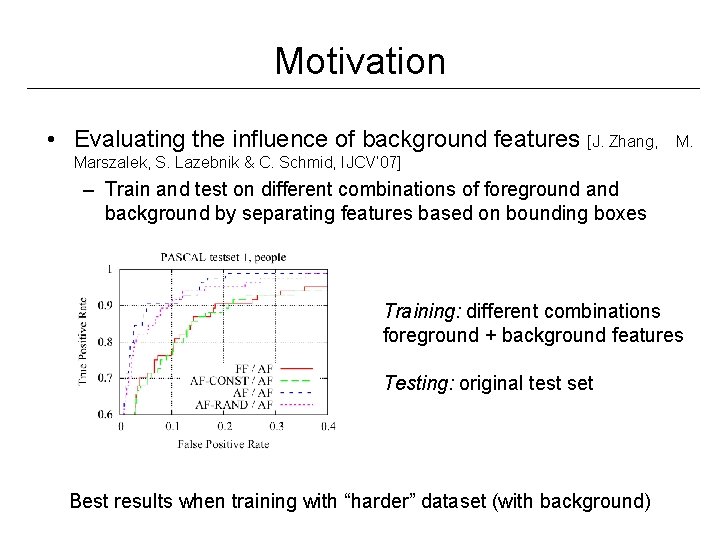
Motivation • Evaluating the influence of background features [J. Zhang, M. Marszalek, S. Lazebnik & C. Schmid, IJCV’ 07] – Train and test on different combinations of foreground and background by separating features based on bounding boxes Training: different combinations foreground + background features Testing: original test set Best results when training with “harder” dataset (with background)
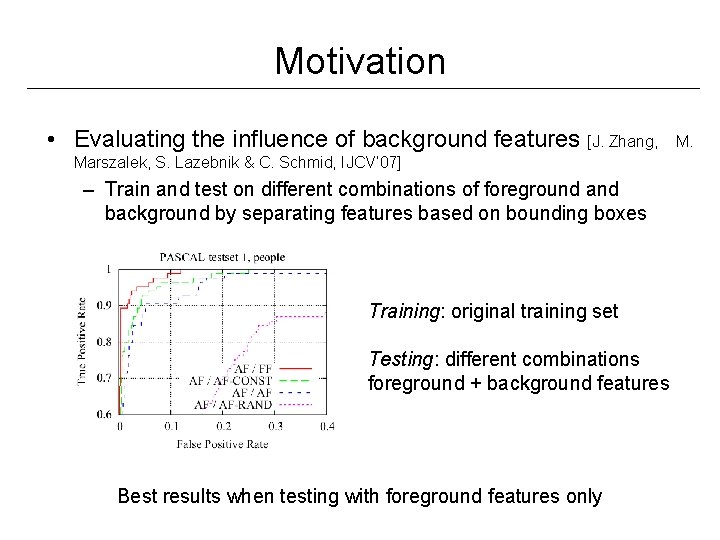
Motivation • Evaluating the influence of background features [J. Zhang, Marszalek, S. Lazebnik & C. Schmid, IJCV’ 07] – Train and test on different combinations of foreground and background by separating features based on bounding boxes Training: original training set Testing: different combinations foreground + background features Best results when testing with foreground features only M.
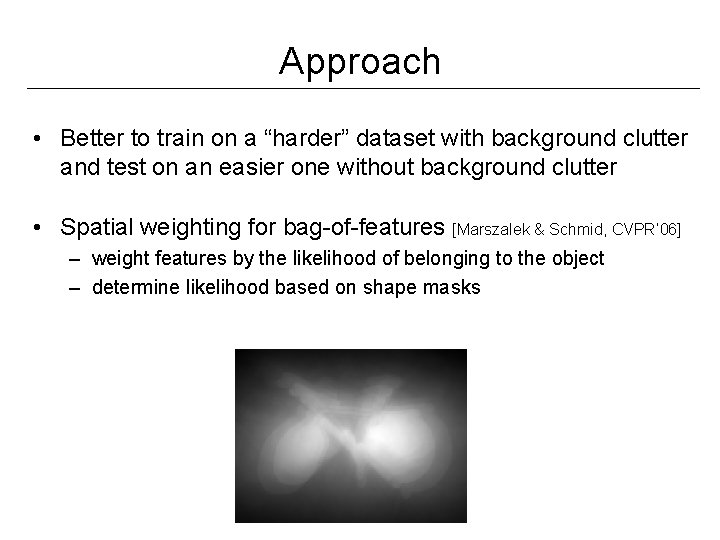
Approach • Better to train on a “harder” dataset with background clutter and test on an easier one without background clutter • Spatial weighting for bag-of-features [Marszalek & Schmid, CVPR’ 06] – weight features by the likelihood of belonging to the object – determine likelihood based on shape masks

Masks for spatial weighting For each test feature: - Select closest training features + corresponding masks (training requires segmented images or bounding boxes) - Align mask based on local co-ordinates system (transformation between training and test co-ordinate systems) Sum masks weighted by matching distance three features agree on object localization, the object has higher weights Weight histogram features with the strength of the final mask

Example masks for spatial weighting
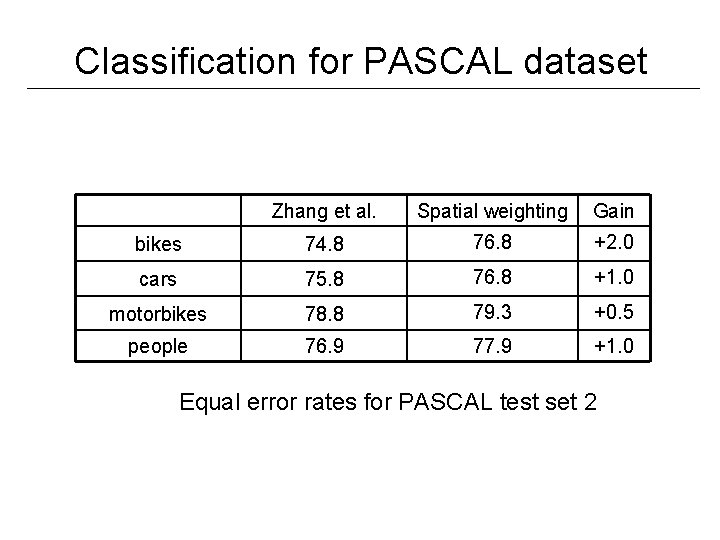
Classification for PASCAL dataset Zhang et al. Spatial weighting Gain bikes 74. 8 76. 8 +2. 0 cars 75. 8 76. 8 +1. 0 motorbikes 78. 8 79. 3 +0. 5 people 76. 9 77. 9 +1. 0 Equal error rates for PASCAL test set 2

Extension to localization • Cast hypothesis – Aligning the mask based on matching features • Evaluate each hypothesis – SVM for local features • Merge hypothesis to produce localization decisions – Online clustering of similar hypothesis, rejection of weak ones [Marszalek & Schmid, CVPR 2007]
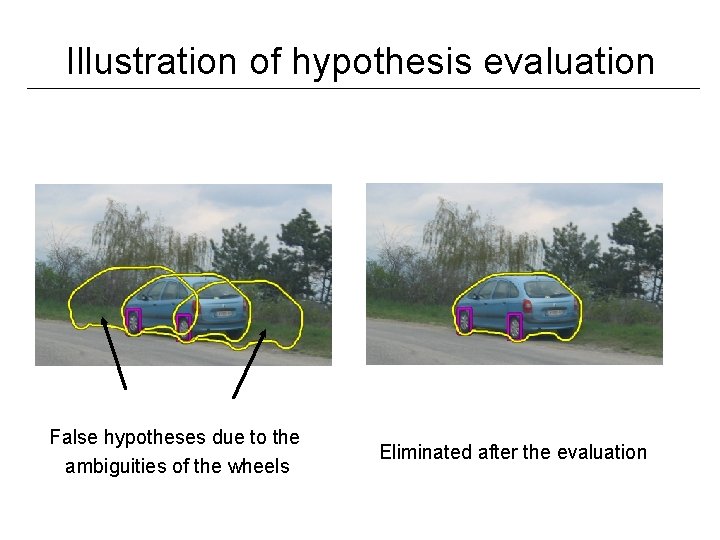
Illustration of hypothesis evaluation False hypotheses due to the ambiguities of the wheels Eliminated after the evaluation

Illustration of hypotheses merging Weak classifier response due to occlusion Merging of evidence based on consistent object features

Localization results
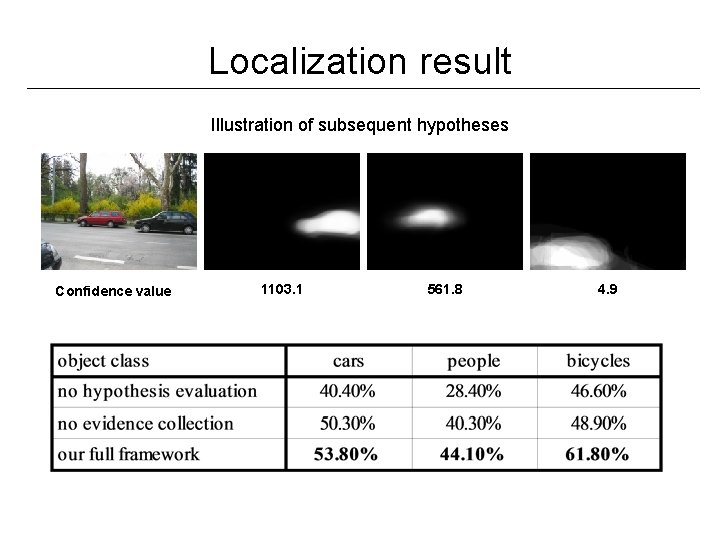
Localization result Illustration of subsequent hypotheses Confidence value 1103. 1 561. 8 4. 9
![Comparison to state-of-the-art Comparison with [Shotton et al. ICCV’ 05] - use their images,](http://slidetodoc.com/presentation_image_h2/6d00a9683beadaee76573684477cd91f/image-26.jpg "Comparison to state-of-the-art Comparison with [Shotton et al. ICCV’ 05] - use their images,")
Comparison to state-of-the-art Comparison with [Shotton et al. ICCV’ 05] - use their images, search at a single scale - improved performance over them, and: - no use of shape-based features - can detect objects at multiple scales
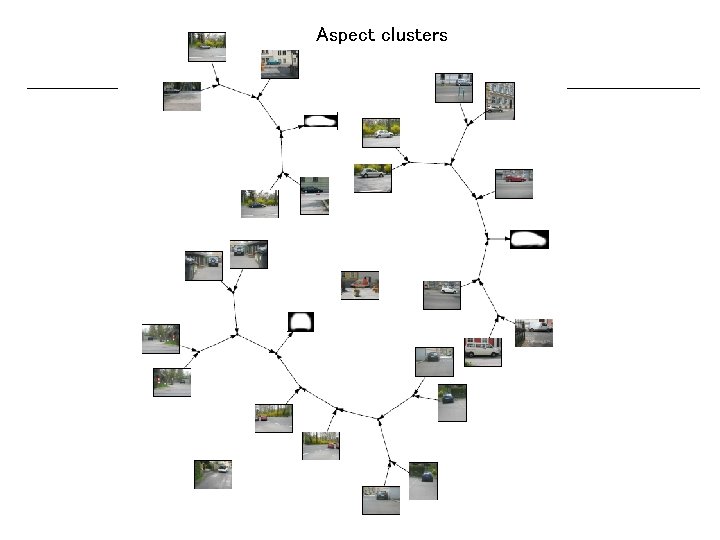
Aspect clusters
Discussion • Including spatial information improves results • Importance of flexible modeling of spatial information – coarse global position information – object based models • Extensions – Hierarchical organization of the objects/aspects
- Slides: 28