
Between the end of the Berlin Blockade in
Between the end of the Berlin Blockade in 1949 and the summit meeting in Geneva in 1955, the Cold War in Europe became institutionalised. On all sides, it was recognised that no comprehensive agreed peace settlement would be possible. The temporary, uncertain postwar arrangements hardened into permanence: two new German states, two new military alliances, NATO and the Warsaw Pact, defending two rival spheres of influence, with rival ideologies and rival economic models. In one sense, the Cold War was unstable and dangerous, with an accelerating arms race between the superpowers and the ever-present possibility that a terrible new war might be caused by provocation or miscalculation. But in another sense the Cold War was highly organised and remarkably stable. Relations between East and West settled into a relatively predictable pattern, not quite peace but with mutual interests in avoiding conflict. In the world outside, however, there was no such stability. In the ‘non-aligned’ countries of Asia, the Middle East, Africa and in Latin America, dangerous flashpoints drew the attention, and often intervention, of the superpowers. Local tensions and disputes arose, particularly from the processes of decolonisation. The origins of these disputes had little to do with the Cold War; but the dynamics of East-West rivalry were so strong that these local disputes were defined in terms of the Cold War. In many cases, such disputes became ‘proxy wars’ dominated by superpower interference. In many cases, the superpowers acted pre-emptively – intervening simply to prevent the ‘other side’ from gaining a perceived economic or strategic advantage. There was a ‘battle for hearts and minds’ as the superpowers competed with each other to extend their spheres of influence through economics, ideology and culture in the global Cold War.
THE ‘THIRD WORLD’ AND THE COLD WAR “Non-alignment can only be understood in the context of the present atomic arms race and the atmosphere of the Cold War. . ” From a speech by Kwame Nkrumah, President of Ghana, New York 1958 “There are two priority tasks for US foreign policy. The first of these is to meet effectively the threat of overt military aggression by the Communist bloc countries. The second priority task is to promote the evolution of a world in which threats to our security and way of life are less likely to arise”. From A Proposal: Key to an Effective Foreign Policy by Max Millikan and Walt Rostow (1957). [Rostow was an economist who was a defence policy adviser to President Eisenhower from 1954] “The national-liberation movement is an anti-imperialist movement. Imperialism has become much weaker with the disintegration of the colonial system. Asian, African and Latin American countries, supported by the socialist countries and progressive forces of the world, are inflicting defeat on the imperialist powers with increasing frequency. ” From a speech by Nikita Khrushchev, 6 January 1961
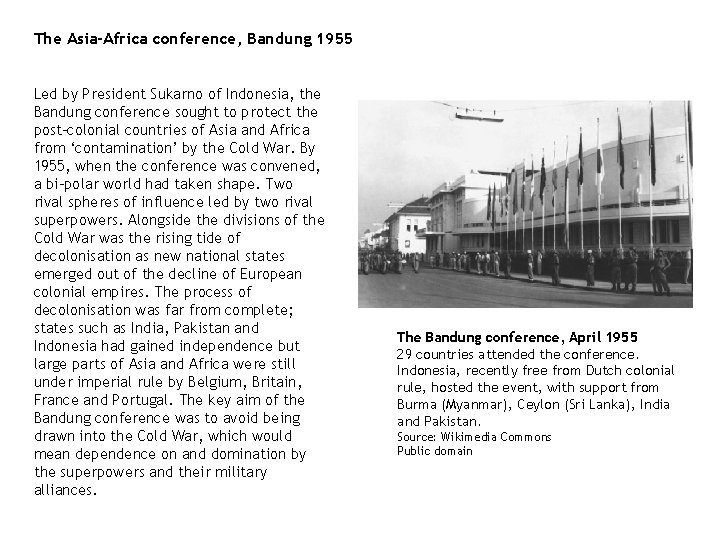
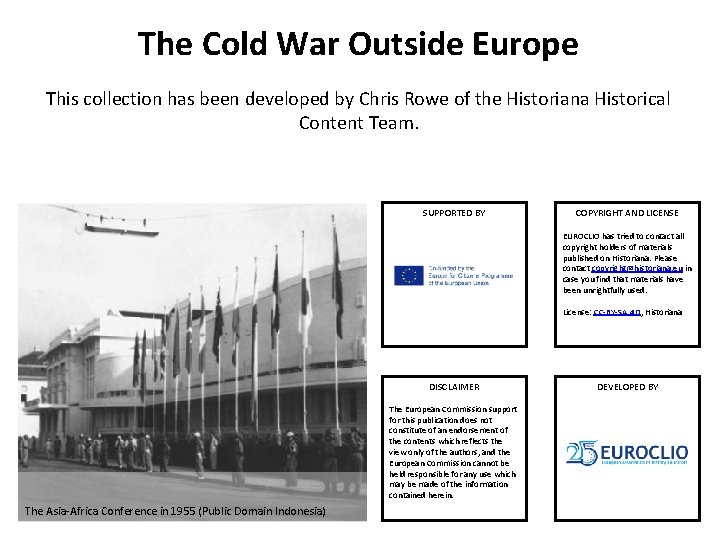
The Asia-Africa conference, Bandung 1955 Led by President Sukarno of Indonesia, the Bandung conference sought to protect the post-colonial countries of Asia and Africa from ‘contamination’ by the Cold War. By 1955, when the conference was convened, a bi-polar world had taken shape. Two rival spheres of influence led by two rival superpowers. Alongside the divisions of the Cold War was the rising tide of decolonisation as new national states emerged out of the decline of European colonial empires. The process of decolonisation was far from complete; states such as India, Pakistan and Indonesia had gained independence but large parts of Asia and Africa were still under imperial rule by Belgium, Britain, France and Portugal. The key aim of the Bandung conference was to avoid being drawn into the Cold War, which would mean dependence on and domination by the superpowers and their military alliances. The Bandung conference, April 1955 29 countries attended the conference. Indonesia, recently free from Dutch colonial rule, hosted the event, with support from Burma (Myanmar), Ceylon (Sri Lanka), India and Pakistan. Source: Wikimedia Commons Public domain
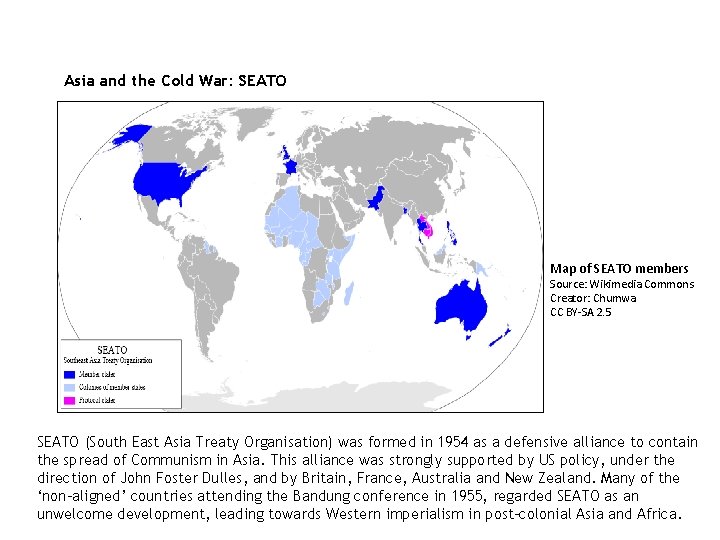
Asia and the Cold War: SEATO Map of SEATO members Source: Wikimedia Commons Creator: Chumwa CC BY-SA 2. 5 SEATO (South East Asia Treaty Organisation) was formed in 1954 as a defensive alliance to contain the spread of Communism in Asia. This alliance was strongly supported by US policy, under the direction of John Foster Dulles, and by Britain, France, Australia and New Zealand. Many of the ‘non-aligned’ countries attending the Bandung conference in 1955, regarded SEATO as an unwelcome development, leading towards Western imperialism in post-colonial Asia and Africa.
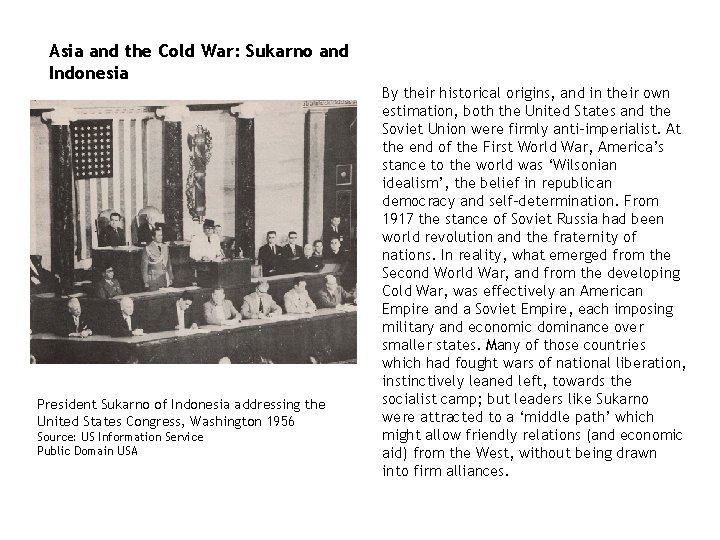
Asia and the Cold War: Sukarno and Indonesia President Sukarno of Indonesia addressing the United States Congress, Washington 1956 Source: US Information Service Public Domain USA By their historical origins, and in their own estimation, both the United States and the Soviet Union were firmly anti-imperialist. At the end of the First World War, America’s stance to the world was ‘Wilsonian idealism’, the belief in republican democracy and self-determination. From 1917 the stance of Soviet Russia had been world revolution and the fraternity of nations. In reality, what emerged from the Second World War, and from the developing Cold War, was effectively an American Empire and a Soviet Empire, each imposing military and economic dominance over smaller states. Many of those countries which had fought wars of national liberation, instinctively leaned left, towards the socialist camp; but leaders like Sukarno were attracted to a ‘middle path’ which might allow friendly relations (and economic aid) from the West, without being drawn into firm alliances.
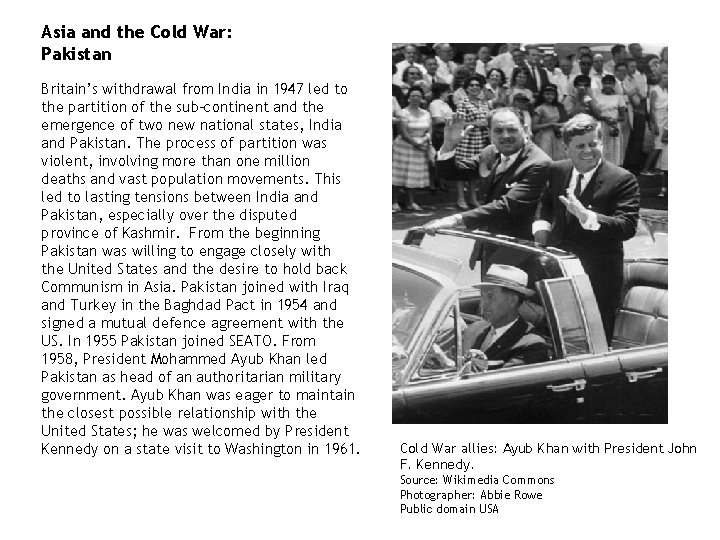
Asia and the Cold War: Pakistan Britain’s withdrawal from India in 1947 led to the partition of the sub-continent and the emergence of two new national states, India and Pakistan. The process of partition was violent, involving more than one million deaths and vast population movements. This led to lasting tensions between India and Pakistan, especially over the disputed province of Kashmir. From the beginning Pakistan was willing to engage closely with the United States and the desire to hold back Communism in Asia. Pakistan joined with Iraq and Turkey in the Baghdad Pact in 1954 and signed a mutual defence agreement with the US. In 1955 Pakistan joined SEATO. From 1958, President Mohammed Ayub Khan led Pakistan as head of an authoritarian military government. Ayub Khan was eager to maintain the closest possible relationship with the United States; he was welcomed by President Kennedy on a state visit to Washington in 1961. Cold War allies: Ayub Khan with President John F. Kennedy. Source: Wikimedia Commons Photographer: Abbie Rowe Public domain USA
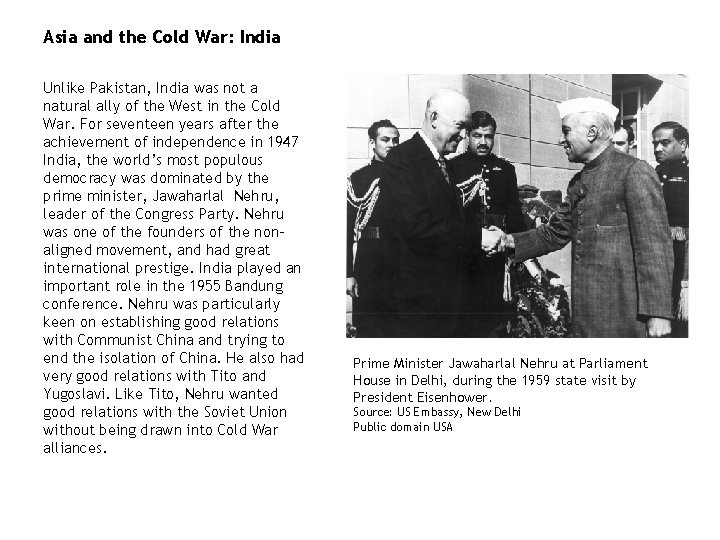
Asia and the Cold War: India Unlike Pakistan, India was not a natural ally of the West in the Cold War. For seventeen years after the achievement of independence in 1947 India, the world’s most populous democracy was dominated by the prime minister, Jawaharlal Nehru, leader of the Congress Party. Nehru was one of the founders of the nonaligned movement, and had great international prestige. India played an important role in the 1955 Bandung conference. Nehru was particularly keen on establishing good relations with Communist China and trying to end the isolation of China. He also had very good relations with Tito and Yugoslavi. Like Tito, Nehru wanted good relations with the Soviet Union without being drawn into Cold War alliances. Prime Minister Jawaharlal Nehru at Parliament House in Delhi, during the 1959 state visit by President Eisenhower. Source: US Embassy, New Delhi Public domain USA
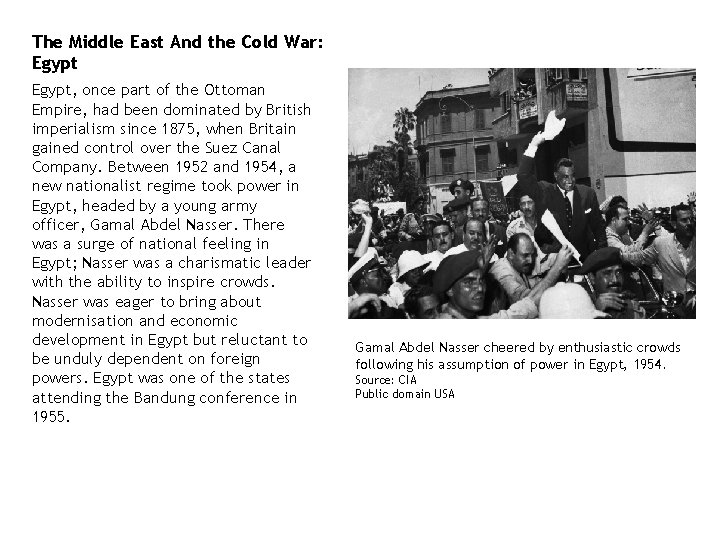
The Middle East And the Cold War: Egypt, once part of the Ottoman Empire, had been dominated by British imperialism since 1875, when Britain gained control over the Suez Canal Company. Between 1952 and 1954, a new nationalist regime took power in Egypt, headed by a young army officer, Gamal Abdel Nasser. There was a surge of national feeling in Egypt; Nasser was a charismatic leader with the ability to inspire crowds. Nasser was eager to bring about modernisation and economic development in Egypt but reluctant to be unduly dependent on foreign powers. Egypt was one of the states attending the Bandung conference in 1955. Gamal Abdel Nasser cheered by enthusiastic crowds following his assumption of power in Egypt, 1954. Source: CIA Public domain USA
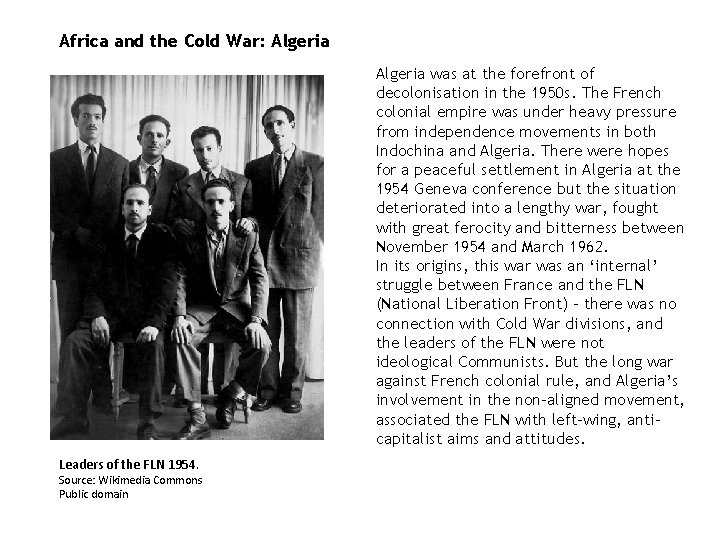
Africa and the Cold War: Algeria was at the forefront of decolonisation in the 1950 s. The French colonial empire was under heavy pressure from independence movements in both Indochina and Algeria. There were hopes for a peaceful settlement in Algeria at the 1954 Geneva conference but the situation deteriorated into a lengthy war, fought with great ferocity and bitterness between November 1954 and March 1962. In its origins, this war was an ‘internal’ struggle between France and the FLN (National Liberation Front) – there was no connection with Cold War divisions, and the leaders of the FLN were not ideological Communists. But the long war against French colonial rule, and Algeria’s involvement in the non-aligned movement, associated the FLN with left-wing, anticapitalist aims and attitudes. Leaders of the FLN 1954. Source: Wikimedia Commons Public domain

Africa and the Cold War: Kwame Nkrumah on the post-colonial world Kwame Nkrumah on a state visit to the United States, 1961 Ghana was the first British colony in Africa to achieve independence, in 1957. Source: Wikimedia Commons Photographer: Abbie Rowe Public domain Non-alignment can only be understood in the context of the present atomic arms race and the atmosphere of the Cold War. There is a wise African proverb: ‘When the bull elephants fight, the grass is trampled down’. When we in Africa survey the industrial and military power concentrated behind the two great powers in the Cold War, we know that no military or strategic act of ours could make one jot of difference to this balance of power, while our involvement might draw us into areas of conflict which so far have not spread south of the Sahara. Our attitude is, I imagine, very much that of America looking at the disputes of Europe in the 19 th century. We do not wish to be involved. In addition, we know that we cannot affect the outcome. Above all, we believe the peace of the world in general is served, not harmed, by keeping one great continent, Africa, free from the strife of and rivalry of military blocs and cold wars. This attitude of non-alignment does not imply indifference to the great issues of our day. It does not imply isolationism. It is in no way anti-Western; nor is it anti-Eastern. The greatest issue of our day is surely to see that there is a tomorrow. Kwame Nkrumah, first president of Ghana, addressing the Council for Foreign Relations, New York 1958 Source: Hanhimäki & Westad, The Cold War, p. 354
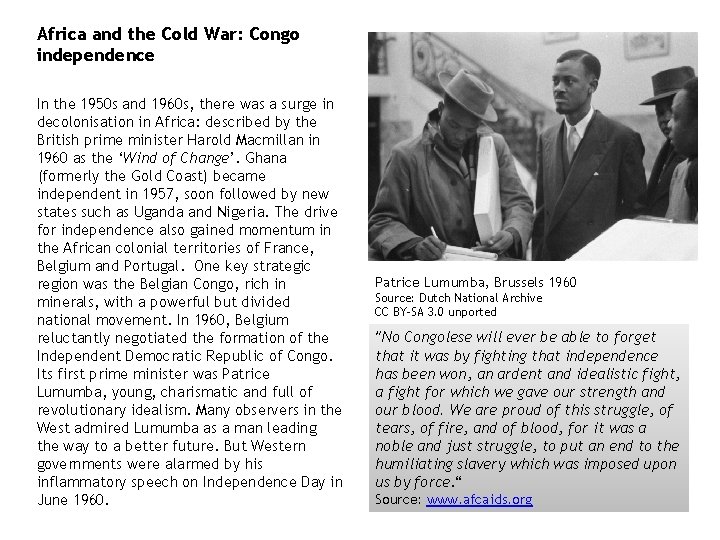
Africa and the Cold War: Congo independence In the 1950 s and 1960 s, there was a surge in decolonisation in Africa: described by the British prime minister Harold Macmillan in 1960 as the ‘Wind of Change’. Ghana (formerly the Gold Coast) became independent in 1957, soon followed by new states such as Uganda and Nigeria. The drive for independence also gained momentum in the African colonial territories of France, Belgium and Portugal. One key strategic region was the Belgian Congo, rich in minerals, with a powerful but divided national movement. In 1960, Belgium reluctantly negotiated the formation of the Independent Democratic Republic of Congo. Its first prime minister was Patrice Lumumba, young, charismatic and full of revolutionary idealism. Many observers in the West admired Lumumba as a man leading the way to a better future. But Western governments were alarmed by his inflammatory speech on Independence Day in June 1960. Patrice Lumumba, Brussels 1960 Source: Dutch National Archive CC BY-SA 3. 0 unported “No Congolese will ever be able to forget that it was by fighting that independence has been won, an ardent and idealistic fight, a fight for which we gave our strength and our blood. We are proud of this struggle, of tears, of fire, and of blood, for it was a noble and just struggle, to put an end to the humiliating slavery which was imposed upon us by force. “ Source: www. afcaids. org
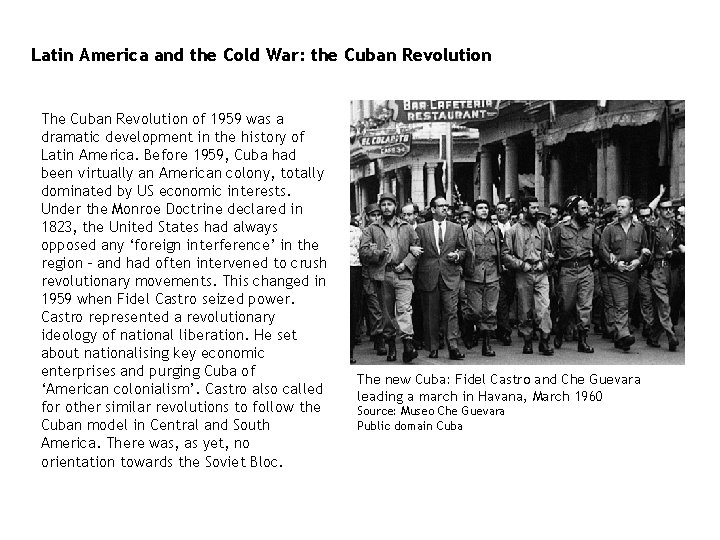
Latin America and the Cold War: the Cuban Revolution The Cuban Revolution of 1959 was a dramatic development in the history of Latin America. Before 1959, Cuba had been virtually an American colony, totally dominated by US economic interests. Under the Monroe Doctrine declared in 1823, the United States had always opposed any ‘foreign interference’ in the region – and had often intervened to crush revolutionary movements. This changed in 1959 when Fidel Castro seized power. Castro represented a revolutionary ideology of national liberation. He set about nationalising key economic enterprises and purging Cuba of ‘American colonialism’. Castro also called for other similar revolutions to follow the Cuban model in Central and South America. There was, as yet, no orientation towards the Soviet Bloc. The new Cuba: Fidel Castro and Che Guevara leading a march in Havana, March 1960 Source: Museo Che Guevara Public domain Cuba
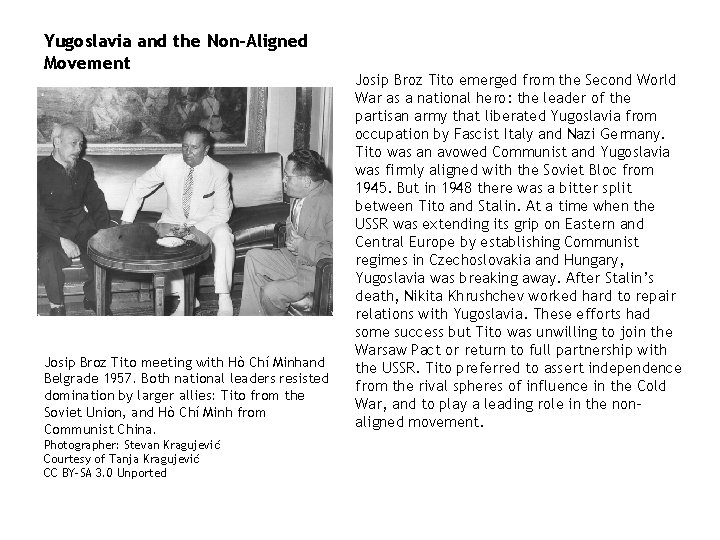
Yugoslavia and the Non-Aligned Movement Josip Broz Tito meeting with Hò Chí Minhand Belgrade 1957. Both national leaders resisted domination by larger allies: Tito from the Soviet Union, and Hò Chí Minh from Communist China. Photographer: Stevan Kragujević Courtesy of Tanja Kragujević CC BY-SA 3. 0 Unported Josip Broz Tito emerged from the Second World War as a national hero: the leader of the partisan army that liberated Yugoslavia from occupation by Fascist Italy and Nazi Germany. Tito was an avowed Communist and Yugoslavia was firmly aligned with the Soviet Bloc from 1945. But in 1948 there was a bitter split between Tito and Stalin. At a time when the USSR was extending its grip on Eastern and Central Europe by establishing Communist regimes in Czechoslovakia and Hungary, Yugoslavia was breaking away. After Stalin’s death, Nikita Khrushchev worked hard to repair relations with Yugoslavia. These efforts had some success but Tito was unwilling to join the Warsaw Pact or return to full partnership with the USSR. Tito preferred to assert independence from the rival spheres of influence in the Cold War, and to play a leading role in the nonaligned movement.
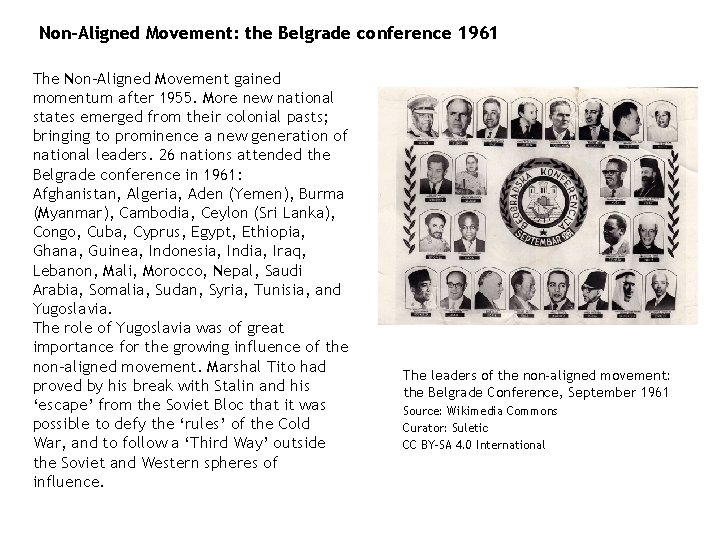
Non-Aligned Movement: the Belgrade conference 1961 The Non-Aligned Movement gained momentum after 1955. More new national states emerged from their colonial pasts; bringing to prominence a new generation of national leaders. 26 nations attended the Belgrade conference in 1961: Afghanistan, Algeria, Aden (Yemen), Burma (Myanmar), Cambodia, Ceylon (Sri Lanka), Congo, Cuba, Cyprus, Egypt, Ethiopia, Ghana, Guinea, Indonesia, India, Iraq, Lebanon, Mali, Morocco, Nepal, Saudi Arabia, Somalia, Sudan, Syria, Tunisia, and Yugoslavia. The role of Yugoslavia was of great importance for the growing influence of the non-aligned movement. Marshal Tito had proved by his break with Stalin and his ‘escape’ from the Soviet Bloc that it was possible to defy the ‘rules’ of the Cold War, and to follow a ‘Third Way’ outside the Soviet and Western spheres of influence. The leaders of the non-aligned movement: the Belgrade Conference, September 1961 Source: Wikimedia Commons Curator: Suletic CC BY-SA 4. 0 International
FLASHPOINTS : 1954 -1967 “The fall of the European empires was, in part, a consequence of the Second World War. The imperial centres had lost the means, economically, militarily and ideologically, to keep their empires together. The wartime victories of the Soviet Union inspired socialist and radical nationalist movements. But the successive waves of decolonisation also had a substantial impact on the way the Cold War was fought. In Indochina, French withdrawal led to increasing American involvement to combat communism there. In Africa, the struggle against colonisation led to the radicalisation of African elites. New leaders in the so-called ‘Third World’ often turned to socialism as the most efficient and just way of rebuilding their countries. In some cases, their ideological inclination led them to an alliance with the Soviet Union. ” Jussi Hanhimäki & Odd Arne Westad, The Cold War 2004) p 347 “The US, as you know, has taken up arms against Communist imperialism in Korea. We have also contributed our resources and skills in other threatened areas, not least in Vietnam. The US remains prepared to support countries everywhere seeking to maintain their freedom against the godless Communist menace. ” Telegram from John Foster Dulles to South Vietnamese leader Ngo Dinh Diem, July 1954 ”The forces of national-liberation are multiplying because a new front of active struggle against US imperialism has come into being, namely Latin America. The thunder of the glorious Cuban revolution has reverberated round the world. Solidarity with revolutionary Cuba is the duty of not only the Latin American peoples, but also the socialist countries, the entire international communist movement. ” From a speech by Nikita Khrushchev, January 1961
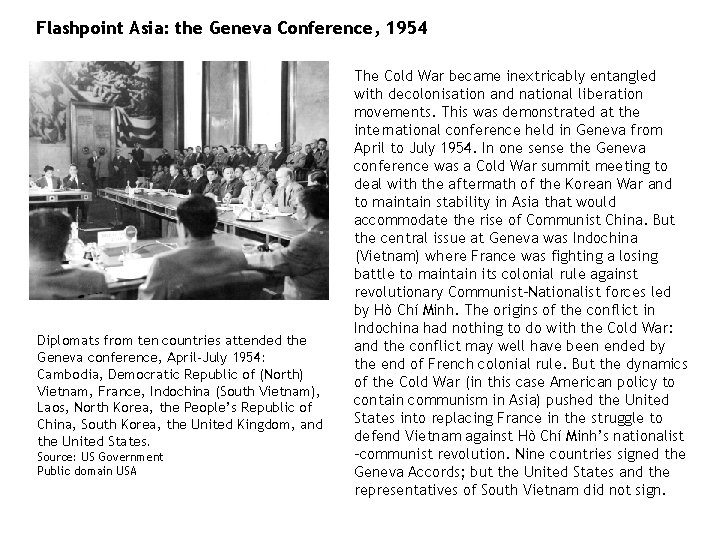
Flashpoint Asia: the Geneva Conference, 1954 Diplomats from ten countries attended the Geneva conference, April-July 1954: Cambodia, Democratic Republic of (North) Vietnam, France, Indochina (South Vietnam), Laos, North Korea, the People’s Republic of China, South Korea, the United Kingdom, and the United States. Source: US Government Public domain USA The Cold War became inextricably entangled with decolonisation and national liberation movements. This was demonstrated at the international conference held in Geneva from April to July 1954. In one sense the Geneva conference was a Cold War summit meeting to deal with the aftermath of the Korean War and to maintain stability in Asia that would accommodate the rise of Communist China. But the central issue at Geneva was Indochina (Vietnam) where France was fighting a losing battle to maintain its colonial rule against revolutionary Communist-Nationalist forces led by Hò Chí Minh. The origins of the conflict in Indochina had nothing to do with the Cold War: and the conflict may well have been ended by the end of French colonial rule. But the dynamics of the Cold War (in this case American policy to contain communism in Asia) pushed the United States into replacing France in the struggle to defend Vietnam against Hò Chí Minh’s nationalist -communist revolution. Nine countries signed the Geneva Accords; but the United States and the representatives of South Vietnam did not sign.
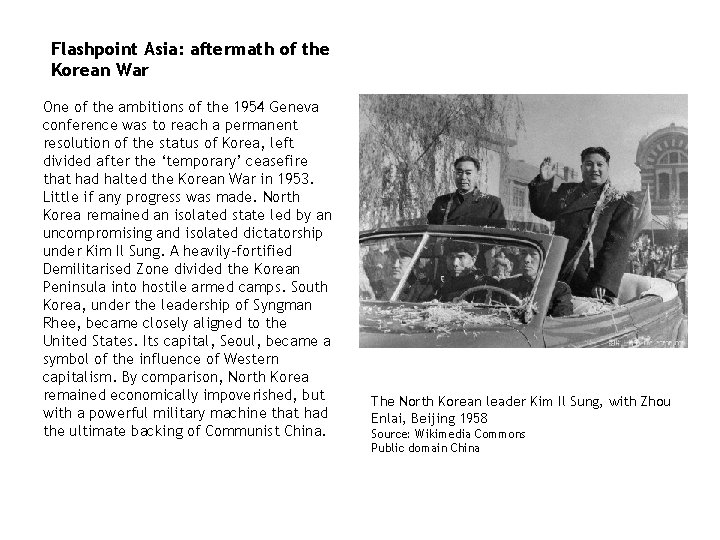
Flashpoint Asia: aftermath of the Korean War One of the ambitions of the 1954 Geneva conference was to reach a permanent resolution of the status of Korea, left divided after the ‘temporary’ ceasefire that had halted the Korean War in 1953. Little if any progress was made. North Korea remained an isolated state led by an uncompromising and isolated dictatorship under Kim Il Sung. A heavily-fortified Demilitarised Zone divided the Korean Peninsula into hostile armed camps. South Korea, under the leadership of Syngman Rhee, became closely aligned to the United States. Its capital, Seoul, became a symbol of the influence of Western capitalism. By comparison, North Korea remained economically impoverished, but with a powerful military machine that had the ultimate backing of Communist China. The North Korean leader Kim Il Sung, with Zhou Enlai, Beijing 1958 Source: Wikimedia Commons Public domain China
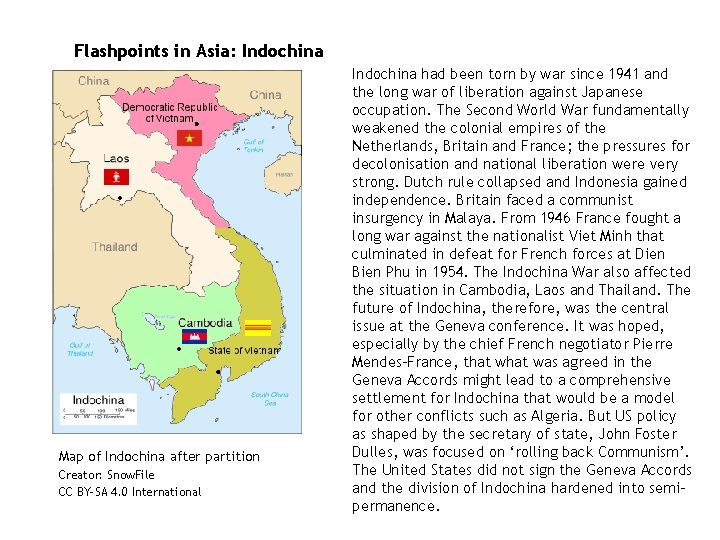
Flashpoints in Asia: Indochina Map of Indochina after partition Creator: Snow. File CC BY-SA 4. 0 International Indochina had been torn by war since 1941 and the long war of liberation against Japanese occupation. The Second World War fundamentally weakened the colonial empires of the Netherlands, Britain and France; the pressures for decolonisation and national liberation were very strong. Dutch rule collapsed and Indonesia gained independence. Britain faced a communist insurgency in Malaya. From 1946 France fought a long war against the nationalist Viet Minh that culminated in defeat for French forces at Dien Bien Phu in 1954. The Indochina War also affected the situation in Cambodia, Laos and Thailand. The future of Indochina, therefore, was the central issue at the Geneva conference. It was hoped, especially by the chief French negotiator Pierre Mendes-France, that was agreed in the Geneva Accords might lead to a comprehensive settlement for Indochina that would be a model for other conflicts such as Algeria. But US policy as shaped by the secretary of state, John Foster Dulles, was focused on ‘rolling back Communism’. The United States did not sign the Geneva Accords and the division of Indochina hardened into semipermanence.
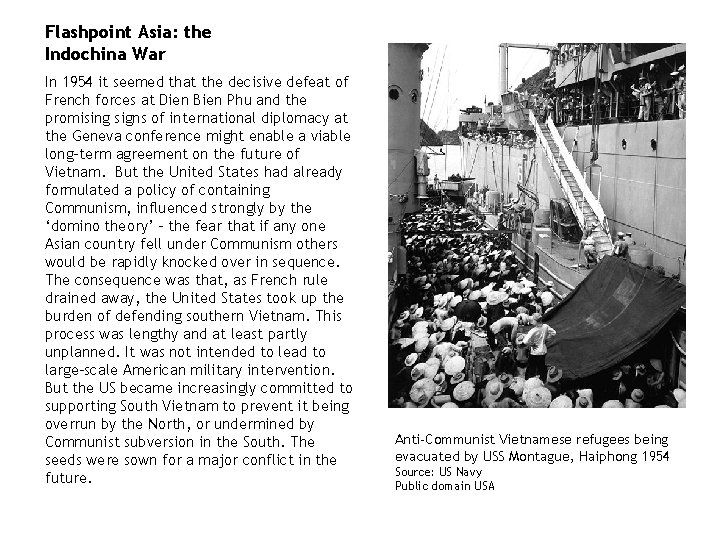
Flashpoint Asia: the Indochina War In 1954 it seemed that the decisive defeat of French forces at Dien Bien Phu and the promising signs of international diplomacy at the Geneva conference might enable a viable long-term agreement on the future of Vietnam. But the United States had already formulated a policy of containing Communism, influenced strongly by the ‘domino theory’ – the fear that if any one Asian country fell under Communism others would be rapidly knocked over in sequence. The consequence was that, as French rule drained away, the United States took up the burden of defending southern Vietnam. This process was lengthy and at least partly unplanned. It was not intended to lead to large-scale American military intervention. But the US became increasingly committed to supporting South Vietnam to prevent it being overrun by the North, or undermined by Communist subversion in the South. The seeds were sown for a major conflict in the future. Anti-Communist Vietnamese refugees being evacuated by USS Montague, Haiphong 1954 Source: US Navy Public domain USA
Flashpoint Asia: Nationalist China (Taiwan) “The attack upon Korea makes it plain beyond all doubt that communism has passed beyond the use of subversion to conquer independent nations and will now use armed invasion and war. In these circumstances the occupation of Formosa (Taiwan) by Communist forces would be a direct threat to the security of the Pacific area and to United States forces. Accordingly, I have ordered the Seventh Fleet to prevent any attack on Taiwan. I am also calling upon the Chinese Government on Formosa to cease all air and sea operations against the mainland. The 7 th Fleet will see that this is done. The determination of the future status of Taiwan must await the restoration of security in the Pacific, a peace settlement between China and Japan, or a settlement by the United Nations. ” A statement by President Harry S. Truman in June 1950, two days after the outbreak of the Korean War. Source: Truman Library public domain USA One of the key causes of Cold War tension in Asia was the disputed status of China. From 1945, the United States had recognised the Nationalist Republic of China led by Jiang Jieshi (Chiang Kai-shek) as the government of China. It was the ROC that held one of the five seats in the United Nations Security Council. But in 1949 the Nationalists were defeated in the Civil War and the Chinese Communists, led by Mao Zedong, controlled all of mainland China. At the outbreak of the Korean War in 1950, President Truman deployed the US 7 th Fleet to the Taiwan Strait, both to protect Nationalist Taiwan and to prevent Nationalist attacks on mainland China. These issues led to the First Taiwan Strait Crisis when Communist China declared its intention to ‘liberate’ Taiwan and unite the whole of China. Jiang Jeshi fortified the islands of Quemoy and Matsu as a first line of defence against invasion. The United States Congress announced maximum support for Taiwan, including the use of nuclear weapons if necessary. It was not until 1971, that Communist China finally took its place on the Security Council.
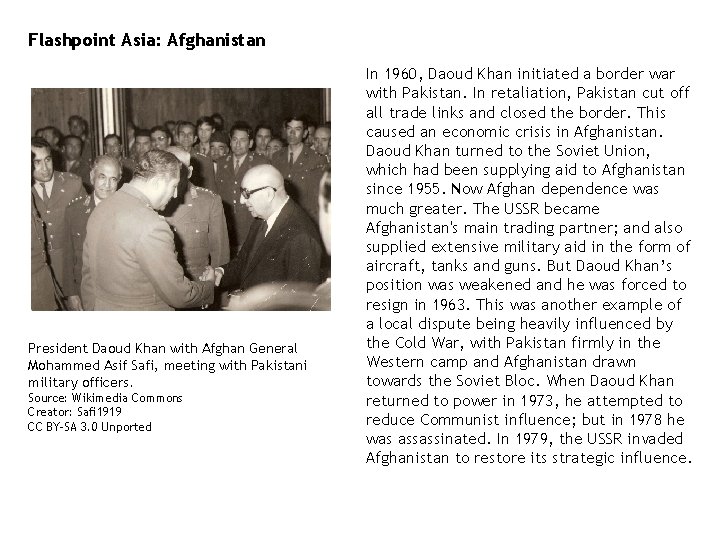
Flashpoint Asia: Afghanistan President Daoud Khan with Afghan General Mohammed Asif Safi, meeting with Pakistani military officers. Source: Wikimedia Commons Creator: Safi 1919 CC BY-SA 3. 0 Unported In 1960, Daoud Khan initiated a border war with Pakistan. In retaliation, Pakistan cut off all trade links and closed the border. This caused an economic crisis in Afghanistan. Daoud Khan turned to the Soviet Union, which had been supplying aid to Afghanistan since 1955. Now Afghan dependence was much greater. The USSR became Afghanistan's main trading partner; and also supplied extensive military aid in the form of aircraft, tanks and guns. But Daoud Khan’s position was weakened and he was forced to resign in 1963. This was another example of a local dispute being heavily influenced by the Cold War, with Pakistan firmly in the Western camp and Afghanistan drawn towards the Soviet Bloc. When Daoud Khan returned to power in 1973, he attempted to reduce Communist influence; but in 1978 he was assassinated. In 1979, the USSR invaded Afghanistan to restore its strategic influence.
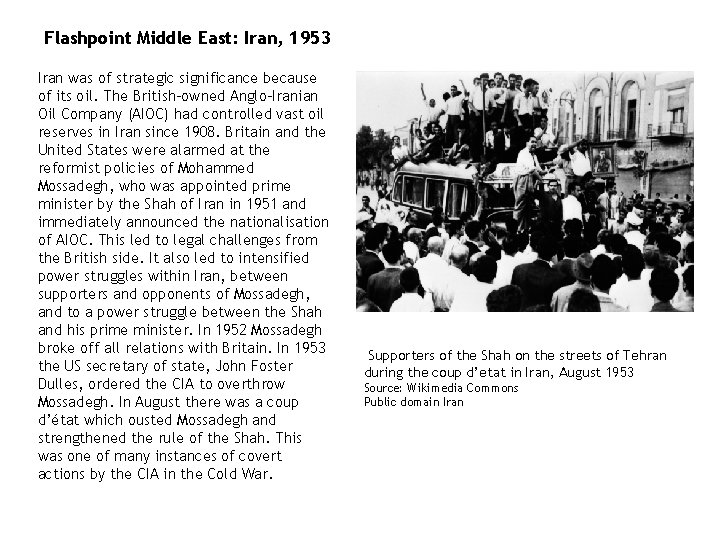
Flashpoint Middle East: Iran, 1953 Iran was of strategic significance because of its oil. The British-owned Anglo-Iranian Oil Company (AIOC) had controlled vast oil reserves in Iran since 1908. Britain and the United States were alarmed at the reformist policies of Mohammed Mossadegh, who was appointed prime minister by the Shah of Iran in 1951 and immediately announced the nationalisation of AIOC. This led to legal challenges from the British side. It also led to intensified power struggles within Iran, between supporters and opponents of Mossadegh, and to a power struggle between the Shah and his prime minister. In 1952 Mossadegh broke off all relations with Britain. In 1953 the US secretary of state, John Foster Dulles, ordered the CIA to overthrow Mossadegh. In August there was a coup d’état which ousted Mossadegh and strengthened the rule of the Shah. This was one of many instances of covert actions by the CIA in the Cold War. Supporters of the Shah in Tehran during the 1953 coup d’atat in Iran. . Supporters of the Shah on the streets of Tehran during the coup d’etat in Iran, August 1953 Source: Wikimedia Commons Public domain Iran
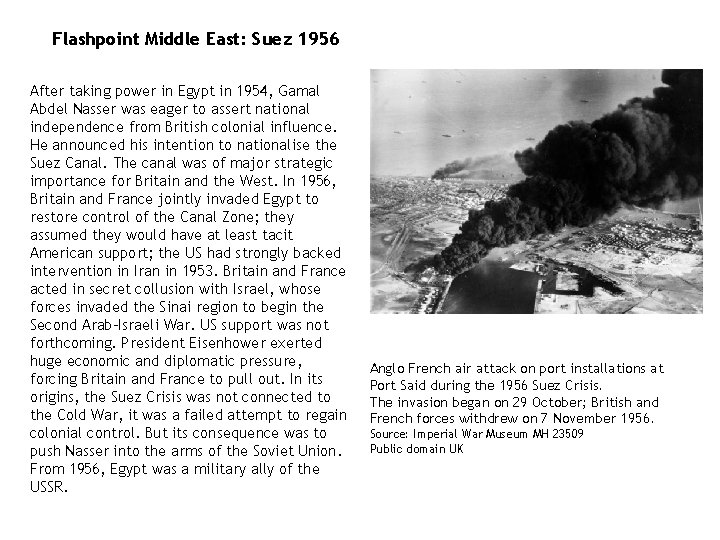
Flashpoint Middle East: Suez 1956 After taking power in Egypt in 1954, Gamal Abdel Nasser was eager to assert national independence from British colonial influence. He announced his intention to nationalise the Suez Canal. The canal was of major strategic importance for Britain and the West. In 1956, Britain and France jointly invaded Egypt to restore control of the Canal Zone; they assumed they would have at least tacit American support; the US had strongly backed intervention in Iran in 1953. Britain and France acted in secret collusion with Israel, whose forces invaded the Sinai region to begin the Second Arab-Israeli War. US support was not forthcoming. President Eisenhower exerted huge economic and diplomatic pressure, forcing Britain and France to pull out. In its origins, the Suez Crisis was not connected to the Cold War, it was a failed attempt to regain colonial control. But its consequence was to push Nasser into the arms of the Soviet Union. From 1956, Egypt was a military ally of the USSR. Anglo French air attack on port installations at Port Said during the 1956 Suez Crisis. The invasion began on 29 October; British and French forces withdrew on 7 November 1956. Source: Imperial War Museum MH 23509 Public domain UK
Flashpoint Middle East: Egypt and the Suez Crisis The central strategic agenda of the Soviet Union was neutralizing the American strategic advantage in Eurasia by establishing naval and military bases throughout the region. Beginning in 1955, the USSR found fertile grounds for expansion in Syria and Egypt. With Egypt at the cultural and political center of the Arab world, and the vulnerability of Syria to Israel and unfriendly Western-backed neighbours, the Soviets were able to exploit the “tide of Arab nationalism and Arab-Israeli enmity”. By meeting Nasser’s need for massive deliveries of modern arms in 1955 and taking up the role of arms supplier and protector of Syria, the USSR reaped substantial strategic dividends. Soviet naval and air facilities neutralized the American strategic advantage. The Soviets now had bases that numerically rivalled American bases in the Middle East. Further, with access to “strategic bomber bases” within range of America’s European allies, the Soviet nuclear deterrent capability was much enhanced. Naval facilities in Alexandria, Port Said and Latakia were able to redress a great source of Soviet weakness: Western control of the Mediterranean. Sean Paul Ashley, COLD WAR POLITICS IN THE MIDDLE EAST (2012) Source: E-International Relations Students
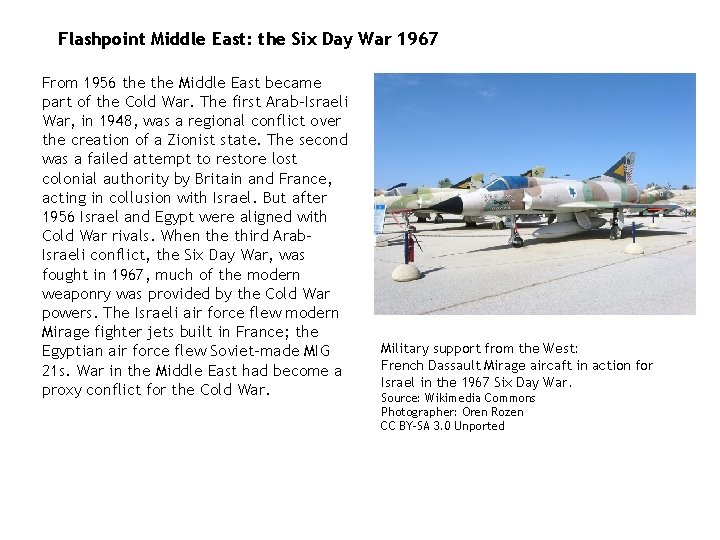
Flashpoint Middle East: the Six Day War 1967 From 1956 the Middle East became part of the Cold War. The first Arab-Israeli War, in 1948, was a regional conflict over the creation of a Zionist state. The second was a failed attempt to restore lost colonial authority by Britain and France, acting in collusion with Israel. But after 1956 Israel and Egypt were aligned with Cold War rivals. When the third Arab. Israeli conflict, the Six Day War, was fought in 1967, much of the modern weaponry was provided by the Cold War powers. The Israeli air force flew modern Mirage fighter jets built in France; the Egyptian air force flew Soviet-made MIG 21 s. War in the Middle East had become a proxy conflict for the Cold War. Military support from the West: French Dassault Mirage aircaft in action for Israel in the 1967 Six Day War. Source: Wikimedia Commons Photographer: Oren Rozen CC BY-SA 3. 0 Unported
Flashpoint Africa: the Assassination of Patrice Lumumba’s speech did not sit well with the former colonizers, Western journalists, nor with multinational mining interests, separatist elements in the east of the country, or the United States government. US policy rejected Lumumba’s entreaties for help against the reactionary Belgians and the secessionists, forcing him to turn to the Soviet Union. Lumumba’s opponents found a willing accomplice: former journalist and now head of the army Joseph Mobutu. Together they worked to foment rebellion in the army, stoke unrest, exploit attacks on whites, create an economic crisis — and eventually kidnap and execute Lumumba. The CIA had tried to poison him, but eventually settled on local politicians (and Belgian killers) to do the job. Lumumba was captured by Mobutu’s mutinous army and flown to the secessionist province of Katanga, where he was tortured, shot, and killed. In the wake of his murder, some of Lumumba’s comrades controlled part of the country and fought on bravely (at one point Che Guevara travelled to Congo on a failed military mission to aid them) but they were finally crushed by American and South African mercenaries. This left Mobutu, under the guise of anti-Communism to declare a one-party, repressive state and govern, with the consent of the United States and Western governments, for the next thirty-odd years. From Patrice Lumumba (1925 -1961) by Sean Jacobs, ‘Jacobin’ 2017 The struggle for Congolese independence from Belgian colonial rule provided a vivid example of the way national liberation movements could be overtaken by the Cold War. The charismatic young Congolese prime minister and anti-colonial leader was assassinated in 1961 probably, as Jacobs in the quote above suggests, with the connivance of Western governments motivated by anti-Communism.
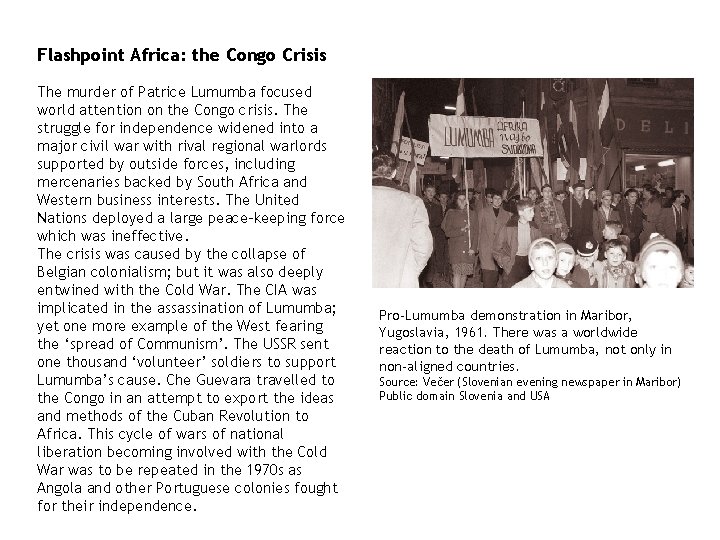
Flashpoint Africa: the Congo Crisis The murder of Patrice Lumumba focused world attention on the Congo crisis. The struggle for independence widened into a major civil war with rival regional warlords supported by outside forces, including mercenaries backed by South Africa and Western business interests. The United Nations deployed a large peace-keeping force which was ineffective. The crisis was caused by the collapse of Belgian colonialism; but it was also deeply entwined with the Cold War. The CIA was implicated in the assassination of Lumumba; yet one more example of the West fearing the ‘spread of Communism’. The USSR sent one thousand ‘volunteer’ soldiers to support Lumumba’s cause. Che Guevara travelled to the Congo in an attempt to export the ideas and methods of the Cuban Revolution to Africa. This cycle of wars of national liberation becoming involved with the Cold War was to be repeated in the 1970 s as Angola and other Portuguese colonies fought for their independence. Pro-Lumumba demonstration in Maribor, Yugoslavia, 1961. There was a worldwide reaction to the death of Lumumba, not only in non-aligned countries. Source: Večer (Slovenian evening newspaper in Maribor) Public domain Slovenia and USA
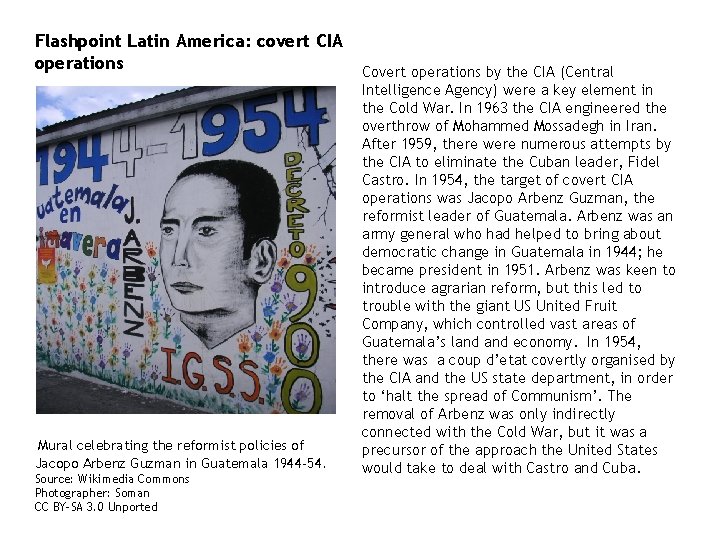
Flashpoint Latin America: covert CIA operations Mural celebrating the reformist policies of Jacopo Arbenz Guzman in Guatemala 1944 -54. Source: Wikimedia Commons Photographer: Soman CC BY-SA 3. 0 Unported Covert operations by the CIA (Central Intelligence Agency) were a key element in the Cold War. In 1963 the CIA engineered the overthrow of Mohammed Mossadegh in Iran. After 1959, there were numerous attempts by the CIA to eliminate the Cuban leader, Fidel Castro. In 1954, the target of covert CIA operations was Jacopo Arbenz Guzman, the reformist leader of Guatemala. Arbenz was an army general who had helped to bring about democratic change in Guatemala in 1944; he became president in 1951. Arbenz was keen to introduce agrarian reform, but this led to trouble with the giant US United Fruit Company, which controlled vast areas of Guatemala’s land economy. In 1954, there was a coup d’etat covertly organised by the CIA and the US state department, in order to ‘halt the spread of Communism’. The removal of Arbenz was only indirectly connected with the Cold War, but it was a precursor of the approach the United States would take to deal with Castro and Cuba.
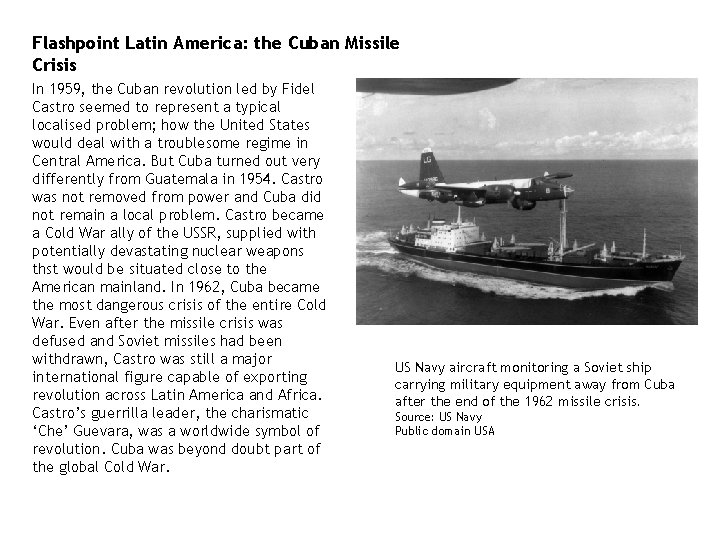
Flashpoint Latin America: the Cuban Missile Crisis In 1959, the Cuban revolution led by Fidel Castro seemed to represent a typical localised problem; how the United States would deal with a troublesome regime in Central America. But Cuba turned out very differently from Guatemala in 1954. Castro was not removed from power and Cuba did not remain a local problem. Castro became a Cold War ally of the USSR, supplied with potentially devastating nuclear weapons thst would be situated close to the American mainland. In 1962, Cuba became the most dangerous crisis of the entire Cold War. Even after the missile crisis was defused and Soviet missiles had been withdrawn, Castro was still a major international figure capable of exporting revolution across Latin America and Africa. Castro’s guerrilla leader, the charismatic ‘Che’ Guevara, was a worldwide symbol of revolution. Cuba was beyond doubt part of the global Cold War. US Navy aircraft monitoring a Soviet ship carrying military equipment away from Cuba after the end of the 1962 missile crisis. Source: US Navy Public domain USA
THE BATTLE FOR HEARTS AND MINDS “America’s basic purposes have always been to keep the peace, to foster progress, and to enhance liberty and dignity among nations. Progress toward these noble goals is persistently threatened by by the Cold War conflict now engulfing the world. We face a hostile ideology global in scope, atheistic in character, ruthless in purpose, and insidious in method. We need to carry forward, steadily and surely, the burdens of a long and complex struggle. ” Eisenhower’s farewell address to the nation at the end of his presidency, January 1961 “It is clear that in the colonial countries the peasants alone are revolutionary for they have nothing to lose and everything to gain. ” Franz Fanon, A Dying Colonialism, 1959 p. 61 ”The deeper I enter into the culture and political circles the clearer I see that the great danger that threatens Africa is the absence of ideology. ” Franz Fanon, Toward the African Revolution 1964 p. 186 The Cold War was not only a struggle between rival alliances with competing military and strategic interests; it was also a struggle to win hearts and minds. Especially outside Cold War Europe, there was a battle of ideologies, attempting to attract and persuade ‘Third World’ countries through the strength of ideas, promises of prosperity and economic modernisation, and social and cultural values. The Cold War became a propaganda war; and this was fought not only by governments and diplomats. Academics and intellectuals put forward critical analysis of the Western and Soviet systems; politicians were influenced by shifts in public opinion, not least by dissent and demonstrations.
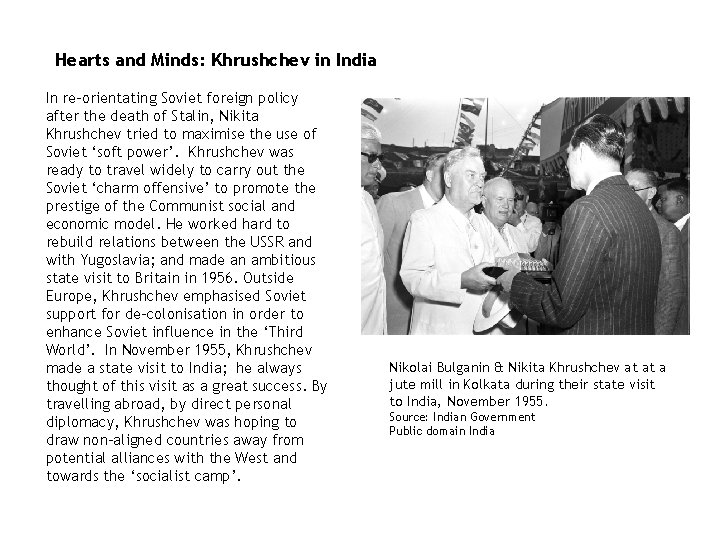
Hearts and Minds: Khrushchev in India In re-orientating Soviet foreign policy after the death of Stalin, Nikita Khrushchev tried to maximise the use of Soviet ‘soft power’. Khrushchev was ready to travel widely to carry out the Soviet ‘charm offensive’ to promote the prestige of the Communist social and economic model. He worked hard to rebuild relations between the USSR and with Yugoslavia; and made an ambitious state visit to Britain in 1956. Outside Europe, Khrushchev emphasised Soviet support for de-colonisation in order to enhance Soviet influence in the ‘Third World’. In November 1955, Khrushchev made a state visit to India; he always thought of this visit as a great success. By travelling abroad, by direct personal diplomacy, Khrushchev was hoping to draw non-aligned countries away from potential alliances with the West and towards the ‘socialist camp’. Nikolai Bulganin & Nikita Khrushchev at at a jute mill in Kolkata during their state visit to India, November 1955. Source: Indian Government Public domain India
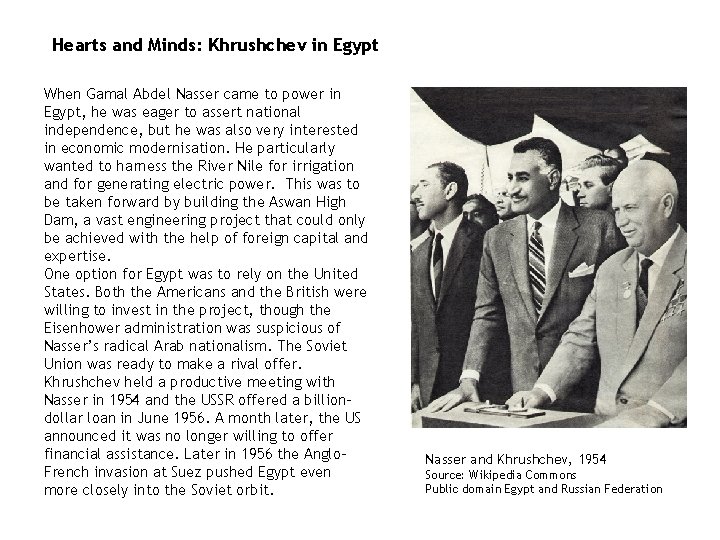
Hearts and Minds: Khrushchev in Egypt When Gamal Abdel Nasser came to power in Egypt, he was eager to assert national independence, but he was also very interested in economic modernisation. He particularly wanted to harness the River Nile for irrigation and for generating electric power. This was to be taken forward by building the Aswan High Dam, a vast engineering project that could only be achieved with the help of foreign capital and expertise. One option for Egypt was to rely on the United States. Both the Americans and the British were willing to invest in the project, though the Eisenhower administration was suspicious of Nasser’s radical Arab nationalism. The Soviet Union was ready to make a rival offer. Khrushchev held a productive meeting with Nasser in 1954 and the USSR offered a billiondollar loan in June 1956. A month later, the US announced it was no longer willing to offer financial assistance. Later in 1956 the Anglo. French invasion at Suez pushed Egypt even more closely into the Soviet orbit. Nasser and Khrushchev, 1954 Source: Wikipedia Commons Public domain Egypt and Russian Federation
Hearts and Minds: Algeria 1964 The President of the Algerian People’s Democratic Republic spoke with admiration of the great successes scored by the Soviet people in the construction of communism under the leadership of the Communist Party of the Soviet Union, which is evidence of the road indicated by the great Lenin for the country’s transformation along socialist lines. The two sides exchanged views on all questions of economic and technical cooperation between the Soviet Union and the Algerian People’s Democratic Republic. In the course of the talks the Algerian side pointed out the significance of Soviet fraternal assistance to the Algerian socialist economy and for the consolidation of Algerian independence. Both sides noted with great satisfaction that friendly cooperation in economic, educational and technical fields between the two countries is acquiring ever greater scope and variety. The Party of National-Liberation of Algeria hails the world’s Party of the Soviet Union which organised the world’s first socialist revolution, inspired and led the people in the building a communist society in the USSR. Joint Soviet-Algerian Communique, 7 May 1964, at the end of the visit to Moscow by the Algerian president Ahmed Ben Bella The effusive tone of the joint statement by Nikita Khrushchev and the Algerian President Ben Bella reflects the ‘mood music’ of the struggle for hearts and minds in the Cold War. The FLN had fought a bitter anti-colonial war against France with a nationalist rather than a Communist ideology and programme; but the price of gaining essential support for the development of the Algerian state from its ‘fraternal’ Soviet ally was to adopt the ‘correct’ ideological stance of the USSR in the Cold War.
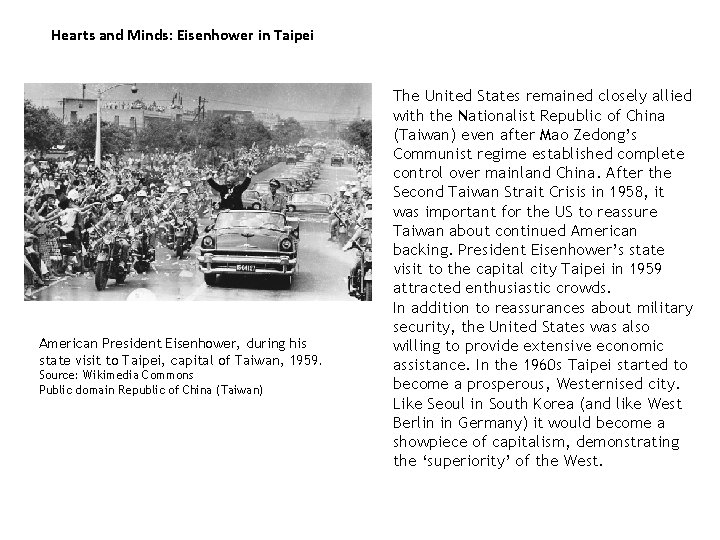
Hearts and Minds: Eisenhower in Taipei American President Eisenhower, during his state visit to Taipei, capital of Taiwan, 1959. Source: Wikimedia Commons Public domain Republic of China (Taiwan) The United States remained closely allied with the Nationalist Republic of China (Taiwan) even after Mao Zedong’s Communist regime established complete control over mainland China. After the Second Taiwan Strait Crisis in 1958, it was important for the US to reassure Taiwan about continued American backing. President Eisenhower’s state visit to the capital city Taipei in 1959 attracted enthusiastic crowds. In addition to reassurances about military security, the United States was also willing to provide extensive economic assistance. In the 1960 s Taipei started to become a prosperous, Westernised city. Like Seoul in South Korea (and like West Berlin in Germany) it would become a showpiece of capitalism, demonstrating the ‘superiority’ of the West.
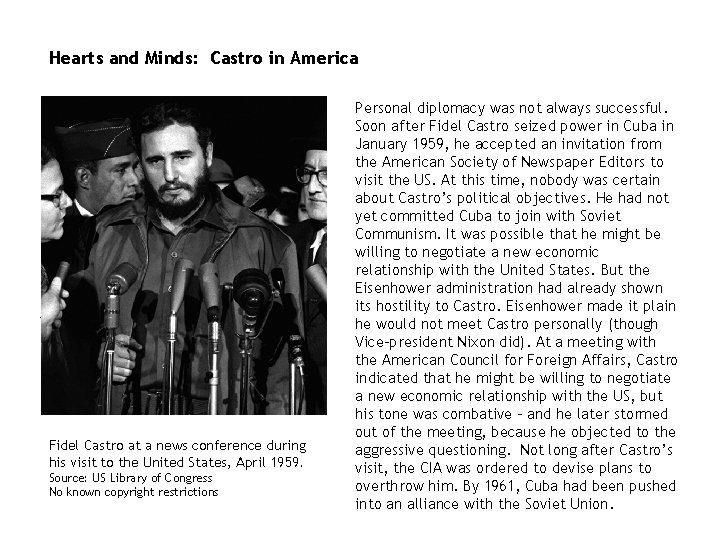
Hearts and Minds: Castro in America The suppression of the Budapest Rising by Soviet forces, November 1956 Fidel Castro at a news conference during his visit to the United States, April 1959. Source: US Library of Congress No known copyright restrictions Personal diplomacy was not always successful. Soon after Fidel Castro seized power in Cuba in January 1959, he accepted an invitation from the American Society of Newspaper Editors to visit the US. At this time, nobody was certain about Castro’s political objectives. He had not yet committed Cuba to join with Soviet Communism. It was possible that he might be willing to negotiate a new economic relationship with the United States. But the Eisenhower administration had already shown its hostility to Castro. Eisenhower made it plain he would not meet Castro personally (though Vice-president Nixon did). At a meeting with the American Council for Foreign Affairs, Castro indicated that he might be willing to negotiate a new economic relationship with the US, but his tone was combative – and he later stormed out of the meeting, because he objected to the aggressive questioning. Not long after Castro’s visit, the CIA was ordered to devise plans to overthrow him. By 1961, Cuba had been pushed into an alliance with the Soviet Union.
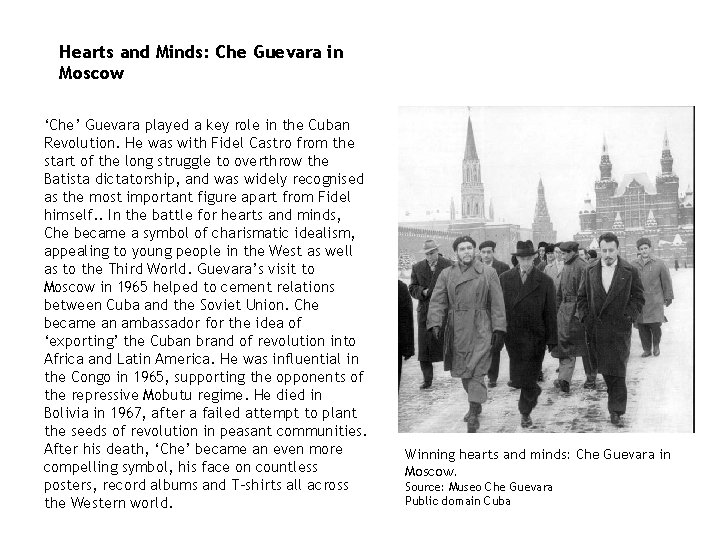
Hearts and Minds: Che Guevara in Moscow ‘Che’ Guevara played a key role in the Cuban Revolution. He was with Fidel Castro from the start of the long struggle to overthrow the Batista dictatorship, and was widely recognised as the most important figure apart from Fidel himself. . In the battle for hearts and minds, Che became a symbol of charismatic idealism, appealing to young people in the West as well as to the Third World. Guevara’s visit to Moscow in 1965 helped to cement relations between Cuba and the Soviet Union. Che became an ambassador for the idea of ‘exporting’ the Cuban brand of revolution into Africa and Latin America. He was influential in the Congo in 1965, supporting the opponents of the repressive Mobutu regime. He died in Bolivia in 1967, after a failed attempt to plant the seeds of revolution in peasant communities. After his death, ‘Che’ became an even more compelling symbol, his face on countless posters, record albums and T-shirts all across the Western world. Winning hearts and minds: Che Guevara in Moscow. Source: Museo Che Guevara Public domain Cuba
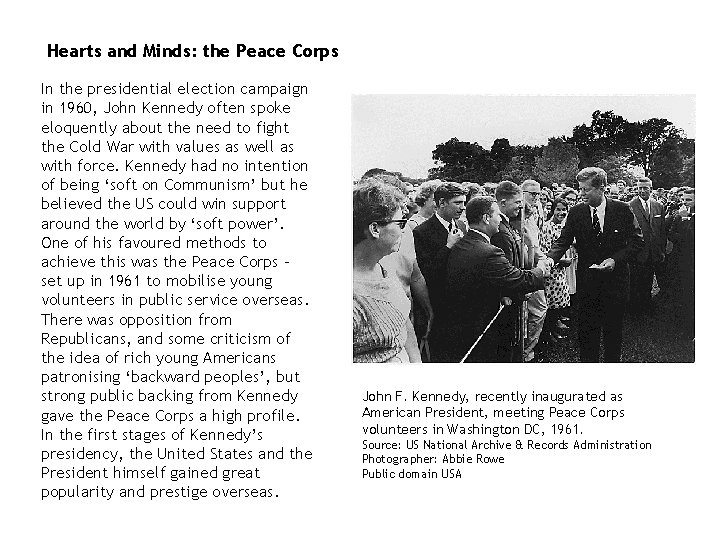
Hearts and Minds: the Peace Corps In the presidential election campaign in 1960, John Kennedy often spoke eloquently about the need to fight the Cold War with values as well as with force. Kennedy had no intention of being ‘soft on Communism’ but he believed the US could win support around the world by ‘soft power’. One of his favoured methods to achieve this was the Peace Corps – set up in 1961 to mobilise young volunteers in public service overseas. There was opposition from Republicans, and some criticism of the idea of rich young Americans patronising ‘backward peoples’, but strong public backing from Kennedy gave the Peace Corps a high profile. In the first stages of Kennedy’s presidency, the United States and the President himself gained great popularity and prestige overseas. John F. Kennedy, recently inaugurated as American President, meeting Peace Corps volunteers in Washington DC, 1961. Source: US National Archive & Records Administration Photographer: Abbie Rowe Public domain USA
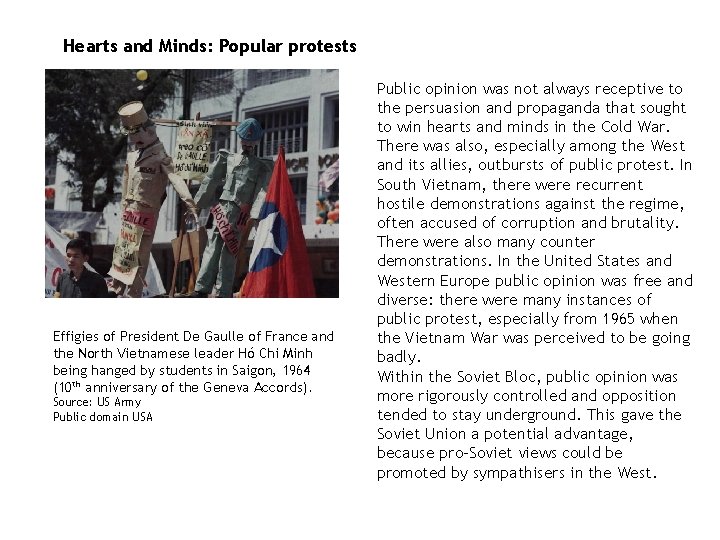
Hearts and Minds: Popular protests Effigies of President De Gaulle of France and the North Vietnamese leader Hó Chi Minh being hanged by students in Saigon, 1964 (10 th anniversary of the Geneva Accords). Source: US Army Public domain USA Public opinion was not always receptive to the persuasion and propaganda that sought to win hearts and minds in the Cold War. There was also, especially among the West and its allies, outbursts of public protest. In South Vietnam, there were recurrent hostile demonstrations against the regime, often accused of corruption and brutality. There were also many counter demonstrations. In the United States and Western Europe public opinion was free and diverse: there were many instances of public protest, especially from 1965 when the Vietnam War was perceived to be going badly. Within the Soviet Bloc, public opinion was more rigorously controlled and opposition tended to stay underground. This gave the Soviet Union a potential advantage, because pro-Soviet views could be promoted by sympathisers in the West.
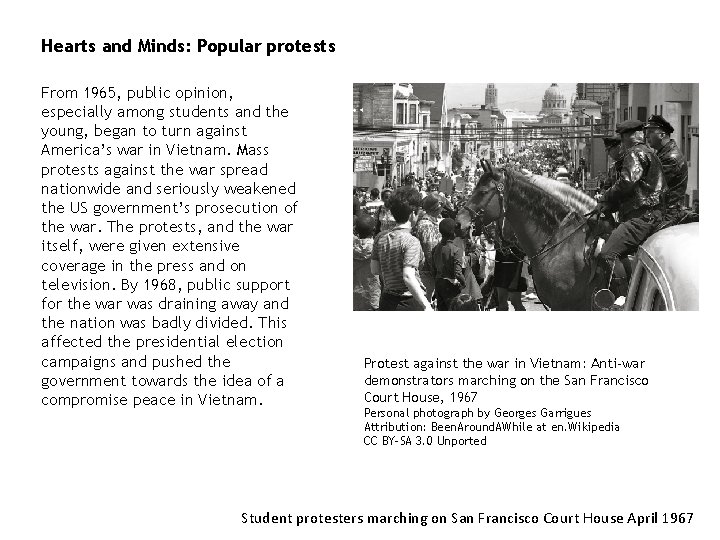
Hearts and Minds: Popular protests From 1965, public opinion, especially among students and the young, began to turn against America’s war in Vietnam. Mass protests against the war spread nationwide and seriously weakened the US government’s prosecution of the war. The protests, and the war itself, were given extensive coverage in the press and on television. By 1968, public support for the war was draining away and the nation was badly divided. This affected the presidential election campaigns and pushed the government towards the idea of a compromise peace in Vietnam. Protest against the war in Vietnam: Anti-war demonstrators marching on the San Francisco Court House, 1967 Personal photograph by Georges Garrigues Attribution: Been. Around. AWhile at en. Wikipedia CC BY-SA 3. 0 Unported Student protesters marching on San Francisco Court House April 1967
HOW DID DEVELOPMENT OF THE THIRD WORLD AFFECT THE COLD WAR? “The emergence of the Third World brought about a triangulation of world politics: a large base of ‘underdeveloped’ nations over which was a divided apex made up of ‘developed’ (highly industrial) nations siding either with the United States or the Soviet Union. ” From Decolonisation (1998) by the American historian Raymond Betts “The 1960 s was in many ways the decade of the Third World. From 1960 to 1963 twentyfour new nations joined an already long list. The rise of the Third World dramatically changed the makeup of the United Nations and altered the balance of power in the General Assembly. Revolutionaries like Castro, Ernesto ‘Che’ Guevara, and the Congo’s Patrice Lumumba inspired oppressed people everywhere and even became romanticised heroes for the left in developed nations. The emphasis placed by the Cold War combatants showed their conviction that the outcome of the Cold War could be decided by what happened in the Third World. ” George C. Herring From Colony to Superpower: US Foreign Relations Since 1776 (2011) p 711
Economic modernisation It might be thought the time has come for the world, and particularly for the Third World, to choose between the capitalist and socialist systems. The underdeveloped countries, which have used the fierce competition between the two systems to ensure the triumph of their struggle for national liberation, should however refuse to become a factor in that competition. They ought to do their utmost to find their own values and methods. Of course, capitalist exploitation and cartels and monopolies are the enemies of under-developed countries. On the other hand, the choice of a socialist system, which is completely oriented towards the people as a whole, will allow us to go forward more quickly, and make it impossible for all economic and political power to be in the hands of a few who regard the nation as a whole with scorn and contempt. Frantz Fanon, The Wretched of the Earth (1961) Frantz Fanon was born under French colonial rule in the Caribbean, and moved to Algeria in 1951. His books, especially, The Wretched of the Earth, had a big impact on the intellectual debate over theories of economic modernisation in the post-colonial world. He was an unorthodox Marxist, much more concerned with the dispossessed peasantry than with the urban working class (Che Guevara expressed similar ideas about the revolution needed in Africa and Latin America). Fanon did not believe in modernisation theory as presented by Western economists like W. W. Rostow; nor did he believe in ‘standard’ Soviet Marxism and the primacy of the industrial proletariat. He believed in peasant revolutionary action. This, Fanon argued, was not what the national-liberation leaders wanted (they usually formed a new national elite); and it was not what either of the superpowers wanted either. Both the West and the Soviet Bloc sought to win hearts and minds among the under-developed countries, but neither was ready to accept transformative change.
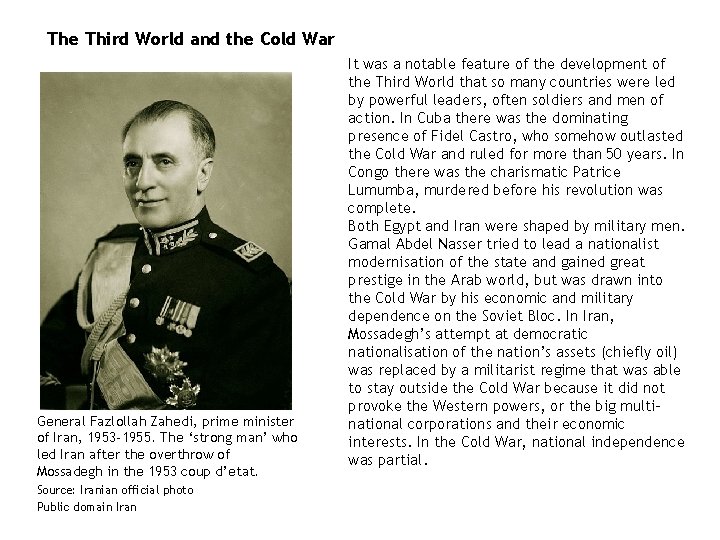
The Third World and the Cold War General Fazlollah Zahedi, prime minister of Iran, 1953 -1955. The ‘strong man’ who led Iran after the overthrow of Mossadegh in the 1953 coup d’etat. Source: Iranian official photo Public domain Iran It was a notable feature of the development of the Third World that so many countries were led by powerful leaders, often soldiers and men of action. In Cuba there was the dominating presence of Fidel Castro, who somehow outlasted the Cold War and ruled for more than 50 years. In Congo there was the charismatic Patrice Lumumba, murdered before his revolution was complete. Both Egypt and Iran were shaped by military men. Gamal Abdel Nasser tried to lead a nationalist modernisation of the state and gained great prestige in the Arab world, but was drawn into the Cold War by his economic and military dependence on the Soviet Bloc. In Iran, Mossadegh’s attempt at democratic nationalisation of the nation’s assets (chiefly oil) was replaced by a militarist regime that was able to stay outside the Cold War because it did not provoke the Western powers, or the big multinational corporations and their economic interests. In the Cold War, national independence was partial.
The Non-Aligned Movement and the Cold War: the Lusaka Manifesto 1970 The policy of the non-aligned movement has emerged from the determination of independent countries to safeguard their national independence and the legitimate rights of their peoples. The growth of non-alignment into a broad international movement cutting across racial, regional and other barriers, is an integral part of significant changes in the structure of the entire international community. It is the result of the world anti-colonial revolution and of the emergence of a large number of newly-liberated countries which, opting for independent political orientation and development, have refused to accept the replacement of centuriesold forms of subordination by new ones. At the root of these changes lies the aspiration for freedom, independence and equality, and the determination to resist all forms of oppression and exploitation: this is a confirmation of the validity of the Belgrade and Cairo Declarations. At a time when the polarisation of the international community on a bloc basis was perceived to be a permanent feature of international relations, and the threat of nuclear conflict between the big powers an ever-present spectre hovering over mankind, the non-aligned countries opened up new prospects for the contemporary world, and paved the way for relaxation of international tensions. The ‘Lusaka Manifesto’: the joint declaration after the non-aligned conference at Lusaka in Angola, Portuguese Africa, September 1970 The Cold War never completely took over the world outside Europe. Instead it lived alongside the processes of decolonisation, national liberation movements, and existing regional conflicts.
The Cold War Outside Europe This collection has been developed by Chris Rowe of the Historiana Historical Content Team. SUPPORTED BY COPYRIGHT AND LICENSE EUROCLIO has tried to contact all copyright holders of materials published on Historiana. Please contact copyright@historiana. eu in case you find that materials have been unrightfully used. License: CC-BY-SA 4. 0, Historiana DISCLAIMER The European Commission support for this publication does not constitute of an endorsement of the contents which reflects the view only of the authors, and the European Commission cannot be held responsible for any use which may be made of the information contained herein. The Asia-Africa Conference in 1955 (Public Domain Indonesia) DEVELOPED BY
- Slides: 44