
Between Groups WithinGroups ANOVA How F is constructed
Between Groups & Within-Groups ANOVA • How F is “constructed” • Things that “influence” F – Confounding – Inflated within-condition variability • Integrating “stats” & “methods”
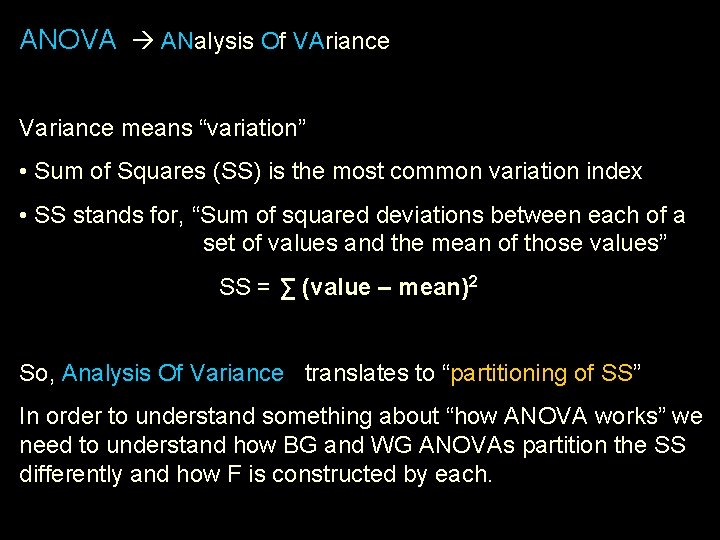
ANOVA ANalysis Of VAriance Variance means “variation” • Sum of Squares (SS) is the most common variation index • SS stands for, “Sum of squared deviations between each of a set of values and the mean of those values” SS = ∑ (value – mean)2 So, Analysis Of Variance translates to “partitioning of SS” In order to understand something about “how ANOVA works” we need to understand how BG and WG ANOVAs partition the SS differently and how F is constructed by each.
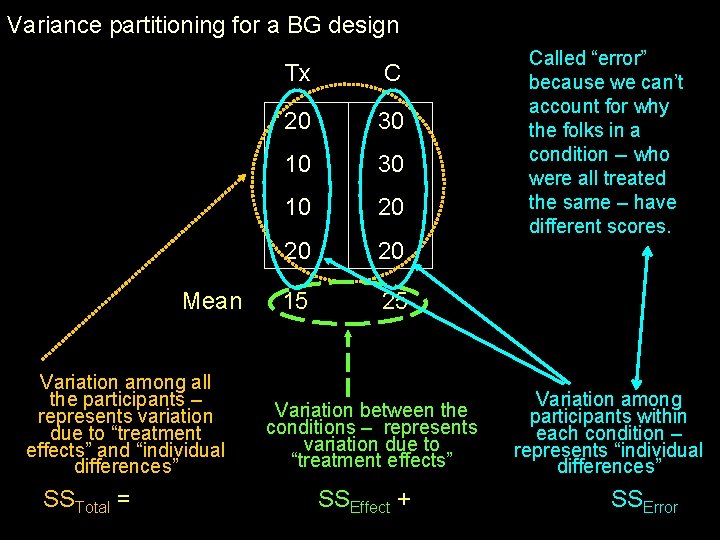
Variance partitioning for a BG design Mean Variation among all the participants – represents variation due to “treatment effects” and “individual differences” SSTotal = Tx C 20 30 10 20 20 20 15 25 Variation between the conditions – represents variation due to “treatment effects” SSEffect + Called “error” because we can’t account for why the folks in a condition -- who were all treated the same – have different scores. Variation among participants within each condition – represents “individual differences” SSError
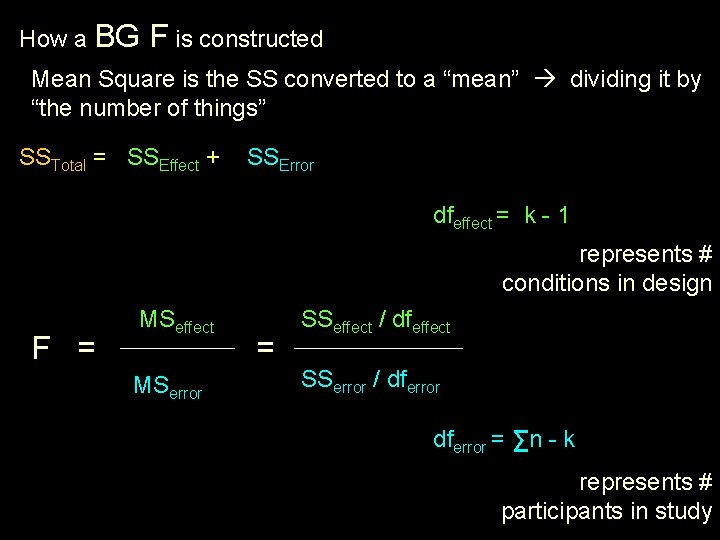
How a BG F is constructed Mean Square is the SS converted to a “mean” dividing it by “the number of things” SSTotal = SSEffect + SSError dfeffect = k - 1 represents # conditions in design F = MSeffect MSerror = SSeffect / dfeffect SSerror / dferror = ∑n - k represents # participants in study
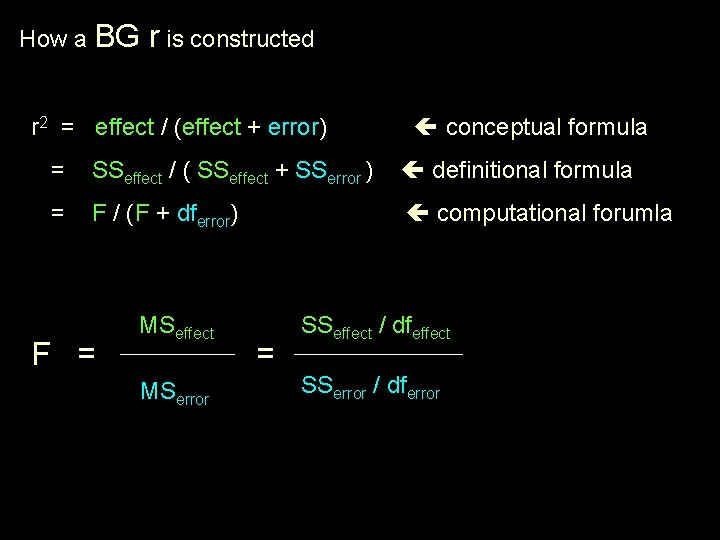
How a BG r is constructed r 2 = effect / (effect + error) conceptual formula = SSeffect / ( SSeffect + SSerror ) definitional formula = F / (F + dferror) computational forumla F = MSeffect MSerror = SSeffect / dfeffect SSerror / dferror
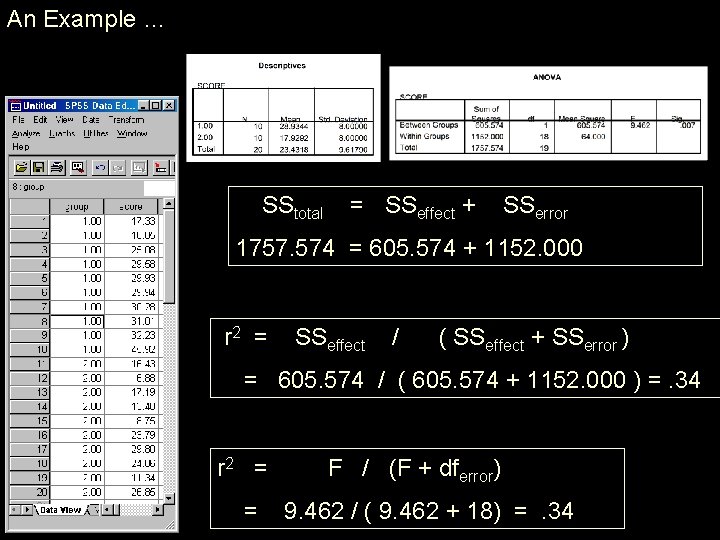
An Example … SStotal = SSeffect + SSerror 1757. 574 = 605. 574 + 1152. 000 r 2 = SSeffect / ( SSeffect + SSerror ) = 605. 574 / ( 605. 574 + 1152. 000 ) =. 34 r 2 = = F / (F + dferror) 9. 462 / ( 9. 462 + 18) =. 34
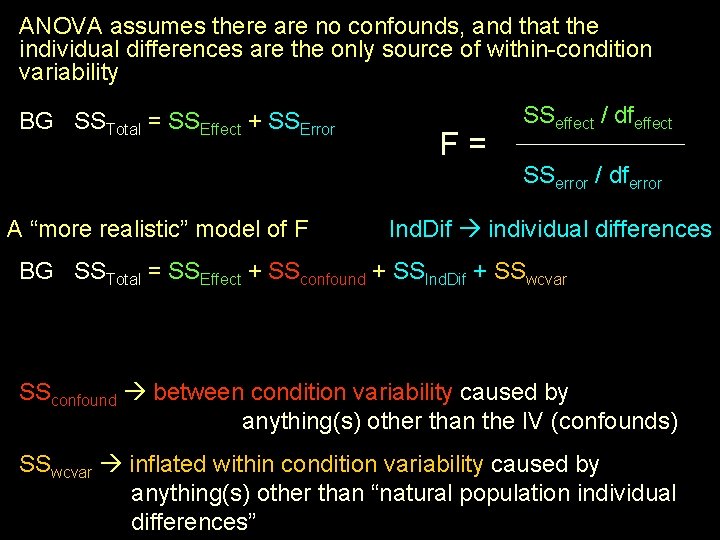
ANOVA assumes there are no confounds, and that the individual differences are the only source of within-condition variability BG SSTotal = SSEffect + SSError A “more realistic” model of F F= SSeffect / dfeffect SSerror / dferror Ind. Dif individual differences BG SSTotal = SSEffect + SSconfound + SSInd. Dif + SSwcvar SSconfound between condition variability caused by anything(s) other than the IV (confounds) SSwcvar inflated within condition variability caused by anything(s) other than “natural population individual differences”
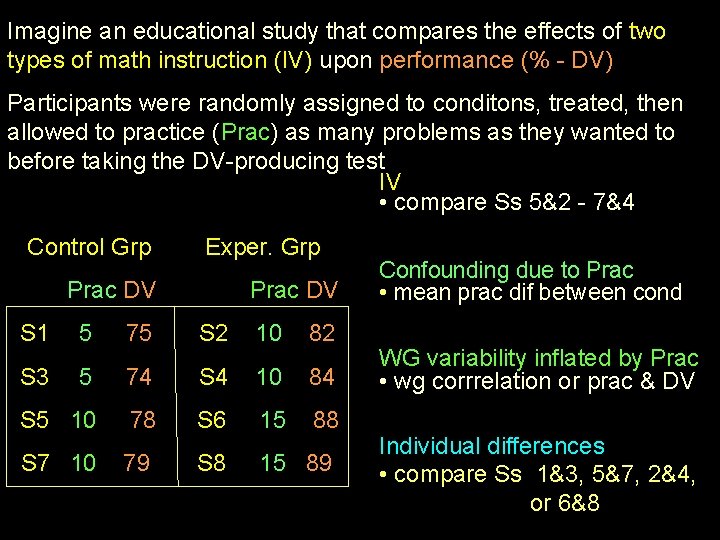
Imagine an educational study that compares the effects of two types of math instruction (IV) upon performance (% - DV) Participants were randomly assigned to conditons, treated, then allowed to practice (Prac) as many problems as they wanted to before taking the DV-producing test IV • compare Ss 5&2 - 7&4 Control Grp Exper. Grp Prac DV S 1 5 75 S 2 10 82 S 3 5 74 S 4 10 84 S 5 10 78 S 6 15 88 S 7 10 79 S 8 15 89 Confounding due to Prac • mean prac dif between cond WG variability inflated by Prac • wg corrrelation or prac & DV Individual differences • compare Ss 1&3, 5&7, 2&4, or 6&8
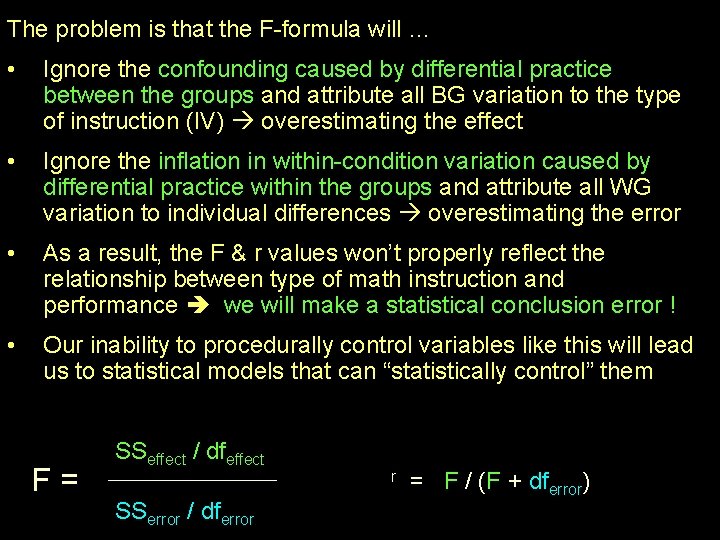
The problem is that the F-formula will … • Ignore the confounding caused by differential practice between the groups and attribute all BG variation to the type of instruction (IV) overestimating the effect • Ignore the inflation in within-condition variation caused by differential practice within the groups and attribute all WG variation to individual differences overestimating the error • As a result, the F & r values won’t properly reflect the relationship between type of math instruction and performance we will make a statistical conclusion error ! • Our inability to procedurally control variables like this will lead us to statistical models that can “statistically control” them F= SSeffect / dfeffect SSerror / dferror r = F / (F + dferror)
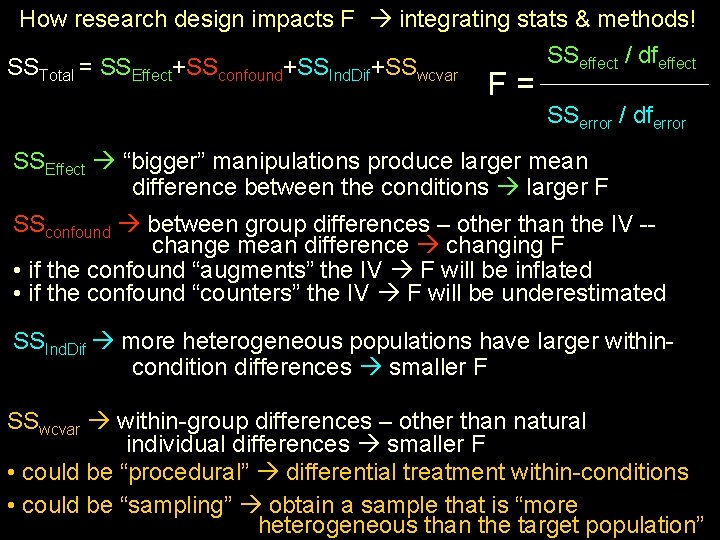
How research design impacts F integrating stats & methods! SSTotal = SSEffect+SSconfound+SSInd. Dif+SSwcvar F= SSeffect / dfeffect SSerror / dferror SSEffect “bigger” manipulations produce larger mean difference between the conditions larger F SSconfound between group differences – other than the IV -change mean difference changing F • if the confound “augments” the IV F will be inflated • if the confound “counters” the IV F will be underestimated SSInd. Dif more heterogeneous populations have larger withincondition differences smaller F SSwcvar within-group differences – other than natural individual differences smaller F • could be “procedural” differential treatment within-conditions • could be “sampling” obtain a sample that is “more heterogeneous than the target population”
- Slides: 10