
Betty Burnett 69 I moved to Flint in
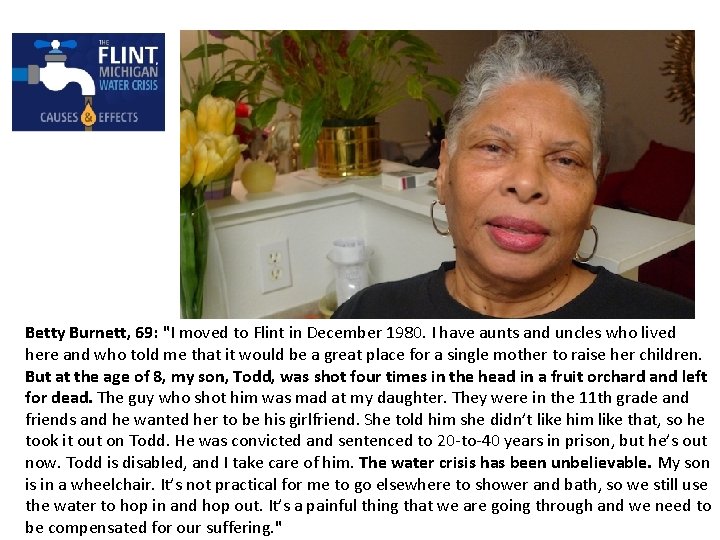
Betty Burnett, 69: "I moved to Flint in December 1980. I have aunts and uncles who lived here and who told me that it would be a great place for a single mother to raise her children. But at the age of 8, my son, Todd, was shot four times in the head in a fruit orchard and left for dead. The guy who shot him was mad at my daughter. They were in the 11 th grade and friends and he wanted her to be his girlfriend. She told him she didn’t like him like that, so he took it out on Todd. He was convicted and sentenced to 20 -to-40 years in prison, but he’s out now. Todd is disabled, and I take care of him. The water crisis has been unbelievable. My son is in a wheelchair. It’s not practical for me to go elsewhere to shower and bath, so we still use the water to hop in and hop out. It’s a painful thing that we are going through and we need to be compensated for our suffering. "
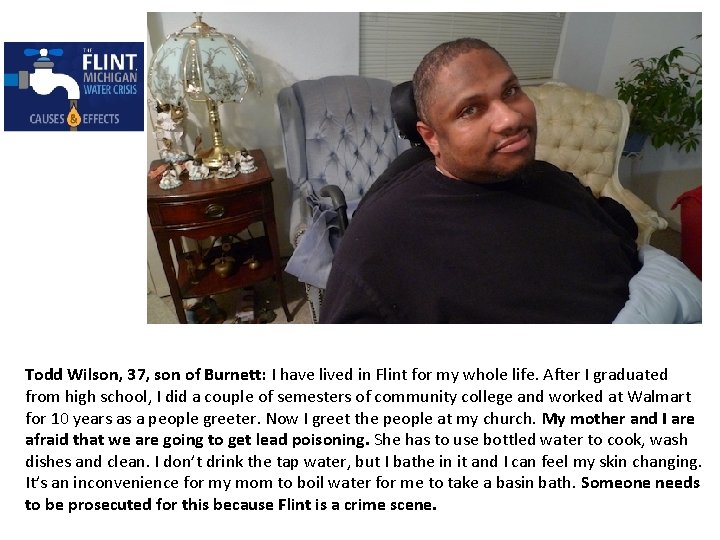
Todd Wilson, 37, son of Burnett: I have lived in Flint for my whole life. After I graduated from high school, I did a couple of semesters of community college and worked at Walmart for 10 years as a people greeter. Now I greet the people at my church. My mother and I are afraid that we are going to get lead poisoning. She has to use bottled water to cook, wash dishes and clean. I don’t drink the tap water, but I bathe in it and I can feel my skin changing. It’s an inconvenience for my mom to boil water for me to take a basin bath. Someone needs to be prosecuted for this because Flint is a crime scene.
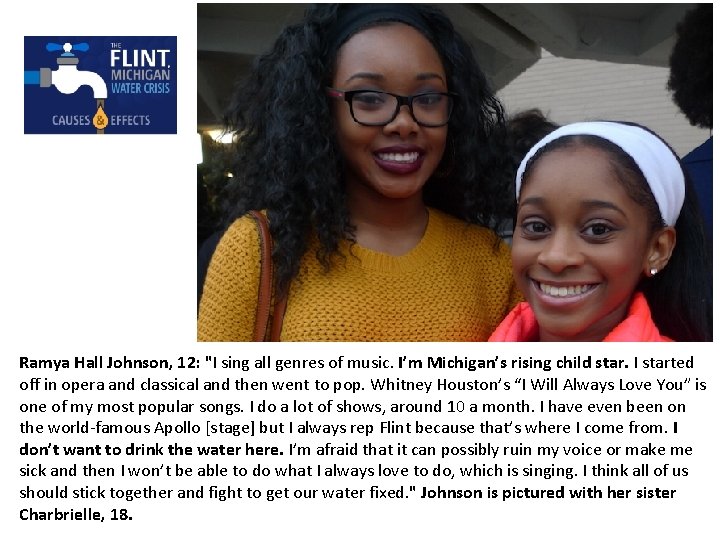
Ramya Hall Johnson, 12: "I sing all genres of music. I’m Michigan’s rising child star. I started off in opera and classical and then went to pop. Whitney Houston’s “I Will Always Love You” is one of my most popular songs. I do a lot of shows, around 10 a month. I have even been on the world-famous Apollo [stage] but I always rep Flint because that’s where I come from. I don’t want to drink the water here. I’m afraid that it can possibly ruin my voice or make me sick and then I won’t be able to do what I always love to do, which is singing. I think all of us should stick together and fight to get our water fixed. " Johnson is pictured with her sister Charbrielle, 18.
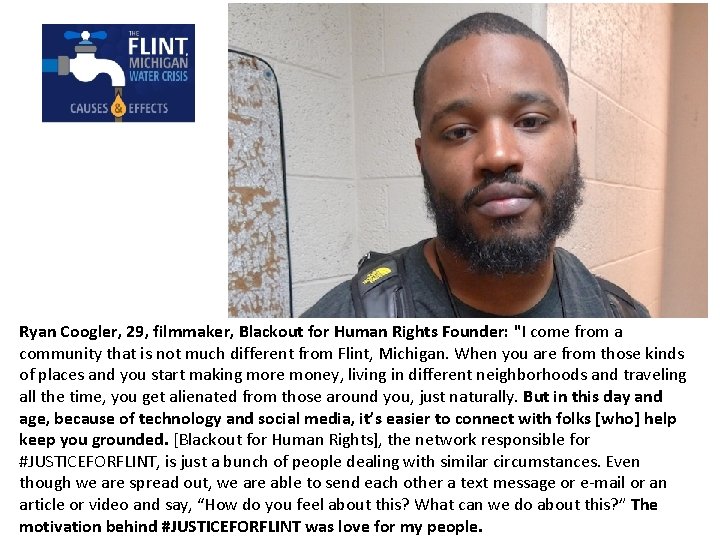
Ryan Coogler, 29, filmmaker, Blackout for Human Rights Founder: "I come from a community that is not much different from Flint, Michigan. When you are from those kinds of places and you start making more money, living in different neighborhoods and traveling all the time, you get alienated from those around you, just naturally. But in this day and age, because of technology and social media, it’s easier to connect with folks [who] help keep you grounded. [Blackout for Human Rights], the network responsible for #JUSTICEFORFLINT, is just a bunch of people dealing with similar circumstances. Even though we are spread out, we are able to send each other a text message or e-mail or an article or video and say, “How do you feel about this? What can we do about this? ” The motivation behind #JUSTICEFORFLINT was love for my people.
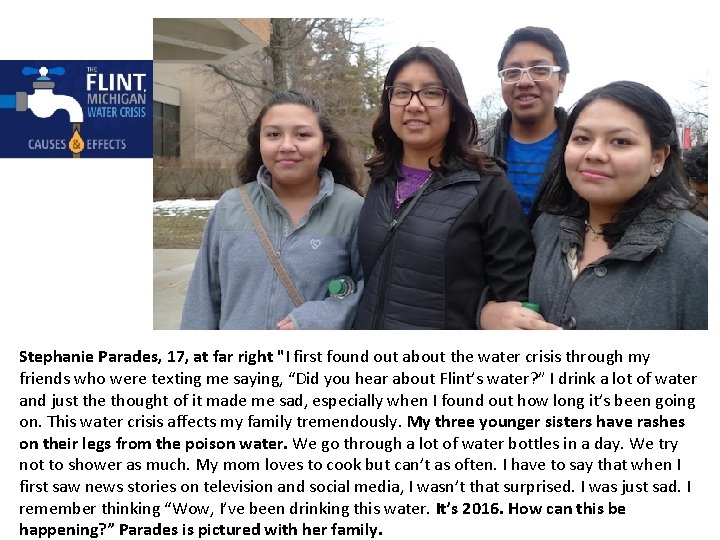
Stephanie Parades, 17, at far right "I first found out about the water crisis through my friends who were texting me saying, “Did you hear about Flint’s water? ” I drink a lot of water and just the thought of it made me sad, especially when I found out how long it’s been going on. This water crisis affects my family tremendously. My three younger sisters have rashes on their legs from the poison water. We go through a lot of water bottles in a day. We try not to shower as much. My mom loves to cook but can’t as often. I have to say that when I first saw news stories on television and social media, I wasn’t that surprised. I was just sad. I remember thinking “Wow, I’ve been drinking this water. It’s 2016. How can this be happening? ” Parades is pictured with her family.
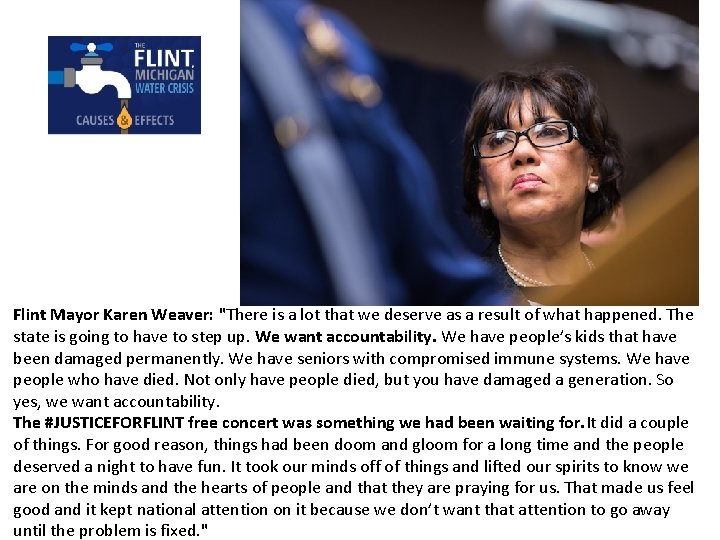
Flint Mayor Karen Weaver: "There is a lot that we deserve as a result of what happened. The state is going to have to step up. We want accountability. We have people’s kids that have been damaged permanently. We have seniors with compromised immune systems. We have people who have died. Not only have people died, but you have damaged a generation. So yes, we want accountability. The #JUSTICEFORFLINT free concert was something we had been waiting for. It did a couple of things. For good reason, things had been doom and gloom for a long time and the people deserved a night to have fun. It took our minds off of things and lifted our spirits to know we are on the minds and the hearts of people and that they are praying for us. That made us feel good and it kept national attention on it because we don’t want that attention to go away until the problem is fixed. "
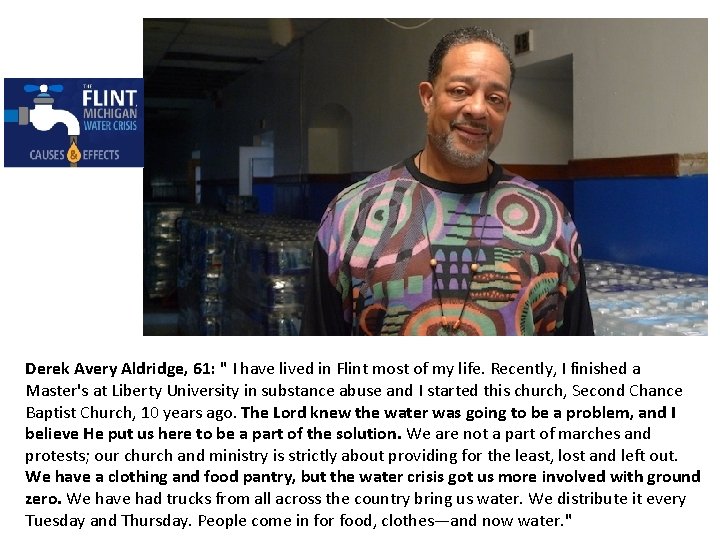
Derek Avery Aldridge, 61: " I have lived in Flint most of my life. Recently, I finished a Master's at Liberty University in substance abuse and I started this church, Second Chance Baptist Church, 10 years ago. The Lord knew the water was going to be a problem, and I believe He put us here to be a part of the solution. We are not a part of marches and protests; our church and ministry is strictly about providing for the least, lost and left out. We have a clothing and food pantry, but the water crisis got us more involved with ground zero. We have had trucks from all across the country bring us water. We distribute it every Tuesday and Thursday. People come in for food, clothes—and now water. "
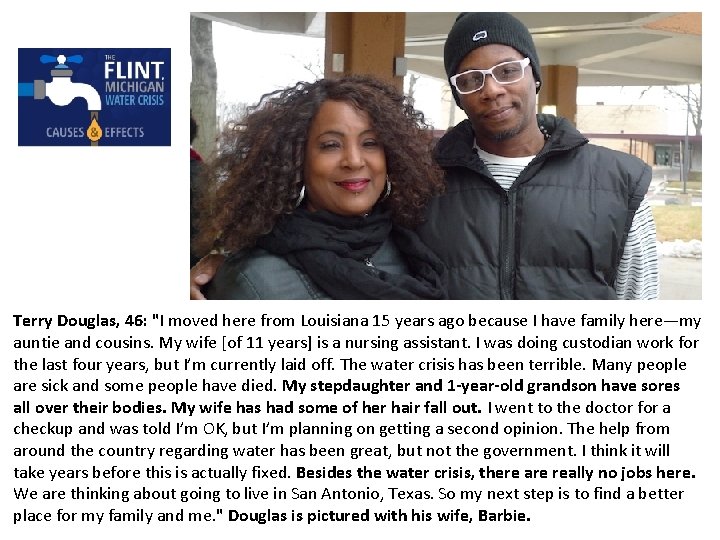
Terry Douglas, 46: "I moved here from Louisiana 15 years ago because I have family here—my auntie and cousins. My wife [of 11 years] is a nursing assistant. I was doing custodian work for the last four years, but I’m currently laid off. The water crisis has been terrible. Many people are sick and some people have died. My stepdaughter and 1 -year-old grandson have sores all over their bodies. My wife has had some of her hair fall out. I went to the doctor for a checkup and was told I’m OK, but I’m planning on getting a second opinion. The help from around the country regarding water has been great, but not the government. I think it will take years before this is actually fixed. Besides the water crisis, there are really no jobs here. We are thinking about going to live in San Antonio, Texas. So my next step is to find a better place for my family and me. " Douglas is pictured with his wife, Barbie.
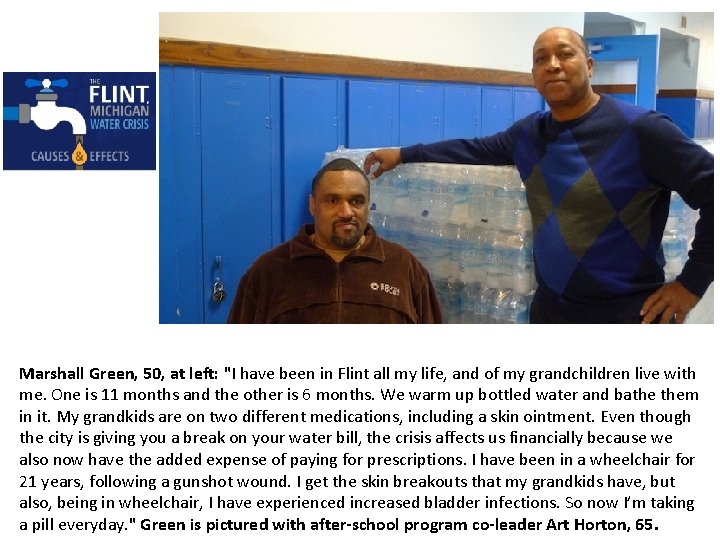
Marshall Green, 50, at left: "I have been in Flint all my life, and of my grandchildren live with me. One is 11 months and the other is 6 months. We warm up bottled water and bathe them in it. My grandkids are on two different medications, including a skin ointment. Even though the city is giving you a break on your water bill, the crisis affects us financially because we also now have the added expense of paying for prescriptions. I have been in a wheelchair for 21 years, following a gunshot wound. I get the skin breakouts that my grandkids have, but also, being in wheelchair, I have experienced increased bladder infections. So now I’m taking a pill everyday. " Green is pictured with after-school program co-leader Art Horton, 65.
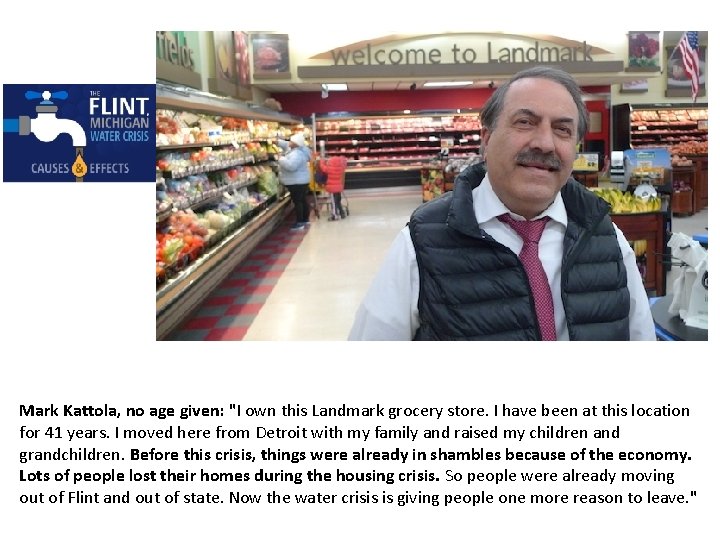
Mark Kattola, no age given: "I own this Landmark grocery store. I have been at this location for 41 years. I moved here from Detroit with my family and raised my children and grandchildren. Before this crisis, things were already in shambles because of the economy. Lots of people lost their homes during the housing crisis. So people were already moving out of Flint and out of state. Now the water crisis is giving people one more reason to leave. "
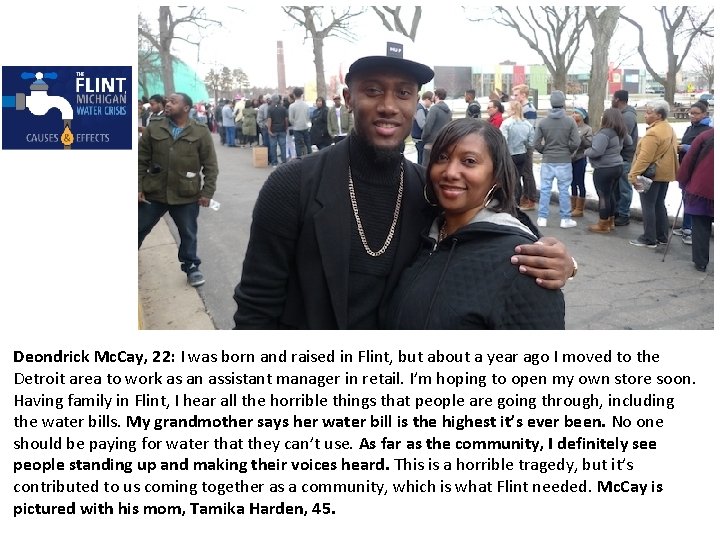
Deondrick Mc. Cay, 22: I was born and raised in Flint, but about a year ago I moved to the Detroit area to work as an assistant manager in retail. I’m hoping to open my own store soon. Having family in Flint, I hear all the horrible things that people are going through, including the water bills. My grandmother says her water bill is the highest it’s ever been. No one should be paying for water that they can’t use. As far as the community, I definitely see people standing up and making their voices heard. This is a horrible tragedy, but it’s contributed to us coming together as a community, which is what Flint needed. Mc. Cay is pictured with his mom, Tamika Harden, 45.
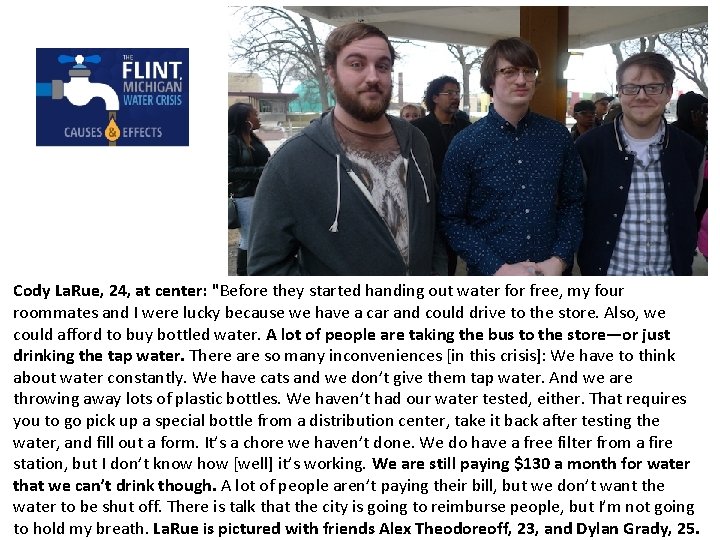
Cody La. Rue, 24, at center: "Before they started handing out water for free, my four roommates and I were lucky because we have a car and could drive to the store. Also, we could afford to buy bottled water. A lot of people are taking the bus to the store—or just drinking the tap water. There are so many inconveniences [in this crisis]: We have to think about water constantly. We have cats and we don’t give them tap water. And we are throwing away lots of plastic bottles. We haven’t had our water tested, either. That requires you to go pick up a special bottle from a distribution center, take it back after testing the water, and fill out a form. It’s a chore we haven’t done. We do have a free filter from a fire station, but I don’t know how [well] it’s working. We are still paying $130 a month for water that we can’t drink though. A lot of people aren’t paying their bill, but we don’t want the water to be shut off. There is talk that the city is going to reimburse people, but I’m not going to hold my breath. La. Rue is pictured with friends Alex Theodoreoff, 23, and Dylan Grady, 25.
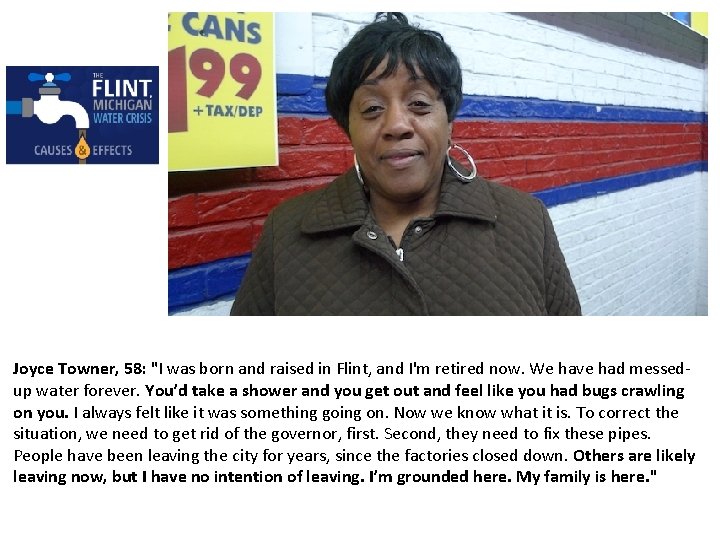
Joyce Towner, 58: "I was born and raised in Flint, and I'm retired now. We have had messedup water forever. You’d take a shower and you get out and feel like you had bugs crawling on you. I always felt like it was something going on. Now we know what it is. To correct the situation, we need to get rid of the governor, first. Second, they need to fix these pipes. People have been leaving the city for years, since the factories closed down. Others are likely leaving now, but I have no intention of leaving. I’m grounded here. My family is here. "
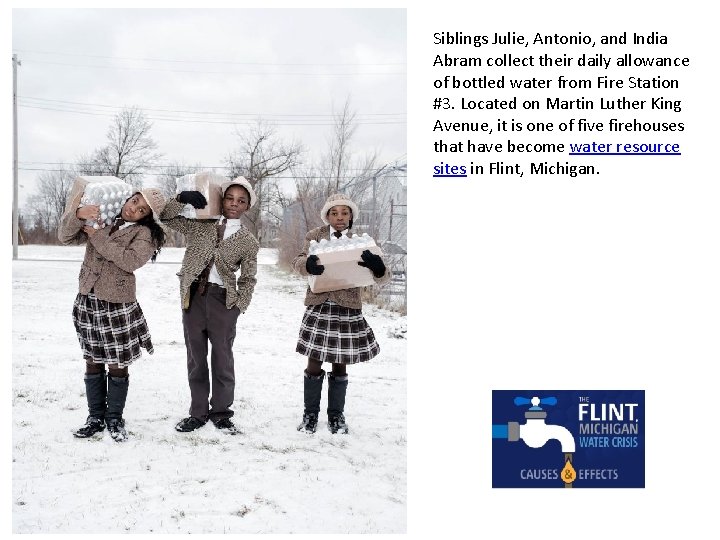
Siblings Julie, Antonio, and India Abram collect their daily allowance of bottled water from Fire Station #3. Located on Martin Luther King Avenue, it is one of five firehouses that have become water resource sites in Flint, Michigan.
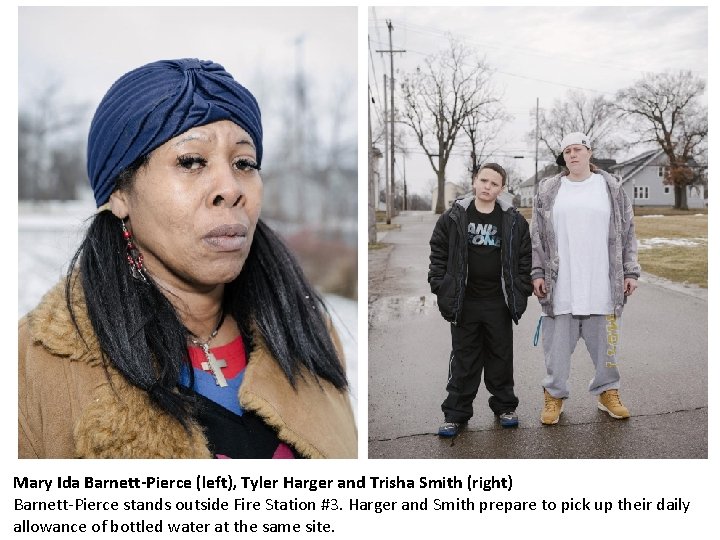
Mary Ida Barnett-Pierce (left), Tyler Harger and Trisha Smith (right) Barnett-Pierce stands outside Fire Station #3. Harger and Smith prepare to pick up their daily allowance of bottled water at the same site.
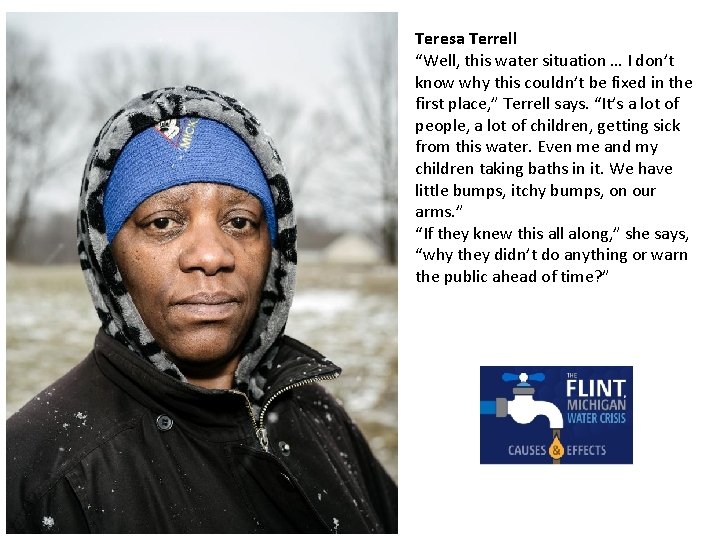
Teresa Terrell “Well, this water situation … I don’t know why this couldn’t be fixed in the first place, ” Terrell says. “It’s a lot of people, a lot of children, getting sick from this water. Even me and my children taking baths in it. We have little bumps, itchy bumps, on our arms. ” “If they knew this all along, ” she says, “why they didn’t do anything or warn the public ahead of time? ”
Pastor Ernest C. Martin “There hasn’t been a ray of hope on what you see coming across the news, ” says Martin. “And it’s generally been mass hysteria, fear, and worry about this or either that. My spirit has been that there needs to be a ray of hope. ”
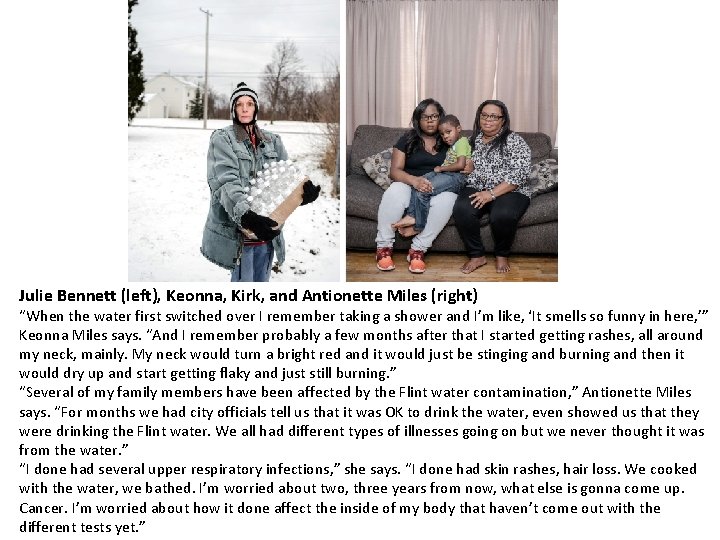
Julie Bennett (left), Keonna, Kirk, and Antionette Miles (right) “When the water first switched over I remember taking a shower and I’m like, ‘It smells so funny in here, ’” Keonna Miles says. “And I remember probably a few months after that I started getting rashes, all around my neck, mainly. My neck would turn a bright red and it would just be stinging and burning and then it would dry up and start getting flaky and just still burning. ” “Several of my family members have been affected by the Flint water contamination, ” Antionette Miles says. “For months we had city officials tell us that it was OK to drink the water, even showed us that they were drinking the Flint water. We all had different types of illnesses going on but we never thought it was from the water. ” “I done had several upper respiratory infections, ” she says. “I done had skin rashes, hair loss. We cooked with the water, we bathed. I’m worried about two, three years from now, what else is gonna come up. Cancer. I’m worried about how it done affect the inside of my body that haven’t come out with the different tests yet. ”
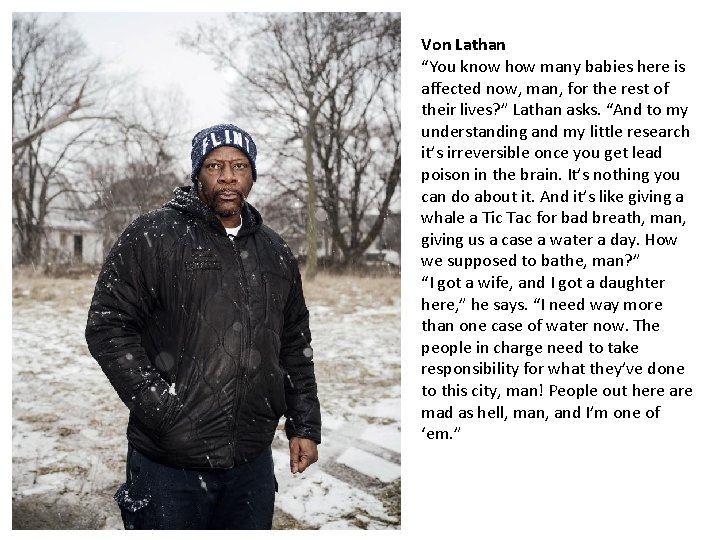
Von Lathan “You know how many babies here is affected now, man, for the rest of their lives? ” Lathan asks. “And to my understanding and my little research it’s irreversible once you get lead poison in the brain. It’s nothing you can do about it. And it’s like giving a whale a Tic Tac for bad breath, man, giving us a case a water a day. How we supposed to bathe, man? ” “I got a wife, and I got a daughter here, ” he says. “I need way more than one case of water now. The people in charge need to take responsibility for what they’ve done to this city, man! People out here are mad as hell, man, and I’m one of ‘em. ”
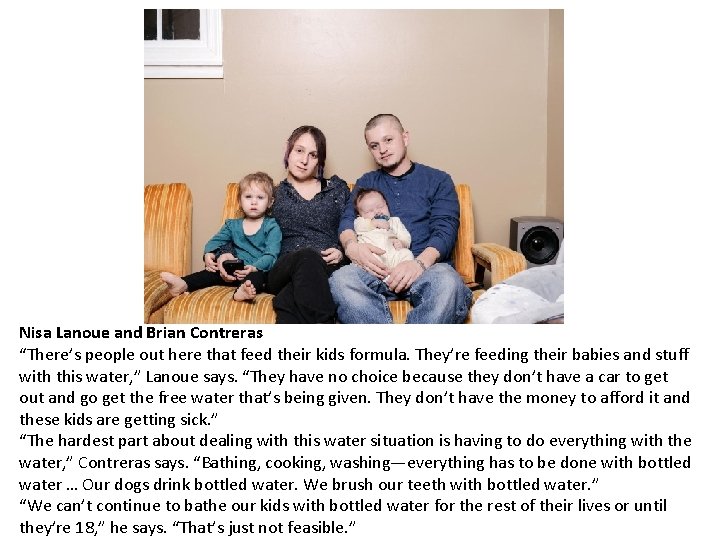
Nisa Lanoue and Brian Contreras “There’s people out here that feed their kids formula. They’re feeding their babies and stuff with this water, ” Lanoue says. “They have no choice because they don’t have a car to get out and go get the free water that’s being given. They don’t have the money to afford it and these kids are getting sick. ” “The hardest part about dealing with this water situation is having to do everything with the water, ” Contreras says. “Bathing, cooking, washing—everything has to be done with bottled water … Our dogs drink bottled water. We brush our teeth with bottled water. ” “We can’t continue to bathe our kids with bottled water for the rest of their lives or until they’re 18, ” he says. “That’s just not feasible. ”
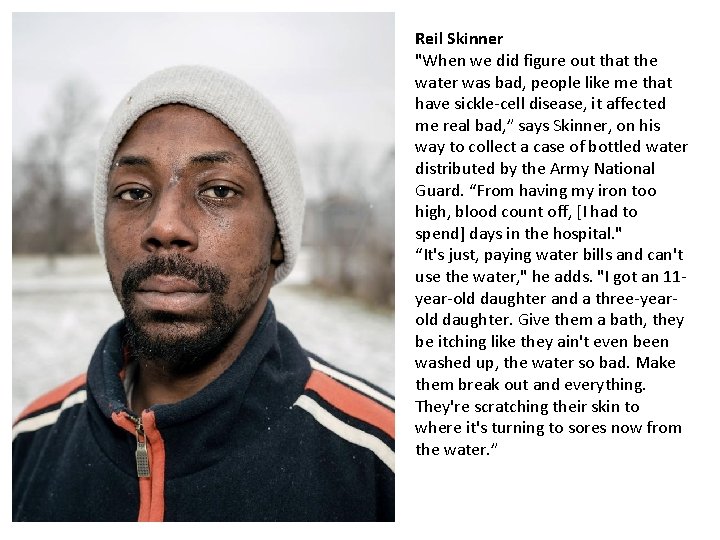
Reil Skinner "When we did figure out that the water was bad, people like me that have sickle-cell disease, it affected me real bad, ” says Skinner, on his way to collect a case of bottled water distributed by the Army National Guard. “From having my iron too high, blood count off, [I had to spend] days in the hospital. " “It's just, paying water bills and can't use the water, " he adds. "I got an 11 year-old daughter and a three-yearold daughter. Give them a bath, they be itching like they ain't even been washed up, the water so bad. Make them break out and everything. They're scratching their skin to where it's turning to sores now from the water. ”
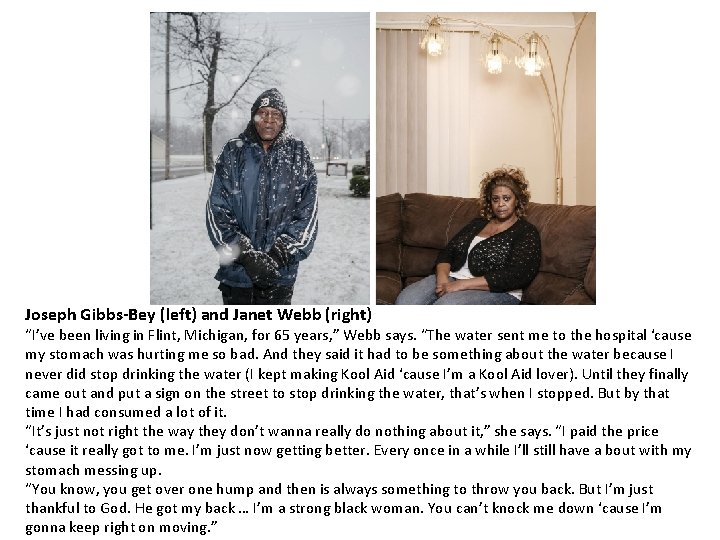
Joseph Gibbs-Bey (left) and Janet Webb (right) “I’ve been living in Flint, Michigan, for 65 years, ” Webb says. “The water sent me to the hospital ‘cause my stomach was hurting me so bad. And they said it had to be something about the water because I never did stop drinking the water (I kept making Kool Aid ‘cause I’m a Kool Aid lover). Until they finally came out and put a sign on the street to stop drinking the water, that’s when I stopped. But by that time I had consumed a lot of it. “It’s just not right the way they don’t wanna really do nothing about it, ” she says. “I paid the price ‘cause it really got to me. I’m just now getting better. Every once in a while I’ll still have a bout with my stomach messing up. “You know, you get over one hump and then is always something to throw you back. But I’m just thankful to God. He got my back … I’m a strong black woman. You can’t knock me down ‘cause I’m gonna keep right on moving. ”
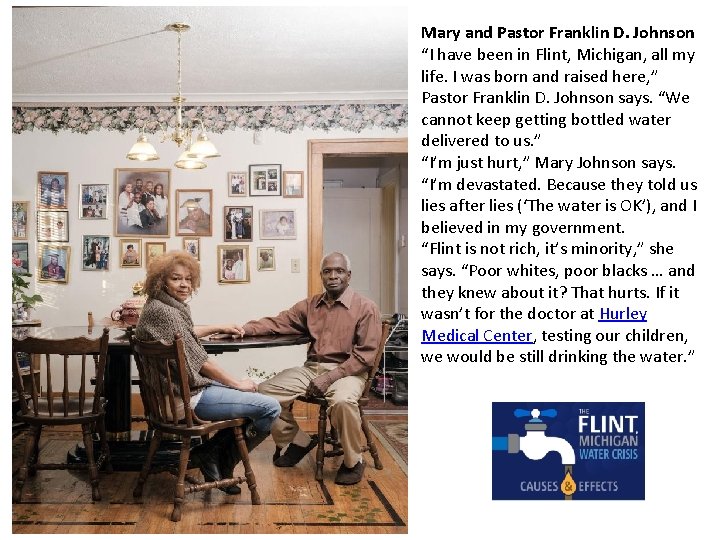
Mary and Pastor Franklin D. Johnson “I have been in Flint, Michigan, all my life. I was born and raised here, ” Pastor Franklin D. Johnson says. “We cannot keep getting bottled water delivered to us. ” “I’m just hurt, ” Mary Johnson says. “I’m devastated. Because they told us lies after lies (‘The water is OK’), and I believed in my government. “Flint is not rich, it’s minority, ” she says. “Poor whites, poor blacks … and they knew about it? That hurts. If it wasn’t for the doctor at Hurley Medical Center, testing our children, we would be still drinking the water. ”
- Slides: 23