
Better Safe than Sorry Biases in spatial cognition
Better Safe than Sorry Biases in spatial cognition. - Evolved navigation theory. - Other biases. Error management theory. - The “smoke detector principle. ” - Implications for erroneous perceptions of danger. - Implications for intergroup cognition.
“Evolved navigation theory” - Fitness costs associated with falling. - Fitness benefits associated with biased assessment of the “difficulty” of navigating places in which the risk of falling is high.
Two specific implications of “Evolved navigation theory”: - Over-estimation of distances along vertical edges. - Over-estimation of vertical height, especially when looking down.
Other biases in perceptions of steepness and distance: Available energetic resources influence perceptions of steepness. - Example: Recent ingestion of glucose slopes seem less steep Anticipated energetic costliness influences perceptions of distance. - Example: Heavier backpack distances seem longer
A broader point to keep in mind: Cognitive biases behavioral decisions fitness implications Some biases may have had positive fitness implications. Adapted cognition ≠ accurate cognition

Error Management Theory If (within the EEA): Potential to make different kinds of judgment errors; And the different errors were associated with different fitness costs… Then: Natural selection favored the evolution of cognitive biases that minimize the likelihood of making especially costly errors (even if those biases produce more frequent errors of other kinds).
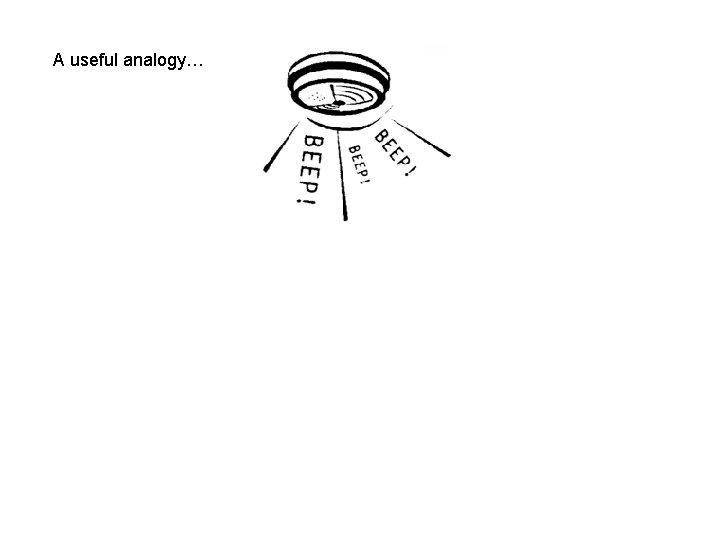
A useful analogy…
![Reality Judgment Fire No fire BEEEEEEP! [alarm] Correct Error (“False alarm”) [no alarm] Error](http://slidetodoc.com/presentation_image_h2/98d9ef091d74db44bd59c5a6bcd3e718/image-8.jpg "Reality Judgment Fire No fire BEEEEEEP! [alarm] Correct Error (“False alarm”) [no alarm] Error")
Reality Judgment Fire No fire BEEEEEEP! [alarm] Correct Error (“False alarm”) [no alarm] Error (“Miss”) Correct Small costs Bigger costs
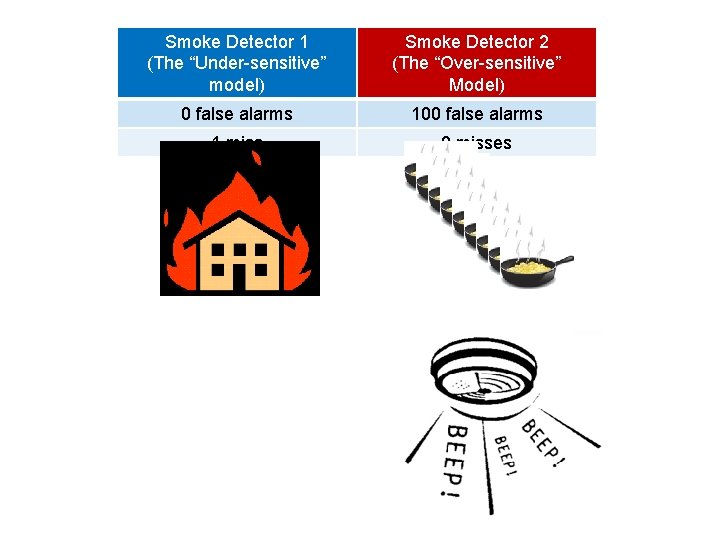
Smoke Detector 1 (The “Under-sensitive” model) Smoke Detector 2 (The “Over-sensitive” Model) 0 false alarms 100 false alarms 1 miss 0 misses
The “smoke detector principle” If: Different fitness costs associated with “false alarm” vs. “miss”… Then: Evolution of cognitive biases that minimize likelihood of the more costly error. (Results in increased likelihood of the less costly error). In context of threats/dangers: Because "misses" were typically more costly than "false alarms, " there evolved cognitive biases that minimize "misses” (and this bias produces lots of “false alarms”). Adaptive flexibility: This cognitive bias is flexible and context-dependent. (It occurs especially when people feel vulnerable).
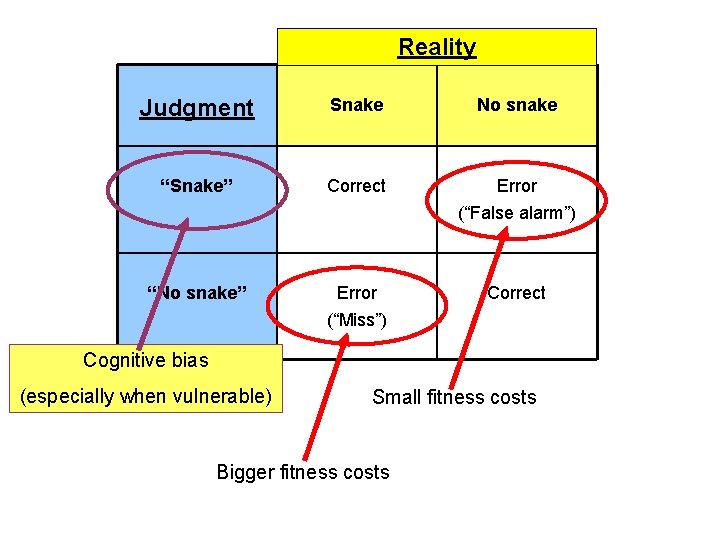
Reality Judgment Snake No snake “Snake” Correct Error (“False alarm”) “No snake” Error (“Miss”) Correct Cognitive bias (especially when vulnerable) Small fitness costs Bigger fitness costs
Implications for erroneous perceptions of danger. . .
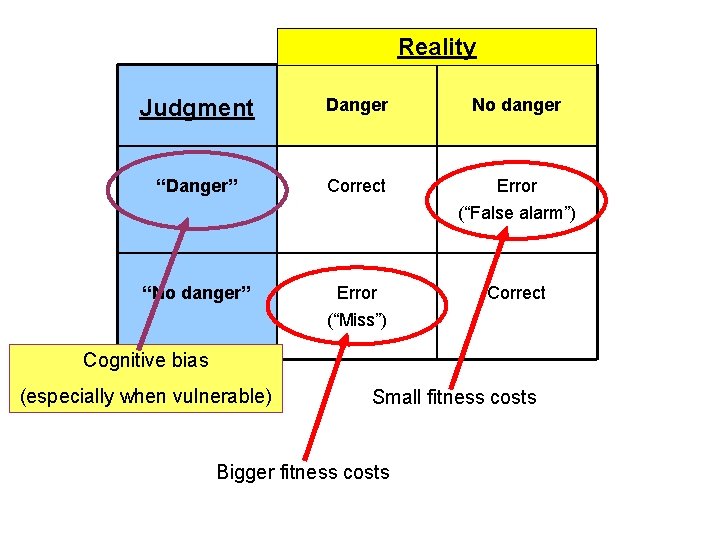
Reality Judgment Danger No danger “Danger” Correct Error (“False alarm”) “No danger” Error (“Miss”) Correct Cognitive bias (especially when vulnerable) Small fitness costs Bigger fitness costs
Implications for intergroup cognition. . .
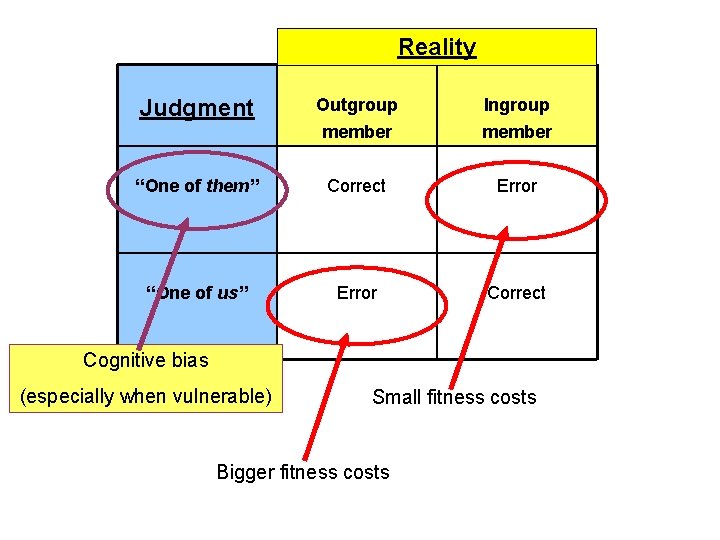
Reality Judgment Outgroup member Ingroup member “One of them” Correct Error “One of us” Error Correct Cognitive bias (especially when vulnerable) Small fitness costs Bigger fitness costs
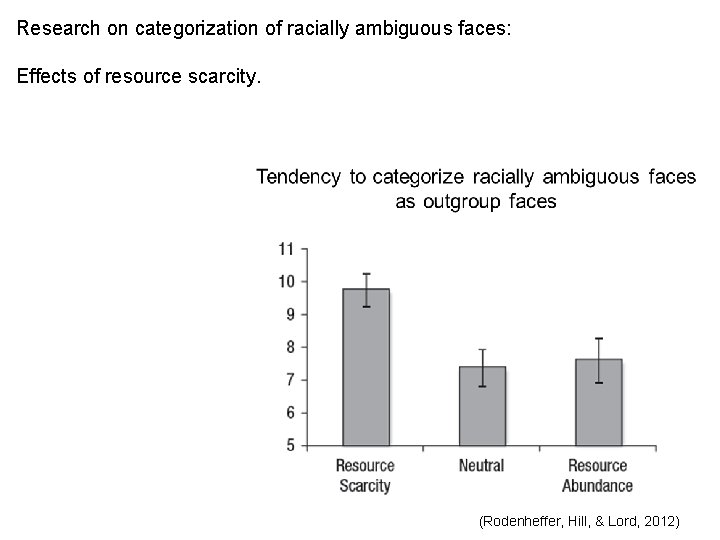
Research on categorization of racially ambiguous faces: Effects of resource scarcity. (Rodenheffer, Hill, & Lord, 2012)
Research on categorization of racially ambiguous faces: Other contextual factors that increase likelihood of perceiving a racially ambiguous face as one of “them”: - If the face has an angry expression. - If it’s a man’s face. - If the perceiver just generally feels more vulnerable to harm. (Miller, Maner, & Becker, 2010)
Error Management Theory Natural selection favored the evolution of cognitive biases that minimize the likelihood of making especially costly errors (even if those biases produce more frequent errors of other kinds). Lots of implications! For instance: Face overgeneralization effects (Zebrowitz, 2017) - Baby-face overgeneralization - Familiar-face overgeneralization - Emotional-face overgeneralization - Unfit-face overgeneralization
- Slides: 18