
Better My SQL Indexes and Schemas Slides Sheeri
Better My. SQL Indexes and Schemas Slides Sheeri Cabral Data Team Manager, Mozilla @sheeri www. sheeri. com
What is an index?
KEY vs. INDEX KEY = KEY CONSTRAINT PRIMARY, UNIQUE, FOREIGN Everything else is an “implementation detail” The plural of INDEX is. . ?
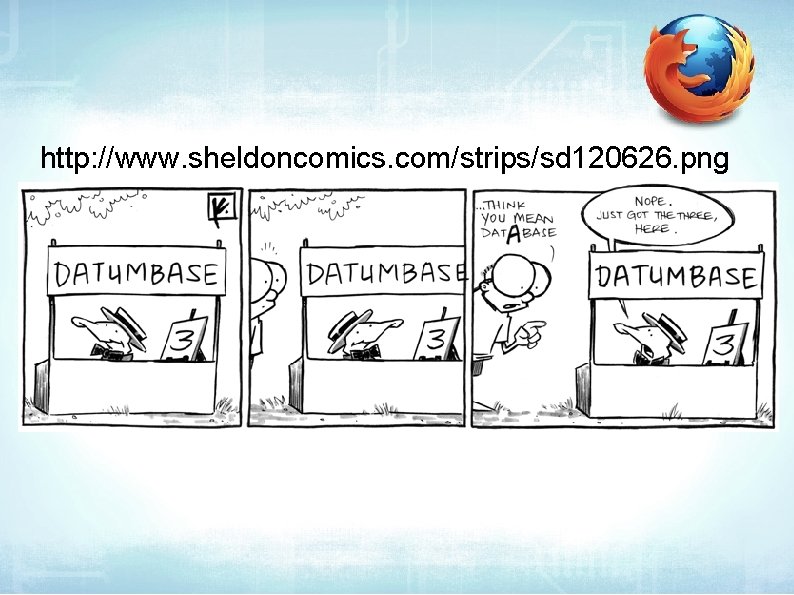
http: //www. sheldoncomics. com/strips/sd 120626. png
More Lingo Simple (last_name) Composite (last_name, first_name)

Data Structures B-TREE for Inno. DB, My. ISAM Can be HASH for MEMORY
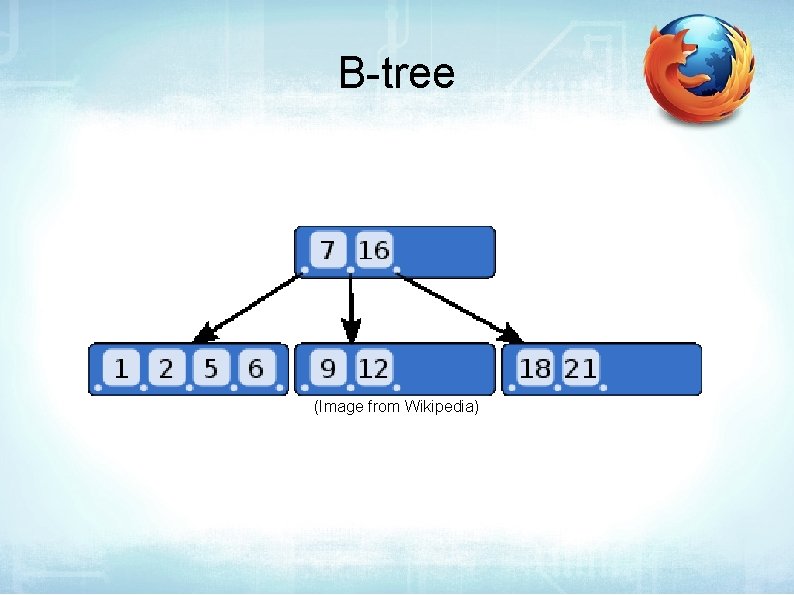
B-tree (Image from Wikipedia)
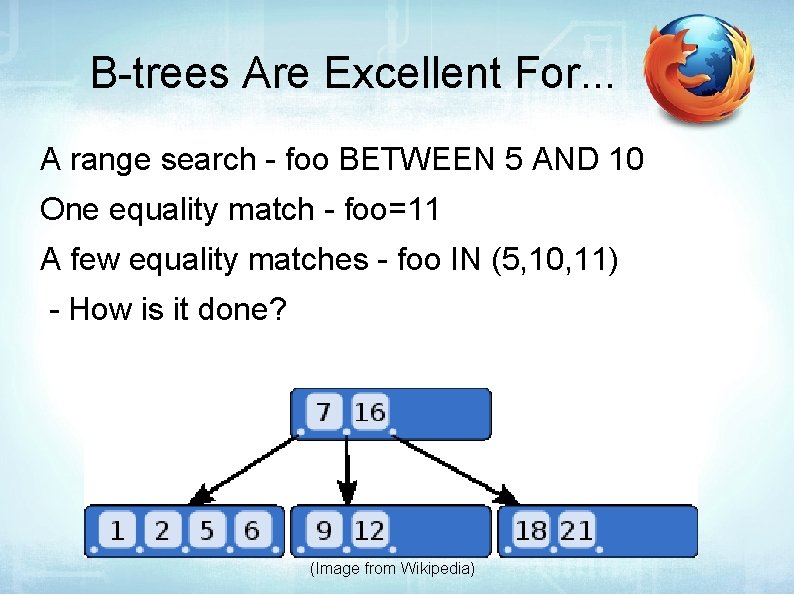
B-trees Are Excellent For. . . A range search - foo BETWEEN 5 AND 10 One equality match - foo=11 A few equality matches - foo IN (5, 10, 11) - How is it done? (Image from Wikipedia)
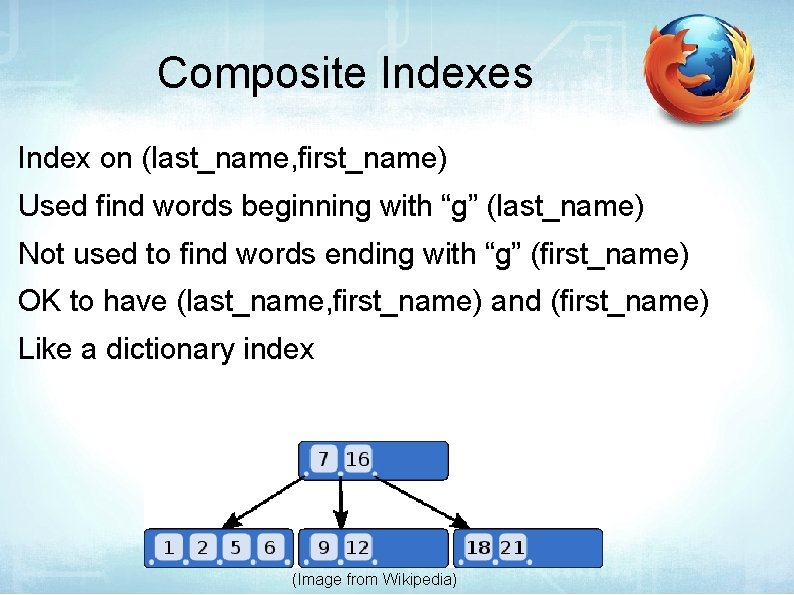
Composite Indexes Index on (last_name, first_name) Used find words beginning with “g” (last_name) Not used to find words ending with “g” (first_name) OK to have (last_name, first_name) and (first_name) Like a dictionary index (Image from Wikipedia)
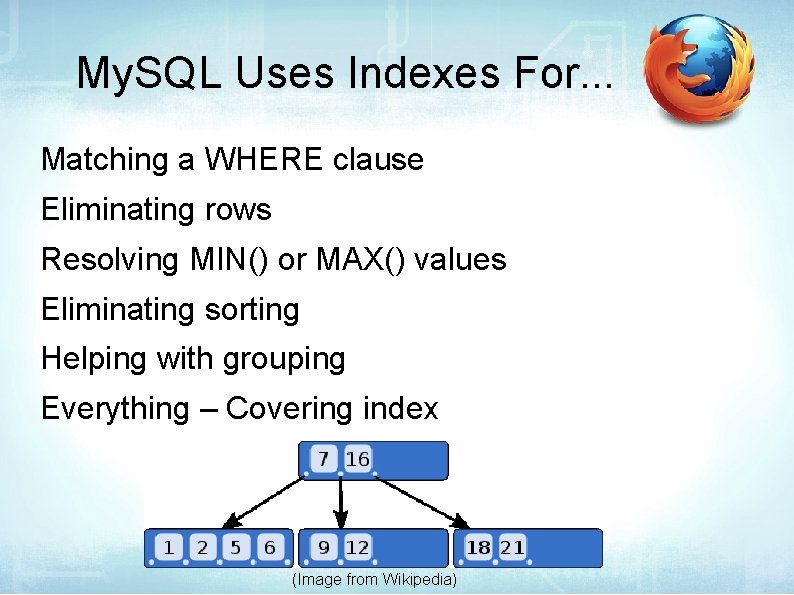
My. SQL Uses Indexes For. . . Matching a WHERE clause Eliminating rows Resolving MIN() or MAX() values Eliminating sorting Helping with grouping Everything – Covering index (Image from Wikipedia)
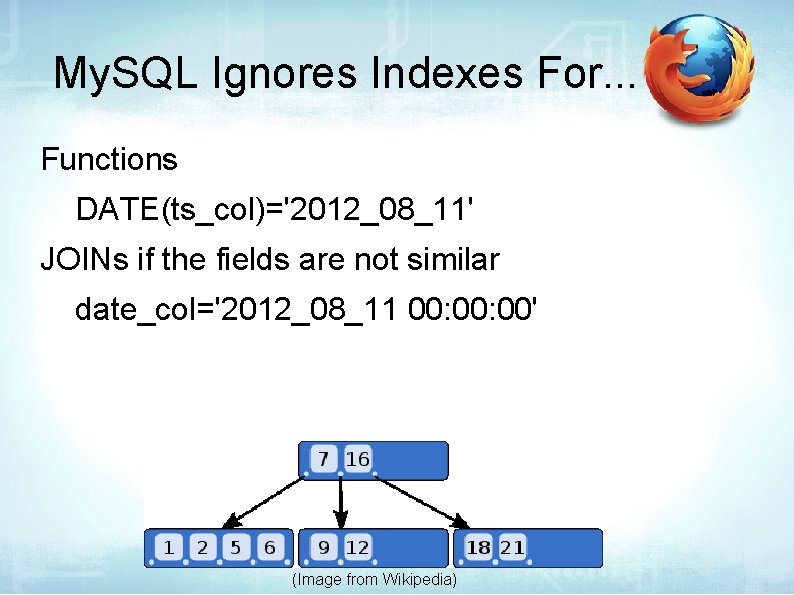
My. SQL Ignores Indexes For. . . Functions DATE(ts_col)='2012_08_11' JOINs if the fields are not similar date_col='2012_08_11 00: 00' (Image from Wikipedia)
My. SQL Ignores Indexes For. . . Queries with multiple WHERE clauses not all using the same index joined by OR For example, imagine a test table, with an index on (last_name, first_name)
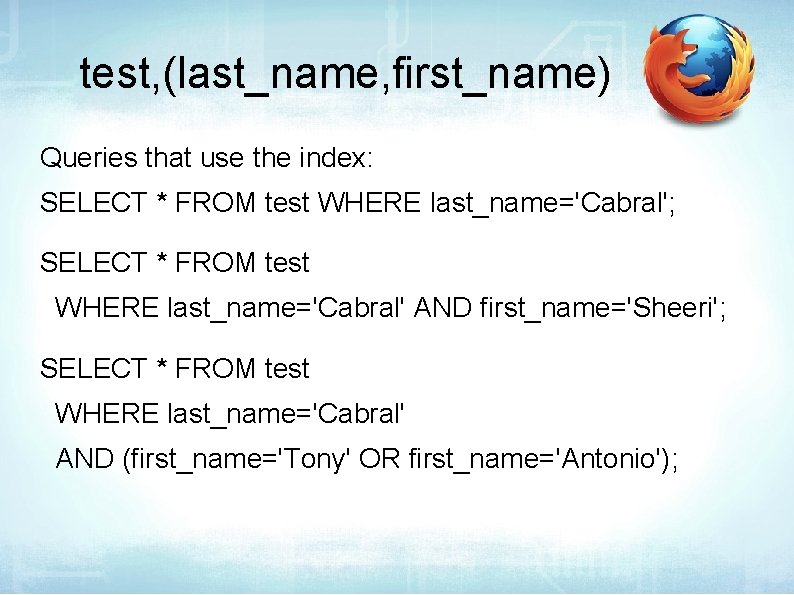
test, (last_name, first_name) Queries that use the index: SELECT * FROM test WHERE last_name='Cabral'; SELECT * FROM test WHERE last_name='Cabral' AND first_name='Sheeri'; SELECT * FROM test WHERE last_name='Cabral' AND (first_name='Tony' OR first_name='Antonio');
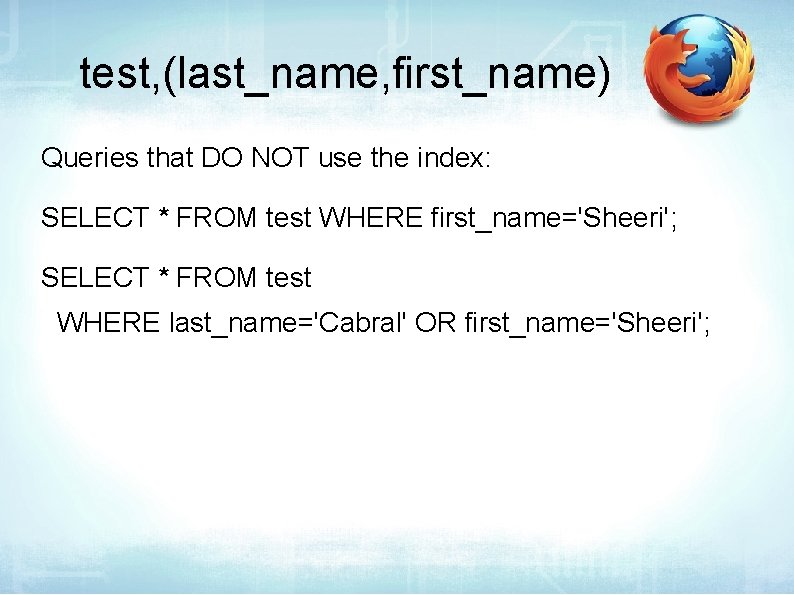
test, (last_name, first_name) Queries that DO NOT use the index: SELECT * FROM test WHERE first_name='Sheeri'; SELECT * FROM test WHERE last_name='Cabral' OR first_name='Sheeri';
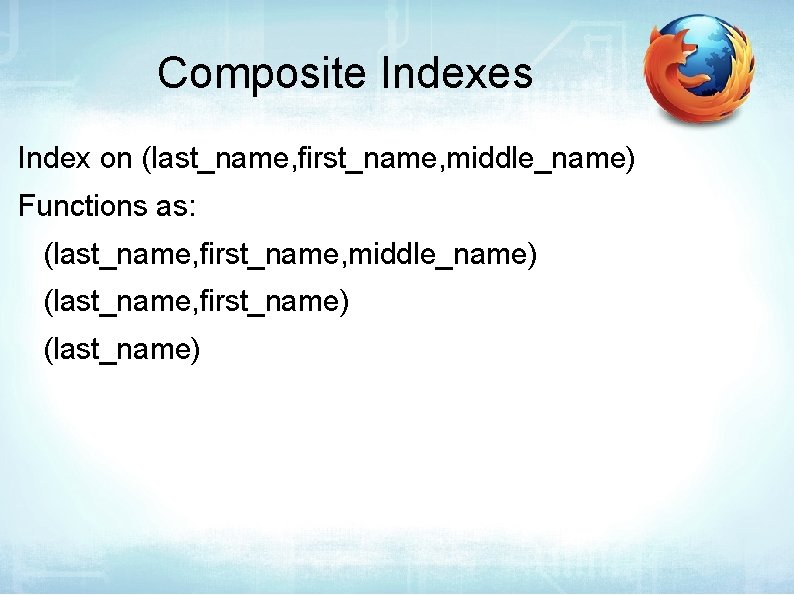
Composite Indexes Index on (last_name, first_name, middle_name) Functions as: (last_name, first_name, middle_name) (last_name, first_name) (last_name)
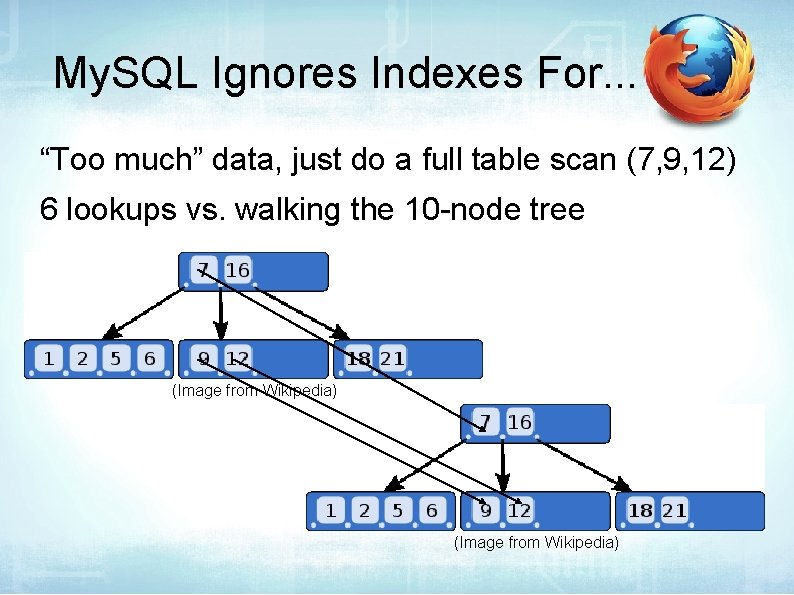
My. SQL Ignores Indexes For. . . “Too much” data, just do a full table scan (7, 9, 12) 6 lookups vs. walking the 10 -node tree (Image from Wikipedia)
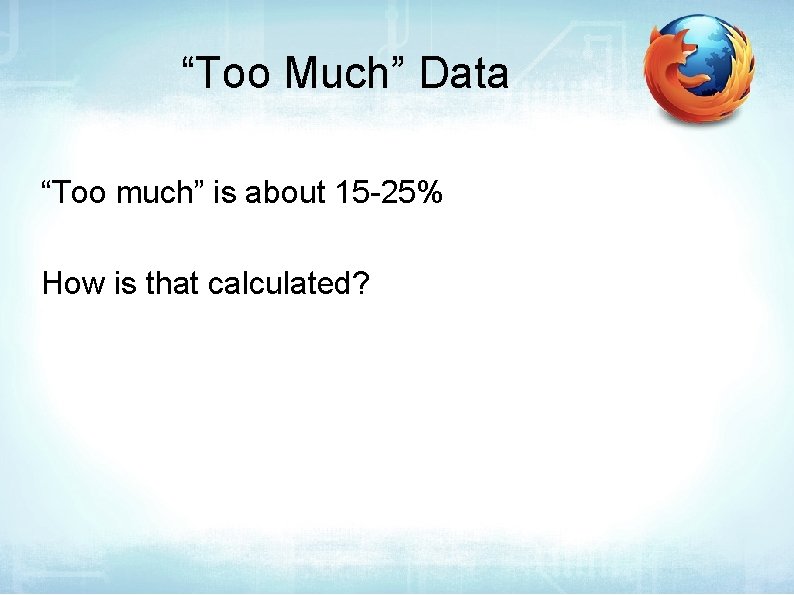
“Too Much” Data “Too much” is about 15 -25% How is that calculated?
Metadata! Exact in My. ISAM (writes are table-locking) Approximate in Inno. DB “value group” Average value group size Used for approx rows for rows read, joins
Average Value Group Size Body parts: 2 eyes, 10 fingers Average value group size = 6 Not perfect optimization for either eyes or fingers Estimate is longer than reality for eyes Estimate is shorter than reality for fingers Remember the “too much data” feature/problem
Composite Index Like a sorted array Can be ASC or DESC But not ASC, DESC or DESC, ASC (Image from Wikipedia)
NULL and Equality NULL = x is not true for ANY value of x NULL = NULL is not true If a referenced value in an equality is NULL My. SQL immediately returns false
NULL and Equality NULL-safe operator is <=> No NULL-safe inequality operator !(foo <=> bar) Remember the “too much data” feature/problem
NULL and Value Groups Options - innodb_stats_method, myisam_stats_method nulls_equal (default) nulls_unequal nulls_ignored
PRIMARY Keys Row identifiers Cannot be NULL Inno. DB orders on disk in PRIMARY KEY order
UNIQUE Keys Row identifiers Can be NULL Both PRIMARY/UNIQUE can be composite index
FOREIGN Keys Parent/child relationship e. g. payment->customer_id Cascading update/deletes
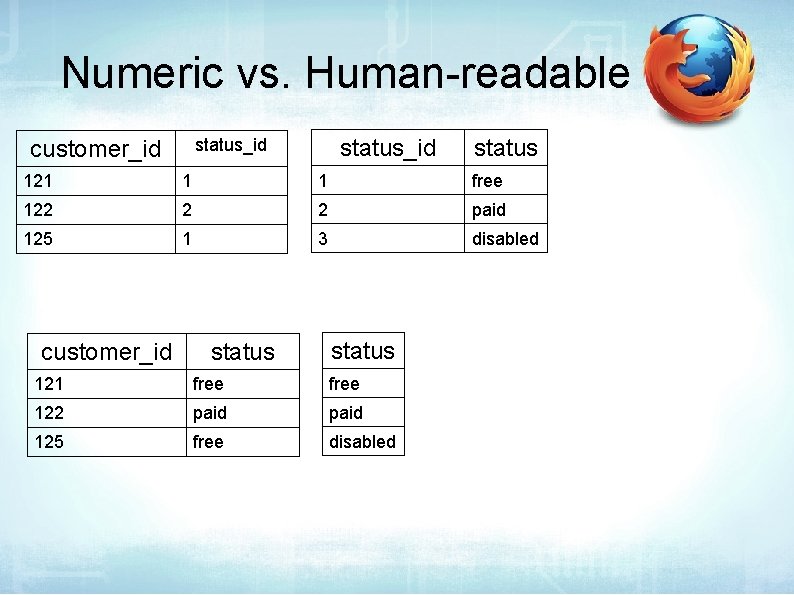
Numeric vs. Human-readable status_id customer_id status 121 1 1 free 122 2 2 paid 125 1 3 disabled customer_id status 121 free 122 paid 125 free disabled
Prefix Indexing For strings Up to 767 bytes on Inno. DB, 1000 on My. ISAM Beware of charset!
FULLTEXT Indexing No prefix indexing Only for CHAR, VARCHAR, TEXT My. ISAM only until My. SQL 5. 6
GROUP BY and Sorting By default, GROUP BY also sorts May cause 'filesort' in EXPLAIN ORDER BY NULL If you do not care about the return order
Knowing All This. . . Use EXPLAIN If you are not getting the index you expect Check your expectations Or file a bug: http: //bugs. mysql. com
How Do I Use EXPLAIN? http: //bit. ly/explainvideo http: //bit. ly/explainslides
index_merge On surface, looks good Use more than one index Better in My. SQL 5. 6
index_merge before 5. 6 Indicates you could make a better index Index merge not used when it should have been – e. g. if range scan was possible May have merged more indexes than necessary

Challenges http: //artfulsoftware. com /infotree/queries. php

Questions? Comments? Our. SQL Podcast www. oursql. com My. SQL Administrator's Bible - tinyurl. com/mysqlbible planet. mysql. com mysqlmarinate. com
- Slides: 36