
Better LMSSIS Integration with IMS Learning Information Services
Better LMS/SIS Integration with IMS Learning Information Services Michael Feldstein Oracle Corporation John A. Lewis Unicon, Inc.
Oracle Safe Harbor Statement The following is intended to outline our general product direction. It is intended for information purposes only, and may not be incorporated into any contract. It is not a commitment to deliver any material, code, or functionality, and should not be relied upon in making purchasing decisions. The development, release, and timing of any features or functionality described for Oracle’s products remains at the sole discretion of Oracle.
Agenda • • Introduction IMS Learning Information Services Campus Solutions Implementation Overview Sakai Implementation Overview
Introduction
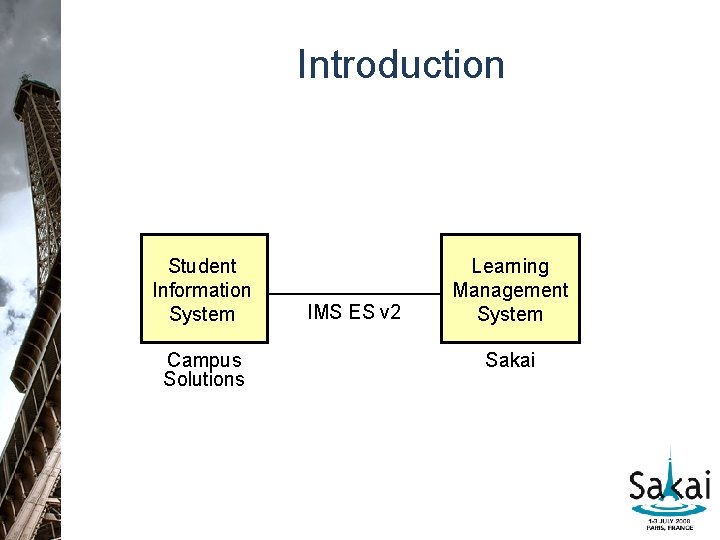
Introduction Student Information System Campus Solutions IMS ES v 2 Learning Management System Sakai
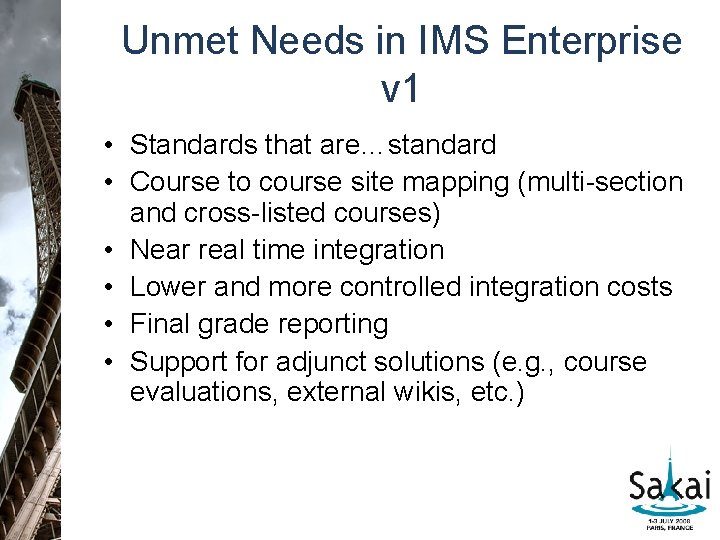
Unmet Needs in IMS Enterprise v 1 • Standards that are…standard • Course to course site mapping (multi-section and cross-listed courses) • Near real time integration • Lower and more controlled integration costs • Final grade reporting • Support for adjunct solutions (e. g. , course evaluations, external wikis, etc. )
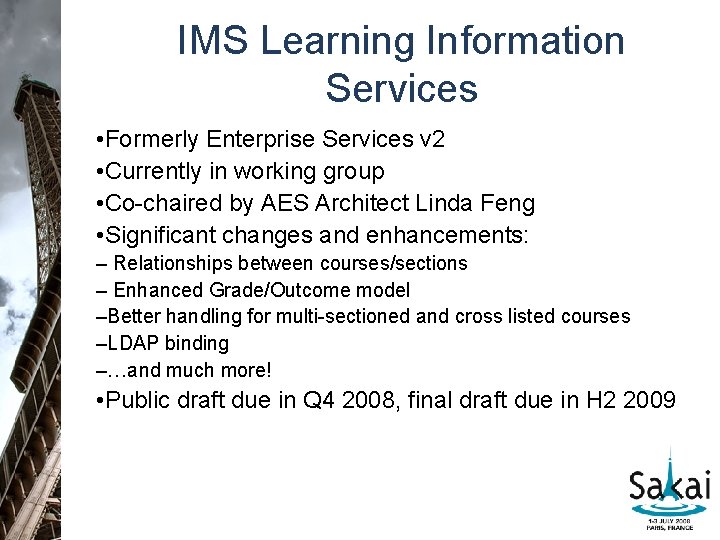
IMS Learning Information Services • Formerly Enterprise Services v 2 • Currently in working group • Co-chaired by AES Architect Linda Feng • Significant changes and enhancements: – Relationships between courses/sections – Enhanced Grade/Outcome model –Better handling for multi-sectioned and cross listed courses –LDAP binding –…and much more! • Public draft due in Q 4 2008, final draft due in H 2 2009
Cycle of Enrichment Community Institutions User Groups, etc.
Student Administration Integration Platform (SAIP) • First product in the Academic Enterprise Solutions product category • Platform for robust integration designed for lower cost of implementation and maintenance, greater ROI • Supported integration solution for the entire academic enterprise
SAIP v 1 • Focuses on Mission Critical Integration of SIS and LMS • Online Functionality for Easy, Flexible Default and Ad hoc Scoping of Courses and Course to Course Site Mapping • Web Services provide Flexible, Comprehensive Batch and Real Time Integration • Inbound Final Grades/Outcomes • LDAP Binding to Support Provisioning to Non. Services Based Solutions
Sakai Integration Status • Code is currently maintained at Unicon to better enable working with the Oracle product before release • Code will be put into the Sakai Contrib area after an implementing Student Information System (e. g. , Campus Solutions) is released
IMS Learning Information Services

IMS V 1 to V 2 comparison
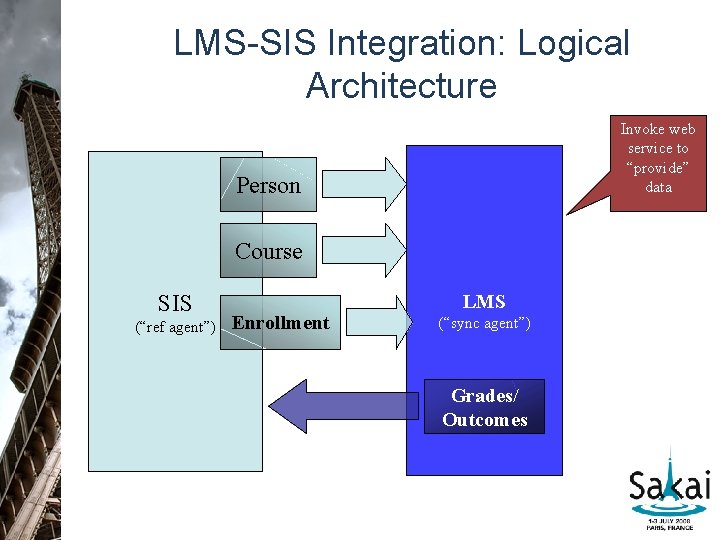
LMS-SIS Integration: Logical Architecture Invoke web service to “provide” data Person Course SIS (“ref agent”) Enrollment LMS (“sync agent”) Grades/ Outcomes
Outbound Integration • Full Synch Snapshot: initialization/ resynchronization capability • Incremental Snapshot: Scheduled process to capture effective dated changes and ensure no missed updates • Event Driven Update: near real time update driven by embedded event triggers – Can be turned off at the Installation level in SAIP’s case
Campus Solutions Implementation Overview
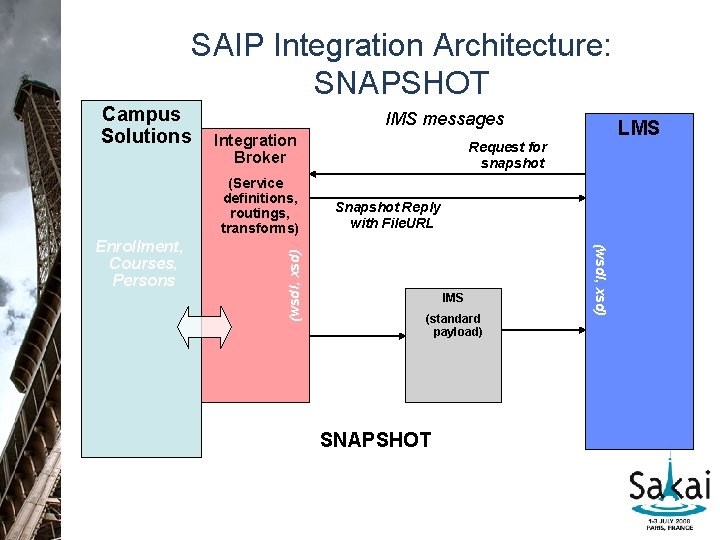
SAIP Integration Architecture: SNAPSHOT Campus Solutions IMS messages Integration Broker Request for snapshot Snapshot Reply with File. URL IMS (standard payload) SNAPSHOT (wsdl, xsd) Enrollment, Courses, Persons (wsdl, xsd) (Service definitions, routings, transforms) LMS
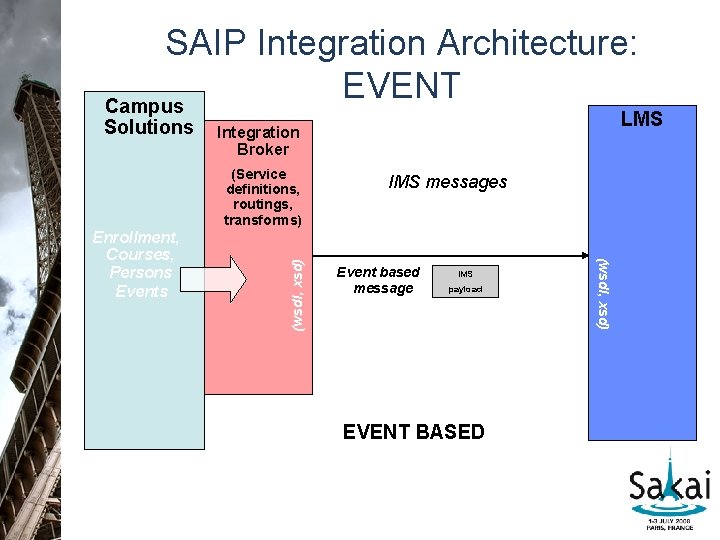
SAIP Integration Architecture: EVENT Campus Solutions IMS messages Event based message IMS payload EVENT BASED (wsdl, xsd) (Service definitions, routings, transforms) Enrollment, Courses, Persons Events LMS Integration Broker
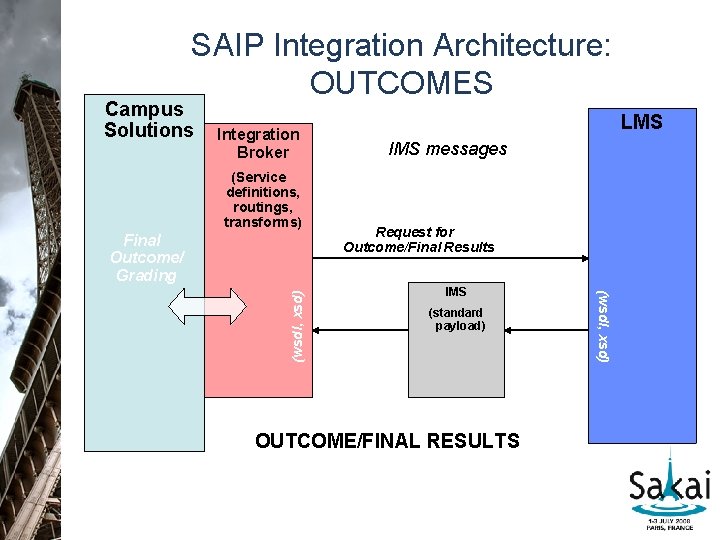
SAIP Integration Architecture: OUTCOMES Campus Solutions Integration Broker (Service definitions, routings, transforms) IMS messages Request for Outcome/Final Results IMS (standard payload) OUTCOME/FINAL RESULTS (wsdl, xsd) Final Outcome/ Grading LMS
Sakai Implementation Overview
Integration Points • Snapshot / Incremental support • Event support • Gradebook support
Sakai Technologies Used • Course Management (CM) API – CM API Hibernate Implementation • Messaging Service • Job Scheduler
Java Technologies Used • Spring Web Services • Java Messaging Service (JMS) / Active MQ • Quartz • Hibernate
Sakai Course Management API • CM API was introduced in Sakai 2. 3 • Sakai Tools and Services Supported – – – Worksite Creation (Site Metadata, Participants) Gradebook (Participant data, Course Metadata) Roster (Participant data) Section Info (Section data) Resources Tool (Course Start/End dates)
Course Management API Implementations • Sakai Course Management API is a series of Java Interfaces • An implementation of the Sakai Course Management API must be chosen • Default implementation that ships with Sakai is a Hibernate database storage implementation • Two general strategies for implement CM API – Directly query the SIS database – Import data into Sakai database
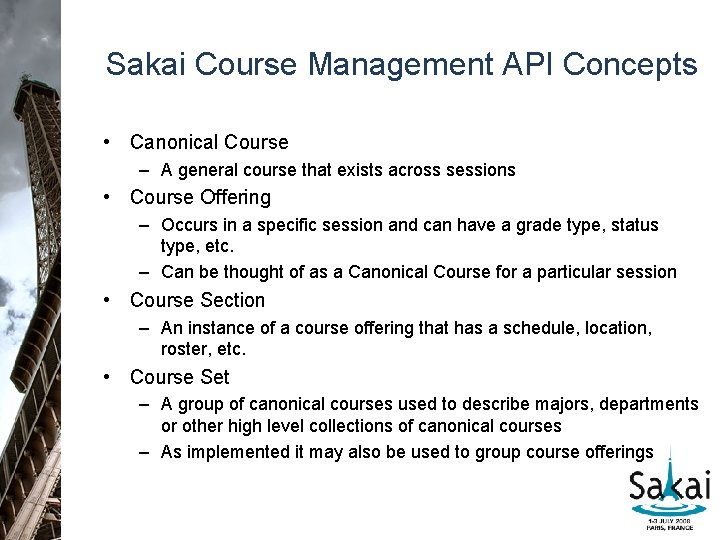
Sakai Course Management API Concepts • Canonical Course – A general course that exists across sessions • Course Offering – Occurs in a specific session and can have a grade type, status type, etc. – Can be thought of as a Canonical Course for a particular session • Course Section – An instance of a course offering that has a schedule, location, roster, etc. • Course Set – A group of canonical courses used to describe majors, departments or other high level collections of canonical courses – As implemented it may also be used to group course offerings
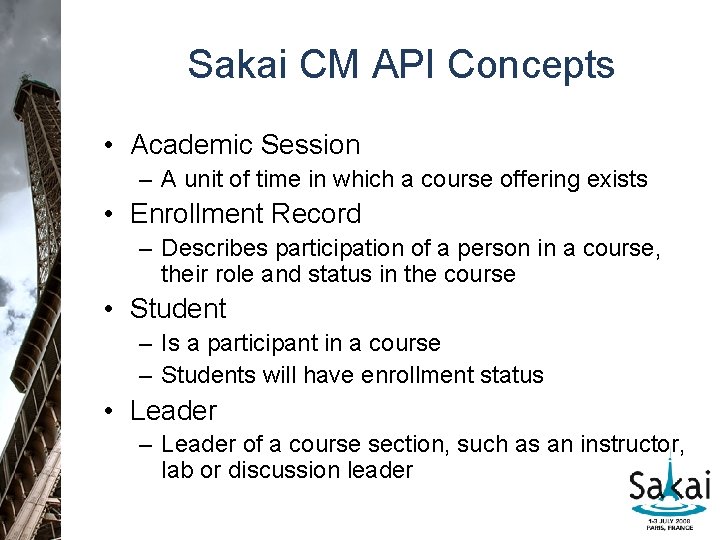
Sakai CM API Concepts • Academic Session – A unit of time in which a course offering exists • Enrollment Record – Describes participation of a person in a course, their role and status in the course • Student – Is a participant in a course – Students will have enrollment status • Leader – Leader of a course section, such as an instructor, lab or discussion leader
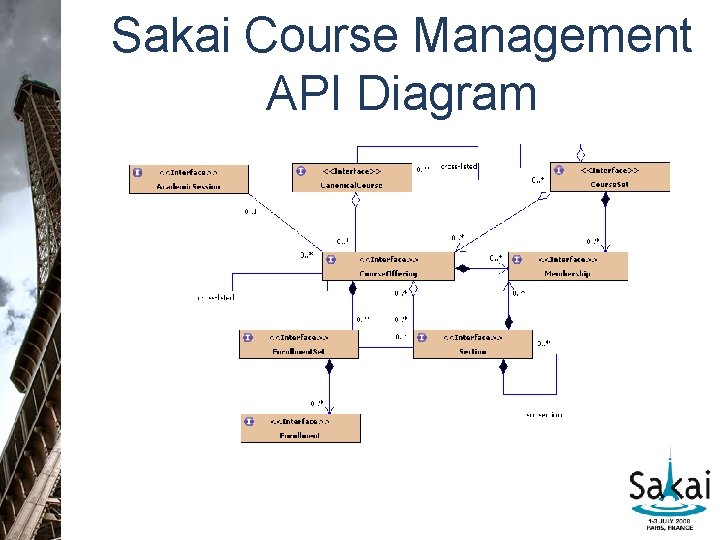
Sakai Course Management API Diagram
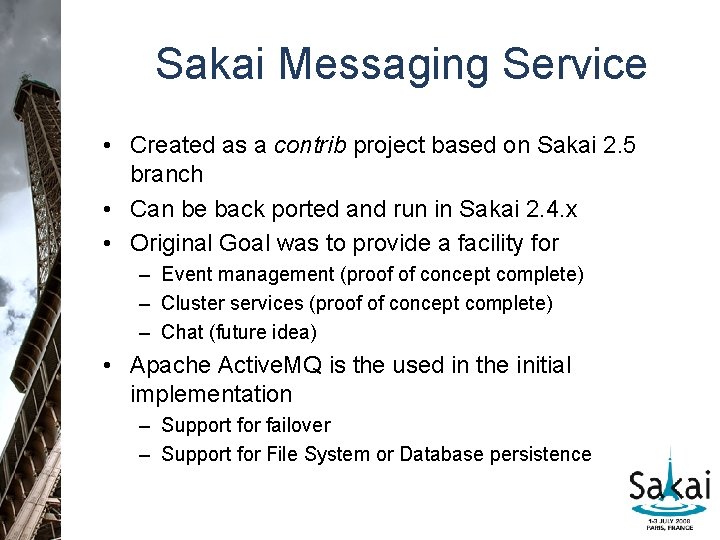
Sakai Messaging Service • Created as a contrib project based on Sakai 2. 5 branch • Can be back ported and run in Sakai 2. 4. x • Original Goal was to provide a facility for – Event management (proof of concept complete) – Cluster services (proof of concept complete) – Chat (future idea) • Apache Active. MQ is the used in the initial implementation – Support for failover – Support for File System or Database persistence
Sakai Job Scheduler • Graphical front-end to the management of a Quartz subsystem • Jobs can be run – now – immediately – future – with cron like triggers
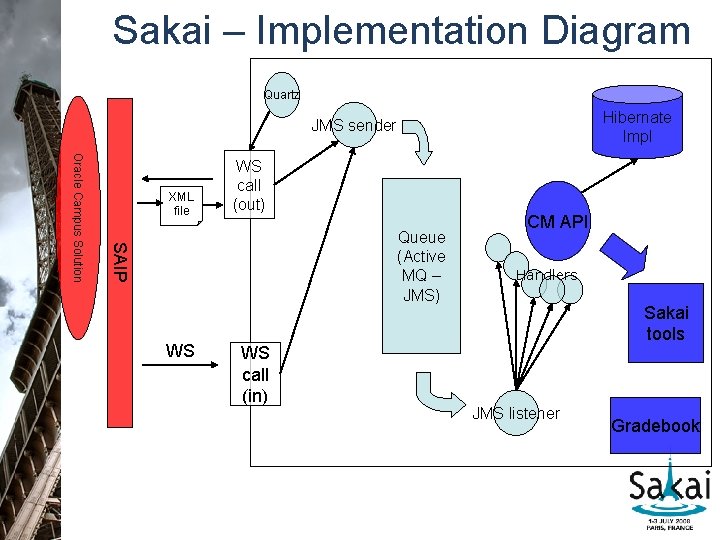
Sakai – Implementation Diagram Quartz Hibernate Impl JMS sender Queue (Active MQ – JMS) SAIP Oracle Campus Solution XML file WS call (out) WS WS call (in) CM API Handlers Sakai tools JMS listener Gradebook
Message Handlers • Handles one or more types of IMS ES messages • Calls Course Management Hibernate Implementation Service Methods • Opportunity to implement Institution specific business rules
Sakai Future Directions • Automated Worksite Provisioning from CM API data • Support for Section Association like data in the CM API • CM API data browser admin tool • Support for the CM API built into more Sakai tools • CM API support for enrollment status
More Information on Sakora • Description of Sakora project in Confluence http: //confluence. sakaiproject. org /confluence/display/IMSES/ • Sakora source code now in Contrib https: //source. sakaiproject. org /contrib/unicon/sakora/
Questions? Michael Feldstein michael. feldstein@oracle. com John A. Lewis jlewis@unicon. net
- Slides: 35