
Better English Pronunciation for Communication A Practical Course
Better English Pronunciation for Communication A Practical Course for Students of English By Dr. Joseph Domenech 1
Unit 2 English Consonants: Stops /p/ /b/ /t/ /d/ /k/ /g/ 2

English Consonants Place of articulation Bilabial Manner of articulation Plosive (清) (� ) Labio. Dental p b Fricative (清) (� ) Alveolar f v θ ð s z Velar Glotal k ɡ ʃ ʒ h ʧ ʤ m Lateral Approximant Palatal t d Affricate (清) (� ) Nasal Palatoalveolar ŋ n l w r Pronunciation Power demo j 3
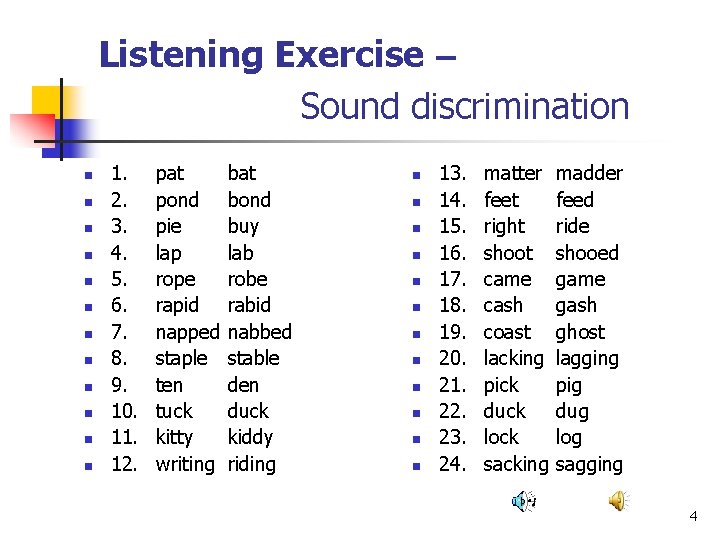
Listening Exercise – Sound discrimination n n n 1. 2. 3. 4. 5. 6. 7. 8. 9. 10. 11. 12. pat pond pie lap rope rapid napped staple ten tuck kitty writing bat bond buy lab robe rabid nabbed stable den duck kiddy riding n n n 13. 14. 15. 16. 17. 18. 19. 20. 21. 22. 23. 24. matter feet right shoot came cash coast lacking pick duck lock sacking madder feed ride shooed game gash ghost lagging pig dug log sagging 4
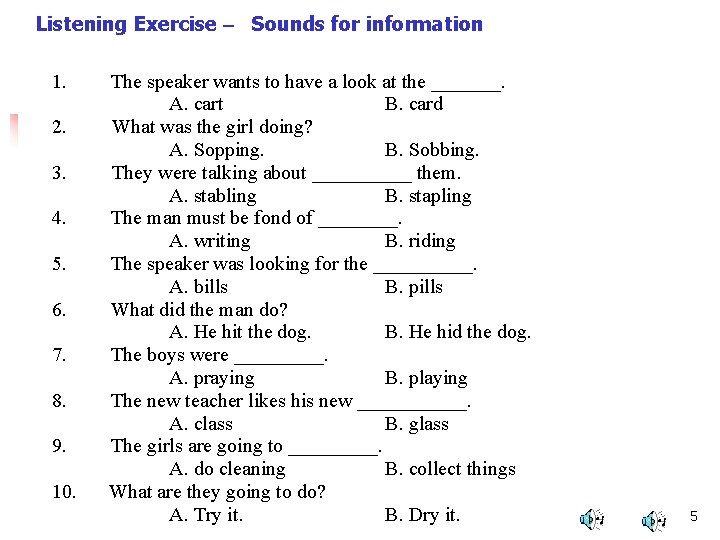
Listening Exercise – Sounds for information 1. The speaker wants to have a look at the _______. A. cart B. card 2. What was the girl doing? A. Sopping. B. Sobbing. 3. They were talking about _____ them. A. stabling B. stapling 4. The man must be fond of ____. A. writing B. riding 5. The speaker was looking for the _____. A. bills B. pills 6. What did the man do? A. He hit the dog. B. He hid the dog. 7. The boys were _____. A. praying B. playing 8. The new teacher likes his new ______. A. class B. glass 9. The girls are going to _____. A. do cleaning B. collect things 10. What are they going to do? A. Try it. B. Dry it. 5
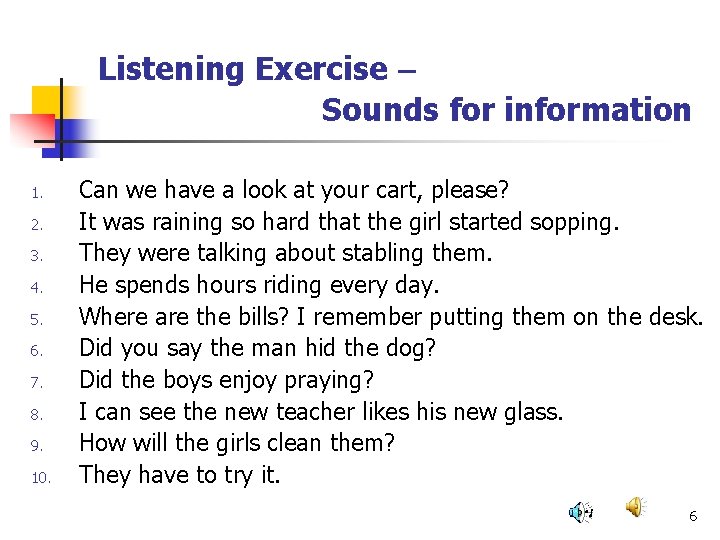
Listening Exercise – Sounds for information 1. 2. 3. 4. 5. 6. 7. 8. 9. 10. Can we have a look at your cart, please? It was raining so hard that the girl started sopping. They were talking about stabling them. He spends hours riding every day. Where are the bills? I remember putting them on the desk. Did you say the man hid the dog? Did the boys enjoy praying? I can see the new teacher likes his new glass. How will the girls clean them? They have to try it. 6
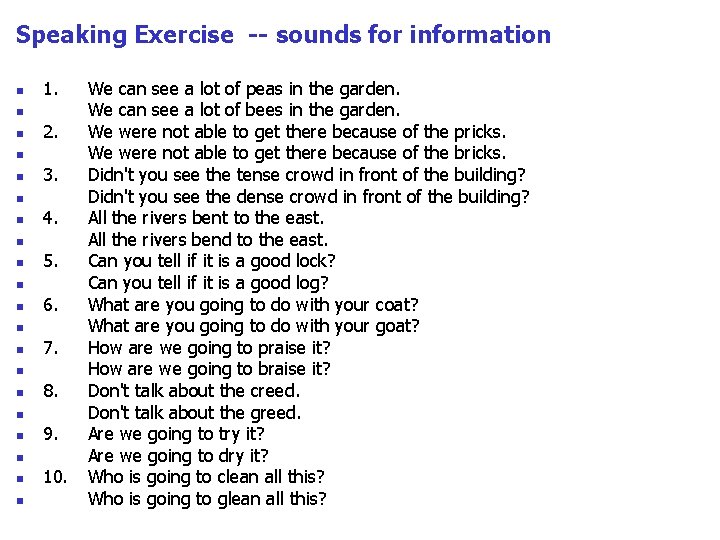
Speaking Exercise -- sounds for information n 1. n n 2. n n 3. n n 4. n n 5. n n 6. n n 7. n n 8. n n 9. n n n 10. We can see a lot of peas in the garden. We can see a lot of bees in the garden. We were not able to get there because of the pricks. We were not able to get there because of the bricks. Didn't you see the tense crowd in front of the building? Didn't you see the dense crowd in front of the building? All the rivers bent to the east. All the rivers bend to the east. Can you tell if it is a good lock? Can you tell if it is a good log? What are you going to do with your coat? What are you going to do with your goat? How are we going to praise it? How are we going to braise it? Don't talk about the creed. Don't talk about the greed. Are we going to try it? Are we going to dry it? Who is going to clean all this? Who is going to glean all this? 7
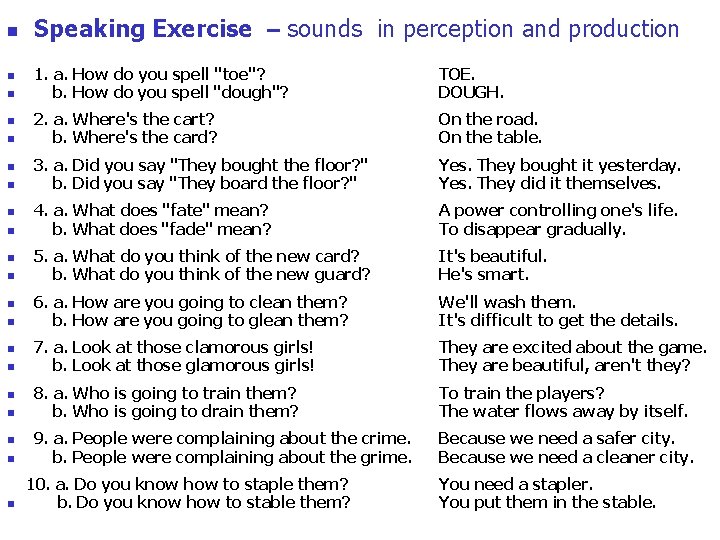
n n n n n Speaking Exercise – sounds in perception and production 1. a. How do you spell "toe"? b. How do you spell "dough"? TOE. DOUGH. 2. a. Where's the cart? b. Where's the card? On the road. On the table. 3. a. Did you say "They bought the floor? " b. Did you say "They board the floor? " Yes. They bought it yesterday. Yes. They did it themselves. 4. a. What does "fate" mean? b. What does "fade" mean? A power controlling one's life. To disappear gradually. 5. a. What do you think of the new card? b. What do you think of the new guard? It's beautiful. He's smart. 6. a. How are you going to clean them? b. How are you going to glean them? We'll wash them. It's difficult to get the details. 7. a. Look at those clamorous girls! b. Look at those glamorous girls! They are excited about the game. They are beautiful, aren't they? 8. a. Who is going to train them? b. Who is going to drain them? To train the players? The water flows away by itself. 9. a. People were complaining about the crime. b. People were complaining about the grime. Because we need a safer city. Because we need a cleaner city. 10. a. Do you know how to staple them? b. Do you know how to stable them? You need a stapler. You put them in the stable. 8
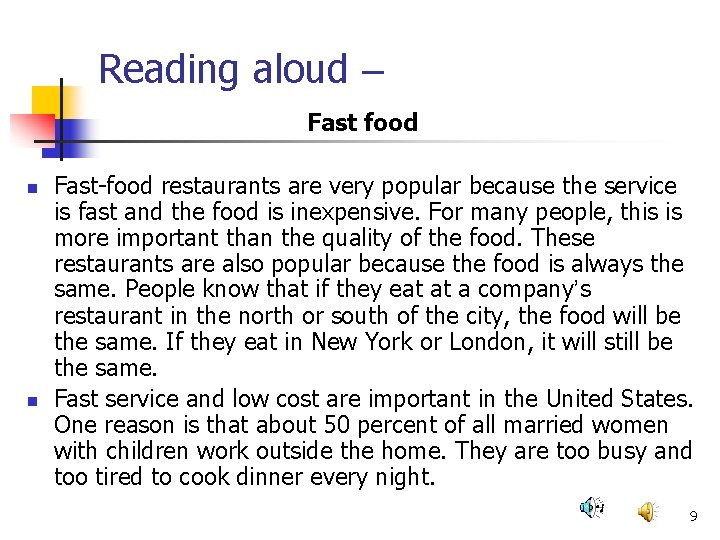
Reading aloud – Fast food n n Fast-food restaurants are very popular because the service is fast and the food is inexpensive. For many people, this is more important than the quality of the food. These restaurants are also popular because the food is always the same. People know that if they eat at a company’s restaurant in the north or south of the city, the food will be the same. If they eat in New York or London, it will still be the same. Fast service and low cost are important in the United States. One reason is that about 50 percent of all married women with children work outside the home. They are too busy and too tired to cook dinner every night. 9
Reading aloud – Identify words that are stressed first. Pay special attention to the pronunciation of stops. 1. 2. 3. 4. 5. 6. 7. 8. 9. 10. 11. 12. 13. 14. 15. Fast-food restaurants are very popular. The service is fast. The food is inexpensive. This is more important than the quality of the food. These restaurants are also popular. The food is always the same. They eat at a company’s restaurant. The restaurants are in the north or south of the city. The food will be the same. If they eat in New York or London, it will still be the same. Fast service is important in the United States. Low cost is also important in the United States. About 50 percent of married women work outside the home. Many married women with children are working outside the home. They are too busy and too tired to cook dinner every night. 10
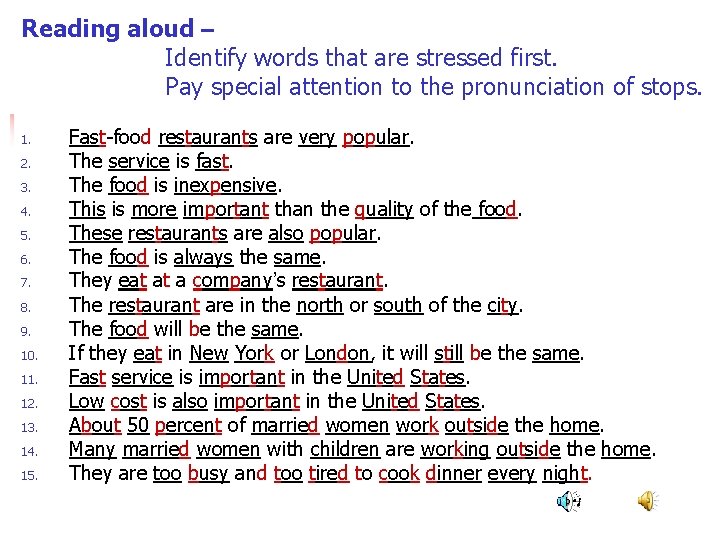
Reading aloud – Identify words that are stressed first. Pay special attention to the pronunciation of stops. 1. 2. 3. 4. 5. 6. 7. 8. 9. 10. 11. 12. 13. 14. 15. Fast-food restaurants are very popular. The service is fast. The food is inexpensive. This is more important than the quality of the food. These restaurants are also popular. The food is always the same. They eat at a company’s restaurant. The restaurant are in the north or south of the city. The food will be the same. If they eat in New York or London, it will still be the same. Fast service is important in the United States. Low cost is also important in the United States. About 50 percent of married women work outside the home. Many married women with children are working outside the home. They are too busy and too tired to cook dinner every night. 11
Listen & Imitate 12
Listen & Imitate n n n D: G: J: Hi, Gloria. How is it going? OK, I guess. Gloria, this is a friend of mine, John. Hi, Gloria. Glad to meet you. 13

Listen & Imitate 14
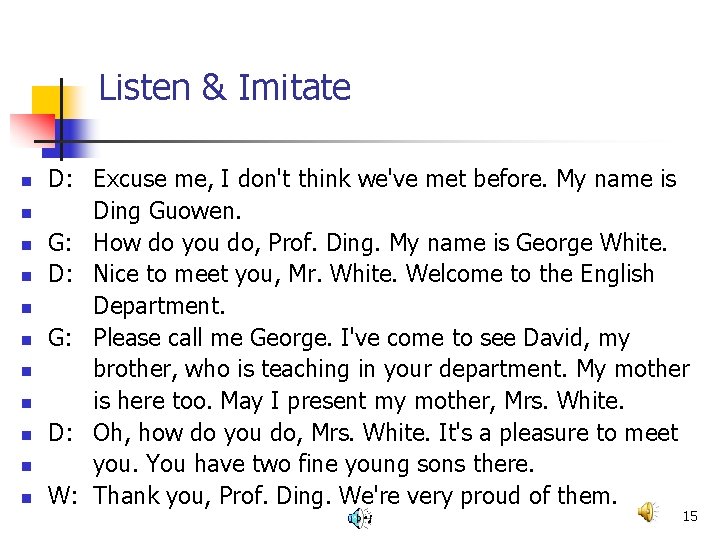
Listen & Imitate n n n D: Excuse me, I don't think we've met before. My name is Ding Guowen. G: How do you do, Prof. Ding. My name is George White. D: Nice to meet you, Mr. White. Welcome to the English Department. G: Please call me George. I've come to see David, my brother, who is teaching in your department. My mother is here too. May I present my mother, Mrs. White. D: Oh, how do you do, Mrs. White. It's a pleasure to meet you. You have two fine young sons there. W: Thank you, Prof. Ding. We're very proud of them. 15
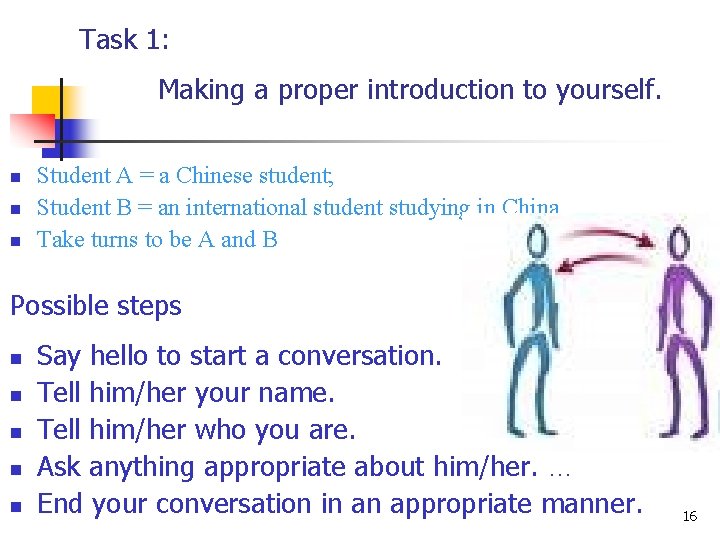
Task 1: Making a proper introduction to yourself. n n n Student A = a Chinese student; Student B = an international student studying in China Take turns to be A and B Possible steps n n n Say hello to start a conversation. Tell him/her your name. Tell him/her who you are. Ask anything appropriate about him/her. … End your conversation in an appropriate manner. 16
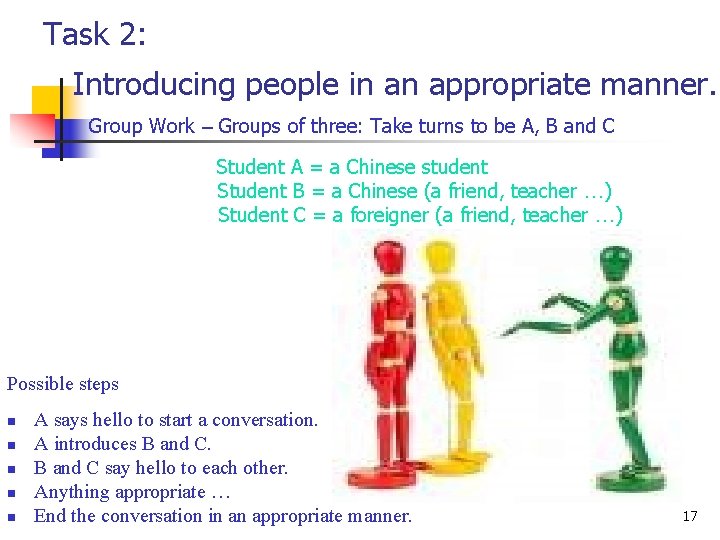
Task 2: Introducing people in an appropriate manner. Group Work – Groups of three: Take turns to be A, B and C Student A = a Chinese student Student B = a Chinese (a friend, teacher …) Student C = a foreigner (a friend, teacher …) Possible steps n n n A says hello to start a conversation. A introduces B and C say hello to each other. Anything appropriate … End the conversation in an appropriate manner. 17
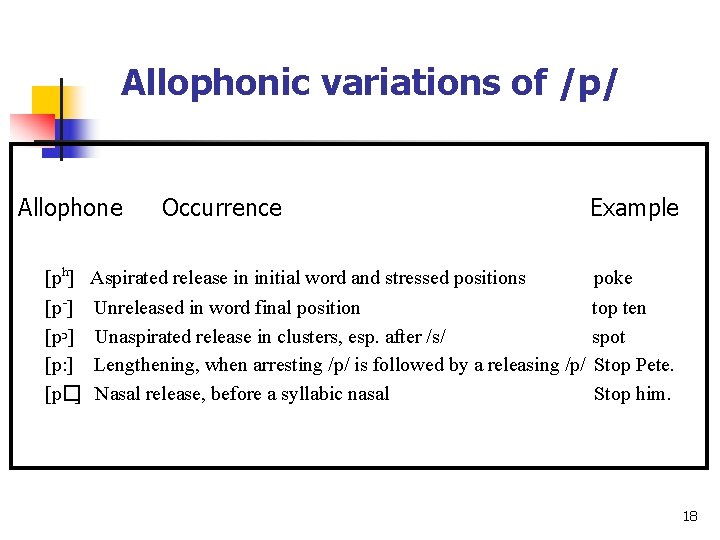
Allophonic variations of /p/ Allophone [ph] [p-] [pɔ] [p: ] ~ [p� ] Occurrence Aspirated release in initial word and stressed positions Unreleased in word final position Unaspirated release in clusters, esp. after /s/ Lengthening, when arresting /p/ is followed by a releasing /p/ Nasal release, before a syllabic nasal Example poke top ten spot Stop Pete. Stop him. 18
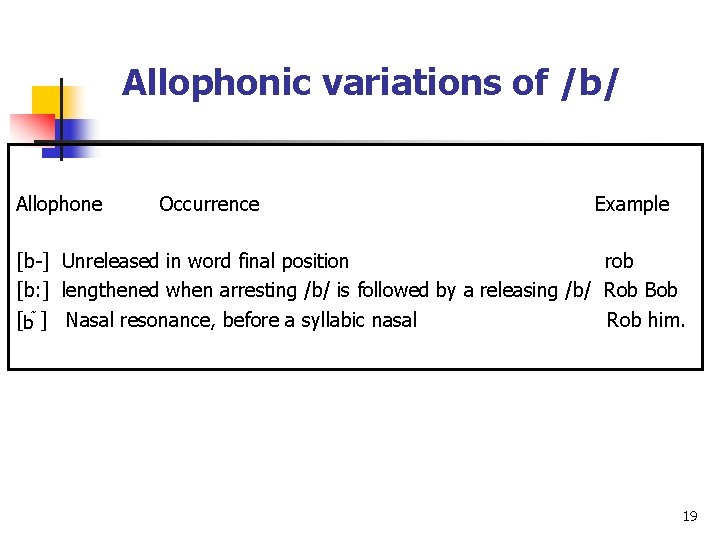
Allophonic variations of /b/ Allophone Occurrence Example [b-] Unreleased in word final position rob [b: ] lengthened when arresting /b/ is followed by a releasing /b/ Rob Bob [b ] Nasal resonance, before a syllabic nasal Rob him. 19
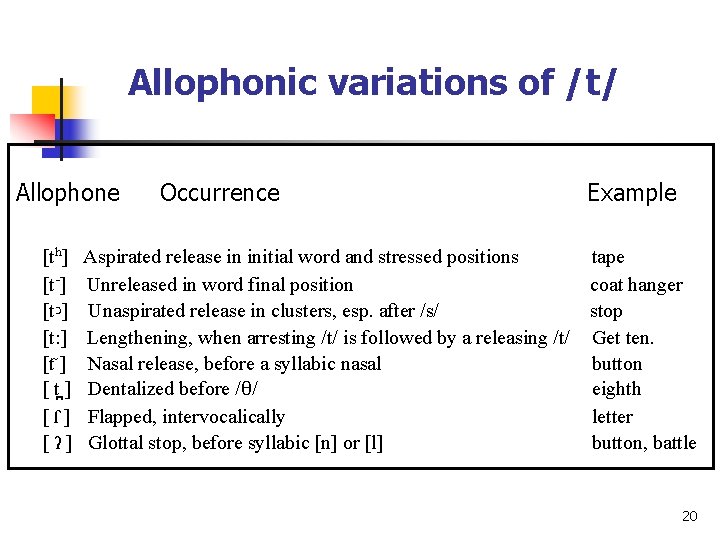
Allophonic variations of /t/ Allophone [th] [t-] [tɔ] [t: ] [t ] [ſ] [ʔ] Occurrence Example Aspirated release in initial word and stressed positions tape Unreleased in word final position coat hanger Unaspirated release in clusters, esp. after /s/ stop Lengthening, when arresting /t/ is followed by a releasing /t/ Get ten. Nasal release, before a syllabic nasal button Dentalized before /θ/ eighth Flapped, intervocalically letter Glottal stop, before syllabic [n] or [l] button, battle 20
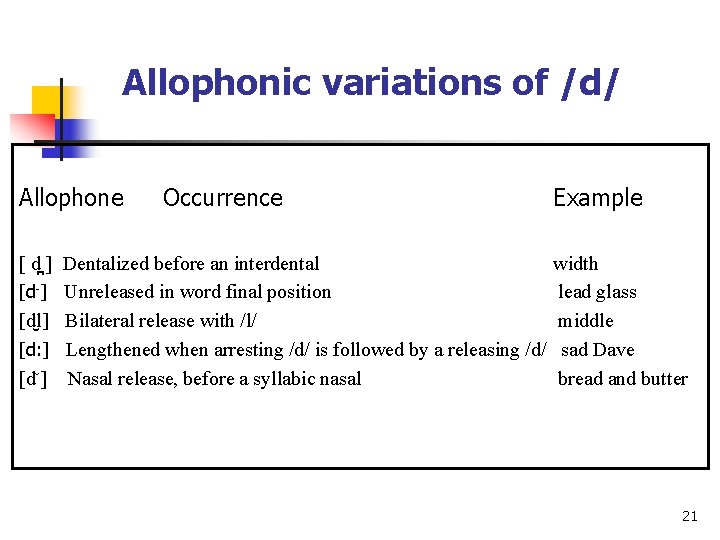
Allophonic variations of /d/ Allophone Occurrence [ d ] Dentalized before an interdental [d-] Unreleased in word final position [d l] Bilateral release with /l/ [d: ] Lengthened when arresting /d/ is followed by a releasing /d/ [d ] Nasal release, before a syllabic nasal Example width lead glass middle sad Dave bread and butter 21
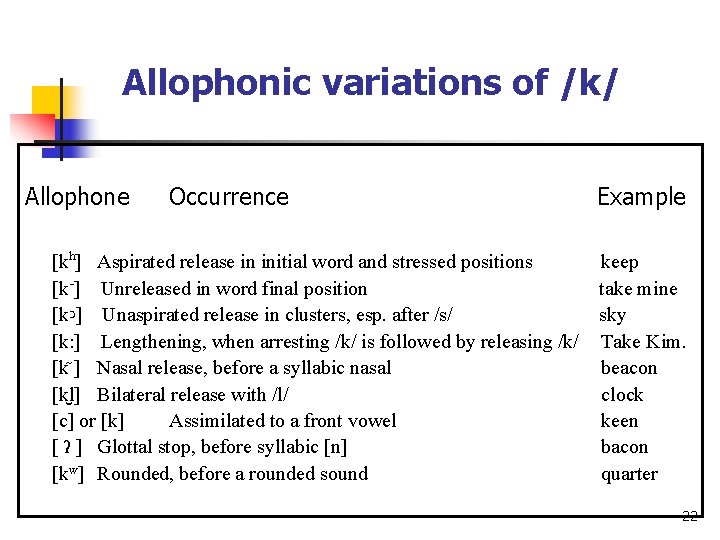
Allophonic variations of /k/ Allophone Occurrence [kh] Aspirated release in initial word and stressed positions [k-] Unreleased in word final position [kɔ] Unaspirated release in clusters, esp. after /s/ [k: ] Lengthening, when arresting /k/ is followed by releasing /k/ [k ] Nasal release, before a syllabic nasal [k l] Bilateral release with /l/ [c] or [k] Assimilated to a front vowel [ ʔ ] Glottal stop, before syllabic [n] [kw] Rounded, before a rounded sound Example keep take mine sky Take Kim. beacon clock keen bacon quarter 22
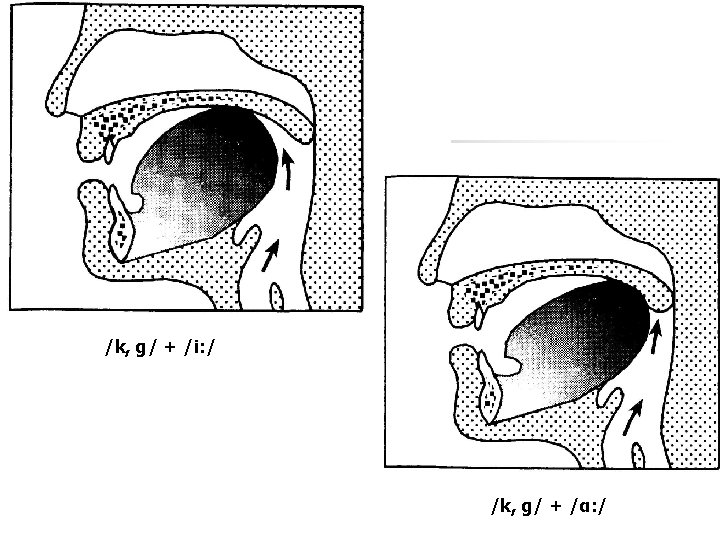
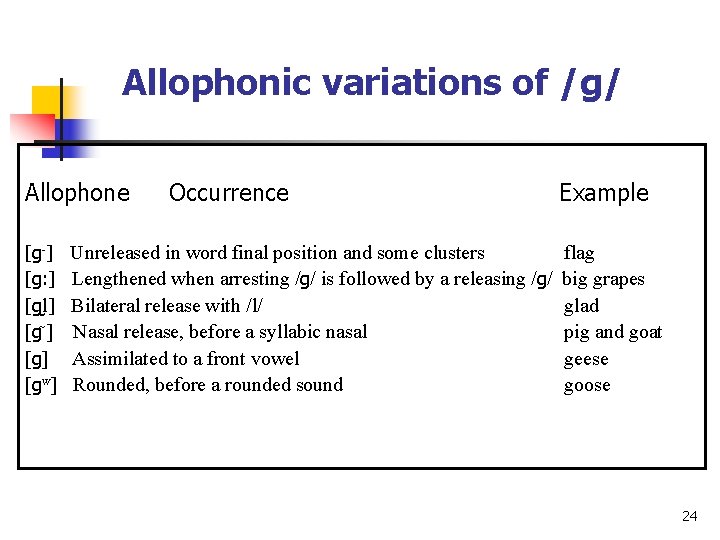
Allophonic variations of /g/ Allophone [g-] [g: ] [g l] [g ] [gw] Occurrence Unreleased in word final position and some clusters Lengthened when arresting /g/ is followed by a releasing /g/ Bilateral release with /l/ Nasal release, before a syllabic nasal Assimilated to a front vowel Rounded, before a rounded sound Example flag big grapes glad pig and goat geese goose 24
THE END 25!
- Slides: 25