
Beta and Gamma Decay Series I can complete
Beta and Gamma Decay Series
• I can complete beta and gamma decay problems and describe a decay series.
What happens in BETA DECAY? • During BETA DECAY: – A NEUTRON splits to form a PROTON and an ELECTRON. – The PROTON is added to the NUCLEUS. – The ELECTRON is lost as a BETA PARTICLE.
How does Beta Decay change the nucleus? • What really happened? – 1 – Lost a NEUTRON – decreases Atomic Mass Number by 1. – 2. – Gained a PROTON, increases BOTH the Atomic Mass Number and the Atomic Number by 1. – NET CHANGE – ATOMIC MASS NUMBER stays the same, AN increases by 1…. the atom is transmuted into an isotope of the next higher element.
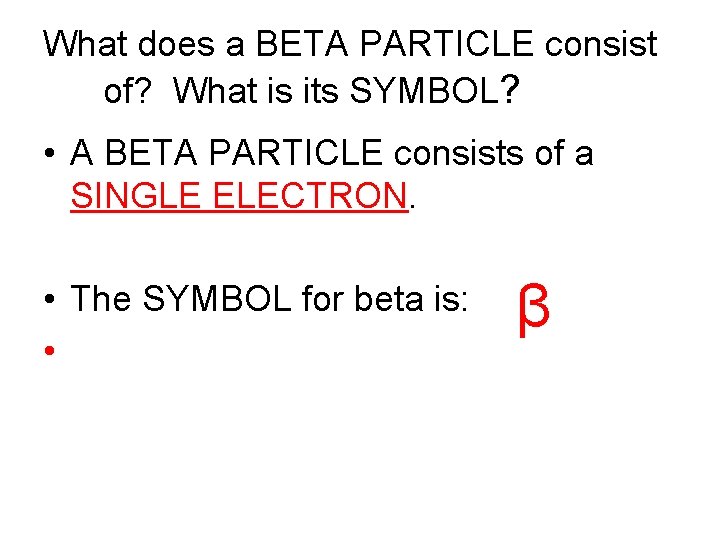
What does a BETA PARTICLE consist of? What is its SYMBOL? • A BETA PARTICLE consists of a SINGLE ELECTRON. • The SYMBOL for beta is: • β
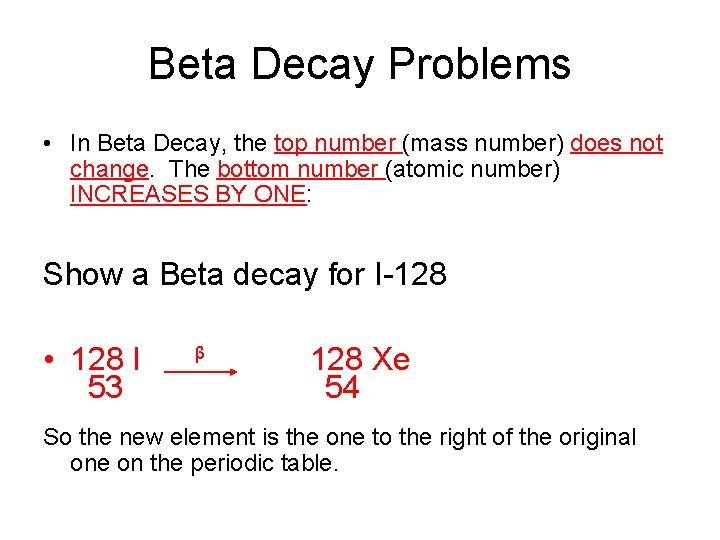
Beta Decay Problems • In Beta Decay, the top number (mass number) does not change. The bottom number (atomic number) INCREASES BY ONE: Show a Beta decay for I-128 • 128 I 53 β 128 Xe 54 So the new element is the one to the right of the original one on the periodic table.
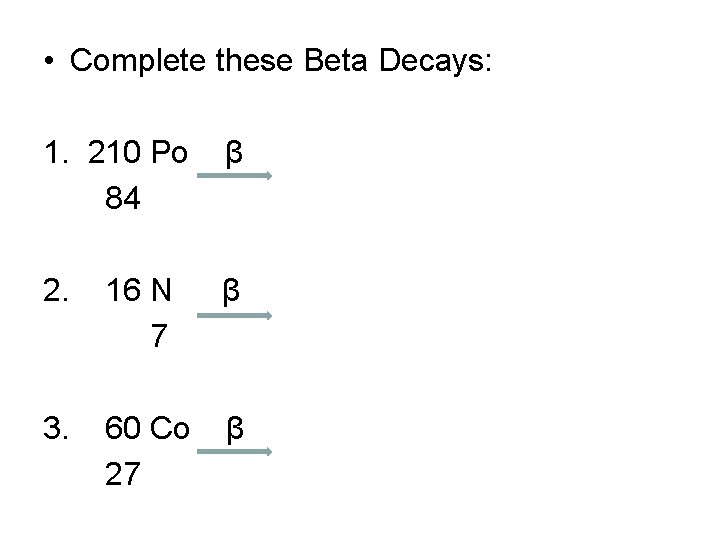
• Complete these Beta Decays: 1. 210 Po 84 β 2. 16 N 7 β 3. 60 Co 27 β
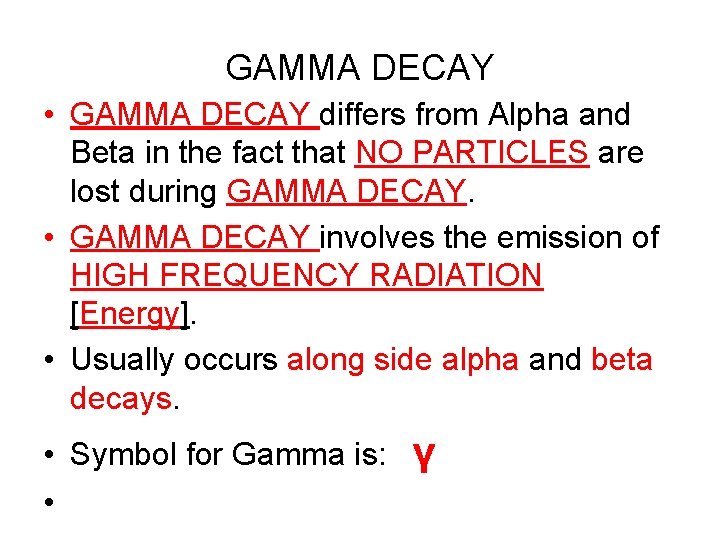
GAMMA DECAY • GAMMA DECAY differs from Alpha and Beta in the fact that NO PARTICLES are lost during GAMMA DECAY. • GAMMA DECAY involves the emission of HIGH FREQUENCY RADIATION [Energy]. • Usually occurs along side alpha and beta decays. • Symbol for Gamma is: • γ
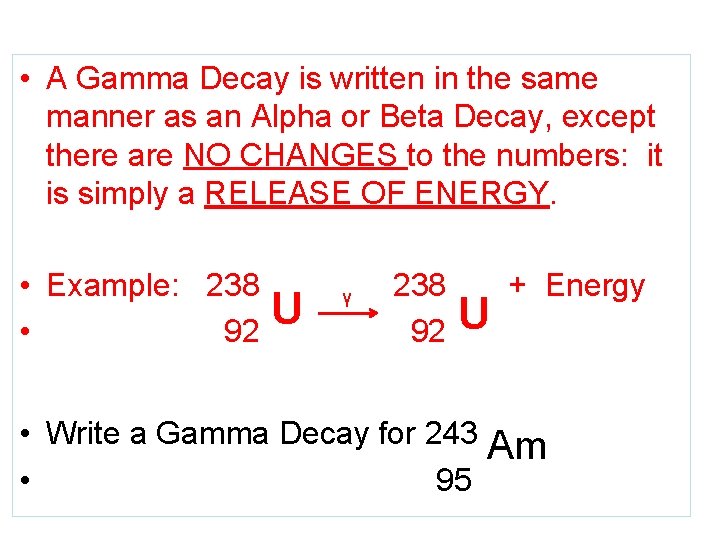
• A Gamma Decay is written in the same manner as an Alpha or Beta Decay, except there are NO CHANGES to the numbers: it is simply a RELEASE OF ENERGY. • Example: 238 • 92 U γ 238 92 U + Energy • Write a Gamma Decay for 243 Am • 95
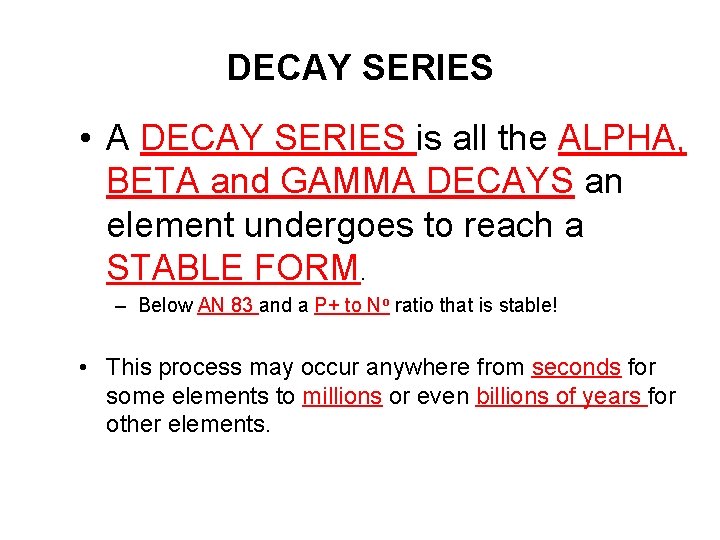
DECAY SERIES • A DECAY SERIES is all the ALPHA, BETA and GAMMA DECAYS an element undergoes to reach a STABLE FORM. – Below AN 83 and a P+ to No ratio that is stable! • This process may occur anywhere from seconds for some elements to millions or even billions of years for other elements.
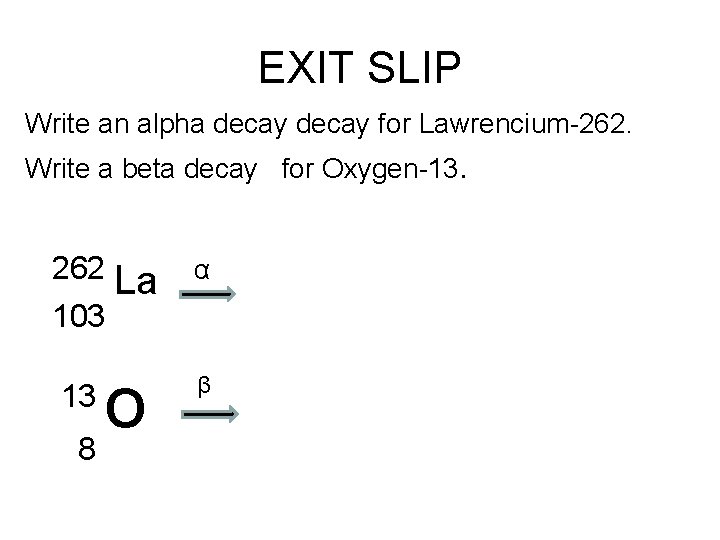
EXIT SLIP Write an alpha decay for Lawrencium-262. Write a beta decay for Oxygen-13. 262 La 103 13 8 O α β
- Slides: 11