
BET Module 1 Understanding the Links between Ecosystem
BET Module 1 Understanding the Links between Ecosystem Services and Business 24 th October 2012 Santiago, Chile Prepared for: Consejo Minero de Chile A. G. and Antofagasta Minerals S. A. By James Spurgeon, Sustain Value james. spurgeon@sustainvalue. co. uk www. sustainvalue. co. uk
Business Ecosystems Training – Contributors All content is based on WBCSD material and publically available reports. BET curriculum and structure was designed by for , adapted here by and The structure and content development of BET was governed by an Advisory Committee consisting of WBCSD member companies and Regional Network partners, NGOs, UN and academic institutions. 2
Session 1 Introduction and sustainable development
Module 1 objectives By the end of the module, delegates should be able to: Ë Understand the key terms and concepts around biodiversity, ecosystems, ecosystem services, environment and sustainability. Ë Be aware of the main drivers of ecosystem change Ë Understand the business case for companies to better manage biodiversity and ecosystems 4
Introduction to Sustainable Development Brundtland definition, from Our Common Future (WCED 1987) “Sustainable development is development that meets the needs of the present without compromising the ability of future generations to meet their own needs. ” Corporate sustainability “Managing resources to ensure that a business can survive and maintains conditions under which it can produce goods and services and exist in harmony with nature. It is therefore important to ensure that a business has knowledge of its dependencies on both ecology and society. ” Millennium Development Goals Eradicate Extreme Poverty and Hunger; Achieve Universal Primary Education; Promote Gender Equality and Empower Women; Reduce Child Mortality; Improve Maternal Health; Combat HIV/AIDS, Malaria and Other Diseases; Ensure Environmental Sustainability; and Develop a Global Partnership for Development. Sources: http: //www. un-documents. net/ocf-02. htm#I http: //www. un. org/millenniumgoals/bkgd. shtml 5
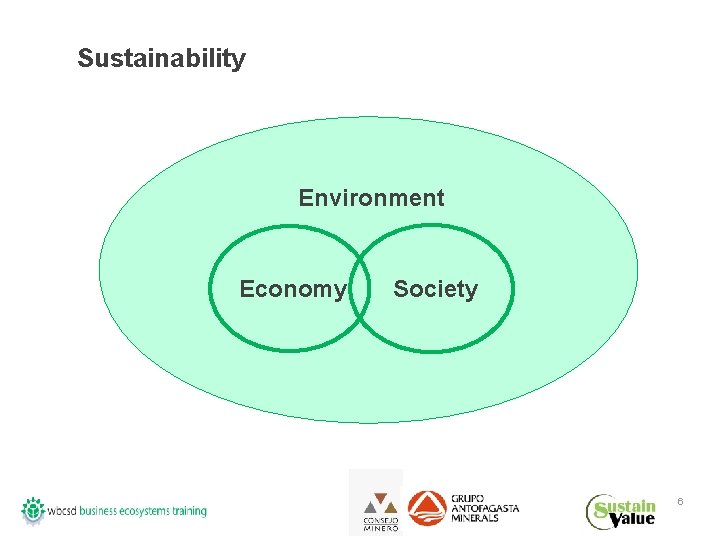
Sustainability Environment Economy Society 6
How are companies addressing this issue? Holcim: “Our commitment is to continuously improve our environmental performance and provide positive contributions to our business and to Source: http: //www. holcim. com/fileadmin/templates/CORP/doc/SD/env. Policywebversion. pdf society. ” Anglo American “Placing sustainability at the heart of our business is not only the right thing Source: to do, http: //www. angloamerican. com/media/releases/2011 pr/angloamerican_ftse 4 good but also delivers clear benefits to all our stakeholders” Kimberly-Clark: “ 25 percent reduction in manufacturing water use by 2015” Source: http: //www. cms. kimberly-clark. com/Umbraco. Images/Umbraco. File. Media/2010 Sustainability. Report_umbraco. File. pdf Unilever: Source: http: //www. unilever. com/sustainability/environment/agriculture/index. aspx “By 2020 we will source 100% of our agricultural raw materials sustainably. ” 7
Session 2 Biodiversity, Ecosystems and Ecosystem Services – the basics
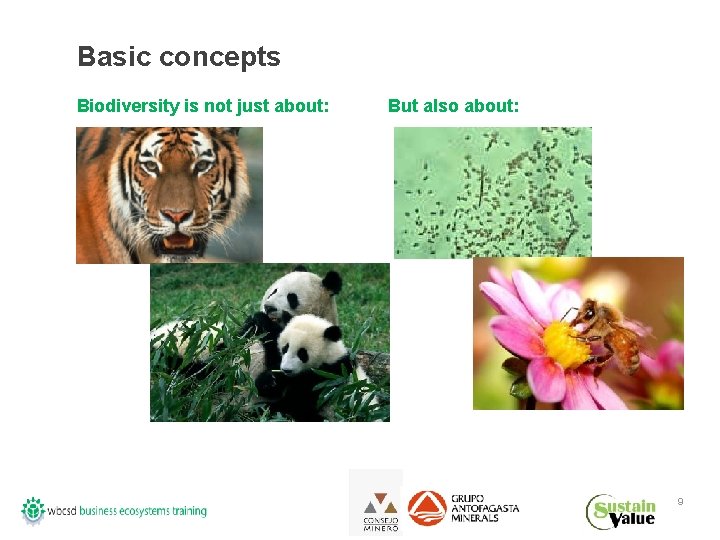
Basic concepts Biodiversity is not just about: But also about: 9
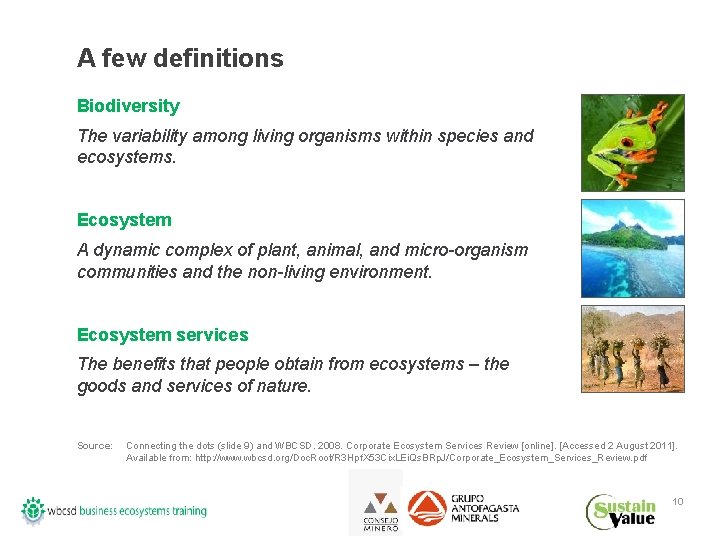
A few definitions Biodiversity The variability among living organisms within species and ecosystems. Ecosystem A dynamic complex of plant, animal, and micro-organism communities and the non-living environment. Ecosystem services The benefits that people obtain from ecosystems – the goods and services of nature. Source: Connecting the dots (slide 9) and WBCSD. 2008. Corporate Ecosystem Services Review [online]. [Accessed 2 August 2011]. Available from: http: //www. wbcsd. org/Doc. Root/R 3 Hpf. X 53 Cix. LEi. Qs. BRp. J/Corporate_Ecosystem_Services_Review. pdf 10
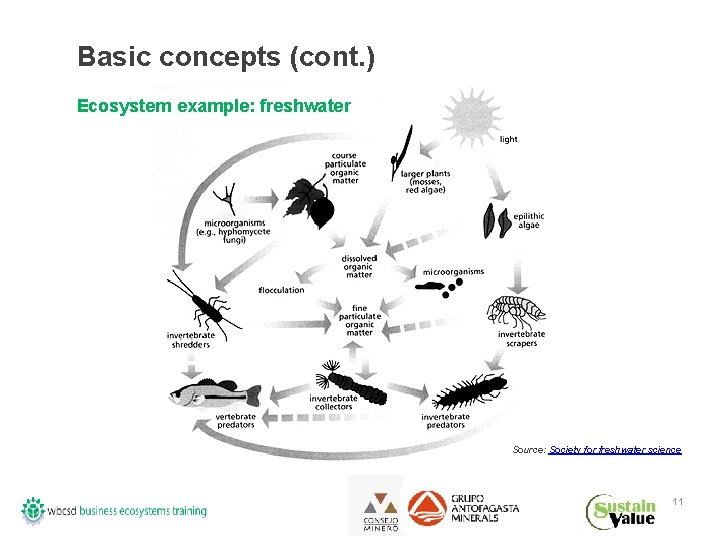
Basic concepts (cont. ) Ecosystem example: freshwater Source: Society for freshwater science 11
Concepts Ë Ecosystem Dependency: “Environmental conditions required for successful corporate performance”, e. g. the agricultural industry is dependent on plant pollinator species such as bees. Ë Ecosystem Impact: “Company affects the quantity or quality of the ecosystem service”, e. g. mining industry has an impact on ecosystems that exist on the land occupied by extraction sites. Ë Priority Ecosystem Services: “those services on which the company has a high dependence and/or impact”, e. g. the mining industry is often highly dependent on water. Ë Drivers: “factors–natural or man-made–that cause changes in an ecosystem and its ability to supply ecosystem services”. Ë Resource scarcity: Production of useful resources by ecosystems diminishes, thereby putting pressure on people and industries who are dependent on them. Source: Connecting the dots (slide 9) and WBCSD. 2008. Corporate Ecosystem Services Review [online]. [Accessed 2 August 2011]. Available from: http: //www. wbcsd. org/Doc. Root/R 3 Hpf. X 53 Cix. LEi. Qs. BRp. J/Corporate_Ecosystem_Services_Review. pdf 12
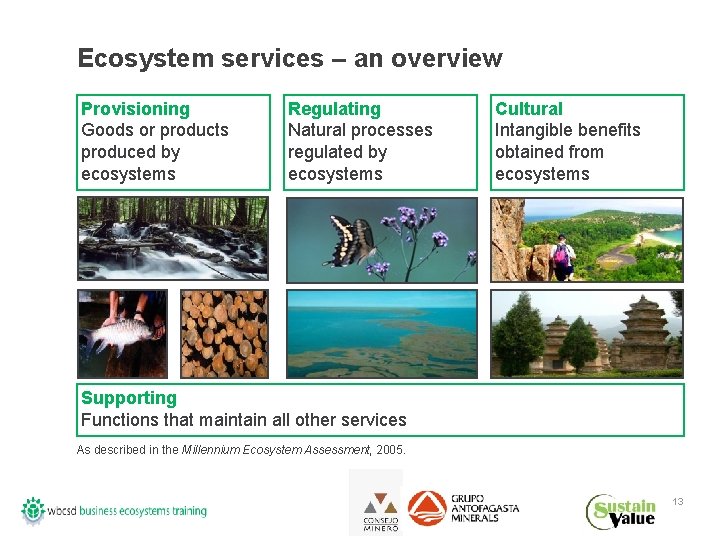
Ecosystem services – an overview Provisioning Goods or products produced by ecosystems Regulating Natural processes regulated by ecosystems Cultural Intangible benefits obtained from ecosystems Supporting Functions that maintain all other services As described in the Millennium Ecosystem Assessment, 2005. 13
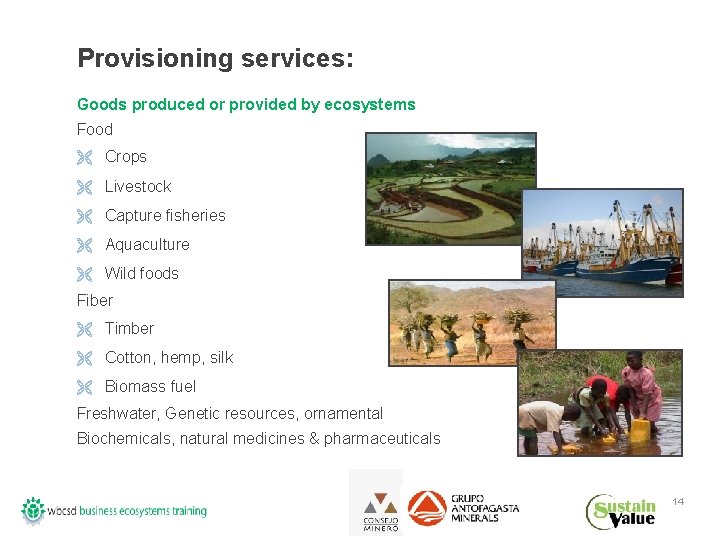
Provisioning services: Goods produced or provided by ecosystems Food Ë Crops Ë Livestock Ë Capture fisheries Ë Aquaculture Ë Wild foods Fiber Ë Timber Ë Cotton, hemp, silk Ë Biomass fuel Freshwater, Genetic resources, ornamental Biochemicals, natural medicines & pharmaceuticals 14
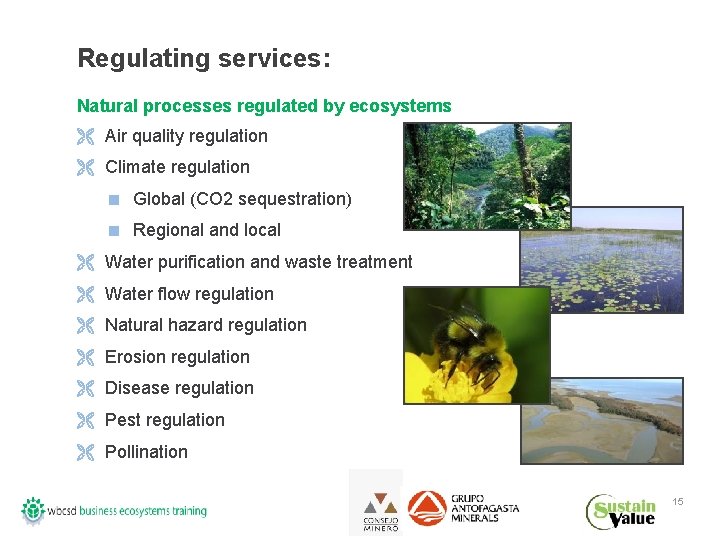
Regulating services: Natural processes regulated by ecosystems Ë Air quality regulation Ë Climate regulation < Global (CO 2 sequestration) < Regional and local Ë Water purification and waste treatment Ë Water flow regulation Ë Natural hazard regulation Ë Erosion regulation Ë Disease regulation Ë Pest regulation Ë Pollination 15
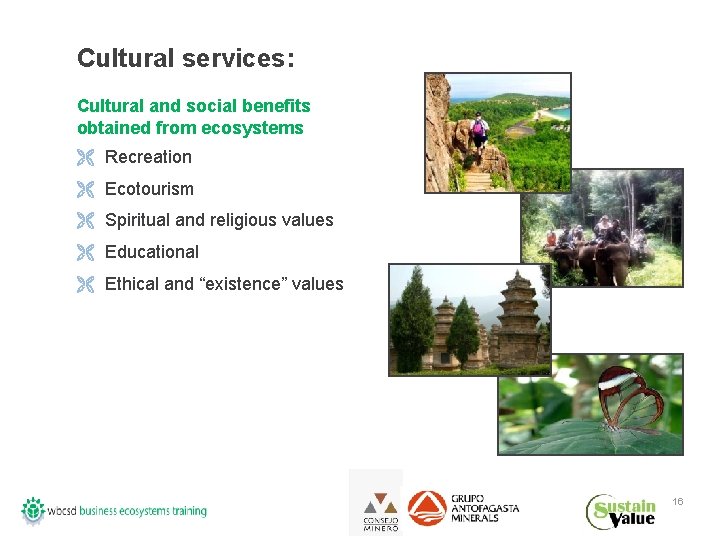
Cultural services: Cultural and social benefits obtained from ecosystems Ë Recreation Ë Ecotourism Ë Spiritual and religious values Ë Educational Ë Ethical and “existence” values 16
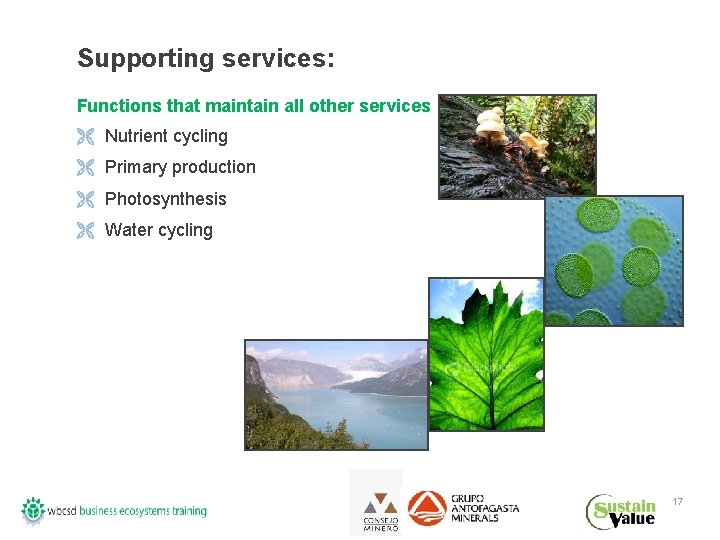
Supporting services: Functions that maintain all other services Ë Nutrient cycling Ë Primary production Ë Photosynthesis Ë Water cycling 17
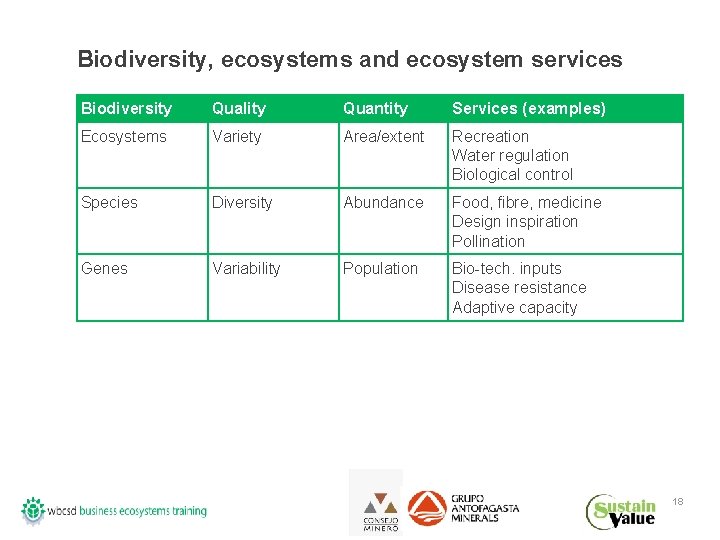
Biodiversity, ecosystems and ecosystem services Biodiversity Quality Quantity Services (examples) Ecosystems Variety Area/extent Recreation Water regulation Biological control Species Diversity Abundance Food, fibre, medicine Design inspiration Pollination Genes Variability Population Bio-tech. inputs Disease resistance Adaptive capacity 18
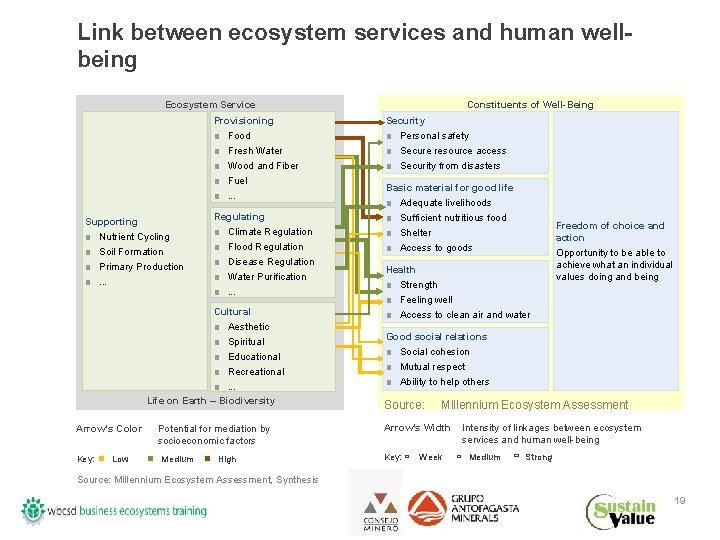
Link between ecosystem services and human wellbeing Ecosystem Service Supporting ■ Nutrient Cycling ■ Soil Formation ■ Primary Production ■. . . Provisioning ■ Food Security ■ Personal safety ■ ■ Fresh Water Wood and Fiber Fuel. . . ■ Secure resource access ■ Security from disasters Regulating ■ Climate Regulation ■ Sufficient nutritious food ■ Shelter ■ Access to goods ■ ■ Flood Regulation Disease Regulation Water Purification. . . Cultural ■ Aesthetic ■ Spiritual ■ Educational ■ Recreational ■. . . Life on Earth – Biodiversity Arrow’s Color Key: Low Potential for mediation by socioeconomic factors Medium Constituents of Well-Being High Basic material for good life ■ Adequate livelihoods Freedom of choice and action Opportunity to be able to achieve what an individual values doing and being Health ■ Strength ■ Feeling well ■ Access to clean air and water Good social relations ■ Social cohesion ■ Mutual respect ■ Ability to help others Source: Millennium Ecosystem Assessment Arrow’s Width Key: Week Intensity of linkages between ecosystem services and human well-being Medium Strong Source: Millennium Ecosystem Assessment, Synthesis 19
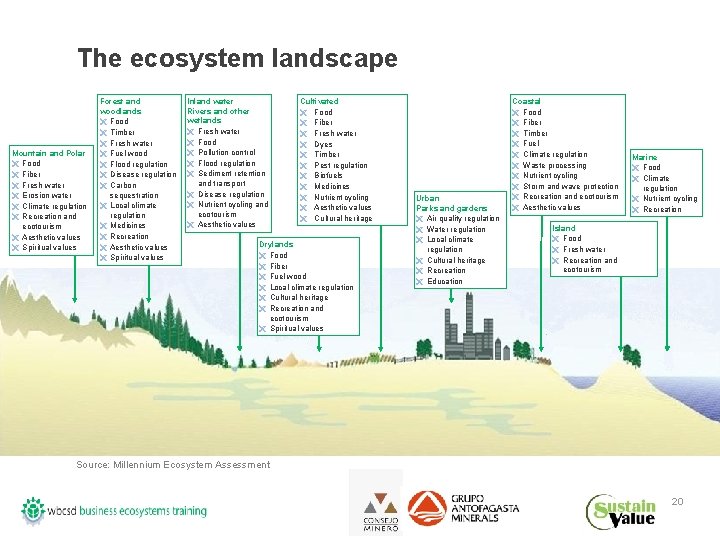
The ecosystem landscape Mountain and Polar Ë Food Ë Fiber Ë Fresh water Ë Erosion water Ë Climate regulation Ë Recreation and ecotourism Ë Aesthetic values Ë Spiritual values Forest and woodlands Ë Food Ë Timber Ë Fresh water Ë Fuel wood Ë Flood regulation Ë Disease regulation Ë Carbon sequestration Ë Local climate regulation Ë Medicines Ë Recreation Ë Aesthetic values Ë Spiritual values Inland water Rivers and other wetlands Ë Fresh water Ë Food Ë Pollution control Ë Flood regulation Ë Sediment retention and transport Ë Disease regulation Ë Nutrient cycling and ecotourism Ë Aesthetic values Cultivated Ë Food Ë Fiber Ë Fresh water Ë Dyes Ë Timber Ë Pest regulation Ë Biofuels Ë Medicines Ë Nutrient cycling Ë Aesthetic values Ë Cultural heritage Drylands Ë Food Ë Fiber Ë Fuel wood Ë Local climate regulation Ë Cultural heritage Ë Recreation and ecotourism Ë Spiritual values Urban Parks and gardens Ë Air quality regulation Ë Water regulation Ë Local climate regulation Ë Cultural heritage Ë Recreation Ë Education Coastal Ë Food Ë Fiber Ë Timber Ë Fuel Ë Climate regulation Ë Waste processing Ë Nutrient cycling Ë Storm and wave protection Ë Recreation and ecotourism Ë Aesthetic values Marine Ë Food Ë Climate regulation Ë Nutrient cycling Ë Recreation Island Ë Food Ë Fresh water Ë Recreation and ecotourism Source: Millennium Ecosystem Assessment 20
Basic concepts (cont. ) – stakeholder engagement Ë Stakeholders are groups or individuals: a) that can reasonably be expected to be significantly affected by the organization’s activities, products, and/or services; or b) whose actions can reasonably be expected to affect the ability of the organization to successfully implement its strategies and achieve its objectives. Ë Stakeholder engagement Ë Stakeholder mapping 21
Session 3 Introduction to policy
Background to ecosystem policy Long history of environmental regulation a) 1388 UK water pollution measures b) 1973 EU Action Programme on the Environment / Water The limits to growth (1972) Ë Modelled world population, industrialization, pollution, food production and resource depletion Brundtland Report (1987) Ë Defined sustainable development Ë Called for increased international cooperation Conventions, treaties, protocols, agreements… Over 250 multilateral environmental agreements exist The Earth Summit (1992) – start of ‘The Rio Process’ 23
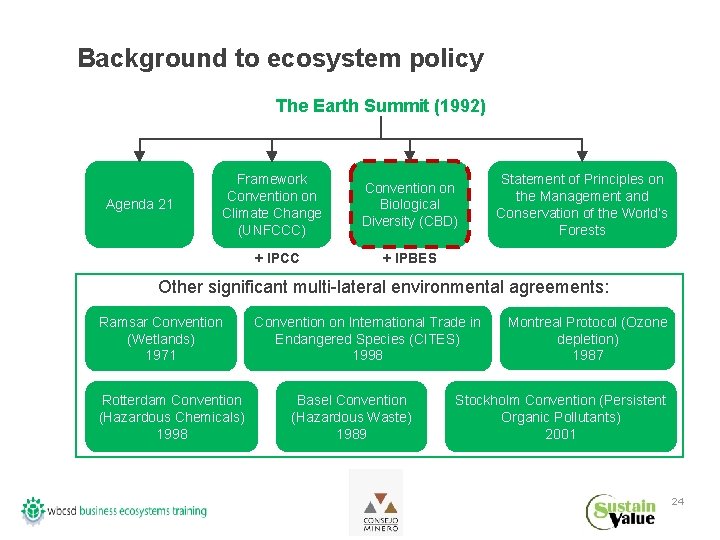
Background to ecosystem policy The Earth Summit (1992) Agenda 21 Framework Convention on Climate Change (UNFCCC) + IPCC Convention on Biological Diversity (CBD) Statement of Principles on the Management and Conservation of the World’s Forests + IPBES Other significant multi-lateral environmental agreements: Ramsar Convention (Wetlands) 1971 Rotterdam Convention (Hazardous Chemicals) 1998 Convention on International Trade in Endangered Species (CITES) 1998 Basel Convention (Hazardous Waste) 1989 Montreal Protocol (Ozone depletion) 1987 Stockholm Convention (Persistent Organic Pollutants) 2001 24
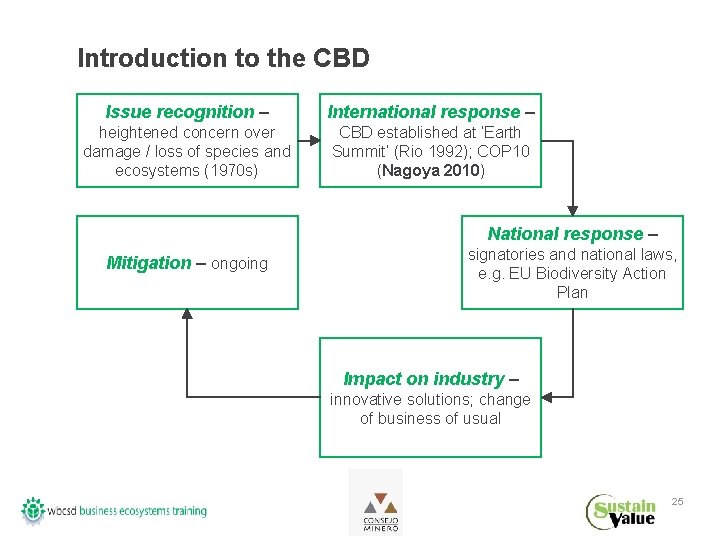
Introduction to the CBD Issue recognition – International response – heightened concern over damage / loss of species and ecosystems (1970 s) CBD established at ‘Earth Summit’ (Rio 1992); COP 10 (Nagoya 2010) National response – Mitigation – ongoing signatories and national laws, e. g. EU Biodiversity Action Plan Impact on industry – innovative solutions; change of business of usual 25
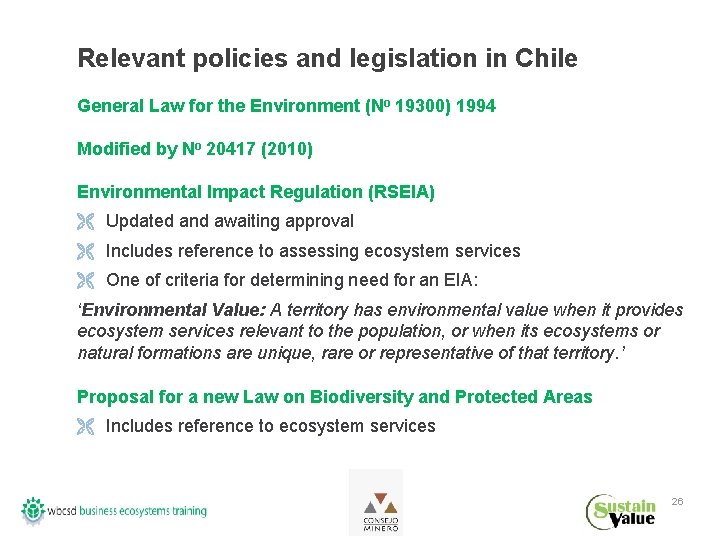
Relevant policies and legislation in Chile General Law for the Environment (No 19300) 1994 Modified by No 20417 (2010) Environmental Impact Regulation (RSEIA) Ë Updated and awaiting approval Ë Includes reference to assessing ecosystem services Ë One of criteria for determining need for an EIA: ‘Environmental Value: A territory has environmental value when it provides ecosystem services relevant to the population, or when its ecosystems or natural formations are unique, rare or representative of that territory. ’ Proposal for a new Law on Biodiversity and Protected Areas Ë Includes reference to ecosystem services 26
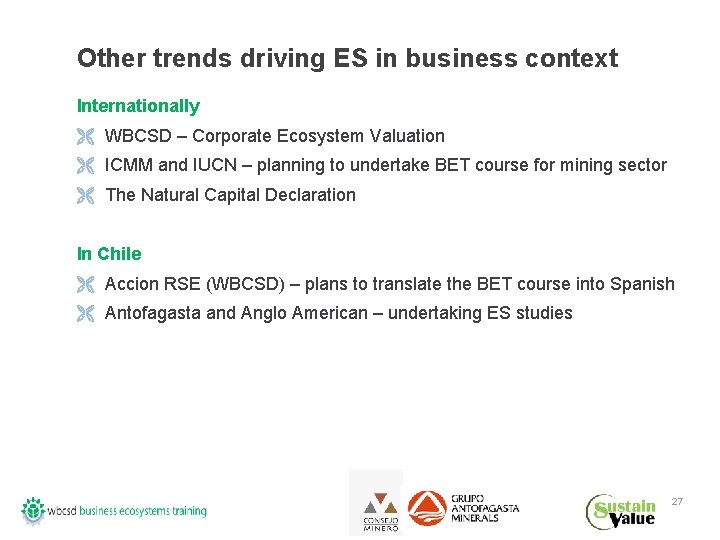
Other trends driving ES in business context Internationally Ë WBCSD – Corporate Ecosystem Valuation Ë ICMM and IUCN – planning to undertake BET course for mining sector Ë The Natural Capital Declaration In Chile Ë Accion RSE (WBCSD) – plans to translate the BET course into Spanish Ë Antofagasta and Anglo American – undertaking ES studies 27
Session 4 Identifying key ecosystem services (exercise)
Ecosystems: identifying key ecosystem services What are the main ecosystem services your companies depend on and impact upon? 5 minutes 29
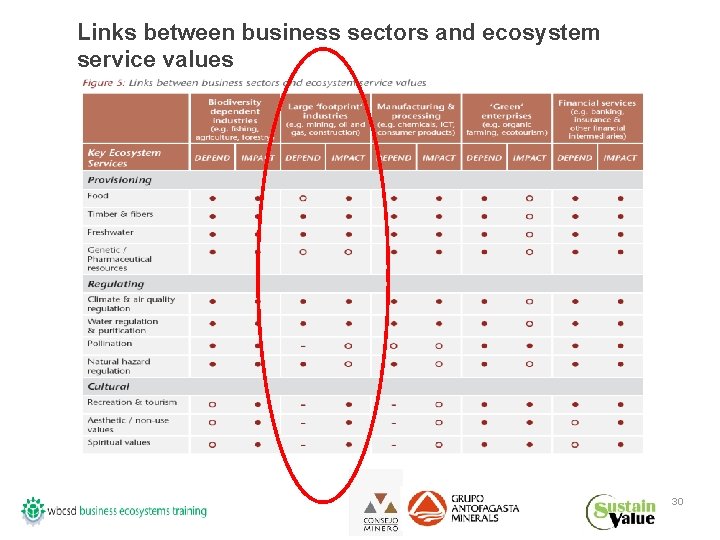
Links between business sectors and ecosystem service values 30
Session 5 The global ecosystem challenge
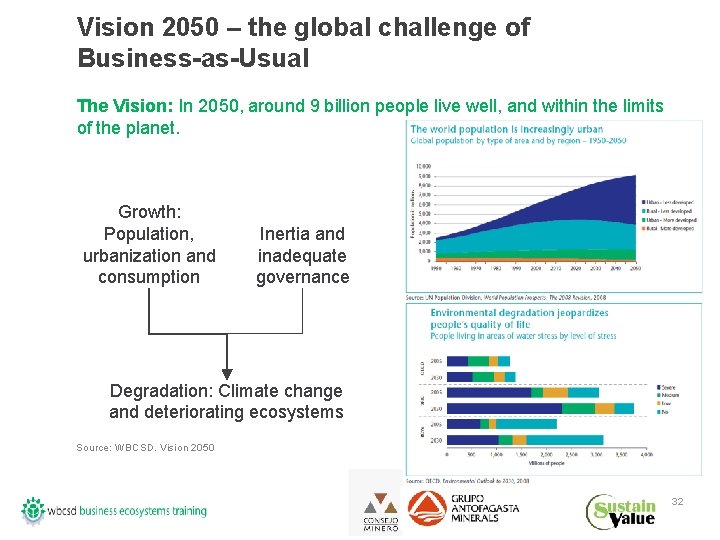
Vision 2050 – the global challenge of Business-as-Usual The Vision: In 2050, around 9 billion people live well, and within the limits of the planet. Growth: Population, urbanization and consumption Inertia and inadequate governance Degradation: Climate change and deteriorating ecosystems Source: WBCSD. Vision 2050 32
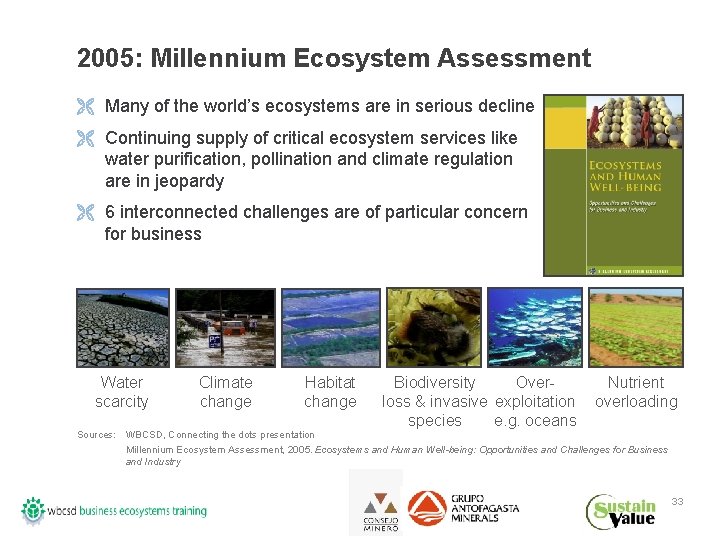
2005: Millennium Ecosystem Assessment Ë Many of the world’s ecosystems are in serious decline Ë Continuing supply of critical ecosystem services like water purification, pollination and climate regulation are in jeopardy Ë 6 interconnected challenges are of particular concern for business Water scarcity Climate change Habitat change Biodiversity Overloss & invasive exploitation species e. g. oceans Nutrient overloading Sources: WBCSD, Connecting the dots presentation Millennium Ecosystem Assessment, 2005. Ecosystems and Human Well-being: Opportunities and Challenges for Business and Industry 33
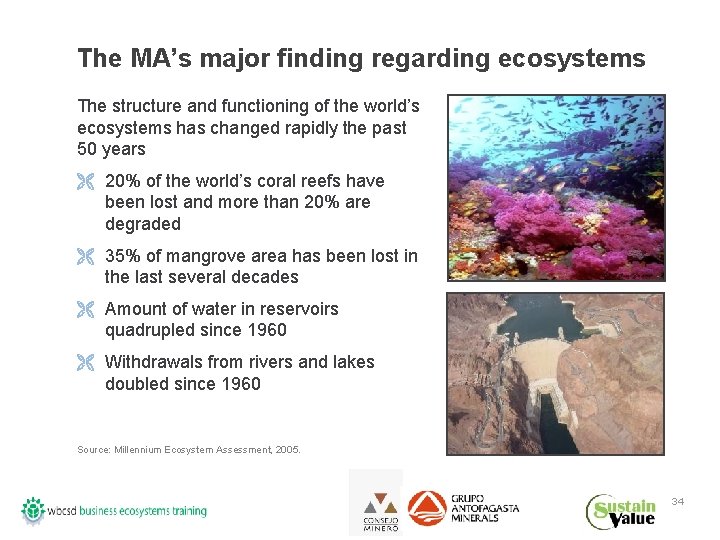
The MA’s major finding regarding ecosystems The structure and functioning of the world’s ecosystems has changed rapidly the past 50 years Ë 20% of the world’s coral reefs have been lost and more than 20% are degraded Ë 35% of mangrove area has been lost in the last several decades Ë Amount of water in reservoirs quadrupled since 1960 Ë Withdrawals from rivers and lakes doubled since 1960 Source: Millennium Ecosystem Assessment, 2005. 34
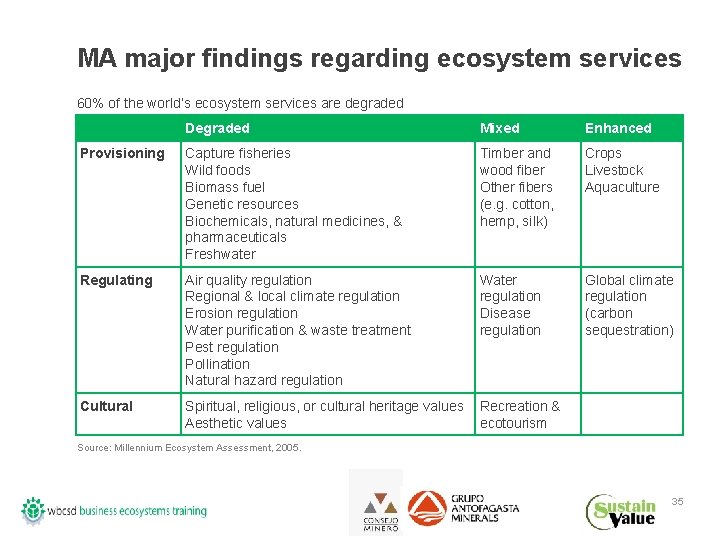
MA major findings regarding ecosystem services 60% of the world’s ecosystem services are degraded Degraded Mixed Enhanced Provisioning Capture fisheries Wild foods Biomass fuel Genetic resources Biochemicals, natural medicines, & pharmaceuticals Freshwater Timber and wood fiber Other fibers (e. g. cotton, hemp, silk) Crops Livestock Aquaculture Regulating Air quality regulation Regional & local climate regulation Erosion regulation Water purification & waste treatment Pest regulation Pollination Natural hazard regulation Water regulation Disease regulation Global climate regulation (carbon sequestration) Cultural Spiritual, religious, or cultural heritage values Aesthetic values Recreation & ecotourism Source: Millennium Ecosystem Assessment, 2005. 35
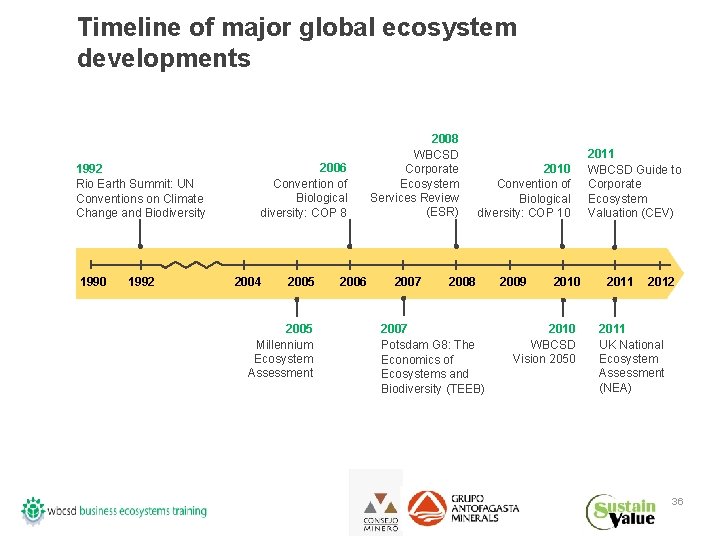
Timeline of major global ecosystem developments 1992 Rio Earth Summit: UN Conventions on Climate Change and Biodiversity 1990 1992 2006 Convention of Biological diversity: COP 8 2004 2005 Millennium Ecosystem Assessment 2006 2008 WBCSD Corporate Ecosystem Services Review (ESR) 2007 2010 Convention of Biological diversity: COP 10 2008 2007 Potsdam G 8: The Economics of Ecosystems and Biodiversity (TEEB) 2009 2010 WBCSD Vision 2050 2011 WBCSD Guide to Corporate Ecosystem Valuation (CEV) 2011 2012 2011 UK National Ecosystem Assessment (NEA) 36
Global Biodiversity Outlook report (CBD) Continued decline in all three major components of biodiversity: Ë Genes Ë Species Ë Ecosystems 37
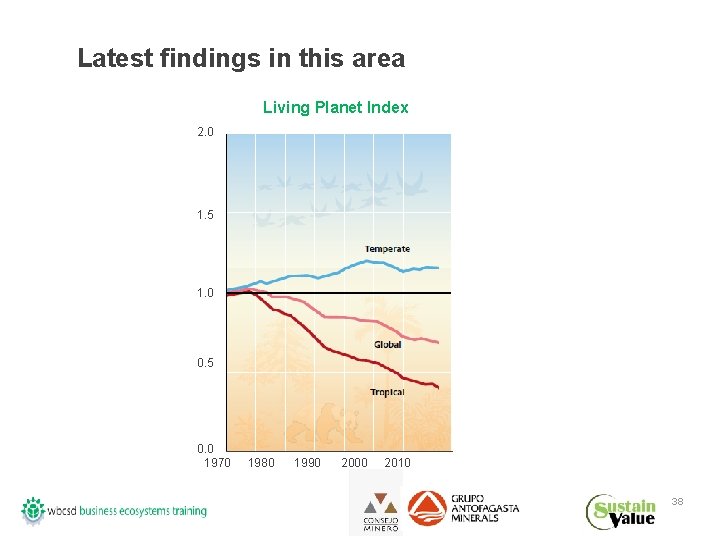
Latest findings in this area Living Planet Index 2. 0 1. 5 1. 0 0. 5 0. 0 1970 1980 1990 2000 2010 38
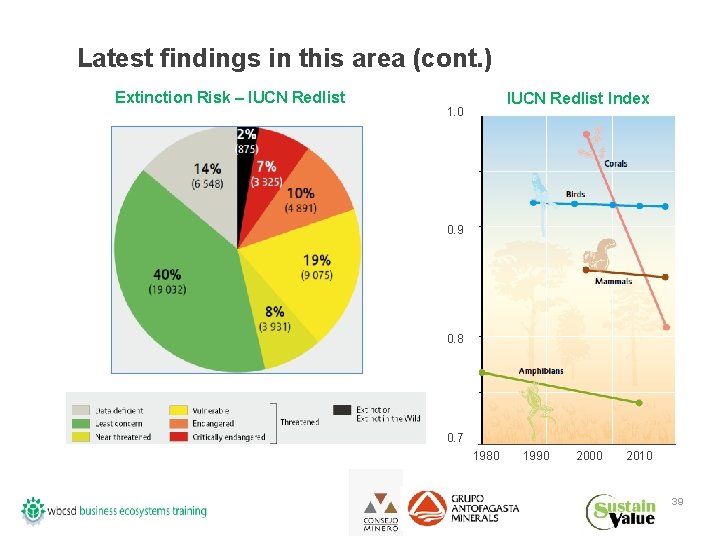
Latest findings in this area (cont. ) Extinction Risk – IUCN Redlist Index 1. 0 0. 9 0. 8 0. 7 1980 1990 2000 2010 39
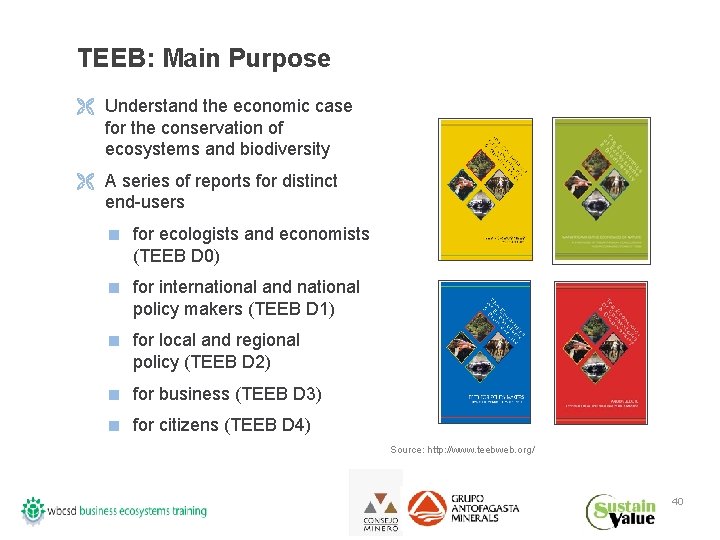
TEEB: Main Purpose Ë Understand the economic case for the conservation of ecosystems and biodiversity Ë A series of reports for distinct end-users < for ecologists and economists (TEEB D 0) < for international and national policy makers (TEEB D 1) < for local and regional policy (TEEB D 2) < for business (TEEB D 3) < for citizens (TEEB D 4) Source: http: //www. teebweb. org/ 40
The value of nature is changing – TEEB Urgent strategic priorities: Ë Halt deforestation and forest degradation Ë Protect tropical coral reefs Ë Save and restore global fisheries Ë Recognize link between ecosystem degradation and the persistence of rural poverty Policy solutions: Ë Rewarding benefits through payments and markets Ë Reforming environmentally harmful subsidies Ë Adding value through protected areas Ë Investing in ecological infrastructure 41
Session 6 Lafarge example
Creating business value – Lafarge The issue Ë Lafarge is a French group operating in resources extraction and building materials Ë Worldwide operations, significantly in developing countries. Ë Several potential impacts, e. g. removal of soil and destruction of habitats. Ë Managing and mitigating impacts for corporate reputation and the acceptability of mining operations. 43
Creating business value – Lafarge The response Plant nurseries as part of biodiversity restoration Ë Lafarge has developed a biodiversity management system, including tools and best practices. Ë Local nurseries: important feature of rehabilitation as plants ensure soil stability and landscape integration. Local nurseries respect indigenous species, adaptation to the local biogeographical context, and avoid spread of invasive species. Ë Local collection: specific rehabilitation programs in Uganda and the Philippines. Seeds and material for vegetative multiplication are collected directly in the vicinity of the quarry. Ë Local know-how: plays an important role by helping to choose the most adapted species and build the protocols for planting and care. Partnerships with botanical authorities is the ultimate stage of the process. 44
Creating business value – Lafarge (cont. ) The results Different projects for same objective: biodiversity conservation. Ë In Uganda, nursery production capacity is 100, 000 seedlings per year. Ë 30, 000 -50, 000 seedlings are used for alternative fuel plantations and 12, 000 -15, 000 seedlings are used for rehabilitating the mined area. Ë The local communities receive 30, 000 to 50, 000 seedlings. Ë The nursery projects employ more than 30 people. Ë These actions, whilst helping Lafarge rehabilitate its former quarry, have also helped the company secure its license to operate in the region. 45
Session 7 The business case for action
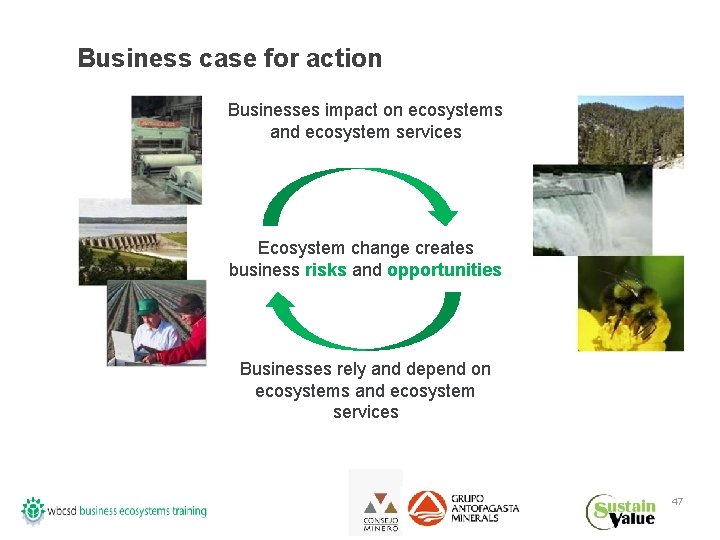
Business case for action Businesses impact on ecosystems and ecosystem services Ecosystem change creates business risks and opportunities Businesses rely and depend on ecosystems and ecosystem services 47
Introduction to business case Issues business can face in daily operations and supply chains: Ë Water scarcity and declining water quality Ë Disruption of food, fiber or other natural industrial inputs Ë Increasing incidents of extreme flooding, storms or drought Ë Increasing stakeholder expectations (NGOs, customers, investors etc. ) Ë Tightened public policies on natural resource management or operational permitting Ë Traditional risk management processes do not always capture ecosystem risks / opportunities 48
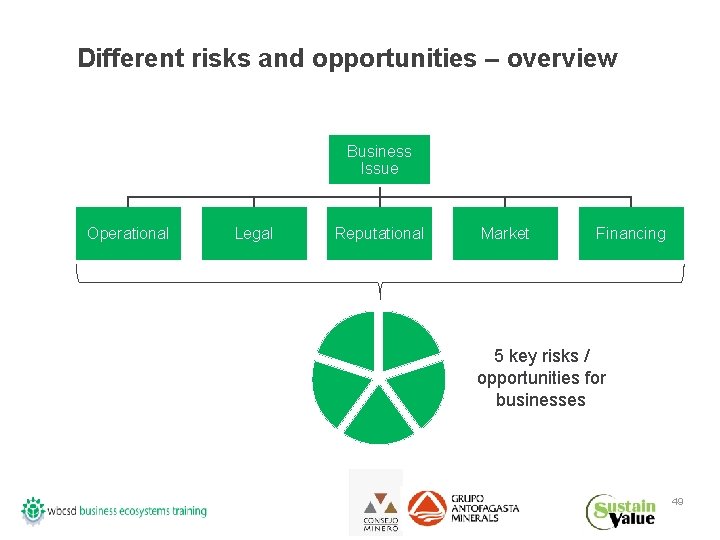
Different risks and opportunities – overview Business Issue Operational Legal Reputational Market Financing 5 key risks / opportunities for businesses 49
Introduction to different types of risks and opportunities Operational Risks Ë Increased scarcity and cost of raw materials Opportunities Ë Improving operational efficiencies and saving costs Ë Building awareness amongst employees/stakeholders 50
Introduction to different types of risks and opportunities (cont. ) Regulatory and legal Risks & opportunities: Ë Public policies (e. g. taxes, subsidies and moratoria on extractive activities). Examples of laws that currently consider the value of ecosystems include: < The water framework directive < The marine strategy framework directive < South African water white paper < The Environmental liability directive < Access and benefit sharing 51
Introduction to different types of risks and opportunities (cont. ) Reputational Risks Ë Relationships with their customers and other stakeholders. Ë Affect a company’s brand, image, “goodwill” (e. g. image from media and NGOs) Opportunities Ë Implementing and communicating sustainable purchasing, operating or investment practices in order to differentiate corporate brands 52
Introduction to different types of risks and opportunities (cont. ) Market and product Risks Ë Relate to product and service offerings, consumer preferences, and other market factors that affect corporate performance Opportunities Ë Potential new revenue streams when participating in emerging environmental markets 53
Introduction to different types of risks and opportunities (cont. ) Financing Risks Ë Affect the cost and availability of capital to companies Opportunities Ë Could potentially include companies obtaining more favourable lending terms Ë Access to new green funds 54
How can business respond? Ë Measure, manage and mitigate biodiversity & ecosystem impact and dependence risks and explore new opportunities Ë Undertake corporate ecosystem valuation to quantify business risks and opportunities Ë Innovate and lead the development of: < Markets for ecosystem services < Eco-efficient goods, services & technologies Ë Encourage suppliers & purchasers – including SMEs – to adopt “best” biodiversity practices through the supply chain Ë Enter into creative partnerships with municipalities, governments, NGOs, science community for on-the-ground solutions Ë Support “smart” ecosystem regulation that reverses degradation, leverage market forces, “levels the playing field” for all and supports social & livelihood benefits 55
Arcelor. Mittal Tubarao, Brazil Issue Ë LD slag is major waste generated in steel production Response Ë Convert LD Slag into a product. Ë Create specific management area to develop new applications and sales Ë Developed partnerships with universities and laboratories Ë Conducted studies to assess environmental safety Results Ë Since 1983 74 million tons of slabs produced, 92% for export Ë Use in pyramid artificial reefs – enhance fishing and mussel production Ë Use in paving roads 56
Los Pelambres (Antofagasta), Chile Issue Ë Los Pelambres copper mine port, used for shipping concentrate is located next to Conchali Lagoon Ë Lagoon was a wetland with roaming cattle and dogs and much rubbish Ë To gain environmental permit, Los Pelambres must protect the wetland Response Ë In 1997 Los Pelambres acquired the lagoon Ë Installed fencing, footpaths, information boards and now visitor centre Ë Worked with CONAMA (National Environmental Commission) and CONAF (National Forest Corporation) Results Ë In 2000 site became a Nature Sanctuary - Chile’s 8 th Ramsar site Ë Now provides local jobs and nearby local students act as tour guides 57
Minera Escondida Ltda, (BHP Billiton) Chile Issue Ë 1990 MEL built copper concentrate filtering plant and port facility at Punto Coloso Ë Operates in sensitive protected coastal area next to marine reserve Response Ë Run a marine environmental monitoring programme Ë Evaluated key marine species – macroalgae, invertebrates and fish Ë Focussed studies on a sea squirt, an alien habitat building species Results Ë Sea squirt in reserve harbours 116 species – outside reserve only 66 Ë Adds credibility and transparency to operations Ë Demonstrates that MEL has not had negative impact on marine species 58
Disclaimer Business Ecosystems Training (BET) is a capacity building program released in the name of the WBCSD. It is the result of a collaborative effort by members of the secretariat and senior executives from KPMG and an Advisory Committee composed of member companies, Regional Network partners, NGOs, UN and academic institutions, and others. A wide range of members reviewed drafts, thereby ensuring that BET broadly represents the majority of the WBCSD membership. It does not mean, however, that every member company agrees with every word. Business Ecosystems Training (BET) has been prepared for capacity building only, and does not constitute professional advice. You should not act upon the information contained in BET without obtaining specific professional advice. No representation or warranty (express or implied) is given as to the accuracy or completeness of the information contained in BET and its translations in different languages, and, to the extent permitted by law, WBCSD, KPMG, members of the Advisory Committee, their members, employees and agents do not accept or assume any liability, responsibility or duty of care for any consequences of you or anyone else acting, or refraining to act, in reliance on the information contained in this capacity building program or for any decision based on it. Copyright © World Business Council for Sustainable Development February 2012 Disclaimer and information on Sustain Value The original four part BET Modules have been significantly cut down and adapted to a mining context by James Spurgeon of Sustain Value. This has been to convert the two day general BET course into a one day course targeted at the mining sector in Chile, on behalf of the Chilean Mining Council and Antofagasta Minerals S. A. The revised materials do not constitute professional advice, and no representation or warranty (express or implied) is given as to the accuracy or completeness of the information contained in the slides, most of which is reliant on external sources. In preparing and delivering the revised BET course, James Spurgeon has been able to draw upon 20 years of international experience undertaking Environmental Impact Assessments, Ecosystem Service Assessments, Corporate Ecosystem Valuations and Biodiversity Offsets; and developing numerous bespoke tools for companies and governments to apply the concepts in a simple and cost-effective manner. February 2012 59
References Ë WBCSD. Connecting the Dots presentation Ë WBCSD. Corporate Ecosystem Services Review Ë WBCSD. Responding to the Biodiversity Challenge: Business contributions to the Convention on Biological Diversity – http: //www. wbcsd. org/work-program/ecosystems-training-tools. aspx Ë WBCSD. Vision 2050 Ë WBCSD. Pathways to 2050 Ë Millennium Ecosystem Assessment. 2005. Ecosystems and Human Well-being: Opportunities and Challenges for Business and Industry – http: //www. maweb. org/documents/document. 353. aspx. pdf Ë Millennium Ecosystem Assessment, 2005. Ecosystems and Human Well-being: Synthesis – http: //www. maweb. org/documents/document. 356. aspx. pdf Ë United Nations, Millennium development goals – http: //www. un. org/millenniumgoals/bkgd. shtml Ë TEEB – http: //www. teebweb. org/ Ë TEEB for business – http: //www. teebweb. org/Portals/25/Documents/TEEB%20 for%20 Business/TEEB%20 for%20 Bus%20 Exec%2 0 English. pdf Ë Brundtland report outputs – http: //www. un-documents. net/ocf-02. htm#I Ë Brundtland report, 20 years on – http: //www. un. org/esa/sustdev/csd 15/media/backgrounder_brundtland. pdf 60
References (cont). Policy frameworks chapter: Ë CITES – http: //www. cites. org/ Ë Plant example – http: //www. cites. org/common/prog/african-cherry/11 -CUNNINGHAM. pdf Ë Crocodile example – http: //www. doc. govt. nz/upload/documents/about- doc/role/international/cites-crocs. pdf Ë UK Environmental Law Association guide – http: //www. environmentlaw. org. uk/rte. asp? id=108 Ë Limits to growth – http: //www. clubofrome. org/? p=326 Ë UN Earth Summit Fact Sheet – http: //www. un. org/geninfo/bp/enviro. html Ë CBD – http: //www. cbd. int/2010 -target/goals-targets. shtml Additional cases: IUCN and ICMM (2004) Integrating mining and biodiversity conservation: Case studies from around the world. 48 pp CEBDS (2010) Biodiversity: Brazilian Business Cases 61
- Slides: 61