
Best viewed with Office 2010 Chapter 7 FUNDAMENTAL
Best viewed with Office 2010 Chapter 7 FUNDAMENTAL ACCOUNTING PRINCIPLES AND
Introduction Accounting principles and conventions (or ‘concepts’) are daily transactions rules that we followed when recording ________ financial statements and preparing _________. accurate and This makes accounting information more ________, uniform and thus more useful to different users.
Business entity The business entity concept states that a business is treated as an entity separate from its owner(s). business should be Only transactions that affect the _____ recorded in the books of the business. personal transactions and matters of the owner No ____ should be entered in a firm’s accounting records. The personal resources of the owner will affect a firm’s accounting records only when he brings drawings _______ capital into the firm or makes _____.
Business entity The business entity concept states that a business is treated as an entity separate from its owner(s). It ensures that the accounting information provided by a firm represents just the financial performance and business entity itself. position of the _______ Example Without this concept, it would be easy for the owner to The owner may attempt to manipulate a firm’s accounts. boost the firm’s earnings by _____ treating his personal income as the firm’s.
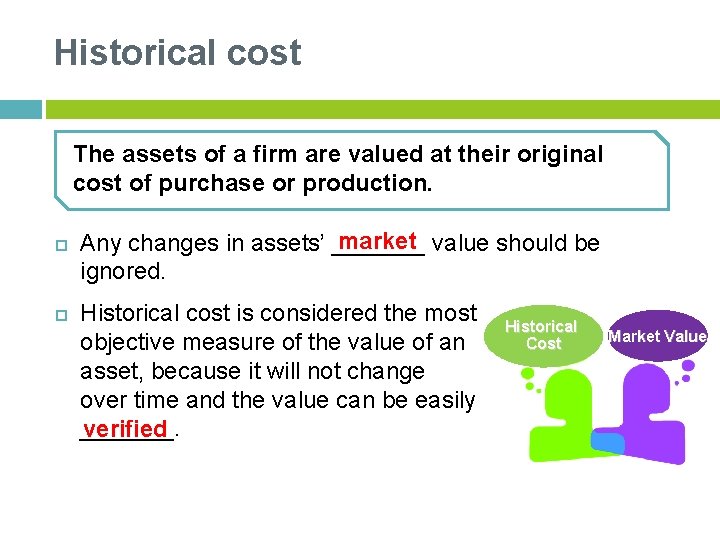
Historical cost The assets of a firm are valued at their original cost of purchase or production. market value should be Any changes in assets’ _______ ignored. Historical cost is considered the most objective measure of the value of an asset, because it will not change over time and the value can be easily _______. verified Historical Cost Market Value
Historical cost The assets of a firm are valued at their original cost of purchase or production. The historical cost principle is important in ensuring that reliable and free from bias. the valuation of assets is _______ Without the application of this principle, the assets of a firm might be valued at their current market value, which objective as historical cost and is not as _____ fluctuates over time. _____
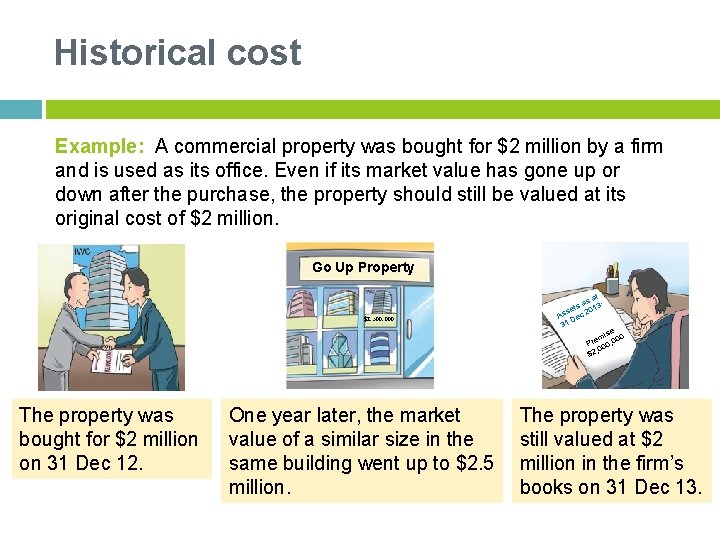
Historical cost Example: A commercial property was bought for $2 million by a firm and is used as its office. Even if its market value has gone up or down after the purchase, the property should still be valued at its original cost of $2 million. Go Up Property $2, 500, 000 at as 3: s t se 201 As Dec 31 se mi 00 Pre 00, 0 $2 The property was bought for $2 million on 31 Dec 12. One year later, the market value of a similar size in the same building went up to $2. 5 million. The property was still valued at $2 million in the firm’s books on 31 Dec 13.
Going concern A business will continue in operation for the foreseeable future. close the business or There is no intention to _____ Example reduce its scale significantly _______ of operations. A firm is facing bankruptcy to This assumption must hold even whenoraisbusiness is be sold soon poorly performing ______. historical If this assumption is no longer valid, the _____ cost principle is no longer applicable. The assets _____ market value. should then be valued at current _______
Going concern A business will continue in operation for the foreseeable future. Hence, treating a business entity as a going concern is historical cost principle. closely related to the _______ The going concern concept is important in ensuring that assets are consistently valued at historical cost.
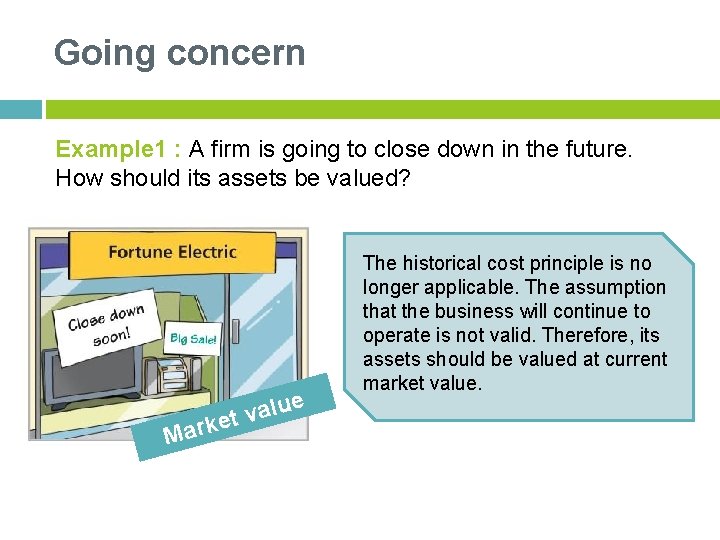
Going concern Example 1 : A firm is going to close down in the future. How should its assets be valued? Mar e lu a v t ke The historical cost principle is no longer applicable. The assumption that the business will continue to operate is not valid. Therefore, its assets should be valued at current market value.
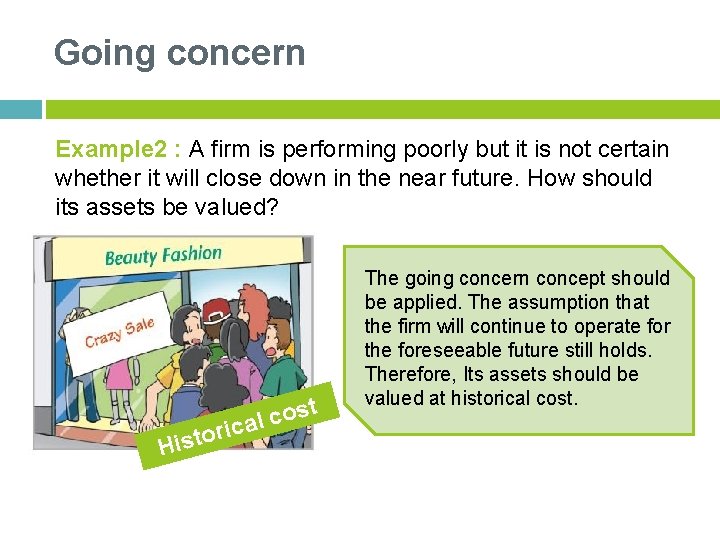
Going concern Example 2 : A firm is performing poorly but it is not certain whether it will close down in the near future. How should its assets be valued? ri o t s i H t s o c cal The going concern concept should be applied. The assumption that the firm will continue to operate for the foreseeable future still holds. Therefore, Its assets should be valued at historical cost.
Consistency A firm should keep using the same accounting policy or method for similar items. Various methods can be used to calculate depreciation on non-current assets, including the ______ straight-line method and the reducing-balance method. Once a firm has adopted a depreciation method for a certain type of non-current asset, it should keep same method for that type of using the ______ non-current asset year after year.
Consistency A firm should keep using the same accounting policy or method for similar items. However, a firm can change the method it uses, if such accurate a change is necessary and can give a more ____ view of the business. When a change occurs in a certain year and significantly affects the financial results for that year, the disclosed and effects of the change should be _____ explained _____.
Consistency A firm should keep using the same accounting policy or method for similar items. The consistency principle is important in facilitating the comparison of financial results between different ______ periods and between different businesses. Without the application of this principle, it would be easy manipulate to _____ a firm’s financial results by switching to a more favourable accounting method.
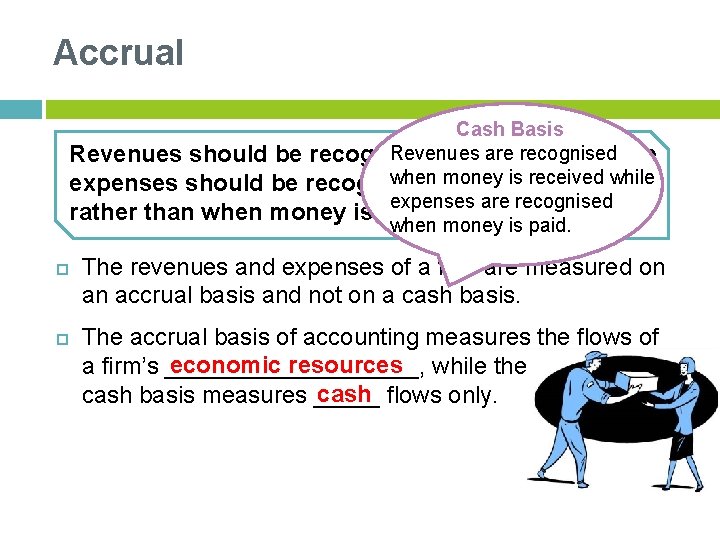
Accrual Cash Basis Revenues areearned recognised Revenues should be recognised when while when money incurred, is received while expenses should be recognised expenses are recognised rather than when money is received or paid. when money is paid. The revenues and expenses of a firm are measured on an accrual basis and not on a cash basis. The accrual basis of accounting measures the flows of economic resources while the a firm’s __________, cash flows only. cash basis measures _____
Accrual Revenues should be recognised when earned while expenses should be recognised when incurred, rather than when money is received or paid. Hence, the accrual basis is considered fairer than the cash basis in measuring the _______ overall performance of a firm during a period. It ensures that the accounting information actual operations of a business reflects the ________ without it being affected by the timing of payments.
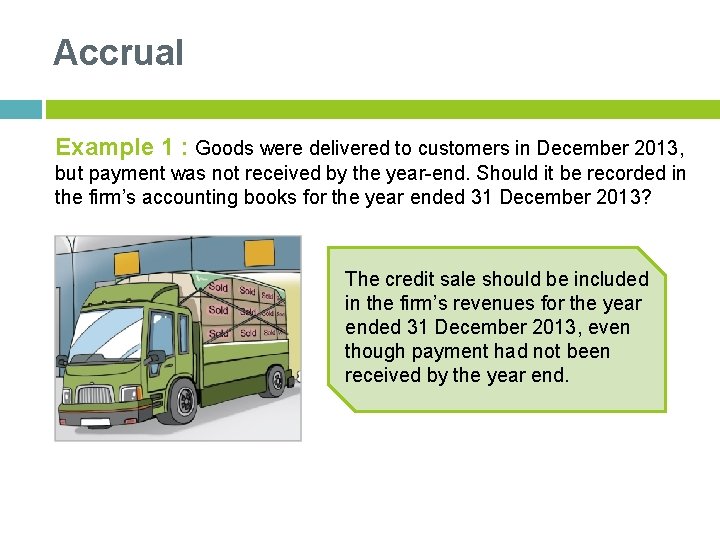
Accrual Example 1 : Goods were delivered to customers in December 2013, but payment was not received by the year-end. Should it be recorded in the firm’s accounting books for the year ended 31 December 2013? The credit sale should be included in the firm’s revenues for the year ended 31 December 2013, even though payment had not been received by the year end.
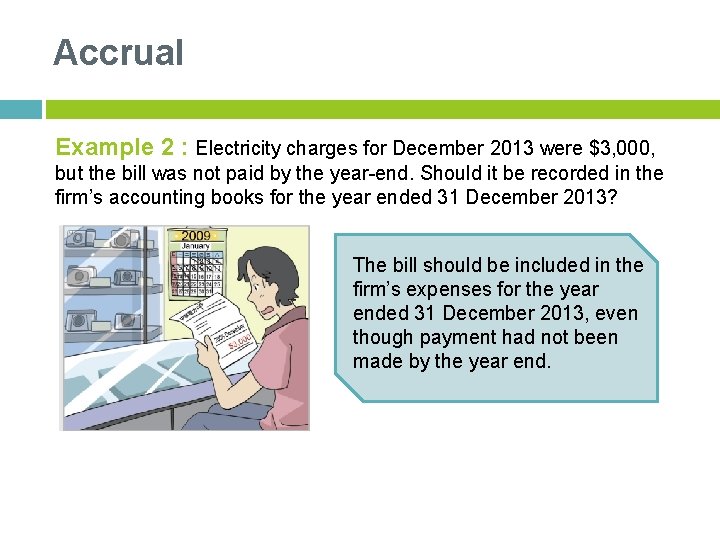
Accrual Example 2 : Electricity charges for December 2013 were $3, 000, but the bill was not paid by the year-end. Should it be recorded in the firm’s accounting books for the year ended 31 December 2013? The bill should be included in the firm’s expenses for the year ended 31 December 2013, even though payment had not been made by the year end.
Importance of accounting principles and conventions It is very important for users of financial statements to have an understanding of these principles and misinterpret the conventions. Otherwise, users may ______ reported results of a business and make the wrong decisions. For instance, if people do not realise that financial statements accrual basis, they may not understand are prepared on an _______ why a firm with high sales revenue can be short of cash. A cash shortage can occur if most of the sales are credit basis and debtors have been made on a ______ slow to make payments.
- Slides: 19