
Best Practices Standards Vol I An Overview OBJECTIVES
Best Practices Standards Vol. I: An Overview
OBJECTIVES Define Best Practices Standards Ø Identify the need for Best Practices Standards Ø Briefly examine each of the Best Practices Standards in Volume One Ø Discuss the impact of Best Practices Standards on Drug/DWI Court’s operation Ø

Best Practice Standards Set benchmarks for new and existing programs Focus on practices supported by reliable and convincing evidence Are both aspirational and directive
Best Practices Standards I. Target Population II. Historically Disadvantaged Groups III. Roles and Responsibilities of the Judge IV. Incentives, Sanctions, and Therapeutic Adjustments V. Substance Abuse Treatment
I. Target Population Objective Eligibility & Exclusion Criteria Specified in writing Communicated to team

I. Target Population High-Risk and High Need Participants 1) Substantial risk for reoffending, community supervision failure, and/or treatment failure. 2) Addicted
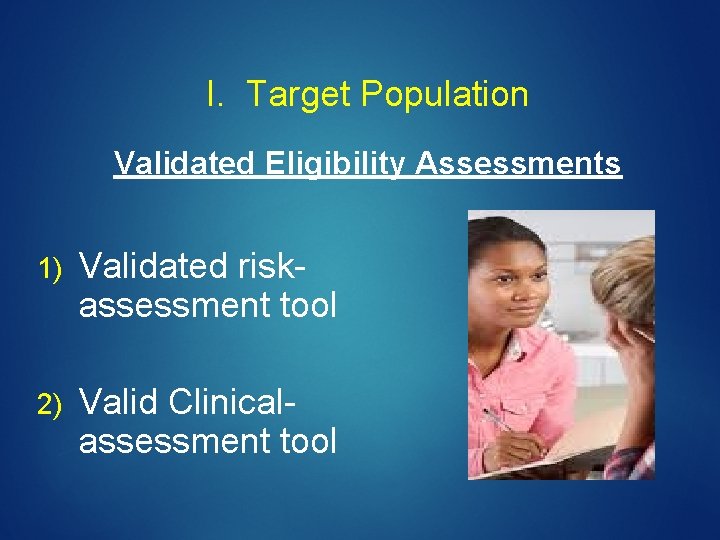
I. Target Population Validated Eligibility Assessments 1) Validated riskassessment tool 2) Valid Clinicalassessment tool
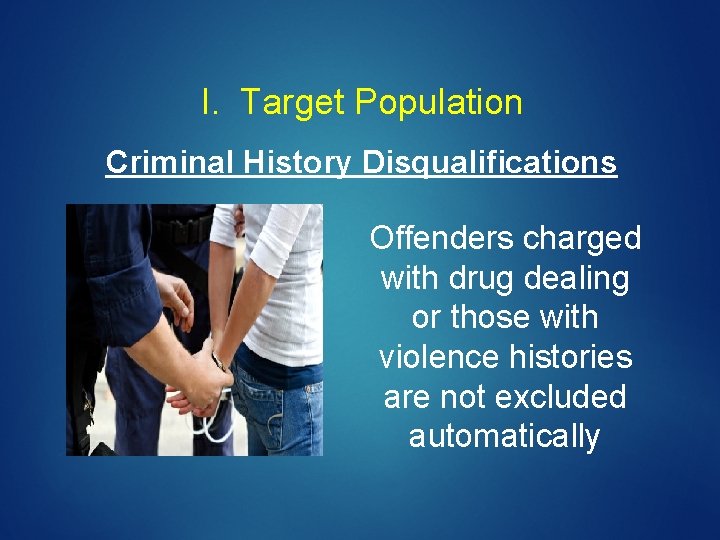
I. Target Population Criminal History Disqualifications Offenders charged with drug dealing or those with violence histories are not excluded automatically
I. Target Population Clinical Disqualifications Candidates are not disqualified automatically due to: Co-occurring mental health diagnosis Medical Condition Legally prescribed psychotropic or addiction medication
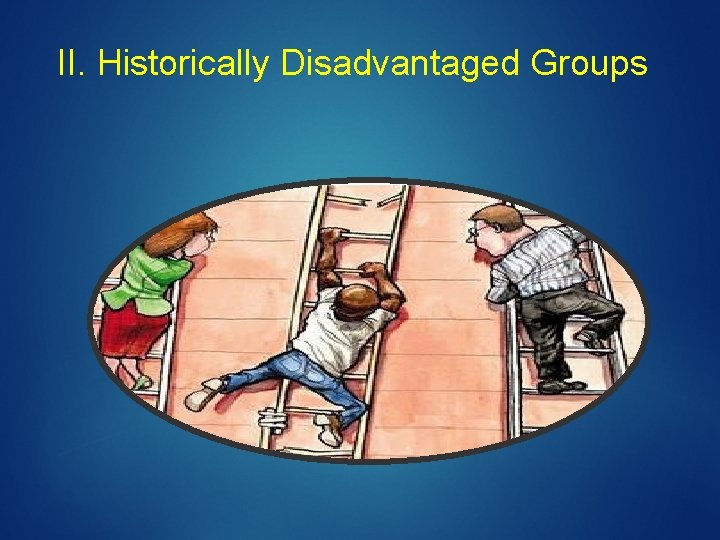
II. Historically Disadvantaged Groups
II. Historically Disadvantaged Groups Equivalent Access Nondiscriminatory in intent and impact Valid assessment tools for members of group
II. Historically Disadvantaged Groups Equivalent retention Monitors completion rates for group, if lower Investigate reasons for disparity Develop remedial action plan Reevaluate
II. Historically Disadvantaged Groups Equivalent Treatment Equivalent incentives & Sanctions Equivalent Dispositions -Monitor Evidence-Disparate based Dispositions? -Remedial treatment for -More frequent action if needed cultural group terminations? -Harsher sentences?
II. Historically Disadvantaged Groups Team Training Ø Ø Develop culturally sensitive attitudes Develop concrete strategies to correct and remediate disparities in services and outcomes
III. Roles & Responsibilities of the Judge
III. Roles & Responsibilities of the Judge Professional Training Constitutional Ethics Evidence-based substance abuse Mental Health treatment Behavior modification Community Supervision
III. Roles & Responsibilities of the Judge Length of Term No less than two consecutive years Consistent Dockets Participate in Pre-court Staff Meetings
III. Roles & Responsibilities of the Judge Frequency of Status Hearings At least every two weeks during first phase No less than once per month in later phases Length of Interaction with participant At least three minutes
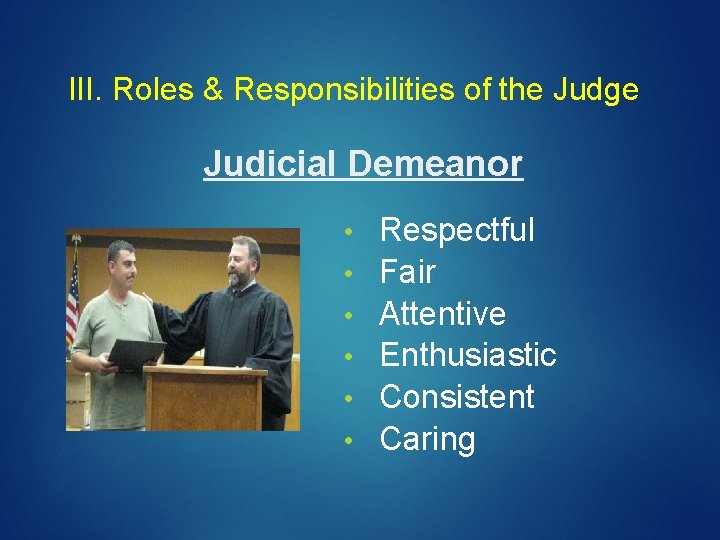
III. Roles & Responsibilities of the Judge Judicial Demeanor • • • Respectful Fair Attentive Enthusiastic Consistent Caring
III. Roles & Responsibilities of the Judge Judicial Decision Making Ø Seek and value team input Ø Responsible for weighing facts Ø Don’t decide by majority vote
IV. Incentives, Sanctions, and Therapeutic Adjustments
III. Roles & Responsibilities of the Judge Ø Advance Notice Ø Ø Opportunity to Be Heard • Ø Written policies and procedures Explanation – by participant, by judge Equivalent Consequences

IV. Incentives, Sanctions, and Therapeutic Adjustments Progressive sanctions Intermediate range Proximal Behaviors Distal Behaviors
IV. Incentives, Sanctions, and Therapeutic Adjustments Licit addictive or intoxicating substances Continued use is contrary to evidence-based practices except when medically necessary Authorized use only: Competent medical evidence indicates medically indicated, and effective alternative treatments are not reasonably available
IV. Incentives, Sanctions, and Therapeutic Adjustments Early phase: Maintaining abstinence may be extremely difficult Adjust treatment based on expertise of trained clinicians Later phase: After treatment and stabilization sanctions can escalate for illicit drug or alcohol use.
IV. Incentives, Sanctions, and Therapeutic Adjustments Incentivizing Productivity Improved outcomes when court uses higher levels of praise and positive incentives Phase Promotion • Clearly defined phase structure • Clearly defined behavior requirements • Rewards participant and sets expectations
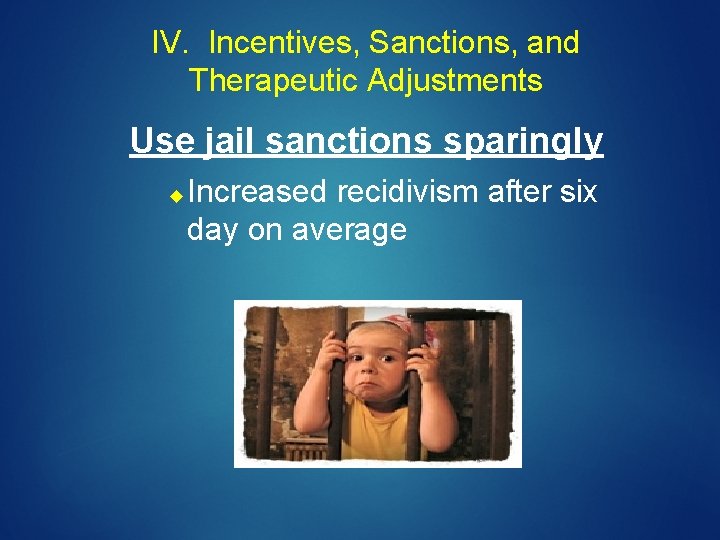
IV. Incentives, Sanctions, and Therapeutic Adjustments Use jail sanctions sparingly Increased recidivism after six day on average
IV. Incentives, Sanctions, and Therapeutic Adjustments Ø Those who automatically Terminate participants for new drug or alcohol use or drug possession offenses have: Ø 50% higher recidivism Ø 48% loser cost savings
IV. Incentives, Sanctions, and Therapeutic Adjustments Consequences of graduation and termination Favorable criminal justice outcomes should result from graduation More restrictive or more stringent criminal justice outcomes should result from unsuccessful termination or withdrawal
V. Substance Abuse Treatment
V. Substance Abuse Treatment Continuum of Care Standardized patient placement criteria governs level of care provided. Incarceration § Is not used to achieve clinical or social service objectives (e. g. , for detox) Treatment § Is not used to accomplish non-clinical goals (e. g. , for housing or for those who need jail)
V. Substance Abuse Treatment Clinically trained representative from one or two treatment agencies are core members of team and attend staffing and hearings
V. Substance Abuse Treatment Dosage and Duration 9 to 12 months; 200 hours of counseling Treatment Modalities One individual per week in Phase 1 Group membership is guided by evidence-based selection criteria Evidence-Based Treatments Medications
V. Substance Abuse Treatment Medication Assisted Treatment Effective with and necessary for some participants when combined with psychosocial treatment Programs avoid blanket prohibitions Best when prescribed by a physician specializing in addiction medicine Judge exercises discretion to prohibit MAT only when determined to not be medically necessary by a physician advising the court
V. Substance Abuse Treatment Provider Training and Credentials Licensed or certified Experience working with criminal justice populations Clinically supervised
V. Substance Abuse Treatment Peer Support Groups § Structured model or curriculum § 12 -Step and secular alternatives Continuing Care • Continue with pro-social activities and remain connected with a peer support group after Drug Court

Best Practices Standards Vol. I: An Overview
- Slides: 37