
Best Practices Integration of Risk Management and Corrective
Best Practices: Integration of Risk Management and Corrective and Preventive Action Presented by: Norman L. Collazo Worldwide Director of Strategic Quality Cordis Corporation, a Johnson & Johnson company 1
The views expressed are those of the speaker and are not necessarily those of Cordis Corporation or Johnson & Johnson. The views are offered to provide an overview of issues related to Risk Management and Corrective and Preventive Action activities. 2
Agenda v About Cordis Corporation v What is Risk Management v What is CAPA v Key Definitions v Inputs and Triggers v Root Cause Analysis v Preventive Actions v Continuous Improvement: Some Suggestions v Q&A 3
About Cordis Corporation was established in Miami, Florida, in 1959 as a medical device corporation and rapidly gains recognition for being a pioneer in innovative devices and products for interventional vascular medicine and electrophysiology. In 1966, Cordis introduced the first full line of “Pre-shaped” Judkins catheters. These shapes become the industry standard. In 1990, Cordis introduced the first PTCA (percutaneous transluminal coronary angioplasty) balloon utilizing nylon balloon technology. This material becomes the industry standard. In 1996, Cordis Corporation merged with Johnson & Johnson Interventional Systems Co. to form Cordis Corporation, a Johnson & Johnson company with approximately 3, 500 employees worldwide. Source: http: //www. cordis. com/logc_common/layout/show. Page. jsp? article_name=includes/about_history. jspf&page. Data=about_history. xml 4
About Cordis - What did this mean? ? In 2003, Cordis received FDA approval to market its CYPHER® Sirolimus-eluting Coronary Stent in the U. S. , making it the first drug/device combination product for the treatment of restenosis. As a combination device, what parts of CFR 210/211 apply? • Annual Product Review? Yes. • Stability Testing changes? Yes. Impact of launch on: • • • Complaints System - Major Regulatory Requirements - Major Compliance Profile - Major CAPA System - Major Risk Management - Major 5
RISK Probability of occurrence + severity of the hazard Physical injury or or damage to to health of of people or or damage to to property or or the environment 6
What is Risk Management? Companies want to know the impact (Risk) of decisions being made on the product. Challenge “…each stakeholder places a different value on the probability of harm occurring and on the detriment that might be suffered on exposure to a hazard. ” 7
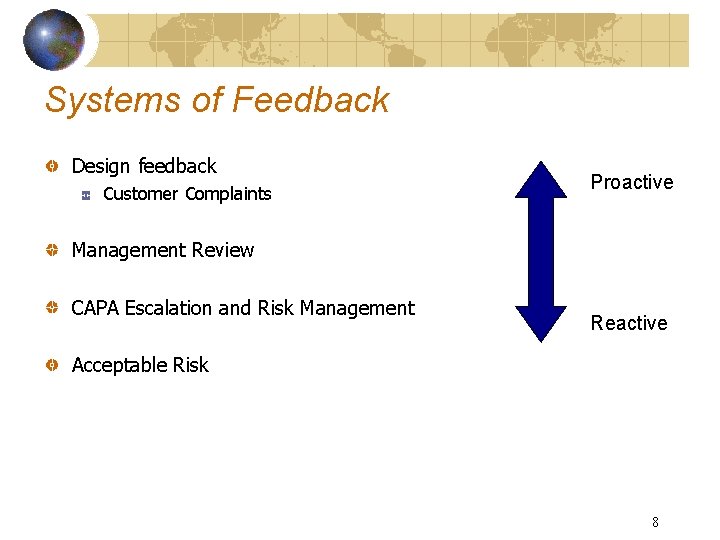
Systems of Feedback Design feedback Customer Complaints Proactive Management Review CAPA Escalation and Risk Management Reactive Acceptable Risk 8
Risk Management Challenges: No clear escalation from when an input reaches a threshold and when a CAPA is opened Risk assessment process/tool not established or well defined Combination products (e. g. , drug/devices) have shifted landscape Adverse events due to the drug/device interaction Procedural aspects of the case e. g. , new techniques or uses, incorrect technique CAPA process not linked to risk management documentation (Design Controls documents, process and product FMEAs, etc. ) Data not readily available to establish occurrence and therefore calculate risk 9
CAPA Escalation: Health Hazard Evaluations Complaint and MDRs provide inputs into health hazard evaluations (HHE) by characterizing: Observed or potential harm to the patient Relevant procedural issues Contributing anatomical or pharmacological factors Demographics of affected patients Comparison of risks associated with same hazards for competitive products or alternate treatment modality Ultimately, HHEs act as a risk-benefit analysis for post-launch issues to characterize the necessity for a CAPA and the need for field action 10
Acceptable Risk What is the acceptable risk problem? A decision process (Fischoff, et. al. 1981) that Specifies the objectives to measure the desirability or lack thereof Defines possible options, including no action Identifies the consequences of each option and likelihood of occurrence Specifying the desirability of consequences Analyzing the options and selecting the “most acceptable” option 11
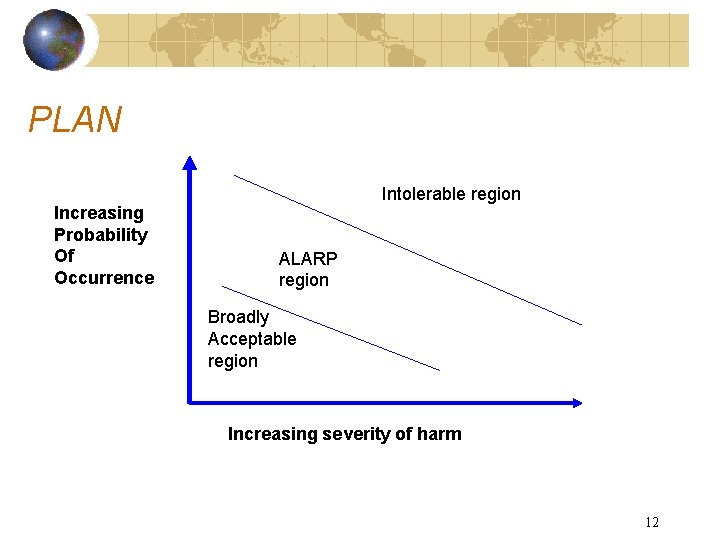
PLAN Increasing Probability Of Occurrence Intolerable region ALARP region Broadly Acceptable region Increasing severity of harm 12

BALANCE RISK BENEFIT 13
Why Risk as part of CAPA System? What is the impact of risk to the CAPA system? What hurdles will we encounter? 14
CAPA Escalation: Connecting Risk Management and Trending Critical questions that drive into the CAPA process and determine the depth of investigation/priority of CAPA: Is this a new or unknown hazard? Has the severity increased? Decreased? Has the frequency of occurrence increased? Have the causes of the hazard been confirmed? Are there new causes of the hazard that have inadequate or no mitigation? Complaint and MDR investigations and trends provide answers to many of the questions above 15
Why is CAPA important? 88% of all FDA Warning Letters and 483’s issued in 2003 were CAPA related 16
Key Definitions Nonconformance (NC) • Any noncompliance with the requirements of the Quality System (product and nonproduct). Correction • Repair, rework, or adjustment related to the disposition of an existing nonconformity. Corrections are typically one-time fixes. Corrective Action (CA) • Action taken to eliminate the causes of an existing nonconformity, defect, or other undesirable situation in order to prevent recurrence. Preventive Action (PA) • Action taken to eliminate the cause of a potential nonconformity, defect, or other undesirable situation in order to prevent occurrence and improve quality trends. 17
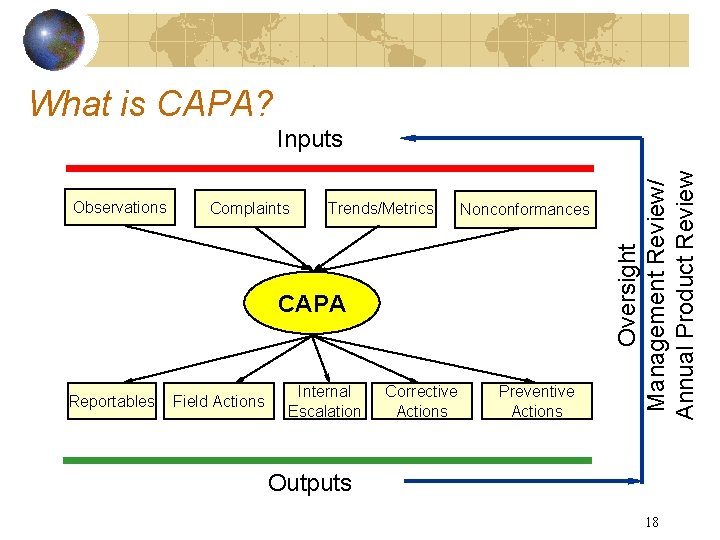
What is CAPA? Observations Complaints Trends/Metrics Nonconformances CAPA Reportables Field Actions Internal Escalation Corrective Actions Preventive Actions Oversight Management Review/ Annual Product Review Inputs Outputs 18
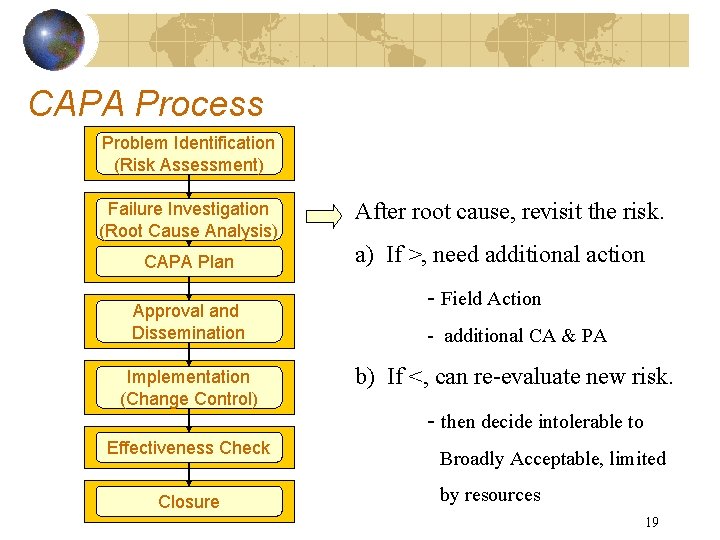
CAPA Process Problem Identification (Risk Assessment) Failure Investigation (Root Cause Analysis) CAPA Plan Approval and Dissemination Implementation (Change Control) Effectiveness Check Closure After root cause, revisit the risk. a) If >, need additional action - Field Action - additional CA & PA b) If <, can re-evaluate new risk. - then decide intolerable to Broadly Acceptable, limited by resources 19
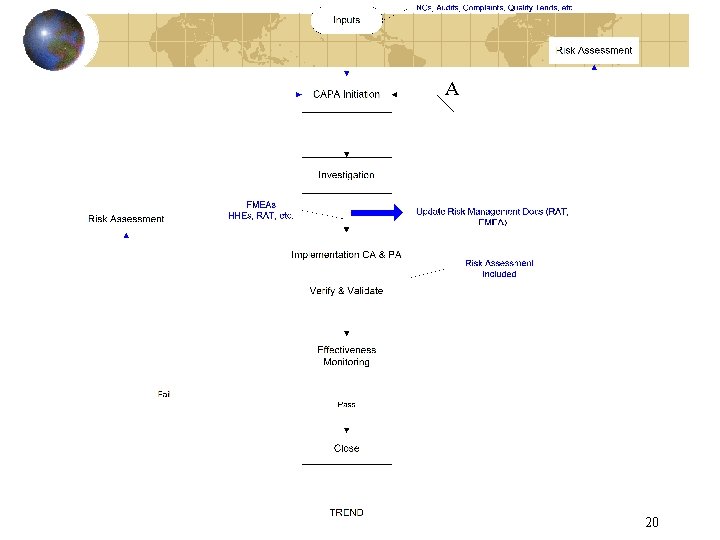
A 20
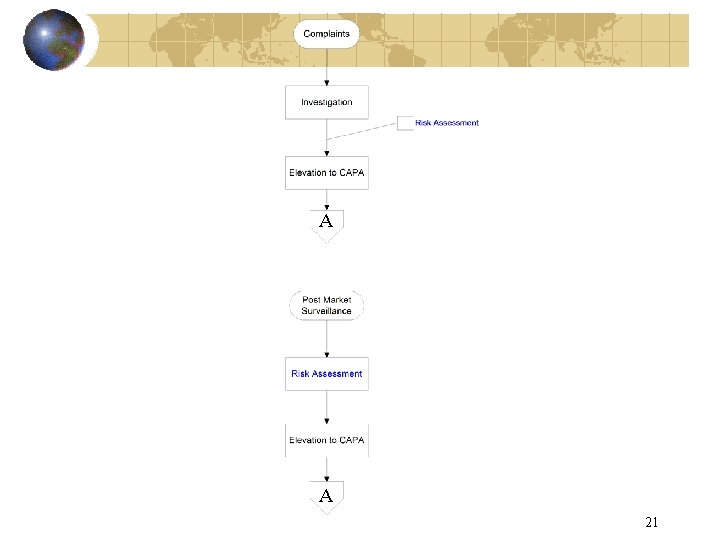
A A 21
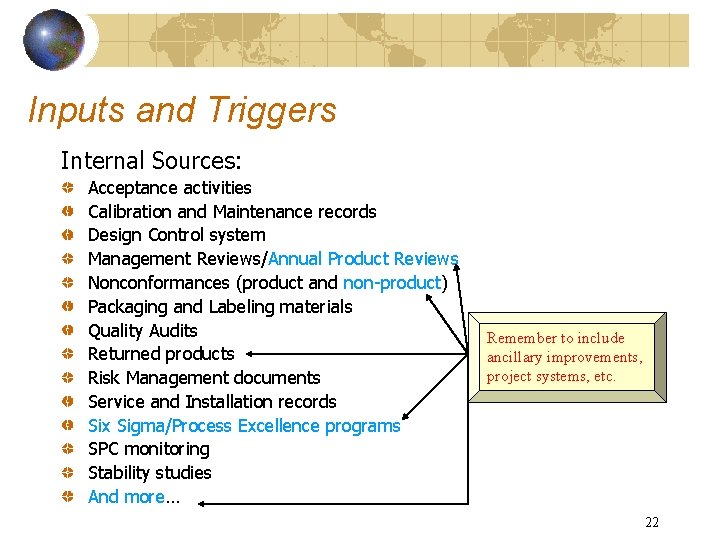
Inputs and Triggers Internal Sources: Acceptance activities Calibration and Maintenance records Design Control system Management Reviews/Annual Product Reviews Nonconformances (product and non-product) Packaging and Labeling materials Quality Audits Returned products Risk Management documents Service and Installation records Six Sigma/Process Excellence programs SPC monitoring Stability studies And more… Remember to include ancillary improvements, project systems, etc. 22
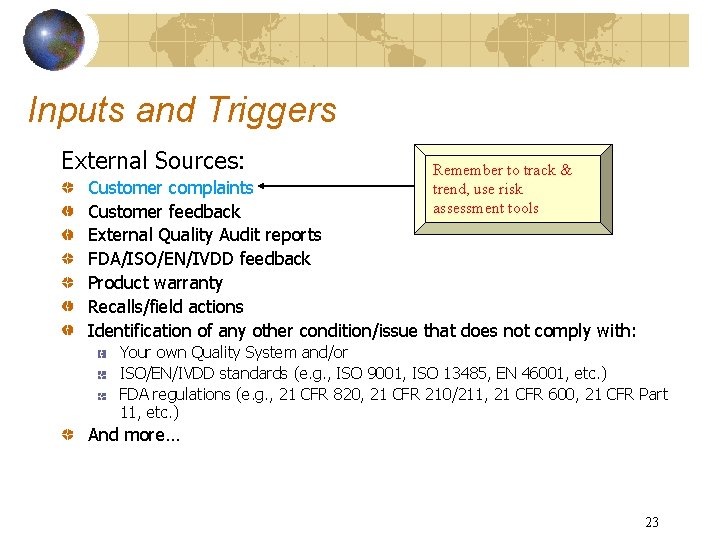
Inputs and Triggers External Sources: Remember to track & trend, use risk assessment tools Customer complaints Customer feedback External Quality Audit reports FDA/ISO/EN/IVDD feedback Product warranty Recalls/field actions Identification of any other condition/issue that does not comply with: Your own Quality System and/or ISO/EN/IVDD standards (e. g. , ISO 9001, ISO 13485, EN 46001, etc. ) FDA regulations (e. g. , 21 CFR 820, 21 CFR 210/211, 21 CFR 600, 21 CFR Part 11, etc. ) And more… 23
Inputs and Triggers Challenges: Inputs not clearly defined or established Trigger thresholds not established Focus on reactive metrics (Nonconformances, Complaints, Audit Observations) Data not easily retrievable Data not easy to analyze for trends 24
Root Cause Analysis Challenges: Poor/lack of technical skills to conduct root cause analysis Poor/lack of writing skills in documenting root cause analysis Poor/little business knowledge in conducting root cause analysis across processes, systems, product lines, and Quality Systems 25
Preventive Actions Challenges: When everything is corrective, how can the organization assign resources to address Preventive Action? Risk assessment may not be designed to address elevation to CAPA for a potential issue or improvement (Preventive Action). CAPA metrics tend to focus on closure rates, cycle time, number of open CAPAs, etc. Preventive Actions are, in most cases, longer-term solutions across processes, systems, product lines, and Quality Systems and will take more time to close. 26
From Corrective to Preventive – some suggestions: Inputs and Triggers Clearly define inputs and establish thresholds Implement predictive metrics/indicators Routinely review and act on sources of product and quality data Make data reporting available and easy to users and management 27
From Corrective to Preventive – some suggestions: Risk Management Establish elevation mechanisms to CAPA Use a risk assessment process to allow prioritization of CAPAs and elevation to Management Use a risk assessment process that allows CAPAs for Preventive Action Link CAPA to Risk Management documentation (e. g. , FMEAs, Design Control documents) Make data reporting available and easy to users and management 28
From Corrective to Preventive – some suggestions: Root Cause Analysis Establish clear roles and responsibilities for conducting investigation Increase technical skills on root cause analysis tools Improve writing skills Use team approach to conduct investigation to increase business and technical knowledge Align with Six Sigma/Process Excellence 29
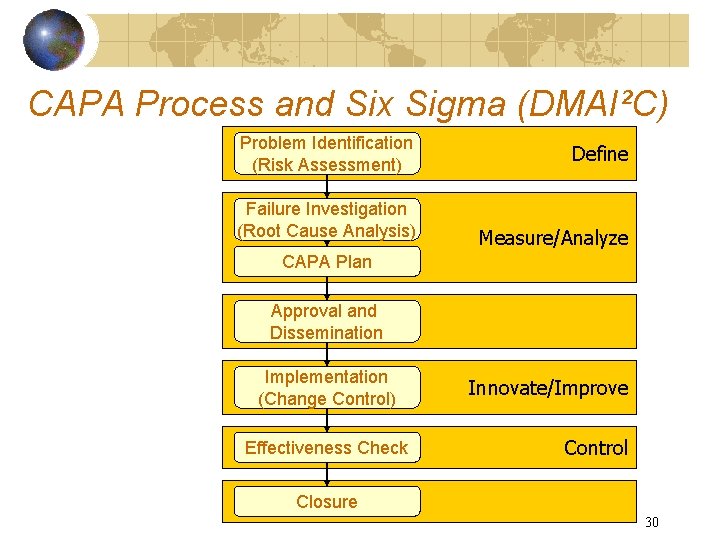
CAPA Process and Six Sigma (DMAI²C) Problem Identification (Risk Assessment) Failure Investigation (Root Cause Analysis) Define Measure/Analyze CAPA Plan Approval and Dissemination Implementation (Change Control) Effectiveness Check Innovate/Improve Control Closure 30
From Corrective to Preventive – some suggestions: Preventive Action Implement predictive metrics/indicators Routinely review and act on sources of product and quality data Use a risk assessment process that allows CAPAs for Preventive Action Improve linkage between CAPA into Design Controls Take a holistic view of issues Can it link to other Quality Systems, product lines, systems, and/or processes? 31
From Corrective to Preventive – some suggestions: CAPA Process Integrate, integrate across business solutions and across sites Streamline/Lean your CAPA process Implement a global process for all sites Establish technical and user support for your CAPA system Leverage sister companies for design and experience (lessons learned) Establish joint partnership between business/system owner and Information Technology for continuous improvement efforts Project team (business and Information Technology) need to be experts in the process as well as the software solution Take a holistic view of the CAPA process Does it link to other Quality Systems and business systems? 32
From Corrective to Preventive – some suggestions: Software Solution Integrate, integrate across software solutions and sites Implement a global software solution Establish technical and user support for your CAPA system Leverage sister companies for infrastructure and validation Ensure that the hardware is reliable and support users needs including connection time, processing speed, 24 x 7 availability, etc. Increase technical expertise and involvement from your software vendor during initial design and implementation phases Project team (business and Information Technology) need to be experts in the process as well as the software solution Take a holistic view of the CAPA process and software solution Can/does it link to other Quality Systems and business systems? 33
From Corrective to Preventive – some suggestions: Management Support and Oversight Ensure Management oversight and commitment Align CAPA with company, departmental, and individual goals and objectives Create rewards and recognition programs Establish joint partnership between business/system owner and Information Technology for continuous improvement efforts Align metrics from departmental to corporate level 34
Annual Product Review - Requirements Does it apply to devices? Yes, for combination devices such as, drug/device, biologics/device, etc. . q Written records subject to this review include, but are not limited to, the following: q Manufacturing and quality records from lots or batches of drug/device combination products manufactured within the previous year, including: – – – – receiving inspection in-process final release testing results deviations investigations change control records quality system trends 35
Annual Product Review (continued) q Post market quality records such as: – – – – complaints Medical Device Reporting (MDR) adverse events field actions product corrections regulatory submissions returned or salvaged products product stability data 36
Conclusions - Annual Product Review Covers the product cradle to grave. Presents management a view of product and process behavior over time. Is influenced by all aspects of the Quality System - including in process and release testing. Supports decisions related to design control, process validation and control as well as user drift. Identifies trends/opportunities across mfg lines or sites. 37
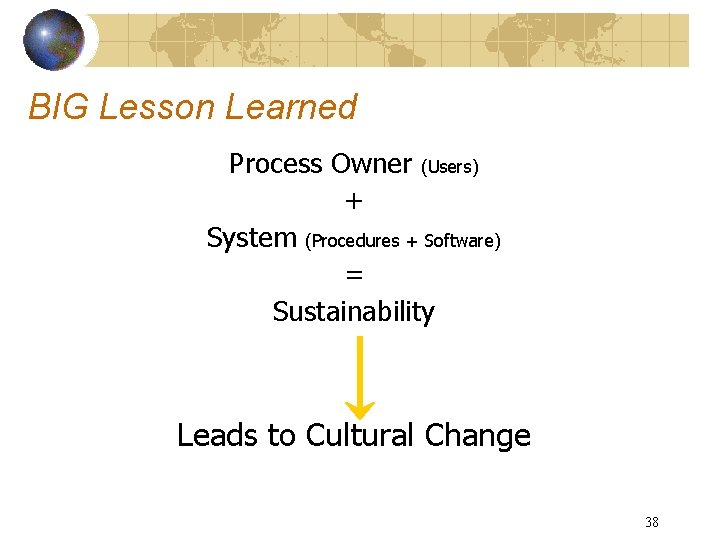
BIG Lesson Learned Process Owner (Users) + System (Procedures + Software) = Sustainability Leads to Cultural Change 38
Q&A Contact Info: Norman L. Collazo Cordis Corporation 14201 NW 60 th Avenue, Miami Lakes, FL 33014 Ncollaz 1@CRDUS. jnj. com 786. 313. 2266 39
Thanks go to: Miguel Avila - CAPA Director, Cordis John Daley - Executive Director Quality Systems, Cordis Bryan Olin - Executive Director Product Quality Services, Cordis Frances Akelewicz - Practical Solutions Many others over the years for their patience and guidance…. . 40
- Slides: 40