
Best Practices in the Question Formulation Technique QFT
+ Best Practices in the Question Formulation Technique (QFT) Sarah Westbrook Director of Professional Learning The Right Question Institute Dutchess BOCES Poughkeepsie 9/25/17 Doreen Boone-Pitcher Christine Murphy Hyde Park Public Schools
+ Today’s Agenda 1) Welcome and Community Building 2) Collaborative Learning with the Question Formulation Technique (QFT) 3) The Art and Science of the QFT 4) Lunch 5) Workshop Sessions 6) Advancing the Work: From Seminar to Action 7) Closing Reflections, Q&A, & Evaluations #QFTCon #QFT
+ We’re Tweeting… @Right. Question #QFTCon #QFT
+ To Access Today’s Materials: http: //rightquestion. org/educators/ seminar-resources/ Join our Educator Network for: Templates you can use tomorrow in class § Classroom Examples § Instructional Videos § Forums and Discussions with other Educators §

+ Review a Lesson Planning Workbook n Name some of the challenges of planning a lesson or session with the QFT. What part or pieces seems particularly tricky? n Look at how the workbook is structured. What do you notice? What seems helpful or useful about this planning tool? n What questions do you have about planning so far?
+ QFT: An ART and a SCIENCE The Science: A rigorous protocol, with specific steps and sequence, that produces consistent results The QFT 1. Discuss the rules 2. Present a Question Focus 3. Improve questions 4. Prioritize questions 5. Discuss next steps 6. Reflect
+ QFT: An ART and a SCIENCE The Art: Tailoring the QFT process to the specific content and students you are teaching. Tailor the QFT through: n. Design of the Question Focus (Qfocus) n. Instructions for prioritizing n. Next steps for using the questions n. Reflection questions n. Facilitation
+ Five Areas Related to the Art of the QFT 1. Linking the QFT to Teaching and Learning Goals 2. QFocus Design 3. Prioritization Instructions 4. Reflection Questions 5. Facilitation
+ The QFT as a Shortcut, Not a Detour
+ Various Teaching Purposes n. Engagement n. Knowledge acquisition n. Formative assessment n. Summative assessment n. Peer review n. Skill development
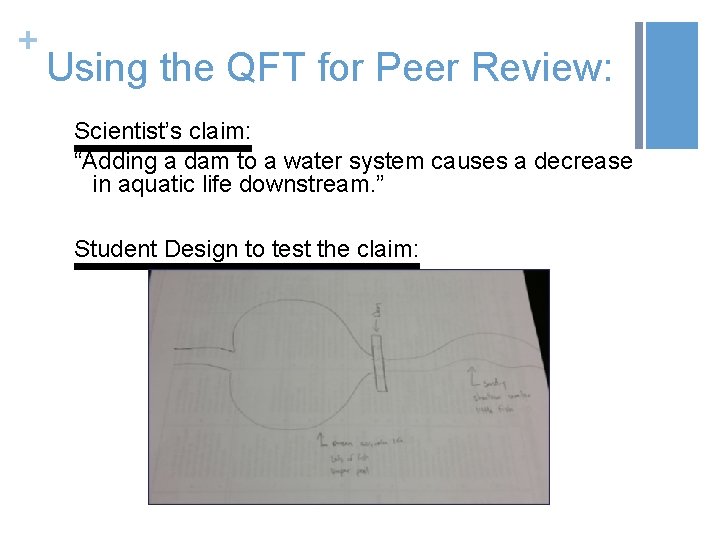
+ Using the QFT for Peer Review: Scientist’s claim: “Adding a dam to a water system causes a decrease in aquatic life downstream. ” Student Design to test the claim:

+ Next Steps:
+ Five Areas Related to the Art of the QFT 1. Linking the QFT to Teaching and Learning Goals 2. QFocus Design 3. Prioritization Instructions 4. Reflection Questions 5. Facilitation
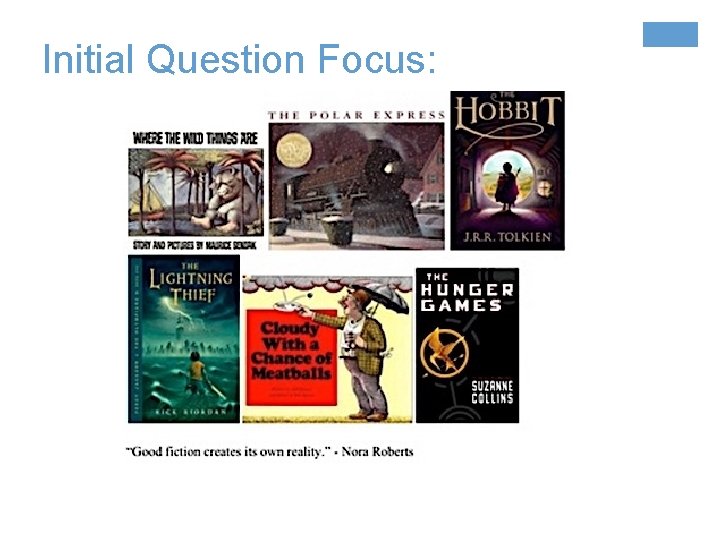
Initial Question Focus:
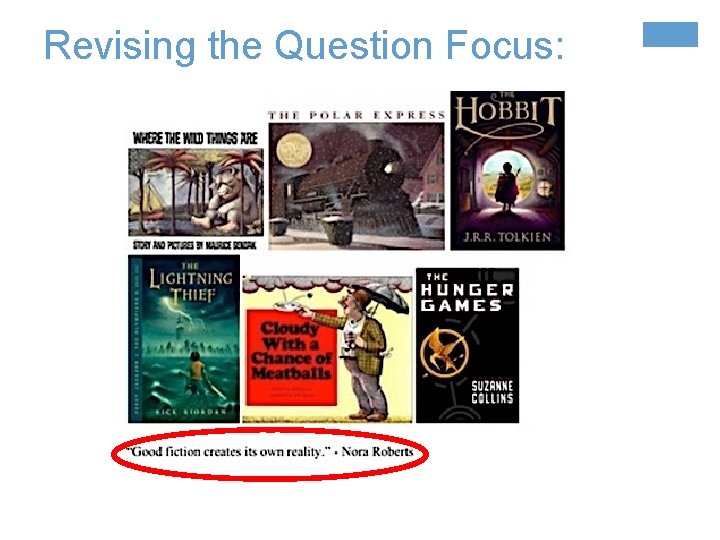
Revising the Question Focus:
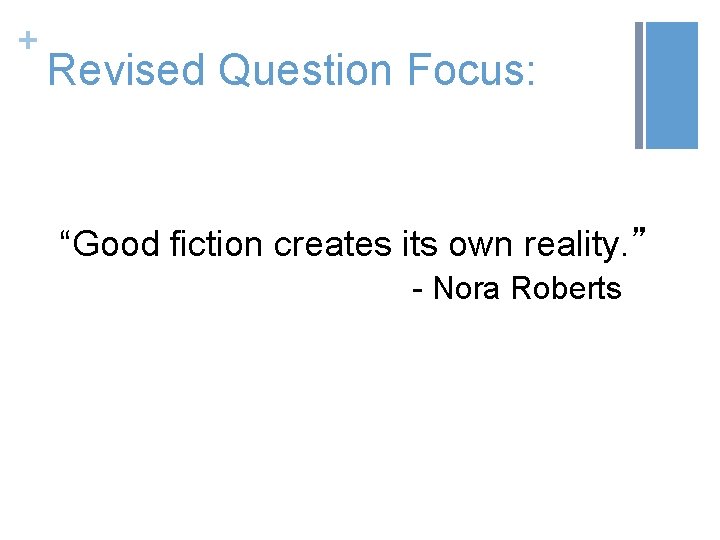
+ Revised Question Focus: “Good fiction creates its own reality. ” - Nora Roberts
+ Before reading The Plague by Albert Camus
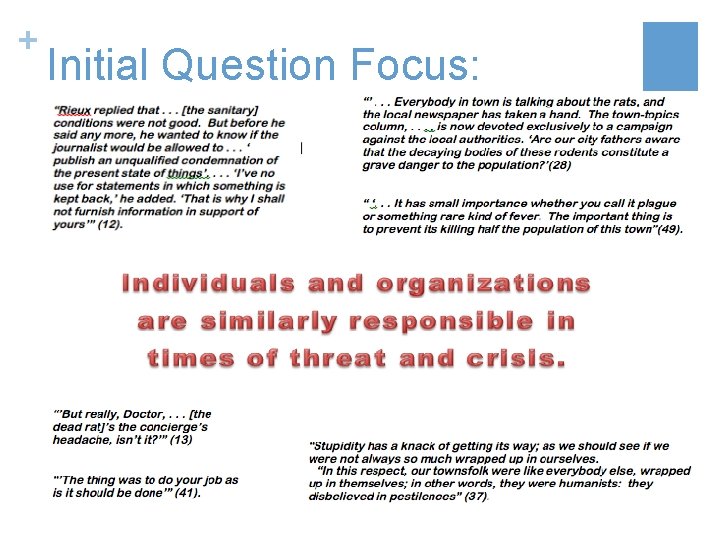
+ Initial Question Focus:
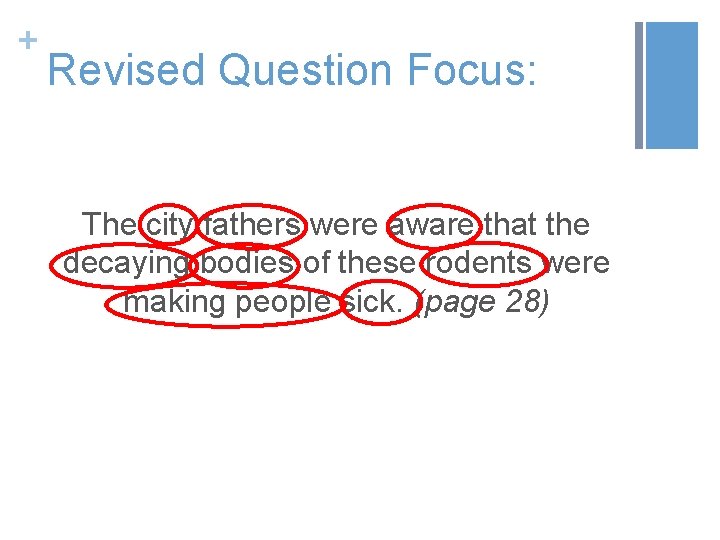
+ Revised Question Focus: The city fathers were aware that the decaying bodies of these rodents were making people sick. (page 28)
+ Question Focus Design: Moving From Complicated to Simple
+ Five Areas Related to the Art of the QFT 1. Linking the QFT to Teaching and Learning Goals 2. QFocus Design 3. Prioritization Instructions 4. Reflection Questions 5. Facilitation
+ Prioritization Instructions Choose three most important questions Choose three questions you consider most important.
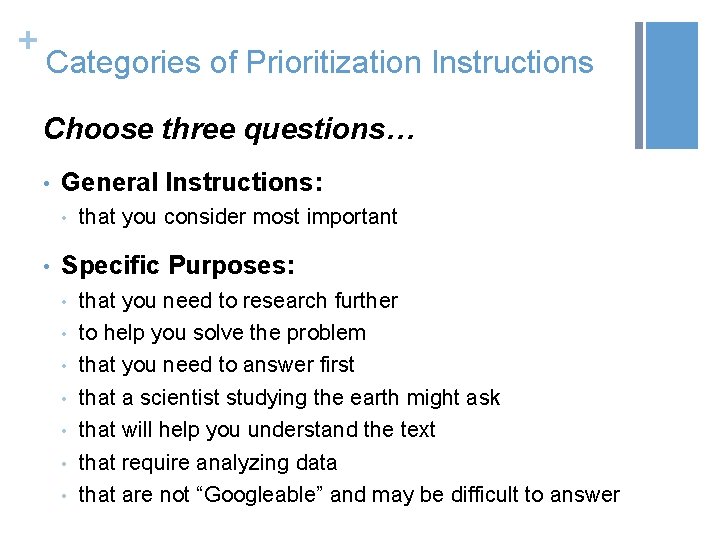
+ Categories of Prioritization Instructions Choose three questions… • General Instructions: • • that you consider most important Specific Purposes: • • that you need to research further to help you solve the problem that you need to answer first that a scientist studying the earth might ask that will help you understand the text that require analyzing data that are not “Googleable” and may be difficult to answer
+ Five Areas Related to the Art of the QFT 1. Linking the QFT to Teaching and Learning Goals 2. QFocus Design 3. Prioritization Instructions 4. Reflection Questions 5. Facilitation
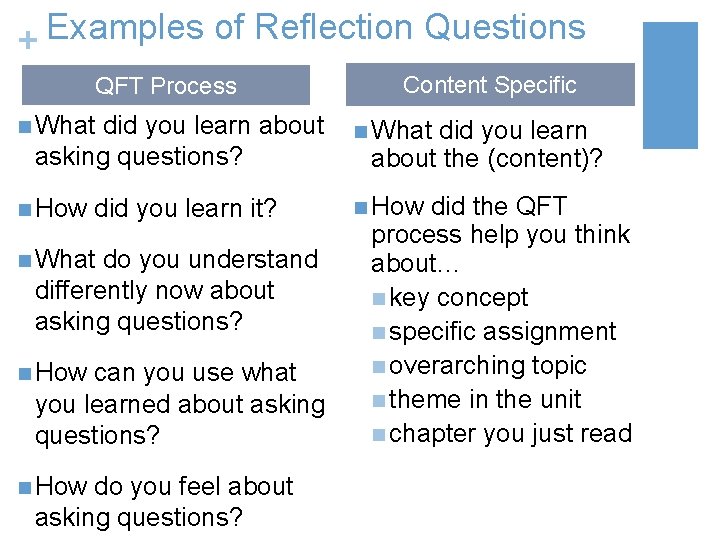
Examples of Reflection Questions + QFT Process n What did you learn about asking questions? n How did you learn it? n What do you understand differently now about asking questions? n How can you use what you learned about asking questions? n How do you feel about asking questions? Content Specific n What did you learn about the (content)? n How did the QFT process help you think about… n key concept n specific assignment n overarching topic n theme in the unit n chapter you just read
+ Five Areas Related to the Art of the QFT 1. Linking the QFT to Teaching and Learning Goals 2. QFocus Design 3. Prioritization Instructions 4. Reflection Questions 5. Facilitation
+ Four Principles of Facilitation 1. Monitor student adherence to the process 2. Do not give examples 3. Do not get pulled into group discussion 4. Acknowledge all contributions equally ØPair & Share: What could be challenging about each principle? What might be important about each?
+ The Science of the QFT: a protocol The Art of the QFT: You
+ Today’s Agenda 1) Welcome and Community Building 2) Collaborative Learning with the Question Formulation Technique (QFT) 3) The Art and Science of the QFT 4) Lunch 5) Workshop Sessions 6) Closing Reflections, Q&A, & Evaluations #QFTCon #QFT
+ Today’s Agenda 1) Welcome and Community Building 2) Collaborative Learning with the Question Formulation Technique (QFT) 3) The Art and Science of the QFT 4) Lunch 5) Workshop Sessions 6) Advancing the Work: From Seminar to Action 7) Closing Reflections, Q&A, & Evaluations #QFTCon #QFT
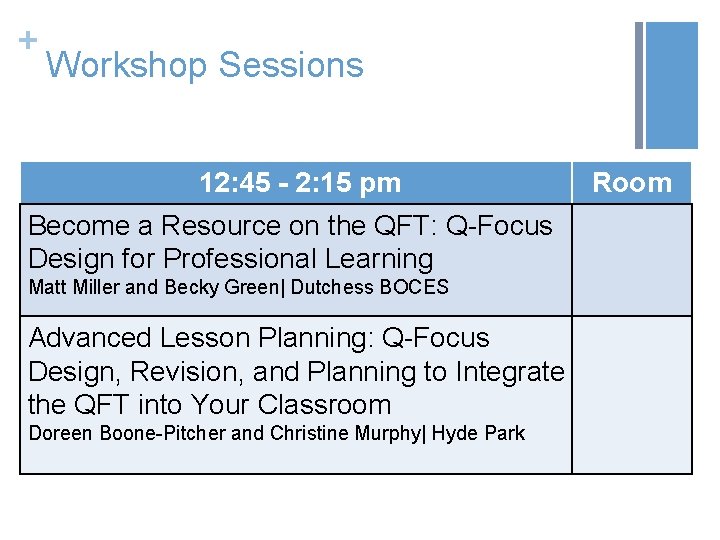
+ Workshop Sessions 12: 45 - 2: 15 pm Become a Resource on the QFT: Q-Focus Design for Professional Learning Room Matt Miller and Becky Green| Dutchess BOCES Advanced Lesson Planning: Q-Focus Design, Revision, and Planning to Integrate the QFT into Your Classroom Doreen Boone-Pitcher and Christine Murphy| Hyde Park
- Slides: 31