
Best Practices in ServiceLearning Impacting Student Success PAUL
Best Practices in Service-Learning: Impacting Student Success PAUL SCHMIDT, PHD ASSOCIATE PROFESSOR, PHYSICS, UNIVERSITY OF SAINT FRANCIS & CAITLIN KROUSE, DNP, FNP-BC, RN ASSISTANT PROFESSOR, NURSING, UNIVERSITY OF SAINT FRANCIS
Definition of Service-Learning Service-learning is an educational approach (pedagogy) that utilizes meaningful community service experiences and critical reflection to transform academic learning and encourage civic participation. Through service-learning, students are asked to apply academic skills and knowledge to “realworld” community needs, issues, or problems.

Service-Learning & Student Success • One of George Kuh’s “High Impact Educational Practices” leading to student success • It is particularly helpful to students from underrepresented populations • Students who participate in service-learning are more likely to: • • • ◦ • • • Earn higher grade point averages Work harder and be more engaged in their courses Persist from freshman to sophomore year Complete their college degree Be satisfied with their college experience Gain skills in communication, leadership, and collaboration Have a greater understanding of the complexity of social issues, such as racism, poverty, and oppression Be connected to their communities Be interested in future citizenship activities Choose careers that are impact service, public policy, and political work (and be more confident in their career choice)
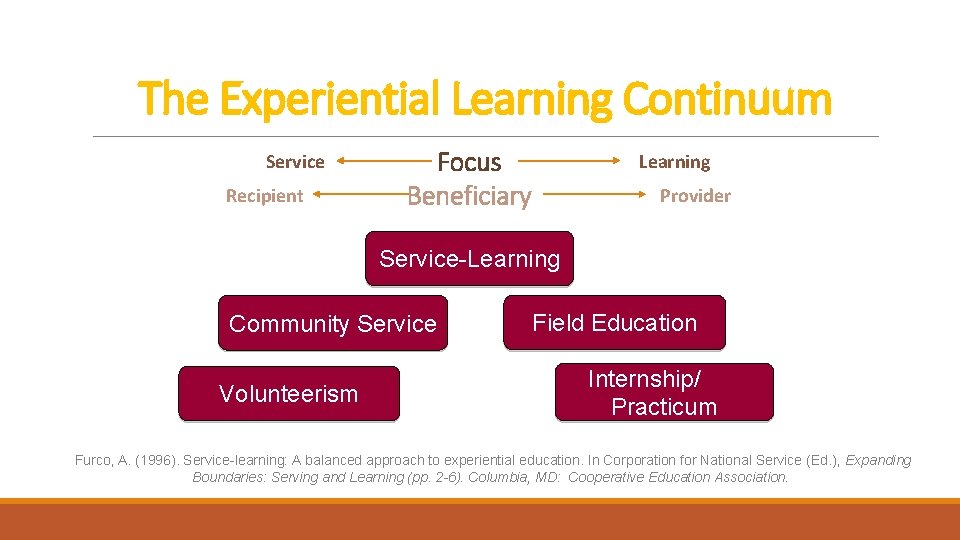
The Experiential Learning Continuum Service Recipient Focus Beneficiary Learning Provider Service-Learning Community Service Volunteerism Field Education Internship/ Practicum Furco, A. (1996). Service-learning: A balanced approach to experiential education. In Corporation for National Service (Ed. ), Expanding Boundaries: Serving and Learning (pp. 2 -6). Columbia, MD: Cooperative Education Association.
Best Practices in Service-Learning • It meets a recognized need/concern in the community • It is done in collaboration with community partners • Outcomes for the Service-Learning experience are tied to curricular outcomes • Reflection is done before, during, and after service experience • It promotes social/civic responsibility and dedication to social change • Service-learning is assessed and evaluated
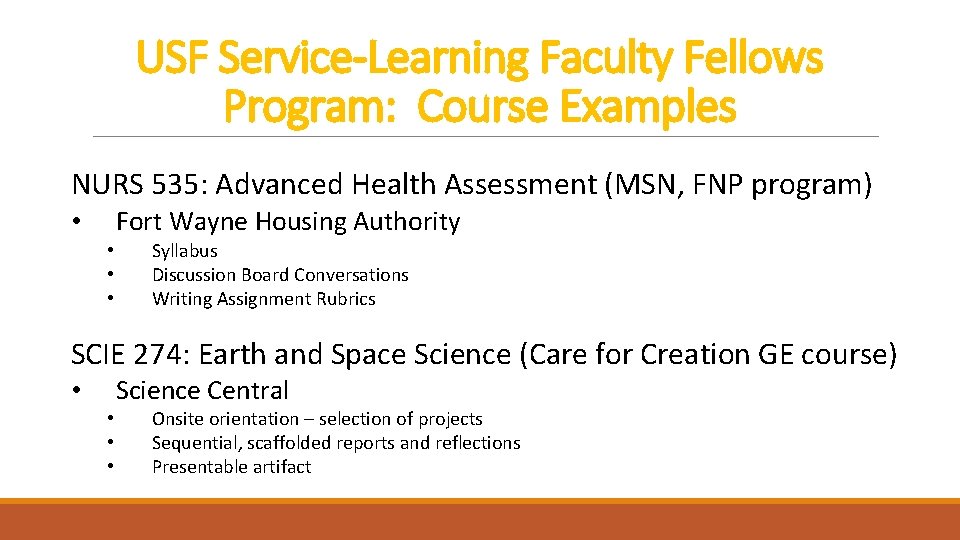
USF Service-Learning Faculty Fellows Program: Course Examples NURS 535: Advanced Health Assessment (MSN, FNP program) Fort Wayne Housing Authority • • Syllabus Discussion Board Conversations Writing Assignment Rubrics SCIE 274: Earth and Space Science (Care for Creation GE course) Science Central • • Onsite orientation – selection of projects Sequential, scaffolded reports and reflections Presentable artifact
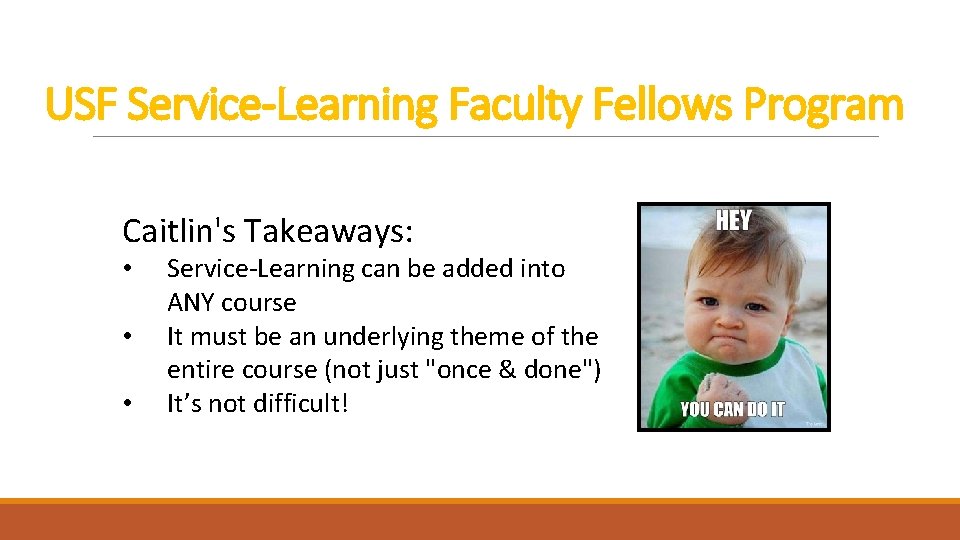
USF Service-Learning Faculty Fellows Program Caitlin's Takeaways: • • • Service-Learning can be added into ANY course It must be an underlying theme of the entire course (not just "once & done") It’s not difficult!
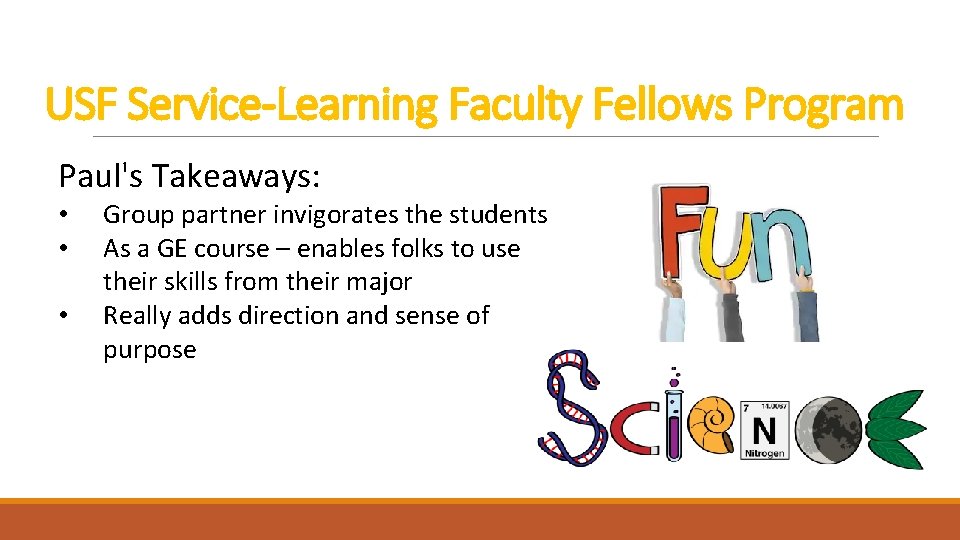
USF Service-Learning Faculty Fellows Program Paul's Takeaways: • • • Group partner invigorates the students As a GE course – enables folks to use their skills from their major Really adds direction and sense of purpose
References & Resources Bringle, R. G. , Hatcher, J. A. , Muthiah, R. N. (2010). The role of service-learning in the retention of first-year students to second year. Michigan Journal of Community Service Learning, 16(2), 38 -49. Cress, C. M. , Burack, C. , Giles, D. E. , Elkins, J. , & Stevens, M. C. (2010). A promising connection: Increasing college access and success through civic engagement. Boston: Campus Compact. Gallini, S. , & Moely, B. (2003). Service-learning and engagement, academic challenge, and retention. Michigan Journal of Community Service Learning, 10(1), 5– 14. Howard, Jeffery (2001). Service-learning course design workbook. Michigan Journal of Community Service Learning. Jacoby, B. (2015). Service-learning essentials: Questions, answers, and lessons learned. San Francisco: Jossey-Bass Keup, J. R. (2005). The impact of curricular interventions on intended second-year enrollment. Journal of College Student Retention, 7(1 -2), 61 -89. Lockeman, K. S. , & Pelco, L. E. (2013). The relationship between service-learning and degree completion. Michigan Journal of Community Service Learning, 20(1), 18 -30. Northwest Service Academy (2001). Reflection Toolkit. Retrieved from https: //forumea. org/wp-content/uploads/2018/04/ST-Reflection-Toolkit. pdf Reed, S. C. , Rosenberg, H. , Statham, A. , & Rosing, H. (2015). The effect of community service learning on undergraduate persistence in three institutional contexts. Michigan Journal of Community Service Learning, 21(2), 22 -36.
- Slides: 9