
BEST PRACTICES IN PROCUREMENT IN MINISTRY OF DEFENCE
BEST PRACTICES IN PROCUREMENT IN MINISTRY OF DEFENCE
LIMITATIONS • Discussion restricted to Capital Acquisition • Largely relevant to Stores procurement HOWEVER • Ø Ø Ø We can adopt certain practices that suit : Both Works and Stores tenders Processing and decision making on Capital projects Specifications and standardization of scales
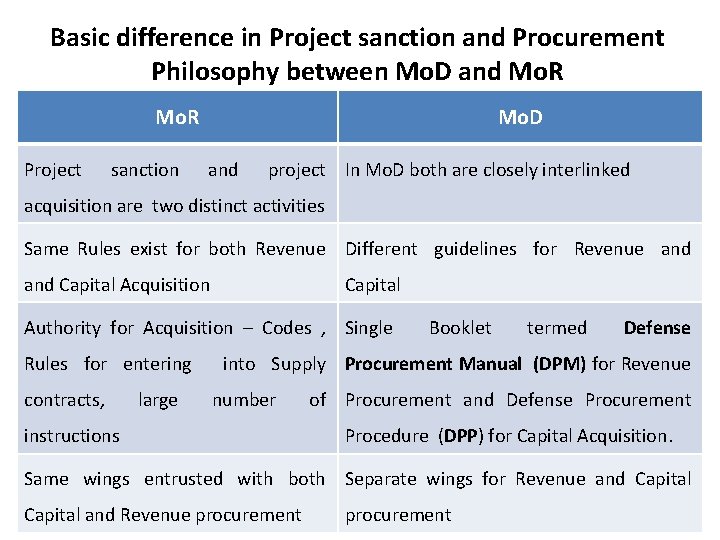
Basic difference in Project sanction and Procurement Philosophy between Mo. D and Mo. R Project sanction Mo. D and project In Mo. D both are closely interlinked acquisition are two distinct activities Same Rules exist for both Revenue Different guidelines for Revenue and Capital Acquisition Capital Authority for Acquisition – Codes , Single Booklet termed Defense Rules for entering into Supply Procurement Manual (DPM) for Revenue contracts, large number instructions of Procurement and Defense Procurement Procedure (DPP) for Capital Acquisition. Same wings entrusted with both Separate wings for Revenue and Capital and Revenue procurement
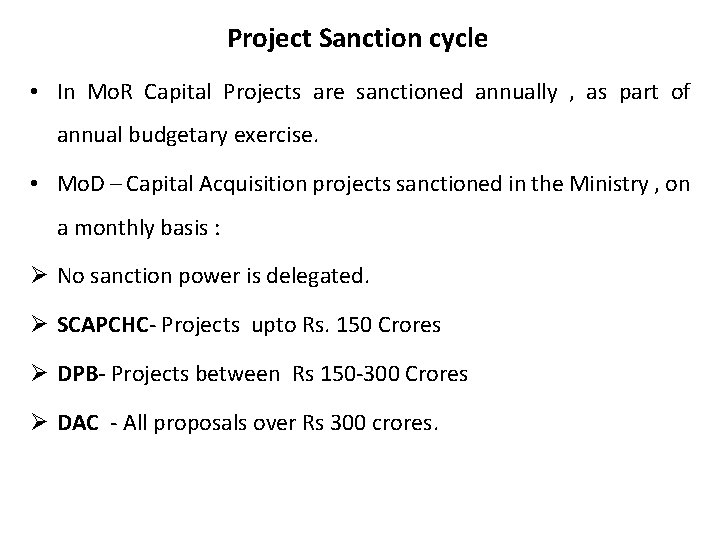
Project Sanction cycle • In Mo. R Capital Projects are sanctioned annually , as part of annual budgetary exercise. • Mo. D – Capital Acquisition projects sanctioned in the Ministry , on a monthly basis : Ø No sanction power is delegated. Ø SCAPCHC- Projects upto Rs. 150 Crores Ø DPB- Projects between Rs 150 -300 Crores Ø DAC - All proposals over Rs 300 crores.
BENEFITS • Capital Acquisition planning is a regular activity unlike Railways where it is reduced to an annual activity and a budgetary exercise. • There is possibility for review, discussion and remedy before final acceptance. • All stakeholders get adequate time to respond and if need be, seek amendments. SUGGESTIONS • A system of monthly examination of projects , to be consolidated in Pink Book for the Annual Budget. Will permit detailed examination and remediation before approval. Current practice of “CONVINCE OR PERISH “ disappears.
Prerequisites for Processing Capital Acquisition Cases • PLANNING • SCALING • SPECIFICATIONS • MODE OF PROCUREMENT
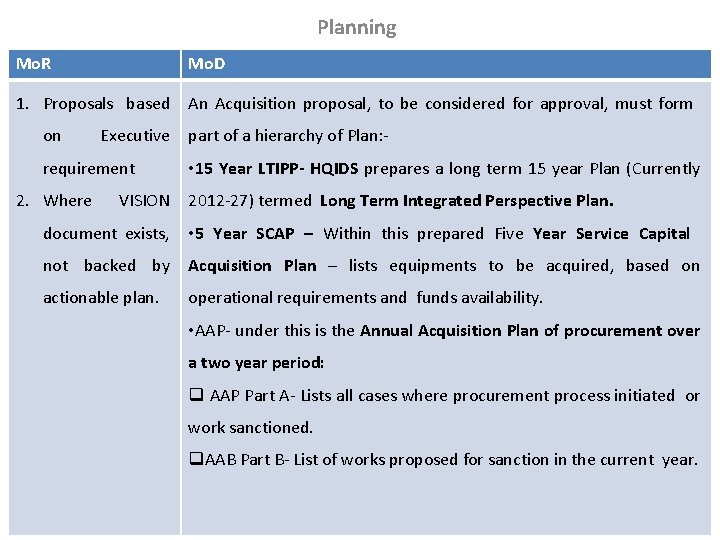
Planning Mo. R Mo. D 1. Proposals based An Acquisition proposal, to be considered for approval, must form on Executive part of a hierarchy of Plan: - requirement 2. Where • 15 Year LTIPP- HQIDS prepares a long term 15 year Plan (Currently VISION 2012 -27) termed Long Term Integrated Perspective Plan. document exists, • 5 Year SCAP – Within this prepared Five Year Service Capital not backed by Acquisition Plan – lists equipments to be acquired, based on actionable plan. operational requirements and funds availability. • AAP- under this is the Annual Acquisition Plan of procurement over a two year period: q AAP Part A- Lists all cases where procurement process initiated or work sanctioned. q. AAB Part B- List of works proposed for sanction in the current year.
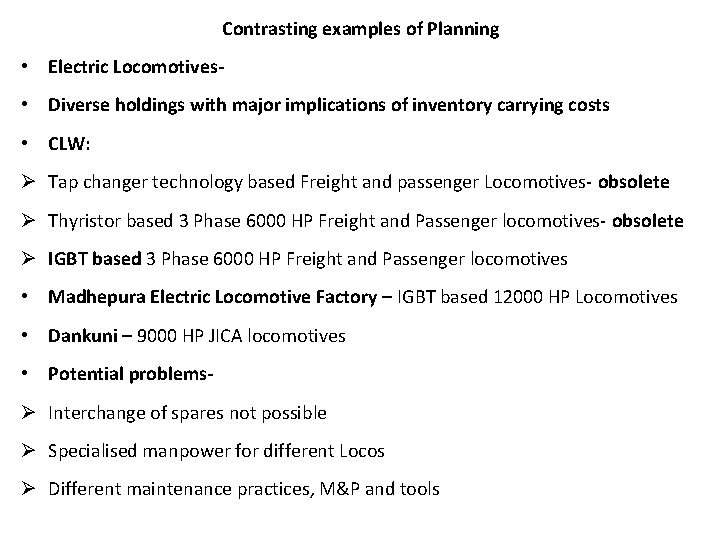
Contrasting examples of Planning • Electric Locomotives • Diverse holdings with major implications of inventory carrying costs • CLW: Ø Tap changer technology based Freight and passenger Locomotives- obsolete Ø Thyristor based 3 Phase 6000 HP Freight and Passenger locomotives- obsolete Ø IGBT based 3 Phase 6000 HP Freight and Passenger locomotives • Madhepura Electric Locomotive Factory – IGBT based 12000 HP Locomotives • Dankuni – 9000 HP JICA locomotives • Potential problemsØ Interchange of spares not possible Ø Specialised manpower for different Locos Ø Different maintenance practices, M&P and tools
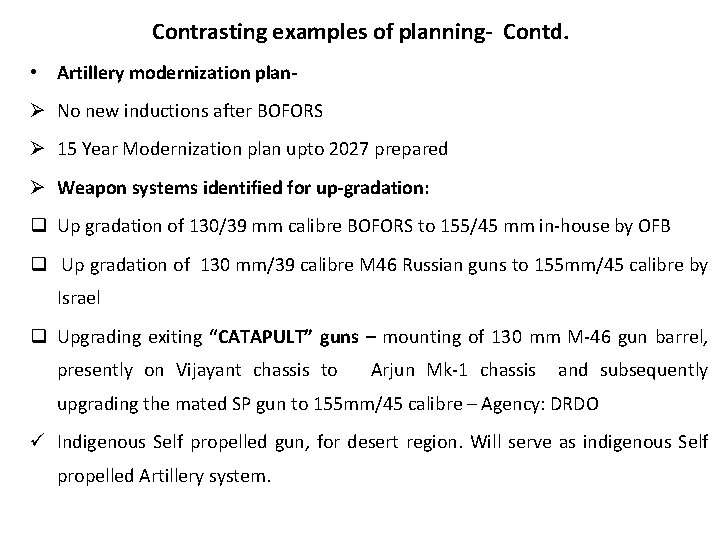
Contrasting examples of planning- Contd. • Artillery modernization planØ No new inductions after BOFORS Ø 15 Year Modernization plan upto 2027 prepared Ø Weapon systems identified for up-gradation: q Up gradation of 130/39 mm calibre BOFORS to 155/45 mm in-house by OFB q Up gradation of 130 mm/39 calibre M 46 Russian guns to 155 mm/45 calibre by Israel q Upgrading exiting “CATAPULT” guns – mounting of 130 mm M-46 gun barrel, presently on Vijayant chassis to Arjun Mk-1 chassis and subsequently upgrading the mated SP gun to 155 mm/45 calibre – Agency: DRDO ü Indigenous Self propelled gun, for desert region. Will serve as indigenous Self propelled Artillery system.
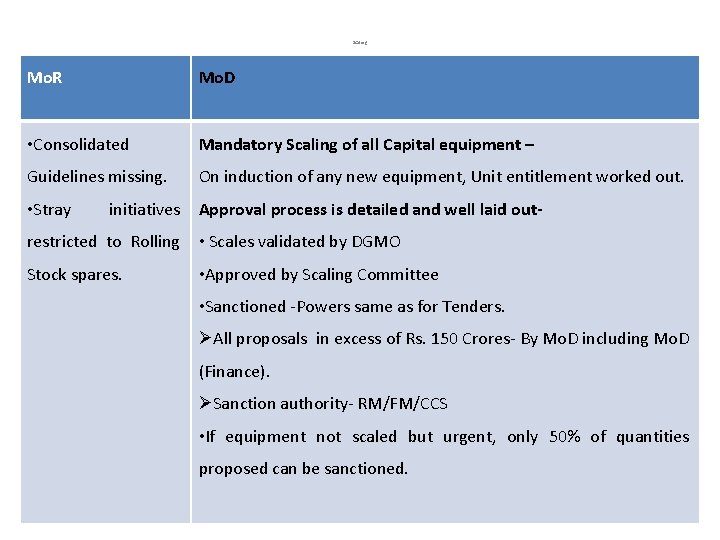
Scaling Mo. R Mo. D • Consolidated Mandatory Scaling of all Capital equipment – Guidelines missing. On induction of any new equipment, Unit entitlement worked out. • Stray initiatives Approval process is detailed and well laid out- restricted to Rolling • Scales validated by DGMO Stock spares. • Approved by Scaling Committee • Sanctioned -Powers same as for Tenders. ØAll proposals in excess of Rs. 150 Crores- By Mo. D including Mo. D (Finance). ØSanction authority- RM/FM/CCS • If equipment not scaled but urgent, only 50% of quantities proposed can be sanctioned.
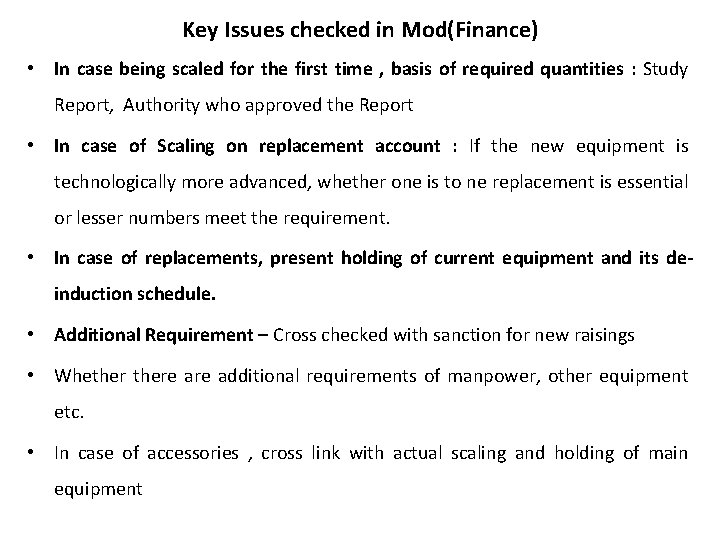
Key Issues checked in Mod(Finance) • In case being scaled for the first time , basis of required quantities : Study Report, Authority who approved the Report • In case of Scaling on replacement account : If the new equipment is technologically more advanced, whether one is to ne replacement is essential or lesser numbers meet the requirement. • In case of replacements, present holding of current equipment and its deinduction schedule. • Additional Requirement – Cross checked with sanction for new raisings • Whethere additional requirements of manpower, other equipment etc. • In case of accessories , cross link with actual scaling and holding of main equipment
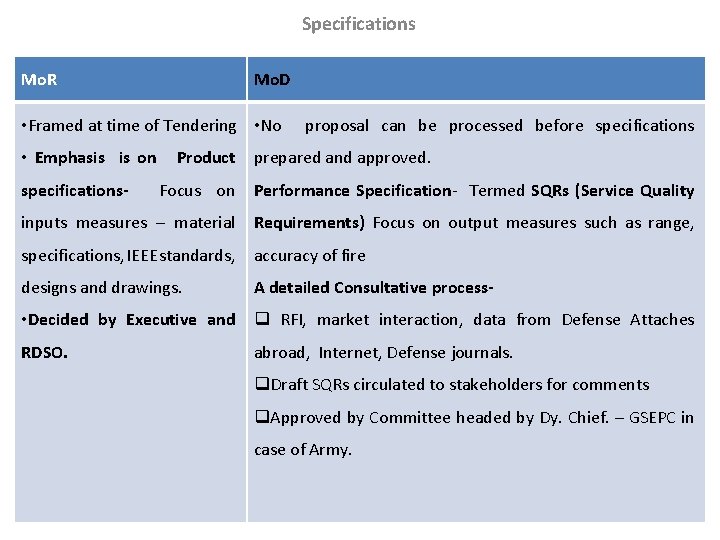
Specifications Mo. R Mo. D • Framed at time of Tendering • No proposal can be processed before specifications • Emphasis is on specifications- Product prepared and approved. Focus on Performance Specification- Termed SQRs (Service Quality inputs measures – material Requirements) Focus on output measures such as range, specifications, IEEE standards, accuracy of fire designs and drawings. A detailed Consultative process- • Decided by Executive and q RFI, market interaction, data from Defense Attaches RDSO. abroad, Internet, Defense journals. q. Draft SQRs circulated to stakeholders for comments q. Approved by Committee headed by Dy. Chief. – GSEPC in case of Army.

Negatives and Positives of Product vs. Performance Specifications Mo. R- Product Specifications Mo. D- Performance Specifications Benefits: Match offer against requirement. Stringent trials Quick Tender Finalization No failure in performance Drawbacks- Tender finalization delayed • NCNC trials reduce Vendor Subjectivity where most not all specs met. Ø My experience with RDSO TRs and Kolkata Metro • Specification finalization purely domain Executive + RDSO/PUs. • Wider consultation absent, even for new products. • CVC guidelines for new complex products being violated. participation. of • TC has little leeway to discharge a tender.
CVC CIRCULAR NO 01/02/11 ON TRASNPARENCY IN TENDERING SYSTEM • Where plant/equipment to be procured is of complex nature and procuring organization does not possess full knowledge: Ø Float expression of interest Ø Finalise specifications after technical discussions with reputed manufacturers/ suppliers and other stakeholders. Ø Then invite techno-commercial offer. • DPP provisions relating to finalization of GSQRs are in line with this. • In Mo. R, such concept missing. Technical discussions held at pre-bid stage. • Pre-bid is not meant to revisit tender criteria but we often treat it as such. • Case of Coaches for Kolkata Metro- changes in eligibility requirement after pre-bid.

Mode of Procurement • DPP recognises different modes of procurement and lays down the preferred hierarchy. • Proposal must justify a given choice • First necessity : Single versus multi-vendor bid Ø Justify Single Vendor bid Ø In case of multi vendor proposal, include results of RFI showing Vendors who responded and their suitability in the technical compliance matrix. • Second necessity : Source of Procurement in declining preference Ø Buy Indian - at least 30% indigenous content on total cost basis Ø Buy Global with To. T Ø Buy Global
Additional Facts on Modes of Procurement • Inter-Governmental Agreements- Normal rules of tender discarded and Agreement between the Indian and the selling Government. • We have a large order value of procurement with US Government under their foreign Management Sales (FMS). Ø Currently 32 cases for USD 7. 2 Billion Ø All negotiations and Agreements between US Government (USG) and Mo. D. Ø USG does procurement from their sources (Private suppliers) on behalf of Go. I. Ø All normal rules of Government procurement , applicable to US procurements, also followed for FMS cases. Ø Benefits- Transparency, ease of mind being Govt. to Govt. procurement, no need for export licenses.
Suggestions • Scaling : Ø There is need to identify units/ structures where uniform yardsticks in terms of manpower, hierarchy, vehicles, tools, M&P, spares etc can be uniformly laid down Eg- Loco Sheds, Track Machine Depots, Coaching depots etc. Ø Uniformity of resources will lead to common practices across units, proliferation of best practices, efficiencies. • Specifications-We should shift to a mix of both Product and Performance specifications Ø Product specifications ideal for equipment already inducted Ø Performance specifications suited for new products/technologies and EPC Contracts Ø Story of first 132 Traction Motors of 22 ABB Locomotives.
Procurement Strategy • Mo. D differentiates between “COTS – Commercially off the shelf item” and specialised item where SQRs framed • For COTS item – DGS&D or Open Tender • For specialised items, the normal mode of procurement is based on “Special Limited Tender” Mode- Ø Vendor identification through the net and existing list available, before any proposal. Ø RFP issued to Vendors who respond to RFI, substantially meet the commercial compliance matrix i. e QR parameters specified in the RFI • Preference is to minimise variety, to keep inventory costs low, ensure ease of use and training. Example- Heavy mobility vehicles (HMV)– Earlier BEML’s TATRA • Now all HMV 6 x 6 will be Tata Motors and 8 x 8 will be Ashok Leyland
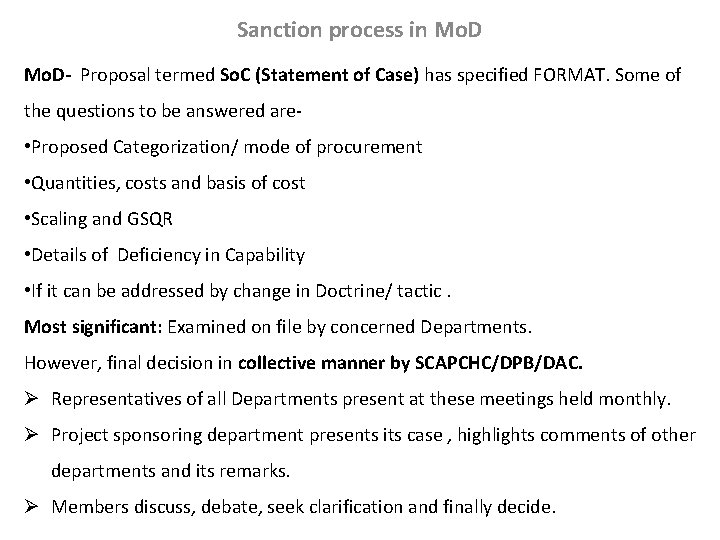
Sanction process in Mo. D- Proposal termed So. C (Statement of Case) has specified FORMAT. Some of the questions to be answered are- • Proposed Categorization/ mode of procurement • Quantities, costs and basis of cost • Scaling and GSQR • Details of Deficiency in Capability • If it can be addressed by change in Doctrine/ tactic. Most significant: Examined on file by concerned Departments. However, final decision in collective manner by SCAPCHC/DPB/DAC. Ø Representatives of all Departments present at these meetings held monthly. Ø Project sponsoring department presents its case , highlights comments of other departments and its remarks. Ø Members discuss, debate, seek clarification and finally decide.
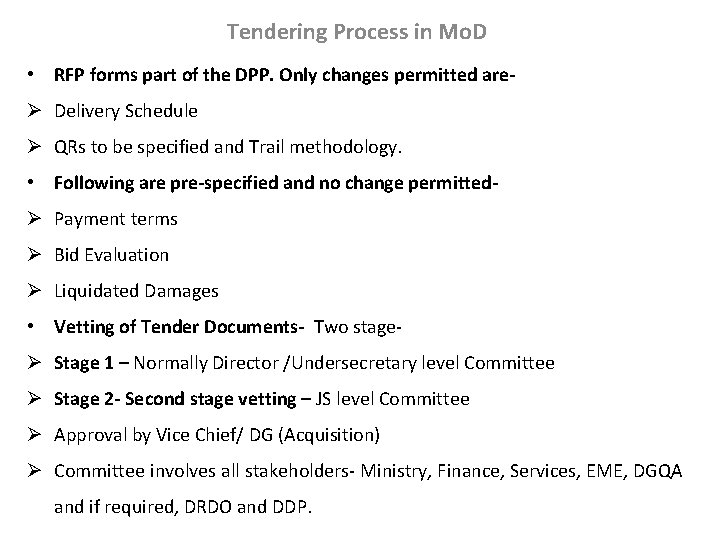
Tendering Process in Mo. D • RFP forms part of the DPP. Only changes permitted areØ Delivery Schedule Ø QRs to be specified and Trail methodology. • Following are pre-specified and no change permittedØ Payment terms Ø Bid Evaluation Ø Liquidated Damages • Vetting of Tender Documents- Two stageØ Stage 1 – Normally Director /Undersecretary level Committee Ø Stage 2 - Second stage vetting – JS level Committee Ø Approval by Vice Chief/ DG (Acquisition) Ø Committee involves all stakeholders- Ministry, Finance, Services, EME, DGQA and if required, DRDO and DDP.
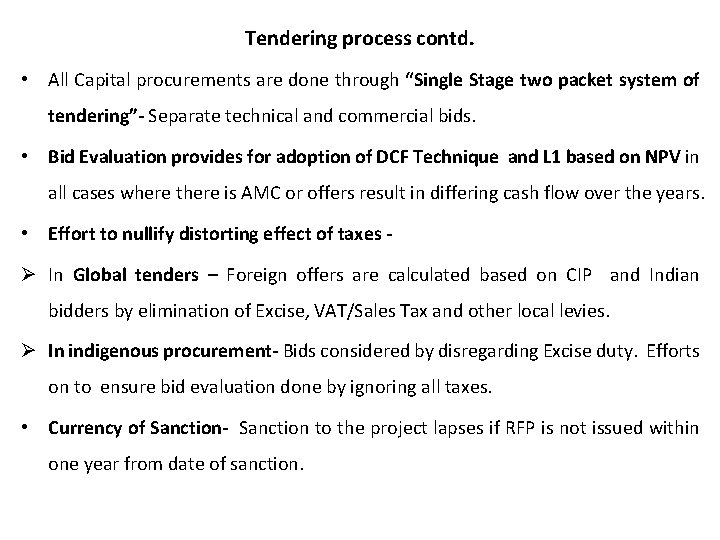
Tendering process contd. • All Capital procurements are done through “Single Stage two packet system of tendering”- Separate technical and commercial bids. • Bid Evaluation provides for adoption of DCF Technique and L 1 based on NPV in all cases where there is AMC or offers result in differing cash flow over the years. • Effort to nullify distorting effect of taxes Ø In Global tenders – Foreign offers are calculated based on CIP and Indian bidders by elimination of Excise, VAT/Sales Tax and other local levies. Ø In indigenous procurement- Bids considered by disregarding Excise duty. Efforts on to ensure bid evaluation done by ignoring all taxes. • Currency of Sanction- Sanction to the project lapses if RFP is not issued within one year from date of sanction.
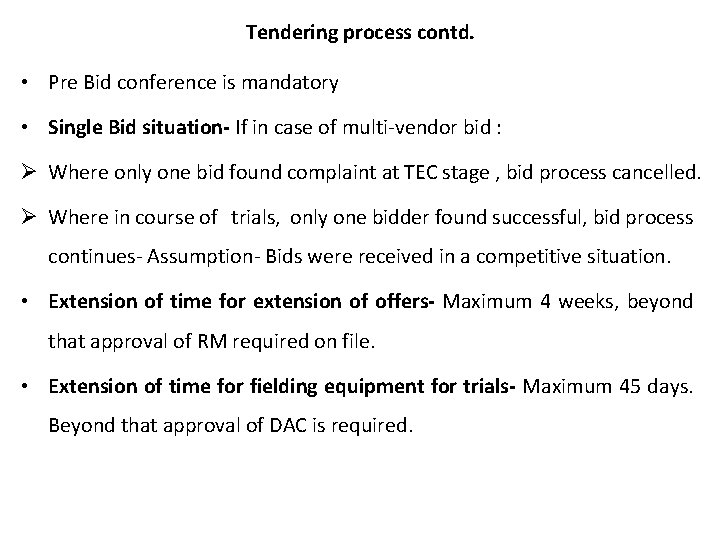
Tendering process contd. • Pre Bid conference is mandatory • Single Bid situation- If in case of multi-vendor bid : Ø Where only one bid found complaint at TEC stage , bid process cancelled. Ø Where in course of trials, only one bidder found successful, bid process continues- Assumption- Bids were received in a competitive situation. • Extension of time for extension of offers- Maximum 4 weeks, beyond that approval of RM required on file. • Extension of time for fielding equipment for trials- Maximum 45 days. Beyond that approval of DAC is required.
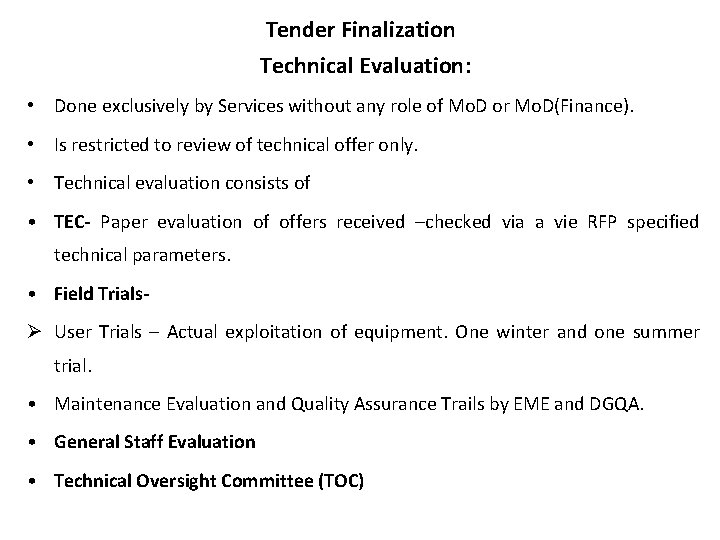
Tender Finalization Technical Evaluation: • Done exclusively by Services without any role of Mo. D or Mo. D(Finance). • Is restricted to review of technical offer only. • Technical evaluation consists of • TEC- Paper evaluation of offers received –checked via a vie RFP specified technical parameters. • Field TrialsØ User Trials – Actual exploitation of equipment. One winter and one summer trial. • Maintenance Evaluation and Quality Assurance Trails by EME and DGQA. • General Staff Evaluation • Technical Oversight Committee (TOC)
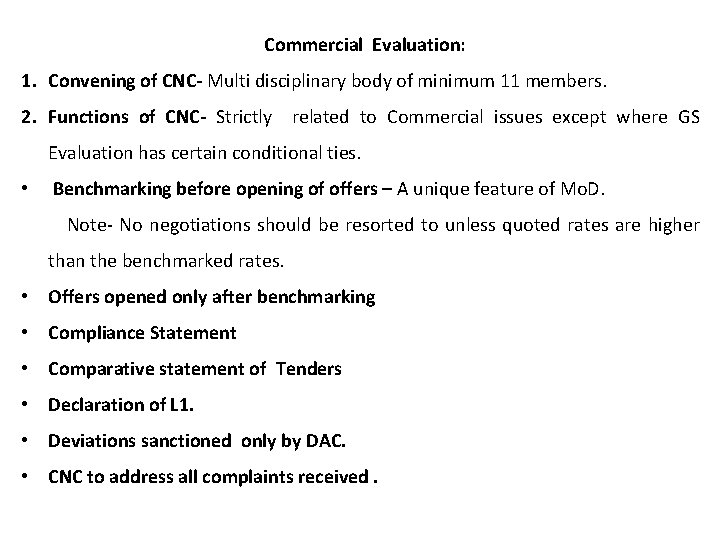
Commercial Evaluation: 1. Convening of CNC- Multi disciplinary body of minimum 11 members. 2. Functions of CNC- Strictly related to Commercial issues except where GS Evaluation has certain conditional ties. • Benchmarking before opening of offers – A unique feature of Mo. D. Note- No negotiations should be resorted to unless quoted rates are higher than the benchmarked rates. • Offers opened only after benchmarking • Compliance Statement • Comparative statement of Tenders • Declaration of L 1. • Deviations sanctioned only by DAC. • CNC to address all complaints received.
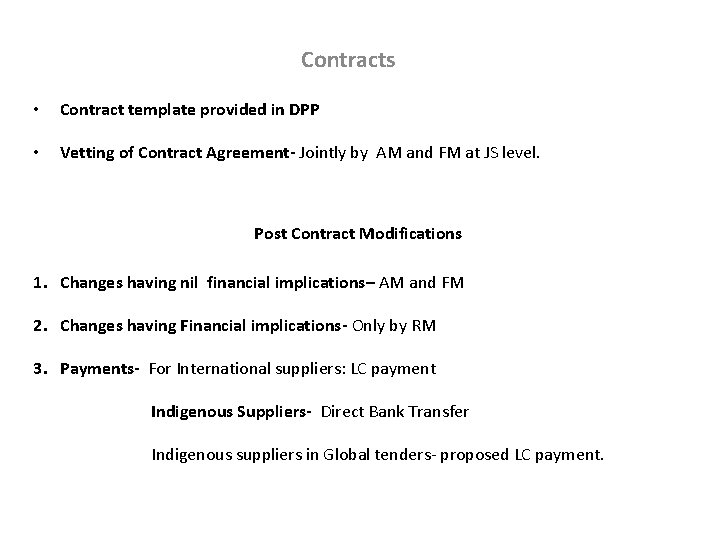
Contracts • Contract template provided in DPP • Vetting of Contract Agreement- Jointly by AM and FM at JS level. Post Contract Modifications 1. Changes having nil financial implications– AM and FM 2. Changes having Financial implications- Only by RM 3. Payments- For International suppliers: LC payment Indigenous Suppliers- Direct Bank Transfer Indigenous suppliers in Global tenders- proposed LC payment.
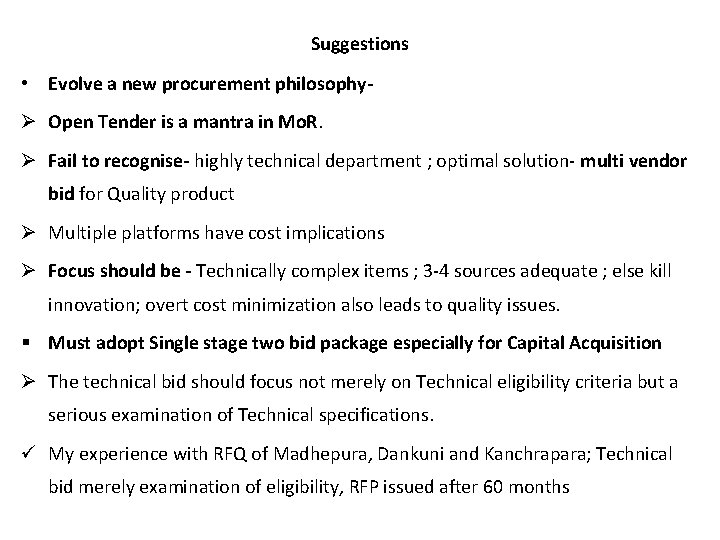
Suggestions • Evolve a new procurement philosophyØ Open Tender is a mantra in Mo. R. Ø Fail to recognise- highly technical department ; optimal solution- multi vendor bid for Quality product Ø Multiple platforms have cost implications Ø Focus should be - Technically complex items ; 3 -4 sources adequate ; else kill innovation; overt cost minimization also leads to quality issues. § Must adopt Single stage two bid package especially for Capital Acquisition Ø The technical bid should focus not merely on Technical eligibility criteria but a serious examination of Technical specifications. ü My experience with RFQ of Madhepura, Dankuni and Kanchrapara; Technical bid merely examination of eligibility, RFP issued after 60 months
Suggestions contd Ø Ideally, fashion the bids in such a manner that Finance member’s role restricted only to Commercial issues and Financial eligibility criteria. § Time for submission of bids- Define minimum threshold as existing 30 days + maximum celling on extension. Ø Further, time for bid submission should be fixed realistically – 30 days not suited for EPC/PPP/ Design and build contracts ü Recent case of Development tender in Mo. D- inadequate time leading to Single bid situation. § Bid Evaluation- Adoption of DCF technique wherever different offers lead to differing cash flows. § Benchmarking before opening of commercial bid § There should be restricted delegation of powers where there are deviations from the Tender document.
Fast Track Procurement • Procedure designed for meeting urgent operational requirements. • It refers to procurements under “Buy Category” and includes both equipment already inducted in to service and new equipment. • Requirements of SQRs, Scaling dispensed with. IF SQRs not formulated, Services can formulate broad operational requirements for procurement. • There is no field trial or GS Evaluation. • Only Technical examination , based on data submitted , is to be done. • For already inducted equipment, Single Vendor procurement and for new equipment multi-vendor/Inter Government procurement.
Strict Time-lines prescribed for FTP: 1. DAC approval to the proposal – 7 days 2. Preparation, vetting and issue of RFP – 10 days 3. Receipt of offers- 30 -45 days 4. Technical Evaluation – 10 days 5. CNC proceedings- 15 -30 days 6. Contract to be signed after approval- 112 -169 days 7. Supply Period- 3 -12 months • Monitoring Mechanism- DPB • A healthy practice over Mo. R where often our only response to urgency is to float single Tender.
Make Projects • A transparent mechanism for induction of new systems. • Story of Track fittings- 2012. Ø Modernisation often Vendor driven. Ø Recourse to Open tender, finalise on single bids. • Mo. D has structured provision for induction of new systems via indigenous manufacture , under “Make project” Ø Strategic , Complex and Security sensitive systems to be developed by DRDO. Ø However, high technology complex systems to be developed under “Make” by Private sector/OFB/DPSUs Ø Must form part of LTIPP and AAP. Ø Sanctioned as “Make” project by DAC. Ø Preliminary SQRs to be framed
Make Project contd • PSQRs to differentiate between essential and desirable parameters. • Essential parameters to be based on proven state of the art technology available in India/abroad and desirable on futuristic/emerging technologies. • PSQRs can be revised during prototype development • Select list of Vendors through Eo. I • Shortlist two Vendors based on capability- Quality based scoring selection- mix of performance, level of technology and R&D, access to To. T and levels of Technology transfer (mere license to IPR) and financials. Level of technology offered primary criteria. • Shortlisted Vendors to submit DPR – Ø Broad technical details Ø Detailed Bill of Material with cost Ø Financials Ø Exit criteria, Risk Register and risk mitigation plan
Make Project contd • If DPR accepted, execute development contract for design and manufacture of Prototype • Mo. D funds 80% of the cost, DA funds 20% • Stage payments on achievement of pre-specified milestones. • All IPRs produced by Mo. D funds finally vest with Mo. D. • A project Management team including reps from services, DRDO, DGQA, EME, User , Finance and DDP constituted for Vendor selection , DPR finalization and project monitoring. • Prototype to undergo field trials and GS Evaluation. • If approved GSQRs formulated. • Regular tendering process with successful DAs for bulk quantity initiated. • Prototype must have minimum 30% indigenous content on total cost basis.

THANK YOU
- Slides: 33