
BEST PRACTICES IN ONLINE COURSE AND ASSIGNMENT DESIGN

BEST PRACTICES IN ONLINE COURSE AND ASSIGNMENT DESIGN LSA Minicourse: Teaching Hybrid and Fully Online: Best Practices in Course Development and Delivery Lynn Santelmann Portland State University January 7, 2021

Opener discussion ■ Take 2 minutes and reflect on what helps you navigate websites – Which websites that you use do you find easy to navigate? – Which ones do you find frustrating? – Why? ■ Share one insight/reflection in large group discussion or the chat
BEST PRACTICES FOR CONTENT ORGANIZATION
Acknowledgment ■ NILSON, LINDA B. ; AND LUDWIKA A. GOODSON. 2018. Online teaching at its best: Merging instructional design with teaching and learning research. San Francisco, CA: Jossey-Bass.
Universal Design for Learning ■ Use tools from Universal Design for Learning ■ “a framework to improve and optimize teaching and learning for all people based on scientific insights into how humans learn. ” https: //udlguidelines. cast. org/ ■ UDL: Provide multiple means of engagement, multiple means of representation, multiple means of action/expression
The Three Cs: Consistency, Clarity, Communication ■ Online learning creates an additional cognitive burden ■ Attending to the three Cs – makes content more accessible – reduces student frustration – increases student engagement ■ Consistency, clarity, and communication should be built into course design, assignment design, and assessment

Consistency in organization & design ■ Consistency: Create a consistent structure for each topic/week – Orient students to the structure – Follow structure your institution promotes – Create a learning cycle where students know what to expect for each topic – Organize topics in the order of coverage – Make frequently used resources easy to find
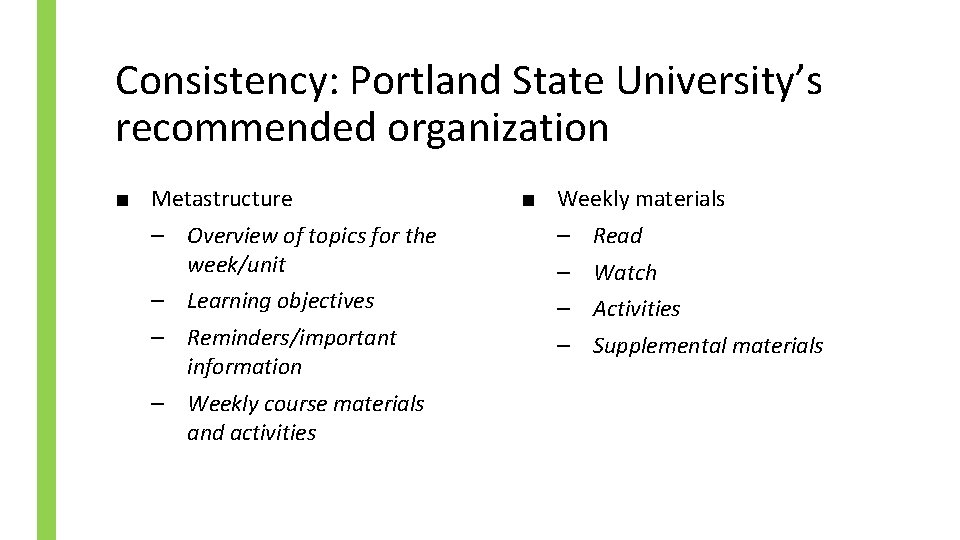
Consistency: Portland State University’s recommended organization ■ Metastructure ■ Weekly materials – Overview of topics for the week/unit – Read – Learning objectives – Activities – Reminders/important information – Weekly course materials and activities – Watch – Supplemental materials
■ Switch to example from Ling 390
Reflection ■ If you’ve taught online, how consistent and easy to navigate is your course? What could you improve? ■ If you’re taken online courses, what design elements are most helpful to you? What will you incorporate into your own teaching?

CLARITY & COMMUNICATION TO BUILD INTERACTION
Clarity ■ Clarity of communication and instructions is essential – Students need more scaffolding for activities in online or hybrid learning – You will find out from students if your instructions are not clear.
Scaffolding ■ Different types of scaffolding may be needed for different topics/types of students: – Procedural, e. g. , breaking tasks into smaller parts, demonstrate tasks to be completed, or help organizing time – Task/assignment specific, e. g. , providing rubrics or examples of successful projects/activities or ways – Conceptual, e. g. , helping students organize or connect concepts or skills; linking to previous knowledge, opportunities for students to discuss or reflect on assignments,
Communication ■ Consistent communication from the instructor in synchronous, and hybrid courses – Be a visible presence in the course – Use announcement features regularly for course info and occasional lighter things – Use both email and LMS for communication – Personalize interactions where you can – Make discussion forums for both specific topics and general questions – Consider outside resources such as Slack or Discord
The value of interaction ■ Student interaction with instructors, content, and peers is essential for learning. – It’s even more important to cultivate in online environments where students may be isolated or separated from the learning community ■ Online teaching requires thoughtful, pre-planned interactions
Reflection ■ What creates good interaction in an online course? What activities work best? What has not work? Why? ■ Reflect for a few minutes and then share to the group or chat
Principles of good practice for high-quality interaction online (Nilson & Goodson, 2018) ■ Student-faculty contact at the beginning of the course (email, online discussions, conferences) ■ Student-student interaction in study groups, group problem solving, teams ■ Active learning assignments ■ Prompt feedback (automated quizzes, instructor feedback) ■ Scaffolding time management (recommended time on task, progress) ■ Communication of high-expectations and clear criteria ■ Opportunities for students to express understanding & talents in different ways
Student-student interaction ■ Create opportunities for meaningful interaction, such as – Discussion – Debate – Collaboration – Peer review – Peer instruction
Reflection ■ How well do you think you do in creating interaction in online or hybrid teaching? What can you do to improve? ■ Reflect for a few minutes and then share to the group or chat
BEST PRACTICES IN ACTIVITY DESIGN
Planning activities: Learning outcomes as a starting point ■ Start with your learning outcomes – Cleary define what you want learners to take away from the course ■ Write clearning outcomes – Start with a verb that can be operationalized (define, evaluate, reflect, value…. ) – Be specific about what they’re supposed to learn
Taxonomies of Learning ■ Taxonomies of learning can be very helpful for creating learning goals. ■ There a number of different taxonomies that address different kinds of learning – Bloom’s taxonomy of knowledge (cognitive) – Fink’s significant learning outcomes (cognitive, affective, learning) – Krathwohl’s affective learning (affective)
Course activities: Align learning outcomes with activities ■ Evaluate your learning outcomes – Are they operationalizable? Measurable? – Are they necessary? Most experts recommend 7 -10 ■ Have assignments that help learners reach those goals – Making coherent arguments about structural analysis requires tools for analysis – so students need some facility with structures, but that facility should aid argumentation ■ Map your activities to the outcomes
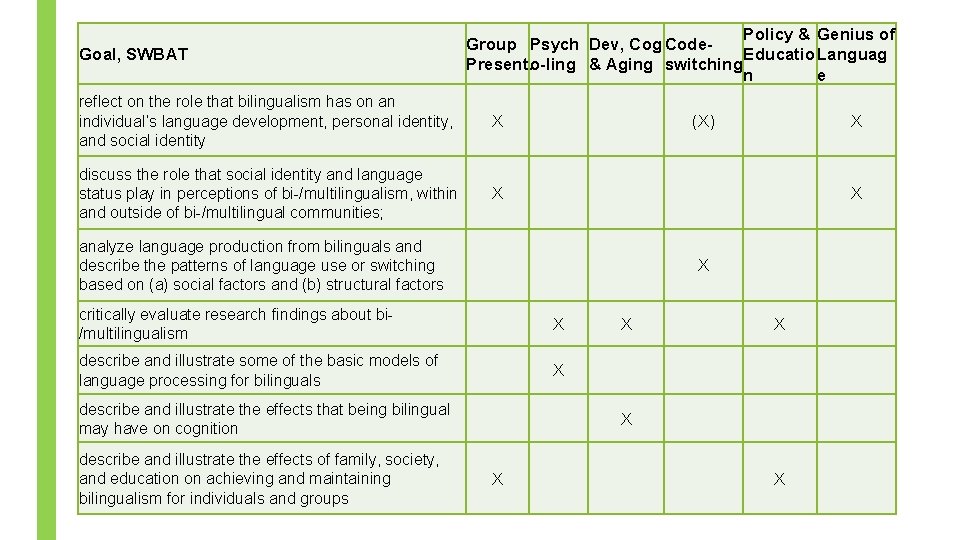
Goal, SWBAT Policy & Genius of Group Psych Dev, Cog Code. Educatio Languag Present. o-ling & Aging switching n e reflect on the role that bilingualism has on an individual’s language development, personal identity, and social identity X discuss the role that social identity and language status play in perceptions of bi-/multilingualism, within and outside of bi-/multilingual communities; X (X) X analyze language production from bilinguals and describe the patterns of language use or switching based on (a) social factors and (b) structural factors X critically evaluate research findings about bi/multilingualism X describe and illustrate some of the basic models of language processing for bilinguals X describe and illustrate the effects that being bilingual may have on cognition describe and illustrate the effects of family, society, and education on achieving and maintaining bilingualism for individuals and groups X X X
Best practices for activities ■ Activities should be relevant, logically organized, free from extraneous content (Nilson & Goodson, 2018) ■ Design activities that learners with ways to apply or see the relevance of the content ■ If possible, design activities that allow students to choose from different ways to demonstrate knowledge – But be wary of the time it takes for assessment ■ Not all activities need be graded
Activity ■ List (or create) one student learning outcome from a course you have taught (or might teach). ■ Suggest one activity that could help students achieve that outcome https: //docs. google. com/presentation/d/1 KQAr. Gq 9 IGn 9 Om. Ta. MGVx_S 40 A NK 0 Mlsui. SPOu. QVOU 3 ZU/edit? usp=sharing
References and Resources ■ BROWN, PETER C. ; HENRY L. ROEDIGER III. ; AND MARK A. MCDANIEL. 2014. Make it stick: The science of successful learning. Cambridge MA: Bellknap Press of Harvard University Press. ■ CENTER FOR THE STUDY OF GLOBAL CHANGE, INDIANA UNIVERSITY. What is an affective learning taxonomy? Center for the Study of Global Change, Global Teaching. https: //global. indiana. edu/documents/Learning-Taxonomy-Affective. pdf. ■ KRATHWOHL, DAVID R. 2002. A revision of Bloom’s Taxonomy: An overview. Theory Into Practice 41. 212– 218. doi: 10. 1207/s 15430421 tip 4104_2. ■ LEASE, LYNN. Krathwohl and Bloom’s Affective Taxonomy. https: //lynnleasephd. com/2018/08/23/krathwohl-and-blooms-affective-taxonomy/. ■ NILSON, LINDA B. ; AND LUDWIKA A. GOODSON. 2018. Online teaching at its best: Merging instructional design with teaching and learning research. San Francisco, CA: Jossey-Bass. ■ UNIVERSITY OF BUFFALO CENTER FOR EDUCATIONAL INNOVATION. Bloom’s taxonomy of knowledge. Bloom’s Taxonomy of Knowledge. http: //www. buffalo. edu/ubcei/enhance/designing/learningoutcomes/blooms-taxonomy-of-knowledge. html. ■ UNIVERSITY OF BUFFALO CENTER FOR EDUCATIONAL INNOVATION. Fink’s significant learning outcomes. Fink’s Significant Learning Outcomes. http: //www. buffalo. edu/ubcei/enhance/designing/learningoutcomes/finks-significant-learning-outcomes. html. ■ WILSON, LESLIE OWEN. Three domains of learning - cognitive, affective, psychomotor. The Second Principle. https: //thesecondprinciple. com/instructional-design/threedomainsoflearning/.
- Slides: 27