
Best Practices in First Trimester Miscarriage Management Linda

Best Practices in First Trimester Miscarriage Management Linda Prine MD Vanita Kumar MD Catherine De. Good DO
Objectives: Miscarriage Management n For participants to be able to: n n n 1. Define three common types of spontaneous abortions 2. Describe the diagnostic and treatment algorithm of miscarriage management. 3. Describe the advantages and disadvantages of expectant, medical, and aspiration treatment of spontaneous abortion and when to use each.
Definitions n n n Spontaneous Ab- loss of pregnancy without outside intervention before 20 weeks Threatened Ab- VB w/o cervical change Inevitable Ab- VB, dilated cervix, and Ab will inevitably occur Incomplete Ab- VB, cervical dilation, passage of portion of POCs (products of conception) Missed Ab- non-viable pregnancy with no uterine activity to expel POC’s
General Facts n n Miscarriage uncommon after 10 weeks EGA When FHT identified on U/S, the risk of SAB decreases to 3% Diagnosis- requires two visits to trend B-HCG’s Suspect ectopic if : transvaginal U/S shows no intrauterine gestational sac when the Bh. CG > 1, 500 IU per L If the Bh. CG plateaus or fails to double in 48 hours and the US fails to identify an intrauterine GS
Case 1: n n Maria is 24 y/o who is 6 wks pregnant by LMP who comes into your office complaining of heavy bleeding and cramping for 2 days. She is comfortable but concerned. Vitals signs are stable Urine BHCG- positive
Case 2 Sonia 28 y/o w/ a planned pregnancy. By LMP she is 6 wks She goes for a 1 st tri U/S. The radiologist calls you… empty gestational sac, irregular in appearance, too small for a 6 week pregnancy. She has had no bleeding or cramping.
Definitions-viablity n n n Anembryonic gestation- no yolk sac when the gestational sac > 10 mm 43 days (6 + wks) or no fetal pole is seen when GS > 18 mm (7 wks) Empty sac- no embryonic pole by 49 days (7 wks) Fetal demise- absence of cardiac activity in fetus > 8 wks
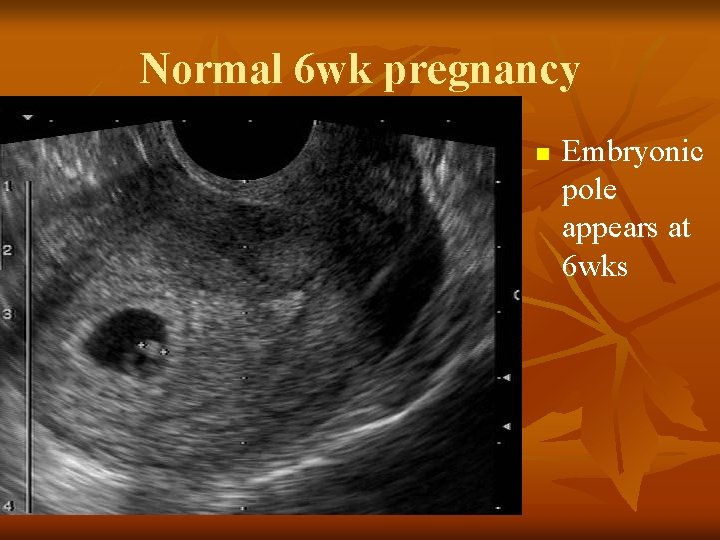
Normal 6 wk pregnancy n Embryonic pole appears at 6 wks

Gestational Sac n n Seen at ~ 4. 5 wks Visible when Hcg >1500 by vag probe, Hcg >3600 abd probe
Empty Sac n Yolk sac (arrowheads) but no fetal pole. Diagnosis not confirmed until another US one week later showed no growth in the sac.
General Facts n About 20% pregnant women have some bleeding before 20 weeks n n n 1. 2. Half of these will end in spontaneous abortion One meta-analysis- chromosomal abnormalities occurs 49% of spontaneous abortions 1 Risk Factors: n Maternal age (high and low), previous spont. Ab, heavy bleeding, smoking, high caffeine intake, uterine anomalies 2 Goddijn et al Best Pract Res Clin Ob-Gyn, 2000 Risk Factors for Spontaneous Abortion in Early Symptomatic 1 st Trimester Pregnancies. Clarisa R. , et al. Obstetrics & Gynecology 2005
Case 3: n n n Ayesha comes into your office bleeding. She reluctantly admits she used misoprostol on her own, and learned about it from a lay midwife in her community. On exam, her uterus is 8 weeks in size and her vagina is full of clots. The cervix is soft and the os is open. What are the options for treatment?
Management § Expectant Management- watchful waiting n Medical- Misoprostol n Surgical- traditional n D & C- no longer standard of care n Suction- EVA or MVA n Choice based on clinical scenario and pt preference
Expectant Management n n For incomplete abortion- expectant management is successful 82 -96%. Average time to completion is 9 days Success rate is less for embryonic death or anembryonic gestations (missed abortions) (25 -76%) First trimester miscarriages may be expectantly managed indefinitely if without hemorrhage or infections
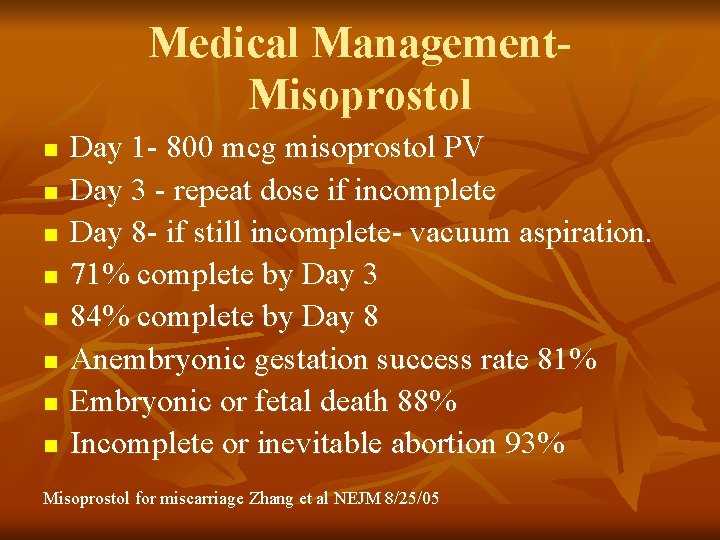
Medical Management. Misoprostol n n n n Day 1 - 800 mcg misoprostol PV Day 3 - repeat dose if incomplete Day 8 - if still incomplete- vacuum aspiration. 71% complete by Day 3 84% complete by Day 8 Anembryonic gestation success rate 81% Embryonic or fetal death 88% Incomplete or inevitable abortion 93% Misoprostol for miscarriage Zhang et al NEJM 8/25/05
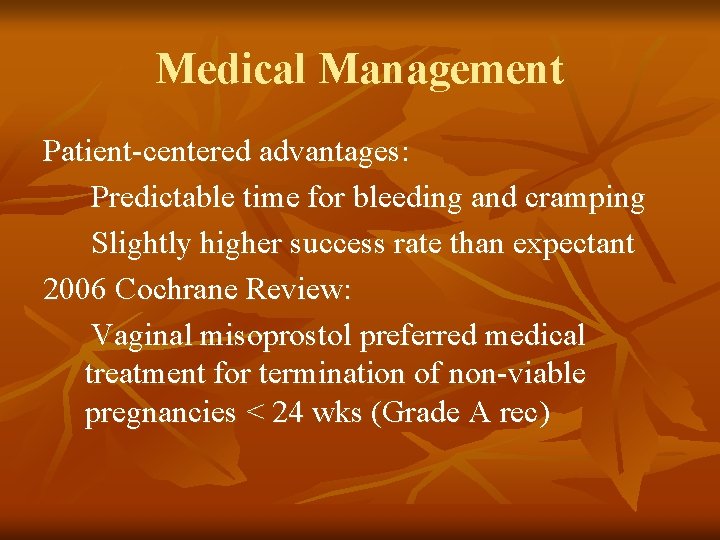
Medical Management Patient-centered advantages: Predictable time for bleeding and cramping Slightly higher success rate than expectant 2006 Cochrane Review: Vaginal misoprostol preferred medical treatment for termination of non-viable pregnancies < 24 wks (Grade A rec)
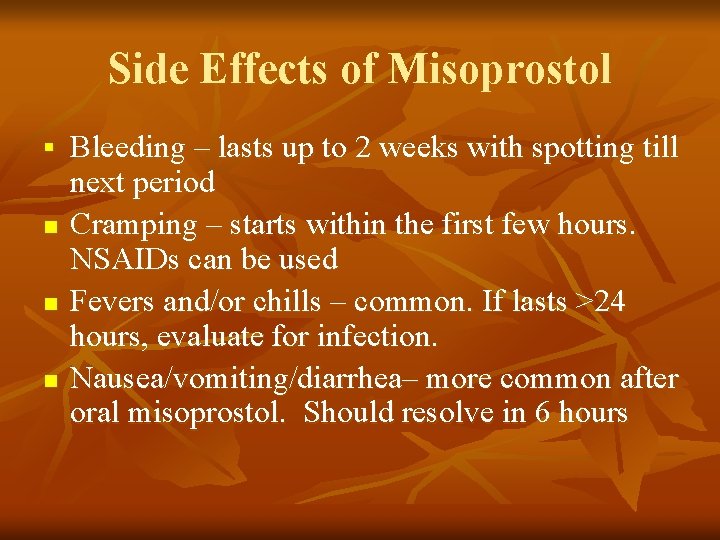
Side Effects of Misoprostol § n n n Bleeding – lasts up to 2 weeks with spotting till next period Cramping – starts within the first few hours. NSAIDs can be used Fevers and/or chills – common. If lasts >24 hours, evaluate for infection. Nausea/vomiting/diarrhea– more common after oral misoprostol. Should resolve in 6 hours
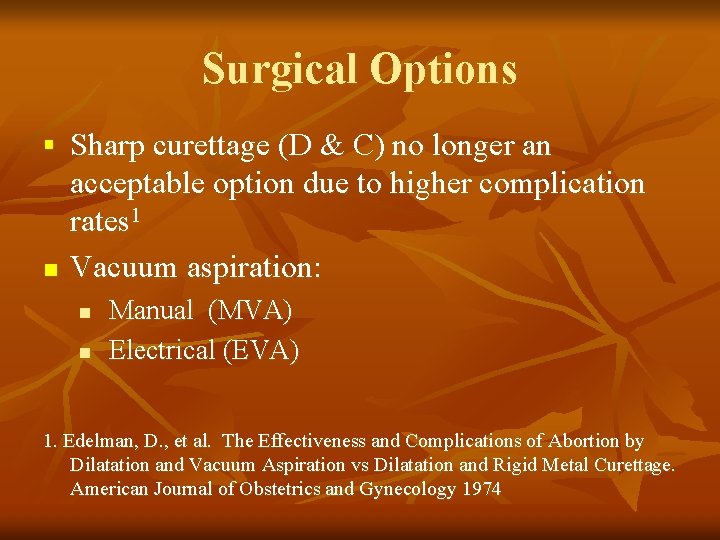
Surgical Options § Sharp curettage (D & C) no longer an n acceptable option due to higher complication rates 1 Vacuum aspiration: n n Manual (MVA) Electrical (EVA) 1. Edelman, D. , et al. The Effectiveness and Complications of Abortion by Dilatation and Vacuum Aspiration vs Dilatation and Rigid Metal Curettage. American Journal of Obstetrics and Gynecology 1974
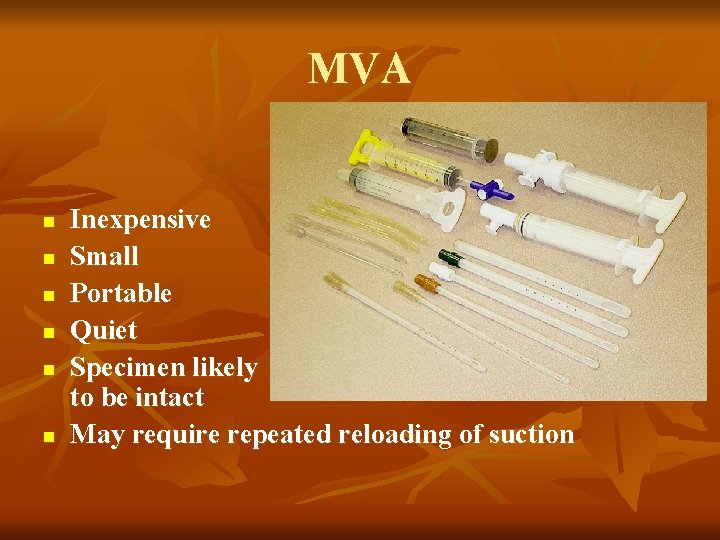
MVA n n n Inexpensive Small Portable Quiet Specimen likely to be intact May require repeated reloading of suction

Cochrane Review 2006 n n Expectant management and surgical treatment both safe and effective Expectant management- higher rates of mild bleeding, need for unplanned aspiration, and incomplete miscarriage Surgical management- higher rates of pelvic infection No clear indication for routine surgical management. Therefore patient preference should be respected. Nanda K, et al. Expectant care vs surgical treatment for miscarriage. Cochrane Database Syst Rev 2006; (2): CD 003518
What if they want Surgical Management? MVA in clinic/ED/floor/ vs. EVA in OR n n n Waiting time reduced by 52% Procedure time reduced from mean 33 to 19 minutes Costs reduced by 41% ($1404 to $827, P <. 01) for all three outcomes Blumenthal PD, Remsburg RE. Int J Gynecol Obstet 1994, 45: 261 -267

Psychological Care n n n n n Acknowledge, dispel guilt Legitimize grief Provide comfort, ongoing support Reassure about the future Counsel patient how to tell family, friends Warn of anniversary phenomenon Include partner in psychological care Assess level of grief and adjust counseling accordingly Don’t forget – half of pregnancies are unintended!
Summary: Miscarriage Management n n n Three options- expectant, medical (misoprostol), and suction. Each has its own advantages and disadvantages, and often depends on patient preference. Family physicians can provide continuity of care in diagnosing, managing and supporting women through miscarriages.
- Slides: 23