
BEST PRACTICES IN DESIGN AND IMPLEMENTATION OF FINANCIAL
BEST PRACTICES IN DESIGN AND IMPLEMENTATION OF FINANCIAL LITERACY PROGRAMS Market Conduct Supervision Training Program Armenuhi Mkrtchyan 6 -10 August 2018, Harare
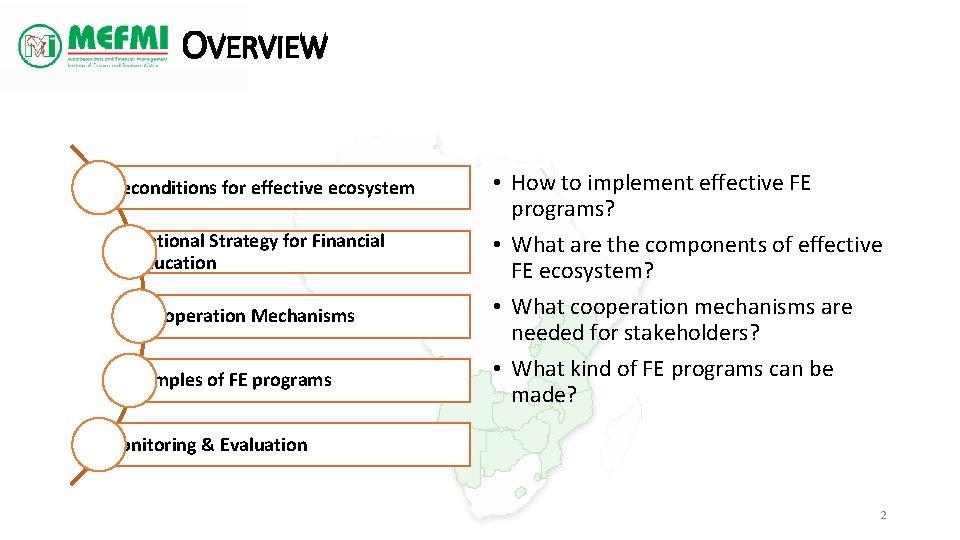
OVERVIEW Preconditions for effective ecosystem National Strategy for Financial Education Cooperation Mechanisms Samples of FE programs • How to implement effective FE programs? • What are the components of effective FE ecosystem? • What cooperation mechanisms are needed for stakeholders? • What kind of FE programs can be made? Monitoring & Evaluation 2
FINANCIAL EDUCATION NATIONAL ECOSYSTEM
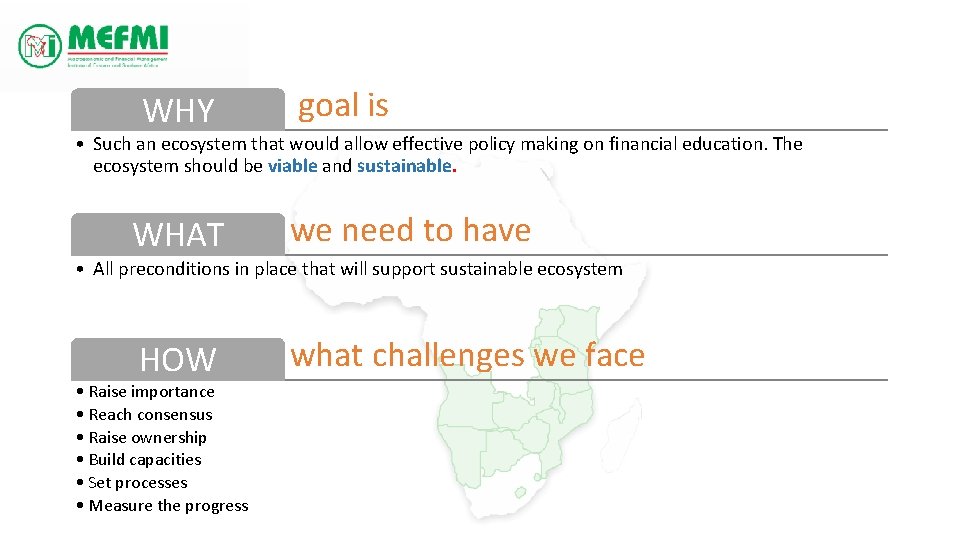
WHY goal is WHAT we need to have HOW what challenges we face • Such an ecosystem that would allow effective policy making on financial education. The ecosystem should be viable and sustainable. • All preconditions in place that will support sustainable ecosystem • Raise importance • Reach consensus • Raise ownership • Build capacities • Set processes • Measure the progress
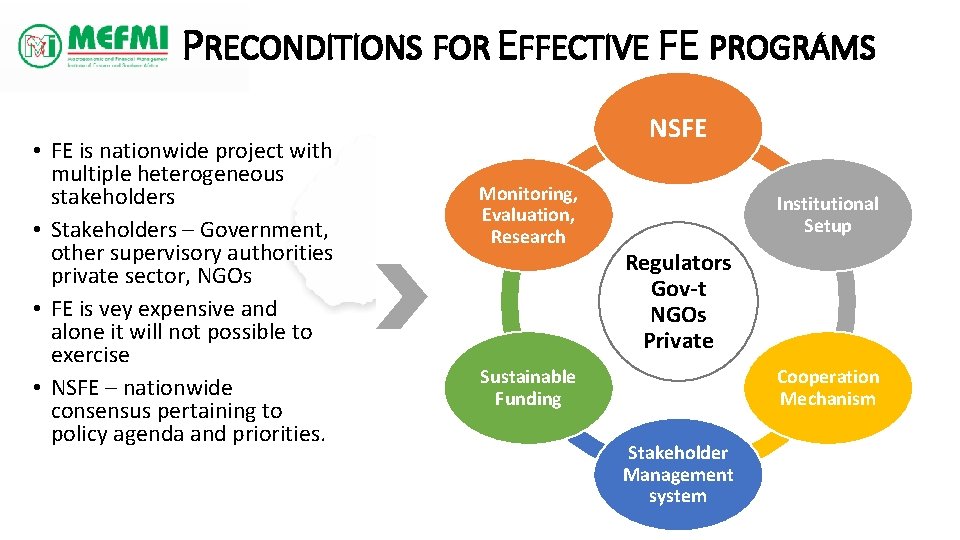
PRECONDITIONS FOR EFFECTIVE FE PROGRAMS • FE is nationwide project with multiple heterogeneous stakeholders • Stakeholders – Government, other supervisory authorities private sector, NGOs • FE is vey expensive and alone it will not possible to exercise • NSFE – nationwide consensus pertaining to policy agenda and priorities. NSFE Monitoring, Evaluation, Research Institutional Setup Regulators Gov-t NGOs Private Sustainable Funding Cooperation Mechanism Stakeholder Management system
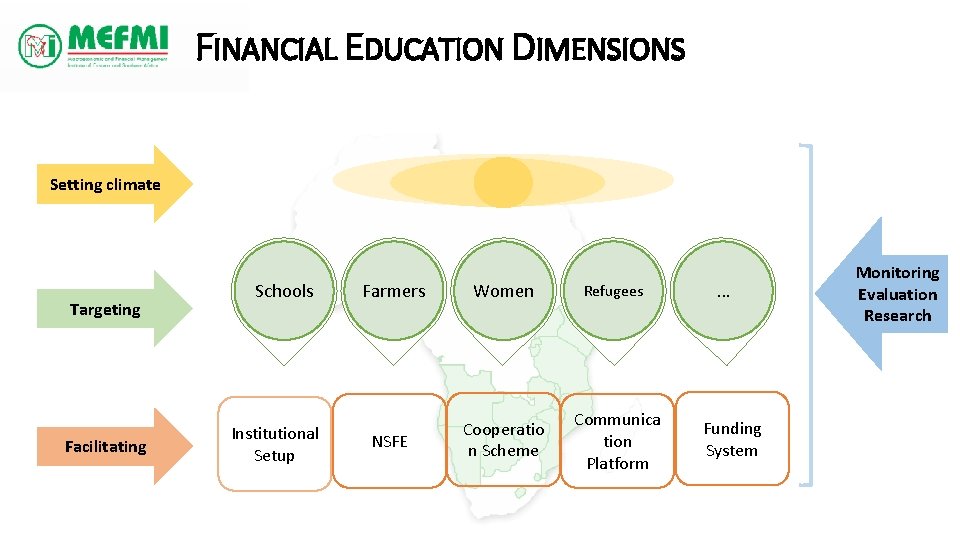
FINANCIAL EDUCATION DIMENSIONS Setting climate Targeting Facilitating Schools Institutional Setup Farmers Women Refugees NSFE Cooperatio n Scheme Communica tion Platform … Funding System Monitoring Evaluation Research
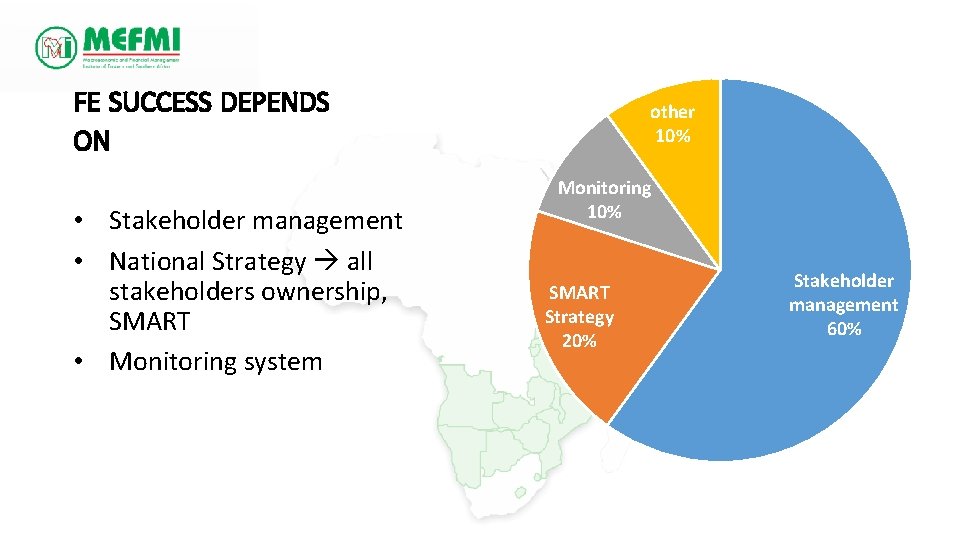
Financial Education Success Structure FE SUCCESS DEPENDS ON • Stakeholder management • National Strategy all stakeholders ownership, SMART • Monitoring system other 10% Monitoring 10% SMART Strategy 20% Stakeholder management 60%
NATIONAL STRATEGY FOR FINANCIAL EDUCATION (NSFE)
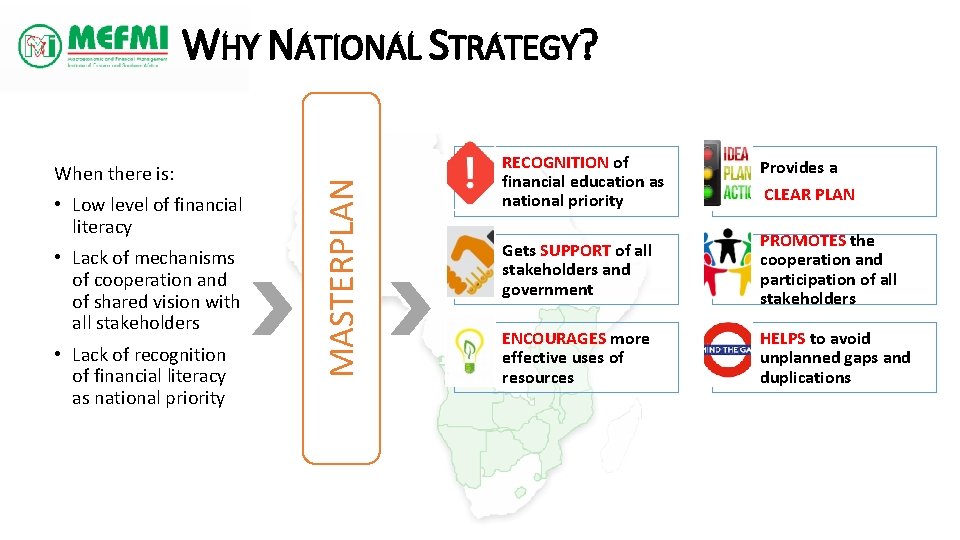
When there is: • Low level of financial literacy • Lack of mechanisms of cooperation and of shared vision with all stakeholders • Lack of recognition of financial literacy as national priority MASTERPLAN WHY NATIONAL STRATEGY? RECOGNITION of financial education as national priority Provides a CLEAR PLAN Gets SUPPORT of all stakeholders and government PROMOTES the cooperation and participation of all stakeholders ENCOURAGES more effective uses of resources HELPS to avoid unplanned gaps and duplications
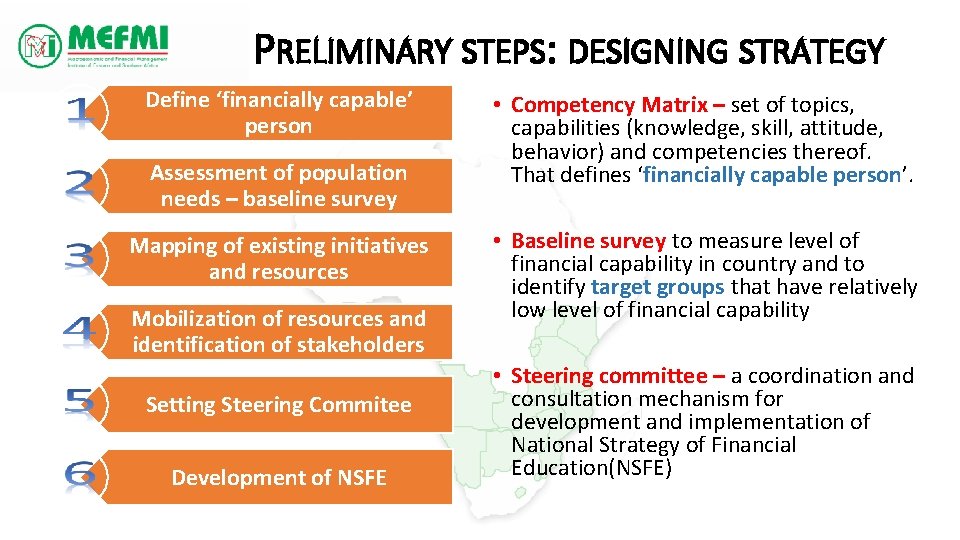
PRELIMINARY STEPS: DESIGNING STRATEGY Define ‘financially capable’ person Assessment of population needs – baseline survey Mapping of existing initiatives and resources Mobilization of resources and identification of stakeholders Setting Steering Commitee Development of NSFE • Competency Matrix – set of topics, capabilities (knowledge, skill, attitude, behavior) and competencies thereof. That defines ‘financially capable person’. • Baseline survey to measure level of financial capability in country and to identify target groups that have relatively low level of financial capability • Steering committee – a coordination and consultation mechanism for development and implementation of National Strategy of Financial Education(NSFE)
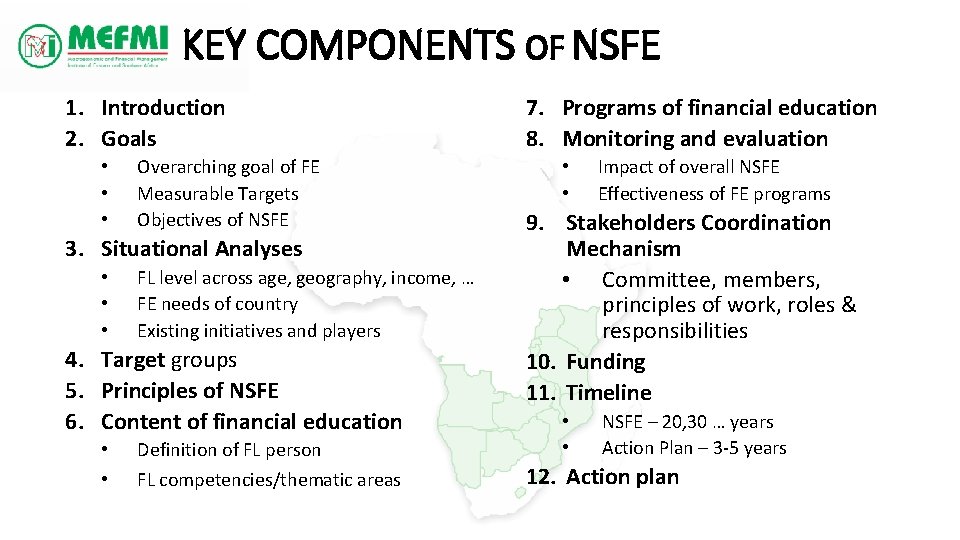
KEY COMPONENTS OF NSFE 1. Introduction 2. Goals • • • Overarching goal of FE Measurable Targets Objectives of NSFE 3. Situational Analyses • • • FL level across age, geography, income, … FE needs of country Existing initiatives and players 4. Target groups 5. Principles of NSFE 6. Content of financial education • • Definition of FL person FL competencies/thematic areas 7. Programs of financial education 8. Monitoring and evaluation • • Impact of overall NSFE Effectiveness of FE programs 9. Stakeholders Coordination Mechanism • Committee, members, principles of work, roles & responsibilities 10. Funding 11. Timeline • • NSFE – 20, 30 … years Action Plan – 3 -5 years 12. Action plan
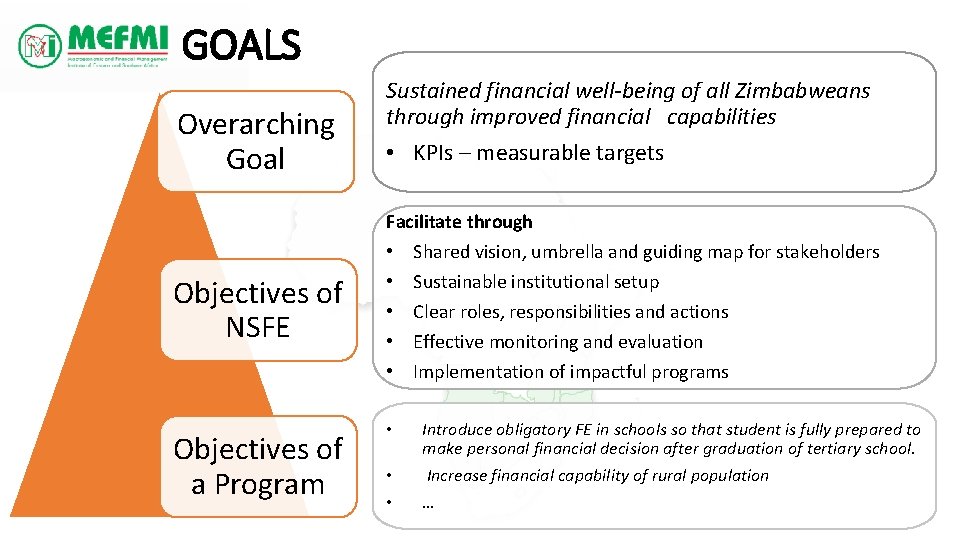
GOALS Overarching Goal Sustained financial well-being of all Zimbabweans through improved financial capabilities • KPIs – measurable targets Facilitate through Objectives of NSFE Objectives of a Program • • Shared vision, umbrella and guiding map for stakeholders Sustainable institutional setup Clear roles, responsibilities and actions Effective monitoring and evaluation Implementation of impactful programs Introduce obligatory FE in schools so that student is fully prepared to make personal financial decision after graduation of tertiary school. Increase financial capability of rural population …
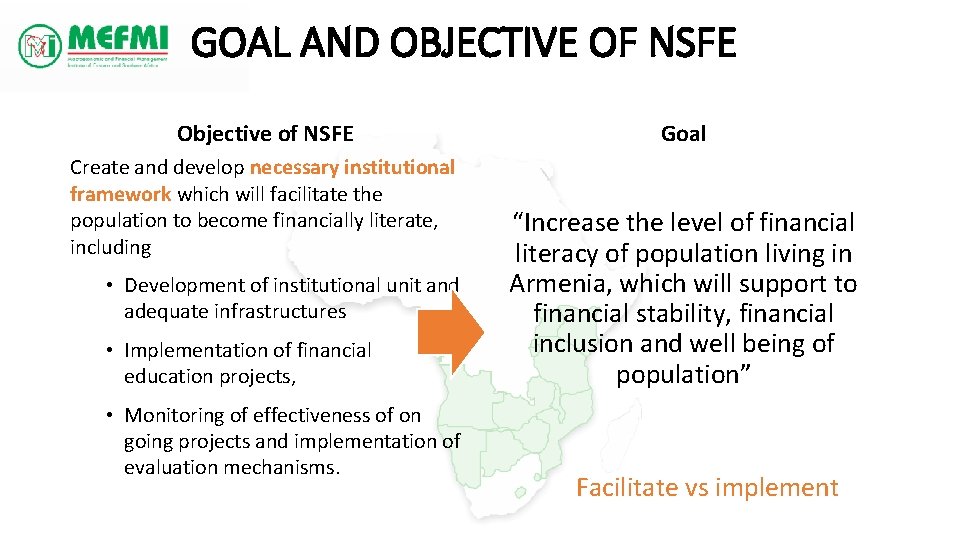
GOAL AND OBJECTIVE OF NSFE Objective of NSFE Create and develop necessary institutional framework which will facilitate the population to become financially literate, including • Development of institutional unit and adequate infrastructures • Implementation of financial education projects, • Monitoring of effectiveness of on going projects and implementation of evaluation mechanisms. Goal “Increase the level of financial literacy of population living in Armenia, which will support to financial stability, financial inclusion and well being of population” Facilitate vs implement
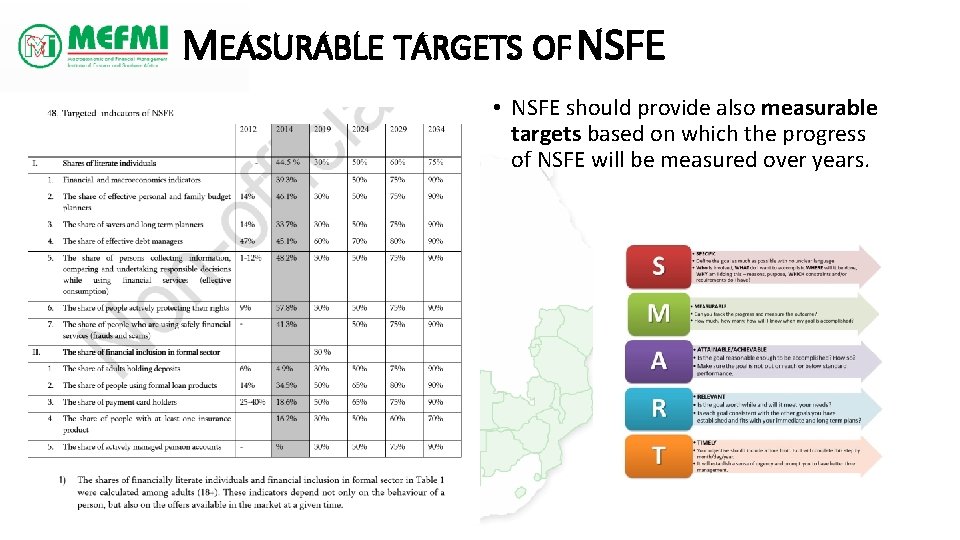
MEASURABLE TARGETS OF NSFE • NSFE should provide also measurable targets based on which the progress of NSFE will be measured over years.
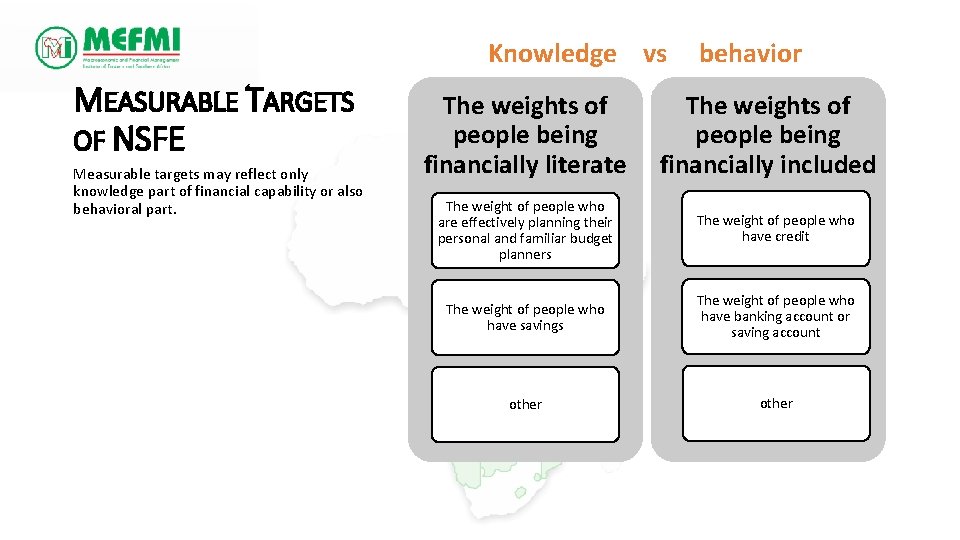
Knowledge vs MEASURABLE TARGETS OF NSFE Measurable targets may reflect only knowledge part of financial capability or also behavioral part. The weights of people being financially literate behavior The weights of people being financially included The weight of people who are effectively planning their personal and familiar budget planners The weight of people who have credit The weight of people who have savings The weight of people who have banking account or saving account other
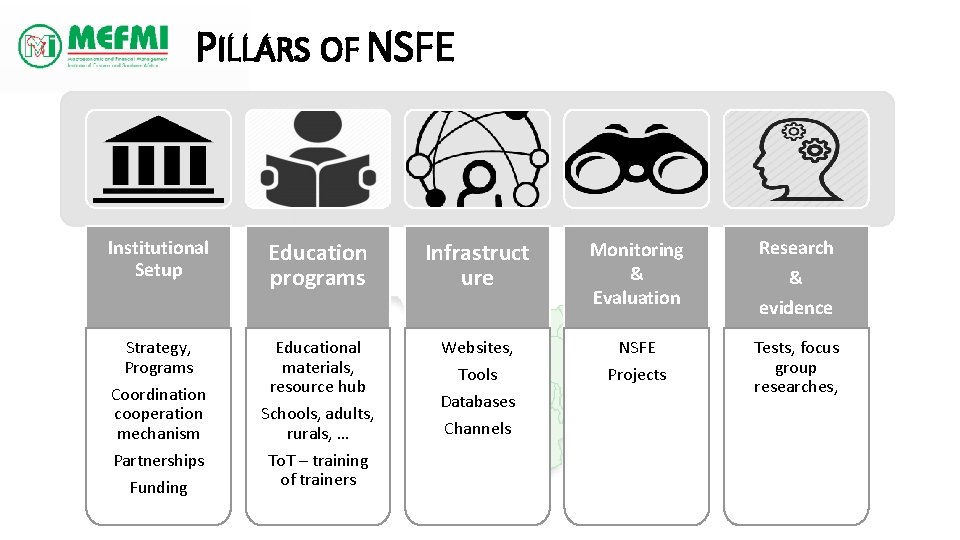
PILLARS OF NSFE Institutional Setup Education programs Infrastruct ure Monitoring & Evaluation Research Strategy, Programs Coordination cooperation mechanism Partnerships Funding Educational materials, resource hub Schools, adults, rurals, … To. T – training of trainers Websites, NSFE Tools Databases Channels Projects Tests, focus group researches, & evidence
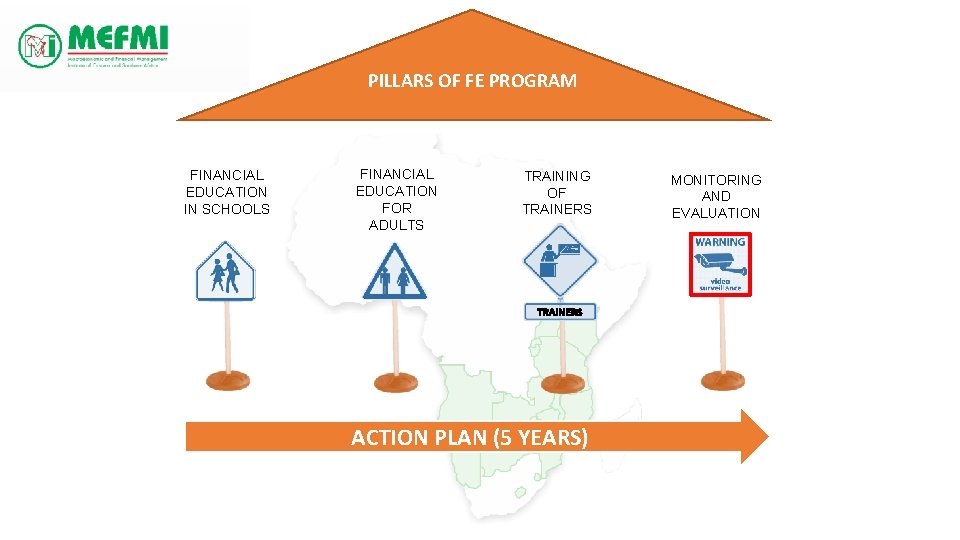
PILLARS OF FE PROGRAM FINANCIAL EDUCATION IN SCHOOLS FINANCIAL EDUCATION FOR ADULTS TRAINING OF TRAINERS ACTION PLAN (5 YEARS) MONITORING AND EVALUATION
PRINCIPLES OF NSFE • life-long learning • using a variety of channels and methods • clear, simple, relevant and engaging communications • prioritization • monitoring and evaluating programs • evidence based
TARGET GROUPS OF NSFE • • • School children Students People living in rural areas Women Person who needs financial education in the specific moment of life (teachable moment) • Should be clearly stated in NSFE • Based on baseline survey/gap assessment
CONTENT OF FINANCIAL EDUCATION • • • Personal and familiar budget planning Money and cash and non-cash payment Saving and investment Debt and management of debt Financial tools (services) and management of personal finances Right protection Information collecting and professional consulting Understanding of the safe use of financial instruments (financial fraud Financial system and main macroeconomic indicators COMPETENCY MATRIX Minimum financial capability required to be financially literate
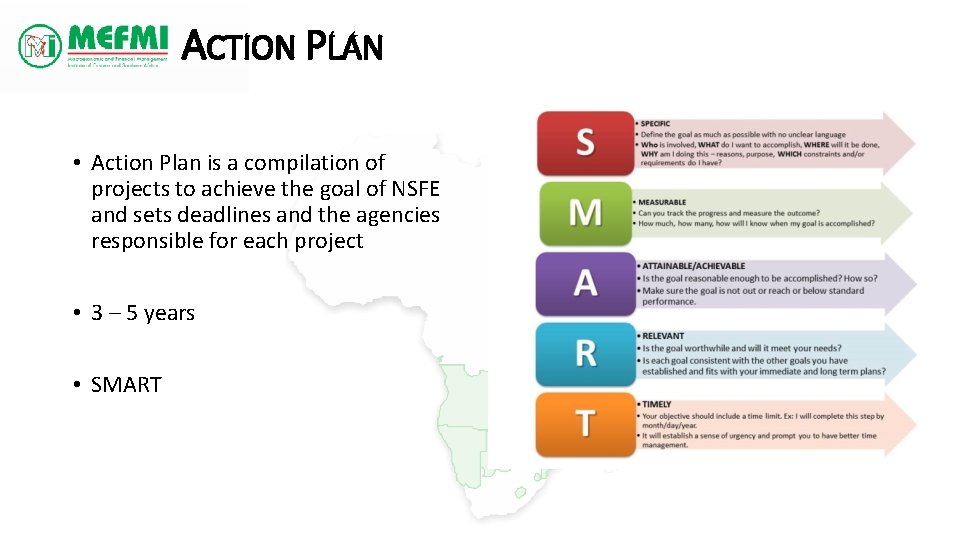
ACTION PLAN • Action Plan is a compilation of projects to achieve the goal of NSFE and sets deadlines and the agencies responsible for each project • 3 – 5 years • SMART
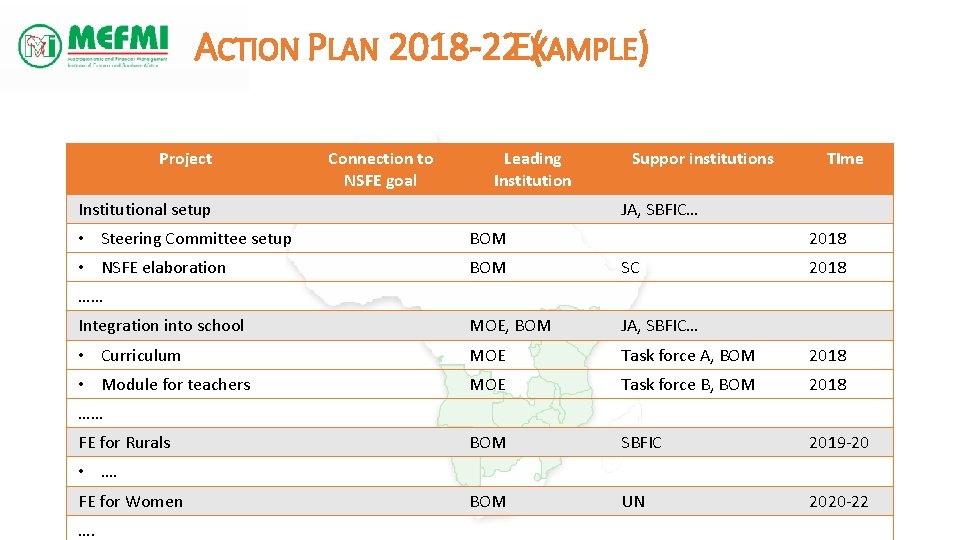
ACTION PLAN 2018 -22 EXAMPLE ( ) Project Connection to NSFE goal Leading Institutional setup Suppor institutions TIme JA, SBFIC… • Steering Committee setup BOM 2018 • NSFE elaboration BOM SC Integration into school MOE, BOM JA, SBFIC… • Curriculum MOE Task force A, BOM 2018 • Module for teachers MOE Task force B, BOM 2018 BOM SBFIC 2019 -20 BOM UN 2020 -22 2018 …… …… FE for Rurals • …. FE for Women ….
We will talk about this during school project STAKEHOLDER MANAGEMENT • raising the importance with top management • 60 -80% of success depends on stakeholder management • It should be part of day-to-day management
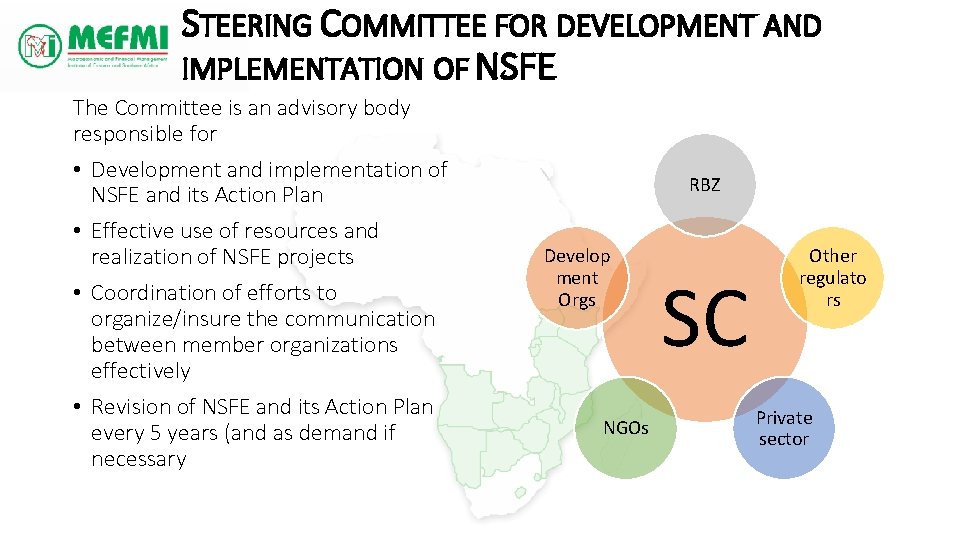
STEERING COMMITTEE FOR DEVELOPMENT AND IMPLEMENTATION OF NSFE The Committee is an advisory body responsible for • Development and implementation of NSFE and its Action Plan • Effective use of resources and realization of NSFE projects • Coordination of efforts to organize/insure the communication between member organizations effectively • Revision of NSFE and its Action Plan every 5 years (and as demand if necessary RBZ Develop ment Orgs NGOs SC Other regulato rs Private sector
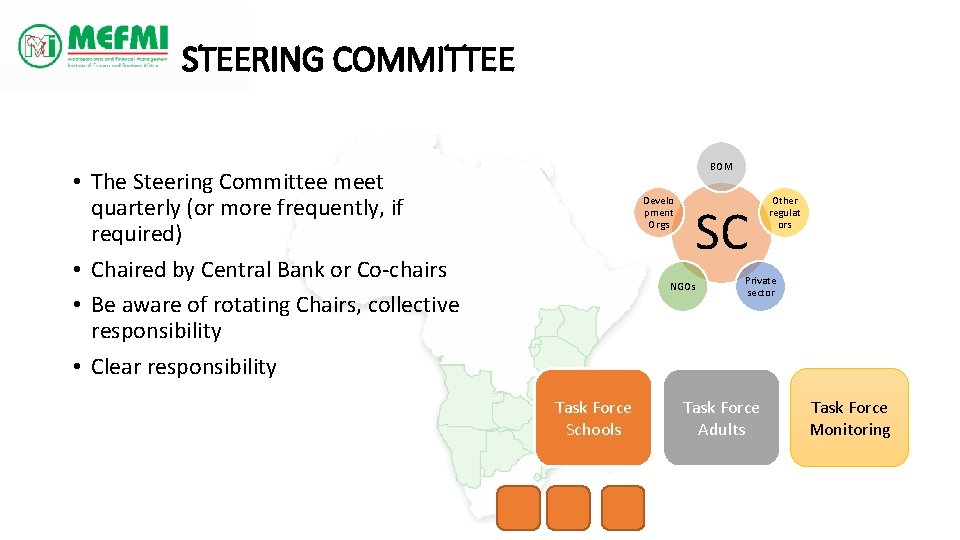
STEERING COMMITTEE BOM • The Steering Committee meet quarterly (or more frequently, if required) • Chaired by Central Bank or Co-chairs • Be aware of rotating Chairs, collective responsibility • Clear responsibility Develo pment Orgs SC NGOs Task Force Schools Other regulat ors Private sector Task Force Adults Task Force Monitoring
USEFUL PRACTICES FOR FINANCIAL EDUCATION
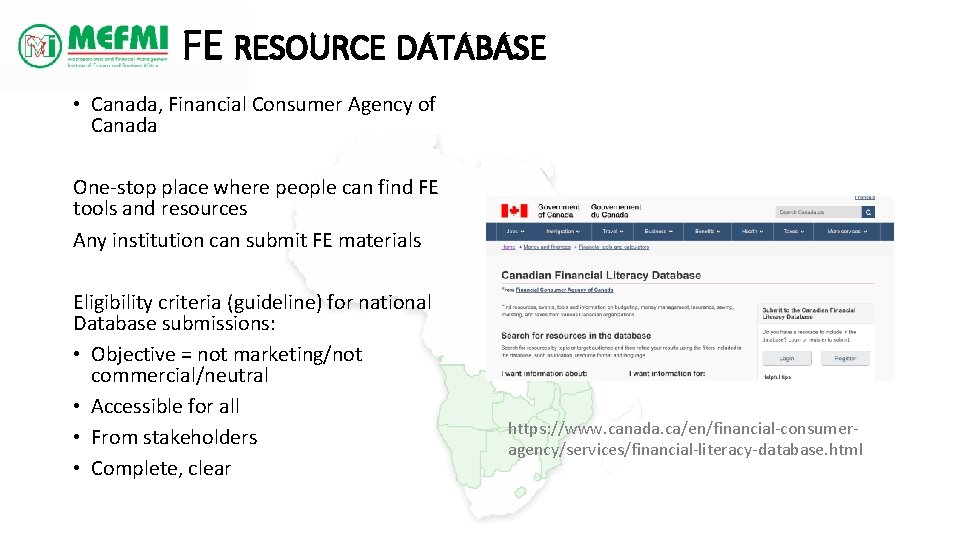
FE RESOURCE DATABASE • Canada, Financial Consumer Agency of Canada One-stop place where people can find FE tools and resources Any institution can submit FE materials Eligibility criteria (guideline) for national Database submissions: • Objective = not marketing/not commercial/neutral • Accessible for all • From stakeholders • Complete, clear https: //www. canada. ca/en/financial-consumeragency/services/financial-literacy-database. html
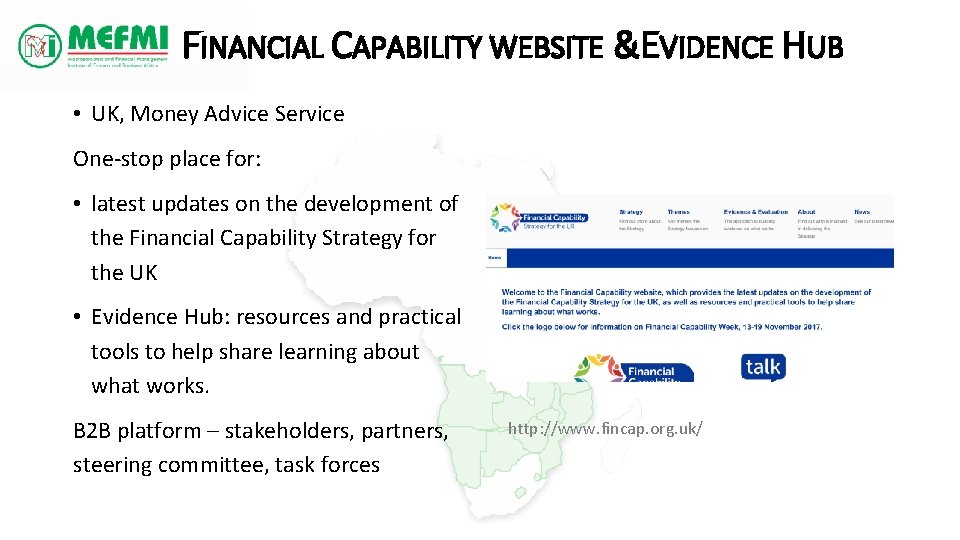
FINANCIAL CAPABILITY WEBSITE &EVIDENCE HUB • UK, Money Advice Service One-stop place for: • latest updates on the development of the Financial Capability Strategy for the UK • Evidence Hub: resources and practical tools to help share learning about what works. B 2 B platform – stakeholders, partners, steering committee, task forces http: //www. fincap. org. uk/
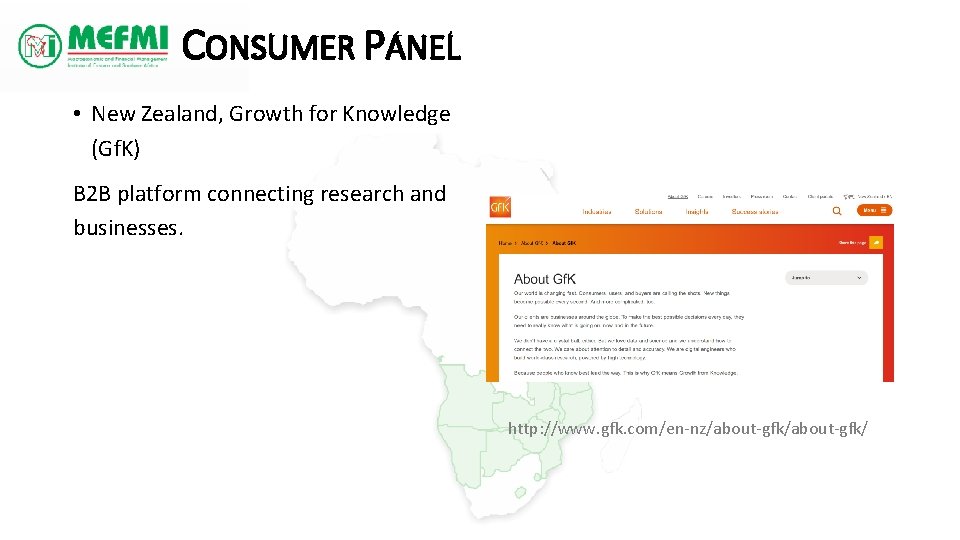
CONSUMER PANEL • New Zealand, Growth for Knowledge (Gf. K) B 2 B platform connecting research and businesses. http: //www. gfk. com/en-nz/about-gfk/
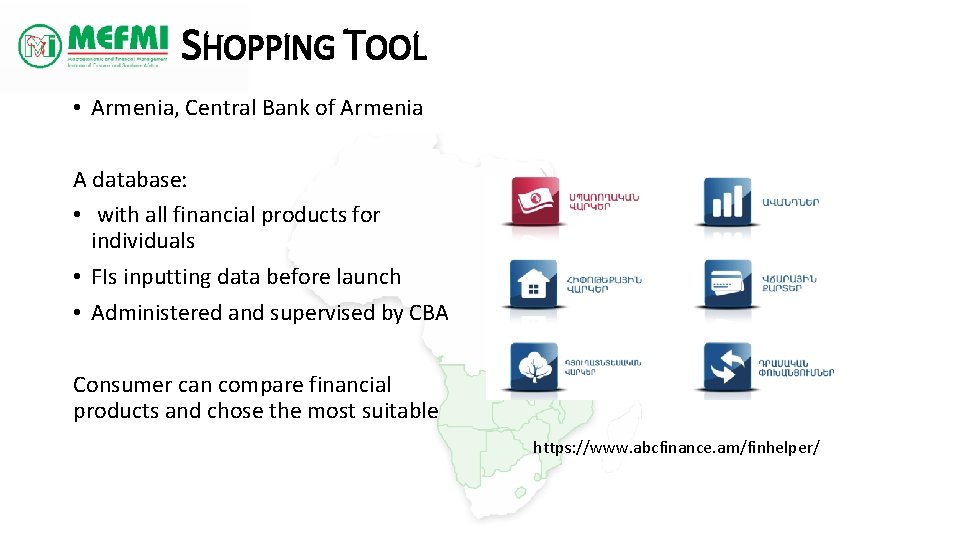
SHOPPING TOOL • Armenia, Central Bank of Armenia A database: • with all financial products for individuals • FIs inputting data before launch • Administered and supervised by CBA Consumer can compare financial products and chose the most suitable https: //www. abcfinance. am/finhelper/
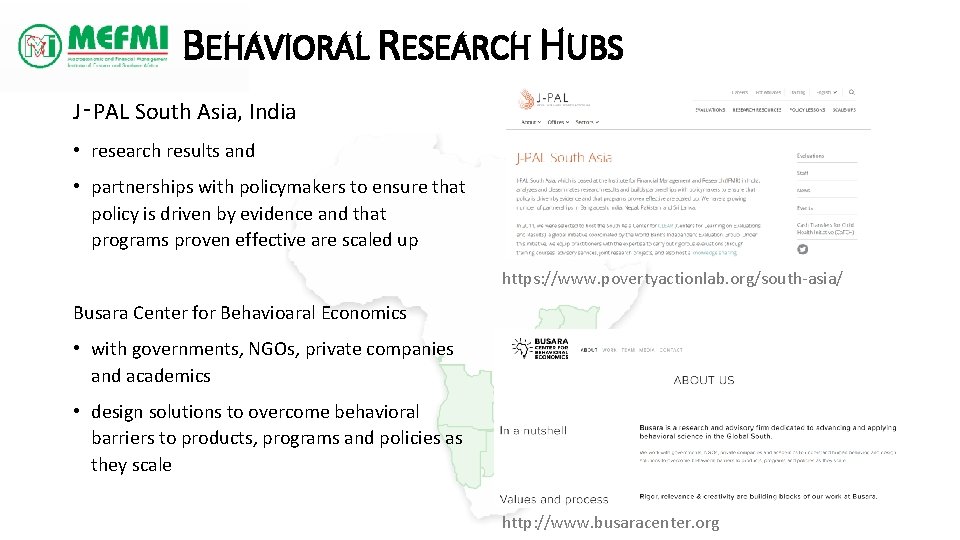
BEHAVIORAL RESEARCH HUBS J‑PAL South Asia, India • research results and • partnerships with policymakers to ensure that policy is driven by evidence and that programs proven effective are scaled up https: //www. povertyactionlab. org/south-asia/ Busara Center for Behavioaral Economics • with governments, NGOs, private companies and academics • design solutions to overcome behavioral barriers to products, programs and policies as they scale http: //www. busaracenter. org
SOME MORE TIPS • Chat box is useful to scale up calls, Personal tailored advice becoming demanded (New Zealand) • Peer-to-peer leaning key channel for youth to learn (Hong Kong) • Classroom workshops are effective in rural areas (Armenia) • Workplace financial education raise improve fin health and bring to higher efficiency and vice versa (Netherlands, Canada) • Rules of Thumbs (heuristics) better taken by consumers (Armenia, Hong Kong, …)
FINANCIAL EDUCATION PROGRAMS • Programs for target groups • Teachable moments • Behavioral insights
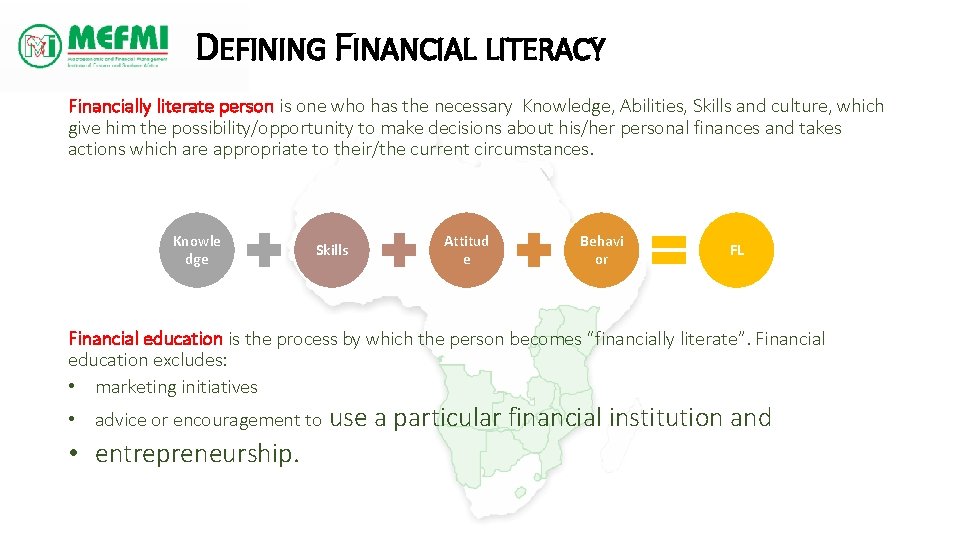
DEFINING FINANCIAL LITERACY Financially literate person is one who has the necessary Knowledge, Abilities, Skills and culture, which give him the possibility/opportunity to make decisions about his/her personal finances and takes actions which are appropriate to their/the current circumstances. Knowle dge Skills Attitud e Behavi or FL Financial education is the process by which the person becomes “financially literate”. Financial education excludes: • marketing initiatives • advice or encouragement to • entrepreneurship. use a particular financial institution and
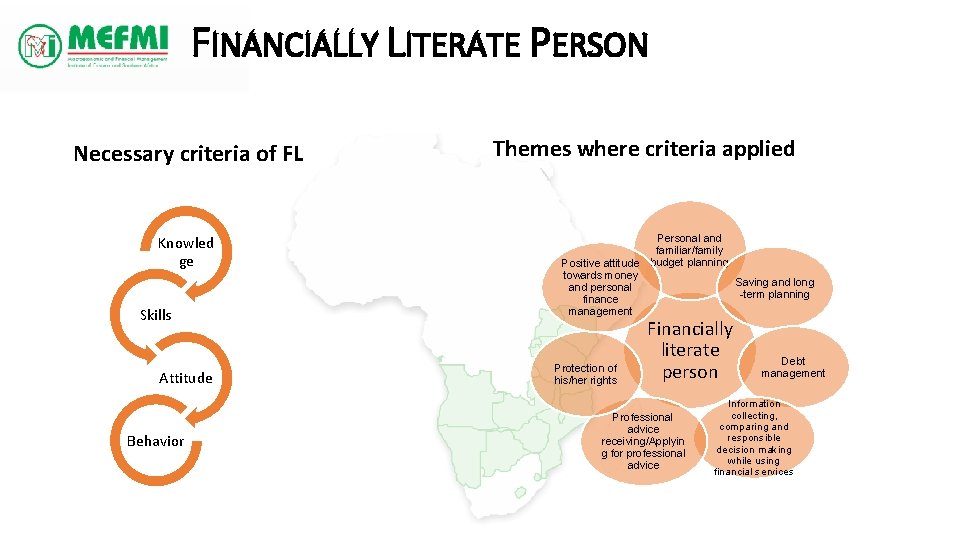
FINANCIALLY LITERATE PERSON Necessary criteria of FL Knowled ge Skills Attitude Behavior Themes where criteria applied Positive attitude towards money and personal finance management Protection of his/her rights Personal and familiar/family budget planning Saving and long -term planning Financially literate person Professional advice receiving/Applyin g for professional advice Debt management Information collecting, comparing and responsible decision making while using financial services
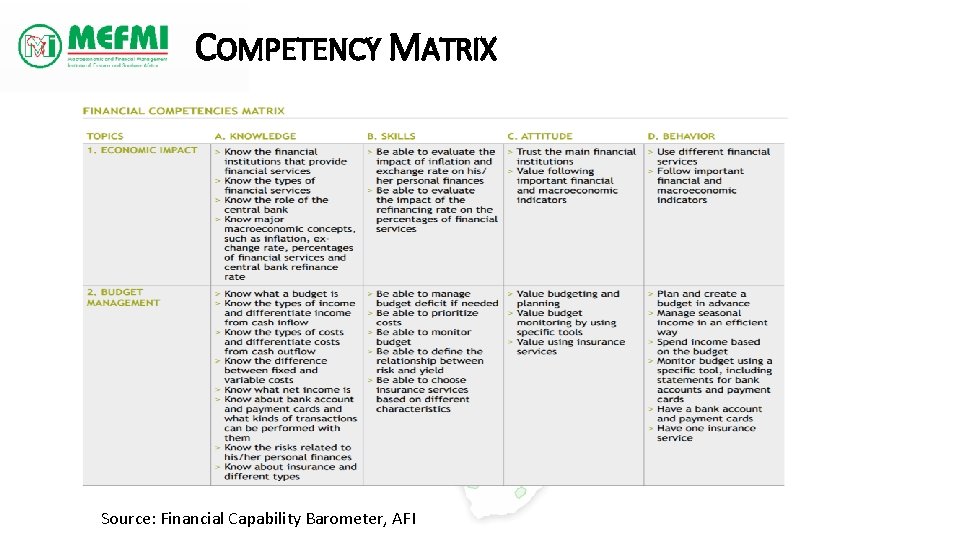
COMPETENCY MATRIX Source: Financial Capability Barometer, AFI
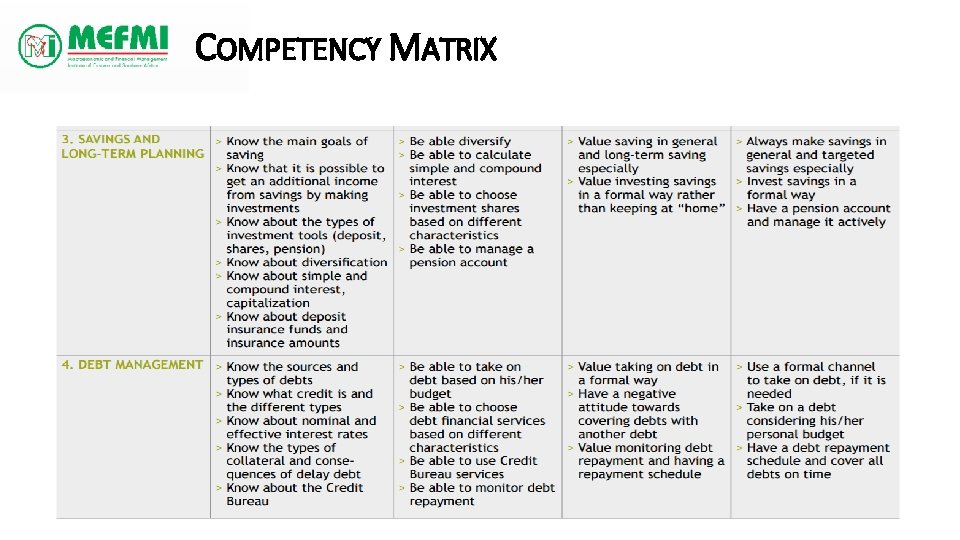
COMPETENCY MATRIX
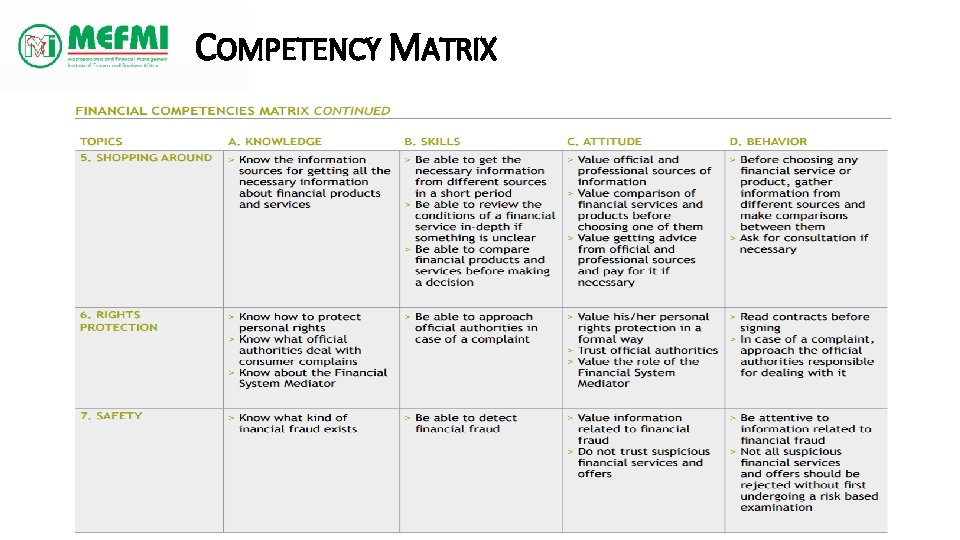
COMPETENCY MATRIX
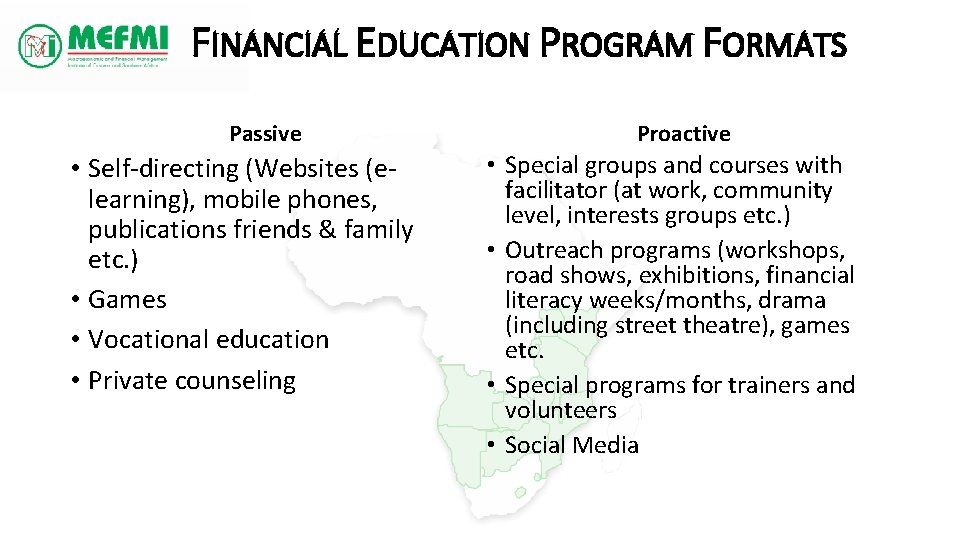
FINANCIAL EDUCATION PROGRAM FORMATS Passive • Self-directing (Websites (elearning), mobile phones, publications friends & family etc. ) • Games • Vocational education • Private counseling Proactive • Special groups and courses with facilitator (at work, community level, interests groups etc. ) • Outreach programs (workshops, road shows, exhibitions, financial literacy weeks/months, drama (including street theatre), games etc. • Special programs for trainers and volunteers • Social Media
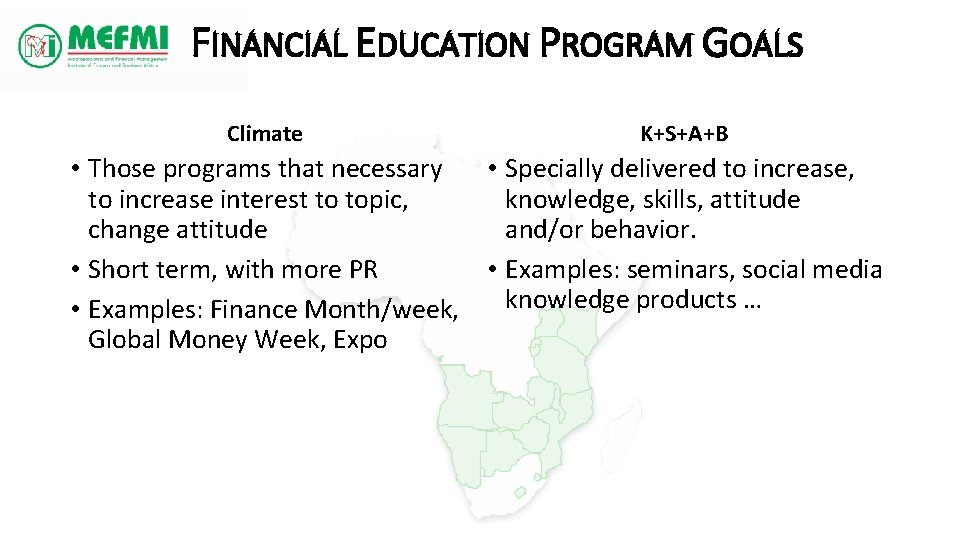
FINANCIAL EDUCATION PROGRAM GOALS Climate K+S+A+B • Those programs that necessary • Specially delivered to increase, to increase interest to topic, knowledge, skills, attitude change attitude and/or behavior. • Short term, with more PR • Examples: seminars, social media knowledge products … • Examples: Finance Month/week, Global Money Week, Expo
• Continuous education is needed to affect on behavior and attitudes CHALLENGES Changes of behavior and attitudes of adults are very difficult Lack of pattern of financial literacy and effective communication channels by target groups. • Need of creation educational mobile groups for sustainable education in regio
WEB IS KEY RESOURCE Unified web portal non partial and free for consumers of financial services with educational materials such as : • educational materials on financial services, • financial calculators and tools • financial tests, games & puzzles etc. ) • news, Target groups should be defined: • schoolchildren, • teachers, • students, • journalists, • Workers/employees • young people … UK, New Zealand, Australia ASIC…
SOCIAL MEDIA Can be a key active tool for everyday reach Facebook, tweeter, …. Define: • Best social media for your country context • The main target group of that SM • make a SM Communication Strategy
SAMPLES OF PROGRAMS - SCHOOLCHILDREN • brain-ring of economic and financial issues for school children • Competitions • Seminars Cooperate with international orgs such as Junior Achievement, AIESEC, European Youth Parliament, ….
FINANCIAL EDUCATION FOR ADULTS Target groups • Students • Villagers /people living in rural areas/ • Women Teachable moments • Buying a house • Getting married • Getting divorced • Birth of a child • First job experience, etc. • BUYING financial product “Shopping tool”: which will help consumers to choose from available products the one which best meets to their needs
SAMPLES OF PROGRAMS - ADULTS • • • Web Portal Social Media campaigns Open seminars (passive) On field seminars (active) – workplace, university, village… road shows, exhibitions, financial literacy weeks Finance Month/week Education through celebrities people Soap operas, TV Open door visits to financial institutions Each Program should have : • Strong campaign to raise attitude • curriculum and educational materials, created specifically to meet each target groups’ needs • Action Plan to reach general population
BEHAVIORAL CENTERED DESIGN • Behavioral biases influences financial decision making • Thus while designing financial education programs behavioral insights should be considered Some behavioral design tools: • Focus group with different target groups from all regions of Armenia • In-hall testing’ • In-depth interviews • Behavioral mapping • Customer journe map • personas
MONITORING & EVALUATION
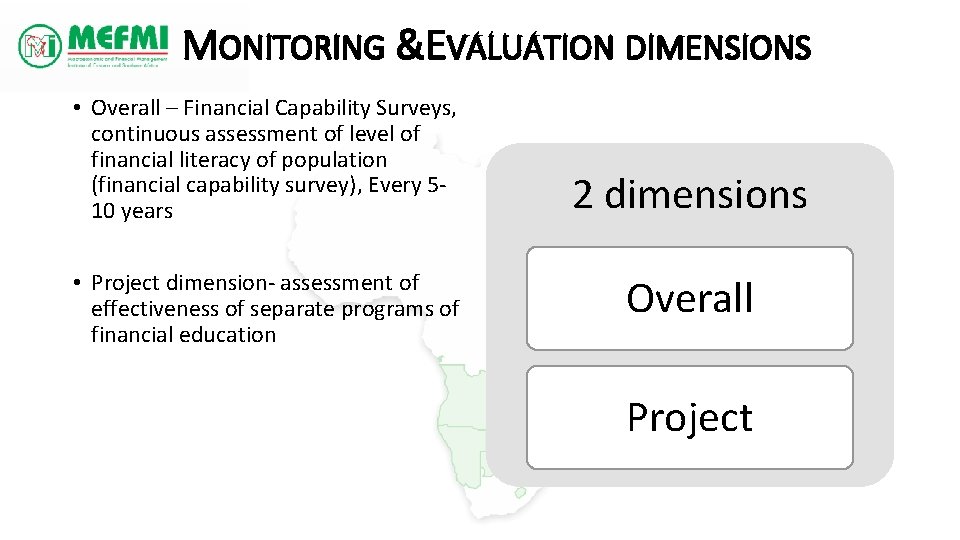
MONITORING &EVALUATION DIMENSIONS • Overall – Financial Capability Surveys, continuous assessment of level of financial literacy of population (financial capability survey), Every 510 years • Project dimension- assessment of effectiveness of separate programs of financial education 2 dimensions Overall Project
WHY FINANCIAL CAPABILITY SURVEYS ARE NEEDED • Baseline surveys are important to understand evaluate the level of financial literacy and capability of the population and to design appropriate strategies/policies to increase the current level of education • Follow up Financial Capability Surveys are effective way to support the effectiveness of NSFE • through assessing the baseline levels of NSFE measurable targets, • monitoring them • reacting on time for policy changes • creating public accountability
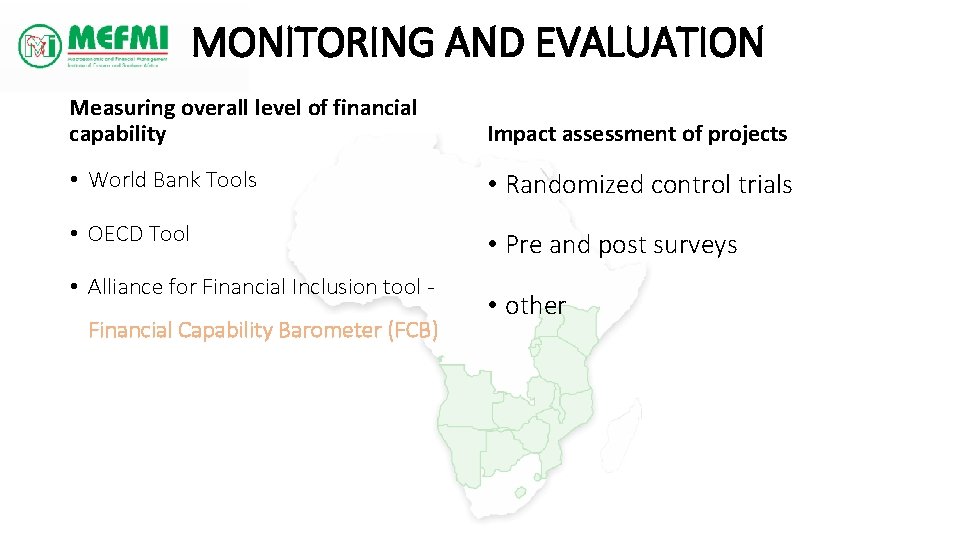
MONITORING AND EVALUATION Measuring overall level of financial capability Impact assessment of projects • World Bank Tools • Randomized control trials • OECD Tool • Pre and post surveys • Alliance for Financial Inclusion tool Financial Capability Barometer (FCB) • other
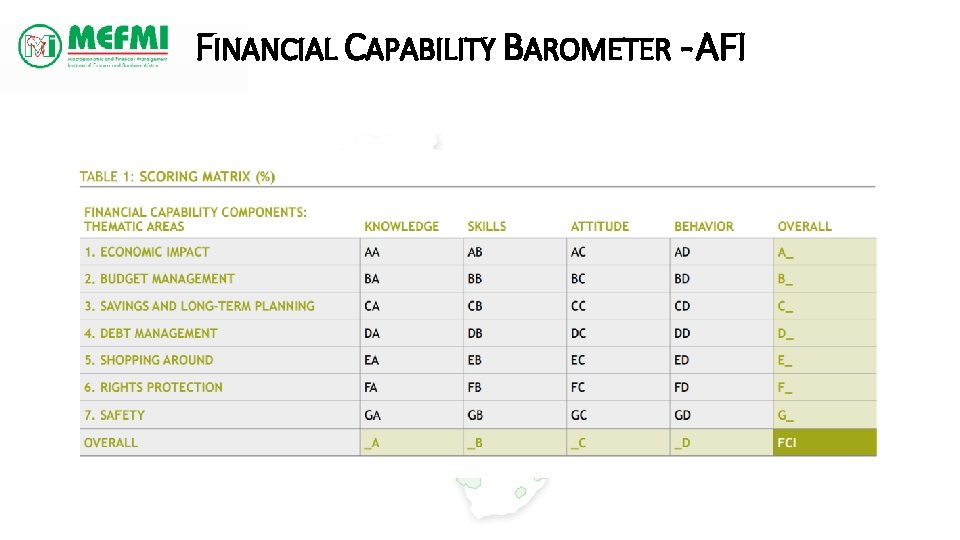
FINANCIAL CAPABILITY BAROMETER - AFI
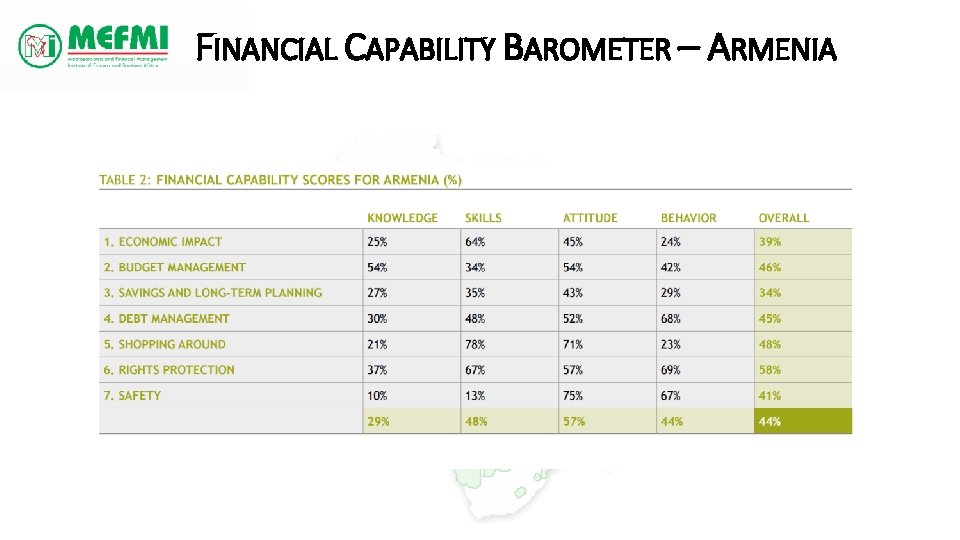
FINANCIAL CAPABILITY BAROMETER – ARMENIA
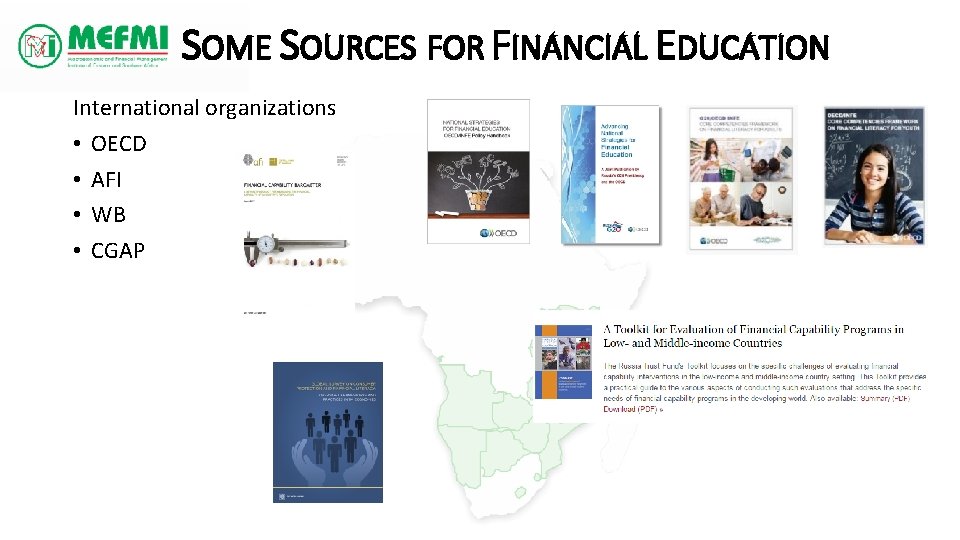
SOME SOURCES FOR FINANCIAL EDUCATION International organizations • OECD • AFI • WB • CGAP
QUESTIONS? Armenuhi Mkrtchyan Head of Consumer Protection and Financial Education Centre, Central Bank of Armenia armenuhi. mkrtchyan@cba. am www. cba. am – for Armenian legislation www. abcfinance. am – financial education website
- Slides: 55