
Best Practices in Cryopreservation Steven Budd M S
Best Practices in Cryopreservation Steven Budd, M. S. Product Line Business Specialist Cell B io lo gy Systems, ATCC April 21, 2016
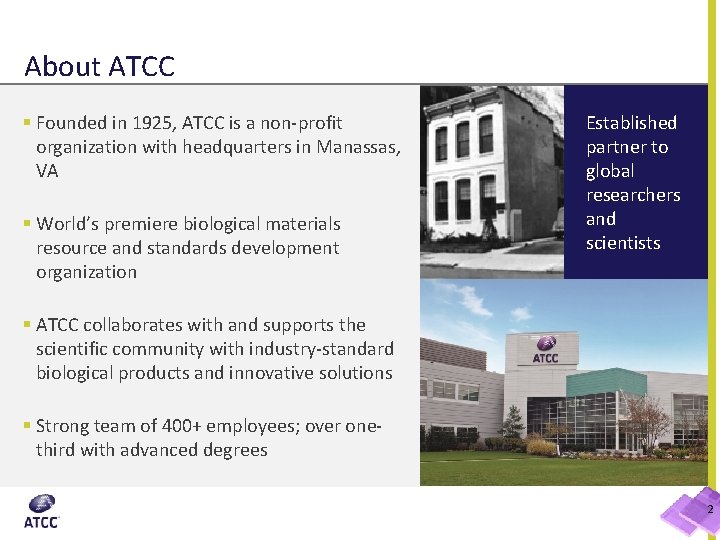
About ATCC § Founded in 1925, ATCC is a non-profit organization with headquarters in Manassas, VA § World’s premiere biological materials resource and standards development organization Established partner to global researchers and scientists § ATCC collaborates with and supports the scientific community with industry-standard biological products and innovative solutions § Strong team of 400+ employees; over onethird with advanced degrees 2
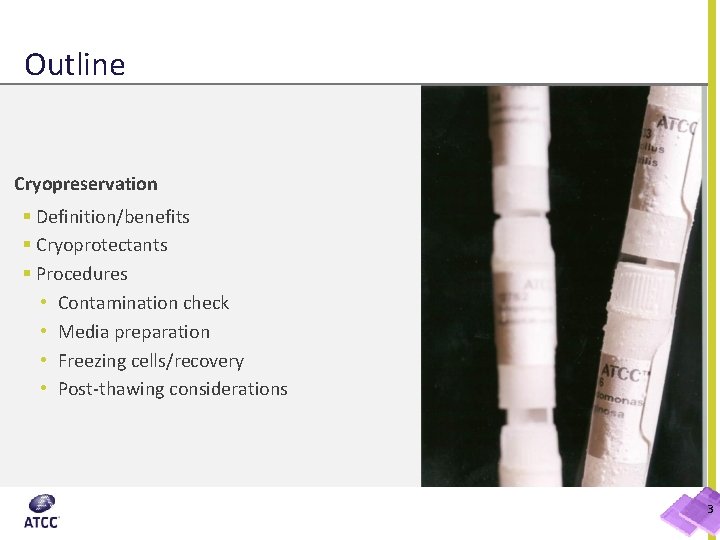
Outline Cryopreservation § Definition/benefits § Cryoprotectants § Procedures • Contamination check • Media preparation • Freezing cells/recovery • Post-thawing considerations 3
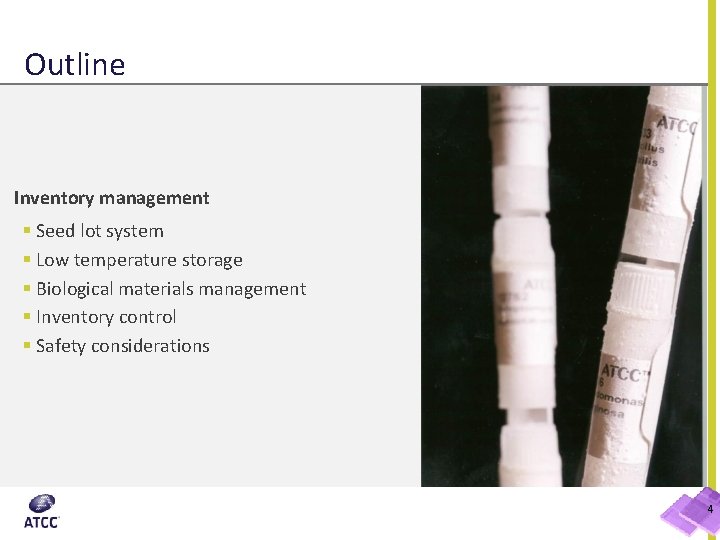
Outline Inventory management § Seed lot system § Low temperature storage § Biological materials management § Inventory control § Safety considerations 4

Cryopreservation defined § The use of very low temperatures to structurally preserve intact living cells and tissue § Unprotected freezing is normally lethal to cells while controlled cooling can be used to produce stable conditions that preserve life 5
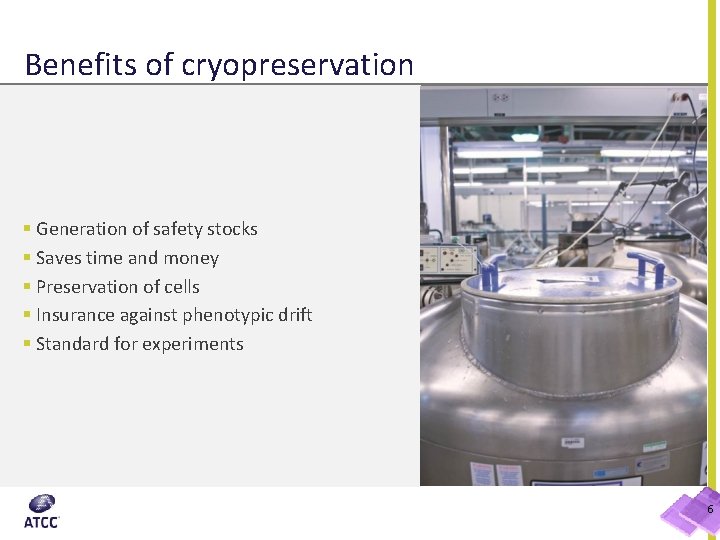
Benefits of cryopreservation § Generation of safety stocks § Saves time and money § Preservation of cells § Insurance against phenotypic drift § Standard for experiments 6
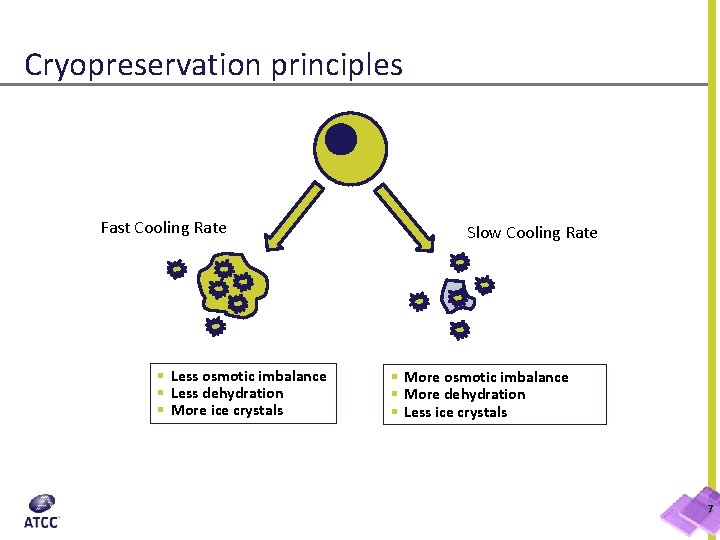
Cryopreservation principles Fast Cooling Rate § Less osmotic imbalance § Less dehydration § More ice crystals Slow Cooling Rate § More osmotic imbalance § More dehydration § Less ice crystals 7
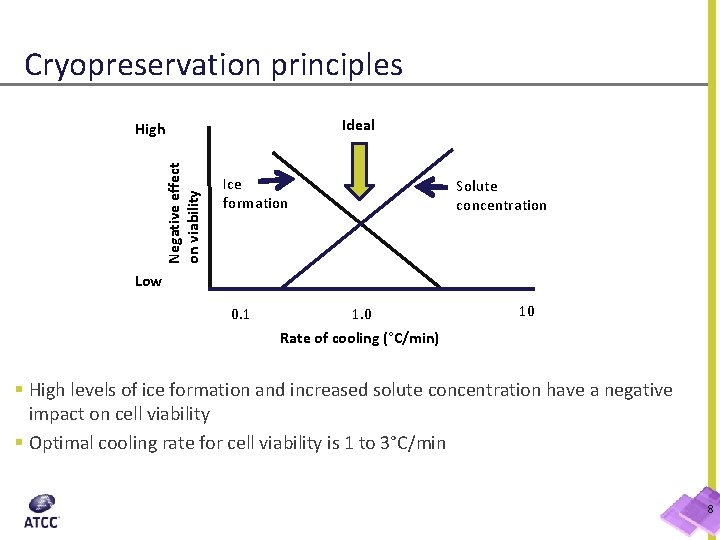
Cryopreservation principles Ideal Negative effect on viability High Ice formation Solute concentration Low 0. 1 1. 0 Rate of cooling (°C/min) 10 § High levels of ice formation and increased solute concentration have a negative impact on cell viability § Optimal cooling rate for cell viability is 1 to 3°C/min 8
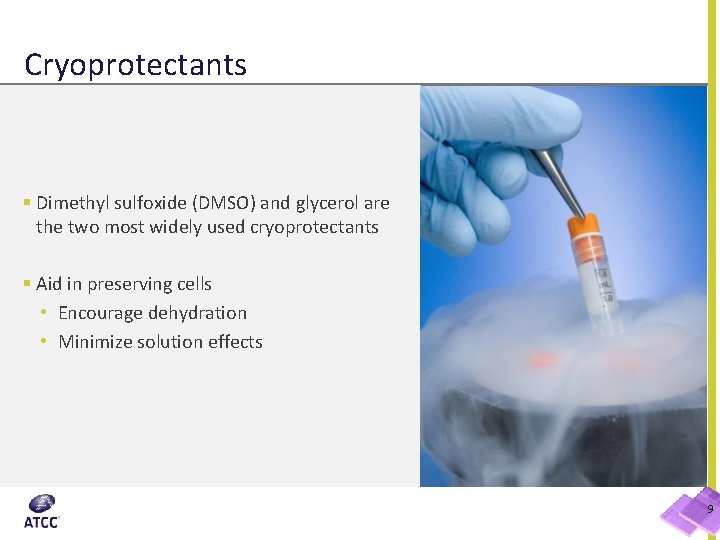
Cryoprotectants § Dimethyl sulfoxide (DMSO) and glycerol are the two most widely used cryoprotectants § Aid in preserving cells • Encourage dehydration • Minimize solution effects 9
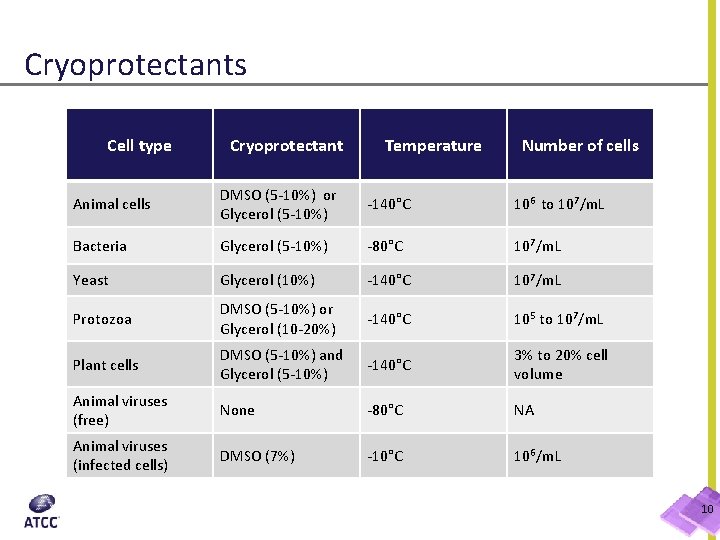
Cryoprotectants Cell type Cryoprotectant Temperature Number of cells Animal cells DMSO (5 -10%) or Glycerol (5 -10%) -140°C 106 to 107/m. L Bacteria Glycerol (5 -10%) -80°C 107/m. L Yeast Glycerol (10%) -140°C 107/m. L Protozoa DMSO (5 -10%) or Glycerol (10 -20%) -140°C 105 to 107/m. L Plant cells DMSO (5 -10%) and Glycerol (5 -10%) -140°C 3% to 20% cell volume Animal viruses (free) None -80°C NA Animal viruses (infected cells) DMSO (7%) -10°C 106/m. L 10
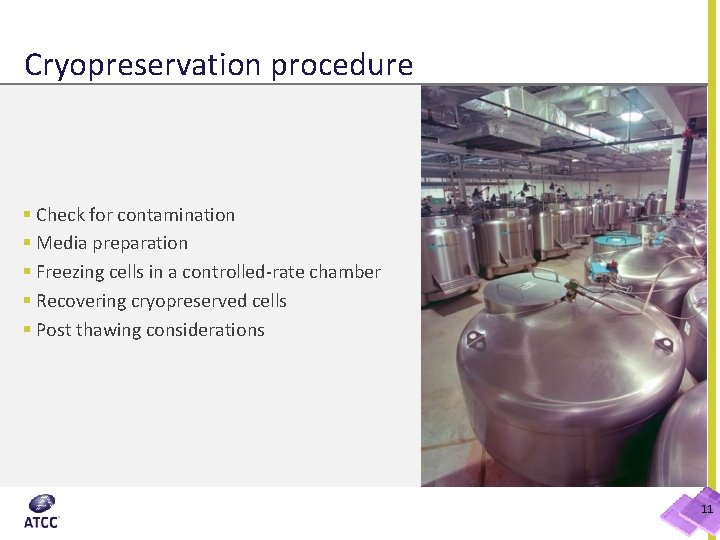
Cryopreservation procedure § Check for contamination § Media preparation § Freezing cells in a controlled-rate chamber § Recovering cryopreserved cells § Post thawing considerations 11
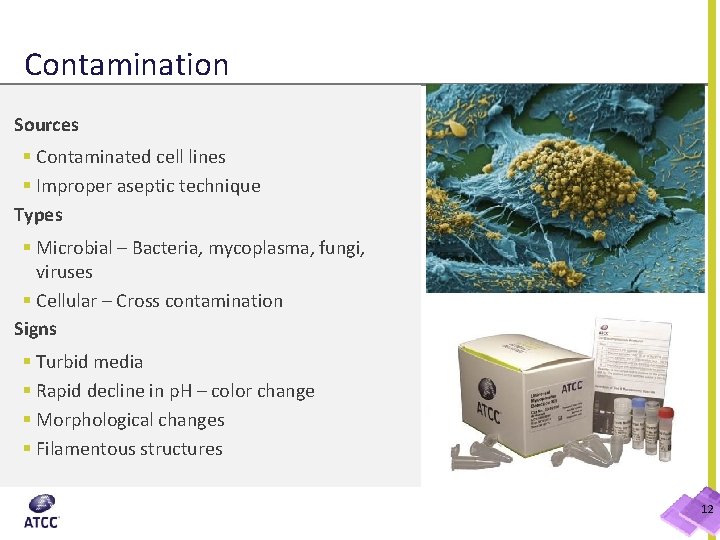
Contamination Sources § Contaminated cell lines § Improper aseptic technique Types § Microbial – Bacteria, mycoplasma, fungi, viruses § Cellular – Cross contamination Signs § Turbid media § Rapid decline in p. H – color change § Morphological changes § Filamentous structures 12

Media preparation Classical Cell Culture Media Dulbecco’s Modified Eagles Medium (DMEM) and Eagle’s Minimum Essential Medium (EMEM) RPMI-1640 (for suspension cells) § 5 -10% DMSO § 20% fetal bovine serum (FBS) or bovine serum albumin (BSA) • Additional cryprotectant properties • Necessary for post-thaw cell survival ATCC Serum-free Freezing Media (ATCC® 302600™) § All in one media § 10% DMSO with proteins and additives for cell survival Cell Suspension § 3 x 10⁶ to 5 x 10⁶ cells/m. L § 1 m. L total volume 13
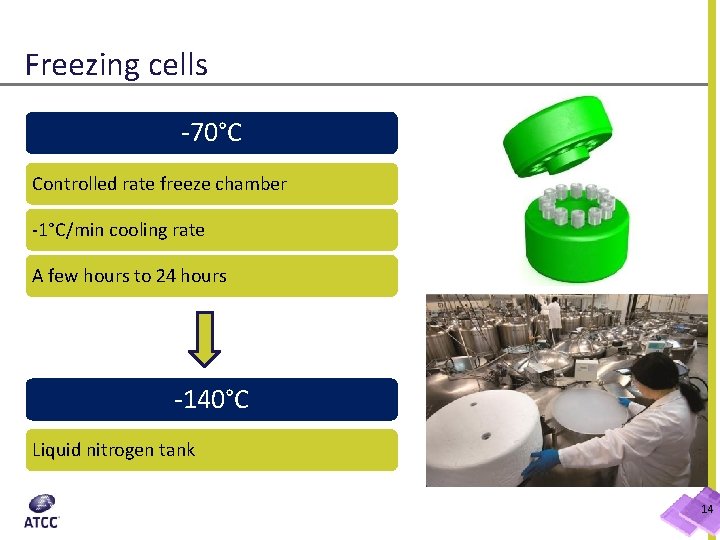
Freezing cells -70°C Controlled rate freeze chamber -1°C/min cooling rate A few hours to 24 hours -140°C Liquid nitrogen tank 14
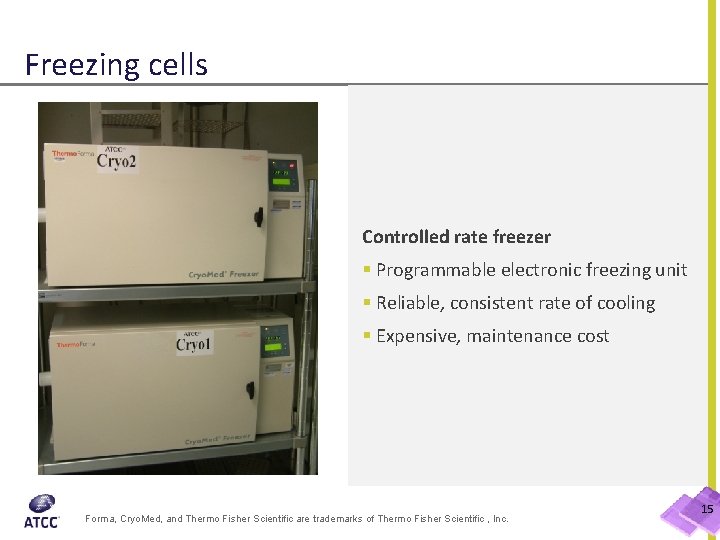
Freezing cells Controlled rate freezer § Programmable electronic freezing unit § Reliable, consistent rate of cooling § Expensive, maintenance cost Forma, Cryo. Med, and Thermo Fisher Scientific are trademarks of Thermo Fisher Scientific , Inc. 15
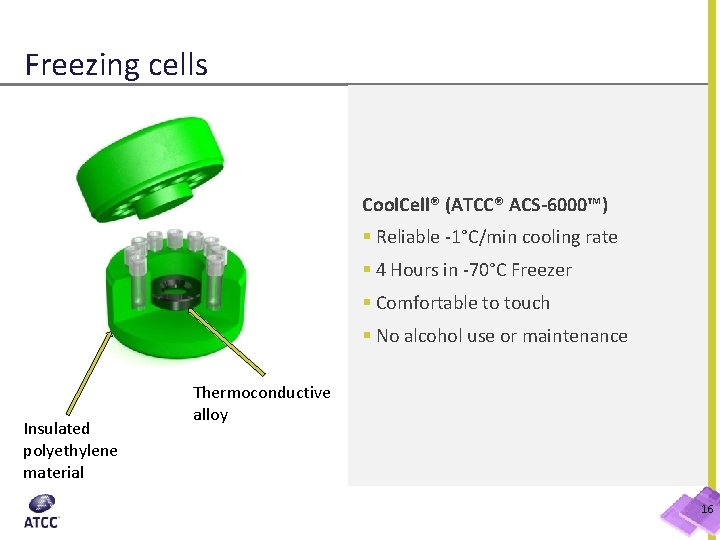
Freezing cells Cool. Cell® (ATCC® ACS-6000™) § Reliable -1°C/min cooling rate § 4 Hours in -70°C Freezer § Comfortable to touch § No alcohol use or maintenance Insulated polyethylene material Thermoconductive alloy 16
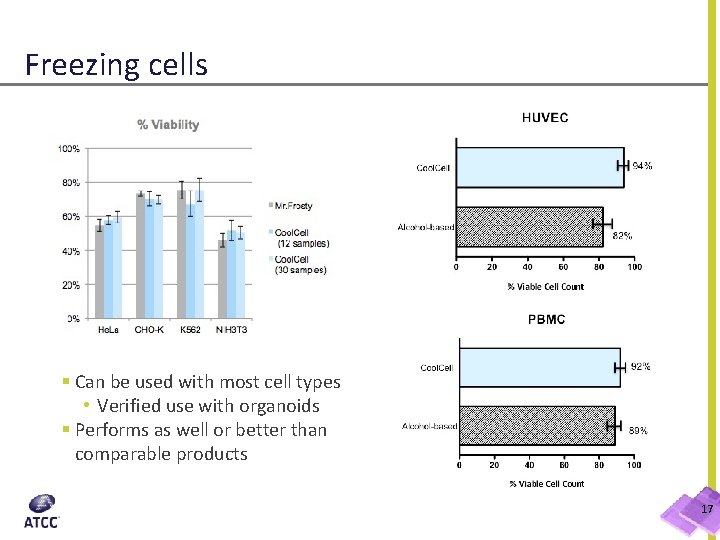
Freezing cells § Can be used with most cell types • Verified use with organoids § Performs as well or better than comparable products 17
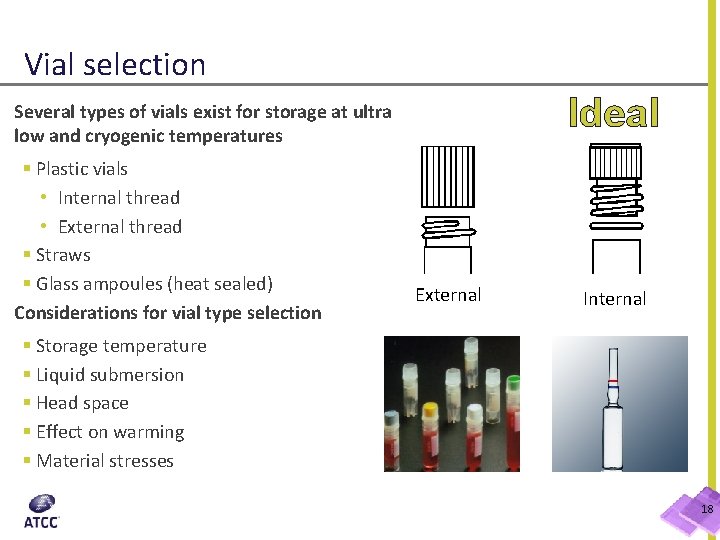
Vial selection Ideal Several types of vials exist for storage at ultra low and cryogenic temperatures § Plastic vials • Internal thread • External thread § Straws § Glass ampoules (heat sealed) Considerations for vial type selection External Internal § Storage temperature § Liquid submersion § Head space § Effect on warming § Material stresses 18
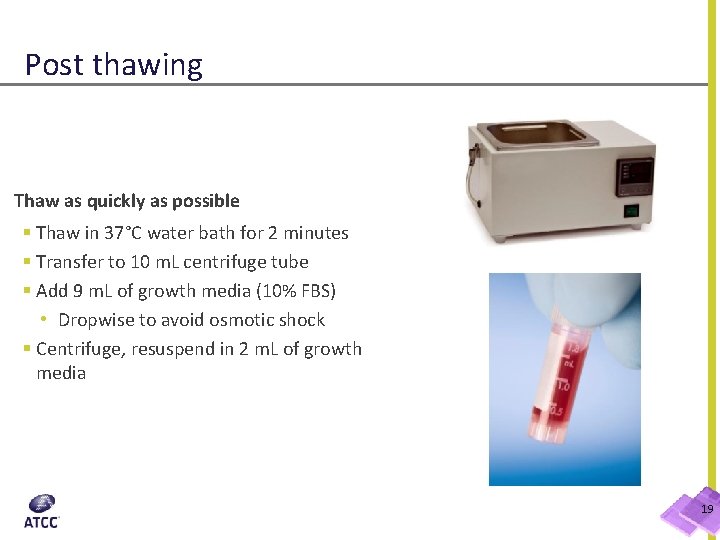
Post thawing Thaw as quickly as possible § Thaw in 37°C water bath for 2 minutes § Transfer to 10 m. L centrifuge tube § Add 9 m. L of growth media (10% FBS) • Dropwise to avoid osmotic shock § Centrifuge, resuspend in 2 m. L of growth media 19
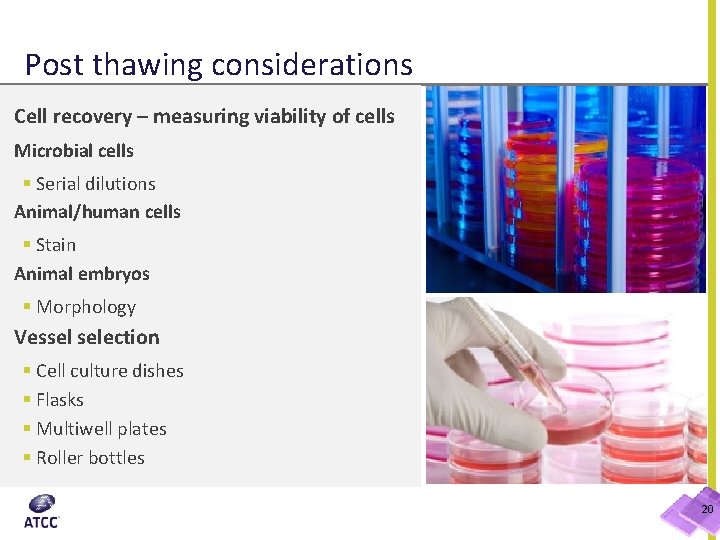
Post thawing considerations Cell recovery – measuring viability of cells Microbial cells § Serial dilutions Animal/human cells § Stain Animal embryos § Morphology Vessel selection § Cell culture dishes § Flasks § Multiwell plates § Roller bottles 20
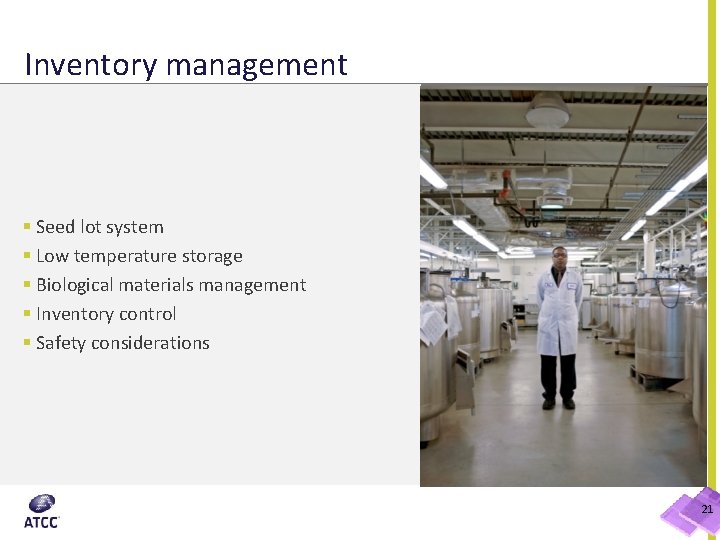
Inventory management § Seed lot system § Low temperature storage § Biological materials management § Inventory control § Safety considerations 21
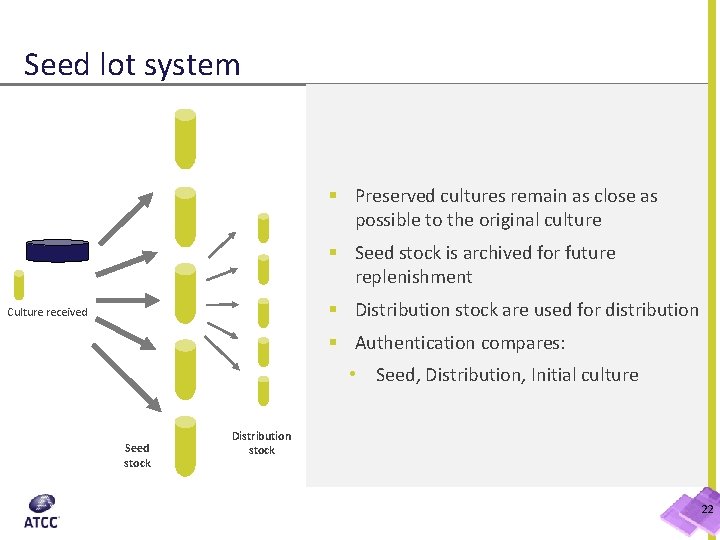
Seed lot system § Preserved cultures remain as close as possible to the original culture § Seed stock is archived for future replenishment § Distribution stock are used for distribution Culture received § Authentication compares: • Seed, Distribution, Initial culture Seed stock Distribution stock 22
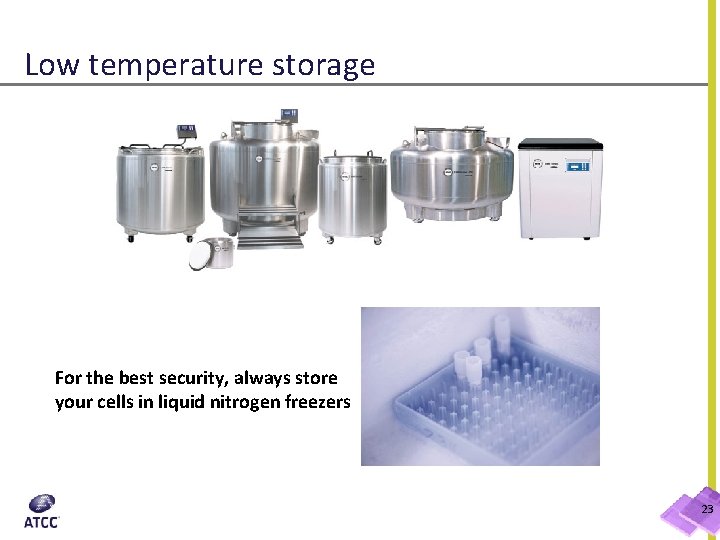
Low temperature storage For the best security, always store your cells in liquid nitrogen freezers 23
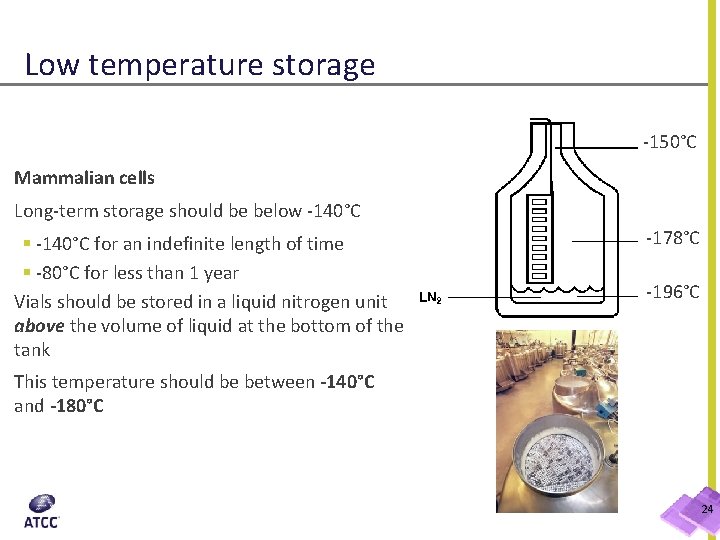
Low temperature storage -150°C Mammalian cells Long-term storage should be below -140°C § -140°C for an indefinite length of time § -80°C for less than 1 year Vials should be stored in a liquid nitrogen unit above the volume of liquid at the bottom of the tank -178°C -196°C This temperature should be between -140°C and -180°C 24
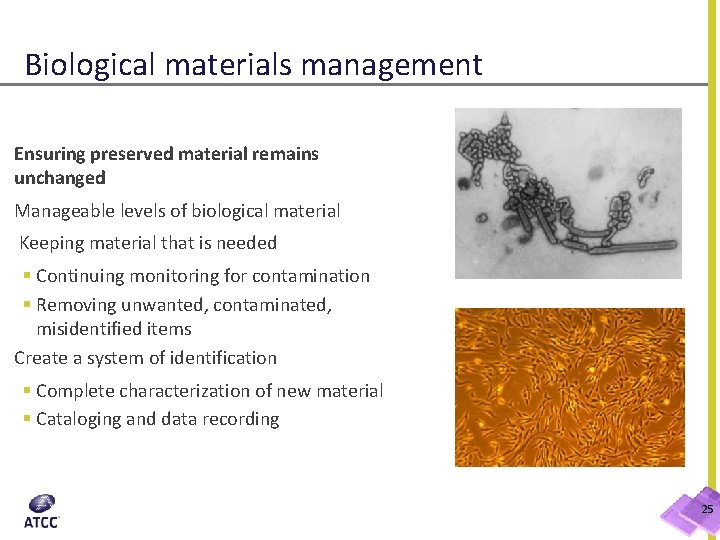
Biological materials management Ensuring preserved material remains unchanged Manageable levels of biological material Keeping material that is needed § Continuing monitoring for contamination § Removing unwanted, contaminated, misidentified items Create a system of identification § Complete characterization of new material § Cataloging and data recording 25
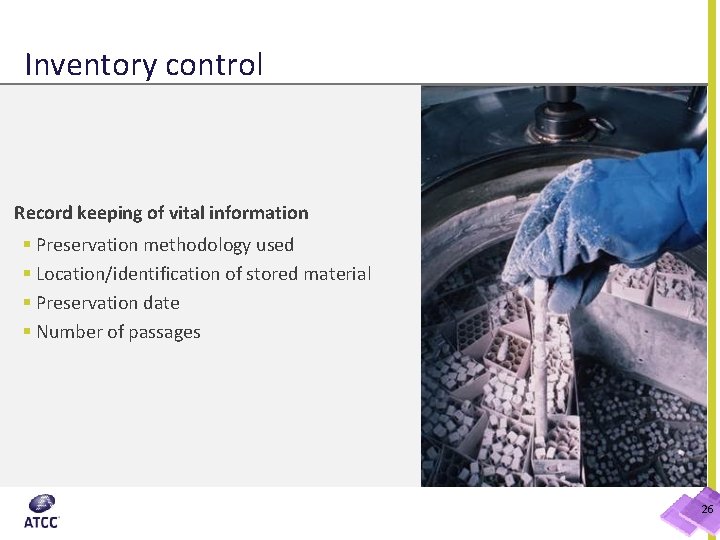
Inventory control Record keeping of vital information § Preservation methodology used § Location/identification of stored material § Preservation date § Number of passages 26
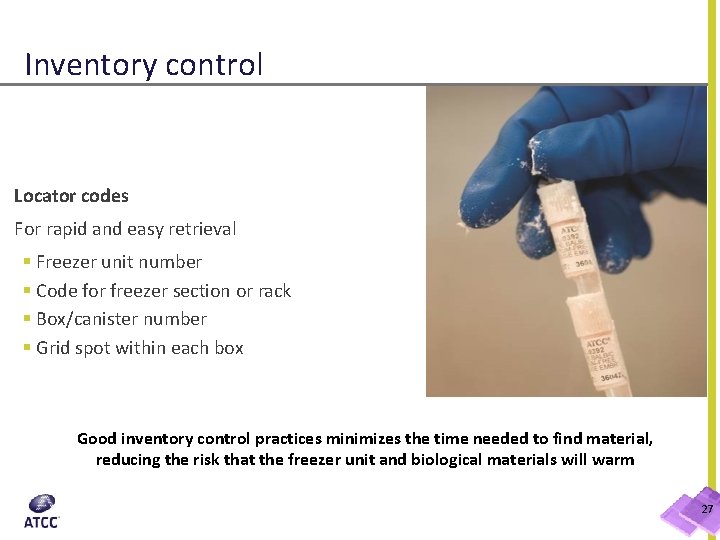
Inventory control Locator codes For rapid and easy retrieval § Freezer unit number § Code for freezer section or rack § Box/canister number § Grid spot within each box Good inventory control practices minimizes the time needed to find material, reducing the risk that the freezer unit and biological materials will warm 27
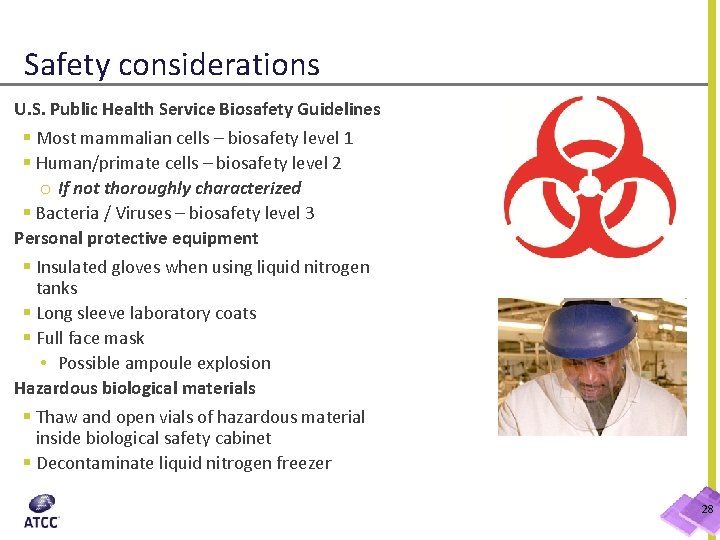
Safety considerations U. S. Public Health Service Biosafety Guidelines § Most mammalian cells – biosafety level 1 § Human/primate cells – biosafety level 2 o If not thoroughly characterized § Bacteria / Viruses – biosafety level 3 Personal protective equipment § Insulated gloves when using liquid nitrogen tanks § Long sleeve laboratory coats § Full face mask • Possible ampoule explosion Hazardous biological materials § Thaw and open vials of hazardous material inside biological safety cabinet § Decontaminate liquid nitrogen freezer 28
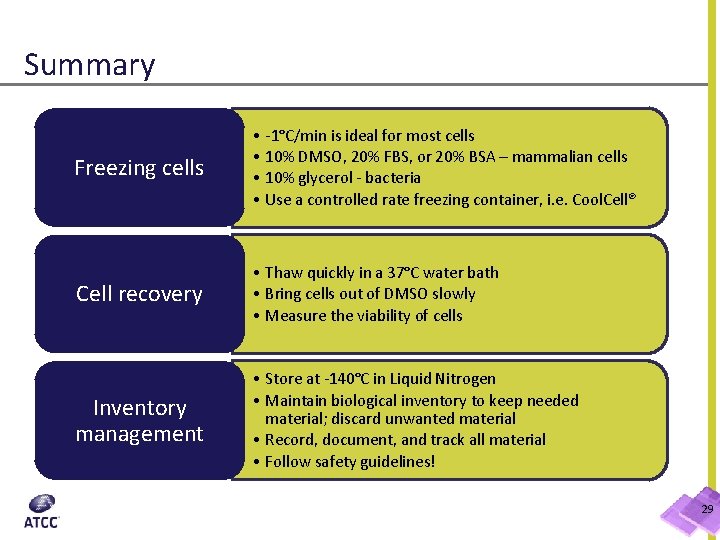
Summary Freezing cells • -1°C/min is ideal for most cells • 10% DMSO, 20% FBS, or 20% BSA – mammalian cells • 10% glycerol - bacteria • Use a controlled rate freezing container, i. e. Cool. Cell® Cell recovery • Thaw quickly in a 37°C water bath • Bring cells out of DMSO slowly • Measure the viability of cells Inventory management • Store at -140°C in Liquid Nitrogen • Maintain biological inventory to keep needed material; discard unwanted material • Record, document, and track all material • Follow safety guidelines! 29

Thank you for joining today! Register for more ATCC “Excellence in Research” webinars, or watch recorded webinars, at www. atcc. org/webinars. § April 28, 2016 10: 00 AM, 3: 00 PM EST Frank Simione, M. S. , Director, Standards Resource Organization, ATCC The ATCC Story: A Ninety Year Celebration § May 5, 2016 10: 00 AM, 3: 00 PM EST Cara Wilder, Ph. D. , Technical Writer, ATCC Carbapenem-resistant Enterobacteriaceae (CRE) – A Growing Superbug Population Please email additional questions to: tech@atcc. org 30
- Slides: 30