
Best Practices in Body Positioning Best practices in
Best Practices in Body Positioning

Best practices in body positioning • Best practice is to know where your hands are at all times. • Sometimes when we loose sight of our hands, we loose sight of what the dangers are. • If you have to put your hands in a machine, an opening or some place where you loose sight of your hands, your only way of knowing what you’re doing is by feel. • This can be a huge distraction on the safety awareness factor to which your

Best practices in body positioning • The following situations could all lead to a recordable injury or even a death. • We need to assess the areas where we are working to know where to place our hands and where not to place our hands.

Best Practice • Label clearly • Give advanced notice • Use illustrations wherever possible
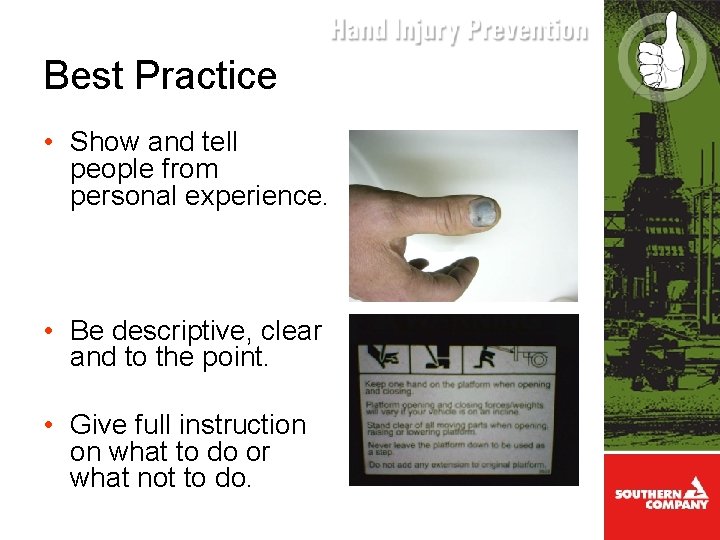
Best Practice • Show and tell people from personal experience. • Be descriptive, clear and to the point. • Give full instruction on what to do or what not to do.
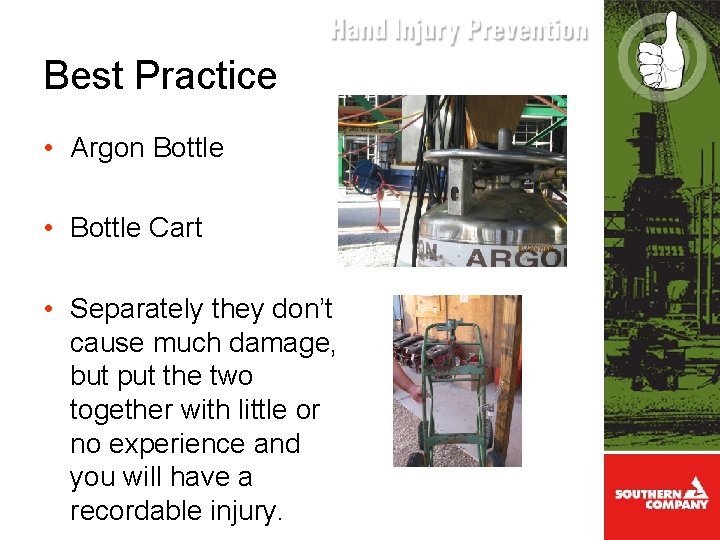
Best Practice • Argon Bottle • Bottle Cart • Separately they don’t cause much damage, but put the two together with little or no experience and you will have a recordable injury.
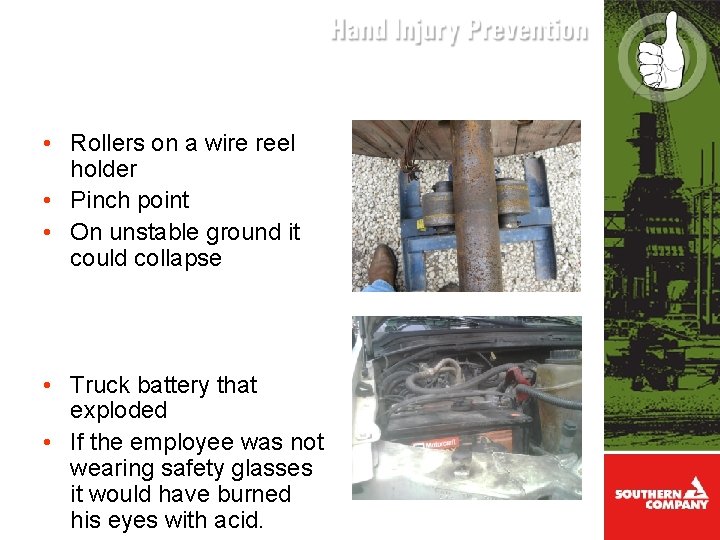
• Rollers on a wire reel holder • Pinch point • On unstable ground it could collapse • Truck battery that exploded • If the employee was not wearing safety glasses it would have burned his eyes with acid.
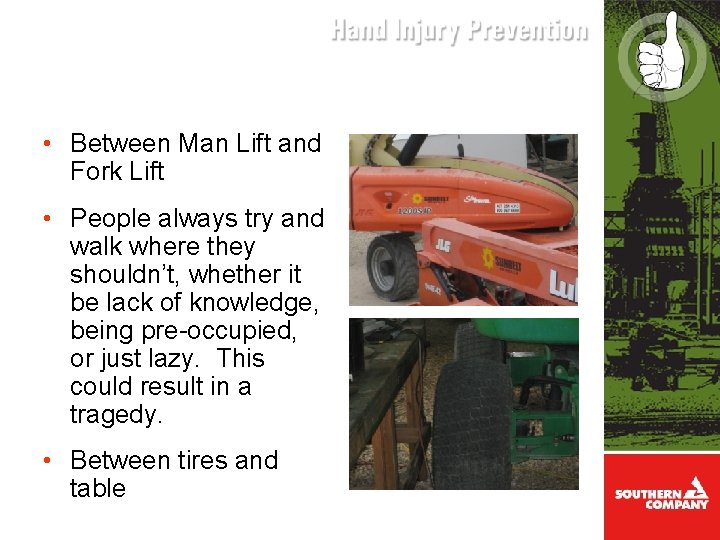
• Between Man Lift and Fork Lift • People always try and walk where they shouldn’t, whether it be lack of knowledge, being pre-occupied, or just lazy. This could result in a tragedy. • Between tires and table

• Between pipe and Man lift basket • Placing our hands in the wrong spot can have life long lasting effects. • High voltage power

These are just a few examples of situations we encounter every day. With the right training and the knowledge of standard operating procedures, we lower our risk of being in the wrong spot.
- Slides: 10