
BEST PRACTICES IN BILINGUAL ASSESSMENT Wilda LaijaRodriguez Ph
BEST PRACTICES IN BILINGUAL ASSESSMENT Wilda Laija-Rodriguez, Ph. D. , LEP California State University, Northridge California Association of School Psychologists Conference March 5 -7, 2003

THE ISSUES
Statistics: Why is it important to know how to work with bilingual students? b b By 2010, it is estimated that NY, TX, CA, and FL will have about 1/3 of the nations minority youth (Hodginson & Outz, 1992) The Hispanic population in US has grown faster than the rest of the population as a whole (Carrasquillo, 1999) Hispanic children, including LEP students, make up a significant percentage of the public school population in US (Carrasquillo, 1999) In 2002, the majority of newborns are Hispanic
Educational Issues with Minority Children b Minority students lag academically behind majority children (Carrasquillo, 1999; Meier & Stewart, 1991) b Hispanic students lag behind other minority groups in various areas (Carrasquillo, 1999) b As a result, there has been a significant overrepresentation of Hispanic students in special education and other remedial programs (Figueroa & Artiles, 1999)
Issues with Minority/ Bilingual Students 1) Language Proficiency Issues (Cummins, 1984) 2) Low Academic Achievement (Carrasquillo, 1999) 3) Overrepresentation special education and other remedial programs (Figueroa & Artiles, 1999; Stewart & Meier, 1991) 4) Lack of adequate programs for bilingual students in public schools

SECOND LANGUAGE DEVELOPMENT
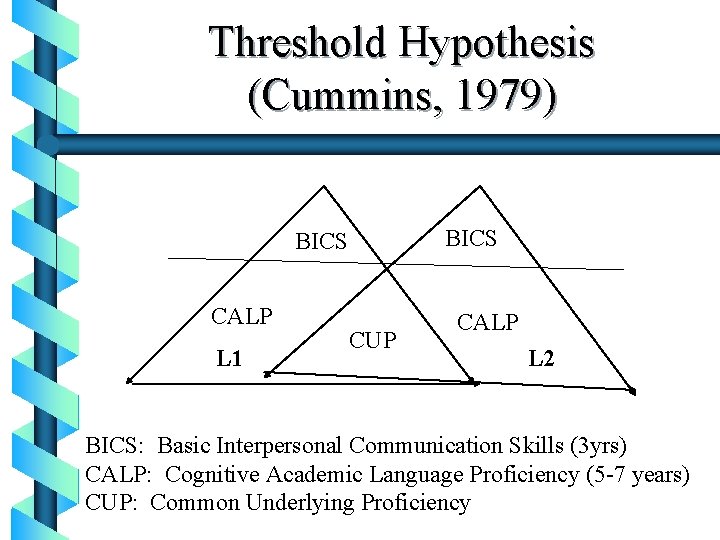
Threshold Hypothesis (Cummins, 1979) BICS CALP L 1 CUP CALP L 2 BICS: Basic Interpersonal Communication Skills (3 yrs) CALP: Cognitive Academic Language Proficiency (5 -7 years) CUP: Common Underlying Proficiency
FACTORS INFLUENCING SECOND LANGUAGE ACQUISTION • AGE: – young second language learners use same part of the brain for both L 1 and L 2 – older learners use a different part of the brain for their L 2 than they used for their first (Kim, Relkin, Lee & Hirsch, 1997). – Younger second language learners don’t necessarily develop accent – Older second language learners (ages 8 -12) develop language faster; possibly due to cognitive maturity and L 1 competence – Children older than 12 slow down, probably due to increased academic demands
FACTORS INFLUENCING SECOND LANGUAGE ACQUISTION – Personality – strong self-esteem outgoing vs. shy and withdrawn – Social Factors – language models – motivation
The Acquisition-Learning Distinction (Stephen Krashen) – Corresponding to Natural Language Approach b b b Language acquisition = “picking up a language” Language learning = learning language in formal manner Affective filter = emotional barrier to language learning Learning provides a monitor = allows learner to correct language output based on previously learned language rules. In short run, older learners develop competence faster than younger children. Children outperform adults in L 2 in the long run
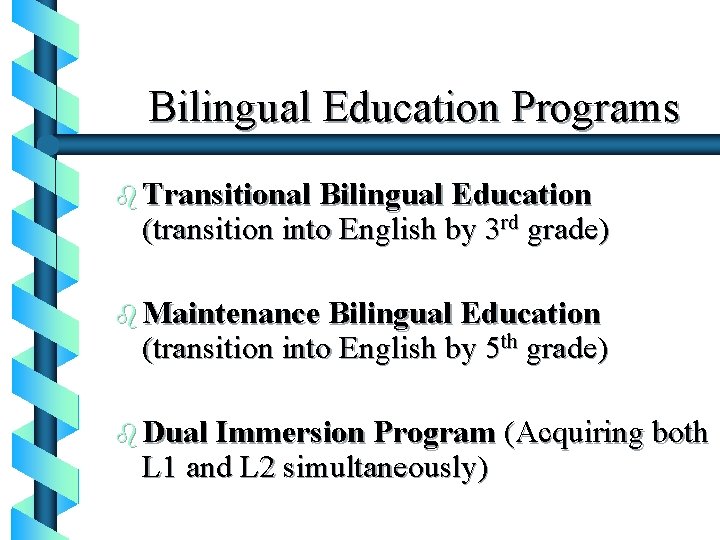
Bilingual Education Programs b Transitional Bilingual Education (transition into English by 3 rd grade) b Maintenance Bilingual Education (transition into English by 5 th grade) b Dual Immersion Program (Acquiring both L 1 and L 2 simultaneously)
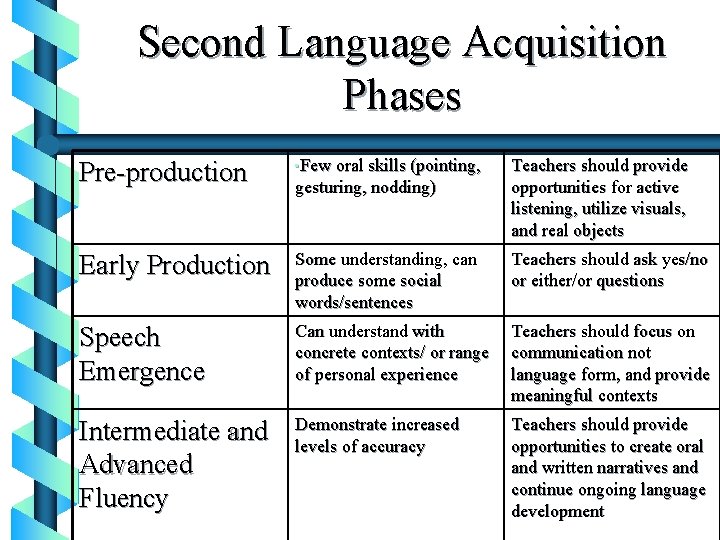
Second Language Acquisition Phases Pre-production • Few oral skills (pointing, Early Production Some understanding, can produce some social words/sentences Teachers should ask yes/no or either/or questions Speech Emergence Can understand with concrete contexts/ or range of personal experience Teachers should focus on communication not language form, and provide meaningful contexts Intermediate and Advanced Fluency Demonstrate increased levels of accuracy Teachers should provide opportunities to create oral and written narratives and continue ongoing language development gesturing, nodding) Teachers should provide opportunities for active listening, utilize visuals, and real objects
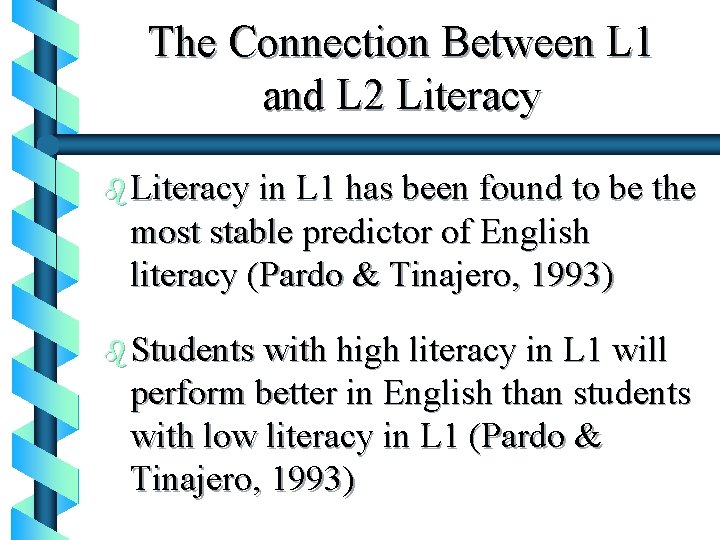
The Connection Between L 1 and L 2 Literacy b Literacy in L 1 has been found to be the most stable predictor of English literacy (Pardo & Tinajero, 1993) b Students with high literacy in L 1 will perform better in English than students with low literacy in L 1 (Pardo & Tinajero, 1993)

LOW ACADEMIC ACHIEVEMENT
Reading Proficiency Among Hispanic Students b Overall academic achievement, especially reading proficiency among Hispanic students is far below the national average (Carrasquillo, 1991).

Research in L 2 Reading b There are differences in basic underlying cognitive processes during first and second language reading (Koda, 1994; Segalowitz, 1986) b Reduced automaticity of word recognition with fluent bilinguals (Hernandez et al, 1996; Segalowitz, 1986) b Repetition effects occur more readily within languages than they do between languages, thus L 2 reading may be affected (Scarborough, 1984)
OVER REPRESENTATION IN SPECIAL EDUCATION

Testing, the Law and LEP Students: Diana v. State Board of Education (1970): • Spanish speaking students were being placed in MR classes based on their scores from intelligence tests administered in English o Important results from the case: • 1) language competence should be assessed • 2) tests should be administered in students’ L 1 • 3) emphasis on nonverbal measures • 4) students placed incorrectly should be reevaluated
Public Law 94 -142 /IDEA ‘ 97: Specific Issues with LEP Students b *Assessment should be conducted in students’ b native language or mode of communication b *Assessment procedures should be non-discriminatory b *Assessment instruments …must measure disability, b not child’s English language skills b *Tests should be valid for purposes used b *Tests are administered by trained and b knowledgeable personnel b *Single test should not be sole criterion for disability b *Areas related to suspected disability should be assessed.

ASSESSMENT ISSUES
REFERRALS TO SPECIAL EDUCATION b The use of the SST b Pre-referral Questions (LEP Questionnaire) b Pre-referral Interventions
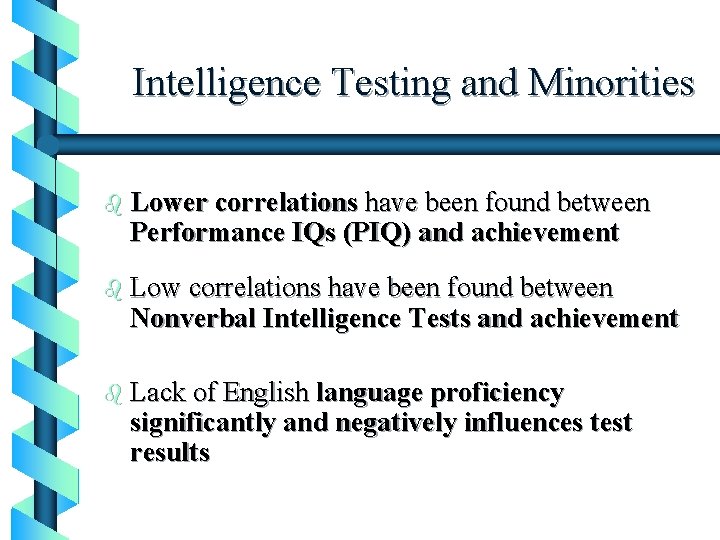
Intelligence Testing and Minorities b Lower correlations have been found between Performance IQs (PIQ) and achievement b Low correlations have been found between Nonverbal Intelligence Tests and achievement b Lack of English language proficiency significantly and negatively influences test results
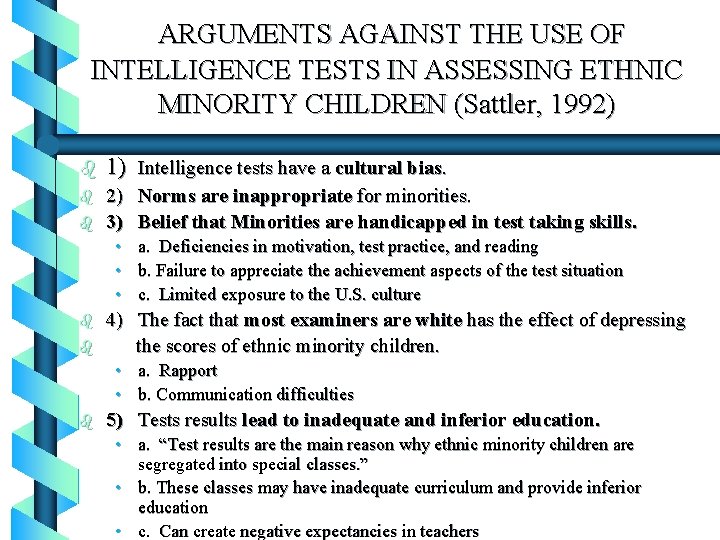
ARGUMENTS AGAINST THE USE OF INTELLIGENCE TESTS IN ASSESSING ETHNIC MINORITY CHILDREN (Sattler, 1992) b 1) Intelligence tests have a cultural bias. b 2) Norms are inappropriate for minorities. 3) Belief that Minorities are handicapped in test taking skills. b • • • b b a. Deficiencies in motivation, test practice, and reading b. Failure to appreciate the achievement aspects of the test situation c. Limited exposure to the U. S. culture 4) The fact that most examiners are white has the effect of depressing the scores of ethnic minority children. • a. Rapport • b. Communication difficulties b 5) Tests results lead to inadequate and inferior education. • a. “Test results are the main reason why ethnic minority children are segregated into special classes. ” • b. These classes may have inadequate curriculum and provide inferior education • c. Can create negative expectancies in teachers
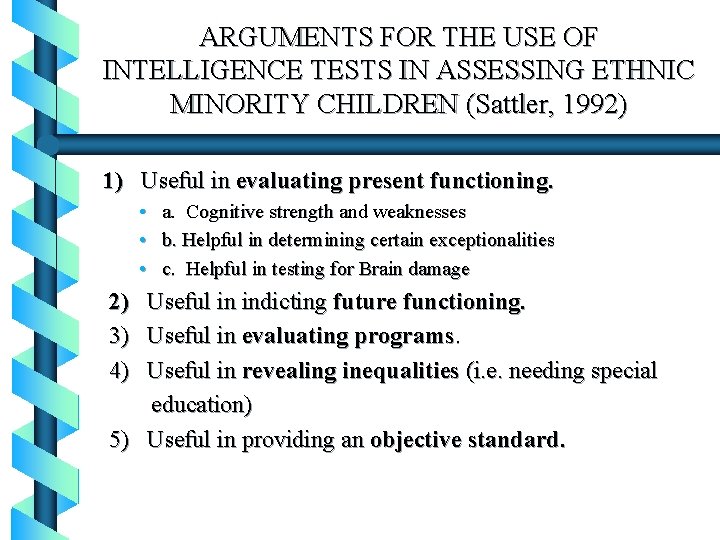
ARGUMENTS FOR THE USE OF INTELLIGENCE TESTS IN ASSESSING ETHNIC MINORITY CHILDREN (Sattler, 1992) 1) Useful in evaluating present functioning. • a. Cognitive strength and weaknesses • b. Helpful in determining certain exceptionalities • c. Helpful in testing for Brain damage 2) Useful in indicting future functioning. 3) Useful in evaluating programs. 4) Useful in revealing inequalities (i. e. needing special education) 5) Useful in providing an objective standard.
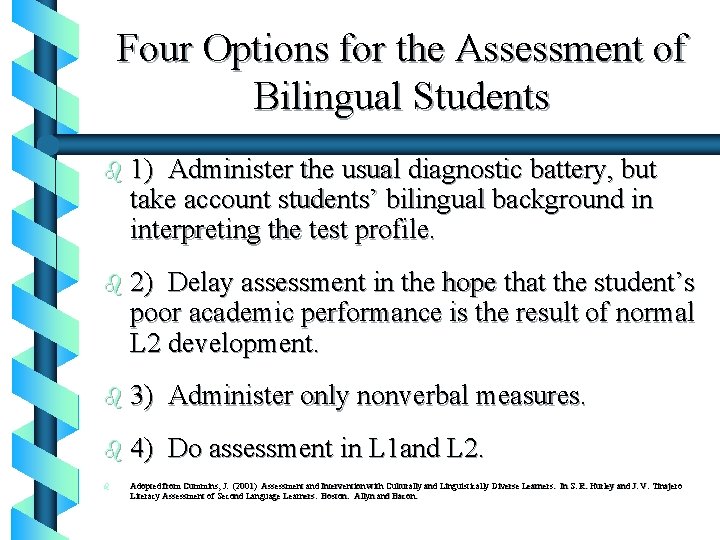
Four Options for the Assessment of Bilingual Students b 1) Administer the usual diagnostic battery, but take account students’ bilingual background in interpreting the test profile. b 2) Delay assessment in the hope that the student’s poor academic performance is the result of normal L 2 development. b 3) Administer only nonverbal measures. b 4) Do assessment in L 1 and L 2. b Adopted from Cummins, J. (2001) Assessment and Intervention with Culturally and Linguistically Diverse Learners. In S. R. Hurley and J. V. Tinajero Literacy Assessment of Second Language Learners. Boston: Allyn and Bacon.
Usual Diagnostic Battery While Considering Student’s Bilingual Background b Use of verbal and nonverbal measures in English, but accounting for students’ bilingual background. b Dangers: Mis-interpreting results and over- representation of students in Special Education (Ortiz & Yates, 1983; Mercer, 1973). b Tendency to ignore or underestimate the influence of language proficiency on individuals’ performance (Oller, 1997; as cited in Cummins, 2001)
Administering Only Nonverbal Measures b Nonverbal measures not good predictors of academic achievement b Language competency needs to be assessed (Diana vs. State Board of Ed, 1970) b Most learning disabilities are related to language b If there are visual perceptual difficulties, nonverbal measures will not be valid.
Assessment in L 1 and L 2 b Few Bilingual Psychologists/Speech Pathologists b Appropriate use of interpreters b Questionable norms (monolingual norms in Spanish or English) b Caution in interpreting languages separately

Bilingual Assessment Model (Wilda’s model in progress) LEP Bilingual *Has had instruction in L 1 *Uses Spanish to a high degree Bilingual Assessment: Assessment in L 1 and L 2 • Observations • Interviews (parents and teachers) • Appropriate Norm referenced tests - consider language and standardization. • Criterion based tests • Curriculum Based Measurement Bilingual *Fluent in English *No previous instruction in L 1 Assessment in English with consideration regarding culture and L 2 development • Observations • Interviews (parents and teachers) • Appropriate Norm referenced tests • Criterion based tests • Curriculum Based Measurement Wilda Laija, Ph. D. 2000
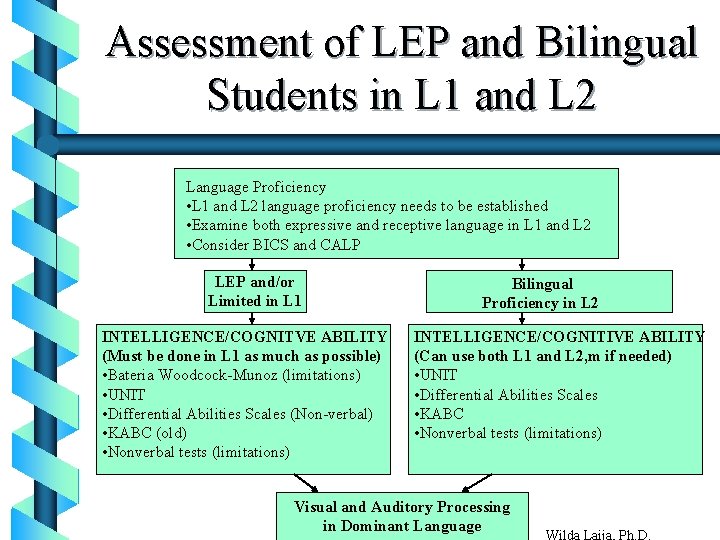
Assessment of LEP and Bilingual Students in L 1 and L 2 Language Proficiency • L 1 and L 2 language proficiency needs to be established • Examine both expressive and receptive language in L 1 and L 2 • Consider BICS and CALP LEP and/or Limited in L 1 INTELLIGENCE/COGNITVE ABILITY (Must be done in L 1 as much as possible) • Bateria Woodcock-Munoz (limitations) • UNIT • Differential Abilities Scales (Non-verbal) • KABC (old) • Nonverbal tests (limitations) Bilingual Proficiency in L 2 INTELLIGENCE/COGNITIVE ABILITY (Can use both L 1 and L 2, m if needed) • UNIT • Differential Abilities Scales • KABC • Nonverbal tests (limitations) Visual and Auditory Processing in Dominant Language Wilda Laija, Ph. D.
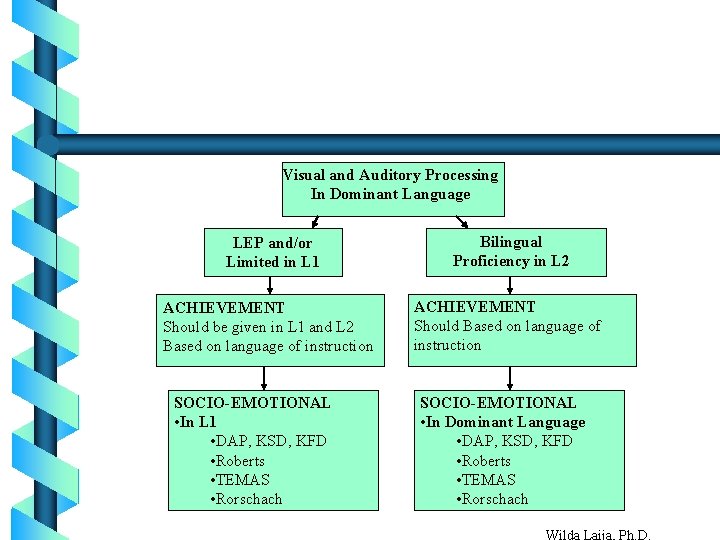
Visual and Auditory Processing In Dominant Language LEP and/or Limited in L 1 Bilingual Proficiency in L 2 ACHIEVEMENT Should be given in L 1 and L 2 Based on language of instruction ACHIEVEMENT Should Based on language of instruction SOCIO-EMOTIONAL • In L 1 • DAP, KSD, KFD • Roberts • TEMAS • Rorschach SOCIO-EMOTIONAL • In Dominant Language • DAP, KSD, KFD • Roberts • TEMAS • Rorschach Wilda Laija, Ph. D.
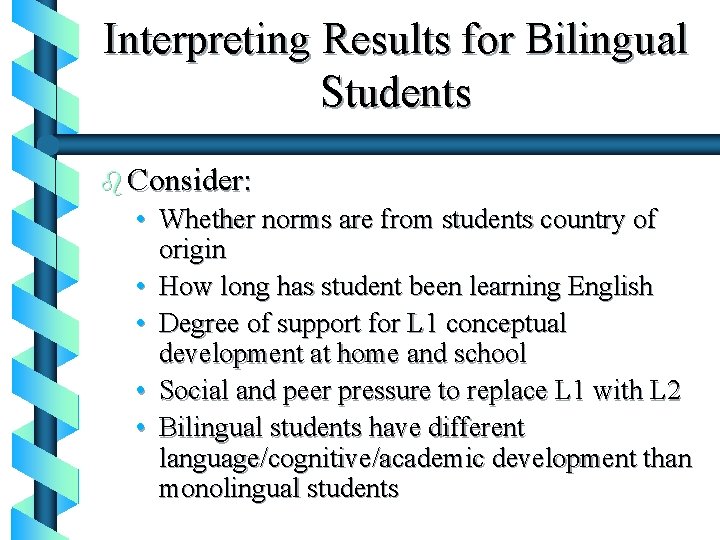
Interpreting Results for Bilingual Students b Consider: • Whether norms are from students country of origin • How long has student been learning English • Degree of support for L 1 conceptual development at home and school • Social and peer pressure to replace L 1 with L 2 • Bilingual students have different language/cognitive/academic development than monolingual students
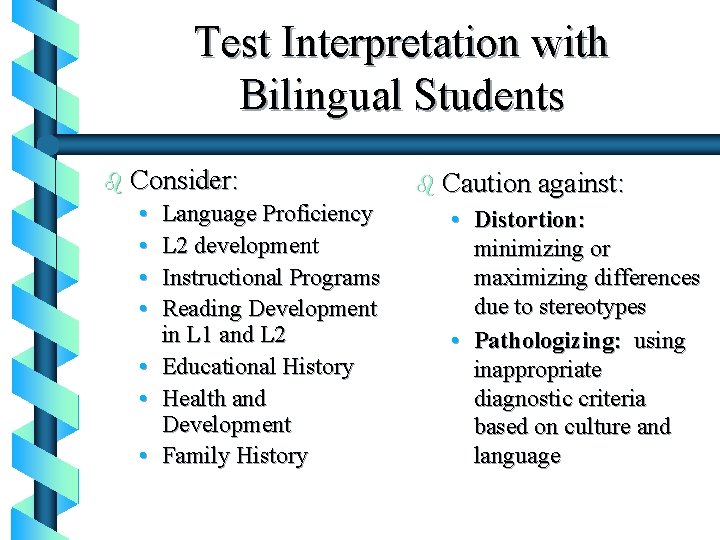
Test Interpretation with Bilingual Students b Consider: • • Language Proficiency L 2 development Instructional Programs Reading Development in L 1 and L 2 Educational History Health and Development Family History b Caution against: • Distortion: minimizing or maximizing differences due to stereotypes • Pathologizing: using inappropriate diagnostic criteria based on culture and language
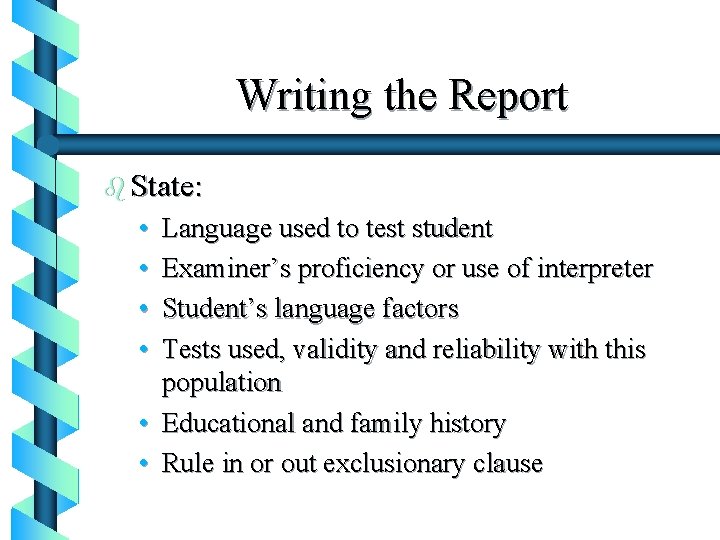
Writing the Report b State: • • • Language used to test student Examiner’s proficiency or use of interpreter Student’s language factors Tests used, validity and reliability with this population Educational and family history Rule in or out exclusionary clause
Classroom Interventions for Promoting L 2 Competencies b Reading aloud to the students at their conceptual level b Providing experiences for listening comprehension b Encouraging oral language development b Sharing reading between the teacher and students b Modeling and guiding oral language and reading development b Shared reading: dictating to the teacher and then illustrating books b Using materials that are socially sensitive and culturally specific
- Slides: 36