
BEST PRACTICES IN ASSESSMENT IN SPORT MANAGEMENT EDUCATION
BEST PRACTICES IN ASSESSMENT IN SPORT MANAGEMENT EDUCATION Heath Hooper, Ph. D. Shorter University Bob Stinchcomb, Ed. D. CMAA, Shorter University Lauren Duplantis, Ph. D, Shorter University
Introduction § Shorter University Department of Sport Management Mission § The Department of Sport Management and degree program at Shorter University is a product of a very robust College of Business. The Department of Sport Management is built upon sound business principles with an emphasis in the sport industry sector. We are committed to the relationship between sport and business through learning avenues that engage and prepare future leaders in our industry. We strive to enhance character, Christian values, diversity, and professionalism throughout the curriculum and experiential learning activities. § The Purpose § To effectively practice and develop an assessment plan for the departmental and students in order to promote excellence in sport management education. § The objective is to effectively assess four departmental and four student learning outcomes on a year to year basis. § Assessment Areas § Departmental Outcomes § Student Learning Outcomes (SLO’s)

Department of Sport Management § Goals for Assessment § Develop departmental outcomes evaluation to better assess our responsibilities and duties. § Develop measures and criteria for Student Learning Outcomes evaluation in order to asses student progression towards stated objectives. § Integrate strategies for continuous improvement in accordance with COSMA Principals. § Create a developmental approach to excellence in Sport Management Education. § Assessment – 2015 -2016 Academic Year (Traditional students enrolled in the traditional Bachelor of Business Administration (BBA) in Sport Management.
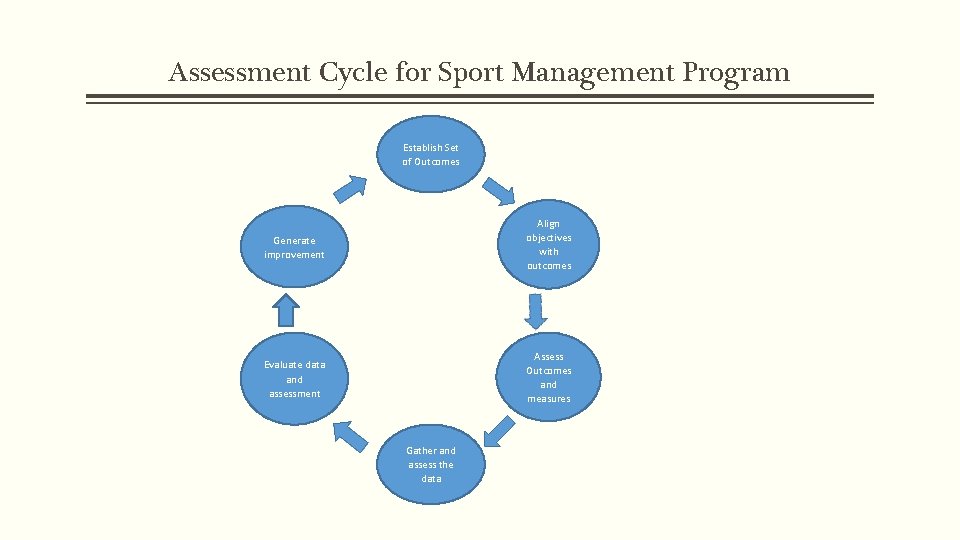
Assessment Cycle for Sport Management Program Establish Set of Outcomes Generate improvement Align objectives with outcomes Evaluate data and assessment Assess Outcomes and measures Gather and assess the data
Departmental Assessment Pieces Defined 1. Advising § During the 2015 -2016 academic year, traditional students enrolled in the traditional BBA in Sport Management will be academically advised by the Department of Sport Management Faculty. After the completion of the advising, the student will then be sent a satisfaction survey via email. 2. Teacher Evaluations § During the 2015 -2016 academic year, faculty will be evaluated by the students at the completion of every course. Students will complete end of course evaluations for each course on the instructor of the course. Evaluations will be studied to show improvements needed to be made for courses and self-evaluations for each instructor. 3. Community Relations § During the 2015 -2016 academic year, the faculty will develop strategies and outreach opportunities to communicate and gain new opportunities for students outside of Shorter University. Community relations outcome will be measured on how many new sport organizations as a department we can establish a relationship with for future opportunities 4. Student Communication § During the 2015 -2016 academic year, the faculty of the Department of Sport Management will develop and implement communication strategies for current traditional students. Student communication will be measured on the amount of students we have sign up for Remind 101 Text Message Application, in which we send out Sport Management news, updates and opportunities for our students.
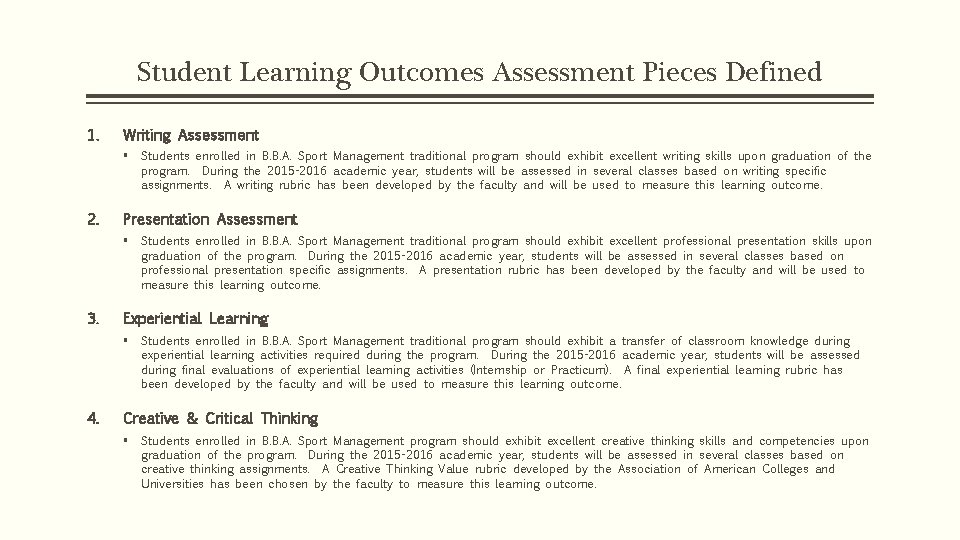
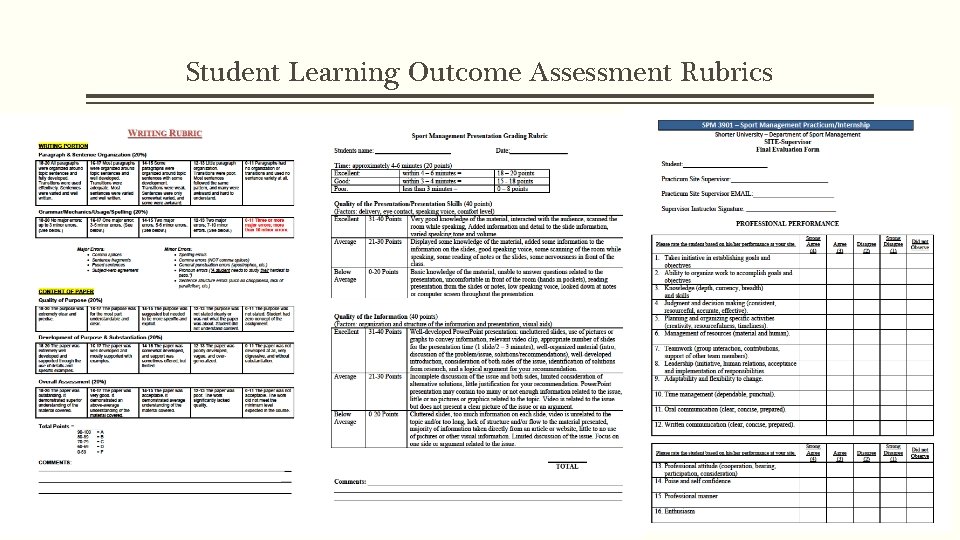
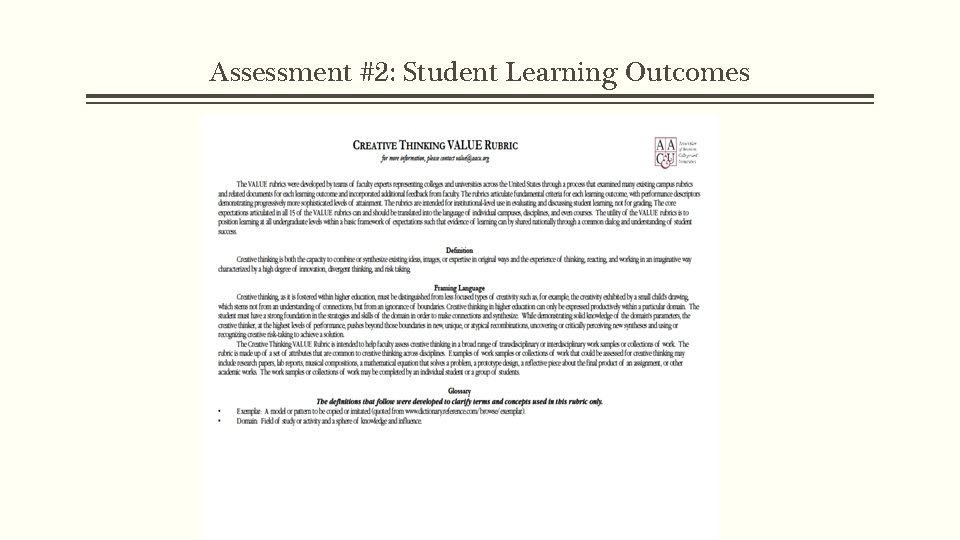
Student Learning Outcomes Assessment Pieces Defined 1. Writing Assessment § Students enrolled in B. B. A. Sport Management traditional program should exhibit excellent writing skills upon graduation of the program. During the 2015 -2016 academic year, students will be assessed in several classes based on writing specific assignments. A writing rubric has been developed by the faculty and will be used to measure this learning outcome. 2. Presentation Assessment § Students enrolled in B. B. A. Sport Management traditional program should exhibit excellent professional presentation skills upon graduation of the program. During the 2015 -2016 academic year, students will be assessed in several classes based on professional presentation specific assignments. A presentation rubric has been developed by the faculty and will be used to measure this learning outcome. 3. Experiential Learning § Students enrolled in B. B. A. Sport Management traditional program should exhibit a transfer of classroom knowledge during experiential learning activities required during the program. During the 2015 -2016 academic year, students will be assessed during final evaluations of experiential learning activities (Internship or Practicum). A final experiential learning rubric has been developed by the faculty and will be used to measure this learning outcome. 4. Creative & Critical Thinking § Students enrolled in B. B. A. Sport Management program should exhibit excellent creative thinking skills and competencies upon graduation of the program. During the 2015 -2016 academic year, students will be assessed in several classes based on creative thinking assignments. A Creative Thinking Value rubric developed by the Association of American Colleges and Universities has been chosen by the faculty to measure this learning outcome.
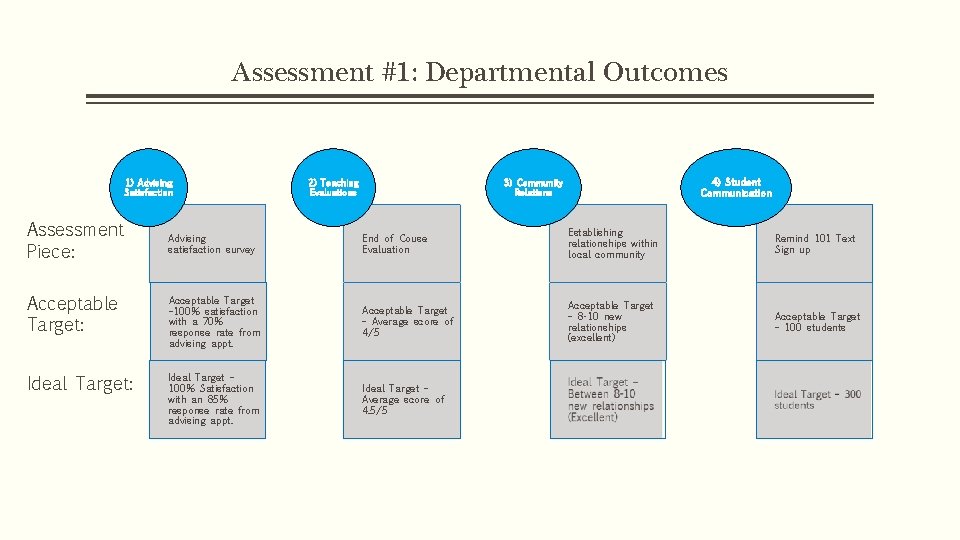
Assessment #1: Departmental Outcomes 1) Advising Satisfaction Assessment Piece: 2) Teaching Evaluations 4) Student Communication 3) Community Relations Advising satisfaction survey End of Couse Evaluation Establishing relationships within local community Remind 101 Text Sign up Acceptable Target: Acceptable Target – 100% satisfaction with a 70% response rate from advising appt. Acceptable Target – Average score of 4/5 Acceptable Target – 8 -10 new relationships (excellent) Acceptable Target – 100 students Ideal Target: Ideal Target – 100% Satisfaction with an 85% response rate from advising appt. Ideal Target – Average score of 4. 5/5
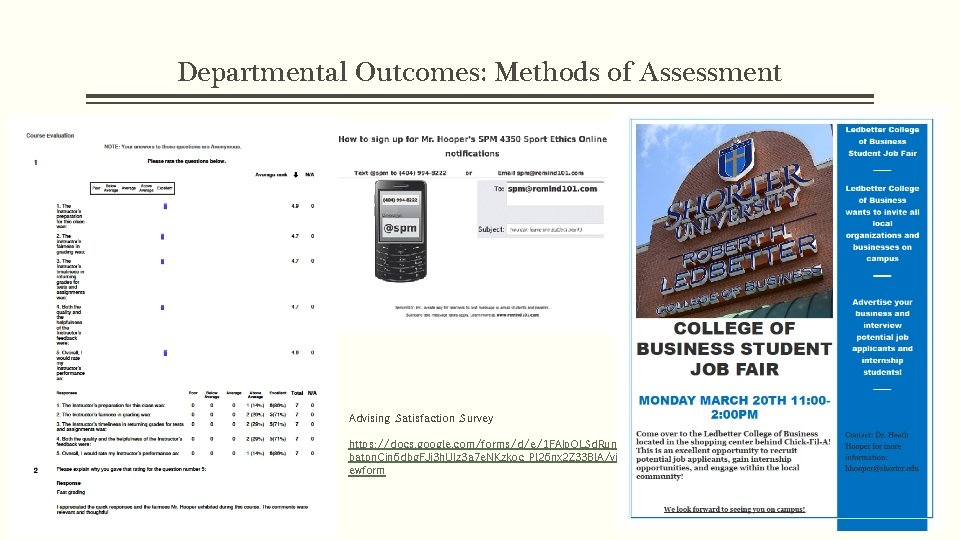
Departmental Outcomes: Methods of Assessment Advising Satisfaction Survey https: //docs. google. com/forms/d/e/1 FAIp. QLSd. Run batpn. Cjn 6 dbg. FJi 3 h. UIz 3 a 7 e. NKzkoc_Pl 26 nx 2 Z 33 Bl. A/vi ewform
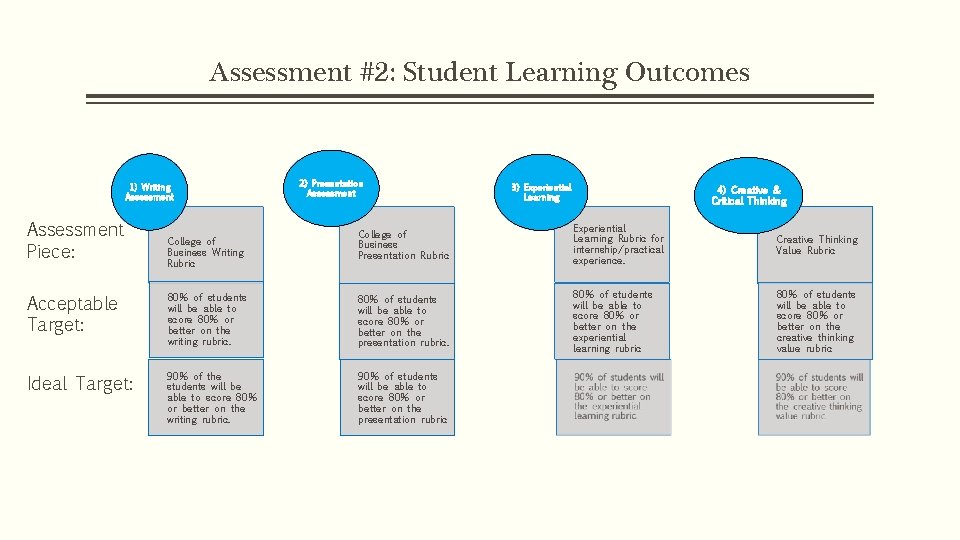
Assessment #2: Student Learning Outcomes 1) Writing Assessment Piece: College of Business Writing Rubric 2) Presentation Assessment 3) Experiential Learning 4) Creative & Critical Thinking College of Business Presentation Rubric Experiential Learning Rubric for internship/practical experience. Creative Thinking Value Rubric 80% of students will be able to score 80% or better on the experiential learning rubric 80% of students will be able to score 80% or better on the creative thinking value rubric Acceptable Target: 80% of students will be able to score 80% or better on the writing rubric. 80% of students will be able to score 80% or better on the presentation rubric. Ideal Target: 90% of the students will be able to score 80% or better on the writing rubric. 90% of students will be able to score 80% or better on the presentation rubric
Student Learning Outcome Assessment Rubrics
Assessment #2: Student Learning Outcomes
Departmental Outcome Assessment Results § Advising Satisfaction § N = 36 out of 41 (88%) students took survey § Results indicate 100% of students stated their advisor more than adequately met the students’ needs and provided ample time. § Acceptable Target Met § Teaching Evaluations § N = 43 students assessed § Avg. satisfactory score (N = 4. 88 out of 5. 0) § Ideal Target Met § Community Relations § Number of new relationships established § N = 11 new partnerships with sport organizations. § Ideal Target Met § Student Communication § § Remind 101 Sign up 2014 -2015 (N = 34) 2015 -2016 (N = 133) Acceptable Target Met
Student Learning Outcomes Assessment Results § Writing Assessment § N = 52 students assessed in SPM 4350 Sport Ethics & SPM 4700 Event & Facility Management. § 88% of students scored 80% or higher on the assessment. § Acceptable Target Met § Presentation Assessment § N = 34 students assessed in SPM 1500 Intro to Sport Management. § 85% of students scored 80% or higher on the assessment. § Acceptable Target Met § Experiential Learning § N = 20 students assessed in SPM 3901 Sport Practicum & SPM 4050 Internship. § 100% of students scored 80% or higher on the assessment. § Ideal Target Met § Creative & Critical Thinking § N = 38 students assessed in SPM 3600 Sport Marketing & SPM 3360 Sport Communication. § 79% of students scored 80% or higher on the assessment. § Acceptable Target not met
Conclusions § Indication of areas in which the Sport Management Faculty is thriving with the students and opportunities. § Enrollment growth as a program § Communication § Establishing relationships § Areas in need of improvement § Creative & critical thinking skills § “Norming session” § New method of assessment can help alleviate the low % § Student Development § Practical Experience § International Exposure § Going forward…. § Produce evidence of basic skills development through the curriculum and evidence of personal development within each student
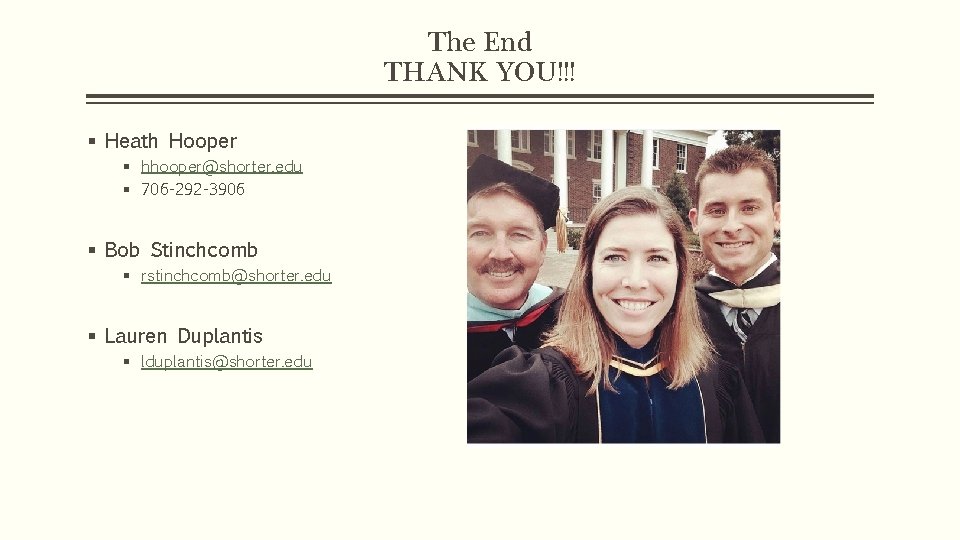
The End THANK YOU!!! § Heath Hooper § hhooper@shorter. edu § 706 -292 -3906 § Bob Stinchcomb § rstinchcomb@shorter. edu § Lauren Duplantis § lduplantis@shorter. edu
- Slides: 15