
Best practices in addressing nutrition challenges Examples of
Best practices in addressing nutrition challenges: Examples of nutrition support through community participation and action in Kenya Rose Ndolo, Senior Nutrition and Food Security Adviser World Vision UK Brussels Development Briefing for Nutrition Wednesday 20, May 2015
Outline • • • World Vision nutrition framework Nutrition situation in Kenya Case studies on linking nutrition & agriculture Case study on social accountability Challenges Lessons and Recommendations

WORLD VISION GLOBAL NUTRITION FRAMEWORK & INTERVENTIONS Improve nutrition of children U 5, girls, women and vulnerable groups Immediate factors Underlying factors WV Interventions Adequate dietary intake Adequate Household Food Security & Livelihoods Quality food for infants and young children Health Adequate Maternal & Child Care Practices Care of young child Healthy Environment & Adequate Health Services Maternal and Child Health (community-based) Care of mother and girls Adequate diet for families Family response to child illness Quantity/quality of food for families in crisis Household and personal hygiene of household members Effective livelihood strategies and assured income Basic factors at societal level Access to Essential Primary Health Care (facility-based) Healthy Environment
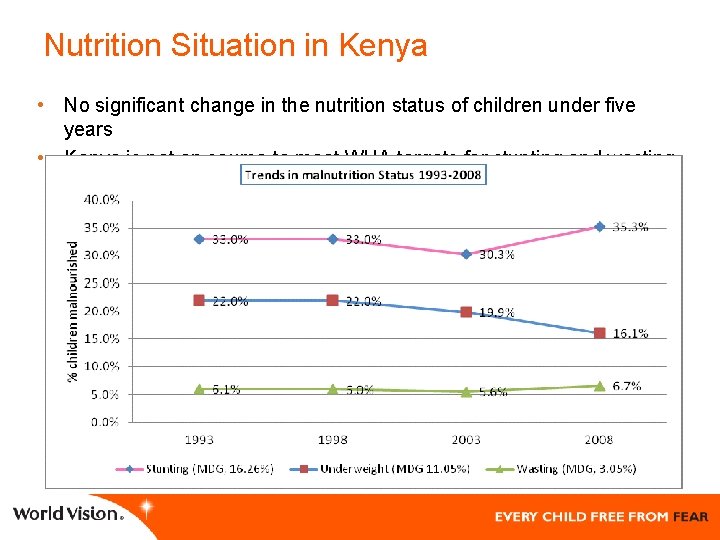
Nutrition Situation in Kenya • No significant change in the nutrition status of children under five years • Kenya is not on course to meet WHA targets for stunting and wasting

Linking Nutrition & Agriculture ECHO/ UNICEF funded nutrition project linking with EC funded Livelihoods project in Samburu County - mother support groups approach for Infant and young child feeding • Majeiyo group of 14 mothers, 10 youthful girls and 4 men • Members learn together • Trained on home gardening & rearing of small stock • Receive farm inputs
Linking Nutrition & Agriculture EC funded Maternal Child Health and Nutrition project in Taita Taveta County by World Vision, IMC and St Josephs' Shelter of Hope • Targeting through CMAM programme • Caregivers are trained by agriculture extension workers • Set up home gardens • Receive small stock- goats and chicken
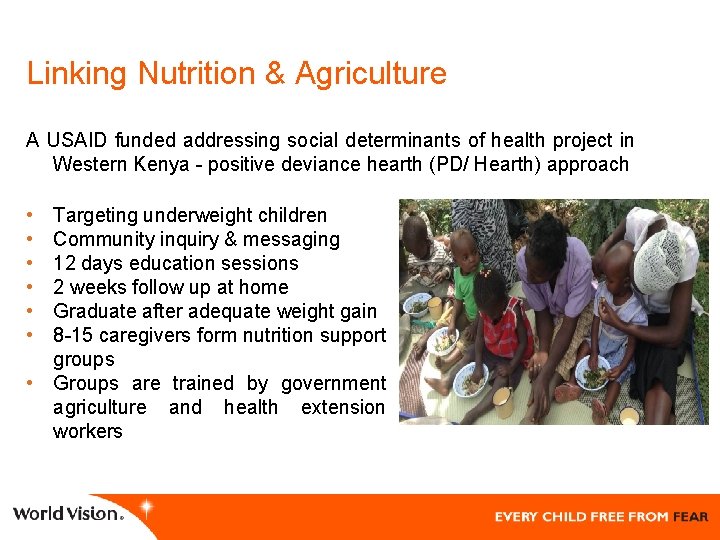
Linking Nutrition & Agriculture A USAID funded addressing social determinants of health project in Western Kenya - positive deviance hearth (PD/ Hearth) approach • • • Targeting underweight children Community inquiry & messaging 12 days education sessions 2 weeks follow up at home Graduate after adequate weight gain 8 -15 caregivers form nutrition support groups • Groups are trained by government agriculture and health extension workers
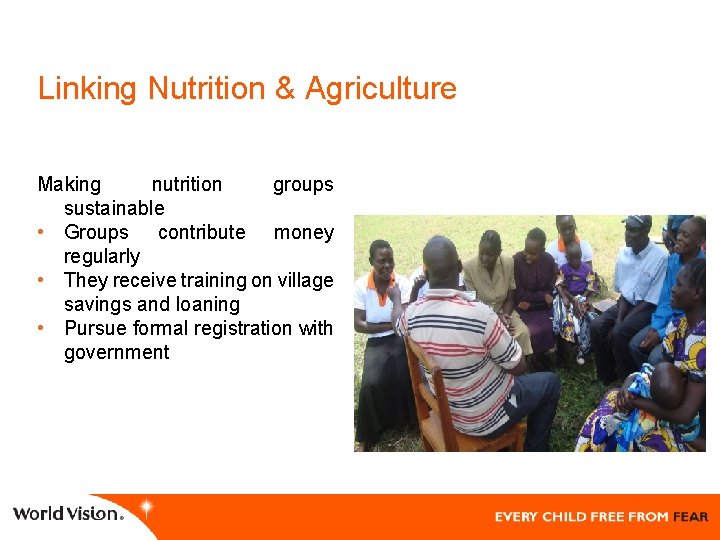
Linking Nutrition & Agriculture Making nutrition groups sustainable • Groups contribute money regularly • They receive training on village savings and loaning • Pursue formal registration with government
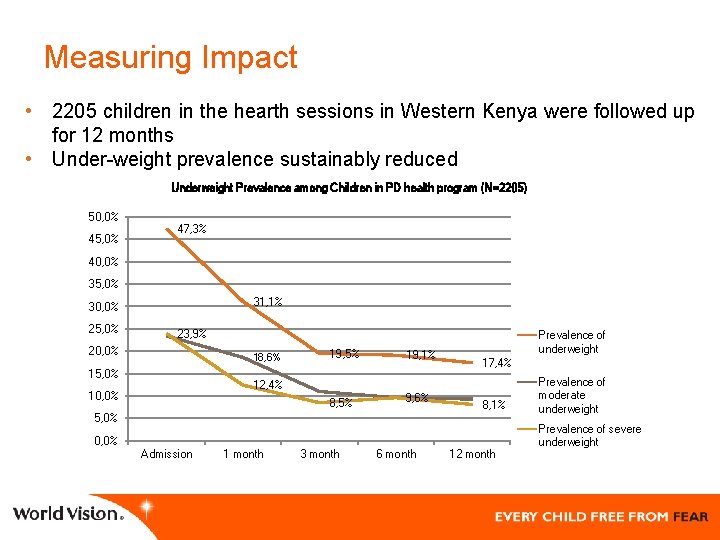
Measuring Impact • 2205 children in the hearth sessions in Western Kenya were followed up for 12 months • Under-weight prevalence sustainably reduced Underweight Prevalence among Children in PD health program (N=2205) 50, 0% 45, 0% 47, 3% 40, 0% 35, 0% 31, 1% 30, 0% 25, 0% 23, 9% 20, 0% 18, 6% 15, 0% 19, 5% 19, 1% Prevalence of underweight 17, 4% 12, 4% 10, 0% 8, 5% 9, 6% 8, 1% 5, 0% 0, 0% Admission 1 month 3 month 6 month 12 month Prevalence of moderate underweight Prevalence of severe underweight
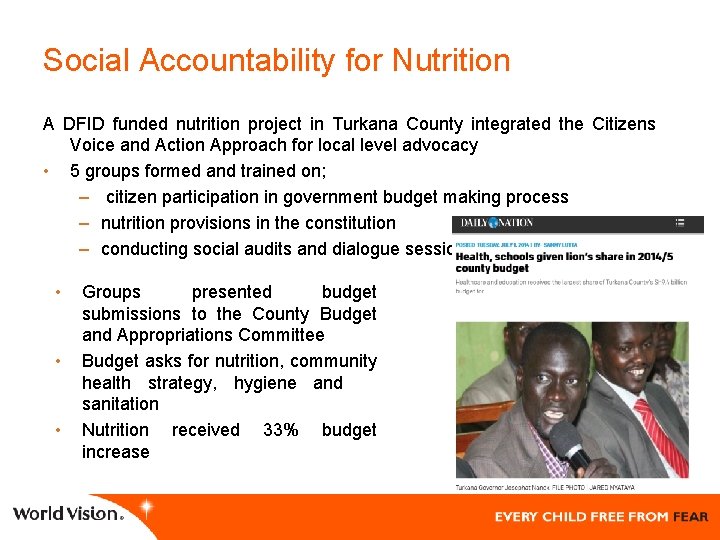
Social Accountability for Nutrition A DFID funded nutrition project in Turkana County integrated the Citizens Voice and Action Approach for local level advocacy • 5 groups formed and trained on; – citizen participation in government budget making process – nutrition provisions in the constitution – conducting social audits and dialogue sessions • • • Groups presented budget submissions to the County Budget and Appropriations Committee Budget asks for nutrition, community health strategy, hygiene and sanitation Nutrition received 33% budget increase
Challenges • The food security project didn't have population level nutrition data • Limited capacity to measure impact of agriculture interventions on nutrition • Inadequate scale up project level interventions • Lack of joint nutrition frameworks across sectors/ ministries
Lessons and Specific Recommendations • Communities have to be at the core for sustainable linkages • Build cross – sectoral/ ministerial collaborations for ownership • Target the most vulnerable; malnourished children, children under 2 & 5 years, women • Select and track appropriate indicators at project and national levels • Build capacity to measure impact • Embed social accountability into programmes Overall Recommendations • National level- joint multi- sectoral frameworks for nutrition • International level- include the 6 WHA nutrition targets as part of the SDGs to deliver change for nutrition
Voices of women Jane Lekasuya, assistant chairlady of Majeiyo group says, ‘we are confident that we will slowly bring change to our community's way of living. When other women in our community come to our group to buy sukuma wiki (kale), some ask for saplings to plant and want to know how they can emulate us. We advise them to form and register a group and then seek training’
- Slides: 13