
Best Practices for ISPs By Ahmer Ghazi Sysnet

Best Practices for ISPs By Ahmer Ghazi, Sysnet
Introduction • POP Hierarchy • Scaling IGP – – – Not running IGP with the customer No customer routes in IGP No Redistribution from BGP to IGP Summarization Partitioning into areas • Scaling BGP – Aggregation – Filtering Policy – Route Reflector Design

POP Hierarchy Other POPs Core Peering ISPs Distribution Access Primary POP Customers Secondary POP
Scaling IGP • Never run IGP with the customer – Increases the database size and difficult to control – Routing instability within the customers’ network will be propagated to the ISP. • If non-BGP customer, ISP should put static routes for customers address blocks. • Customer static routes should not be redistributed into IGP. • Redistribute customer static routes directly into BGP; send towards core using i. BGP.
Scaling IGP (Managing Edge links) – Edge links, if required should be summarized at the AS Boundary router – Edge link IP addresses should be assigned from contiguous address block – Externals create Type-5 LSA in OSPF and flooded everywhere – If not summarized at ASBR, externals cannot be summarized at ABR

Scaling IGP (No Redistribution from BGP to IGP) • Goal of the IGP design should be to minimize the number of prefixes and only carry the BGP Next-Hops. • Never redistribute BGP into IGP • Try to bring customers in stub area; that way redistribution (even if configured) won’t work.

Scaling IGP (Summarization) • IGP Summarization at POP boundary • Manageable address allocation – Edge Links – Customer addresses – Internal (to the POP) addresses • No backhaul connections by-passing the core • Not summarizing Loopbacks

Scaling IGP (Area Partitioning) • Scalable but complex • Less Load on routers • Instability is hidden
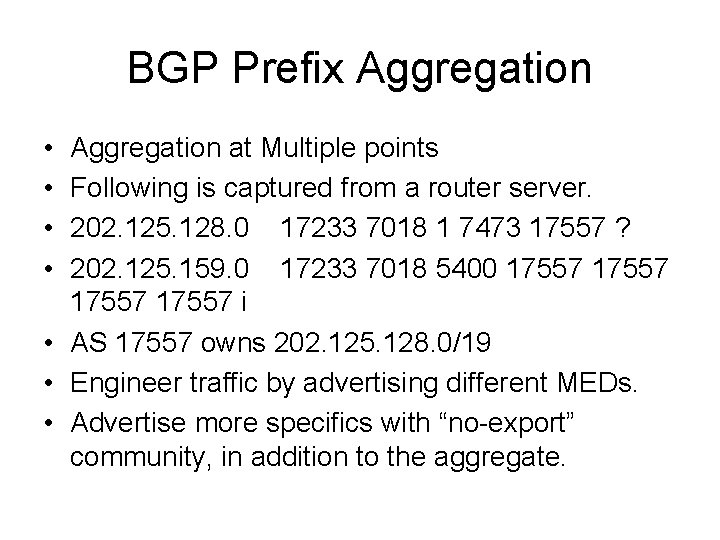
BGP Prefix Aggregation • • Aggregation at Multiple points Following is captured from a router server. 202. 125. 128. 0 17233 7018 1 7473 17557 ? 202. 125. 159. 0 17233 7018 5400 17557 i • AS 17557 owns 202. 125. 128. 0/19 • Engineer traffic by advertising different MEDs. • Advertise more specifics with “no-export” community, in addition to the aggregate.
Filtering Policy • Filter to prevent the injection of invalid routes into global tables. • Prefixes should not be accepted as smaller blocks. • ISP should only accept prefixes originated from the customers’ AS and those for which the customer is offering transit services. • Avoid becoming an unintended transit.
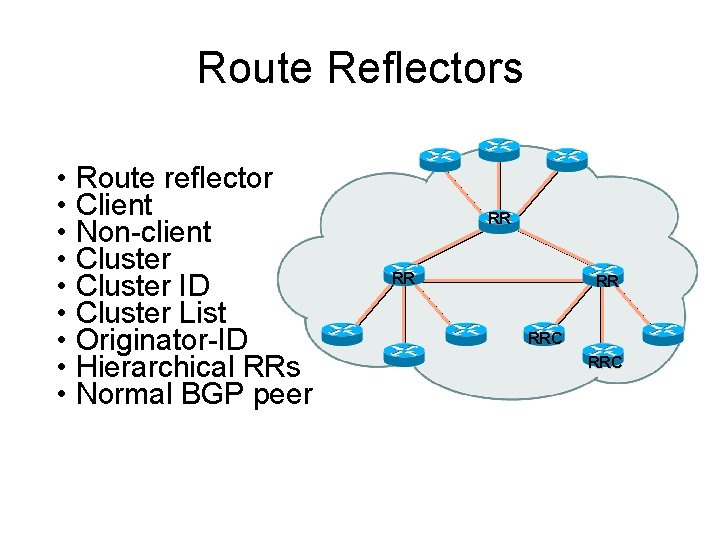
Route Reflectors • • • Route reflector Client Non-client Cluster ID Cluster List Originator-ID Hierarchical RRs Normal BGP peer RR RRC RRC
Route Reflector • RR advertises i. BGP learned routes from its clients to other i. BGP routers. • A Cluster consists of RR + Clients; Cluster, Cluster-ID, Cluster List • RR does not modify any of the BGP attributes. • Route Reflector might not come in the actual traffic path. • The RR discards the route if it sees its own cluster-id in the cluster list
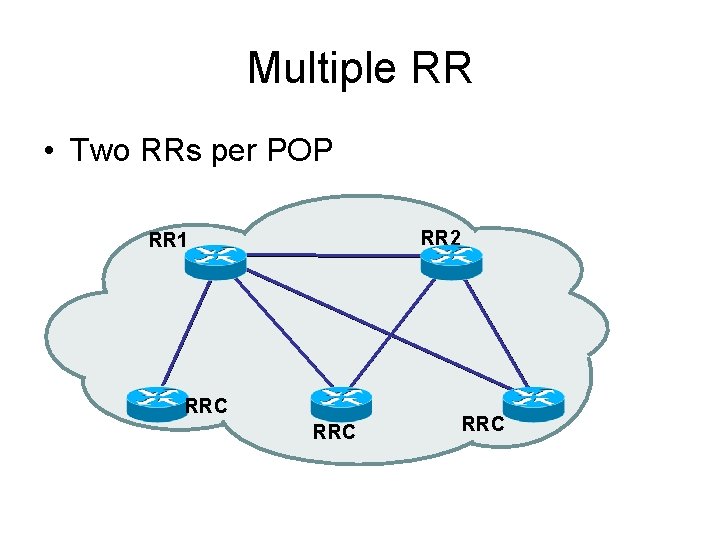
Multiple RR • Two RRs per POP RR 2 RR 1 RRC RRC
RR Designs • Follow physical topology • Larger POPs can have two levels of route reflection. • Core (RR), Distribution (RR & Client), Edge routers (Client) • RR of smaller POPs will be clients of the top level RR of the larger POPs. • All the RR should either be i. BGP fully meshed or connected to another layer of RR.

Hierarchical RR Other POPs Core RR RR Distribution Peering ISPs RR/RRC RR RR RR/RRC Access RRC RRC Primary POP Customers RRC RRC Secondary POP
Summary • Scaling IGP – – – Not running IGP with the customer No customer routes in IGP No Redistribution from BGP to IGP Summarization Partitioning into areas • Scaling BGP – Prefix Aggregation – Filtering Policy – Route Reflector Design
- Slides: 16