
Best practices for high concentration Ultrafiltration Applications Subhasis
Best practices for high concentration Ultrafiltration Applications Subhasis Banerjee, Ph. D. Group Manager, BSN, Merck Millipore Biowavers, Biologics & Biosimilar Conference; Hyderabad, Oct 2014
Overview ■ Driver for high protein concentration (HPC) in Biologics. ■ Challenges in processing HPC using UF. ■ New UF cassette development for HPC applications.

High Concentration Drivers for Biologics ■ High patient doses required for biological products (m. Abs): – ~1 -3 mg/k. G (→ upto 10 mg/kg) ■ Intravenous (IV) infusion – traditional delivery method – Issues: Infusion side effects, cost, quality of life, patient compliance 3
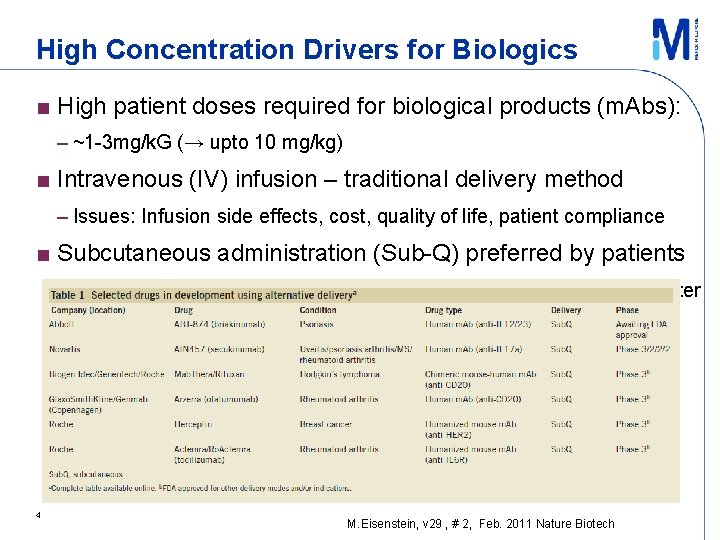
High Concentration Drivers for Biologics ■ High patient doses required for biological products (m. Abs): – ~1 -3 mg/k. G (→ upto 10 mg/kg) ■ Intravenous (IV) infusion – traditional delivery method – Issues: Infusion side effects, cost, quality of life, patient compliance ■ Subcutaneous administration (Sub-Q) preferred by patients – Ease of Use, savings in time & cost, convenience, mitigate severe after -effects of infusion 4 M. Eisenstein, v 29 , # 2, Feb. 2011 Nature Biotech
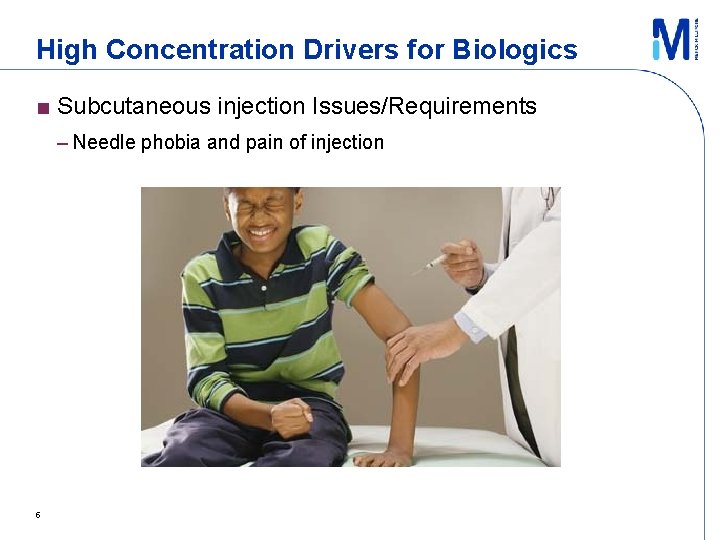
High Concentration Drivers for Biologics ■ Subcutaneous injection Issues/Requirements – Needle phobia and pain of injection 5
High Concentration Drivers for Biologics ■ Subcutaneous injection Issues/Requirements – Needle phobia and pain of injection ► ► Studies show that increasing injection vol from 0. 5 ml to 1 ml increases pain significantly Target injection vol < 1 ml • For a 2 -3 mg/kg dose, for a 70 kg person → 140 -210 mg dose; if injectiion vol. needs to be less than 1 ml, we are talking about a protein concentration of > 140 -210 g/L Sub-Q injections require high conc. protein formulations 6

Challenges with High Concentration of Proteins ■ Potentially significant changes in solution properties – Viscosity → mechanical processing, drug delivery – Osmotic Pressure → max conc in a TFF process – Thermodynamic properties (excluded volume, donnan) → impurity clearance in diafiltration 7

Challenges with High Concentration of Proteins ■ Viscosity and Osmotic effects may combine to limit the ‘Max’ achievable concentration in a TFF process ■ Let’s see how? 8

Viscosity Effects ■ Viscosity increases non-linearly with concentration Burckbuchler, V. , European Journal of Pharmaceutics 2010 9
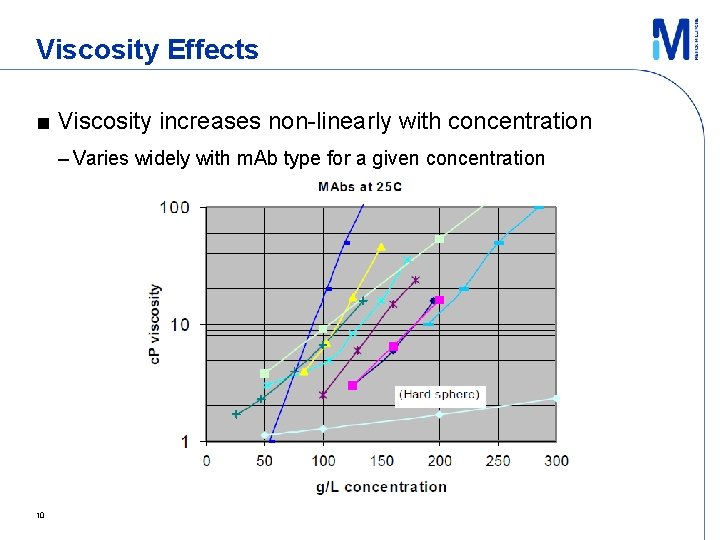
Viscosity Effects ■ Viscosity increases non-linearly with concentration – Varies widely with m. Ab type for a given concentration 10

Viscosity Effects – TFF Processing ■ Pressure drop in a TFF system ↑ as viscosity ↑ Diafiltration buffer PSystem QR PValve Retentate valve Retentate PR Feed Tank PF QF PM TMP Feed PP Permeate QP 11

Viscosity Effects – TFF Processing ■ Pressure drop in a TFF system ↑ as viscosity ↑ – Cassette resistance dominates for a given flow geometry PSystem 12

Viscosity Effects – TFF Processing ■ For a given flow, viscosity, cassette resistance determined by geometry: – Channel size, screen type V A screen “fine” C screen “coarse” V screen “suspended” C A - High pressure drop - Medium pressure drop - Very Low pressure drop Screen variables − Weave pattern, wire diameter, mesh count, mesh opening, overmolding, orientation, etc. Da. Costa, A. , JMS 1994 13
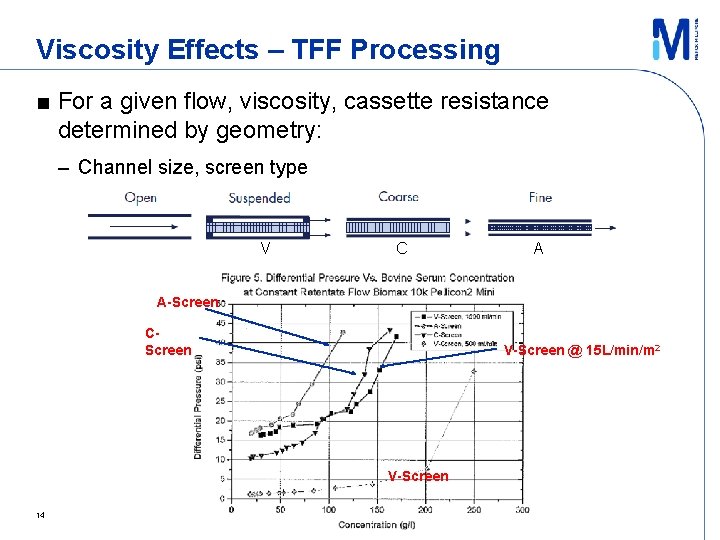
Viscosity Effects – TFF Processing ■ For a given flow, viscosity, cassette resistance determined by geometry: – Channel size, screen type V C A A-Screen CScreen V-Screen @ 15 L/min/m 2 V-Screen 14

Osmotic Pressure Effects – TFF Processing ■ Osmotic pressure resulting from concentration difference between membrane wall (Cw) and permeate (Cf 0) Cb Feed k Retentate Cw membrane TMP Permeate Cf ■ Applied TMP must be > osmotic pressure to force permeate flow − Modules and equipment limit maximum TMP 15

How do high viscosity & osmotic pressure affect TFF processing? ■ Permeate flux through a TFF membrane: – Is determined by excess TMP over osmotic pressure – Depends on mass transfer coeff (flow, geom) and solute conc. 16
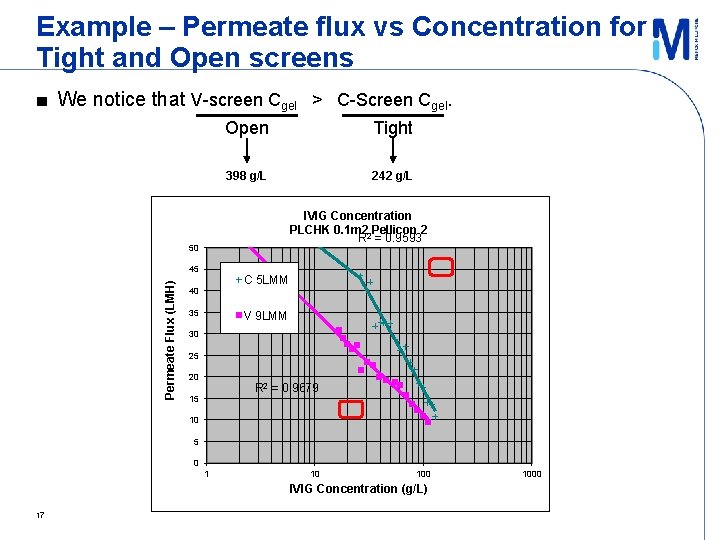
Example – Permeate flux vs Concentration for Tight and Open screens Permeate Flux (LMH) ■ We notice that V-screen Cgel > C-Screen Cgel. IVIG Concentration (g/L) 17
Inference ■ High final concentrations achievable at lower feed flows and more open feed channel! – Develop a more optimum feed channel for high conc (high viscosity) apps ► Existing C-Screen too tight, V-Screen possibly too open → optimum probably inbetween ■ Trade-off: lower permeate flux, larger membrane area 18
High Viscosity Screen/Cassette Development ■ Product need: – What is the right screen size? What viscosity do we target? 19
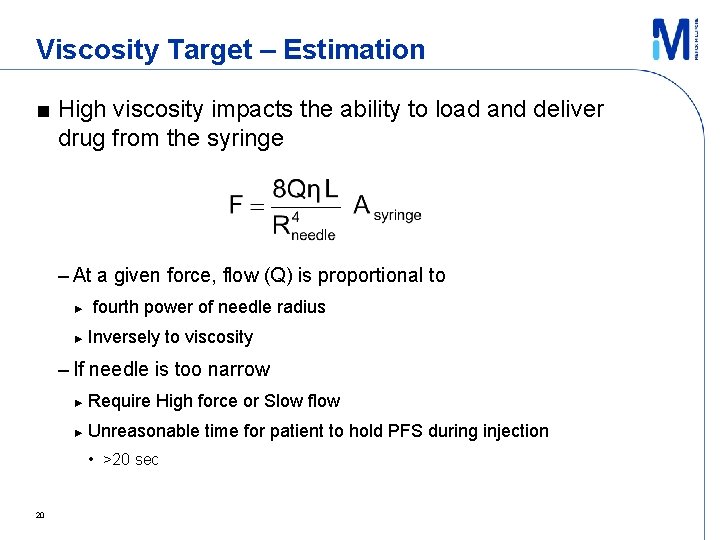
Viscosity Target – Estimation ■ High viscosity impacts the ability to load and deliver drug from the syringe – At a given force, flow (Q) is proportional to ► ► fourth power of needle radius Inversely to viscosity – If needle is too narrow ► Require High force or Slow flow ► Unreasonable time for patient to hold PFS during injection • >20 sec 20
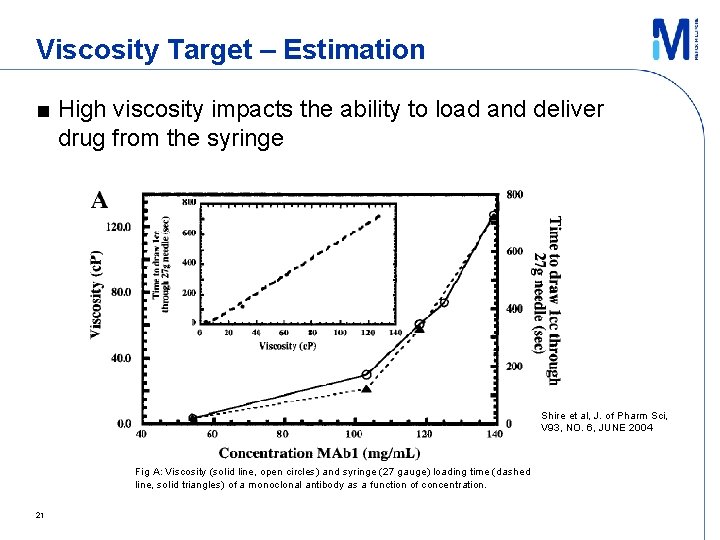
Viscosity Target – Estimation ■ High viscosity impacts the ability to load and deliver drug from the syringe Shire et al, J. of Pharm Sci, V 93, NO. 6, JUNE 2004 Fig A: Viscosity (solid line, open circles) and syringe (27 gauge) loading time (dashed line, solid triangles) of a monoclonal antibody as a function of concentration. 21
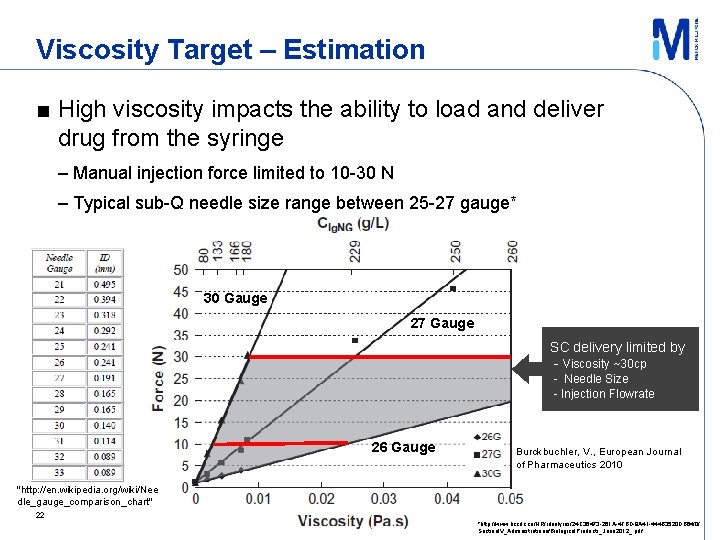
Viscosity Target – Estimation ■ High viscosity impacts the ability to load and deliver drug from the syringe – Manual injection force limited to 10 -30 N – Typical sub-Q needle size range between 25 -27 gauge* 30 Gauge 27 Gauge SC delivery limited by - Viscosity ~30 cp - Needle Size - Injection Flowrate 26 Gauge Burckbuchler, V. , European Journal of Pharmaceutics 2010 "http: //en. wikipedia. org/wiki/Nee dle_gauge_comparison_chart" 22 *http: //www. bccdc. ca/NR/rdonlyres/24 C 36473 -261 A-4 FBD-8 A 41 -444 B 3520 DB 64/0/ Section. IV_Administrationof. Biological. Products_June 2012_. pdf
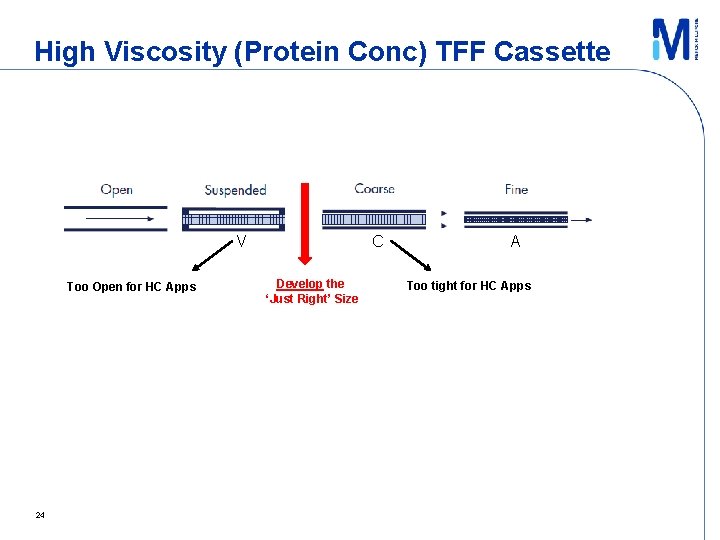
High Viscosity (Protein Conc) TFF Cassette V Too Open for HC Apps 24 C Develop the ‘Just Right’ Size A Too tight for HC Apps
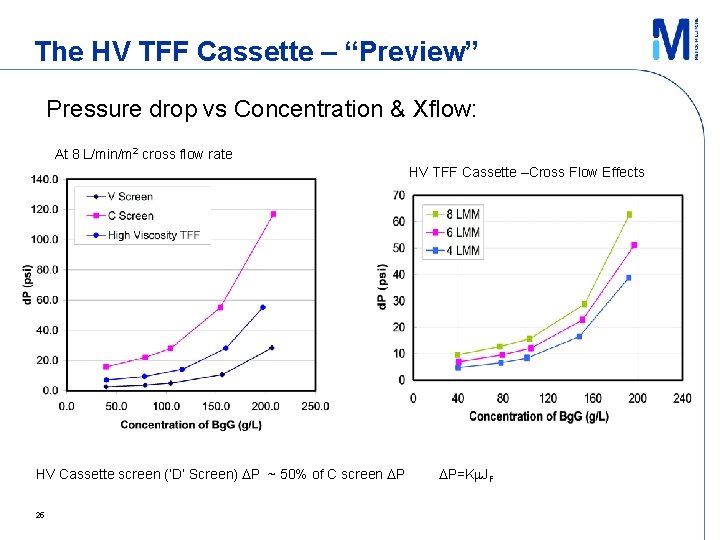
The HV TFF Cassette – “Preview” Pressure drop vs Concentration & Xflow: At 8 L/min/m 2 cross flow rate HV TFF Cassette –Cross Flow Effects HV Cassette screen (‘D’ Screen) DP ~ 50% of C screen DP 25 DP=Km. JF

The HV TFF Cassette – “Preview” Flux vs. Concentration & Xflow: At 8 L/min/m 2 cross flow rate HV Cassette (D) screen J~ 80% of C screen J 26 HV TFF Cassette –Cross Flow Effects
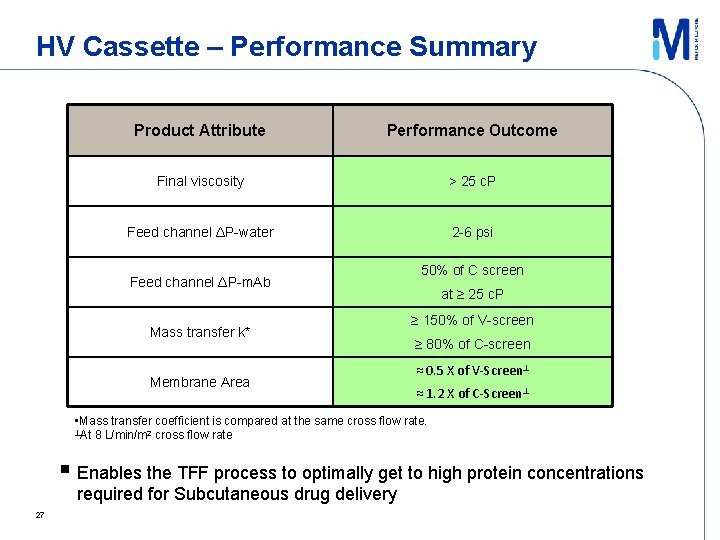
HV Cassette – Performance Summary Product Attribute Performance Outcome Final viscosity > 25 c. P Feed channel ΔP-water 2 -6 psi Feed channel ΔP-m. Ab Mass transfer k* Membrane Area 50% of C screen at ≥ 25 c. P ≥ 150% of V-screen ≥ 80% of C-screen ≈ 0. 5 X of V-Screen ≈ 1. 2 X of C-Screen • Mass transfer coefficient is compared at the same cross flow rate. At 8 L/min/m 2 cross flow rate § Enables the TFF process to optimally get to high protein concentrations required for Subcutaneous drug delivery 27
Thank You! Acknowledgements Herb Lutz Joseph Parrella Bala Raghunath
- Slides: 27