
Best Practices for Digital Imaging and Metadata Roy
Best Practices for Digital Imaging and Metadata Roy Tennant The Library, University of California, Berkeley http: //sunsite. berkeley. edu/~manager/Presentations/ICDE/
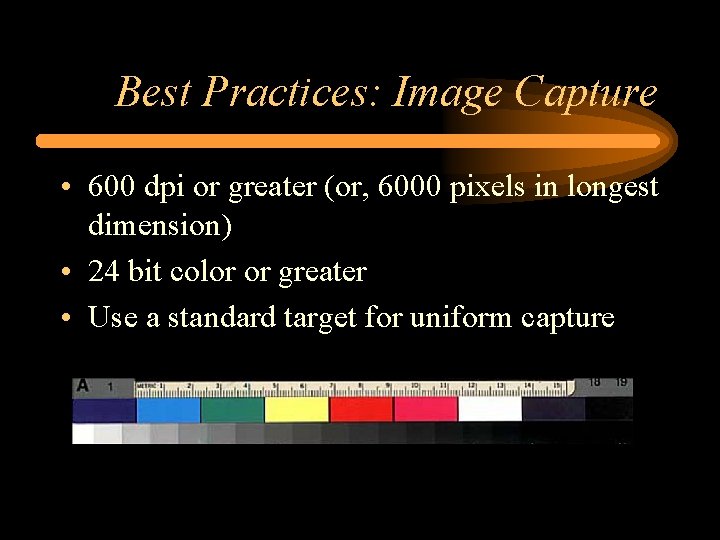
Best Practices: Image Capture • 600 dpi or greater (or, 6000 pixels in longest dimension) • 24 bit color or greater • Use a standard target for uniform capture

Best Practices: Image Formats • • Archival version: uncompressed TIFF Preview: Compuserve GIF Screen: JFIF (JPEG), medium quality Printing: JFIF (JPEG), medium - high quality
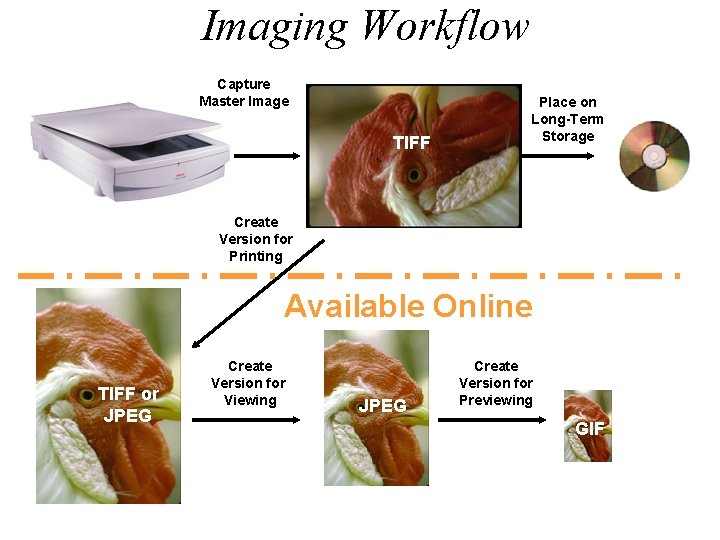
Imaging Workflow Capture Master Image TIFF Place on Long-Term Storage Create Version for Printing Available Online TIFF or JPEG Create Version for Viewing JPEG Create Version for Previewing GIF

Metadata Definitions • • • Cataloging Data about data “structured description” “ an object or collection of objects” Structured description of an object or collection of objects
Types of Metadata • Descriptive • Administrative • Structural
Descriptive Metadata • Purposes: – to provide access points (discovery) – to describe the intellectual characteristics of an item • Example elements: – Author – Title – Subject
Best Practices: Descriptive Metadata • Capture as much as you can • Use controlled vocabularies and authority control • Use standards or draft standards, e. g. , : – MARC – Dublin Core
Administrative Metadata • Purposes: – to enable the appropriate management of the object • Examples: – Rights – File format – File size
Best Practices: Administrative Metadata • Enough metadata to: – Understand what you have – Be able to manipulate/process it via software – Be able to manage it over time • Examples: – File date, file type, source type, compression format, color space,
Structural Metadata • Purposes: – to provide a structure that enables an object to be used appropriately – to associate a file with other, related files that may comprise a single intellectual item • Examples: – Page one – Section heading
Best Practices: Structural Metadata • Capture enough structural information to: – Present the object as a navigable whole – Allow the user to identify and display key elements (e. g. , chapter headings) – Allow the user to limit their search to particular parts • Follow standards or best practices as they emerge
What Elements to Capture • Key questions: – What is the least you can get by with? – What is the most that might be needed? – What is a reasonable point between the two? • Considerations: – Cost – Usefulness – Access goal • Bottom line: get everything you can afford
Initiatives to Watch • Dublin Core (for basic metadata elements) – http: //purl. org/dc/ • Making of America II (for structural and administrative metadata) – http: //sunsite. berkeley. edu/moa 2/ • U. S. Library of Congress – http: //www. loc. gov/
- Slides: 14