
BEST PRACTICES FOR ASSESSING YOUNG CHILDREN AND EARLY
BEST PRACTICES FOR ASSESSING YOUNG CHILDREN AND EARLY CHILDHOOD PROGRAMS David Pratt, Ph. D. Purdue University Northwest Early Childhood Conference- 2017
AGENDA Assessment Review Best Practices • Purpose for Assessment • Issues with Current State of Assessment • Top 10 Approaches to Assessing Effectively Sample Assessments • Academic • Executive Functions • Behavior Checklist
WHY ARE WE DOING THIS? ? ? we are required assess kindergarten readiness screen for disabilities assist in developing curriculum and daily activities evaluate the effectiveness of a project or a program provide feedback to parents
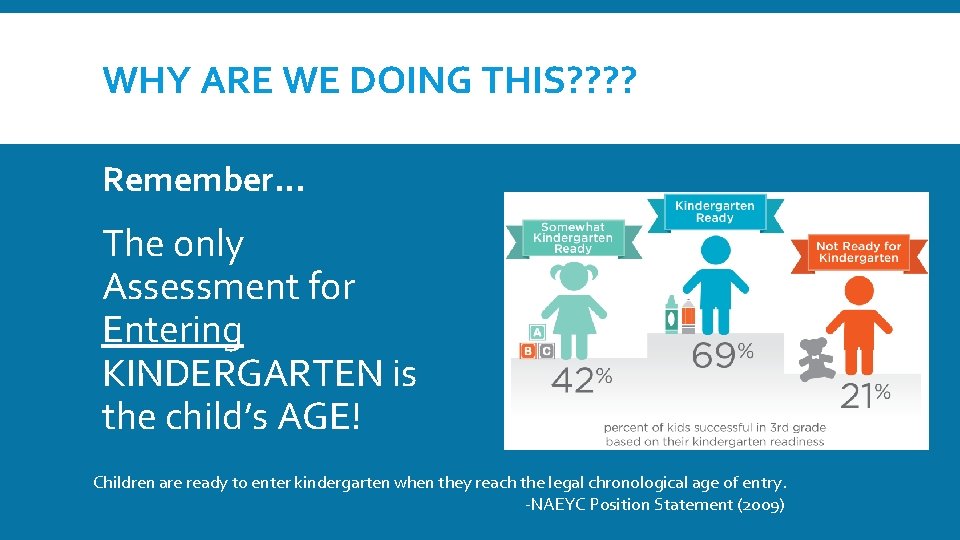
WHY ARE WE DOING THIS? ? Remember… The only Assessment for Entering KINDERGARTEN is the child’s AGE! Children are ready to enter kindergarten when they reach the legal chronological age of entry. -NAEYC Position Statement (2009)
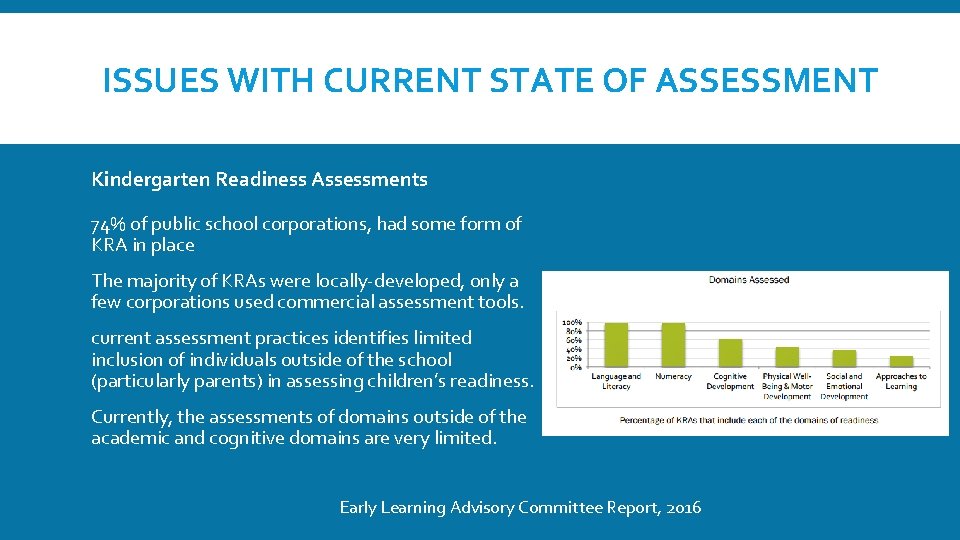
ISSUES WITH CURRENT STATE OF ASSESSMENT Kindergarten Readiness Assessments 74% of public school corporations, had some form of KRA in place The majority of KRAs were locally-developed, only a few corporations used commercial assessment tools. current assessment practices identifies limited inclusion of individuals outside of the school (particularly parents) in assessing children’s readiness. Currently, the assessments of domains outside of the academic and cognitive domains are very limited. Early Learning Advisory Committee Report, 2016
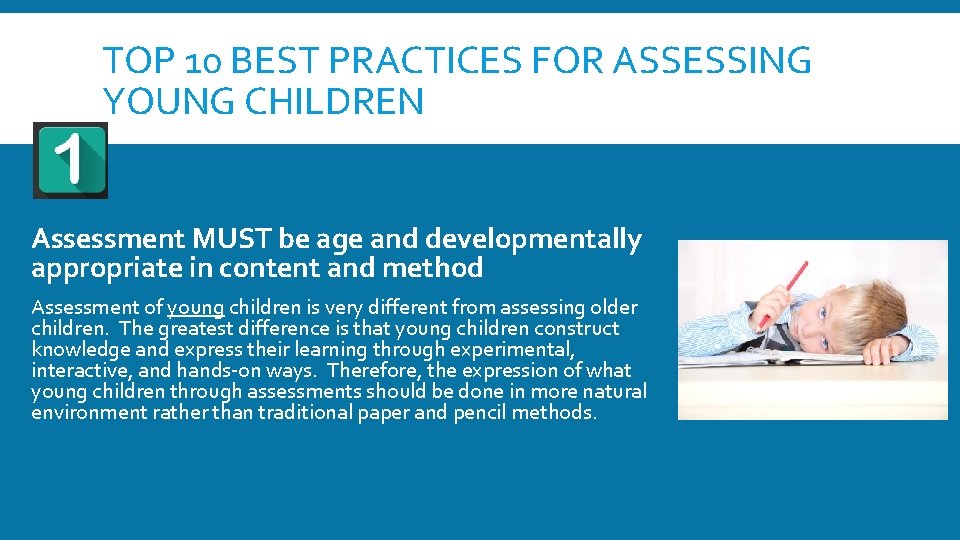
TOP 10 BEST PRACTICES FOR ASSESSING YOUNG CHILDREN Assessment MUST be age and developmentally appropriate in content and method Assessment of young children is very different from assessing older children. The greatest difference is that young children construct knowledge and express their learning through experimental, interactive, and hands-on ways. Therefore, the expression of what young children through assessments should be done in more natural environment rather than traditional paper and pencil methods.
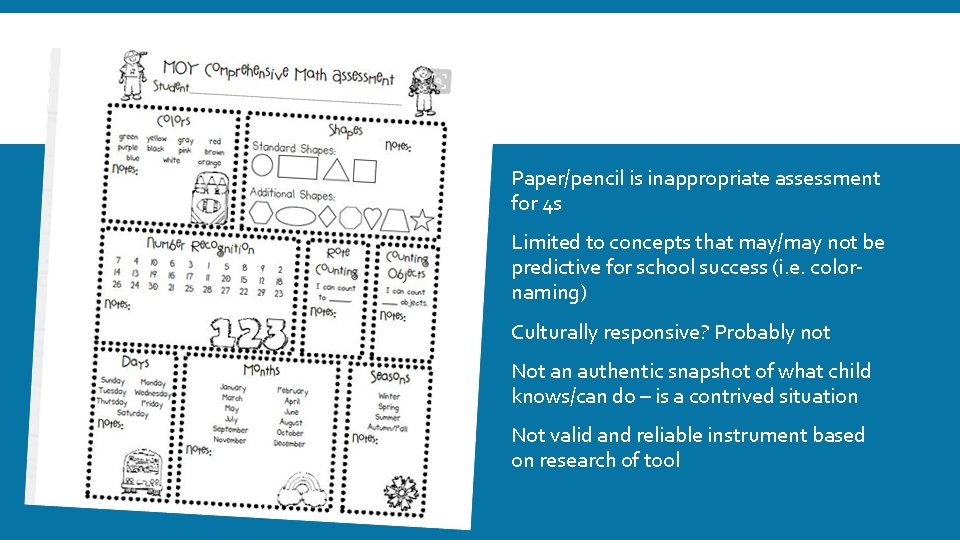
Paper/pencil is inappropriate assessment for 4 s Limited to concepts that may/may not be predictive for school success (i. e. colornaming) Culturally responsive? Probably not Not an authentic snapshot of what child knows/can do – is a contrived situation Not valid and reliable instrument based on research of tool
TOP 10 BEST PRACTICES FOR ASSESSING YOUNG CHILDREN A variety of assessments should be used to consider the whole child’s development. Many assessments focus only on academic or cognitive development. One must also consider the physical/motor, psychosocial, cognitive, language, and literacy development. Additionally, multiple sources of information should be considered while making an assessment.
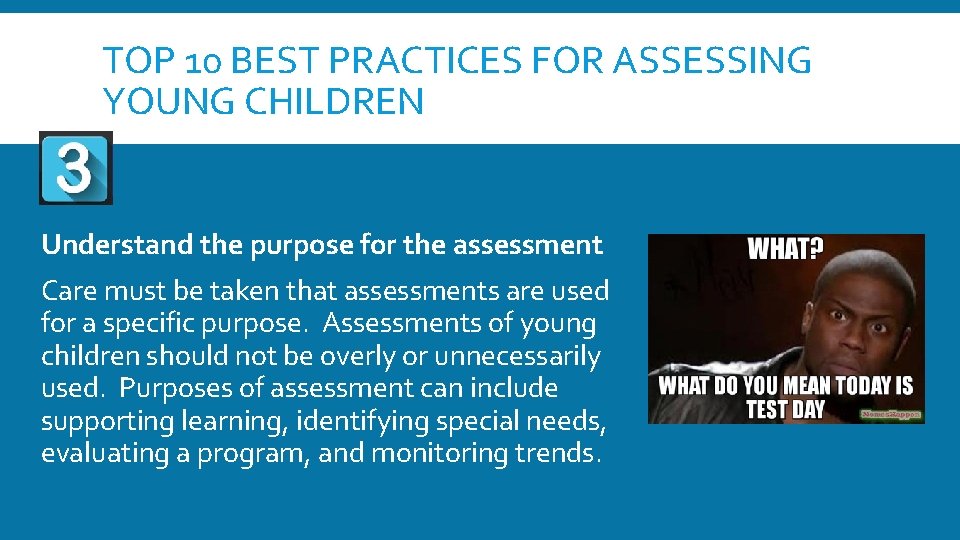
TOP 10 BEST PRACTICES FOR ASSESSING YOUNG CHILDREN Understand the purpose for the assessment Care must be taken that assessments are used for a specific purpose. Assessments of young children should not be overly or unnecessarily used. Purposes of assessment can include supporting learning, identifying special needs, evaluating a program, and monitoring trends.
TOP 10 BEST PRACTICES FOR ASSESSING YOUNG CHILDREN Valid, reliable and fair instruments are used. Only assessments that are high quality and have been established as accurate and reliable for using with children. High stakes assessments should not be administered until at least grade 3.
TOP 10 BEST PRACTICES FOR ASSESSING YOUNG CHILDREN Quality assessment practices take time One must consider the administration of individual assessments by an instructor takes time and educators should plan time for assessments accordingly. Additionally, care must be taken to not take too much time away from the child’s regular activities.
TOP 10 BEST PRACTICES FOR ASSESSING YOUNG CHILDREN Assessment should consider the uneven growth patterns of young children According to research, a child’s development is rapid, uneven and episodic. This development is also highly influenced by the environment. Care must be taken to appreciate the backgrounds, environmental factors, and context in which the assessment is delivered.
TOP 10 BEST PRACTICES FOR ASSESSING YOUNG CHILDREN Consider program assessment along with assessments done of the young child. When assessing children, it is important to also assess the environment in which the children are conducing most of their activities.
TOP 10 BEST PRACTICES FOR ASSESSING YOUNG CHILDREN Value parents as an important source of assessment information. Parents have information that would be helpful regarding the background of the child that should be consider when conducting assessments.
TOP 10 BEST PRACTICES FOR ASSESSING YOUNG CHILDREN Follow ethical guidelines regarding the use of assessments. This relates to assuring the assessment and use of the assessments are communicated to parents and staff. Teachers or staff who conduct the assessments should be well informed of the protocols and assure appropriate methods are used.
TOP 10 BEST PRACTICES FOR ASSESSING YOUNG CHILDREN Assessments should be aligned to state’s early learning and development standards. Indiana standards should be aligned to the assessments being used as they are the guidelines for what is considered developmentally appropriate for various ages.
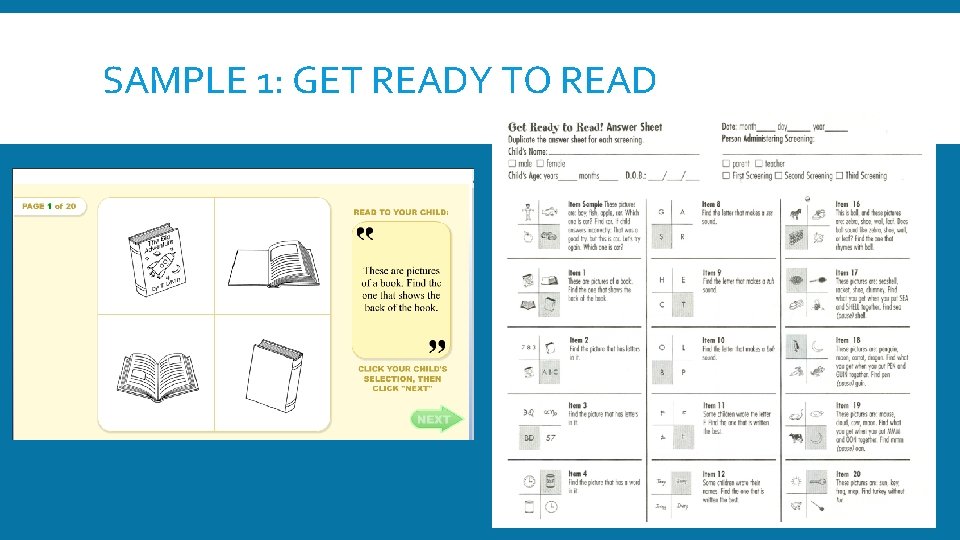
SAMPLE 1: GET READY TO READ About the Assessment Get Ready to Read! screening tool is a valid indicator of early print knowledge and linguistic awareness abilities according to research. Studies of the predictive validity of the Get Ready to Read! screening tool confirm that the tool is a moderate to strong predictor of school success overall and reading skill development in kindergarten and first grade. Description of Instrument Get Ready to Read! This assessment includes a total of 25 questions which take approximately 10 -15 minutes to administer. Participants received one point if they got the answer correct and 0 if incorrect. The Get Ready to Read! focuses on: Print knowledge: the child’s understanding of books, printed letters and words. Linguistic awareness: the child’s understanding of how words and language works. Emergent writing: the child’s first efforts to create and use print in a meaningful way.
SAMPLE 1: GET READY TO READ
SAMPLE 2: HEAD TOES KNEES SHOULDERS About the Assessment Is a measure of • inhibitory control (a child must inhibit the dominant response of imitating the examiner) • working memory (a child must remember the rules of the task) • attention focusing (must focus attention to the directions being presented by the examiner) Description of Instrument Children are asked to play a game in which they must do the opposite of what the experimenter says. The experimenter instructs children to touch their head (or their toes), but instead of following the command, the children are supposed to do the opposite and touch their toes. If children pass the head/toes part of the task, they complete an advanced trial where the knees and shoulders commands are added. This assessment takes approximately 15 -20 minutes to complete.
SAMPLE 3: BEHAVIORAL OBSERVATION CHECKLIST About the Assessment • developed using survey results from stakeholders which include items they deemed most important for kindergarten readiness. • These initial items were originally provided by Michael Conn. Powers (IU) Kindergarten Essential Skills survey of teachers in Indiana. • They were presented to the Executive Committee of the Regional Group participating in the assessments locally for final evaluation.
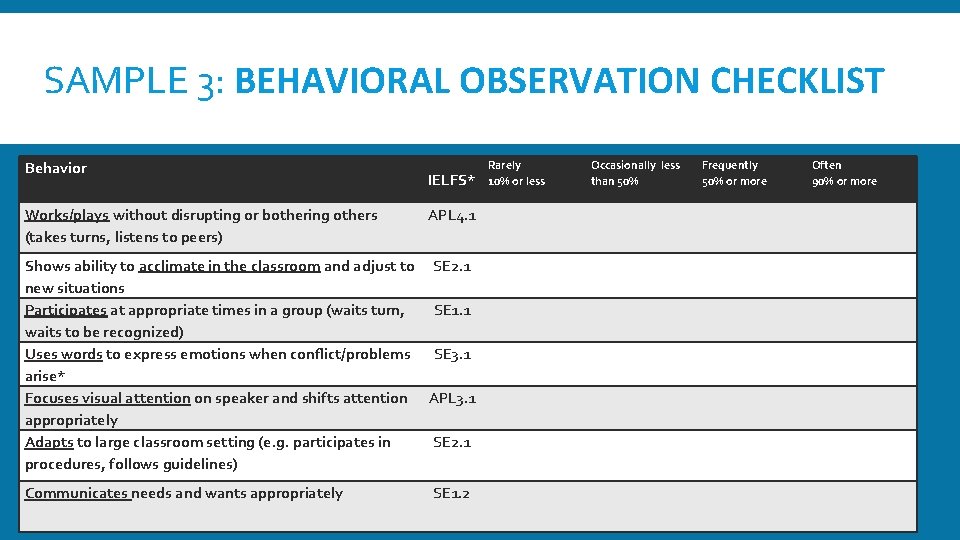
SAMPLE 3: BEHAVIORAL OBSERVATION CHECKLIST Behavior Works/plays without disrupting or bothering others (takes turns, listens to peers) IELFS* Rarely 10% or less Occasionally less than 50% Frequently 50% or more Often 90% or more APL 4. 1 Shows ability to acclimate in the classroom and adjust to new situations Participates at appropriate times in a group (waits turn, waits to be recognized) Uses words to express emotions when conflict/problems arise* Focuses visual attention on speaker and shifts attention appropriately Adapts to large classroom setting (e. g. participates in procedures, follows guidelines) SE 2. 1 SE 1. 1 SE 3. 1 APL 3. 1 SE 2. 1 Communicates needs and wants appropriately SE 1. 2
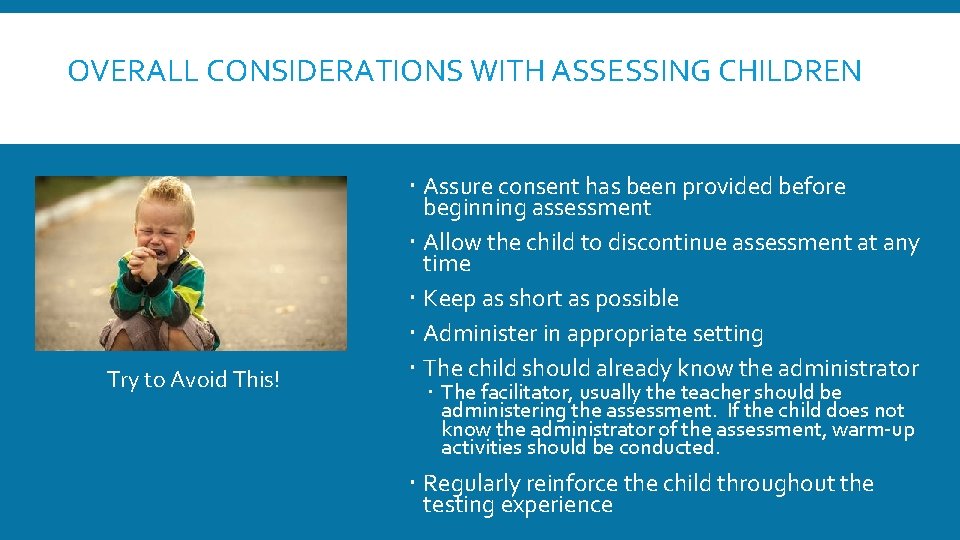
OVERALL CONSIDERATIONS WITH ASSESSING CHILDREN Try to Avoid This! Assure consent has been provided before beginning assessment Allow the child to discontinue assessment at any time Keep as short as possible Administer in appropriate setting The child should already know the administrator The facilitator, usually the teacher should be administering the assessment. If the child does not know the administrator of the assessment, warm-up activities should be conducted. Regularly reinforce the child throughout the testing experience
- Slides: 22