
Best practices and future challenges in remanufacturing 15
Best practices and future challenges in remanufacturing 15 th of March 2016 at University of Grenoble Alpes - Grenoble FRANCE

European Remanufacturing Network Funded by the Horizon 2020 Framework Programme of the European Union
ERN project goals • Map the remanufacturing landscape in Europe. • Equip remanufacturers and would-be remanufacturers with the tools to remanufacture profitably and resource-efficiently. • Raise the profile of remanufacturing in the public and political and policy making spheres. • Facilitate the development of sustainable partnerships between remanufacturing organisations for future research, collaboration, knowledge transfer and lobbying. • Set up a European Remanufacturing Council (ERC) that will represent the views of remanufacturers across Europe and continue the work started under the Council after the project has completed.
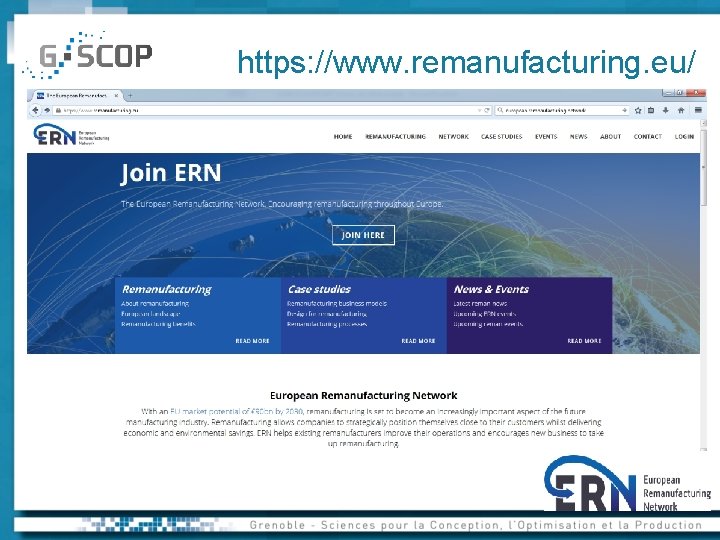
https: //www. remanufacturing. eu/
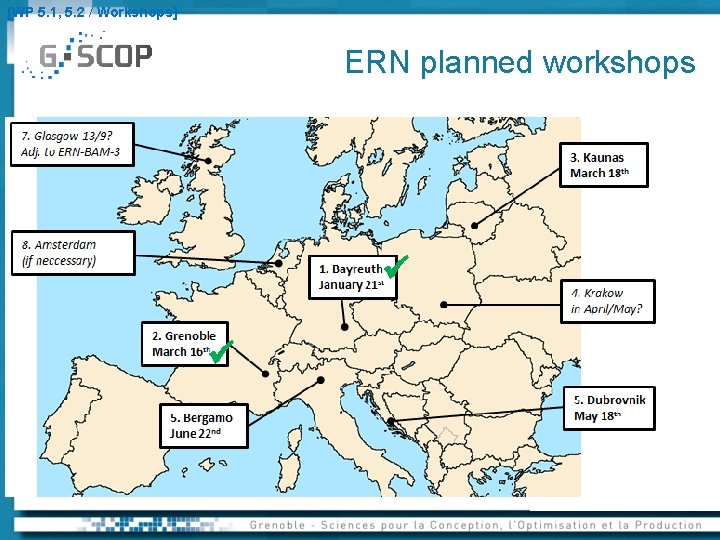
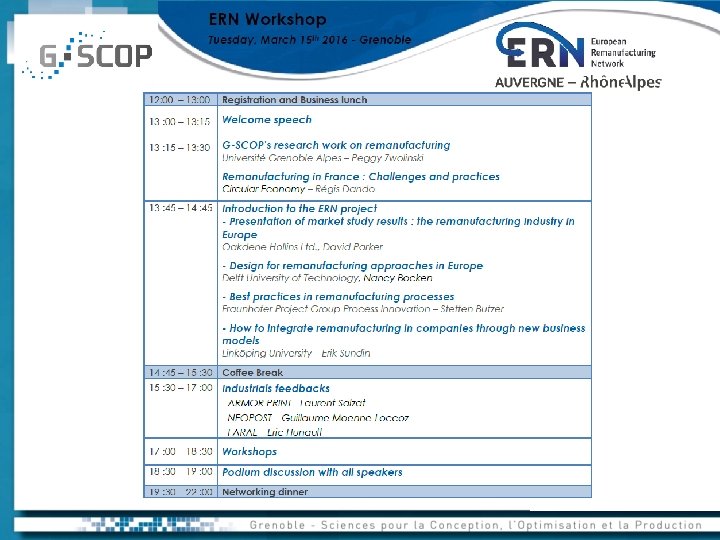
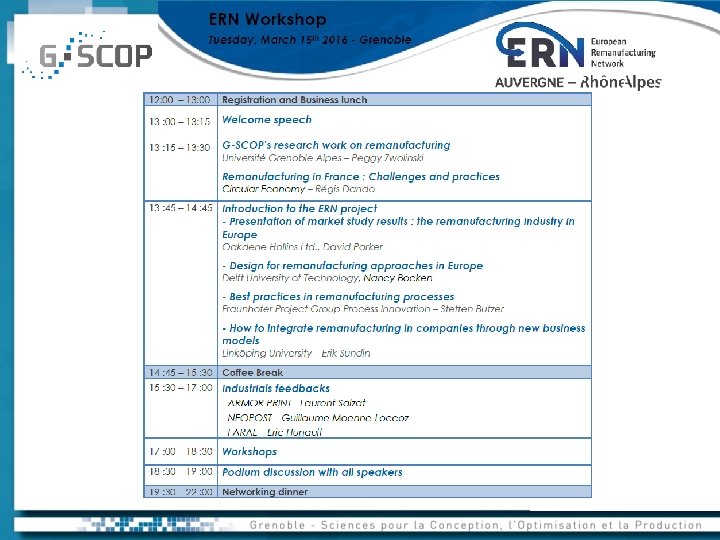
[WP 5. 1, 5. 2 / Workshops] ERN planned workshops
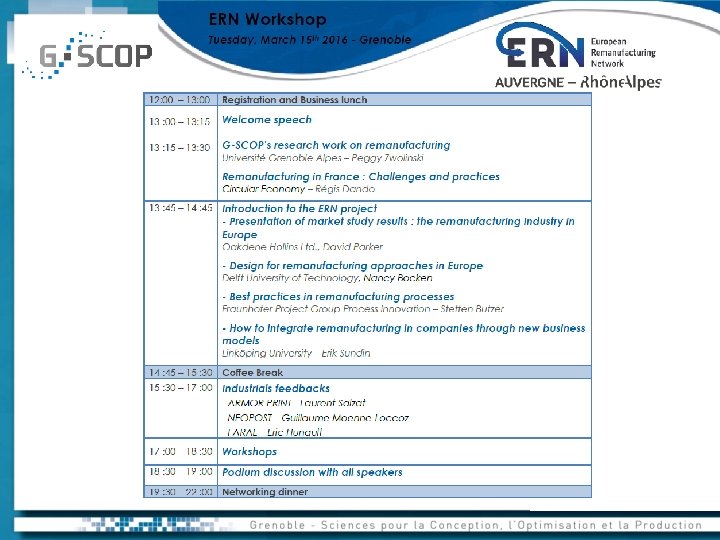
G-SCOP’s research work on remanufacturing Peggy Zwolinski University Grenoble Alpes Best practices and future challenges in remanufacturing 15 th of March 2016 at University of Grenoble Alpes - Grenoble FRANCE
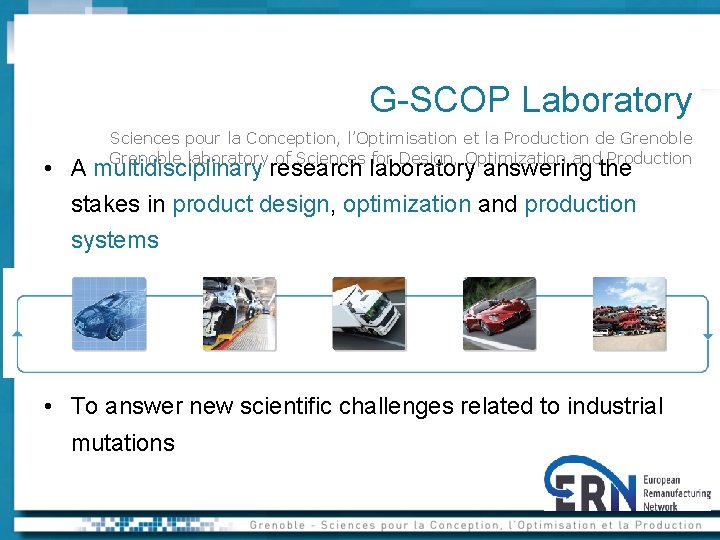
G-SCOP Laboratory Sciences pour la Conception, l’Optimisation et la Production de Grenoble laboratory of Sciences for Design, Optimization and Production • A multidisciplinary research laboratory answering the stakes in product design, optimization and production systems • To answer new scientific challenges related to industrial mutations
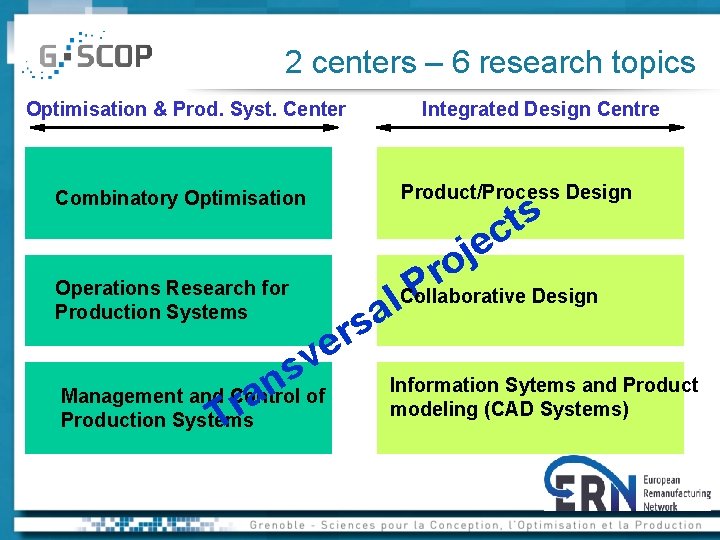
2 centers – 6 research topics Optimisation & Prod. Syst. Center Product/Process Design Combinatory Optimisation s t c e j o Operations Research for Production Systems r P Collaborative Design l a s r e v s an Tr Integrated Design Centre Management and Control of Production Systems Information Sytems and Product modeling (CAD Systems)
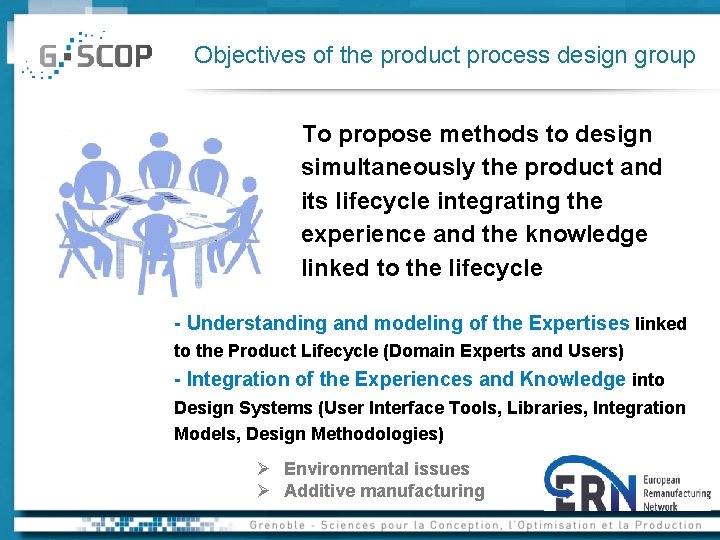
Objectives of the product process design group To propose methods to design simultaneously the product and its lifecycle integrating the experience and the knowledge linked to the lifecycle - Understanding and modeling of the Expertises linked to the Product Lifecycle (Domain Experts and Users) - Integration of the Experiences and Knowledge into Design Systems (User Interface Tools, Libraries, Integration Models, Design Methodologies) Ø Environmental issues Ø Additive manufacturing
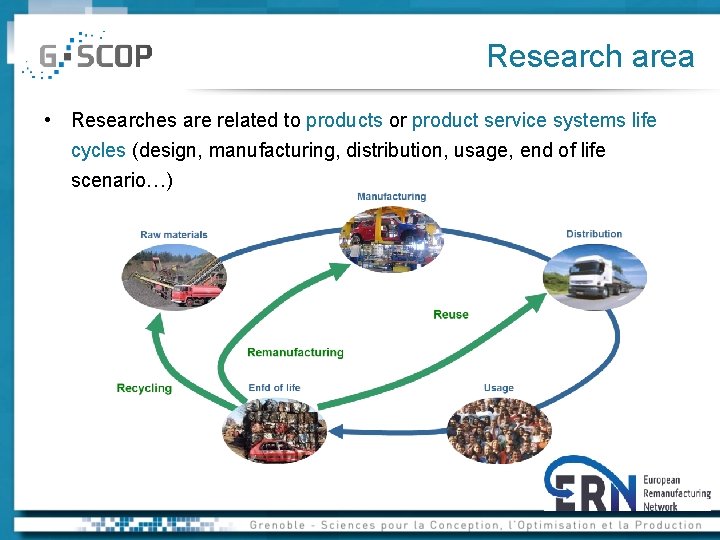
Research area • Researches are related to products or product service systems life cycles (design, manufacturing, distribution, usage, end of life scenario…)
Remanufacturing principles • Remanufacturing is a recycling technique that enables products and components at their end-of-life to serve as a stock of resources for manufacturing new products which quality is at least equal to the quality of products made from extracted raw materials. – Keep the maximum of value of the unuseful products and components in the economy – Use this value in a new cycle of a product life – Make as many life cycles as possible
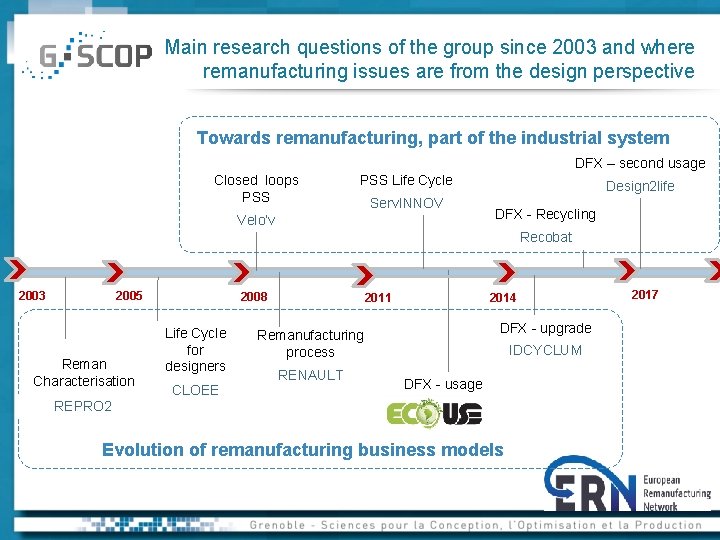
Main research questions of the group since 2003 and where remanufacturing issues are from the design perspective Towards remanufacturing, part of the industrial system DFX – second usage Closed loops PSS Life Cycle Serv. INNOV Velo’v Design 2 life DFX - Recycling Recobat 2005 2003 Reman Characterisation REPRO 2 2008 Life Cycle for designers CLOEE 2011 2014 DFX - upgrade Remanufacturing process RENAULT IDCYCLUM DFX - usage Eco. Use Evolution of remanufacturing business models 2017
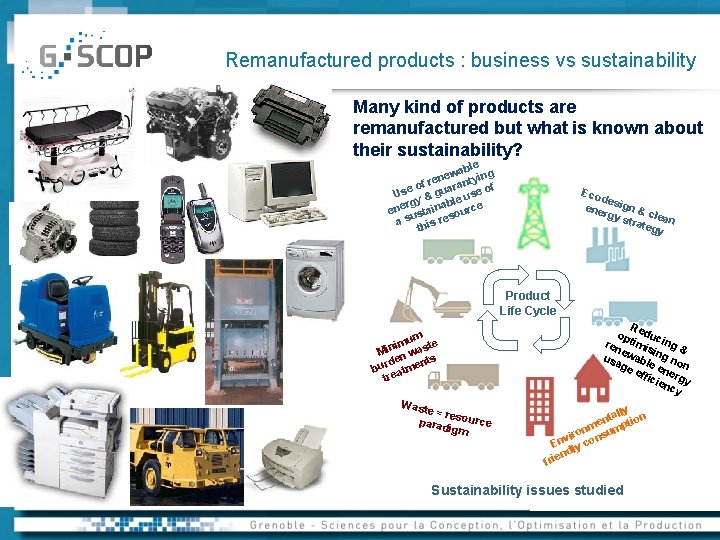
Remanufactured products : business vs sustainability Many kind of products are remanufactured but what is known about their sustainability? able g w e tyin ren of uaran e of e s U g us gy & nable e r e c en stai our a su his res t Eco de ene sign & rgy c stra lean tegy Product Life Cycle um te m i n Mi n was de nts bur atme tre Wast e = re s parad ource igm R op educ t ren imis ing & e i usa wabl ng no e n ge eff energ icie ncy y ally on t n pti me on sum r i n v En ly co d n frie Sustainability issues studied
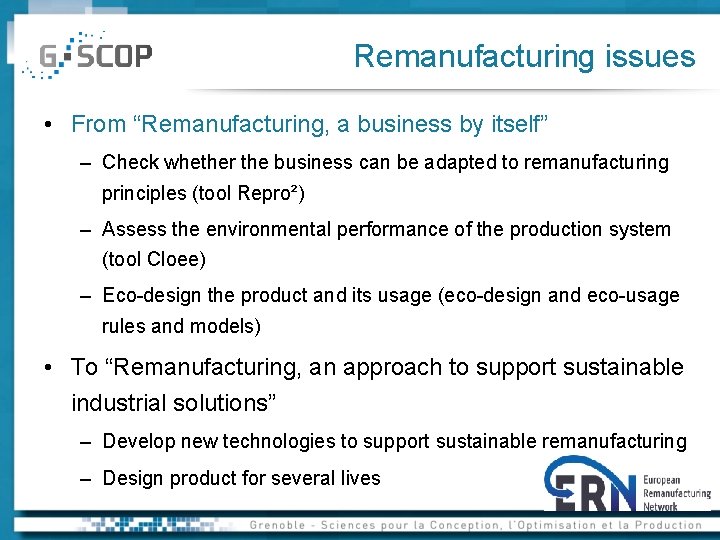
Remanufacturing issues • From “Remanufacturing, a business by itself” – Check whether the business can be adapted to remanufacturing principles (tool Repro²) – Assess the environmental performance of the production system (tool Cloee) – Eco-design the product and its usage (eco-design and eco-usage rules and models) • To “Remanufacturing, an approach to support sustainable industrial solutions” – Develop new technologies to support sustainable remanufacturing – Design product for several lives
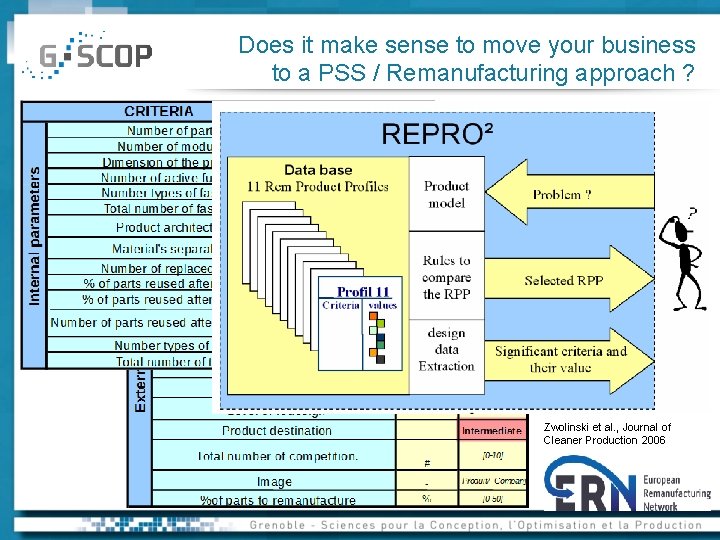
Does it make sense to move your business to a PSS / Remanufacturing approach ? Zwolinski et al. , Journal of Cleaner Production 2006
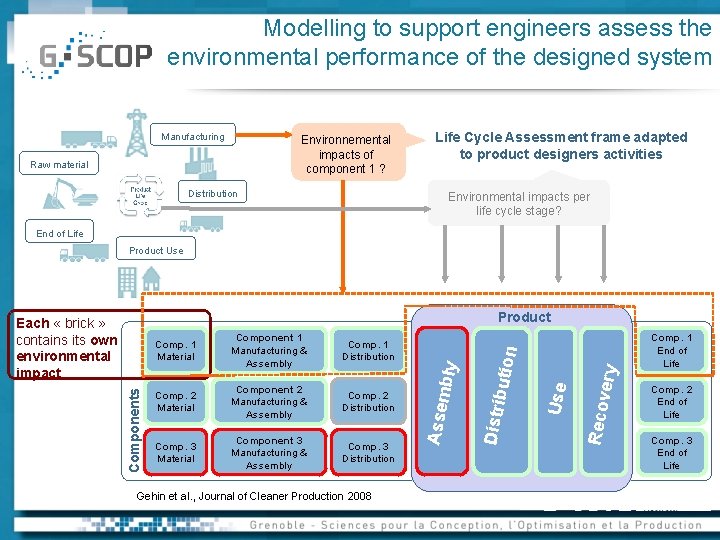
Modelling to support engineers assess the environmental performance of the designed system Manufacturing Environnemental impacts of component 1 ? Raw material Distribution Life Cycle Assessment frame adapted to product designers activities Environmental impacts per life cycle stage? End of Life Product Use Component 3 Manufacturing & Assembly Comp. 3 Distribution Gehin et al. , Journal of Cleaner Production 2008 very Comp. 3 Material Reco Comp. 2 Distribution Use Component 2 Manufacturing & Assembly butio Comp. 2 Material Distri Comp. 1 Distribution mbly Component 1 Manufacturing & Assembly Asse Components Comp. 1 Material n Product Each « brick » contains its own environmental impact Comp. 1 End of Life Comp. 2 End of Life Comp. 3 End of Life
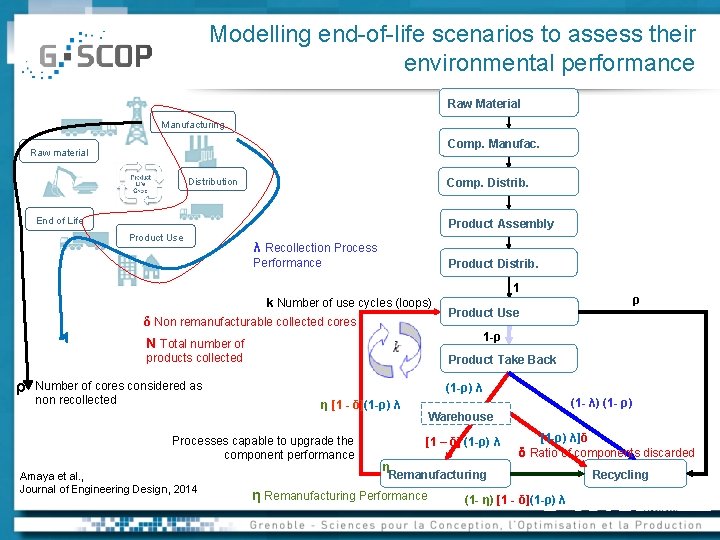
Modelling end-of-life scenarios to assess their environmental performance Raw Material Manufacturing Comp. Manufac. Raw material Distribution Comp. Distrib. End of Life Product Assembly Product Use λ Recollection Process Performance Product Distrib. 1 k Number of use cycles (loops) δ Non remanufacturable collected cores 1 -ρ N Total number of products collected ρ Number of cores considered as non recollected Product Take Back (1 -ρ) λ η [1 - δ](1 -ρ) λ Processes capable to upgrade the component performance Amaya et al. , Journal of Engineering Design, 2014 ρ Product Use (1 - λ) (1 - ρ) Warehouse [1 – δ] (1 -ρ) λ η Remanufacturing Performance [1 -ρ) λ]δ δ Ratio of components discarded (1 - η) [1 - δ](1 -ρ) λ Recycling
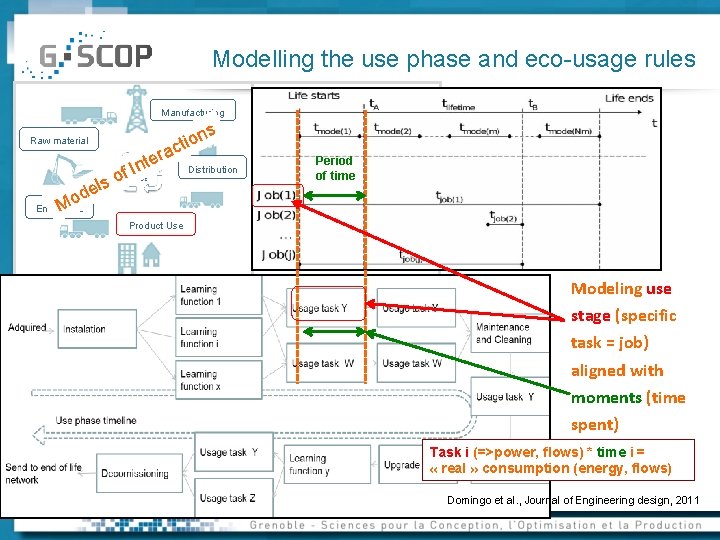
Modelling the use phase and eco-usage rules Manufacturing Raw material a er t n I of ns o i t c s l e od + Interactions Period of time Distribution M End of Life Product Use + User in context Modeling use Product stage (specific task = job) aligned with moments (time spent) Task i (=>power, flows) * time i = « real » consumption (energy, flows) Domingo et al. , Journal of Engineering design, 2011
Remanufacturing issues • From “Remanufacturing, a business by itself” – Check whether the business can be adapted to remanufacturing principles (tool Repro²) – Assess the environmental performance of the production system (tool Chloe) – Eco-design the product and its usage (eco-design and eco-usage rules and models) • To “Remanufacturing, an approach to support sustainable industrial solutions” – Develop new technologies to support sustainable remanufacturing – Design product for several lives
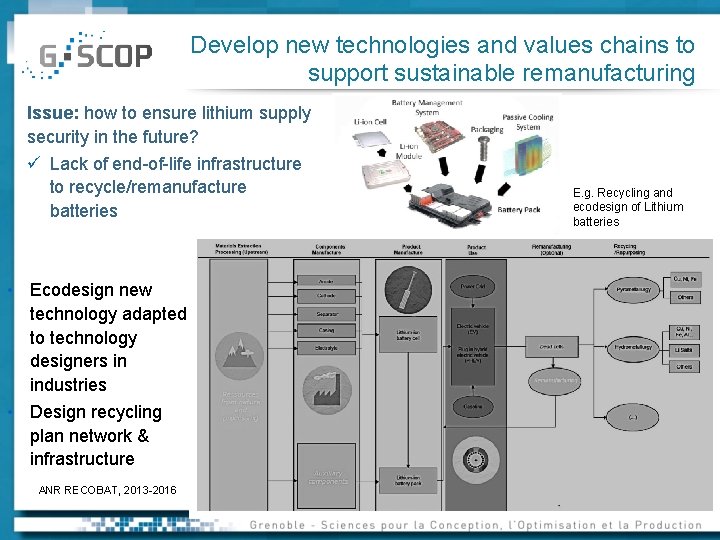
Develop new technologies and values chains to support sustainable remanufacturing Issue: how to ensure lithium supply security in the future? ü Lack of end-of-life infrastructure to recycle/remanufacture batteries • Ecodesign new technology adapted to technology designers in industries • Design recycling plan network & infrastructure ANR RECOBAT, 2013 -2016 E. g. Recycling and ecodesign of Lithium batteries
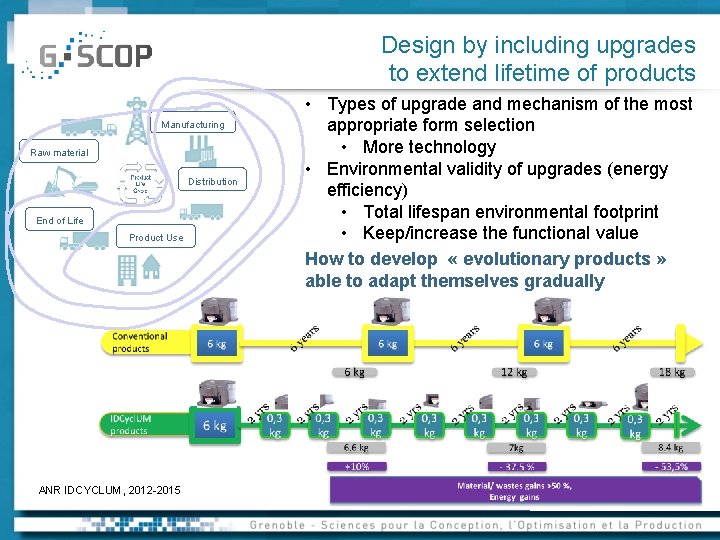
Design by including upgrades to extend lifetime of products Manufacturing Raw material Distribution End of Life Product Use ANR IDCYCLUM, 2012 -2015 • Types of upgrade and mechanism of the most appropriate form selection • More technology • Environmental validity of upgrades (energy efficiency) • Total lifespan environmental footprint • Keep/increase the functional value How to develop « evolutionary products » able to adapt themselves gradually
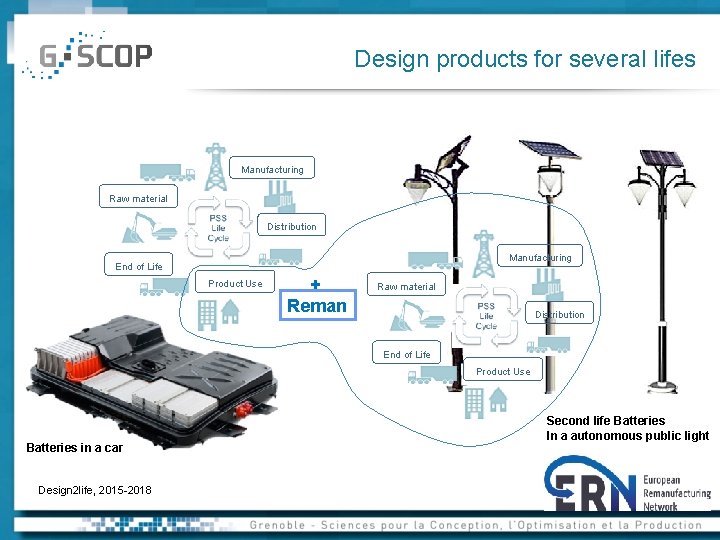
Design products for several lifes Manufacturing Raw material Distribution Manufacturing End of Life Product Use + Reman Raw material Distribution End of Life Product Use Batteries in a car Design 2 life, 2015 -2018 Second life Batteries In a autonomous public light
Conclusions • Environmental sustainability of remanufacturing can be there when – Considering the system as a whole and remanufacturing as a part of the value chain – Incorporating innovation to add value for the customer; technological, organisational and usage innovations are called – Changing deeply users’ behaviours; sustainability results come from both users and manufacturers • Design and engineering have to move to new techniques and methods to support innovative solutions including remanufacturing • Need of design methodologies and indicators dedicated to sustainable remanufacturing
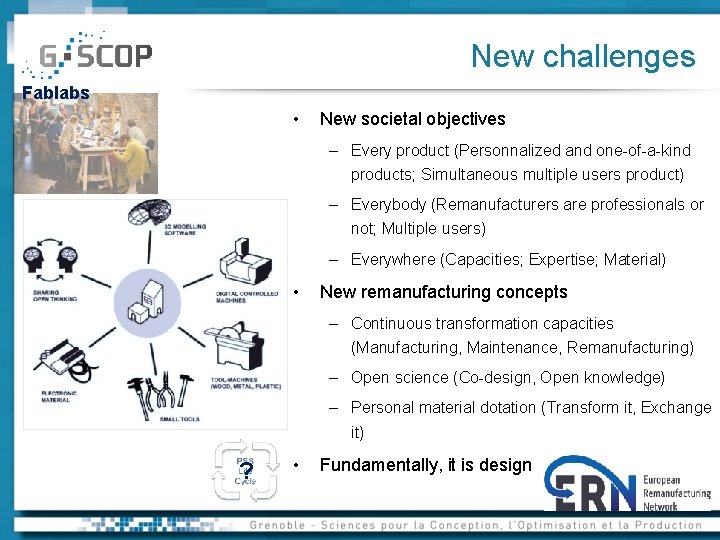
New challenges Fablabs • New societal objectives – Every product (Personnalized and one-of-a-kind products; Simultaneous multiple users product) – Everybody (Remanufacturers are professionals or not; Multiple users) – Everywhere (Capacities; Expertise; Material) • New remanufacturing concepts – Continuous transformation capacities (Manufacturing, Maintenance, Remanufacturing) – Open science (Co-design, Open knowledge) – Personal material dotation (Transform it, Exchange it) ? • Fundamentally, it is design
Thank you for your attention Best practices and future challenges in remanufacturing 15 th of March 2016 at University of Grenoble Alpes - Grenoble FRANCE
Introduction to the ERN project Best practices and future challenges in remanufacturing 15 th of March 2016 at University of Grenoble Alpes - Grenoble FRANCE
Industrial feedbacks Best practices and future challenges in remanufacturing 15 th of March 2016 at University of Grenoble Alpes - Grenoble FRANCE
Workshops Best practices and future challenges in remanufacturing 15 th of March 2016 at University of Grenoble Alpes - Grenoble FRANCE
Podium discussion with all speakers Best practices and future challenges in remanufacturing 15 th of March 2016 at University of Grenoble Alpes - Grenoble FRANCE

Conclusion of the day Best practices and future challenges in remanufacturing 15 th of March 2016 at University of Grenoble Alpes - Grenoble FRANCE
- Slides: 34