
Best Practices and Current State Findings Current State
Best Practices and Current State Findings
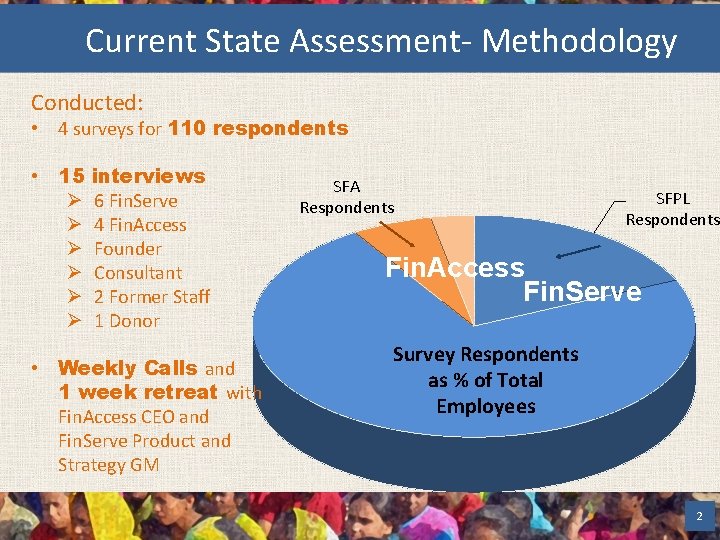
Current State Assessment- Methodology Conducted: • 4 surveys for 110 respondents • 15 Ø Ø Ø interviews 6 Fin. Serve 4 Fin. Access Founder Consultant 2 Former Staff 1 Donor • Weekly Calls and 1 week retreat with Fin. Access CEO and Fin. Serve Product and Strategy GM SFA Respondents SFPL Respondents Fin. Access Fin. Serve Survey Respondents as % of Total Employees 2
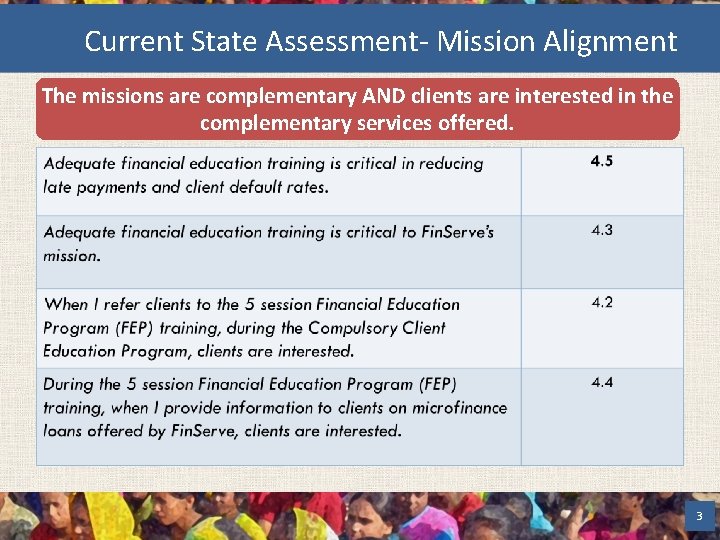
Current State Assessment- Mission Alignment The missions are complementary AND clients are interested in the complementary services offered. 3
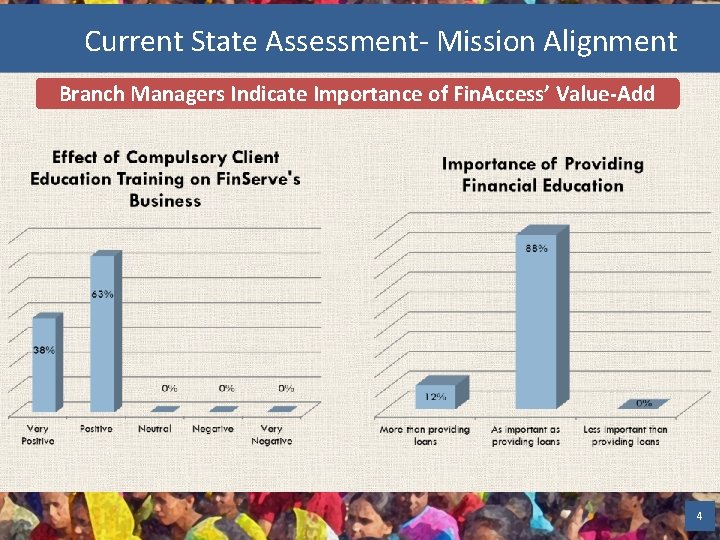
Current State Assessment- Mission Alignment Branch Managers Indicate Importance of Fin. Access’ Value-Add 4
focus of best practice research Marketing Operations/Processes Incentives Collaborative Projects Earned Income Business Models Partnerships
best practices in marketing/communication All products integrated Cross-selling through standardized marketing materials and sales pitch Structured internal communication plans Focus on training and providing supervisory support Nonprofit builds for-profit brand
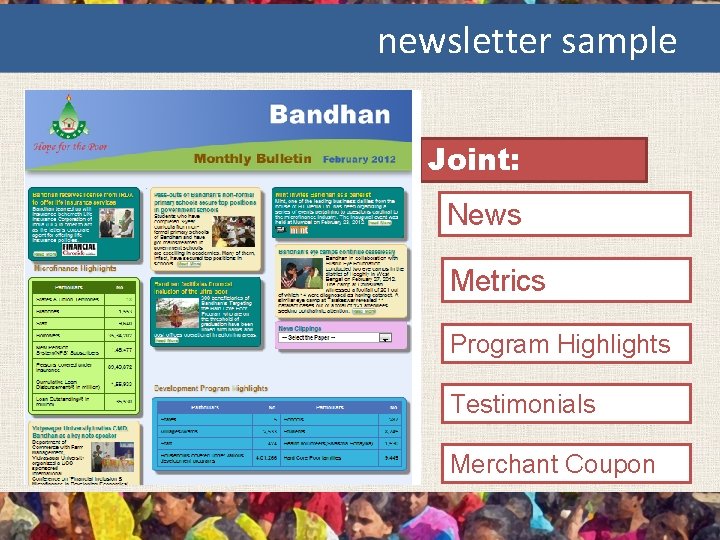
newsletter sample Joint: News Metrics Program Highlights Testimonials Merchant Coupon
focus of best practice research Marketing Operations/Processes Incentives Collaborative Projects Earned Income Business Models Partnerships
best practices in operations Centralized management Set defined goals/theory of change Mission-oriented job descriptions Cross-train employees
focus of best practice research Marketing Operations/Processes Incentives Collaborative Projects Earned Income Business Models Partnerships
best practices for incentive structures Incentives for borrowers and employees Professional development/career planning Performance reviews Mentorships
making the case for intrinsic rewards Advantages of Intrinsic Rewards • Leverages and promotes mission in MDEs • Aids in recruitment and selection (via self-sorting) • Inexpensive – Less financial cost – Less managerial oversight • Often the best way to move employees from “perfunctory” to “consummate” performance • Employees prefer to view their motives as intrinsic – Clients also prefer to view employees’ motives as intrinsic
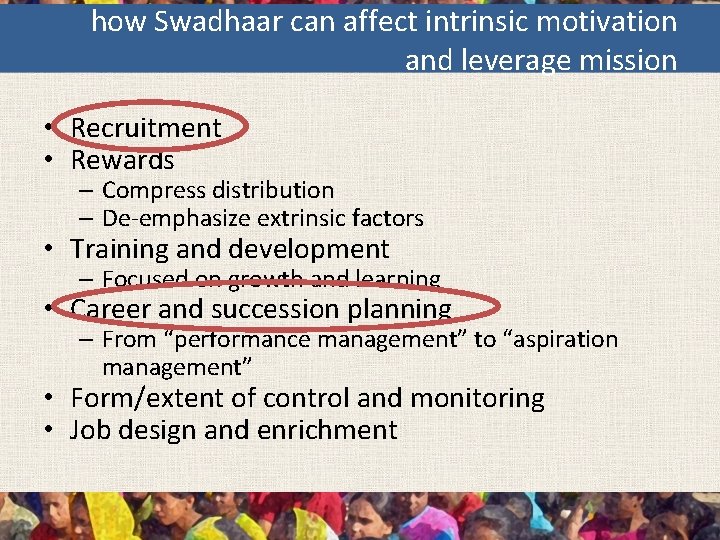
how Swadhaar can affect intrinsic motivation and leverage mission • Recruitment • Rewards – Compress distribution – De-emphasize extrinsic factors • Training and development – Focused on growth and learning • Career and succession planning – From “performance management” to “aspiration management” • Form/extent of control and monitoring • Job design and enrichment
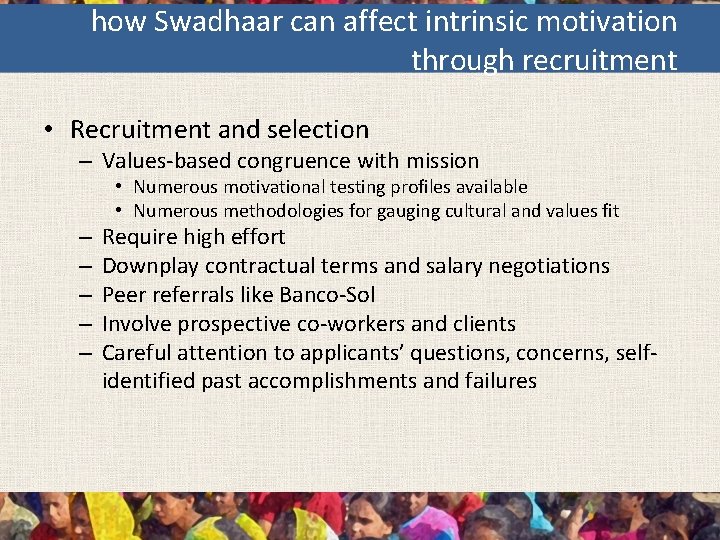
how Swadhaar can affect intrinsic motivation through recruitment • Recruitment and selection – Values-based congruence with mission • Numerous motivational testing profiles available • Numerous methodologies for gauging cultural and values fit – – – Require high effort Downplay contractual terms and salary negotiations Peer referrals like Banco-Sol Involve prospective co-workers and clients Careful attention to applicants’ questions, concerns, selfidentified past accomplishments and failures
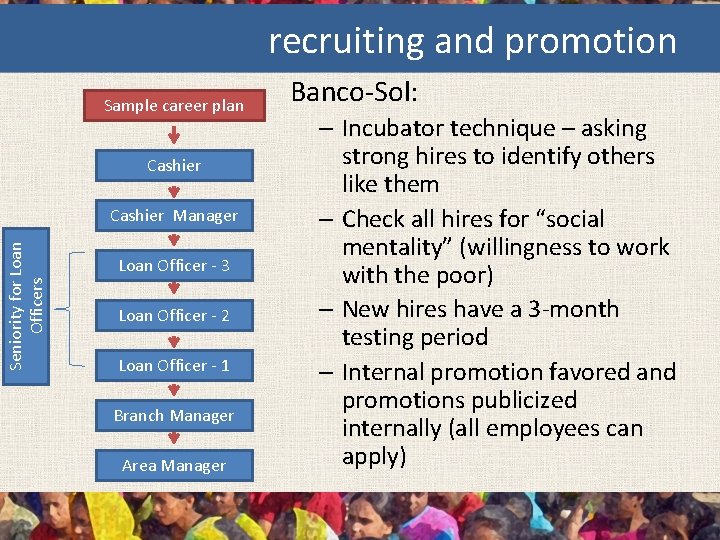
recruiting and promotion Sample career plan Cashier Seniority for Loan Officers Cashier Manager Loan Officer - 3 Loan Officer - 2 Loan Officer - 1 Branch Manager Area Manager Banco-Sol: – Incubator technique – asking strong hires to identify others like them – Check all hires for “social mentality” (willingness to work with the poor) – New hires have a 3 -month testing period – Internal promotion favored and promotions publicized internally (all employees can apply)
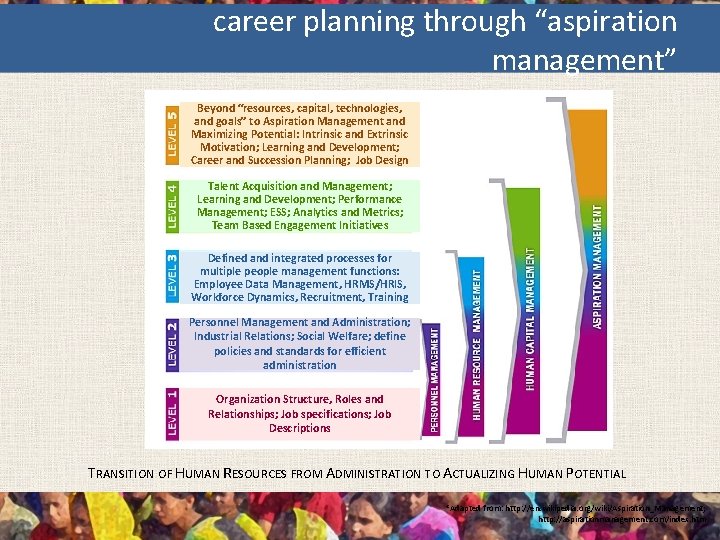
career planning through “aspiration management” Beyond “resources, capital, technologies, and goals” to Aspiration Management and Maximizing Potential: Intrinsic and Extrinsic Motivation; Learning and Development; Career and Succession Planning; Job Design Talent Acquisition and Management; Learning and Development; Performance Management; ESS; Analytics and Metrics; Team Based Engagement Initiatives Defined and integrated processes for multiple people management functions: Employee Data Management, HRMS/HRIS, Workforce Dynamics, Recruitment, Training Personnel Management and Administration; Industrial Relations; Social Welfare; define policies and standards for efficient administration Organization Structure, Roles and Relationships; Job specifications; Job Descriptions TRANSITION OF HUMAN RESOURCES FROM ADMINISTRATION TO ACTUALIZING HUMAN POTENTIAL *Adapted from: http: //en. wikipedia. org/wiki/Aspiration_Management; http: //aspirationmanagement. com/index. htm
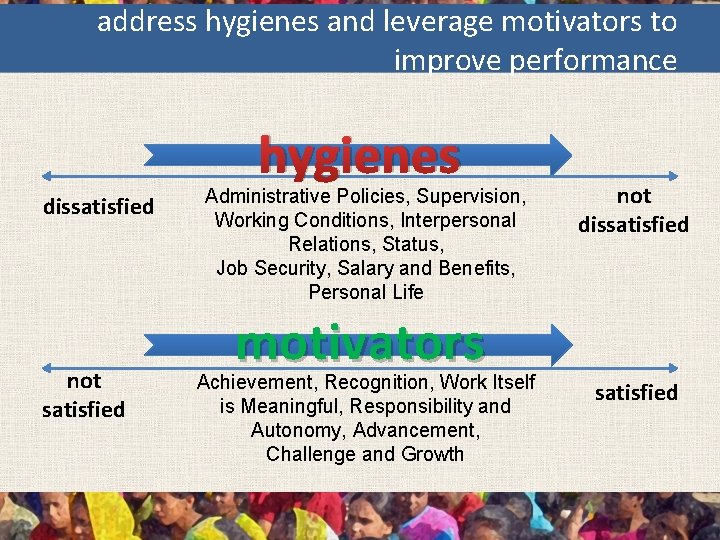
address hygienes and leverage motivators to improve performance hygienes dissatisfied not satisfied Administrative Policies, Supervision, Working Conditions, Interpersonal Relations, Status, Job Security, Salary and Benefits, Personal Life not dissatisfied motivators Achievement, Recognition, Work Itself is Meaningful, Responsibility and Autonomy, Advancement, Challenge and Growth satisfied
focus of best practice research Marketing Operations/Processes Incentives Collaborative Projects Earned Income Business Models Partnerships
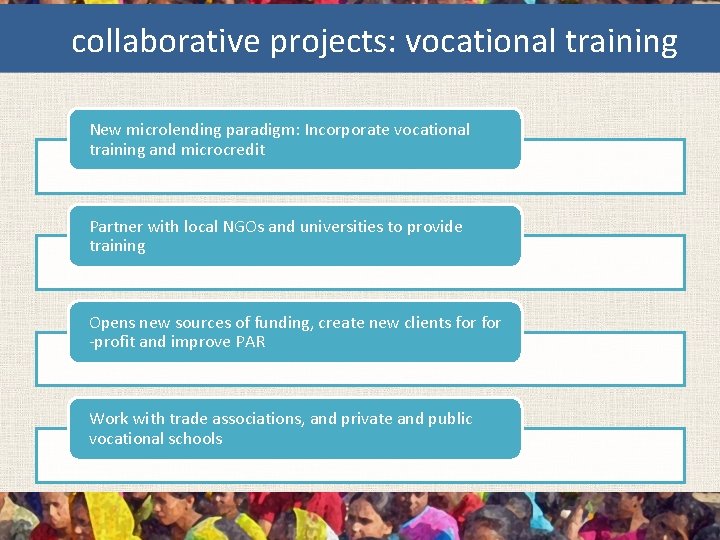
collaborative projects: vocational training New microlending paradigm: Incorporate vocational training and microcredit Partner with local NGOs and universities to provide training Opens new sources of funding, create new clients for -profit and improve PAR Work with trade associations, and private and public vocational schools
focus of best practice research Marketing Operations/Processes Incentives Collaborative Projects Earned Income Business Models Partnerships
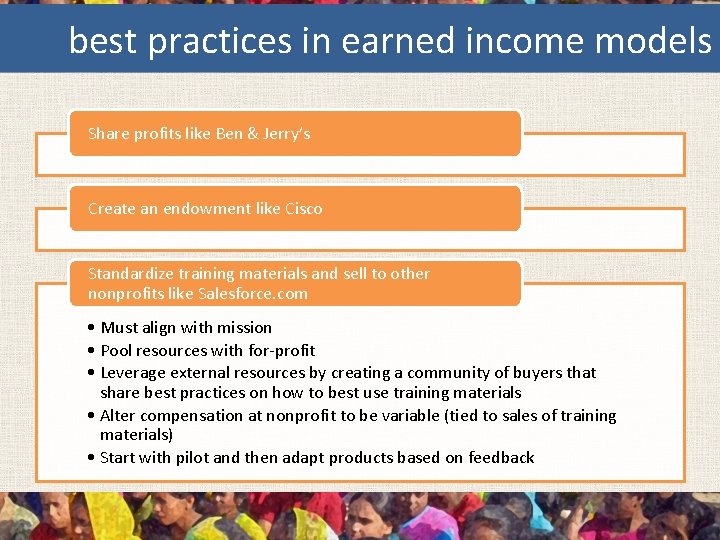
best practices in earned income models Share profits like Ben & Jerry’s Create an endowment like Cisco Standardize training materials and sell to other nonprofits like Salesforce. com • Must align with mission • Pool resources with for-profit • Leverage external resources by creating a community of buyers that share best practices on how to best use training materials • Alter compensation at nonprofit to be variable (tied to sales of training materials) • Start with pilot and then adapt products based on feedback
focus of best practice research Marketing Operations/Processes Incentives Collaborative Projects Earned Income Business Models Partnerships
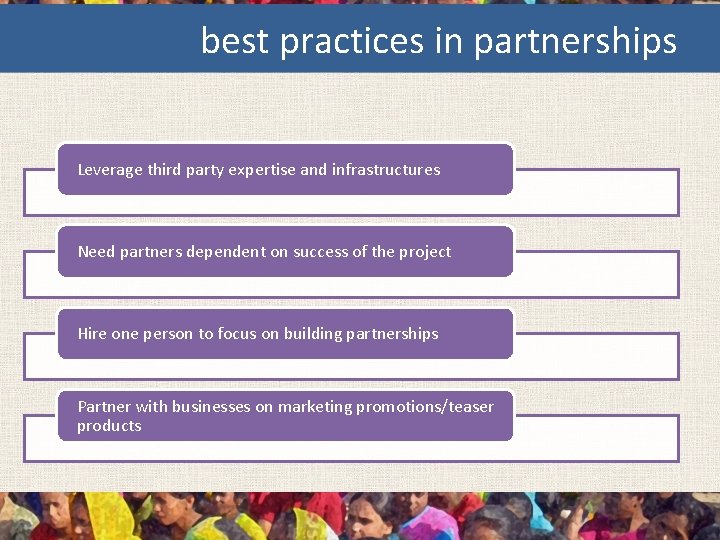
best practices in partnerships Leverage third party expertise and infrastructures Need partners dependent on success of the project Hire one person to focus on building partnerships Partner with businesses on marketing promotions/teaser products
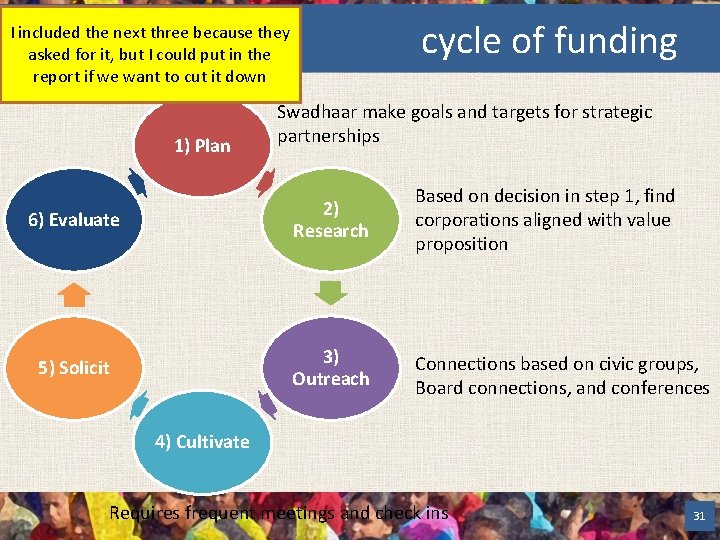
cycle of funding I included the next three because they asked for it, but I could put in the report if we want to cut it down 1) Plan Swadhaar make goals and targets for strategic partnerships 6) Evaluate 2) Research Based on decision in step 1, find corporations aligned with value proposition 5) Solicit 3) Outreach Connections based on civic groups, Board connections, and conferences 4) Cultivate Requires frequent meetings and check ins 31
checklist for corporate sponsors • Need to have established marketing effort in place so that you keep in touch with clients through e-mail, a website, events, newsletters, conferences, etc – huge value to corporations • Clear description of Swadhaar’s demographics • Research competitors sponsors as potential ideas • List of companies headquartered in your area. – What do they produce, and who are their customers? Are there crosspromotions you can work up that will help them sell to one of your existing sponsors or team up with an existing sponsor? • Join networks and civic organizations made up of business people, so that you can gain insight and access into the business community • Revenue generating ideas/strategies to show that Swadhaar is not solely dependent on corporation
plan for corporate sponsors • Strategic partnerships: 1) Find ways to create shared value 2) Make case for why this is a good marketing investment • View as a business deal, not a donation • Research companies whose value chain could be enhanced by Swadhaar value proposition to create shared value – meaningful benefit that also adds to their bottom line • By building business case for the value that Swadhaar provides, you become engrained in core business and decrease reliance on checks • Examples: – Companies that want to increase disposable income for future consumers or improve life of local labor in Mumbai operations – Companies expanding in emerging markets need to increase brand recognition and find ways to increase reach in these markets. Swadhaar provides reach/touch in target accounts and geographies. – Potential targets: P&G, Samsung, Nestle, Pepsi, and Coke 33
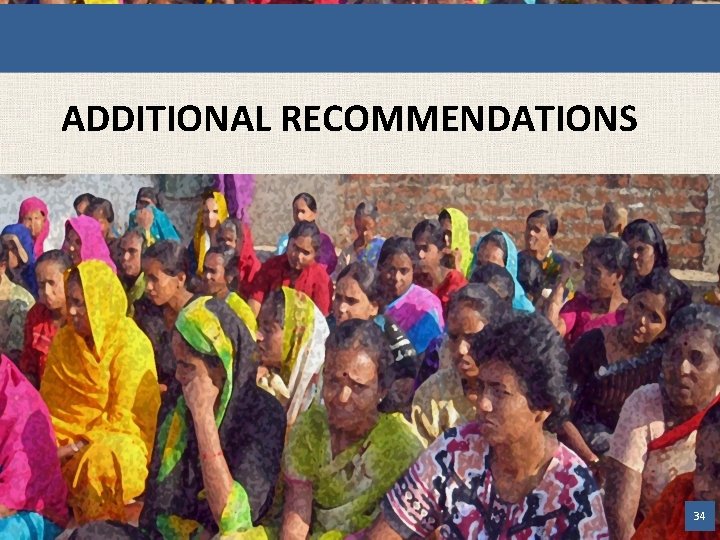
ADDITIONAL RECOMMENDATIONS 34
best practices on linkages Support for Cheri’s section. Report or presentation? • Bridgespan’s organization diagnostic data reveals that coordination and linkages are the #1 structural problem facing nonprofits
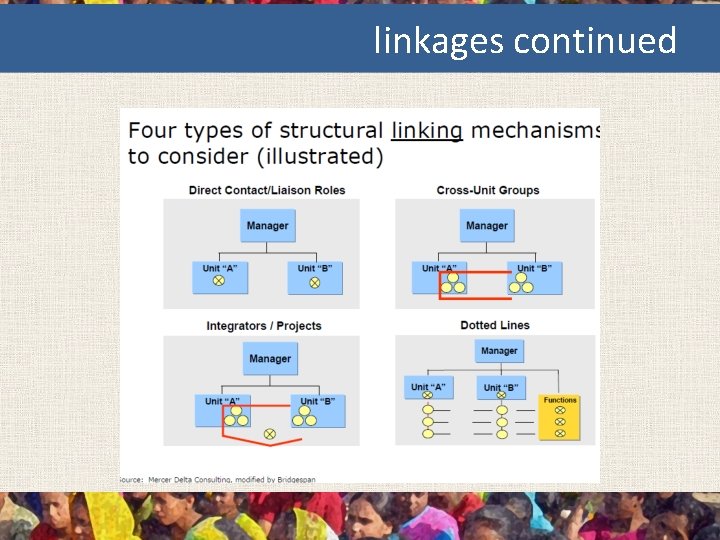
linkages continued
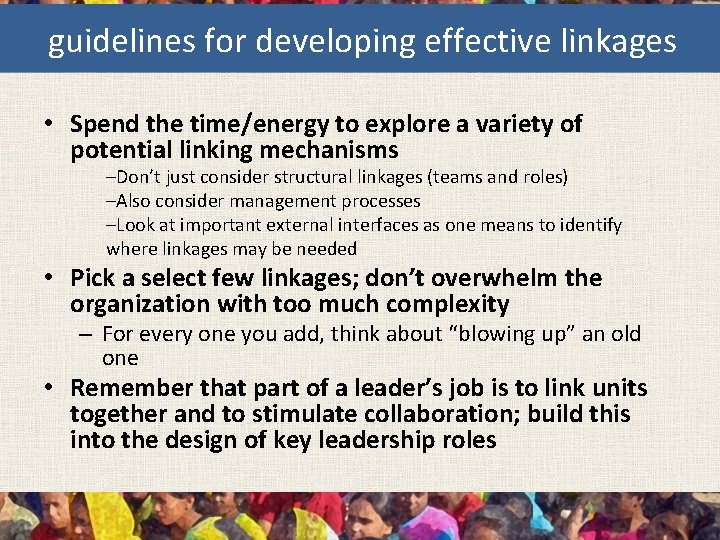
guidelines for developing effective linkages • Spend the time/energy to explore a variety of potential linking mechanisms –Don’t just consider structural linkages (teams and roles) –Also consider management processes –Look at important external interfaces as one means to identify where linkages may be needed • Pick a select few linkages; don’t overwhelm the organization with too much complexity – For every one you add, think about “blowing up” an old one • Remember that part of a leader’s job is to link units together and to stimulate collaboration; build this into the design of key leadership roles
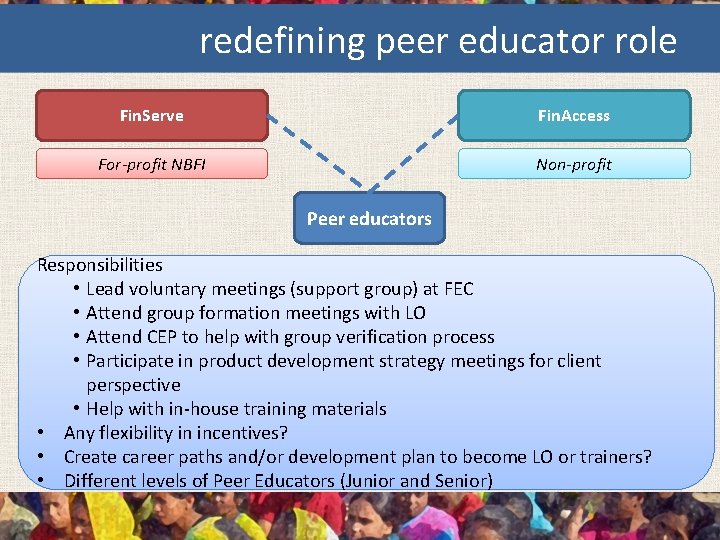
redefining peer educator role Fin. Serve Fin. Access For-profit NBFI Non-profit Peer educators Responsibilities • Lead voluntary meetings (support group) at FEC • Attend group formation meetings with LO • Attend CEP to help with group verification process • Participate in product development strategy meetings for client perspective • Help with in-house training materials • Any flexibility in incentives? • Create career paths and/or development plan to become LO or trainers? • Different levels of Peer Educators (Junior and Senior)
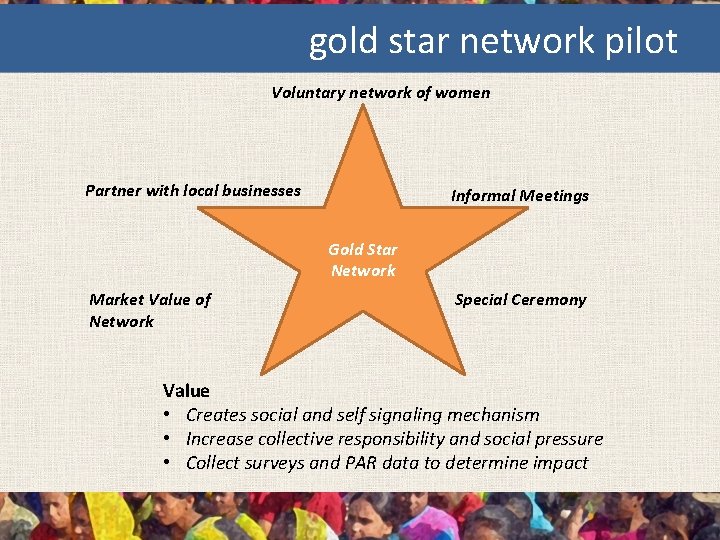
gold star network pilot Voluntary network of women Partner with local businesses Informal Meetings Gold Star Network Market Value of Network Special Ceremony Value • Creates social and self signaling mechanism • Increase collective responsibility and social pressure • Collect surveys and PAR data to determine impact
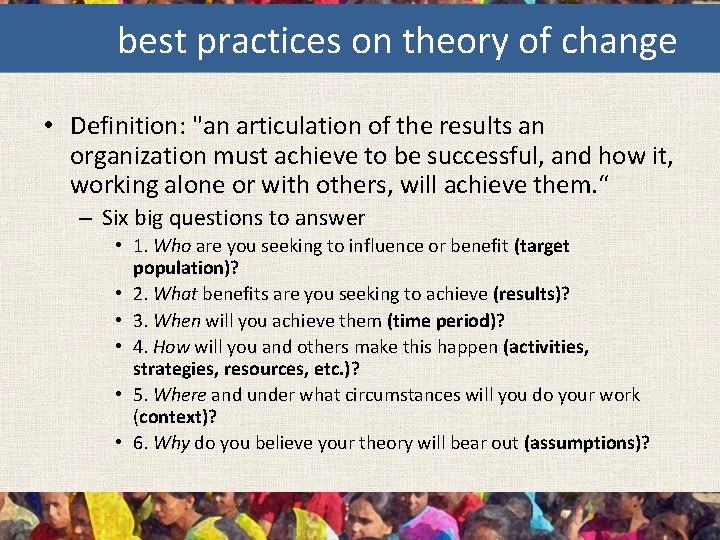
best practices on theory of change • Definition: "an articulation of the results an organization must achieve to be successful, and how it, working alone or with others, will achieve them. “ – Six big questions to answer • 1. Who are you seeking to influence or benefit (target population)? • 2. What benefits are you seeking to achieve (results)? • 3. When will you achieve them (time period)? • 4. How will you and others make this happen (activities, strategies, resources, etc. )? • 5. Where and under what circumstances will you do your work (context)? • 6. Why do you believe your theory will bear out (assumptions)?
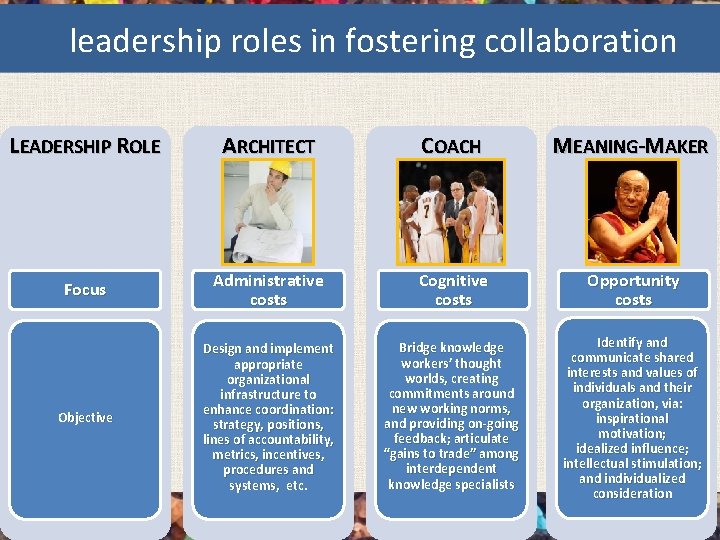
leadership roles in fostering collaboration LEADERSHIP ROLE ARCHITECT COACH MEANING-MAKER Focus Administrative costs Cognitive costs Opportunity costs Objective Design and implement appropriate organizational infrastructure to enhance coordination: strategy, positions, lines of accountability, metrics, incentives, procedures and systems, etc. Bridge knowledge workers’ thought worlds, creating commitments around new working norms, and providing on-going feedback; articulate “gains to trade” among interdependent knowledge specialists Identify and communicate shared interests and values of individuals and their organization, via: inspirational motivation; idealized influence; intellectual stimulation; and individualized consideration
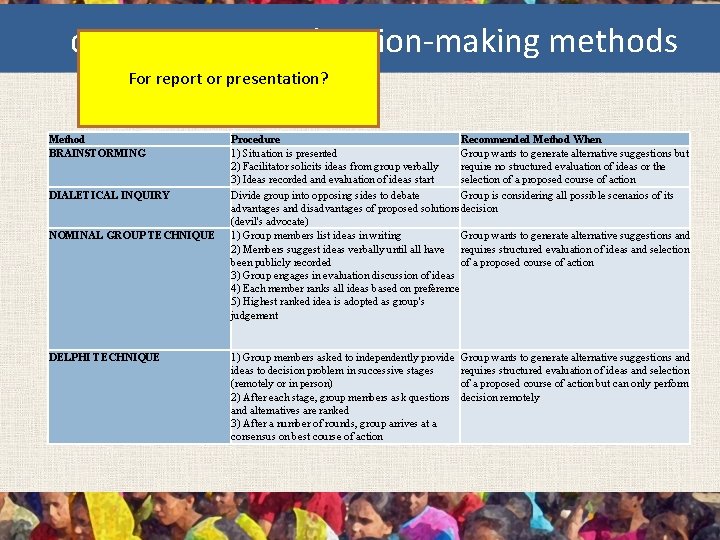
common group decision-making methods For report or presentation? Method BRAINSTORMING DIALETICAL INQUIRY NOMINAL GROUP TECHNIQUE DELPHI TECHNIQUE Procedure Recommended Method When 1) Situation is presented Group wants to generate alternative suggestions but 2) Facilitator solicits ideas from group verbally require no structured evaluation of ideas or the 3) Ideas recorded and evaluation of ideas start selection of a proposed course of action Divide group into opposing sides to debate Group is considering all possible scenarios of its advantages and disadvantages of proposed solutions decision (devil's advocate) 1) Group members list ideas in writing Group wants to generate alternative suggestions and 2) Members suggest ideas verbally until all have requires structured evaluation of ideas and selection been publicly recorded of a proposed course of action 3) Group engages in evaluation discussion of ideas 4) Each member ranks all ideas based on preference 5) Highest ranked idea is adopted as group's judgement 1) Group members asked to independently provide ideas to decision problem in successive stages (remotely or in person) 2) After each stage, group members ask questions and alternatives are ranked 3) After a number of rounds, group arrives at a consensus on best course of action Group wants to generate alternative suggestions and requires structured evaluation of ideas and selection of a proposed course of action but can only perform decision remotely
- Slides: 35