
Best Methods for Identification of Mosquito Species for
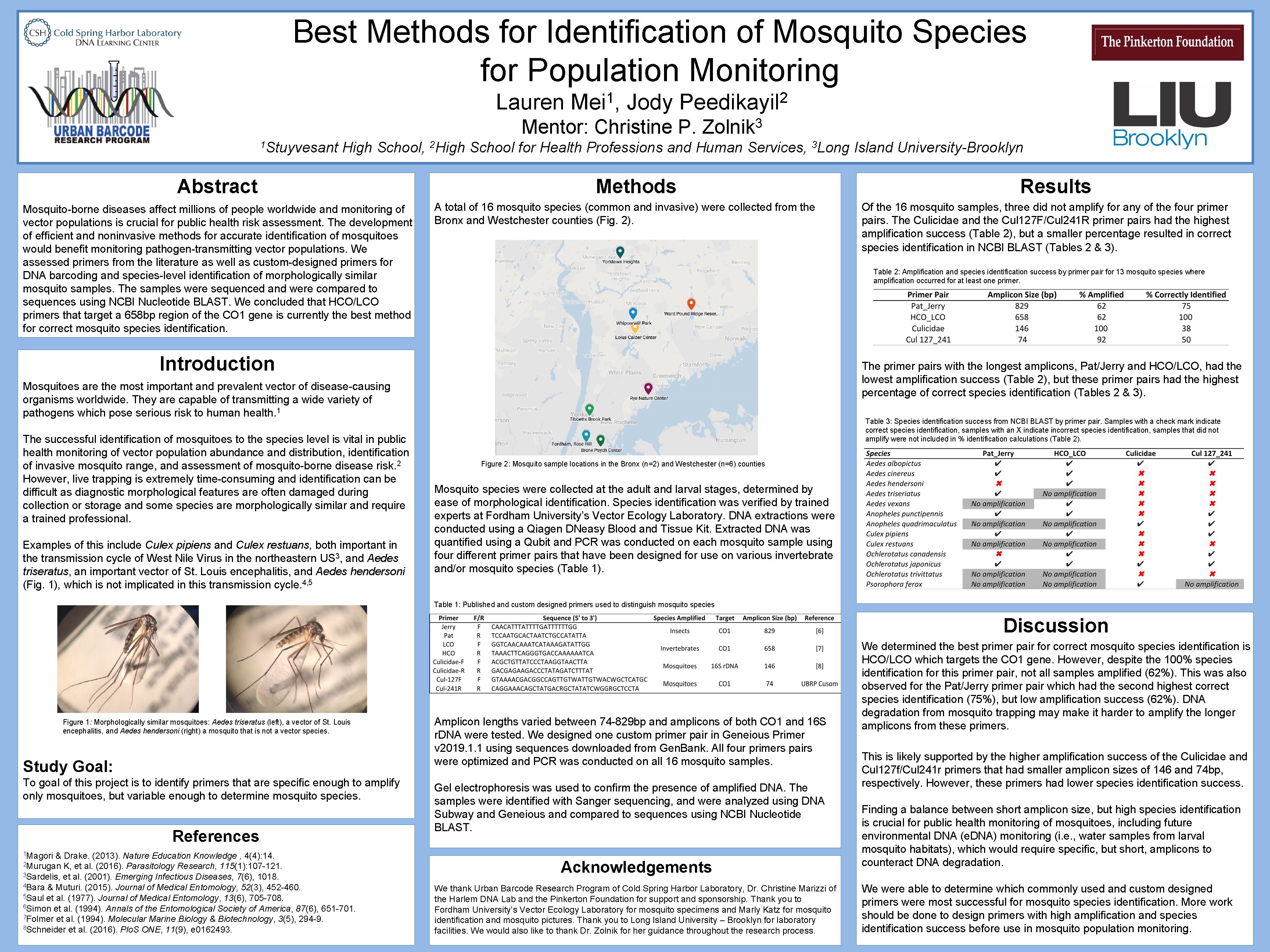
Best Methods for Identification of Mosquito Species for Population Monitoring Lauren 1 Mei , Jody 2 Peedikayil Mentor: Christine P. 1 Stuyvesant 3 Zolnik High School, 2 High School for Health Professions and Human Services, 3 Long Island University-Brooklyn Abstract Mosquito-borne diseases affect millions of people worldwide and monitoring of vector populations is crucial for public health risk assessment. The development of efficient and noninvasive methods for accurate identification of mosquitoes would benefit monitoring pathogen-transmitting vector populations. We assessed primers from the literature as well as custom-designed primers for DNA barcoding and species-level identification of morphologically similar mosquito samples. The samples were sequenced and were compared to sequences using NCBI Nucleotide BLAST. We concluded that HCO/LCO primers that target a 658 bp region of the CO 1 gene is currently the best method for correct mosquito species identification. Methods A total of 16 mosquito species (common and invasive) were collected from the Bronx and Westchester counties (Fig. 2). The primer pairs with the longest amplicons, Pat/Jerry and HCO/LCO, had the lowest amplification success (Table 2), but these primer pairs had the highest percentage of correct species identification (Tables 2 & 3). Mosquitoes are the most important and prevalent vector of disease-causing organisms worldwide. They are capable of transmitting a wide variety of pathogens which pose serious risk to human health. 1 Examples of this include Culex pipiens and Culex restuans, both important in the transmission cycle of West Nile Virus in the northeastern US 3, and Aedes triseratus, an important vector of St. Louis encephalitis, and Aedes hendersoni (Fig. 1), which is not implicated in this transmission cycle. 4, 5 Of the 16 mosquito samples, three did not amplify for any of the four primer pairs. The Culicidae and the Cul 127 F/Cul 241 R primer pairs had the highest amplification success (Table 2), but a smaller percentage resulted in correct species identification in NCBI BLAST (Tables 2 & 3). Table 2: Amplification and species identification success by primer pair for 13 mosquito species where amplification occurred for at least one primer. Introduction The successful identification of mosquitoes to the species level is vital in public health monitoring of vector population abundance and distribution, identification of invasive mosquito range, and assessment of mosquito-borne disease risk. 2 However, live trapping is extremely time-consuming and identification can be difficult as diagnostic morphological features are often damaged during collection or storage and some species are morphologically similar and require a trained professional. Results Table 3: Species identification success from NCBI BLAST by primer pair. Samples with a check mark indicate correct species identification, samples with an X indicate incorrect species identification, samples that did not amplify were not included in % identification calculations (Table 2). Figure 2: Mosquito sample locations in the Bronx (n=2) and Westchester (n=6) counties Mosquito species were collected at the adult and larval stages, determined by ease of morphological identification. Species identification was verified by trained experts at Fordham University’s Vector Ecology Laboratory. DNA extractions were conducted using a Qiagen DNeasy Blood and Tissue Kit. Extracted DNA was quantified using a Qubit and PCR was conducted on each mosquito sample using four different primer pairs that have been designed for use on various invertebrate and/or mosquito species (Table 1). Table 1: Published and custom designed primers used to distinguish mosquito species Discussion Figure 1: Morphologically similar mosquitoes: Aedes triseratus (left), a vector of St. Louis encephalitis, and Aedes hendersoni (right) a mosquito that is not a vector species. Study Goal: To goal of this project is to identify primers that are specific enough to amplify only mosquitoes, but variable enough to determine mosquito species. References 1 Magori & Drake. (2013). Nature Education Knowledge , 4(4): 14. 2 Murugan K, et al. (2016). Parasitology Research, 115(1): 107 -121. 3 Sardelis, et al. (2001). Emerging Infectious Diseases, 7(6), 1018. 4 Bara & Muturi. (2015). Journal of Medical Entomology, 52(3), 452 -460. 5 Saul et al. (1977). Journal of Medical Entomology, 13(6), 705 -708. 6 Simon et al. (1994). Annals of the Entomological Society of America, 87(6), 651 -701. 7 Folmer et al. (1994). Molecular Marine Biology & Biotechnology, 3(5), 294 -9. 8 Schneider et al. (2016). Plo. S ONE, 11(9), e 0162493. Amplicon lengths varied between 74 -829 bp and amplicons of both CO 1 and 16 S r. DNA were tested. We designed one custom primer pair in Geneious Primer v 2019. 1. 1 using sequences downloaded from Gen. Bank. All four primers pairs were optimized and PCR was conducted on all 16 mosquito samples. Gel electrophoresis was used to confirm the presence of amplified DNA. The samples were identified with Sanger sequencing, and were analyzed using DNA Subway and Geneious and compared to sequences using NCBI Nucleotide BLAST. Acknowledgements We thank Urban Barcode Research Program of Cold Spring Harbor Laboratory, Dr. Christine Marizzi of the Harlem DNA Lab and the Pinkerton Foundation for support and sponsorship. Thank you to Fordham University’s Vector Ecology Laboratory for mosquito specimens and Marly Katz for mosquito identification and mosquito pictures. Thank you to Long Island University – Brooklyn for laboratory facilities. We would also like to thank Dr. Zolnik for her guidance throughout the research process. We determined the best primer pair for correct mosquito species identification is HCO/LCO which targets the CO 1 gene. However, despite the 100% species identification for this primer pair, not all samples amplified (62%). This was also observed for the Pat/Jerry primer pair which had the second highest correct species identification (75%), but low amplification success (62%). DNA degradation from mosquito trapping may make it harder to amplify the longer amplicons from these primers. This is likely supported by the higher amplification success of the Culicidae and Cul 127 f/Cul 241 r primers that had smaller amplicon sizes of 146 and 74 bp, respectively. However, these primers had lower species identification success. Finding a balance between short amplicon size, but high species identification is crucial for public health monitoring of mosquitoes, including future environmental DNA (e. DNA) monitoring (i. e. , water samples from larval mosquito habitats), which would require specific, but short, amplicons to counteract DNA degradation. We were able to determine which commonly used and custom designed primers were most successful for mosquito species identification. More work should be done to design primers with high amplification and species identification success before use in mosquito population monitoring.
- Slides: 1